Who were the Belgae?

The Belgae (originators of the name of the modern country of Belgium) were a fascinating and influential ethnic-cultural group of tribes with a dominant political and ideological presence among northern Europe’s ‘Celtic’ peoples before and after Romanisation, in the period spanning the 2ndC BCE to the 4thC CE. Their territories at the time of Julius Caesar’s Gallic conquest extended in an area covering roughly the lands between the Seine and the mouth of the Rhine – parts of modern day France, Belgium, the Netherlands and Germany. In Book 5, Chapter 12 of his Comentarii de Bello Gallico, Caesar states that the southeastern British tribes were ruled by descendants of the Belgae, explaining the fact that Belgic tribal names were found in Britain, for instance the Atrebates, and even the Menapii who were recorded in Ireland by 2ndC CE by Greco-Egyptian geographer Ptolemy as the Manapi and from whom Co. Fermanagh is possibly named, possibly even also the Isle of Man (once known as Menapia/Monavia):

The interior portion of Britain is inhabited by those of whom they say that it is handed down by tradition that they were born in the island itself: the maritime portion by those who had passed over from the country of the Belgae for the purpose of plunder and making war; almost all of whom are called by the names of those states from which being sprung they went thither, and having waged war, continued there and began to cultivate the lands. The number of the people is countless, and their buildings exceedingly numerous, for the most part very like those of the Gauls: the number of cattle is great. They use either brass or iron rings, determined at a certain weight, as their money. (trans. W. A. McDevitte and W. S. Bohn.)

Caesar states that the Belgae, in particular the western branch known as Bellovaci, were of a particularly fearsome and unsympathetic nature in regard to the Romans. Indeed, their resistance played an important part in the final stages of his conquest of northern Gaul, when they formed an alliance with both the British and Armorican tribes, whose cross-channel neighbours were again ‘Belgae’, according to Ptolemy. Influential 20thC Irish scholar T.F. O’Rahilly even suggested that the Fir Bolg mentioned in the Lebor Gabála Érenn might be a branch of this widely-spread Iron Age ‘tribal group’ supplanted by Goidelic peoples from Spain in the 1stC BCE. It appears that the ‘Belgae’ were an influential bunch!

In assessing the origins of tribes calling themselves ‘Belgae’, however, there is an important cultural movement among Iron Age Europeans that needs to be examined. This hinges on the events in the immediate aftermath of the death of Alexander The Great, perhaps also triggered by displacements caused by tribal movements from northern Europe. The culmination of this was the (infamous if you were Greek) events of 279BCE, which saw an invasion by a federation of massed Gaulish war-bands through the Balkans and the homelands of the Macedonian-Greek Empire of Alexander, penetrating right down into the Greek and Anatolian heartlands. This movement appears to have had a fundamental impact upon the warrior-culture of western Europe’s Celtic elites who absorbed the iconography of deified Alexander as Apollo, Mars/Ares and Ammon/Zeus/Jupiter and spread it back into NW Europe, famously represented in their magnificent coinage. The leaders and heroes of this famous invasion included the theophorically named Bolgios, who – as far as we know – survived the campaign and would have had sufficient prestige to then rule as a tribal dynast. The Gaulish tribe known as the Volcae-Tectosages were one of several whose creation appears to have resulted from this pan-Gallic enterprise, and who returned to the Gaulish homelands in the west, so it is possible that the Belgae might have been another cultural group or part of a Pan-Gallic movement who participated in this great warrior event. The names Volcae and Belgae/Bolgae in fact appear to be synonyms or variants of the same tribal designation, incorporating the name of the Pan-European god Belenos or Volos/Veles/Velnias who appears to have shared the same solar-martial aspects as the deified (at least by the Celts) Macedonian Warrior-King who conquered most of the known world… The Romans and Greeks would hereafter comment upon a fanatical, boastful and decapitation-obsessed faction when talking about Celtic barbarians – something akin to the modern Sunni Muslim ISIS/ISIL and Al-Qaeda movements.
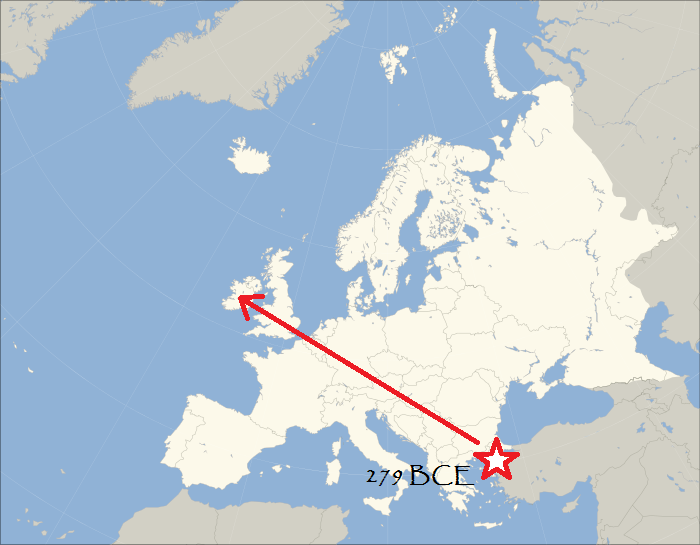
From Galatia to Galway: The NW thrust of 'Belgic' culture after 279.

From Galatia to Galway: The NW thrust of ‘Belgic’ culture after 279.

By Caesar’s time (1stC BCE), he was able to identify separate Belgae and Volcae, the latter being placed in the Hercynian forest, as well as Gallia Narbonensis (the Volcae Tectosages and Volcae Arecomici):

“… And there was formerly a time when the Gauls excelled the Germans in prowess, and waged war on them offensively, and, on account of the great number of their people and the insufficiency of their land, sent colonies over the Rhine. Accordingly, the Volcae Tectosages, seized on those parts of Germany which are the most fruitful around the Hercynian forest, (which, I perceive, was known by report to Eratosthenes and some other Greeks, and which they call Orcynia), and settled there. Which nation to this time retains its position in those settlements, and has a very high character for justice and military merit; now also they continue in the same scarcity, indigence, hardihood, as the Germans, and use the same food and dress.. ” Comentarii de Bellum Gallicum, Book 6.

The Hercynian forest described by Caesar stretched from the lands of the Helvetii, eastward along the Danube into Dacia and Pannonia – modern Romania. This was a kind of Roman mental ‘event horizon’ which they failed to gather the will to cross after a history of disastrous military campaigns, resulting in the development of something of a ‘pseudo-ethnicity’ of ‘Germanii’ to describe the peoples living beyond it, even though contemporary sources such as Posidonius considered tribes such as the Boii (whose homelands included parts of Germania as far as the Baltic) to be ‘Celts’ – a belief supported by archaeological evidence. I might also add my own observations on the aspects of the Celtic solar war-god, Belenos, found in later Germanic, Slavic and Baltic cultures…

In short, my theory is this: The ‘Belgae’ were a manifestation of a cultural-religious movement that was an expression of the Celtic ‘war-band’ culture which sought the glory of Alexander and Delphic Apollo (who they identified with their main god, Belenos) and invaded and settled in Greece and Anatolia in the 3rdC BCE. This internationalist and warrior-centric culture transcended local ethnicity and introduced a fundamental ideological change among the Celtic/Germanic peoples of NW Europe which subsequently influenced their religious, military and philosophical outlook and had great influence upon their mercantile and numismatic culture. ‘Bel’, ‘Vel’ or ‘Belenos’ was the god most venerated in this culture who gave his name to this cultural movement which spread from Greece and the Balkans, up through the La Tene heartlands, up the Rhine and into Britain and Ireland over the next 4 centuries….

This ‘southeast-northwest cultural corridor’ of influence appears to have been the fostering ground of both religious and secular power in the post-Roman era, as the Belgic territories of the Suessiones (focussed on modern Soissons) eventually became a heartland of the Germanic Frankish kingdoms, the Christianisation of which Irish missionaries were to play such an important role in, sowing the seeds of the superb Carolingian Empire and thus medieval European Christendom…

The Belgae were possibly the main reason that Julius Caesar and the subsequent Roman Emperors invaded northern Europe. They were promoters of a religious system which was fanatical: it knew no fear, promised reincarnation and had a distinct warrior-cult which enticed men to challenge the temporal authority of Rome. This movement had (for the Romans at least) a historical root in the humiliating sack of Rome by Brennus of the Senones and his army of Cisalpine Gauls in the 4thC BCE. That this cultural movement extended well into the very much un-Romanised Germania Superior regions where the very ‘Belgic’ (and Thracian) ‘Gundestrup Cauldron’ was discovered must surely make us examine why ‘Germanic’ paganism is not considered similar to the religions of Europe’s Atlantic pagan Celts…
Gods of War and Agriculture

The identity of Mars in Roman culture shows a curious transition over the six or so centuries from its establishment as a regional power until its turbulent yet glorious Imperial era. Formed from a synthesis of native Latin, Etruscan, Sabine and Umbrian subcultures under a continuous stream of influence from their Greek and ‘barbarian’ neighbours it was a protean and ever-changing hotbed of innovation in both secular and religious matters. Its gods were therefore just as prone to change, and Mars makes an interesting case study:

Unlike the Greek god Ares, who tended to appear in myths (as befitted Greek warrior culture) as a dangerous quarrelsome outsider, Mars was treated more as an ancestral father-figure for the Romans. Livy (Ab Urbe Condita) recounted his role in Rome’s foundation-myth as father of Romulus and Remus by Rhea Silvia – a priestess of Vesta, identifiable with Vesta herself, otherwise cognate with the ancestral mother deity: Larunda, the Mater Larum. Indeed, Rome’s Etruscan forebears called their god of war Laran, which has similar connotations of the spirits of the departed, known as ‘Lares’. His consort was Turan whose entourage included the Lasas – another archaic name for Lares. Turan was also seemingly associated with birds – a common archetype for souls. She became identified in the Republican era with Venus – Mars’ complementary feminine aspect.

Mars’ agricultural aspect and his link to the ancestral spirits of the Etruscans and Romans is illustrated beautifully in the hymn of the priests known as the Arval Bretheren – the Carmen Arvale – preserved in a temple inscription, and invoking both Mars, the Lares and the fertilising spirits or Semones to bless the fields. The month of March (Martis – named after Mars) marked the sprouting of spring wheat and the beginning of the agricultural season as the weather warmed. Another Roman priesthood – the Salii – celebrated the rites of agricultural Mars, and had their origins back in the ancient Roman kingdom. They carried ancient shields called ancilia, which were kept in Mars’ temple. These were supposedly made by a legendary smith-armourer called Mamurius Veturius, possibly cognate with Mars in the Carmen Arvale under the name Marmor. The connection between the cthonic realm, food and metal seems obvious: the earth renders both. The annual re-forging of nature meant that it would not have been unusual for such a theological connection to have been made between smithcraft and the underworld.

Warfare and metal were likewise connected: War and death also. The annual death and rebirth of nature, and the fertility engendered in soil by dead matter (‘Putrefaction’) were likewise important parts of the same semantic field. In fact, the co-ordinated armies of people required for agricultural endeavours and the tendency for battle to be joined a campo in warfare added to this analogy. Rome and Etruria’s ancient wealth and power depended as much on agriculture as it did warfare, and Roman Mars expressed this idea.

Tied closely to Roman Mars’ semantic field-map are Janus, Mercury, Vulcan and Pluto. Pluto, because of the older connection to the cthonic otherworld and the Lares. Janus and Mercury because of the crossing of boundaries between the worlds, and Vulcan because of the active fiery, reforging aspect of Mars as an agricultural deity.

Elsewhere in Europe where hunting and transhumance and nomadic pastoralism were principle modes of food-production, one might imagine that the ‘herdsman’ aspect of cthonic gods was to the fore, and this indeed proved to be the case. The ‘wild hunt’ of Wotan, Velnias, Volundr, Herla are cases where battle-gods or smith-gods fulfill such roles. Thor was a battler-deity favoured for agricultural protection, as was Hercules.

The Greco-Roman mythological character who was the bestower of wealth was the ‘divine child’ Ploutos/Plutus, an aspect of Plouton/Pluto (related to the Roman gods Dis Pater and Orcus)who was at the heart of the Eleusinian Mysteries, and seems to have had a certain similarity to Cthonic Mars. Plutus was the child of Demeter and the Hero, Iasion, who made love to the goddess in a ‘thrice ploughed field’. The birth of Plutus might therefore have a parallel to the birth of the Etruscans’ ‘divine child’ Tages, who emerged from a ploughed field and gave knowledge of Augury and Haruspicy to the people. Knowledge of Sorcery or any form of Augury was to be found in the province of the dead… Mercury/Hermes was the ‘psychopomp’ responsible for conducting souls to this realm, as well as being the god of trade and pecuniary increase – the gift of Plutus transmitted in his hands back to this world from the Otherworld! Janus was also identified with the archaic member of the first Capitoline Triad, the Sabine god Quirinus, who was sometimes identified as a deified form of Mars’ divine son, Romulus. He ‘stood’ over the gates between the Otherworld and this world, and presumably allowed the two-way interaction between the spirit and elemental worlds to occur. Mars himself was therefore a conduit of masculine vital force from the spirit world which influenced the mundane world in a positive way. He was a keystone for the functions of a number of other gods, and was therefore one of the most important of Roman deities, and was venerated (under this wider identity) more than any other in the Romanised Celtic world…

Celtic Belenos and Balto-Slavic Veles

There is a certain difficulty encountered in equating ‘Celtic’ with ‘Slavic’ gods, particularly because the two ethno-cultural denominations are largely historically and archaeologically independent. A similar problem – perhaps more political – arises from the distinction between ‘Balts’ and ‘Slavs’. Some of the interpretation of the paleology and ethnology of the lands of the peoples who today call themselves ‘Balts‘ and ‘Slavs’ is still coloured by 19th and 20thC academic work beset with ideological political bias framed through artificial ethno-nationalist constructs. These were largely designed to support a federalised atheist communist Empire whose western borders desired such a buttress against western European identity. Nonetheless, in the era of the European Iron-Age, there was much more in common and the cultures and religious practices of peoples of this region would have been less determinately ‘Slavic’ or even ‘Germanic’ as the terms would be understood today…

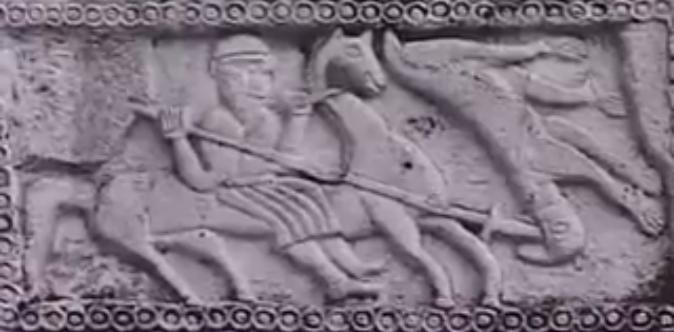
Perun and Veles - aspects of the 'Thracian Horseman' and 'Phrygian Sabazios'?

Croatian depiction of ?Perun and Veles – it demonstrates aspects of the ‘Thracian Horseman’ and ‘Phrygian Sabazios’

Although the pagan mythology of the Slavs is known to us from relatively late (medieval) accounts congruent with some of the pagan Scandinavian cultures, it contains a number of important characters for whom there is reasonable evidence to posit a link to western Europe’s older system of deities. The 12thC ‘Primary Chronicle’ of the Kievan Rus mentions Volos and Perun as the principle gods worshipped by Slavs and Russ before their late conversion during the Viking era:

“…Thus tsars Leo and Alexander made peace with Oleg. After agreeing upon the tribute, they bound themselves by mutual oaths. The tsars kissed the cross, while Oleg and his men took oaths in accordance with Russian law, swearing by their weapons and by their god Perun as well as by Volos, the god of cattle…” (trans. Samuel Cross)

The same Oleg is recorded as visiting sorcerors – the word for which is given as Volkhi. These tell him that he must abandon his favourite horse as it will cause his death, which he assents to and turns it to pasture. The story given is that he then goes to visit it and is told it died, and on visiting its bones a snake emerges from its skull and bites him, causing his death… The relationship between Volkhi, the Scandinavian Volva and the god Volos might be worth mulling over!

Another reference in the Chronicle to Volos and Perun (again in relation to oaths) is a record of a treaty and oath given by the pagan prince Svyatoslav of allegiance to the Byzantine Emperor:

” … And even as I have given oath to the Greek Emperors in company with my boyars and all my subjects, so may we preserve this treaty inviolate. But if we fail in the observance of any of the aforesaid stipulations, either I or my companions, or my subjects, may we be accursed of the god in whom we believe, namely, of Perun and Volos, the god of flocks, and we become yellow as gold, and be slain with our own weapons… ” (trans. Samuel Cross)

Interestingly, Cross translates ‘may we be accursed of the god in whom we believe’ implying the original sense was a singular god with two aspects: Perun and Volos. In fact, later folklore frequently conflates attributes of the two, suggesting this sense may be true.

Baltic Veles:

Marija Gimbutas examined the surviving 19thC Lithuanian and Latvian folklore attached to the spirits of the dead, who were there referred to as vėlės and to whom was attached a ‘leader’ known as Vélnias, Vélinas, or Véls – also used as a synonym for ‘devil’. In fact, an early dictionary of Lithuanian written by an ecclesiastic (Dictionarium Trium Linguarum by Konstanty Szyrwid, 1629) equates Velnias with ‘Piktis‘, another Baltic god-name associated with the ‘devil’, also known as ‘Pikùlas‘, ‘Peckols’ (Prussia) and ‘Patollo‘. These might be an example of the curious and widespread ‘Puck‘ hypostasis, possibly associated with local versions of Perun-Pirkons. The folkloric Vélnias was – like Odin/Wotan – one-eyed and led the troops of vėlės across the skies, causing storms and whirlwinds. He – like Veles – was also linked to herds. The vėlės themselves were – like Gaelic fairies – seen to troop between cemeteries and along their own special ‘paths’. Vélinas was explicitly a god of the hosts of the dead. Gimbutas notes the prevalence of placenames incorporating the name Vélnias that relate to bogs, pools, rivers, fields and forest clearings, suggesting the importance of such places to the local Otherworld mythology.

‘Velchanos’ in Crete:

The ancient Cretan/Minoan god Velchanos has been suggested as the origin for the Roman ‘Vulcan’. The Veles-Perun hypostasis mentioned in the Primary Chronicle of the Kievan Rus seems like it could link to this, particularly if the Weland link is correct. In Crete, he was also known as Zeus-Velchanos. The Latin words for thunderbolt, fulmen and fulgur, seem to have close etymological links to the Vul- prefix of the name Vulcan.

‘Vayl’ in the Isle of Man:

Vaayl‘ or ‘Vael occurs commonly in the Isle of Man (situated between Britain and Ireland) as a local word for ‘Michael’ (the thunder-voiced military archangel, leader of the heavenly hosts). For instance, there is a pagan burial mound referred to as ‘Carn Vael’, situated near the coastal village of Kirk Michael (Keeill Vaayl) – home to some of the syncretic Christian-pagan-era stone crosses and monuments. It is entirely possible that this name was introduced by Baltic settlers in the Viking Age, although convention usually holds to majority being Norwegians. A custom common to Lithuania, Latvia and the Isle of Man was the rolling down hills of burning wheels at Beltain or Midsummer (Manx source: Harold ‘Dusty’ Miller ‘It’s a Fact’). I have discussed the connection between St Michael the Archangel and Belenos elsewhere…

Etymological concordances:

The most obvious etymological link to the Celtic god Belenos is the ‘V’ of ‘Volos’ – a letter seemingly interchangeable with ‘B’ in the ‘Indo-European’ languages. This would suggest Bolos or Beles as a reasonable pronunciation variant of the Slavic divinity. Other versions of the name seem also to appear to in the 9th/10thC CE Old High German ‘Second Meresburg Incantation’:

“… Phol ende uuodan uuorun zi holza. Du uuart demo balderes uolon sin uuoz birenkit. Thu biguol en sinthgunt, sunna era suister; Thu biguol en friia, uolla era suister; Thu biguol en uuodan, so he uuola conda: Sose benrenki, sose bluotrenki, sose lidirenki: Ben zi bena, bluot si bluoda, Lid zi geliden, sose gelimida sin! … ““… Phol and Wodan were riding to the woods, and the foot of Balder’s foal was sprained. So Sinthgunt, Sunna’s sister, conjured it. And Frija, Volla’s sister, conjured it. And Wodan conjured it, as well he could: Like bone-sprain, so blood-sprain, so joint-sprain: Bone to bone, blood to blood, joints to joints, so may they be glued! … “

The names ‘Phol‘ and ‘Volla‘ (uolla, rhymed with uuolla = ‘well’) have sufficient similarity to be considered potentially related. Indeed, the English word for a young horse – ‘foal‘ – has in this context interesting connotations for the Iron Age Celtic coins’ equine/solar imagery, combined with the military sun-child head of Alexander they apparently used to represent Belenos. Going deeper into etymology, the Latin word for a lightly-armoured cavalry skirmisher (a notable form of Celto-Roman auxillary fighter) was Veles, no doubt having a link to the Roman word for warfare: Bellum. The horsemanship of the Dacians (Getae), Thracians, Macedonians and Anatolian peoples was legendary in ancient Europe. In fact, the religious iconography of the Thracian and Phrygian peoples was notable for their depiction of the dragon-slaying horseman figure who would later become incorporated in the image of St George the Dragonslayer, popular among the Slavs.

Another etymological and mythological link between Veles and the ancient ‘Germanic’ world is that to the ‘magical smith’, Weland/Wolund/Wayland/Volundr, who featured prominently in the folklore and legends common to a good number of ethnogeographical pagan cultures in ancient northern Europe. I have discussed the link between Volund, and ‘Vili’ of the Odinnic hypostasis in the Icelandic Eddas, and believe it is worth considering Slavic Veles in the same light.

Another example of this from the Baltic Lithuanians (one of the last European peoples to become officially Christianised in the 14/15thc CE) is the god or divinity called Teliavelis who was recorded in folklore as a ‘blacksmith god’, possibly identical with Vélinas. He has been compared to the Finnic Kalevala god-hero Ilmarinen,and can be linked to the Slavic smith-god referred to as Svarog in the 15thC CE Hypatian Codex. This collection of monkish ephemera claims that Svarog was father of Dažbog (‘giving god’) or the sun – the two are usually thought of as separate. However, the Serbian folklore variant Dabog or Dajbog is sometimes known as Hromi Daba (‘Lame Daba’) and depicted as a distinctly chthonic/demonic character similar to Veles/Velnias, called ‘Shepherd of Wolves’. Lameness (an inability to walk upon the earth) is a trait common to European smith-gods.

Christianity:

Aside from the links to St George (from the ‘Thracian Horseman’), it is widely believed that Slavic Volos/Veles was used as the model for an early Christian saint, popular in the Orthodox Christian community, called Vlas, otherwise Blaise, or Vlasius. St Vlas (whose feast day is 12th February). He is popular in eastern Europe from Macedonia up to Russia, in which regions he has been associated with protection of cattle, in accordance with the Primary Chronicle account. Linda Ivanits (‘Russian Folk Belief’ Pub: Sharpe, New York 1989) notes the tradition of hanging icons of Vlas in cow biers.

like duality seems to explain the Slavic veneration along with George and Vlas all the more. To this observation must be added another: Given the tendency of Indo-European languages to ‘aspirate’ initial consonants, it is also interesting to note how ‘Veles’ can quite easily become a solar ‘Heles‘, implied in the Greek words ‘Helios‘ (a name held by Apollo, also called Phoebus) and, of course the country: ‘Hellas’. The fact that many mountaintop sanctuaries to the Greek god Helios (i.e. – the deified sun) later became dedicated to ‘St. Elias’ (‘the thunderer’), a Christianisation of the monotheism-promoting, Baal-denigrating Hebrew prophet Elijah, invoked by observant Jews at the advent of Sunday in the Havdalah ritual terminating the Shabbat. The Macedonian town with the theophoric name Veles is the site of one such shrine, but there are others. The connection with the sun, thunder and lightning suggests that Perun/Perkunas/Taranis was another aspect of the Veles/Vélinas/Belenos, both of whom took up places in Christianity as modified saints and the devil himself.

This old Serbian Dodola/Dodole (rainmaking) song illustrates the Elijah-Perun link:

Da zarosi sitna rosa,
oj dudula mili Bože!
Oj lija daj Bože daj!
Oj Ilija moj Perune!
Daj Bože daj, daj Ilija daj!
Let fine dew drizzle,
oh dudula dear God!
Oh Elijah give us, God, give!
Oh Elijah, my Perun/Thunder!
Give us, God, give, give, Elijah, give!

Dodola/Dodole was supposed to be Perun’s wife. She is sometimes viewed as a Slavic rain-goddess. The antagonism between Perun and Veles revolved around Perun’s wife being stolen – remember that all rivers were once believed to flow to the otherworld, and the connection between Velnias and water in Lithuania 😉 Elijah functions here quite obviously as the ‘bridging’ function, representing Helios (who travels daily to the underworld in his rotations)…

IN SUMMARY:

– Volos, Veles and Velnias were associated with both the Underworld (realm of the dead) and with herds and hosts, including the hosts of the dead. In the Baltic, Velnias was associated with bogs and pools of water – classic Celtic routes into the Otherworld.

– Veles was closely linked to the ‘thunder god’ Perun (Perkunas or Perkons in the Baltic states) who was a ‘polar antithesis’ of him, possibly representing the forces ‘above’: sky, lightning, the up-thrust of trees, particularly the Quercus or Oak (Try switching the ‘Q’ for ‘P’ after the insular celtic style…). The two were represented in a state of mutual antagonism in some Slavic mythology.

– Veles/Volos may be related to the Germanic smith-god Weland/Volundr. The 9thC second Meresburg charm relates to horses and mentions ‘Phol’ and ‘Volla’. ‘Teliavelis‘ was the name of a Baltic smith-god, and the Slavs had ‘Svarog’ in the same role. A possible association with horses is that smith-gods tended to be crippled, and hence would have used horses to move about. The concept of reincarnation is engendered in the art of smithcraft – a secret fiery re-forging in the otherworld.

– The etymological leap from Vel to Bel is so slight that it would be remiss not to consider a link to Belenos: himself possibly a chthonic war-god, similar to Roman Mars. Likewise the link between Vel and Hel (which would be an aspirated pronunciation of ‘Vel’).

Mountain Mothers: Cybele, the Sybils and the Cailleach

Another great ‘oriental’ influence upon the development of Roman state religion (apart from the Etruscan contribution) during the 1st millennium BCE was the ‘importation’ of the cultic oracular ‘Sybilline Books’ which were consulted in order to assist the state with important decisions. The acquisition of these works was originally ascribed to the legendary (Etruscan) last king of Rome, Tarquinius Superbus, some time in the 6thC BCE, and after the development of the Republic they were kept in the possession of the Senate, and were used to assist decisions and determine possible outcomes. The collection was undoubtedly curated, researched and added to with reference to the various important Apollonian oracles across the eastern mediterranean region, including those at Cumae, Dodona, Delphi, and the Anatolian sites near to the supposed site of Troy* on the Hellespont, from which the original books were supposed to have originated. Although now lost (and at various times in their history, destroyed and recovered) we know that these books contained details of prophetic visions and utterances originating in the cultic goddess-oracles of the archaic world whose female seers were known as the Sybils.

The originating Sybil was supposed, as mentioned, to have been the Hellespontine Sybil who presided over the Apollonian oracle at Gergis in the NW Anatolian *Troad region, and were supposedly received upon Mount Ida nearby. From here, the works were copied and passed to other sibylline oracles, first Erythraea and then eventually to the Greek colony at Cumae, near Naples and from here, apparently to Rome at the advent of the founding of the Republic. The Cumaean Sibyl was an important character in Virgil’s Aeneiad, establishing an oriental Trojan provenance for the Romans’ ancestors, allowing them to incorporate the trappings of Greek civilisation and religion. In the story, she guides the Trojan Aeneas to Hades to meet with his father who blesses his future endeavours as founder of the Roman peoples. The Sibylline Books were therefore possibly a bolster to Roman pseudo-history, providing a religio-political bridge to the intellectual power and influence of the Greek near east. The Etruscan religious books were probably of a more nativist slant, and therefore less capable of such a trans-national religious vision fitting Rome’s future ambitions…

The books were consulted in times of great need, and from deductions made from these ritual interpretative readings, further developments to Rome’s increasingly complicated religious scene often resulted. Of particular interest was the suggestion during the Second Punic wars (205-204BCE) that the Roman state adopt the worship of the Greco-Phrygian goddess Cybele (Kubilya) from the ancient mid-Anatolian highland town of Pessinus (an area settled by Gaulish tribes in the 3rdC BCE) where she had a principle cult-centre, possibly since the 2nd millenium BCE. A small black stone idol (possibly the remains of a meteorite) was removed and taken to Rome where it was introduced as the goddess with much ceremony, and – bizarrely – it appears that the stone was displayed in a cavity in her new statue where the face should have been!… Cybele was linked to the Troad ‘Mount Ida’ by the Roman epithet Magna Mater Idaea, linking to the old Greek myths of the hiding of infant Zeus from Cronus in a mountain cave, either by Gaia or Rhea (both aspects of the ancient European female divine force), although the ‘mute-faced’ Roman depiction evokes an apparent reference to the mute Mater Larum. The names ‘Sybil’ and ‘Cybele’ also share a distinct similarity, and were used interchangeably, identifying chthonic priestesses with the great goddess…

The 1stC BCE Roman Epicurean poet-philosopher Titus Lucretius Carus described a procession of the goddess and her priesthood in book 2 of his De rerum natura in which he refers to the ‘silent blessing’ of the goddess as well as certain ceremonials related to it and the Greek myth of the hiding of the god-child Zeus. In this he makes a profound statement regarding the place of Magna Mater in pagan religion (translation John Selby Watson, 1890):

The old and learned poets of the Greeks sung that she, in
her seat on her chariot, drives two lions yoked together ; sig-
nifying that the vast earth hangs in the open space of the air,
and that one earth cannot stand upon another earth. They
added the lions, because any offspring, however wild, ought to
be softened, when influenced by the good offices of parents.
And they surrounded the top of her head with a mural crown,
because the earth, fortified in lofty places, sustains cities ; dis-
tinguished with which decoration the image of the divine
mother is borne, spreading terror, through the wide world.
Her various nations, according to the ancient practice of their
worship, call the Idaean mother, and assign her bands of
Phrygians as attendants, because they say that from those
parts corn first began to be produced, and thence was diffused
over the globe of the earth. They assign to her also the
Galli ; because they wish to intimate that those, who have
violated the sacred-respect due to their mother, and have been
found ungrateful to their fathers, are to be thought unworthy
to bring living offspring into the realms of light. Distended
drums, and hollow cymbals, resound in their hands around the
goddess ; and their horns threaten with a hoarse noise, while
the hollow pipe excites their minds with Phrygian notes.
And they carry weapons outstretched before them, as signs
of violent rage, which may alarm with terror the undutiful
minds and impious hearts of the crowd, struck with the power
of the goddess.

As soon, therefore, as, riding through great cities, she,
being dumb, bestows a silent blessing on mortals, they strew
the whole course of the road with brass and silver, enriching
her with munificent contributions ; while they diffuse a shower
of roses, overshadowing the mother and her troop of attend-
ants. Here the armed band, whom the Greeks call by the
name of Phrygian Curetes, dance round vigorously with ropes,
and leap about to their tune, streaming with blood. Shaking
the terrible crests on their heads as they nod, they represent
the Dictaean Curetes, who are formerly said, in Crete, to have
concealed that famous infant-cry of Jupiter, when the armed
youths, in a swift dance around the child, struck, in tune,
their brazen shields with their brazen spears, lest Saturn,
having got possession of him, should devour him, and cause
an eternal wound in the heart of his mother. Either for this
reason, therefore, armed men accompany the great mother ;
or else because the priests thus signify that the goddess ad-
monishes men to be willing to defend the land of their country
with arms and valour, and to prepare themselves to be a pro-
tection and honour to their parents.

These parents, though celebrated as being fitly and excel-
lently contrived, are yet far removed from sound reason. For
the whole race of the gods must necessarily, of itself, enjoy
its immortal existence in the most profound tranquillity, far
removed and separated from our affairs; since, being free from
all pain, exempt from all dangers, powerful itself in its own
resources, and wanting nothing of us, it is neither propitiated
by services from the good, nor affected with anger against
the bad.

The earth, indeed, is at all times void of sense, but, because
it contains the primary elements of many things, it brings
forth many productions, in many ways, into the light of the
sun. If any one, then, shall resolve to call the sea Neptune,
and corn Ceres, and chooses rather to abuse the name of Bac-
chus, than to utter the proper appellation of wine ; let us
concede that such a one may pronounce the orb of the earth
to be the mother of the gods, provided that it still be allowed
to remain its real self…

The ‘silent’ aspect of Cybele’s public face may well have been because the sibylline priestesses ‘spoke’ with the voice of Apollo. The divine music of the Kuretes was supposed to be an ‘analogy’ to the voice of the crying god Zeus/Jupiter, masking its sound from Cronus/Saturn in the ancient creation myths. Ovid’s description of Jupiter cutting out the tongue of the Mater Larum evokes this too… a curious syncresis of ideas and traditions.

The introduction of the cult of Magna Mater was hardly a novelty to the wider Roman and Greek world, the Greeks having celebrated Phrygian Cybele for a number of centuries before her official adoption in Rome. In fact, the Phrygians were not even the originators of this particular Aegaean goddess-hypostasis, as the cult of Rhea at Mount Ida on Crete undoubtedly had origins back in the Minoan era. Furthermore, the important temple complex and mystery cult on the Thracian island of Samothrace in the northern Aegaean carried on its own veneration of a similar goddess with similar iconography and mythology, but known originally as Axiérosand apparently associated with a male consort and a pair of divine  sons. It absorbed aspects of the worship of Demeter and Dionysus and the chthonic mysteries of the Greeks. The Roman cult acted to reinforce an older indigenous mythical religious tradition as well as establish a ‘spiritual corridor’ to the supposed ancestral Trojan homelands of the Greeks and Romans in the Hellespont.

So, what of the Cailleach?

Surviving thousands of miles away and thousands of years in time from the homelands and heartlands of the Anatolian mother-goddess, the tradition of the prophetic ‘Great Mother’ appears to have continued in the ‘Gaelic fringe’ of northwest Britain and Ireland – an area never conquered or settled by the pagan Roman empire. She does this in the form of an aged female character known as the ‘Cailleach’, ‘Calliagh’ or ‘Caillagh’, who is associated from the southwest tip of Ireland up into the far highlands of Scotland with mountains, nature, the weather and the power of prophecy. There are so many fragmentary myths and landscape features associated with her in these regions that it is apparent that she held a supra-regional importance from ancient times, well before the coming of christianity. These legends often associate her with the seasonal cycles, and the creation of features of the landscape, as well as guardianship over the flocks of beasts, natural springs and rivers. She is sometimes described as the ‘Queen of the Fairies’, sometimes portrayed as an ultimate ancestress, ruling the world since the ‘time before memory’. Like the black rock representing the face of the statue of Magna Mater in Rome, she is even occasionally described as having a black or blue face (even the ‘Black Annis’ legend from Leicestershire in England has this feature). One of her names in the Isle of Man – ‘Caillagh y Groamagh‘ – even implies a state of mute silence, ‘Groamagh translating as the English word ‘sullen’, which itself is related to ‘silent’ (Kelly’s Manx Dictionary).  The Manx ‘Caillagh’ was a traditional utterer of prophecies, the substance of which were kept as oral traditions, as they were in the Ireland and Scotland. Further connection to the ancient Cybele cult of Rome and the Aegean might also be found in the curious Manx folksong which talked about a bull-stealing witch who is sought among the mountains, where she hides behind stone doors, As y lhiack er e kione –  ‘with a stone on her head’… (if you follow the link, you will note I have corrected WW Gill’s translation.)

It is not my intention to digress on the totality of Cailleach legends in order to prove a link, but needless to say, the evidence of an ancient Earth-Goddess in the British and Irish Isles is compelling, and shows more than a few similarities with Lucretius’ fearsome mute Earth divinity…


tbc!

European paleo-religion: Mater Larum, Holda and Huldra

Ancient Italic religion before christianity is often associated with the hierarchical and immanent-polytheist Olympian model of gods introduced with the economic, cultural and military expansion of the Greek states during the first half of the 1st millenium BCE. This followed closely with the increasing focus of power and settlement upon towns and cities, and a new emphasis upon commoditisation which would reach its zenith with the growth of Rome and its famous Republic, and fall apart after 400 years of Empire. However, the religion of ancient Rome had its roots in a more simplified, animistic and rural spirit and ancestor-based religion common to much larger swathes of Europe extending far into the north and back into the 2nd millenium BCE and beyond…

The traces of this more ancient animistic faith are seen clearly in the form of the disincarnate spirits known as Lares, Manes and Lemures (otherwise Lases, Genii, Daimones, Nymphs, Naiades, etc) whose immanence permeated all households, roads, boundaries, buildings, natural springs, lakes, trees and groves, rocks and bushes in the minds of everyday people. With the growth of powerful city-states, these spirits underwent various phases of promotion, demotion, conflation, renaming and reinvention and added to the already bloating pantheon of divine and semi-divine legendary personages and deified humans that would eventually mark the ultimate collapse of paganism in the face of the stripped, portable and reductionist literal religious philosophies flowing back from the Hellenised Near East. However, the belief in immanent spirits and ancestral gods seemingly refused to die even though the major gods fell away, leaving Europe with rich parallel traditions of animism in the form of folklore about fairies, elves, ghosts, mysterious wild females and man-beasts which persisted alongside monotheism until modern times.

In the literate and artistically creative milieu of the Italic peninsula of the archaic and classical periods, we are lucky to have literary, epigraphic and depictional evidence relating to these animistic beliefs, and in particular to the disincarnate spirits known as Lares or Lases who were at the core of the ancient domestic religion, based in the independent, subsistence tribal cultures of the past. These, like the more modern European ‘fairies’, developed various synonyms and identities based upon their status in relation to individual families, tribes, ethnic groups, places and shifts in power and cultural influence. As regional versions of them amalgamated some became demoted in status, while others grew in stature, this process becoming anchored in the power of the Roman Republic. This produced, from a number of anciently more important divinities, an Olympian hierarchy (important to expression of state power) with a subservient ‘rustic’ pantheon of lesser spirits.

A Lare was what we might call a genius locus – a spirit with a specific haunt. In the ancient world, a spirit was an incorporeal living creature made of what the Greeks called aither or aether, which could be known only by the mind. Gods were deemed the same, and therefore gods and spirits were a philosophical system for describing the mechanisms by which the corporeal elements were excited into life and motion. In Mediterranean immanent polytheism, it was therefore possible for all phenomena to have a god or spirit attached to them. In Roman culture, the Larvae and Lemures were restless and dangerous forms of Lares, whereas Lares themselves were usually spirits in a state of helpful and benevolent equilibrium with mankind. They were ancestral spirits of humans, also known as Dii Penates or Manes, who maintained a presence among the haunts of the living: a form of collective memory, representing the skill and knowledge of ancestors, passed down among the living. Households had shrines to them, and these must have evolved into tribal group-expressions as Lares also had communal shrines encountered in rural and urban districts, at crossroads and along highways. They also had formal worship as part of the greater state-religion, of which more shortly. Festivities associated with these immanent ancestral spirits included the famous Saturnalia and associated Compitalia, the Liminalia, Feralia, Ambarvalia and Lemuria, as well as other rustic celebrations such as the Robigalia. These aspects of the tutelary and protective ancestral genius locus seem to underpin some of the agrarian Etruscan legends I have commented on in other posts. This aspect of italic paleo-religion may have been preserved in Roman culture in the form of the ancient priestly collegia known as the Fratre Arvales (Arval Bretheren) as well as the Augurs and Haruspices. The Arvals held solemn annual rites designed to sanctify agricultural production, ensuring the feeding of city dwellers and thus ultimately the wealth and power of state. This was a chthonic cult appealing to the earthly forces, among whom the dead traditionally resided: a connection to the ancient paleo-religion with its emphasis on death and regeneration. This was such an important tradition that during the period of the Roman Empire, the Emperor himself was always one of the 12 Arval priests, the others being selected patricians who held their office for life. As these priests were not trained specialists like the Augurs, their temple preserved inscriptions of aides-memoires of some of their ritual chants, from which we know the following (Old Latin) ‘Carmen Arvale’ :

Enos Lases iuuate, enos Lases iuuate, enos Lases iuuate

neue lue rue Marmar sins incurrere in pleores
satur fu, fere Mars, limen sali, sta berber
Semunis alternei advocapit conctos
enos Marmor iuuato
enos Marmor iuuato
enos Marmor iuuato
triumpe! triumpe! triumpe! triumpe! triumpe!

This invocation of the Lares (using the archaic form ‘Lases’), Mars/Marmor and the ‘Semunis’ (fertility spirits?) in an important ritual to sanctify agricultural production (90%+ of provincial Roman citizens were agronomists) shines a fascinating light upon older Roman religion. You might ask, for instance: ‘Why Mars? Surely he was a war god?’… Well, for the Romans, Mars was as much a protector and stabiliser during the Republican and early Imperial eras, as he was a symbol for aggressive conquest (during the expansionist era of the Empire). Militarised Romans tended to associate the virile masculine element with warfare rather than that traditionally associated with aspects of nature and animal husbandry during the springtime (Mars’ month is known to us as ‘March’). For the Celts, this symbolism of the fertile war-god was illustrated in the form of the rutting stag or bull with adorned horns, such as is illustrated by the god ‘Cernunnos’ on the French ‘Pillar des Nautes’ and the medieval Irish accounts of the ‘Tain Bo Culainge’ with its ‘rutting’ warriors in their riverside showdowns etc.

The Arvals’ main cult of devotion was to the goddess called Dia or Dea Dia – apparently a female version of the masculine god-principle Dio (Zeus, Jupiter = Dio Pater), otherwise identified with Juno, and also known as Mater Larum – ‘Mother of the Lares’. Juno was, of course, Mars’ mother in Roman myth, so it is no wonder that the Arvals invoked him along with the Lares. This would make Juno (as ‘Mater Larum’) akin to the later Gaelic conception of the ‘Fairy Queen’, as the hypostasis corresponds so closely with later Celtic conceptions of fairies. However, this similarity with later folklore from the historically ‘non-Romanised’ north European world does not stop with the Irish and British Atlantic fringe, but that of the Scandinavians and Germans too:

The evidence for this link comes through a tale told by a single surviving Roman source – the great poet and mythographer, Ovid (1stC BCE/CE), who told a tale about the Mater Larum in his account of Roman festivals known as Fasti. He uses her synonym Lara, claiming her to have been a Naiad (water/spring/river) nymph conducted by Mercury to the gates of the underworld for the sin of betraying Zeus’ love secrets to Juno (of whom she appears to be a ‘hypostasis’). Jupiter apparently orders her tongue cut out as punishment, but Mercury falls in love with her and has intercourse en route to the chthonic realm, where she gives birth to twins (of unspecified gender) – the first Lares. Consequent to her punishment, she became known as Muta or Dea Tacita – the ‘silent goddess’ of the dead. The ‘silence’ is that of the grave – that great keeper of secrets – and her children are hidden in the secret recesses and crevices of liminal places: hearths, crossroads, storerooms (Penates) and so forth.

This account by Ovid of ‘silent’ Lara and her concealed children is curiously similar to the legends which persisted in the (unromanised) German and Scandinavian worlds of a female character known by various names: Holda, Hulder/Huldra, Holle, Hylde. She was the mother of the elves who (in Icelandic and Norwegian Christian tradition) hid her children from God, ashamed by their earthy dirty appearance… The following Christianised account is taken from ‘Icelandic Legends’ by Jón Arnason, (translated by George E. J. Powell and Eiríkur Magnusson) Pub: London, R. Bentley, 1864, pp.19-22:

‘The Genesis of the Hid-Folk’: Once upon a time, God Almighty came to visit Adam and Eve. They received him with joy, and showed him every- thing they had in the house. They also brought their children to him, to show him, and these He found promising and full of hope. Then He asked Eve whether she had no other children than these whom she now showed him. She said ” None.” But it so happened that she had not finished washing them all, and, being ashamed to let God see them dirty, had hidden the unwashed ones. This God knew well, and said therefore to her, ” What man hides from God, God will hide from man.” These unwashed children became forthwith invisible, and took up their abode in mounds, and hills, and rocks. From these are the elves descended, but we men from those of Eve’s children whom she had openly and frankly shown to God. And it is only by the will and desire of the elves themselves that men can ever see them.

The English word ‘Hidden’ translates directly to Hylde/Huld etc in the Germanic tongues. It is immediately apparent that the folklore is immediately comparable to Ovid’s Roman account. It is possible that the ‘Romanised’ Germanic tribes may have introduced this myth into the streams of Scandinavian folklore over the subsequent centuries, but it would be hard to justify, given the obvious religious independence of these regions at the advent of the Christian Roman Empire. What is more likely is that the ancestral cult of the ancient Europeans was widespread and influenced the Italic peoples before the Etruscan and Roman cultures developed and flourished. It is possible that the two important ‘prophetic’ and ‘revelatory’ Etruscan ancestor-divinities, Vegoia and Tages, were the ‘children’ of Lara: Etruscan ‘Mars’ was called ‘Laran’ 😉

The ‘sacred twins’ conceived in a grove between a god and lesser divinity are a continuous theme of Greco-Roman religion: The mythological founders of Rome – Romulus and Remus were supposedly begat by Mars upon Rhea Silvia (said to be a sexually-errant Vestal virgin, but whose name evokes a Dryadic Titaness). Rhea Silvia cast the boys adrift on the Tiber but they were rescued and suckled by a she-wolf (the wolf was Mars’ animal), before being fostered by a woman with the name Acca Larentia, otherwise known as Dea Dia! Castor and Pollux/Polydeukes likewise had a similar furtive beginning when their mother Leda was accosted by a god (Zeus) disguised as a swan, and they seem to be connected – along with Romulus and Remus – to the origin-tale of the ancestral Lares as mentioned by Ovid. This suggests an amalgam of various versions of an older myth with aspects also seen in Irish and Scandinavian mythology. Another example would be the hiding by Gaia (Earth) of young Zeus from his devouring father, Cronus, on Rhea’s sacred Cretan mountain: Mount Ida – perhaps one of the older root-myths of the others…

Another aspect of the ‘Mater Larum’ that needs to be addressed in the form of the fascinating goddess known to the Greeks as Hestia, and to the Italics/Latins as Vesta: She was the virgin sovereign goddess of the domestic hearth, and therefore a candidate to be associated with the ancient domestic cult of the Lares. We know this because Cicero tells us the following (De Natura Deorum 2. 27 (trans. Rackham) – 1stC BCE) :

“…The name Vesta comes from the Greeks, for she is the goddess whom they call Hestia. Her power extends over altars and hearths, and therefore all prayers and all sacrifices end with this goddess, because she is the guardian of the innermost things. Closely related to this function are the Penates or household gods…”

Her cult was associated (as was that of the virgin Bridget at Kildare in Ireland in the 12thC) with the celebration of a hearth with an ‘eternal flame‘. This links quite closely to the Gaelic ideas of fairies/ancestors and the hearth in places like the Isle of Man which persisted down to the 19th/20thC CE. The ‘Getae’ (the Celtic Dacians, ancestors of the Romanians) conquered by Trajan in the 2ndC CE were said by Diodorus Siculus (1stC BCE) to worship ‘Hestia’. Ovid describes Vesta as the third sister of a triad including Juno (Hera) and Ceres (Demeter), implying that she actually represents the fire-cored Earth itself, hence her round domed temple in Rome which suggested the form of the globe of the planet. This copied the form of the Prytaneum at Athens, and was reflected in the design of the Pantheon. He further states that there were no statues of her at her temple – she being represented solely by the eternal flame kept burning there, tended by her famous virgin priestesses. Of interest to Gaelic folklore, is that Hestia or Vesta’s fire was re-kindled with a ritual of friction (an evocation of sexual intercourse) between two pieces of wood, similar to that apparently used for the May/Beltain bonfires (see elsewhere on the blog)… Herein lies a mystery about the ‘virginity’ of Vesta: Far from being a ‘chaste’ force, she is actually a representation of the full sexual potential of the feminine – the flames being a worldly allegory of unconquerable lust and fertile intent. The tales of ‘rape’ and ‘indiscretion’ concerning the genesis of the three sets of ‘divine twins’ at the core of popular Greco-Roman (and Irish, Welsh, Breton and Scaninavian) religious myths are simply an expression of the inevitable transgression of this ‘pure’ state of lust which characterises inevitable natural forces. Vesta or Hestia was therefore also the original ‘Mater Larum’, and actually one of the most fundamental and important goddess-aspects!

Etruscan religion in the Italic Iron Age

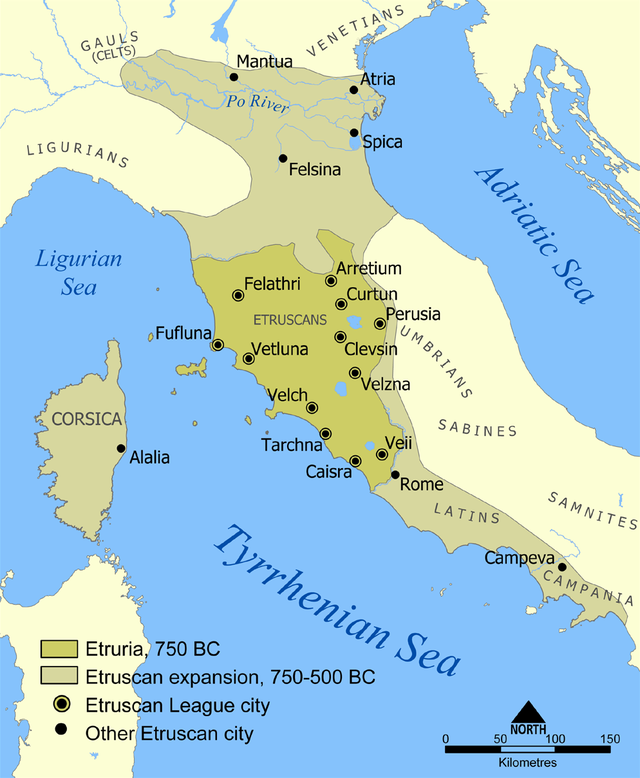
The Etruscan civilisation which dominated northern Italy until the rise of the Roman republic was responsible for contributing significant additions to the religion of one of the great military and cultural powers of the ancient world. It grew out of the 'Villanovan culture', which was itself an ethnic and cultural offshoot of the proto-'celtic' Urnfield Culture of north/central Europe during the Bronze Age. During the 7thC BCE, like other nations and ethnic groups in the Mediterranean region, it came under increasing cultural influence of the Greeks who were expanding their colonies westward via coastal trade and conquest.

640px-Etruscan_civilization_map

Although borrowing aspects of Greek-style immanent polytheist religion and adopting parts of the Olympic pantheon after the 7thC BCE, the Etruscan religious system maintained aspects of its older religious outlook, which by the time of the Roman Republic became identified in particular with a focus on Augury and Haruspicy – the reading of signs from nature and deriving prophecy from the behaviour (and entrails) of animals, and from natural phenomena such as lightning. The Romans referred to this (and the written texts upon which Romans based their augurial practices) as the Etrusca Disciplina, whose precepts became an important part of their religious life.

This particular aspect of Etruscan faith was indeed important: Etruscans were famed for their dedication to religion and required a professional technical priesthood trained in the disciplines of astronomy, natural philosophy (scientia), meteorology, zoology and the gods themselves. In this manner, they appear to have had similarities to the religious specialists among the Gauls and Britons, known to Greeks and Romans as Druids. Like the druids, the Etruscan priesthood were trained in colleges, the most notable late classical example being that opened by the Emperor Claudius in 1stC CE. The powerful influence of this religious system caused it to become the founding model for what would become Roman religious culture, and it therefore unsurprising that Etruscan religion appears to have had a fairly extensive pantheon of gods, albeit that Etruscan culture was formed from autonomous city states, each with their own interpretation of religious practices. These gods seem to have represented a system of immanent polytheism in which all natural phenomena were ascribed a divinity to represent them. However, the Etruscan religious system had three principal gods, named Tinia, Juni and Cel (later supplanted my Menrva). Tinia or Tin was the chief god, Juni his feminine counterpart, and Cel was the 'Earth Mother', perhaps responsible for the subterranean realms (her name evoking tombs and caves – cella). These seem to have evolved into the Roman 'Capitoline Triad' of Jupiter, Juno and Minerva. Under the influence of Greek and other Italic gods, the number of these diversified. However, the art of Augury and Haruspicy was apparently the principle feature of the religion by which the gods' wills were interpreted – Etruscans were natural philosophers par excellence.

Another feature of Etruscan religion which is notable is the fact that it was, by tradition, a revealed faith. The story of this was recounted in 44BCE by Roman author Cicero (De divinatione Book 2; 50-51.23):

“…It is said that, once upon a time, in the countryside of Tarquinii, while the earth was being plowed, a rather deep furrow was dug and suddenly Tages sprang forth and spoke to the man plowing. Now this Tages, according to the books of the Etruscans, is said to have had the appearance of a child, but the wisdom of an elder. When the rustic had gaped at his appearance and had raised a great cry in astonishment, a crowd gathered in a short time, all Etruria assembled at that place. Then he said many things to his numerous listeners, who received all of his words and entrusted them to writing. His whole address was about what is comprised by the discipline of soothsaying (haruspicinae disciplina). Later, as new things were learned and made to refer to those same principles, the discipline grew. We received these things from (the Etruscans) themselves, they preserve these writings, they hold them (as) the source for the discipline…” (Translation: Loeb Classical Library edition)

This tradition has several interesting aspects: Tages was obviously no earthly prophet, but was born from the furrow in a field in a rustic district. This would make him a child of the Etruscan goddess Cel, but also portrays the origins of Etruscan religion as being very indigenous and tied to the ancestral lands of their people. Cicero's account has the peasant gaping in incomprehending wonder while the educated 'townies' write the tiny prophet's words down, suggesting that Etruscan religion was based upon (now lost) canonical texts. Of course, this tale has all the hallmarks of a rustic religion sophisticated by the urbanisation of power in the Italic peninsula during the Iron Age, a process influenced and accelerated by the wealth of the land and commerce with the Greek and Anatolian states. Tarquinii/Tarquinia, founded by the legendary king Tarchon was one of the homelands of Etruscan culture, and therefore 'Tages' (Tarchies – the Etruscan language had no 'g' sound) may well be related as a demoted founder-god.

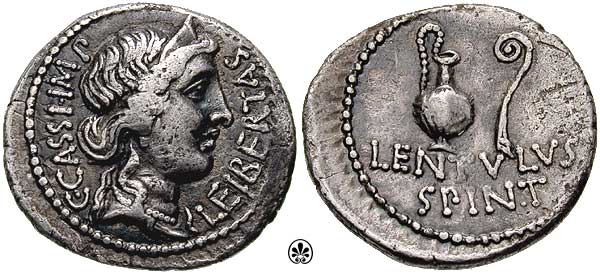
The Etruscan priest-seers are usually represented in Etruscan and Roman art as holding a stave or 'crook' known as a Lituus. This is sometimes depicted as a trumpet very similar to a Gaulish 'Carnyx' – straight with a curved tip. The lituus stave became the model for the Christian bishop's crozier, but its original form is mysterious. It may possibly have been a tool for assisting in the mapping or measurement of the night sky.

Roman Emperors were proud of their Etruscan heritage. This coin depicts the ritual artifacts of an Augur, including the Etruscan 'lituus'. Similar depictions also include a basin instead of the jug, suggesting the use of liquid 'mirrors' in the scrying process...

Roman Emperors were proud of their Etruscan heritage. This coin depicts the ritual artifacts of an Augur, including the Etruscan 'lituus'. Similar depictions also include a basin instead of the jug, suggesting the use of liquid 'mirrors' in the scrying process...

Etruscan cosmology appears to have been quite concerned about the importance of boundaries and divisions in the proper order of things. This probably represented a technical aspect of the need to assign signs and portents based upon where in nature they occurred. For this reason, Roman authors tell us that Etruscan religious teachings state that the gods were ascribed to 16 separate regions in the heavens, and that there were 8 (or 12) great eras of Etruscan history (seculae) the last of which was contemporary to them. The established limits and barriers which organised the Etruscan city-states and the rich agricultural land upon which their civilisation thrived were also of key importance. An account of the Etruscan 'Prophecy of Vegoia' preserved in a Roman treatise on land management known as ‘Corpus agrimensorum Romanorum’ (preserved in a 6thC mss collection) says this about the importance of physical land barriers:

“… Know that the sea was separated from the sky. But when Jupiter claimed the land of Aetruria for himself, he established and ordered that the fields be measured and the croplands delimited. Knowing the greed of men and their lust for land, he wanted everything proper concerning boundaries. And at some time, around the end of the eighth saeculum, someone will violate them on account of greed by means of evil trickery and will touch them and move them [….]. But whoever shall have touched and moved them, increasing his own property and diminishing that of another, on account of his crime he will be damned by the gods. If slaves should do it, there will be a change for the worse in status. But if the deed is sone with the master's consent, very quickly the master will be uprooted and all of his family will perish. The ones who move [the boundaries] will be afflicted by the worst diseases and wounds, and they will feel a weakness in their limbs. Then also the earth will be moved by storms and whirlwinds with frequent destruction, crops will often be injured and will be knocked down by rain and hail, they will perish in the summer heat, they will be felled by mildew. There will be much dissension among people. Know that these things will be done when such crimes are committed. Wherefore be not false or double-tongued. Keep this teaching in your heart…” (Translation quoted from 'The Religion of the Etruscans' Ed. Nancy Thomson de Grummond, Erika Simon; Pub. University of Texas Press 2009)

The Romans obviously took this heart as their annual festivals of the Liminalia and Robigalia seemed designed to celebrate the spirit of this traditional Etruscan prophecy. Vegoia was a female divinity similar to Tages who was quoted in the lost texts of the Etrusca Disciplina. Presumably this prophecy was originally a part of the corpus!

Another important aspect of the Etruscan religion which was followed by Roman religion was the belief in spirits of the dead travelling to and occupying a 'cthonic' or underground location. The cultus of the gods who looked after such realms in Mediterranean pagan cultures were actually deeply rooted to the source of their wealth and success (in both trade and warfare): organised agriculture. This is because of the cycle of death being strongly linked in nature to that of renewal: that which decays fertilises new growth. The ancient domestic ancestral cults linked the presence of the spirits of the departed ancestors with success in the temporal world.

Similar ideas were held by the Greeks and the Celts or barbarians of the 'Atlantic' north. However, one must be careful in how one interprets the idea of the spirits of the dead living in an 'underground' realm: Evidence from all of these cultures seems to suggest that this realm also had a reflected parallel existence to our own, and was also connected to the visible heavens and the concept of the far islands and shores of the world-river, called Okeanos by the Greeks…


The Celtic otherworld in Romanian folk belief

Although largely identifying its modern cultural ethne as ‘Slavic’, Romania’s historical and archaeological past shows that in the ‘Dacian’ Iron Age and late Classical periods its identity was definitely what we today would consider ‘Celtic’. This identity survived until the ethno-cultural engineering of Romanisation, and then the ‘migration period’ displacements of the late 3rdC CE which caused Roman withdrawal in the face of southern migration of Goths and westward migration of Scythic peoples: This introduced the cultural and linguistic foundations nowadays associated with the idea of ‘Slavic’, albeit with an enduring ‘Roman’ identity, preserved in the country’s name. These processes culminated with the early medieval hegemonies of the Caucasus tribes of Avars and Bulgars who eventually formed a stable state which, by fits and starts, had finally Christianised under Byzantine influence by the 9thC CE.

When Herodotus commented upon the Dacians (called ‘Getae’ by the Greeks) in his 5thC BCE Histories, he noted in particular that these peoples believed in the continuity of the soul after death. They were, after all, a people related to the Thracians, among whom the poet-seer Orpheus was supposed to have arisen, providing the European classical world with one of its most important religions, believing firmly in reincarnation. This provided its adherents with a particular map of the Otherworld which modern Celticists can quite easily identify with…

In the modern popular understanding about Romanian folklore, the most influential stories and beliefs surround the dark and fearful aspects of Strigoi – the restless dead who wish to abstract the life-force of the living. These are the model for the modern conception of vampires (and werewolves), and who we nowadays like to think of as humanoids with long sharp canines used to bite and suck the physical blood from peoples’ bodies. The reality (if you can call it that) of the idea of Strigoi is somewhat more complicated, and deeply tied to the ancient beliefs of souls and the otherworld which underpinned the religion of Europe’s Iron Age peoples, possibly extending deeper into antiquity. Characteristically, Strigoi can be either human (‘witches’ – the Italic word for ‘witch’ is ‘Strega’), but they might also be the undying or resurrected dead who seek to abstract human life-force (sometimes as actual blood) and who sicken their victims before finally taking their lives. They can shape-shift into animal forms and pass normally insurmountable physical barriers, and become invisible.

Coupled to the belief in a more sinister Stregoi is the important Romanian myth of the Blajini – the meaning of which translates almost exactly to that same phrase used in Ireland for fairies: ‘Gentle People’. These were spirits supposed to occupy a parallel reflected otherworld which mirrored our own, and at there is still a tradition associated with them, celebrated at Easter, known as Paştele Blajinilor. This festival (often celebrated a week or so after Easter proper) has strong associations with the ancestral dead. Apart from visiting or tending the graves of the departed, it is attached to a custom in which dyed or decorated eggs (often red) were made and eaten in their honour and the shells dropped into rivers to take them to the Blajini (the idea being that they should then know that it was Easter)! Readers of my blog will recognise that this custom is another explicit demonstration of an ancient European belief that all rivers flow to the ‘world-river’ (Apa Sâmbetei to Romanians, Okeanos to the Greeks), which bounds the shores of both our own and the ‘other’ world. Apa Sâmbetei is usually translated or understood as ‘Saturday’s Water‘, but is actually fairly obviously ‘Saturn’s Water‘ since the realm of Saturn or Cronus was in ancient mythology upon the far shores of Okeanos. The term evidently comes through the influence of Trajan’s conquest of the Dacians. Romanian folklore held that the souls of departed travelled through streams and rivers to reach the Otherworld, and this is exactly paralleled in the remains of Celtic pagan beliefs demontrated throughout medieval Irish literature, as I have previously discussed.

More interestingly, another belief attached in traditions to the Blajini was that they continually fasted in the Otherworld in order to sanctify our own world with the divine grace this practice bestows upon christians. They therefore provided a ‘boon’ to humanity, that demanded respect. This is the same belief that Scots minister Robert Kirk described in the Scottish Highlands in his 17thC ‘Secret Commonwealth’ manuscript, concerning the otherworld ‘counterbalance’ – namely when we have plenty, ‘they’ have scarcity!

Both traditions – Strigoi and Blajini – therefore represent different aspects of the same original spirit-belief which so pervaded ‘Celtic’ Europe. They show the idea of the dead living in an inverted state in the otherworld, and whose behaviour towards us seeks to address an imbalance between a mundane and a spiritual existence. However, the ‘reincarnate’ dead who walk the earth again could have no place within the Christian cosmology and folklore except as some fearful ‘evil’ force representing death, darkness, disease and chaos – these evidently evolved to become the Stregoi, whereas the Blajini were ‘allowed’ a continued existence as they largely stayed in the ‘spiritual’ realm beyond the concerns of mundanity, and therefore could not transgress the Christian doctrines to such a degree. In fact, the two ‘archetypes’ are more of a continuity, so that Blajini are sometimes of a more fearful aspect. They are therefore both analogous to the spirits of the Gaelic world, and indeed seem to share the same ancient doctrinal heritage…


Dacian Celtic religion?

“…the Getae are the bravest of the Thracians and the most just. They believe they are immortal in the following sense: they think they do not die and that the one who dies joins Zalmoxis, a divine being; some call this same divine being Gebeleizis. Every four years, they send a messenger to Zalmoxis, who is chosen by chance. They ask him to tell Zalmoxis what they want on that occasion. The mission is performed in the following way: men standing there for that purpose hold three spears; other people take the one who is sent to Zalmoxis by his hands and feet and fling him in the air on the spears. If he dies pierced, they think that the divinity is going to help them; if he does not die, it is he who is accused and they declare that he is a bad person…” Herodotus (Greek, 5thC BCE) – Histories (Book 4) – trans. George Rawlinson (1910)

This curious comment on the Getae (one of a number of proposed ancestors of the Goths, who were from the Danube region, and were also known as 'Dacians') has a fascinating parallel with the later accounts of the Gauls of western Europe, who Julius Caesar claimed also believed in reincarnation and the immortality of souls, and also 'sent' people (it is presumed willingly) on special missions to the otherworld, based upon classical accounts and suggested by current archaeological theories of north European 'bog bodies'.

The name 'Zalmoxis' (sometimes written 'Salmosis') seems in this context to evoke the Indic word 'Moksha', which means 'emancipation', 'liberation' or 'release', in the context of ancient Hindu/Jain concepts of reincarnation. This in fact fits with the similarities shared between these doctrines and what we know of the ancient European Celtic doctrines!

The synonym 'Gebeleizis' is yet more interesting: scholars of Celtic and Indo-European languages might recognise that it possibly contains the word for 'horse'… 'Gebel' or 'Gabal'. Other theories suggest a possible link of the name to 'Cybele', the Anatolian 'Phrygian' goddess, known to her indigenous worshippers as 'Matar Kubileya'. This name itself might mean either 'Mother Cybele' or just possibly even ' Mother of Gebele(izis)'? The regions are so well-linked geographically and culturally that this must be considered, especially as there were Gauls settled in Galatia, further west. Another possible link is to Gaulish Belenos: Ge-Belei-Zi(o)s. The Welsh 'Harleian Genealogies' seem to refer to Belenos as 'Beli Mawr' , which fits with 'Belei'. Zios means 'god' in Proto-Indo-European. 'Ge' might be a reference to the primal Greek earth-goddess, although a compound god-goddess name like this would be unusual…

“… We have conquered even these Getai, the most warlike of all people that have ever existed, not only because of the strength in their bodies, but, also due to the teachings of Zalmoxis who is among their most hailed. He has told them that in their hearts they do not die, but change their location and, due to this, they go to their deaths happier than on any other journey… ” (Lactantius – a Christian author of the 3rdC CE – quoting a supposed speech of Trajan.)

These 'Getae' (from what is now modern Romania) were surely quite similar in their religious outlook and valour to the Gauls Caesar spoke of conquering some three centuries later. If Lactantius was reporting Trajan's words accurately, they held their reputation longer than the Gauls, as they were conquered by his armies during the early 2nd C CE, after which they largely followed similar models of Romanisation as their western cousins – their homelands eventually becoming known as 'Romania'…


Design elements of the insular ‘Celtic horse’ coins: Part 1

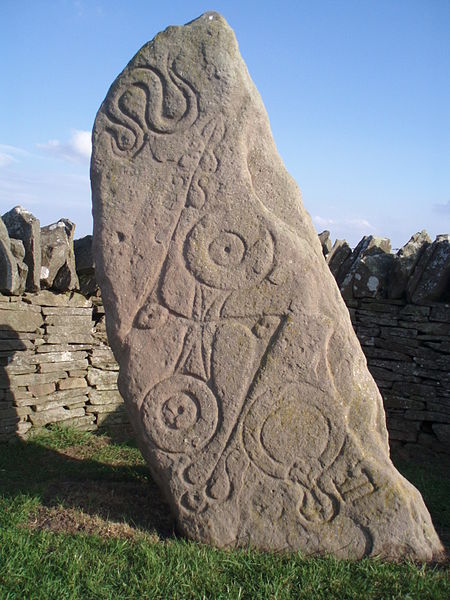
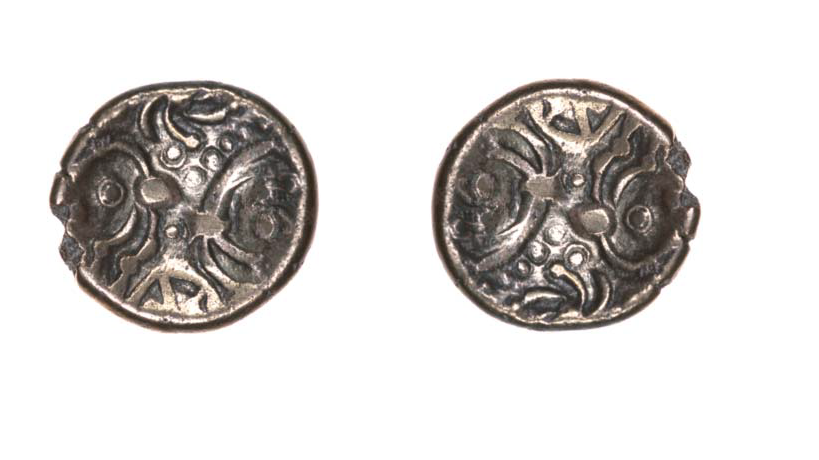
The 'Celtic Horse' seen on the 'primitivist' coins of the Iron Age often showed interesting design characteristics related to concentric circles and points. These became prominent elements of insular Celtic numismatic designs and rock art, such as that seen in Scotland among the 'Picts'. My design here is taken from a coin of the Dobunni (W. Britain).

The ‘Celtic Horse’ seen on the ‘primitivist’ coins of the Iron Age often showed interesting design characteristics related to concentric circles and points. These became prominent elements of insular Celtic coin designs and regional rock-art, such as that seen in Scotland among the ‘Picts’. The design here is taken from a  2000 year old coin of the Dobunni in my collection (W. Britain).

'Aberlemno 1' pictish stone (Angus, Scotland). The 'double disc' motif appears with the 'z-rod' and the mirror: symbols of rotational and reflectional symmetry. The serpent at the top demonstrates that this symbolism is expressive of the Atlantic otherworld beliefs...

‘Aberlemno 1’ pictish stone (Angus, Scotland). The ‘double disc’ motif appears with the ‘z-rod’ and the mirror: symbols of rotational and reflectional symmetry. The serpent at the top demonstrates that this symbolism is expressive of the Atlantic otherworld beliefs…

Note the rotational symmetry seen in the horse-design of this coin! Wiltshire ?Dobunni 1stC BCE.

Note the rotational symmetry seen in the horse-design of this coin! Wiltshire ?Dobunni 1stC BCE. Photo: (c) 2014 http://www.celticcoins.com – Chris Rudd

The ‘warrior’ panel of the Gundestrup cauldron

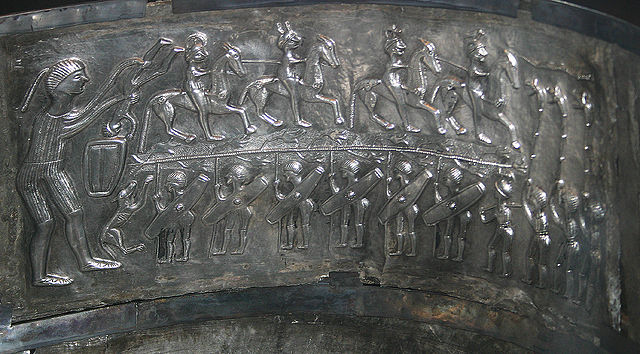
The 'warrior' panel from the interior of the cauldron. Photo: Malene Thyssen

The 'warrior' panel from the interior of the cauldron. Photo: Malene Thyssen

This interior panel from the famous Gundestrup cauldron appears to show a line of seven mail-clad, shield and spear-wielding Celtic warriors advancing in a line from right to left towards a giant warrior who appears to be holding the body of another small warrior over a vessel of some sort. A dog or wolf appears to jump up at his feet. Proceeding from the giant along the upper row, are a line of four finely-arrayed horsemen with elite crested helmets, passing from left to right. Preceding them is a snake. The footsoldiers of the bottom row are followed by three carnyx (boar-headed celtic war-horn) players, whose horns reach up to face the cavalry riding back towards them, and the snake 'flies' above the horn chanters. Separating the rows of footmen and cavlry is a branch from which sprouts foliage or flowers. The metalwork around this is textured, suggesting an aura, a river or a footpath. The 'spears' of the footmen seem to connect with the trunk of the branch.

Symbolism interpreted:

The silver Gundestrup cauldron was probably a ritual deposit in water, pledged to the gods, as it was discovered in pieces in a Danish bog in 1891. Such deposits were an archaeological feature of Europe's 'Atlantic Bronze Age' which were influential upon the Celtic Iron Age cultures of north and central Europe. The organised style of the warriors, their mail suits and war trumpets seem date the cauldron between the 3rdC BCE and the 1stC CE during which time there were broad military and cultural interactions between Celtic tribes of Gaul and those of south and central Europe, explaining the artistic styles (and that of the armour) depicted on the cauldron: In fact, some design elements on the cauldron are so similar to those on objects found in the 'Letnica Hoard' (Bulgaria) to suggest a Gallo-Thracian origin for at least some of the panels. The cauldron shows aspects of both military and spiritual ideas of the afterlife which commentators typically associate with Celtic Iron Age culture.

Our 'warrior' panel shows some key features of a warfare-oriented view of reincarnation:

The footsoldiers:

These are 'ordinary' footsoldiers kitted uniformly for war with shields, spears and chainmail vests. There are seven armed men and three carnyx players. The last of the armed men carries no shield, and may be a youth, as he stands below the topmost 'sprout' of the tree-like design above their heads. They are clearly marching into battle, towards the dog/wolf and the giant figure with his cauldron, who appears to be placing one in or pulling one out of the cauldron. The soldiers are marching in the direction of the roots of the aforementioned tree design. Interestingly, it can be seen that their chainmail hauberks finish at the knee, below which they appear to wear hose and rawhide sandals on their feet, similar to those still in use in Ireland and the Isle of Man into the 19thC.

The giant warrior and his 'cauldron':

The giant warrior's cauldron or vessel appears to be a metaphor for some kind of rebirth promised to the valiant footsoldiers, as proceeding from it in the opposite direction to them are a line of mounted knights with fabulous helmets. The womb-like metaphor for the cauldron as a symbol for rebirth is found in the 'Second Branch' of the medieval Welsh epic tales known as Mabinogion in which the giant, Brân, owns a cauldron which revives the dead. In the case of the Gundestrup cauldron, two things appear to be emerging from this giant's cauldron – glorified warriors and a tree. This has echoes of the Yggdrasil tree mentioned in the 12thC Icelandic accounts of Scandinavian pagan legends: at the base of Yggdrasil were a number of wells from which the lives and fates of men flowed. At the base of the tree, gnawing animals and serpents were found: aspects of the ancient empirical idea of regeneration through putrefaction: these are also represented on the Gundestrup cauldron by the snake and the dog. The message of the panel is that the masculine god of the Otherworld (here portrayed also as a warrior, therefore a 'colleague) promises regeneration to those who glorify themselves in battle, and the new existence may have greater glory, represented by:

The four knights:

Proceeding from the apparent god and his cauldron are four mounted men (knights), remarkable for their elaborate crested helmets. The horses and more beautiful helmets mark them out as part of the warrior elite, and the implication of their appearance in the panel is that valiant footsoldiers might become so great – either through death or attainment. It is notable that there are only four knights, compared to the eight warriors going towards the cauldron (including the man held by the 'god'). Assuming that all of the soldiers on the lower row were looking forward to death in battle, then the panel suggests only four of these seem to have achieved a more glorious reincarnation! This again links to the Norse accounts of beliefs about death of warriors in battle which suggest that only half of the slain went with Odinn to Valhöll. Another interesting concordance.

So what of the other four warriors – what might the panel say about these? We are left with two interesting possibilities:

The first is represented by the animals in the image: first of these are the cavalrymen's horses, which would bring the number of sentient beings up to eight in the top row. The other is the ravenous dog or wolf, who like the crows and carrion birds depicted elsewhere on the cauldron would be features of any battlefield. The folklore of hosts of the restless dead remaining in Atlantic Europe after the Iron Age seems to have relevance here: the Sluagh Sidhe of the Gaelic world, and the 'Wild Hunt' of the Germanic world in particular. It may be that the souls of the unglorified were believed to have been incarnated in the form of the animals who haunt battlefields and the margins of human habitation: the corvidae (crows), vultures, wolves, dogs and foxes. By consuming the flesh of the glorious and providing good deeds in the form of omens and warnings, they might find themselves given a better incarnation in the next life, as well as speeding the recovery of the battlefield etc.

The second possibility of reincarnation is represented by the tree – the ancient metaphor for human generations: 'root, branch and seed'. The panel's design with the tree apparently growing from it suggests the dead are fertilising the regrowth of future generations, perhaps implying the reincarnation of less worthy footsoldiers as humans, ready for another 'go' at attaining greater glory. My feeling, based on the residual folklore and traditions of Europe, is that the truth probably lies somewhere between these two suggestions. The transmigration of souls (described by Roman authors as a central tenet of Gallic/Celtic faith) might lead to a number of outcomes, based variously upon the achievements of individuals in this life: a glorious afterlife, reincarnation as a human, or even a cavalryman's horse, or as a restless ravening creature who plays an important role in the regeneration processes of nature, and who might offer auguries to the living. The calls of ravens and crows, the flight-patterns of birds and the calls and shouts of canines and horses, were all recorded as potential sources of augury in ancient Europe until at least the middle ages.

The snake and the Carnyxes:

The snake has been a symbol of reincarnation for a very long time, based upon their continuous unblinking stare, their shedding their skins, their love of chthonic lairs from which they emerge into daylight, and from their ancient philosophical (morphological) classification along with worms, larvae and maggots as part of natural putrefaction and regenerative processes of nature. The snake is also notable for the visceral, terrifying/transfixing ability it has over its prey, bringing us here to discuss the Carnyx, above which the snake is positioned in the panel. The was the war-trumpet par-excellence of the Celts, whose terrifying cacophonic honking seemed designed to evoke the enraged squeals and bellows of an attacking boar, stag or bull, augmenting the terrifying transfixing effect of soldiers' war-cries upon an enemy. The horn was apparently a potent weapon in itself, designed – like the gaze of the snake – to sap the morale of the enemy.

Summary:

This panel appears to show imagery promising soldiers reincarnation in battle. Their deaths are being 'inverted' into a renewed, more glorious life, and the cauldron and tree act as a central metaphor of regrowth from the well of life, with the dog and snake representing the earthly and allegorical forms of this natural process.