The woman who sat by the sea…

Buried deep within the mythical consciousness of Atlantic Europe is a very particular piece of imagery of a female sat waiting at the water’s edge. In its most common guise, it corresponds to the many stories of Mermaids and Merrows, often apparently found sitting on rocks at the seashore looking for human lovers. For inland-focussed cultures, these became characters such as the Melusine, the slavic Rusalkas, and the medieval ‘Arthurian’ Lake-Ladies and Fountain Maids. Even Frau Holle/Frau Gode has this attribute in some German tales, and consequently also the related Gaelic Cailleach, the Hispanic Moura, the Breton Gro’ach, and the WelshGwrach. She is depicted in stories either as the passive focus of an otherworldly encounter by a questing human protagonist, or as – in the case of the needy mermaid – a seeker of solace in the human world who waits for her catch. Either way, she is often depicted as a shape-shifting divinity who seeks a human lover, and has the power to bestow wealth and privilege, although often with an obligation and a moral sting in the tale.

Of all the places in Europe, the Isle of Man perhaps is perhaps the place where we find the greatest evidence linking mermaid-myths with the celtic goddess of the waters:
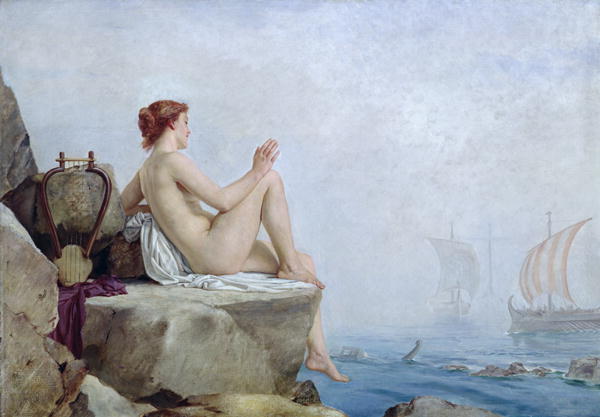
Themes of seduction and the sea are an ancient part of pagan metaphor

Isle of Man mermaid mythology:

The Isle of Man probably had a greater number of mermaid stories and traditions in its past that many places its size and larger. Particular traditions also occur in the other parish districts, with the following being recounted to George Waldron in the early 18thC (A Description of the Isle of Man, 1731) :

“… A very beautiful mermaid, say they, became so much enamour’d of a young man who used to tend his sheep on these rocks, that she would frequently come and sit down by him, bring him pieces of coral, fine pearls, and what were yet greater curiosities, and of infinitely more value, had they fallen into the hands of a person who knew their worth, shells of various forms and figures, and so glorious in their colour and shine that they even dazzled the eye that looked upon them. Her presents were accompanied with smiles, Battings on the cheek, and all the harks of a most sincere and tender passion; but one day throwing her arms more than ordinarily eager about him, he began to be frighted that she had a design to draw him into the sea, and struggled till he disengaged himself, and then ran a good many paces from her; which behaviour she resented so highly, it seems, that she took up a stone, and after throwing it at him, glided into her more proper element, and was never seen on land again. But the poor youth, tho’ but slightly hit with the stone, felt from that moment so excessive a pain in his bowels, that the cry was never out of his mouth for seven days, at the end of which he died …” (‘An account of the Isle of Man’, 1735)

In this, the amorous sea-maiden bestows gifts upon her human lover until spurned, then throws a stone at him causing him to become chronically ill (seemingly a version of the belief that fairies inflict disease with missiles or darts). Such motifs are found in mermaid myths everywhere, and the same themes occur around the Morrigan in Irish legends.

A late 19thC Manchester-based German ethnographer, Karl Roeder, was fascinated with the Isle of Man and produced a series of folklore-related articles in Manx newspapers which were eventually published in a book, ‘Manx Notes and Queries’. He collected a great deal of folkloric material in the island including a number of mermaid traditions among which was this one from the southernmost tip of the Island, where a sound separates the main island from its ‘Calf’:

“….Between Bow Veg and Glen Wither, on the coast north the Sound, is a place called Lhiondaig Pohllinag, or the Mermaid’s Green, or Garden, and the tradition is that the mermaids haunted it and sported about, basking themselves there… “

It is obvious from his description that mermaids were not just considered singular apparitions in the Isle of Man, but members of a tribe. The unusual Manx word ‘Pohllinag‘ means something like ‘sinker’ or possibly ‘pool-dweller’ (I believe it must be a fishermen’s term) and occurs in Archibald Cregeen’s ‘A Dictionary of the Manks Language’ (Pub. Quiggin, Douglas 1835) where he says it is more properly applied to a merman, albeit also in use for mermaids. John Kelly’s earlier Manx dictionary (late 18thC, but unpublished until after Cregeen’s) also gives the even more intriguing term ‘Muiraghan’ for mermaid, which readers might recognise to be a version of the Irish Morrigan – that otherworldly femme fatale encountered by Irish legendary heroes at river crossings! Cregeen and Kelly also both give the altogether more common Manx term used for the mermaid: Ben varrey (Ir. Bean Mara – ‘sea woman’).

The fairy washerwoman:

Another aspect to the celtic mermaid mythology that links with that of the Morrigan/Badb is that of the fairy washer-woman. This archetypal water-spirit is to be found in legend near to streams and rivers, performing her ablutions – sometimes viewed as a vision of death to come, particularly if washing a shroud or armour. The Isle of Man (perhaps unsurprisingly) had its fair stock of these as well, although by the 19th century it appears that mythology had separated mermaids and the ‘Ben Niee‘ (Ir. bean nighe) into two different classes. The fairy washerwoman in the Manx peoples’ imagination haunted the banks of inland streams, was often dressed in red, carried a candle and – like every good Caillagh – wielded a sladdan, which in this case was turned to the duty of beating the washing. W.W. Gill (Third Manx Scrapbook, Pub. Arrowsmith, London 1963) says that a vision of this spirit did not necessarily foretoken death – his early 20thC respondent believed it could signify a change in the weather…

“… The fairy-washerwoman of Maughold haunted a crossing-place on the Struan-ny-Niee named Boayl-ny-Niee, ” Place of the Washing,” …. A local man, R. L., calls this spectral laundress a Liannanshee, and says she held a lighted candle in one hand while she beat the clothes, or whatever it was she had, with her sladhan held in the other. A still older native of the district, K–, whose father actually saw her, and was not frightened at all, says she was “a lil red woman, and used to have a candle stuck in the bank beside her” (which was more sensible and convenient than holding it). In both versions she came out of the river, and to see her was a sure sign of dirty weather at hand, but of nothing worse. (I enquired carefully about that.) The Washer may not have been thought to be always the same personage, or a party of fairies may sometimes have been seen, for I have heard the Boayl-ny-Niee casually alluded to as “the place where the fairies washed their clothes”. But I could meet with no more than the two accounts just given.In other places in the Island it was always in parties that they did their washing. There was a flat stone, not now discoverable with certainty, in the Rhenab river a little way below where the lodge now stands, and at this the fairies were both heard and seen at night and early in the morning, washing clothes.At the side of the Gretch river in Lonan, in a spot called “the Fairy Ground”, the fairies used to be seen washing their babies. These solicitous mothers, like the Maughold laundresses, always wore red costumes.Three other fairy washing-places, which have been mentioned in print but are not included in any volume of folk-lore, may be added here. At a river-crossing in Glen Rushen the fairies soaked, beat, and shook out their garments, and hung them on the gorse-bushes to dry. One article, a beautifully-made cap which was too small for the smallest child in the glen, was brought home by a man who saw it being put on a bush ; but his mother made him take it back, “for fear the fairies would be afther it, an’ there wouldn’ be res’ in the house on the night ” (Lioar Manninagh, iv. p.161). Again, at an unnamed place in Arbory the fairies were often heard “beetling and bleaching their clothes down at the stream”. In another glen, children saw the fairies’ newly-washed linen spread out on a rock to dry (Chambers’ Journal, 1855). Similar sights may have given its name to “Glen Nee-a-nee” in Kirk Bride, thus spelt in Quarrie’s verses. The name probably contains the same word as Boayl-ny-Niee, where the sound would be better represented by ” N’yee.”From washerwomen, either human or spectral, comes the name of the river and of the places on its banks : the Stream of the Washing and the Place of the Washing, and Chibber-ny-Niee, the Well of the Washing, at its source. Near this is a small bridge under which, traditionally, women performed ritual ablutions in order to qualify as witches. The river-name may have travelled up its course from the Place …”

The water horse and the goddess:

The other dangerous or ominous spirit associated with rivers and streams in the Isle of Man (and indeed, throughout Europe) is the water horse or Cabbyl Ushtey, also known as the Glashan or Glashtyn (‘grey-green one’). This creature was supposed to be able to steal you away down into the depths of the waters to drown, probably after taking you on a wild night-time ride about the countryside. Known elsewhere as the Nikker, Kelpie, Nixie and Bäckahästen this pan-European myth is of ancient origin, and is a remnant of the Atlantic religion’s mythological narrative of death and the transit of the soul to the Otherworld. The water horse and the various waterside humanoid spirits are often interchangeable in folklore and mythology – possibly on account of this Atlantic belief – and this is no better illustrated and preserved than in another Manx legend, that of ‘Tehi-Tegi‘, here recounted by George Waldron in his 1731 book ‘A Description of the Isle of Man’, p.75:

‘He told me that a famous enchantress sojourning in this Island, but in what year he was ignorant, had, by her diabolical arts, made herself appear so lovely in the eyes of men, that she ensnared the hearts of as many as beheld her. The passion they had for her so took up all their hearts that they entirely neglected their usual occupations; they neither Flowed nor sowed; neither built houses nor repaired them; their gardens were all overgrown with weeds, and their once fertile fields were covered with stones; their cattle died for want of pasture, their turf lay in the Bowels of the earth undug for; and every thing had the appearance of an utter desolation: even propagation ceased, for no man could have the least inclination for any woman but this universal charmer, who smiled on them, permitted them to follow and admire her, and gave every one leave to hope himself would be at last the happy he.When she had thus allured the male part of the Island, she pretended one day to go a progress through the provinces, and being attended by all her adorers on foot, while she rode on a milk-white palfrey, in a kind of triumph at the head of them: she led them into a deep river, which by her art she made seem passable; and when they were all come a good way in it, she caused a sudden wind to rise, which driving the waters in such abundance to one place, swallowed up the poor lovers to the number of six hundred in their tumultuous waves. After which, the sorceress was seen by some persons who stood on the shore to convert herself into a bat, and fly through the air till she was out of sight; as did her palfrey into a sea-hog or porpoise, and instantly plunged itself to the bottom of the stream.To prevent any such like accident for the future, these wise people have ordained their women to go on foot, and follow wheresoever their lords the men shall lead; and this custom is so religiously observed, as indeed all their traditions are, that if by chance a woman is before, whoever sees her, cries out immediately, Tehi-Tegi! Tehi-Tegi ! which, it seems, was the name of that enchantress which occasioned this law among them.’

The legend recurs in a number of recorded tellings, although Waldron’s description of Tehi-Tegi transforming into a ‘bat’ is a misinterpretation – she turns into a wren, hence the wren-hunting traditions of the Christianised celtic world. The narrative is one of a demonised goddess, who once caused men to err, and for which they paid with their souls. The magnificent horse ridden by Tehi-Tegi is evidently the same as the Cabbyl Ushtey, the Kelpie and his continental cousins. Hannah Anne Bullock (History of the Isle of Man, Pub. Longman, London 1819) gives the more usual story (from Ch.19):

But one of the most curious ceremonies, and which, I believe, is peculiar to the Isle of Man, is, that of hunting the wren, founded on a tradition, that in former times, a fairy of uncommon beauty exerted such undue influence over the male population, that she at various times seduced numbers to follow her footsteps, till, by degrees, she led them into the sea, where they perished. This barbarous exercise of power had continued for a great length of time, till it was apprehended the island would be exhausted of its defenders, when a knight-errant sprung up, who discovered some means of countervailing the charms used by this syren, and even laid a plot for her destruction, which she only escaped at the moment of extreme hazard, by taking the form of a wren; but though she evaded instant annihilation, a spell was cast upon her, by which she was condemned on every succeeding New Year’s Day, to reanimate the same form, with the definitive sentence, that she must ultimately perish by a human hand. In consequence of this well authenticated legend, on the specified anniversary, every man and boy in the island (except those who have thrown off the trammels of superstition), devote the hours between sun-rise and sun-set, to the hope of extirpating the fairy, and woe be to the individual birds of this species, who shew themselves on this fatal day to the active enemies of the race: they are pure sued, pelted, fired at, and destroyed, without mercy, and their feathers preserved with religious care, it being an article of belief, that every one of the relics gathered in this laudable pursuit, is an effectual preservative from shipwreck for one year; and that fisherman would be considered as extremely foolhardy, who should enter upon his occupation without such a safeguard.

Waldron’s translator for his version of the tale (Manx was the predominant spoken language in the 1720’s) evidently conflated the ‘titmouse’ and the ‘flittermouse’ – the former being an English synonym for the wren, goldcrest or firecrest, and the latter being the bat. Either which way, the tale is an important concretion of lost myth which sheds more light on mysterious ancient Celtic symbolism, as well as offering some insight into the symbolism on the mysterious Pictish pteroglyphs of the early middle ages. The transformative aspects of horse > sea creature is evocative of the passages in the Irish ‘Voyage of Bran‘ when Manannan leads the protagonist across the ocean to the otherworld and the horses seem to become fish.

The old woman who sat by the sea:

The Tehi-Tegi legend and the tradition of wren-hunting – like the Manx mermaid traditions – tended to locate around the fishing communities of the southern and western parts of the Isle of Man. Further investigation of the folklore of this region of the island uncovers a number of other variants on the mytheme. In particular, another name emerges for the aquatic female – ‘Yoan Mooir’ or ‘Joan Mere’, whose eponymous ‘house’ and mysterious ‘well’ could once be found near the cave-riddled sea cliffs between Port St Mary and the islet at the southern tip of Mann, known as the ‘Calf’. Manxmen used to use to personify the sea as ‘Joan Gorrym’ (‘Blue-Green Joan’) and ‘Joan Mooir’ is evidently the same personage. Her ‘house’ was actually a natural freshwater spring at the place known as the ‘Chasms’ close to the sea-shore, which flooded with saltwater at high tide. It may now be lost under rock slides, but such sea-side natural springs (as well as natural springs discharging directly into main waterways) may well have once been holy sites to pagans. A local example which has survived time somewhat better is Chibber Catreeney (‘St Catherine’s Well’) on the seafront in the town of Port Erin a couple of miles away from Joan Mere’s well. ‘Catherine’ is interchangeable with ‘Caithlin‘ – a name I have previously mentioned in relation to the names of the goddess from Ireland, and who appears as an aquatic female temptress-adversary (‘Cathaleen’) in the legend of St Caomhin (Kevin) at Glendalough. She also appears as the ‘Cathach’ beast defeated by St Senan of Iniscathy/Scattery in another christianising hagiographic myth, and elsewhere the town of Enniskillen is named after her sacred island on the river there.

In the Isle of Man, the well on the beach in Port Erin was associated with a fair at which a curious ritual used to be carried out, somewhat redolent of the Tehi-Tegi wren myth and customs: A hen was killed, and given a solemn burial complete with funeral dirges, its tail feathers being saved for luck. ‘He’s plucked the hen’s tail’ would be said of a drunkard, in honour of the festive nature of the former St Catherine’s day celebrations. Perhaps the term ‘cocktail’ even has some relation to this? The ‘Cath-‘ suffix in this divine name associated with the aquatic female is redolent of the Greek word ‘Kathe’ meaning ‘seat’, from which the words ‘cat’ (a sitting beast) and ‘cathedral’ (a bishop’s seat) derive, and which is also seen in the Irish word for a ‘fort’: cathair conventionally linked to the word for battle: ‘cath’ (eg – ‘Cath Maigh Tueredh’, the ‘Battle of Moytura’). Explorers of the ancient pagan sites of Ireland and Britain will be familiar with the profusion of sites referred to as ‘chairs’ or ‘seats’ in relation to saints and other mythical personages – this here is a clue! In particular, it appears that the gaelic goddesses sat next to water…

On the western Manx coast is the Baaie Mooar (Great Bay) with its Niarbyl rocks and the former fishing-settlement of Dalby. Apart from once being a good local source of mermaid traditions,this former fishing community also laid claim to a local tradition of a mysterious Old Woman, described by Caesar Cashin in an article for Mannin magazine (Volume 5, 1915), where he explores the Dalby coastal scenery and recounts its legends:

“…But the morning is growing on, so let us continue our walk along the cliffs to the south. First we come to a little cave called Ooig ny Meill, which has three entrances facing south, west, and east. Leading to the west entrance is a little patch of white sand, the only white sand on this coast, and once when a boy I saw on it tiny footprints, no bigger than my thumb, the marks of little clogs they were, going into the cave and round the rock in the middle of it. The rock is about two feet high and it was said that the Shenn Ven Ooig ny Meill—the Old Woman of Meill Cave, often sat on it with her face to the west. I think that she must have died, or shifted to some other cave, as she has not been seen for years…”

The image of an old woman sitting on a rock in a cave looking towards the sunset in the west is potent with the resonance of the Atlantic religious myth of the earth goddess estranged from her sun-god lover!

Cashin also mentions another cave – one of the more famous fairy caves on the Island – the ‘Ooig ny Seyir‘ (‘Cave of the Crafter’) in which the fairies were latterly believed to be heard making barrels for their salt-herring. Followers of my writing might recognise the possible connection here with Bridget – ‘goddess of smithcraft’ and the Romano-Celtic goddess name ‘Sirona‘. In fact, there are other legends which link the Island to Ireland’s tradition of a legendary magical smith, and otherworldly women who haunt the sea-shore and who provides weapons for mythological heroes:

Tiobal, Princess of the Ocean – daughter of Gullinus/Lir:

In her delightful book ‘Manx Fairy Tales’ (Pub. Nutt, London, 1911), Sophia Morrison recounts a more lyrical version of an ancient Irish tradition, first translated and published by Nicholas O’Kearney in the 1852-3 Proceedings of the Kilkenny and Southeast of Ireland Archaeological Society (Vol.2 , p.34), derived from an interlineal gloss in a 12thC Irish manuscript tale known as An T’ochtar Gaedhal (‘The Eight Irishmen’).

“… Gullinus quidem Пοσειδων fuit, nam Lir Ibernicum aut Phoenicum nomen Neptuni, et idem quod mare; ideo Guillinus fuit alterum nomen pro Lir, deo maris ut Tobal maris dea fuit. Nam illa Concubaro Mac Nessa, postea regi Ulthoniae, apparuit sub specie mulieris pulcherissimae, cum in Manniam jussu oraculu cui nomen Cloch-όir – i.e. saxum solis – quod isto tempore celebrerissimum fuit his partibus, adebat ad Gullinum quendam uti daret buadha druidica clypeo et armis ejus. Gullinus imaginem Tiobal in clypeum finxit, et buadha multa invincibilaque habebat, secundum aucthores vetheres Ibernicos .. ”

“… Gullinus was indeed Poseidon, for Lir is the Irish or Phoenician name of Neptune, and the same as the sea; so Gullinus was the other name for Lir, the god of the sea, just as Tiobal was the goddess of the sea. For she appeared to Conchobar Mac Nessa, afterwards King of Ulster, in the form of a very beautiful woman, when by the decree of the oracle, whose name was clochuir, i.e., the stone of the sun, which at the time was very celebrated in these parts, he was going to Man, to a certain Gullinus, in order that he might give him druidical buadha for his shield and arms. Gullinus fashioned the image of Tiobal on his shield, and it had many buadha, according to the old Irish authors …”

The Latin author is obviously keen to address some actual Irish/Manx pagan traditions using his classical learning, and explicitly states that ‘Gullinus’ (i.e. – Cuillin, Gullion, Whallin etc) resided in the Isle of Man and was one and the same as the sea-god, Lir. Manx tradition, of course identifies this character with Manannan, ‘Son of Lir’, who functions in Irish myths as a donator of magical weapons and as lord of the Otherworld. The legend resonates with the imagery of Greek goddess Athena’s shield – the aegis – depicting the head of the monstrous island-goddess and daughter of the ancient Greek sea-god Phorcys: namely, the gorgon Medusa.

Strangely, Irish mythology contains other allusions to mysterious females found wondering the liminal Manx shorelines by adventurers. Tiobal (Tiobhal/’Teeval’) appears (all be it under a different name) in a version of this myth recounted in the 9thC Irish text, Sanas Cormaic (Cormac’s Glossary) This is the story of Prull (an old Irish word meaning’greatly/excessively’) – in which it is not Conchobar who quests to the Isle of Man in search of mysterious buadha from its shoreline denizens, but a party of the legendary Chief Ollamh of Ireland, Senchán Torpeist (who is possibly a legendary model for the Christian mythological ‘hero’ St Senan). In the tale, the Ollamh leaves Ireland with his retinue of 50 bards to visit the Isle of Man, and on his arrival it appears that he meets no less than the Shenn Ven Ooig ny Meill, or at least someone entirely like her…

(Translation and glosses by Whitley Stokes/John O’Donovan)

“… They afterwards reach Mann and leave their fleet on land. As they were on the strand, they saw the old woman (sentuinne) grey-haired, feeble, on the rock. Sentuinne i.e. an old woman [i. Cailleach], ut poeta dixit:

An old woman and old priest,

A grave-broom is their withered beard,

Provided they do not serve God’s Son,

And do not give their first fruits.

Thus was the old woman [Cailleach] on the strand, cutting sea-weed and other sea-produce. Signs of rank (were) her feet and hands, but there was not goodly raiment on her. She had the ghastliness [?] of famine. A pity was this, for she was the poetess, daughter of Ua Dulsaine of Muscraige Liac Thuill in the country of the Hi-Fhidgenti, who had gone on a circuit of Ireland and Scotland until all her people had died. Then the ceard (smith/craftsman!), her brother, son of Ua Dulsaine, was seeking her throughout Ireland, but found her not. …”

The narrative unfolds as one of the ‘loathly lady’ – a crone who is secretly a radiantly beautiful and divine personage. The implication is that the woman is one of the ancient survivors of the first race – a theme which weaves through Irish legends (Book of Invasions, Children of Lir etc). She challenges the poets to a lyrical contest by challenging them to complete verses, but none can best her save for an ugly youth who Senchan had only allowed along as an afterthought. The Cailleach recognises his abilities and Senchan returns to Ireland where the youth then assumes his own true radiant form – as another member of the lost race of Ua Dulsaine – another transformation from ugliness into beauty. ‘Ua Dulsaine’ (Dulsaine = Satire) seems also to be a play on the word ‘Dulse’ – and edible seaweed that has been a traditional staple of Irish seaside communities for millennia, so ‘Ua Dulsaine’ appears to be another reference to the solar sea-god: Lir, Manannan or Cuillin. The ‘sentuinne’ is therefore Tiobal in disguise – the bardic poetics are sheer genius! Senchan was supposed to have lived in the time of King Guaire Aidhne who in the Sanas Cormaic tale, sent him on the quest to find the children of ‘inspiration’ – children who were, in fact, Ireland’s old gods.

Caillagh y Groamagh:

The legend of the ‘Caillagh y Groamagh‘ is another Manx Cailleach tradition which ties the old-woman to the shoreline. Usually translated as ”Old Woman of the Gloom’, the linguistically astute might recognise that the Manx word ‘groamagh’ (pronounced with a m>w lenition as ‘gro-ach’) is the same as the name of legendary seaside female spirit in the Breton legends, the Gro’ach. This is also a metathesis of the Welsh word for ‘hag’, which is gwrach (as in ‘Gwrach y Rhybin’). Gloomy and old she might be, but in the Manx legend she was important enough to have a day named after her – ‘Caillagh y Groamgh’s Day’ which strangely enough coincides with St Bridget’s day, Imbolc, the 1st or 12th of February (depending on how you determine it).

“… Caillagh-ny-groamagh, the gloomy or sulky witch, was said to have been an Irish witch who had been thrown into the sea by the people in Ireland with the intention of drowning her. However, being a witch, she declined to be drowned, and floated easily until she came to the Isle of Man, where she landed on the morning of February 12th. It was a fine, bright day, and she set to work to gather “brasnags”—sticks to light a fire, by which she was able to dry herself. The spring that year was a wet one. It is said that every 12th February morning she still goes out to gather brasnags to make a fire by which to dry herself; that if it be fine up to noon, and she succeeds in doing so, then a wet spring will follow. But, if the morning be wet and she cannot get dry, then the spring will be a dry one …” (Yn Lioar Manninagh, Volume 1 p.223, Manx Natural History and Antiquarian Society, 1889)

Not only was she associated with collecting sticks on the beach early in February (a pastime which might also be observed among the early-nesting ravens during this period!) but she had a piece of headland named after her in Maughold: Gob ny Callee. Maughold was the legendary Manx saint who, curiously, also arrived in the Isle of Man after being cast adrift from Ireland. He was reputed to have found the key to his fetters inside a fish – a pescatological phenomenon also displayed by Pictish/Dalriada saint Kentigern (Mungo) whose mother was reputed in his hagiography (by Jocelyn of Furness, some-time Manx Abbot of Rushen Abbey) to have been cast adrift and discovered by monks on the beach as she grubbed around looking for sticks to light a fire next to which she could give birth to the saint. The story of how Mungo’s mother (note: Mungo = a codifed version of Manannan) came to be in the water was that she fell (was pushed) from a cliff – which happens by coincidence to be another property displayed by the Manx Caillagh y Groamagh. W.W. Gill explained this in relation to the folklore about a land-feature in Ballagilbert Glen in the south of the Isle of Man (‘A Manx Scrapbook’, Pub. Arrowsmith, London, 1929 ):

“… This wide, green, shallow valley, always pleasant in summer with flowing waters and unpleasant with standing waters in winter, secluded and now nearly depopulated, has retained a few place-names and scraps of lore attaching to them which deserve to be rescued. In the lane leading to Ballagilbert farmhouse on the East side of the Glen lurked a moddey dhoo (Ed: ‘black dog’ spirit), headless like that at Hango (Ed: near Castletown). Near the top of the valley is a small depression called Caillagh ny Groamagh, (“Old Woman of the Gloominess”,) into which cavity she fell – or which she scooped out by falling – when trying to step from the top of Barrule to the top of Cronk yn Irree Lhaa. The impression of her heels and her thoin are said to be distinctly visible in the soil. A similar anecdote is told of the more serious fall, resulting in a broken neck and burial, of a Caillagh or Hag who came from the North to perform a series of jumps from height to height among the Lough Crew hills in Meath. Apart from this mishap to the Manx Caillagh, she is well known for her influence over the weather, as related in Folk-lore of I.O.M. and elsewhere; in Scotland she is the actual personification of bad weather. As accounts of the Caillagh my Groamagh vary somewhat, I will include here what I have learned of her in Patrick, which at least contains one detail I believe to be fresh and is certainly striking. First, however, it should be said that her alternative name, ” Fai’ag,” is merely a pronunciation of Faihtag-the exact spelling is optional, as with so many Manx words-meaning prediction or prophecy. Another Hag or Witch, the Caillagh ny Gueshag, is, in so far as these shadowy abstractions can be classified, much the same personage. Taken as one, they seem to combine the characteristics of the Scottish Caillagh ny Bheur (sic), familiar to students of Highland, and especially Argyllshire, folk-lore, and the Irish Cailleach Bera or Bheartha, who, it may be surmised, are sisters of the Teutonic goddess-giantess Berchta or Bertha and entered Britain with the Norse via Scotland. As inghin Ghuillinn, daughter of Cuillin, she was related to the Celtic equivalent of Volundr or Weyland the Smith, who is also known in Man, and she had a house of stone on Slieve Gullion in Co. Armagh and other places …”

Identity of Gullin/Cuillin with Manannan:

In relation to the connection between Manannan and Cuillean, there is another Manx tradition, handed down verbally until it was written in the 16thC states that the people of the island annually paid tribute to the god with bundles of rushes, a practice which is still echoed in the rush-strewing upon the processional way at the annual Tynwald ceremony still held by local officials at the manmade ceremonial hill at St John’s in the shadow of Cuillin’s mountain: Slieu Whallian (the local version of ‘Slieve Gullion’). Here is part of Joseph Train’s rough literal translation of the old manuscript which was written in Manx:

If you would listen to my story,

I will pronounce my chant

As best I can;

I will, with my mouth,

Give you notice of the enchanted Island.

Who he was that had it first,

And then what happened to him;

And how St. Patrick brought in Christianity,

And how it came to Stanley.

Little Mannanan was son of Leirr,

He was the first that ever had it;

But as I can best conceive,

He himself was a heathen.

It was not with his sword he kept it,

Neither with arrows or bow,

But when he would see ships saving,

He would cover it round with a fog.

He would set a man, standing on a hill,

Appear as if he were a hundred ;

And thus did wild Mannanan protect That Island with all its booty.

The rent each landholder paid to him was,

A bunch of coarse meadow grass yearly,

And that, as their yearly tax,

They paid to him each midsummer eve.

Some would carry the grass up

To the great mountain up at Barrool;

Others would leave the grass below,

With Mannanan’s self, above Keamool.

The ‘Manx Traditionary Ballad’ serves as a reminder to the Isle of Man’s persistent attachment to paganism which caused it to protect and preserve so many of the ideas lost to history elsewhere. Train translates rushes (the ancient Gaelic symbol of hospitality) as ‘coarse meadow grass’. Tynwald Day is in fact old midsummer day – reckoned on the Julian calendar, and now falling 13 days after the date of current midsummer day. ‘Keamool’ means ‘stepped hill’, and is a reference to the Tynwald mound:
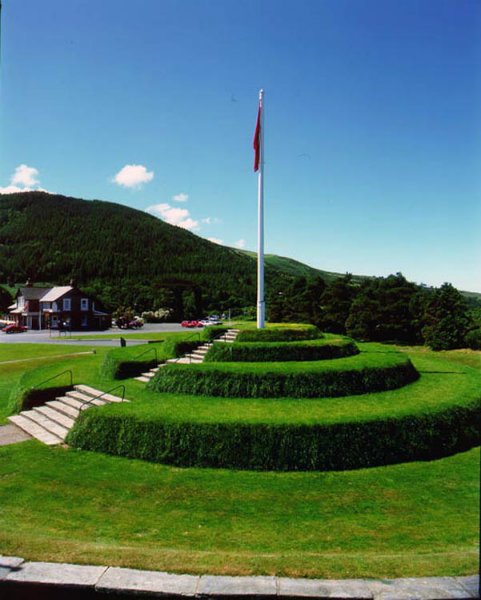
The Tynwald Hill in St John's, Isle of Man. Slieu Whallian is the mountain in the background - it is the terminal peak on the ridge descending from South Barrule, which is cited in Manx legend as home of the god Manannan.


Connections with ancient Greek mythology:

The earliest European literary citations of aquatic feminine divinities come from the legendary corpus of ancient Greek literature. These were basically inscribed versions of a vast plastic oral tradition, often with many regional variations. In Hesiod’s Theogony (ca. 700BC) he talks of Keto – daughter of the personified earth, Gaia, and her son Pontus – the sea. Keto (whose name is usually translated as ‘sea beast’) was the mother of the famous monsters who peopled the far shores of Okeanos in Greek myth – Scylla, the Graeae, Ladon (the dragon from the tree in the garden of the Hesperides) and the Gorgons among them. This makes her the primal oceanic mother of the older Greek gods. She may somehow be related to the sea monster (and constellation) known as Cetus, whom the legendary hero Perseus defeated in order to save princess Andromeda. This makes the ‘old woman of the sea’ a fundamental pagan religious archetype, linked to the chthonic and creative aspects of the serpentine and monstrous beasts of the underworld and the vast ocean.

The Sirenes or Seirenes (described in Homer’s 7thC BCE epic, the Oddyssey) were another category of challenging oceanic island-dwelling females, who perhaps give us the oldest literary mythological attestation of what we would recognise as ‘mermaids’. Rather than being half-fish, however, they (like the Gaelic goddess in her land-based form) partook of the nature of birds. Their beautiful song supposedly drew men to them, and lulled them into a trance, and and they would die of hunger among their flowery meadows . In the legend of Odysseus, they throw themselves off cliffs into the sea and die when Odysseus and his crew pass by their island, apparently unaffected by their magical song. Their name offers a tantalising linguistic link to the shoreline smith-legends of the medieval Gaelic world, as the Gaelic word tSaoire means ‘smith’, a word perhaps related to the sparks which are such a feature of metal-working: ‘Sirom’ was a Gaulish word for ‘star’ (compare Latin sidus). The Sirenoi – as inhabitors of far-off ocean shores – may well owe their literary existence to some well-travelled Greeks, to whom the Atlantic archipelago was as close as they feared get to the edge of the world and the islands of the Gorgons, the Graeae and the Hesperides, where (so the legend goes) ‘here be dragons’…
 

Solar aspects of European gods: Kronos, Janus, Neptunus, Dionysus, Mars, Apollo and Manannan

In the Bronze Age Mediterranean, a profusion of small mobile island-based cultures and vigorous sea-borne trading nations coupled with the developing ‘city’ polities fostered a diversification of European pagan philosophies. In the eastern Mediterranean, these were dominated by the Greek and Phoenician cultures.

Contact with the religiously sophisticated ancient Egyptian and Babylonian civilisations caused a continuous flow of ‘oriental’ cultural and religious ideas (including writing) into the west and the north.

These processes would inevitably lead to a fragmentation and sub-specialisation of the empirical principle of a ‘solar hypostasis god’ (and complimentary earth goddess) into multiple divinities, bearing (perhaps unsurprisingly) many different names. The persistence and re-integration of such divinities into the religious landscape of the dominant cultures of the Classical era Greeks and then the Hellenised Romans led to the demotion or promotion of these gods as part of a hierarchical ‘pantheon’, as well as a ‘familiarisation’, ‘temporalisation’ and ‘spacialisation’ of their existence in mythical traditions, based upon the apparent similarity/relation of one to the other, the age of their traditions and their location of origin. Thus the ‘Solar God’ archetype came to associated with a diverse set of gods, but most importantly: Kronos/Saturn, Poseidon/Neptunus, Dionysus/Bacchus, Mars, Apollo (worshipped by the Romans under his Greek name) and Janus (for whom there was no Greek alternative).

These identities seem to have often aggregated under a unified entity: ‘Zeus’ and ‘Jupiter’ (‘God’ and ‘Father God’) whom the mythological traditions tied up with the formal duties of ‘ruler’ of the others. He was a sky god – grandson (according to tradition) of the deified sky: Ouranus or Uranus. The mythological formality of the ‘ruler’ god, left little subtlety for expression of divine higher truths, and Zeus/Jupiter spent a mythological life doing what kings do: Lounging around, fornicating, making war, punishing miscreants and putting on spectacular displays of power and majesty. The cultic ‘mysteries’ were left to the subservient aspects of the ‘masculine’ solar divinity, who had developed many faces by the 1st millennium BC:

Kronos or Saturn:

Perhaps the most succinct appraisal of this god (borrowing from lost works of Nigidius) comes to us from the brilliant early 5thC CE pagan Greco-Roman author Macrobius Theodosius (‘Macrobius’), and his great work titled Saturnalia – one of the most significant late-classical treatises dealing with pagan mythology. It was written during a period when christianity was being actively incorporated over the shell of the receding pagan world of Rome’s great Empire, and it is possible that Macrobius himself was Christian, and wished to examine the underlying philosophical elements of paganism in order to unite the two in continuity. Of Kronos, he had this to say:

“… Κρóνος (Kronos) is the same as χρóνος (Khronos – time): for as much as the mythographers offer different versions of Saturn in their tales, the physical scientists (‘physici’ – philosophers) restore to him a certain likeness to the truth. They say that he cut off the genitals of his father, Heaven, and that when these were cast into the sea Venus was engendered, taking the name Aphrodite from the foam from which she was formed. They take this to mean that when chaos existed, time did not, since time is a fixed measurement computed from the rotation of the heavens. Hence Κρóνος, who I said was χρóνος, is thought to have been born from heaven (caelo) itself. Because the seeds for engendering all things after heaven flowed down from heaven, and because the elements that fill the world took their start from those seeds, when the world was complete in all its parts and members, the process of bringing forth seeds from heaven for the creation of the elements came to an end at a fxed moment in time, since a full complement of elements had by then been created. The capacity for engendering living things in an unbroken sequence of reproduction was transferred from water to Venus, so that all things would thenceforth come into being through the intercourse of male and female…” (Saturnalia, Book 1, 8.6-8.8, trans. Kaster, Loeb Classical Library)

The castration of the sky (Ouranos/Uranus) by it’s titanic son, Kronos, is therefore the first act producing the male:female dipole upon which the god:goddess conception hinges. The ancients equated the stars of heaven with souls and these are portrayed in the Kronian myth as the seeds spilling from the castrated genitals of the sky into the oceans. Macrobius explains that the Roman word for Kronos, Saturn, is an epithet derived from a Greek word for the penis: σαθη (sathê), from which the Dionysian ‘satyrs’ are named. Charles Darwin’s greatest offence to protestant Victorian society was, it appears, simply to have suggested that the ancient Greek pagans had the right idea about evolution and sex after all! Unseemly!

Macrobius suggests that Kronos is a solar god on account of his genesis of the cycles of time – marked to us by the turning of the days, months and years, which underpin the cycles of fertility in the world. Kronos himself was therefore possibly supposed to represent the sun, representing the first star whose heat nourishes the life on earth. Indeed, his mythological devouring and regurgitation of his divine offspring (the Olympian gods) adds further credence to the destructive and life-giving aspects of the sun. The reason Kronos was not usually considered as an immanently-presiding god, was because his birth and creation of life fixes him at the start of time, where he is doomed to stay in myth and definition: cast on the far shores of Oceanus. As an originator god, Saturn was both the ancestral deity and provider of fertility, celebrated at the annual winter Saturnalia (Rome) or Kronia (Greece) with which Christianity collocated its nativity festival at the winter solstice, when the sun was deemed to be spending most of its time in the Otherworld. The otherworld was both the retreat of dead souls, and the source of returning fertility, which Macrobius noted was engendered on the world through water, into which the sun appears to plunge nightly from western coastal regions. The solar aspect of Kronos are therefore remarkable.

Janus/Ianus:

Janus (after whom the month of January gets its name) was one of the typically Roman gods, who we generally remember as being the one with two faces, ‘looking forwards and backwards in time’. Like with the Greek hearth goddess Hestia, it was customary to invoke Janus first at religious rites of other Roman gods. Macrobius has the following to say:

” … Some claim that Janus is shown to be the sun and has his two-fold nature because both heavenly doorways are in his power, as he opens the day by rising and closes it by setting; and further that when some god’s rite is being celebrated, he is called upon first so that he might open the way to the god to whom the sacrifice is being made, as though sending suppliants’ prayers on to the gods through his own gateways. Hence, too, his likeness is commonly represented keeping the number 300 in its right hand and 65 in its left, to indicate the measure of the year, which is the sun’s chief function… ” (Saturnalia, Book 1, 9.9-9.10, trans. Kaster, Loeb Classical Library)

Macrobius is able to associate Janus with both Diana (the ‘lunar’ huntress whose brother was ‘solar’ Apollo, and who was known to the Greeks as both Artemis and Hecate, among other names) and Juno, wife of Jupiter and chief goddess (known to the Greeks as the scheming and jealous Hera, consort of Zeus). Indeed ‘Janus’ and ‘Juno’ have the appearance of a ‘matrimonial’ or ‘gender-twin’ god-pair similar to, for example Freyr and Freyja. Although Artemis/Diana is depicted as a ‘virgin’ goddess, this status is mystically equated with maximum sexual fertility potential, and Macrobius explains that Diana was considered a feminine part of the god, whose dual-nature is so apparent, arguing that ‘Diana’ is ‘Ianus’ with a super-added ‘D’. As the visible faces of the Roman and Greek gods were in reality fronts or ‘masks’ of their deeper mysteries, he may well be correct.

Janus was therefore a god of gateways and openings, as well as a somewhat daemonic entity, who – somewhat like Mercury or Hermes – carried messages from the mundane to the divine. The gates of the god’s temple were propped open in times of war, and the public reason for this was made into a story involving an early war between the Romans and the Sabines when Janus was said to have mysteriously opened Rome’s closed gate, and sent a torrent of boiling water at the Sabines from his temple, saving the city. Deeper reasons may link to the cult of the afterlife in which both Saturn and Janus played a part – the doors were probably opened to admit souls of dead warriors to the precincts of the god. The god’s statuary attributes (apart from his two faces) were the rod and the key, denoting measurement (?of lives, time, space) and the key (signifying the unlocking of thresholds). It was widely believed that worship of the god preceded the establishment of Rome itself, making Janus one of the rare and antique indigenous gods not borrowed from the Greeks. His cult is shrouded in a good deal of mystery, and his attributes seem to link him closely to Kronos/Saturn, who he may have been the original indigenous version of.

Mars/Quirinus:

Mars and/or Quirinus were – like Janus – aspects of an indigenous Sabine-Etruscan-Latin deity whose veneration appears to have preceded the influence of the Greeks. His Greek counterpart, Ares, was not equivalent – Mars was more of a chthonic deity of abundance-through-strife, whereas Ares was a colder divinity representing violence. Implicit in the idea of Mars was symbolic struggle of nature, and the renewal offered by death. He was therefore closer in conception to Ares’ brother, Apollo, who was identical in practical respects to the Greek solar god, Helios: the sun burns, and the sun renews.

The custom of opening the doors of the temple of Janus in times of war seems to link him to the cult of Mars as a war-god. In fact, Janus was also known as Janus Quirinus suggesting a syncresis. Quirinus was also cited as the deified ancestor-founder of Rome: Romulus. The priest of Quirinus (the Flamen Quirinalis) presided over a number of ancient chthonic-ancestor cult practices, most important of which were the Larentalia (23rd December – associated with the Saturnalia, no less) the late-April celebration of vegetative growth of crops called Robigalia (Robigus was evidently a jealous chthonic ancestral spirit who craved the goodness of grain, and was credited with causing soot and ergot etc) and the Consualia Aestiva in August after harvest was gathered (in honor of Consus, guardian of grain stores). ‘Larentia‘ was a consort of ‘Romulus’ in Rome’s founding myths – she was the ‘Mater Larum’ or guardian of ancestral souls: again an incarnation of the Great Goddess, just as her consort (Quirinus) is the founding male part of the equation. The god Portunus was also worshipped as a protector of storehouses and gateways, indicating he was somehow related to both Quirinus and Janus.

‘Mars Quirinus’ was the god’s epithet in times of peace, and ‘Mars Gradivas’ in times of war, at least in Republican times when he used to be part of the early ‘Capitoline Triad’ of Jupiter, Mars and Quirinus. This was why the principle Flamens (high priests) of the state religion were the Flamen Dialis, Flamen Martialis and Flamen Quirinalis. The ‘Triad’ (based on an older Celtic-style triune deity) eventually changed to Jupiter, Minerva and Juno – reflecting, perhaps, Greek religious tastes.

Poseidon/Neptune:

Poseidon is considered to have been the prime deity of the Mycenaean civilisation from which classical Greek civilisation developed. Neptune was his Roman counterpart, an Italic god of not just the sea but lakes and rivers, who was generally conflated with Greek Poseidon by the 4thC BCE. As the ‘brother’ of Zeus he ruled over the earth and the waters which flowed on and through it. Their other brother, Hades, ruled the cthonic underworld, and Zeus was master of the sky and heavens. This in itself a ‘solar’ triform god hypostasis.

As well as being associated with the waters (and their sculpting force upon the land, believed to include earthquakes) Poseidon/Neptune was the main god associated with horses, both legendary and mundane. These animals were strongly associated with solar mythology, and the sun was depicted as being conveyed in a four-horse quadriga chariot. Waves are figuratively depicted as white horses. The celtic peoples believed the horse would carry you to the otherworld, and their late Iron Age coinage uses the image of the horse and the sun more than any other symbolism.

The Roman god Portunus (mentioned above) was also related to Neptune, in that he was appealed to in order to ensure naval victory, and was a god of ports, harbours and gateways. The sea or water represented a ‘crossing over’ to ancient minds – the sun disappeared into it, and death was assured to those who stayed submerged in it. There might possibly be an older (possibly even non-italic) shared origin for Portunus and Neptune, and they share names with similar sounds. The Irish mythological character Nechtain (mentioned in Dindsenchas as husband of Bóand) might be a celtic version of Neptune (with the P<>Q/K sound transfer) – his magical well in his palace of Síd Nechtain was the mystical source of the River Boyne (Bóand). Other linguistic aspects of note that link the name to horses and water are the ‘Neck’ spirits of north European folklore, otherwise known as ‘water horses’ or ‘kelpies’.

Dionysus/Bacchus:

The epiphanic Dionysus was an important solar god who represented the aspect of sun-driven vegetative growth and in particular, the ecstasy-inducing produce of the vine. He was a central figure of a number of important mystery cults, and was known to the Romans under one of his other names – Bakkhos or Bacchus. His cult may have originated further north in Europe or the Near East, and in Thrace he was known as Sabazios, and shared aspects of Apollo. In fact, at Delphi in Greece (Hellas) he sat in for Apollo once a year when the sun god was deemed to be taking a holiday among the noble barbarians of Hyperborea, somewhere beyond the river Eridanus, site of an infamous mythological accident suffered by the chariot of Helios, whose son Phaeton took it on an ill-starred joyride. Like the sun, Dionysus was portrayed as coming from the east, leading some to posit that he had eastern origins, but this is not necessarily the case. The cult of Dionysos was not just an orgiastic celebration of fertility, but a mystical expression of the connection between death and new life. Aspects of it were borrowed into the mythology of christianity – for instance, the motif of death and rebirth comes from the mythology of Dionysus, particularly in the Orphic mysteries. Unlike the ‘hero’ gods of Greek, Roman and Thracian religion who were depicted armed with weapons, Dionysus flourished the thyrsus – a stave topped with a pine cone, deliberately suggestive of the phallus. His mythical retinue consisted of ‘wise Silenus’, the ithyphallic Satyrs and the crazed retinue of the female maenads.

Dionysus was not just a god, but a ‘prophet’ through whom the mysteries of life and death could be addressed periodically. He was somewhat unobtainable, except through throwing oneself into the wild aspects of his rites. Temples dedicated to him were a late feature of the Roman empire, and in Greece his most significant structures were his open air theatres.

Apollo:

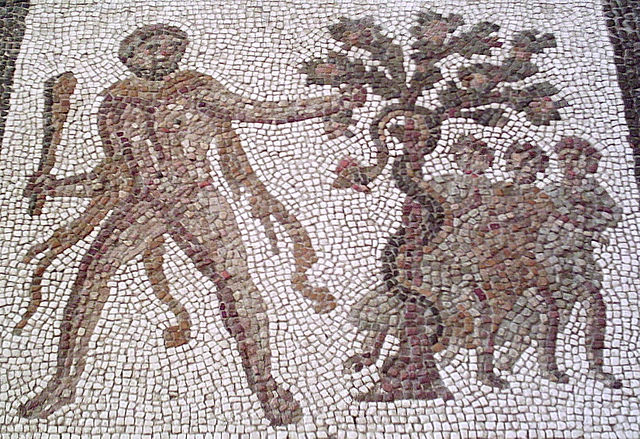
The ‘purest’ or most overt solar god was Apollo, who might be thought of as the youthful god of new dawn. Often cultically portrayed with a bow, arrows and lyre (perhaps signifying the rays of the rising sun), he was also depicted with his chthonic adversary, the serpent Python, which his mythology describes him slaying. This Apollonian myth is also echoed in the myths of semi-mortal Herakles/Hercules who meets the serpent Ladon in the garden of the Hesperides, while seeking the golden apples of immortality. The symbolism was the conquest of death, and it is easy to see the parallels with Dionysus. Along with the Thracian Sabazios, Hercules, Apollo and Dionysus appear to have resonated with the Celts much more than other gods of the Greek and Roman pantheons, and influenced their imagery and religious practices during the syncretic eras between the 3rdC BCE and 3rdC CE.  Unlike Dionysus, Apollo’s was generally seen as a more stable and providential presence. His widespread presence in syncretic-era Celtic shrines attests to the importance of the solar godhead in these cultures.

A note on Hades/Pluto:

Hiding in the shady realms of the Greco-Roman underworld of the dead, it is hard to consider Hades as a ‘solar’ deity, yet the darkness – an inverted state of the sun’s light is itself an aspect of that light. It is therefore important to consider Hades a part of the ‘solar’ god-hypostasis. Indeed, to the Greeks he was part of the triform Olympian brotherhood of Zeus-Poseidon-Hades who ruled over the earth’s aspects: Zeus had the skies and heavens, Poseidon the earth and waters, and Hades the underworld realms.

The Atlantic solar god:

In Irish mythology, the ‘sea’ god Manannán mac Lir shows all of the characteristics of a sun-god. From his ‘epiphanic’ arrivals bearing gifts and challenges in tales such as Echtra Cormaic maic Airt (‘The Deeds of Cormac, son of Art’) to his mysterious psychopompic departures to the Otherworld in the poem Immram Brain maic Febail (‘Voyage of Bran, son of Febhal’), he typifies the solar archetypes which informed the worship of Europe’s ancient solar god-hypostasis. To the Atlantic Celts, the sun’s visible disappearance far away into the great western ocean maintained an implied marine aspect to their sun-god, who being born again every morning in the east, was also god of the Otherworld. Manannán seems to incorporate multiple aspects of the Mediterranean deities under one guise – Zeus, Poseidon, Hades and Apollo in particular. It is likely that Manannán was an elegant expression of (were it not for the Goddess) monotheistic godhood behind Ireland’s apparently rapid transit from paganism to being at the cutting edge of the medieval Christian world.

Of course, ‘Manannán’ was only one name or epithet for the solar god among the Irish celts. and the character appears under other guises across Europe. In fact Manannán’s character in his Irish legends is explicitly that of a shape-shifter and master of disguise. His wizardly abilities identify him with similar god-like characters such as Merlin and Wodan/Odin, as I have discussed previously. To the warlike Iron Age celts he was best-known as ‘Belenos‘ – the god to whom warriors pledged their lives in battle, and who promised them reincarnation. Under the epithet ‘Cernunnos‘, he was depicted as a fighting fertility god, with imagery redolent of the battling, rutting beast. Called ‘Esus‘ he was cultified as the branch-cutting god – another warlike image symbolic of killing, typical to the La Téne age, and a possible link to the Norse ‘Aesir’. Called ‘Teutates’ or ‘Andraste’ he was signified as a tribal ancestor-originator. As ‘Taranis‘, he was the energising regenerator whose ‘wheel’ image was an overt symbol of the sun which promised regeneration to come. Under christianity he became represented as the warrior-angel St Michael, Christianised as ‘Malo‘, ‘Mel’ or a multitude of other saints, and demonised as any number of legendary pseudo-historic evil kings, giants, goblins and devils. Due to the weaving of Roman paganism into continental and British celtic cultures, he was deeply buried in layers of syncretism, of which christianity was the most recent incarnation. Whatever guise the god took, he kept his most complete and fascinating literary and mythological identity in Ireland’s Manannán: the Atlantic otherworld solar god.

The Celtic Mysteries?

So-called ‘mystery religions’ were at the core of paganism in ancient Europe. Many ‘gods’ were used to illustrate the fundamental ideas of commonly-shared philosophies, ideals and empirical observations of nature and existence among ancient Europeans. Their ‘mysteries’ were a method of communicating the dynamic interplay of such forces through the participation of suppliants in story, ritual, drama and ceremony, often through means of ‘initiation’, usually followed by ongoing participation. This communicated higher knowledge and understanding in an intimate personal manner which could not ordinarily be achieved simply by listening to or reading stories. As many of these mystery religions existed within the Hellenic and Roman polities of Europe, North Africa and the Near East we know at least a little about them from archaeology, art and literature which has survived from the Iron Age, Classical and Late Classical eras (8thC BCE to 5thC CE). Because the exact nature of the mysteries was secretive, we are often left guessing about exact details of ritual and ideology. However, we have even less information about the indigenous mystery religions among the Atlantic Europeans or ‘Celts’ whose independent cultural direction was largely crushed or assimilated by the Roman Republic and Empire between the 2ndC BCE and 2ndC CE.

To be an ‘initiate’ in these old European mysteries usually involved submitting oneself to its priests or guardians at a site sacred to the cult. Once there, one would subsume one’s mundane identity into that of an initiate and participate in a number of dramatic performances designed to illustrate the principles of the cult in an atmosphere of mystery, awe and (eventually) revelatory ecstasy. The initiations would be designed to impress a set of ideas onto the initiate which would have a profound influence upon their worldview, while leaving them with questions only partly answered by the immediate experience in order to encourage further participation in the cult, or encourage dialectic philosophical exegesis of the epiphany the initiate had experienced. At the height of their popularity, initiates would come from nearly every walk of life, from slaves up to Emperors and Kings. The great Augustus himself – inheritor of Julius Caesar’s posthumously-declared empire took a particular interest in the mysteries of Eleusis which, as we shall see in the light of Caesar’s commentaries on Celtic religion, is somwhat interesting.

The mysteries were generally secretive, so apart from external observations and some archaeological paraphernalia and written ephemera, we actually have a very limited idea of what they involved or exactly what they were trying to communicate. We don’t know exactly what happened at the convocations of the various mystery cults at the various stages in their existence, but we do now that they had an influential effect upon the societies they operated in.

Literary evidence for ‘Celtic Mysteries’?

After Julius Caesar had completed the task of conquering Gaul, it is apparent that he was keen to portray it an as attempt to civilise a barbarian nation in the grips of a powerful, savage and mysterious religious cult, led by a sect of hierophants called Druids who he had suppressed. He further claimed Gauls said they were descended from a cthonic deity he called ‘Dis Pater’, and that they worshipped ‘Mercury’ (the conductor of departed souls, prime divine Daimôn and god of trade) above their other gods, who he again equated ‘interpretatio romanum’ (See: De Bello Gallico, Book 6). Although he professed no indication of a mystery religion, he certainly alluded to the secretive nature of what was taught by the Druids, who committed none of their teachings to writing, in consequence of which their training was a dedicated and laborious process lasting many years. Nevertheless, he indicates that this instruction was common to the youth of Gaulish society, which may imply an aspect of their religion as a mystery cult with a high degree of social organisation:

“… The Druids do not go to war, nor pay tribute together with the rest; they have an exemption from military service and a dispensation in all matters. Induced by such great advantages, many embrace this profession of their own accord, and are sent to it by their parents and relations. They are said there to learn by heart a great number of verses; accordingly some remain in the course of training twenty years. Nor do they regard it lawful to commit these to writing, though in almost all other matters, in their public and private transactions, they use Greek characters. That practice they seem to me to have adopted for two reasons; because they neither desire their doctrines to be divulged among the mass of the people, nor those who learn, to devote themselves the less to the efforts of memory, relying on writing; since it generally occurs to most men, that, in their dependence on writing, they relax their diligence in learning thoroughly, and their employment of the memory. They wish to inculcate this as one of their leading tenets, that souls do not become extinct, but pass after death from one body to another, and they think that men by this tenet are in a great degree excited to valor, the fear of death being disregarded. They likewise discuss and impart to the youth many things respecting the stars and their motion, respecting the extent of the world and of our earth, respecting the nature of things, respecting the power and the majesty of the immortal gods…” (Book 6, Ch. 14; Trans. W. A. McDevitte and W. S. Bohn)

It is hard to determine from Caesar’s account if Druidism was indeed a ‘mystery cult’ in the Greek or Roman sense, or a highly advanced system of education and cultural indoctrination. Caesar talks of ‘the Gauls’ as a unified whole, and many of them certainly unified to fight him in the 1stC BCE. However, Celtic culture seems to have been historically riven and even driven by intertribal warfare so we must be cautious about his opinions. What does strike me as relevant to the Mediterranean mystery cults is the pre-eminence he accords to cthonic and psychopompic deities and the idea of reincarnation. This suggests Gaulish/Celtic religion shared similarities with the Greek mysteries, and could conceivably have shared common origin with them.

Greek and Roman attitudes to Barbarian culture and The Mysteries:

The first Roman Emperor, Augustus (ruled 27BCE-CE14), is notable for his eventual establishment of an internally stable Roman home province which would remain stable for almost 200 years. He took the reigns from his murdered adoptive ‘uncle’ Julius Caesar, who had expanded the Republic’s territories and cultural influence from Celtic Gaul to Egypt. Subsequent years would see consolidation of Roman influence over Germania west of the Rhine, the Balkan regions of Pannonia and Moesia, as well as Macedonia and Thrace. This, to the Romans, constituted a matter of great pride as they had conquered the greater continental portion of western Europe whose people were known to the Greeks and Romans as ‘barbarians’: a people at once considered to be backward, unsophisticated, frighteningly violent, and yet still mysterious.

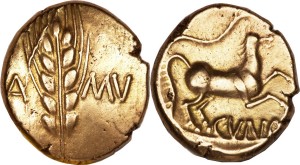
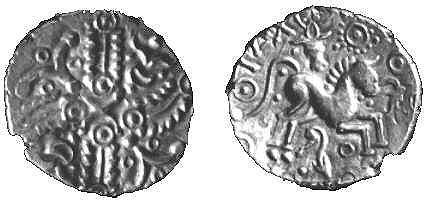
Augustus (Octavian) is notable as being the first Roman leader recorded to have had himself initiated into the Mysteries of Eleusis, whose cult centre was situated near Athens, and was considered the beating heart of Greek religious culture. He was also notable for his attempts to form alliances with British Belgic Celtic leaders, including Tasciovanus of the Catuvellauni and his son and succesor, Cunobelinos (Kymbelinus). Tasciovanus was on such good terms with the Roman Emperor that he sent his sons to be fostered and educated in Rome. Consequently the coins these British monarchs minted show some interesting Romanised features which suggest they themselves were initiates of Eleusis: specifically where they repeatedly display the icon of Demeter and the Mysteries – the ear of wheat or barley:

Coin of Cunobellinus of the Catuvellauni/Trinovantes 1stC AD

Coin of Cunobellinus of the Catuvellauni/Trinovantes 1stC AD

Stater of Tasciovanus demonstrating Eleusinian symbolism -influenced by Augustus?

Stater of Tasciovanus demonstrating Eleusinian symbolism – influenced by Augustus?

Of course, the interest of these Belgic leaders in the Greek mysteries would have been a strong statement of alliance with the worldview of Augustus and his successors. For Augustus himself, it is entirely possible that his own devotion to the Eleusinian Mysteries was designed to better understand the religious worldview of the ‘barbarians’, which the Greeks appeared to have had civilised, and who he was continuing to conquer or gain as allies for his new Empire. The implication might be that the new Emperor felt he could find common religious origin with his newly conquered peoples and allies. The Greeks certainly believed the mysteries to have originated among the barbarians, but to have been civilised in Attica.

Of course, the exposure of Celtic peoples to a cult which dealt with the mysteries of death was far greater than that experienced within the Roman culture. Caesar blamed the apparent fearlessness of Gaulish warriors on a firm belief in reincarnation, indoctrinated into them by the Druids (supposedly originating in Britain), and his successors would spend a good deal of time, money and human lives in eradicating this movement. The origins of it are to be found hundreds of years further back in time, perhaps when the great Celtic warbands formed and stamped their mark on Europe and the Near East from the start of the ‘La Téne’ period. This was the ‘Belgic’ cult which venerated the solar god Belenos as receiver of the dead and lord of the Otherworld. He was equivalent to Apollo, whose most significant shrine at Delphi was famously assaulted (and possibly thoroughly pillaged) by a Gaulish army in 279BCE.

Belenos was the god who promoted growth and decay – the sun who grows vegetation and at the same time hastens putrefaction of the dead. His domain included the lands of the daytime as well as the lands beyond the setting sun – the realm of the Celtic dead. Like the ancient Mars-Quirinus he was a god of war and chthonic fertility. Like Apollo he was a conqueror of serpentine decay and giver of oracles. Like his later development as Wodan/Odin, he was a god of battle-fury and madness – a shaper of madness into purposeful action, which is in fact the political aim of warfare. The mysteries of Belenos were never attested, but the evidence that they existed is reasonably compelling from the opinions of Caesar and the god’s replacement by Apollo in the post-Romanised era at Romanised cult-sites among the Gauls, Britons, Iberians and Germans and in the Balkans.

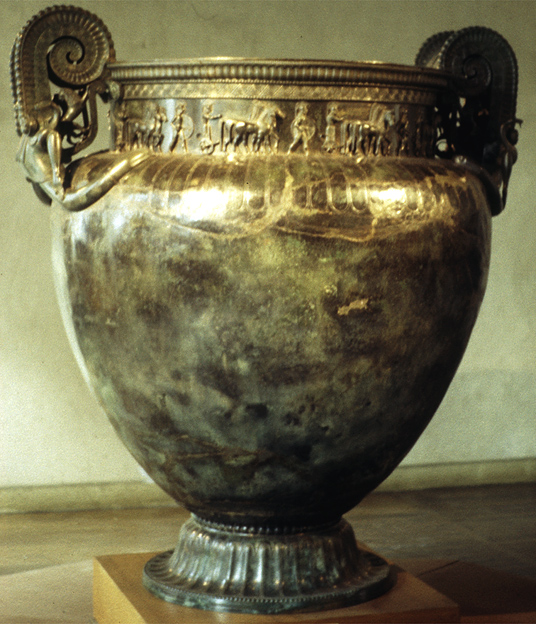
The imagery of this religion could be found inscribed on the coins and monuments of the Celts, although the latter ocurred after the advent of syncretism post-Romanisation. It is evident on the designs and decorations on personal ornaments and weaponry, and on spectacular artefacts such as the Gundestrup cauldron.

Sirona – another syncretic guise of the Celtic ‘Great Goddess’

Sirona was another mask worn by the Roman-era Celtic (ie – Atlantic) ‘Great Goddess’. We know of her name because of epigraphic evidence found associated with statues of her image, often at 2ndC CE religious sites associated with springs of water. Her name ought properly be written tSirona (as would be the  case in modern Irish) as the initial vowel sound of her name is the celtic languages’ dentalised ‘s’, pronounced something like ‘ts-‘ and because of this the name was sometimes written Đirona or Thirona.

The most significant areas of her cult stretched from the east of France, and eastward to the waters of the upper Danube in southern Germany, Austria and Hungary. She seems to have been affiliated with hot springs, and was consequently found linked to a solar male god such as Apollo-Borvo or Apollo-Grannus, and both were associated with healing. The name of Sirona is found as far west as Brittany (Amorica) but has not yet been found in Britain – the Britons named their syncretic deity at the great springs in Bath Sulis-Minerva.

Because of the ages-old association of mineral-rich hot springs with healing, Sirona’s imagery borrows from the Apollonian family of Greek gods and goddesses, in particular that of Hygeia, daughter of Apollo’s medical son Aesculapias. The syncretic-era statues of Sirona often show her twined with a snake after the manner of her Greek counterpart. Remember, the Celtic peoples of Europe were not late-comers to Greek philosophical, religious and cultural influence: they had at least 600 years of exposure to Greek religion before the era of their conquest and assimilation by the Romans. The Romans also relied upon Greek religious philosophy to underpin their own version of it, and Apollo was perhaps the most influential of Greek gods.


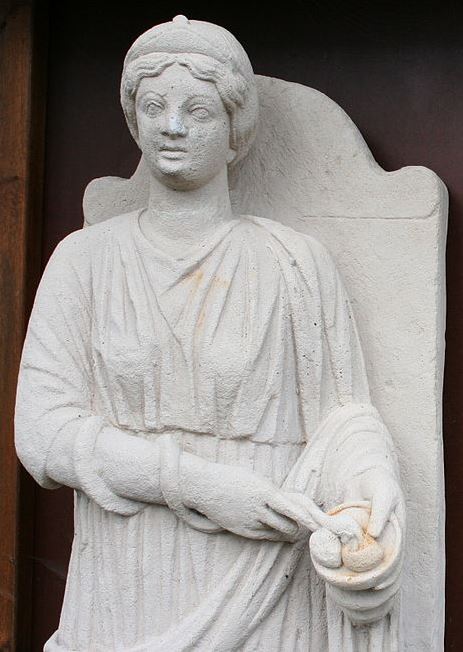
The Sirona statue from the temple discovered at Hochscheid, Moselle, Germany. Note the snake coiled on her arm, eating from a patera of three eggs.

Modern replica of the Sirona statue from the temple discovered at Hochscheid, Moselle, Germany. Note the snake coiled on her arm, eating from a patera of three eggs.

The iconography of Sirona tended to depict her as a young woman wearing a long gown (sometimes she was half-naked) with a diadem on her head. A snake was often coiled around her right arm, and she sometimes held a patera containing three eggs in her other hand. The snake in the Hochscheid example appears to be either guarding or interested in eating the eggs, and the combination of these two together is redolent of the ‘Orphic Egg’ of the ancient Thracian/Greek mysteries. Other features of her imagery indicate further references to the chthonic mystery cults, including ears of corn, associated with Demeter and the Eleusinian Mysteries.

Linguistic aspects of Sirona’s name:

It has been speculated based upon linguistic evidence that Sirona was a ‘star’ goddess. The ancient Transalpine Gaulish word for ‘star’ was ‘sirom‘, related to the Latin word ‘Sidus‘ (from which we get the word ‘Sidereal’). For the Greeks the word was ‘Aster’. The initial ‘tS’ sound of Sirona was a metathesis to ‘sT-‘. ‘Sirona’ could therefore have derived from ‘Sterona’. To derive the Greek ‘Asteria’ (the name of Hecate’s Titaness mother), the word is preceded by the Celtic ‘definite article’ (‘the’), which was pronounced ‘a’, giving ‘Asteria’ or ‘Asterona’. The diadem on the head of the Hochscheid statue is usually cited as support for this theory of naming. However, modern Gaelic orthography may have preserved some early Celtic language conventions: In particular the ‘tS’ and ‘sT’ metathesis. This makes us, by necessity, examine another word which may relate to the name of Sirona, and has been linked to Bridget – Ireland’s goddess of smithcraft: This is the Gaelic word ‘tSaoir’, which means ‘craftsman’ or ‘smith’, and which is demonstrated in Gaelic family names such as ‘MacTeer’ or ‘Teare’, and the Irish mythological name of the ‘Gobban tSaor’. These, of course, relate to Bridget ‘Goddess of Smithcraft’… So ‘Sirona’ might have nothing to do with stars and more to do with the mysteries of nature’s secret re-forging, as suggested by her snake and eggs and veneration at sacred springs.  


Epona and the cult of the Danubian Horsemen

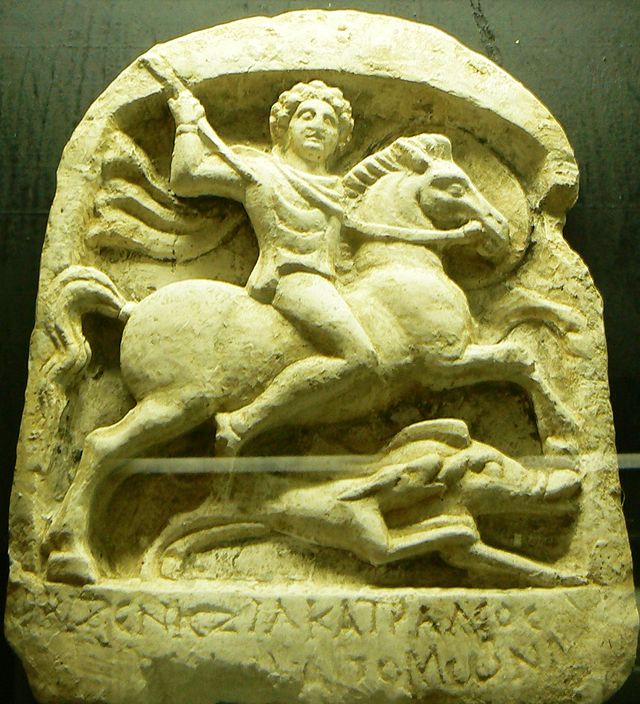
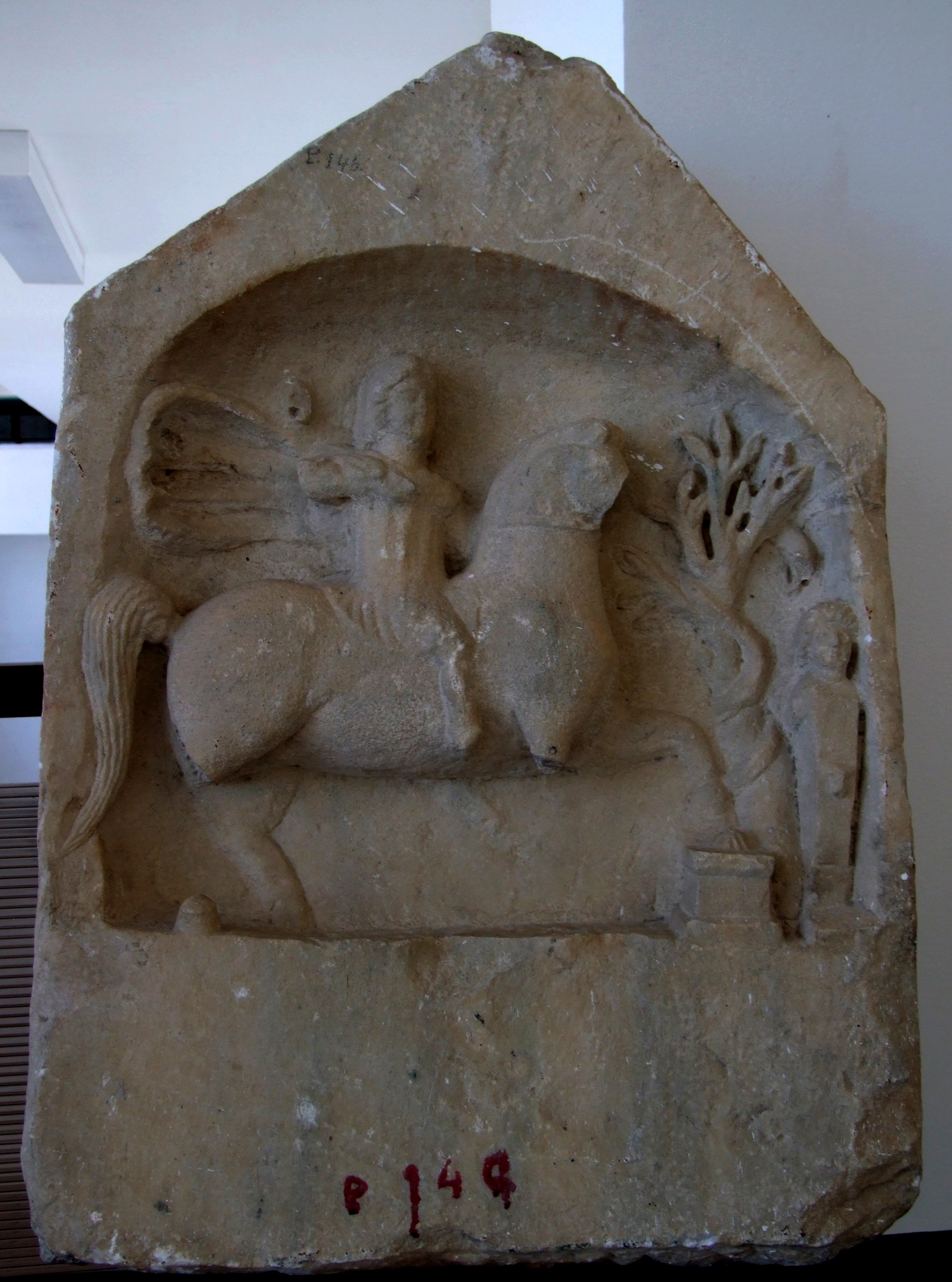
The Getae (Dacians) and other peoples of the Danube basin developed a fascinating religious cult some time between the 1st and 3rdC CE whose imagery seems to have been a syncresis of the worship of Epona and that of the ‘Thracian Hero’ or Sabazios. The reason we know about it is from a collection of small lead plaques and occasional stone stelae  depicting cult images. After Trajan conquered the Dacians at the start of the 2ndC CE, his admiration for them as a military fighting force and organised society led to a rapid assimilation of them into the Empire and offered Dacian warriors and nobility an opportunity to serve with honour in the Roman army – particularly the cavalry. Dacians, Dalmatians, Moesians, Sarmatians and their Thracian cousins and neighbours had a great equestrian tradition and became key recruits to Rome’s elite mounted fighting forces. As such their native religious cults often appear to have involved the horse – in particular the mounted ‘Thracian Hero’ and the more northerly ‘Danubian Horsemen’ imagery come to mind. There was also the ‘celtic’ goddess Epona, whose idea and imagery was popular not only in the Balkans and down the Danube, but among the ‘Germanic’ peoples who existed along and around the river Rhine in Germania, and even in Gaul and Rome itself.

The phenomenon referred to as the ‘Danubian Horsemen’ cult is perhaps of greatest interest, as appears to show elements of syncretism uniting the more western or Celtic ‘Epona’ cult and the more eastern Thracian ‘Horseman’ cult. The lead plaques which are the most common source of the Danubian imagery are typically quite small – they’d fit in the palm of your hand – and were obviously devotional objects of some kind.

An exquisite example of a plaque depicting the 'Danubian Horsemen' and their central goddess... seemingly a version of Epona.

An exquisite example of a plaque depicting the ‘Danubian Horsemen’ and their central goddess… seemingly a version of Epona.

Apart from the central goddess and her two (or four) horses – an image familiar from the Epona cult – they typically show aspects of the chthonic imagery associated with the Thracian/Phrygian deity Sabazios, and Delphic Apollo: namely the serpent or dragon. The dragon was an important and iconic aspect of Dacian symbolism, as evidenced by their legendary ‘Draco’ banners as depicted on Trajan’s column in Rome. The other essential piece of imagery associated with the cult is the sacrificial fish which appears in the image above in three forms: under the hooves of one of the horses, on the ‘altar’ surrounded by three women, and upon a sacral tripod.

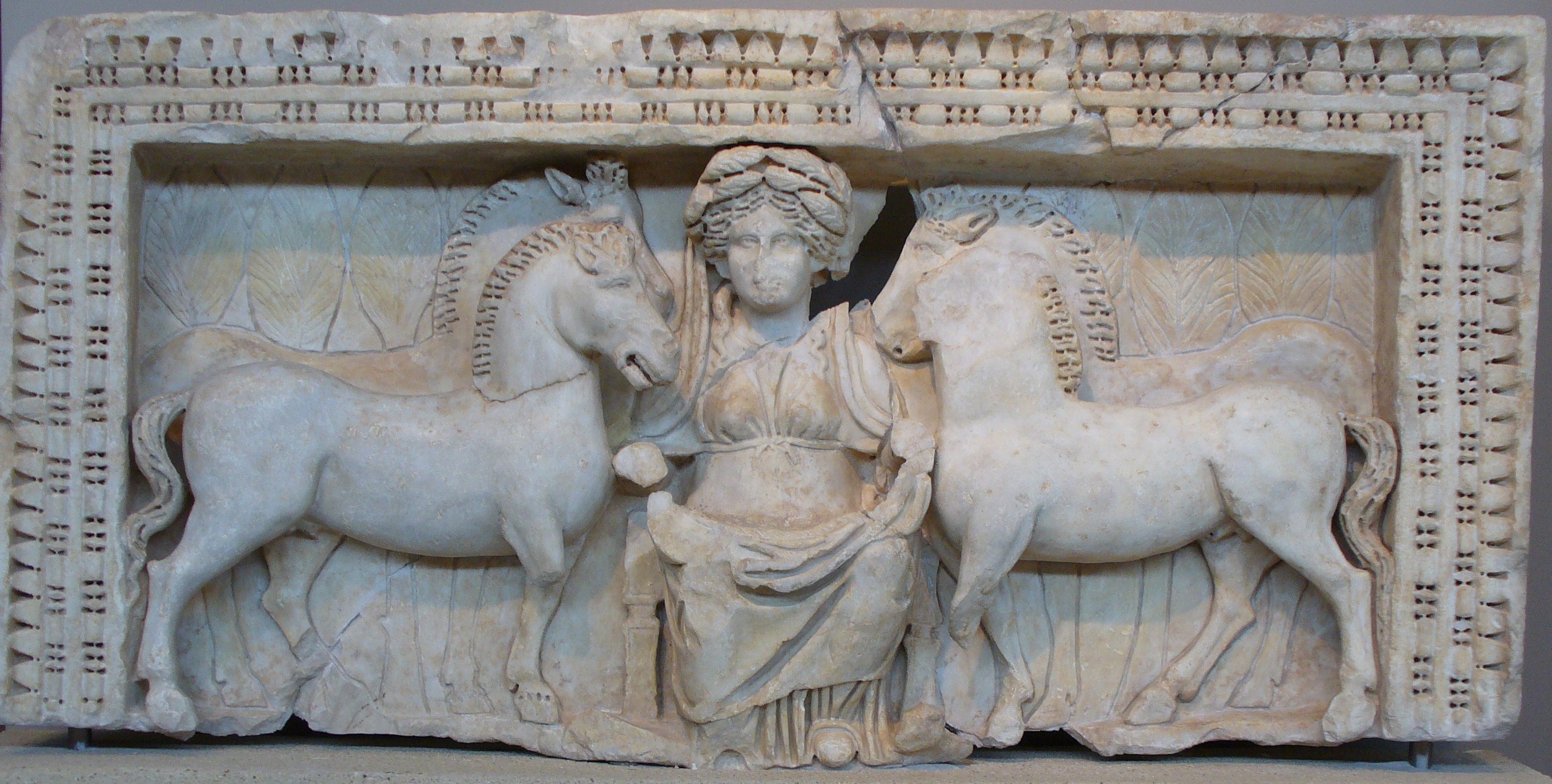
Epona with two horses - note the similarity with the Danubian cult iconography

Epona with four horses – note the similarity with the Danubian cult iconography

The usual appellation of  ‘Danubian Horsemen’ cult actually removes the real central figure from the religion, which is actually the seated goddess. Whereas the ‘Thracian Horseman’ images usually represent the solitary hero on his horse vanquishing a boar or similar beast, here there are two riders – somewhat akin to the Greek Dioskoroi, the famed equestrian brothers of ancient Greek religion, one of whom was mortal and one of whom was divine. Such imagery is an important aspect of the ‘divine hero’ cults which drove societies in this age: it was important that humans could aspire to the divine through identity (tribal or spiritual) with such ideas. Although Hercules was a popular image in this age, his non-equestrian nature would not have appealed so much to warriors of the Danubian region…

By the ‘Dioskorian’ interpretation of this imagery, the goddess seated between the two horsemen would have been seen as an intercessor between the divine and the mortal and therefore a goddess of death and war. The Dioskouroi – Kastor/Castor and Polydeukes/Pollux themselves represented the combination of immortal with mortal – a fact as important to their cult as their association with horses. By common European norms of the day, the owners and riders of horses held a superior cultural and social status – a feature which has endured down to the modern day. The goddess who controls horses was therefore the goddess with power over human society’s elites – perhaps explaining the importance of ‘Epona’. The ‘fertility’ aspect of Epona has often been commented on – perhaps on account of this cultural power-relationship of humans with horses. The imagery of serpents associated with the Sabazios and Danubian cults reflects the power of decay to promote fertility – an aspect reflecting the ideas of kingship and ambition which lead to wars, which in turn led to death and regeneration in Europe’s ancient societies.

Writing in the 1stC BCE, Diodorus of Sicily had this to say about the Celts of Atlantic Europe (which if he is borrowing from Herodotus :

 “…The Keltoi  who dwell along the ocean venerate the Dioskoroi above any of the gods, since they have a tradition handed down from ancient times that these gods appeared among them coming from the ocean…” Library of History 4. 56. 4 (trans. Oldfather)

This may explain the fish in the ‘Danubian Horsemen’ cult imagery – the Dioskouroi were also favourites among Greek and Roman fishermen and mariners, and the Danube basin was famously associated with fisheries and river trade as well as its cavalry traditions, and the river was well-stocked with fish in ancient times, including the freshwater Danube Salmon (Hucho hucho) which can grow to a huge size – as big as a man! The giant fish being trampled by the hooves of the leftmost rider on the ‘Danubian’ plaque may well be one of these. It seems a good fisherman’s alternative to the ‘Thracian Horseman’, typically portrayed trampling his porcine or leonine prey.

So why Epona and what does she signify?

The Danubian ‘Epona’ is depicted making contact with the horses of the two mounted heros, and occupies the central upper part of the plaques’ imagery associated by the usual interpretation with the spiritual or otherworld realms.  In the plaque depicted above, under the arch (which depicts the vault of the heavens) is another figure who appears to be driving a quadriga chariot yoked to four horses and with the rays of the sun coming from his head – evidently this is Helios-Apollo. Other similar plaques depict Sol and Luna (or Helios-Apollo and Artemis-Hecate-Selene, interchangeably Sabazios and Bendis) in the same position. This syncretic imagery seems to have been shared with the late classical Sabazios and Mithras cults of Thracia and Phrygia which subsequently spread throughout the Roman empire. For the solar and lunar gods to be depicted above ‘Epona’ suggests to me that the events in the drama of her mysteries in this cult happened at the gateway to the otherworld, and places this ‘Epona’ as a receiver of the dead. Not a ‘goddess of horses’… She may have been viewed as this by Romans who absorbed Epona’s cult (see: Juvenal, Satires VIII), but they also popularised the Dioscuri as gods of horses! This was evidently a mystery cult whose outward façade hid higher truths.

Some of the Danubian plaques depict Epona interacting with the horses while simultaneously cutting/sacrificing the fish on a tripod altar, sometimes a pedestal altar. Others, like the one above in particular, leave this to a trio of apparently female figures. The image in fact looks like a depiction of Shakespeare’s ‘weird sisters’ around their cauldron, although it may be a pedestal altar. This may be a depiction of a cult practice, but it might equally portray the typically Celtic ‘triple’ aspect of the divinity above, which imagery seems often to have been borrowed by the Greeks and Romans. The left-most figure is dumpy and matronly, the right-most seems lithe and young, the one in the middle is difficult to age unfortunately, but I shouldn’t be surprised if she was supposed to be a crone

Frau Holle

In the mythology of the people of Hesse in Germany, perhaps the most well-known character is that of ‘Frau Holle’. Exposed to the world at large in the writings of  Jacob and Wilhelm Grimm in the early 19th century, she has remained an important and intriguing cornerstone of German folk mythology, and is generally considered to represent a demoted form of the great European goddess of old. That she appears to share such similarities to ‘An Cailleach’ of Gaelic folklore is all the more interesting given the supposed divide between the ideas of ‘Celtic’ and ‘Germanic’ mythology.

‘Frau Holle’ was in fact only one of her many names – the version common in Hesse and Thuringia, from where many of her traditions are recorded. Throughout the northern German and Scandinavian regions she went by a number of other epithets, including ‘Holda’ and ‘Frau Gode’. In the southern regions of Germany she was often known as ‘Perchta’, ‘Berchta’ or ‘Bertha’. As befits the protean Great Goddess of old Europe, the names exhibit a degree of plasticity, having been preserved in oral traditions beyond the era when ‘she’ was officially accepted as a deity. However, in the face of modernisation and the rejection of old customs during the 19thC, we owe her existence in thought and memory today largely to Willhelm Grimm and his tale ‘Frau Holle – Gold Mary and Pitch Mary’, first recounted to him by a Hessian woman called Dortchen Wild on 29th September 1811. The following is the revised 1857 version of this tale:

A widow had two daughters, the one was beautiful and industrious, the other ugly and lazy. She greatly favored the ugly, lazy girl, because she was her own daughter. And the other one had to do all the work, and be the Cinderella of the house.

Every day the poor girl had to sit by a well, next to the highway, and spin so much that her fingers bled. Now it happened that one day the reel was completely bloody, so she dipped it in the well, to wash it off, but it dropped out of her hand and fell in. She cried, ran to her stepmother, and told her of the mishap. She scolded her so sharply, and was so merciless that she said, “Since you have let the reel fall in, you must fetch it out again.”

Then the girl went back to the well, and did not know what to do. Terrified, she jumped into the well to get the reel. She lost her senses. And when she awoke and came to herself again, she was in a beautiful meadow where the sun was shining, and there were many thousands of flowers. She walked across this meadow and came to an oven full of bread. The bread called out, “Oh, take me out. Take me out, or I’ll burn. I’ve been thoroughly baked for a long time.” So she stepped up to it, and with a baker’s peel took everything out, one loaf after the other.

After that she walked further and came to a tree laden with apples. “Shake me. Shake me. We apples are all ripe.” cried the tree. So she shook the tree until the apples fell as though it were raining apples. When none were left in the tree, she gathered them into a pile, and then continued on her way.

Finally she came to a small house. An old woman was peering out from inside. She had very large teeth, which frightened the girl, and she wanted to run away. But the old woman called out to her, “Don’t be afraid, dear child. Stay here with me, and if you do my housework in an orderly fashion, it will go well with you. Only you must take care to make my bed well and shake it diligently until the feathers fly, then it will snow in the world. I am Frau Holle.”

Because the old woman spoke so kindly to her, the girl took heart, agreed, and started in her service. The girl took care of everything to Frau Holle’s satisfaction and always shook her featherbed vigorously until the feathers flew about like snowflakes. Therefore she had a good life with her: no angry words, and boiled or roast meat every day.

Now after she had been with Frau Holle for a time, she became sad. At first she did not know what was the matter with her, but at last she determined that it was homesickness. Even though she was many thousands of times better off here than at home, still she had a yearning to return. Finally she said to the old woman, “I have such a longing for home, and even though I am very well off here, I cannot stay longer. I must go up again to my own people.”

Frau Holle said, “I am pleased that you long for your home again, and because you have served me so faithfully, I will take you back myself.” With that she took her by the hand and led her to a large gate.

The gate was opened, and while the girl was standing under it, an immense rain of gold fell, and all the gold stuck to her, so that she was completely covered with it. “This is yours because you have been so industrious,” said Frau Holle, and at the same time she gave her back the reel which had fallen into the well.

With that the gate was closed and the girl found herself above on earth, not far from her mother’s house. And as she entered the yard the rooster, sitting on the well, cried:

Cock-a-doodle-doo,
Our golden girl is here anew.

Then she went inside to her mother, and as she arrived all covered with gold, she was well received, both by her mother and her sister. The girl told all that had happened to her, and when the mother heard how she had come to the great wealth, she wanted to achieve the same fortune for the other, the ugly and lazy daughter. She made her go and sit by the well and spin. And to make her reel bloody, the lazy girl pricked her fingers and shoved her hand into a thorn bush. Then she threw the reel into the well, and jumped in herself.

Like the other girl, she too came to the beautiful meadow and walked along the same path. When she came to the oven, the bread cried again, “Oh, take me out. Take me out, or else I’ll burn. I’ve been thoroughly baked for a long time.”

But the lazy girl answered, “As if I would want to get all dirty,” and walked away.

Soon she came to the apple tree. It cried out, “Oh, shake me. Shake me. We apples are all ripe.”

But she answered, “Oh yes, one could fall on my head,” and with that she walked on.

When she came to Frau Holle’s house, she was not afraid, because she had already heard about her large teeth, and she immediately began to work for her. On the first day she forced herself, was industrious, and obeyed Frau Holle, when she said something to her, because she was thinking about all the gold that she would give her. But on the second day she already began to be lazy, on the third day even more so, and then she didn’t even want to get up in the morning. She did not make the bed for Frau Holle, the way she was supposed to, and she did not shake it until the feathers flew. Frau Holle soon became tired of this and dismissed her of her duties. This was just what the lazy girl wanted, for she thought that she would now get the rain of gold.

Frau Holle led her too to the gate. She stood beneath it, but instead of gold, a large kettle full of pitch spilled over her. “That is the reward for your services,” said Frau Holle, and closed the gate.

Then the lazy girl went home, entirely covered with pitch. As soon as the rooster on the well saw her, he cried out:

Cock-a-doodle-doo,
Our dirty girl is here anew.

And the pitch stuck fast to her, and did not come off as long as she lived.

The tale exhibits certain key traits that equate Frau Holle with the old European goddess: Firstly, Frau Holle’s world is reached through water into which a bloody spinning reel is dropped. She lives in a beautiful meadow or garden, where her work appears to be baking bread and growing apples. These are, as it happens, the ‘bounty’ depicted on Roman era statues of the goddess known as ‘Nehalennia’ from Zeeland in the Low Countries. She has the power to reward respect and hard work with worldly wealth, and to punish idleness in equal measure. Other traditions about her were subsequently collected and written down, inspired by the recently-recovered Icelandic Edda literature which opened peoples’ eyes to the Old Gods of the Scandinavians and Germans. People were eager to trace a link between folktales and childrens’ rhymes with these, and Frau Holle/Holda became a representative case of a recovered goddess, taken to task by the other Grimm, Jacob, in his seminal work Deutsche Mytholgie (1835).

Grimm found Holda/Perchta strongly associated with the female art of spinning, firmly connected with the traditions of Yuletide and 12th night, the rider of a wagon who was engaged to do work for farmers. She was ascribed a golden bucket from which rivers of water fell as she climbed hills. Holda/Perchta was also associated with the care of unbaptized souls (i.e. – children who died before baptism), and was portrayed as a leader of the ‘Wild Hunt’ usually associated with Woden himself. This led Grimm to make the equation of Holle/Perchta with Frigg and Freyja. She certainly fitted the type of the kind of chthonic fertility goddess we see depicted on Roman era shrines to the Matres/Matronae and Nehalennia, however Grimm had little to say about an identity between Nehalennia and Holda, who I suggest are the same. The name ‘Halen’ is derived by removing the celtic definite article Ne- and the terminal -ia. ‘Hollen’ was another of Holda’s names – associating her with the ‘Tree of the Dead’, the Elder (Sambucus Nigra).

Early references:

The earliest reference to Holda by name appears to come from the pen of a 13thC Cistercian monk, known only to us as Rudolph, who noted the following custom:

“In nocte nativitatis Christi ponunt regina celi quam dominam Holdam vulgus appelat, ut eas ipsa adiuvet.”

“On the night of Christ’s nativity, they set the table in honour of the queen of heaven, commonly known as Holda”

This fits with Grimm’s observations about an association with Yuletide. The Cistercians of the 13thC were hell-bent on correcting any slippages back into heathenism, and were perhaps the greatest promoters of the cult of the Virgin Mary, who was their patron saint. The term ‘queen of heaven’ was applied to her in particular. Contemporary Cistercian authors such as Jocelyn of Furness appear to have gone out of their way to re-forge many old pagan narratives into Christian ones, as can be seen in his Life of St Kentigern. They were up against the popular courtly tales of Arthur & Co, which were almost explicit in their dealing with the goddess, as well as opposing religious sects such as the Cathars of the Pays d’Oc and Italy. In spite of adding an overlay of ‘Mariology’ to medieval Europe’s mythology, they failed to expel the memory and stories of ‘Holda’. Of particular interest to this reference by Rudolph is that the Anglo-Saxon author Bede (‘De Temporum Ratione’ – 8thC) recorded that the heathens celebrated an observance called Mōdraniht on Christmas eve: This means ‘Mothers Night’.


Nehalennia – the ‘Cailleach’ of Zeeland?

In 1645, storms ravaging Domberg in the Dutch coastal province of Zeeland uncovered the remains of a significant Roman-era temple sacred to the hitherto unknown goddesss Nehalennia, whose name and image was inscribed on multiple dedicatory altar-stelae. The temple is believed to have served traders at a port who would have had commerce with Gaul and Britain, and also contained dedications to Neptune, Mercury, Hercules and Jupiter, although those to the goddess were by far the most numerous. Her image depicts her wearing a tunic, shoulder mantle and cloak. Her feet are booted and she is almost always accompanied by a small, friendly-looking dog. In common with the many German images of the Matres she is usually (but not always) seated and bears a basket, patera or cornucopia loaded with fruit, suggesting she was considered benevolent.

Nehalennia

Nehalennia


Although a local goddess, her imagery – like much of that from between the 1st and 4thC CE is obviously culturally Romanised. Her association with fruitfulness and the dog (which appears to be of the Greyhound type) would place her somewhere between the huntress-goddess <Diana-Artemis> and the fertility goddess <Ceres-Demeter>. Her boots and shoulder-mantle render her redolent of the Roman god Mercury, who (as a god of trade, and conductor of souls to the Otherworld) was depicted wearing travelling-wear. Most Roman(ised) goddesses were depicted in sandles. The overall impression is a goddess of fruitfulness, trade and travel – a fact emphasised by a number of images which depict her standing with her foot on the prow of a ship.

Geographic origins of Nehalennia:

One of the question most often asked of her is whether she was of a ‘Celtic’ or ‘Germanic’ origin. This question itself is somewhat complicated by the issue of if there is actually a cultural distinction to made between either, as this was originally a distinction made by Romans on the basis of (i) language and (ii) conquerability! Nonetheless, it is worth noting that Zeeland lies on the Rhine estuary, and that Nehalennia is known to have been depicted as a triple-goddess making her almost indistinguishable from the more common Roman-Era images of the three Matres found in Germany and France. The Matres or Matronae were typically depicted as seated and bearing pateras and cornucopias as well as sheaves of corn etc. A further shrine with altar stones dedicated to the goddess existed near Colijnsplaat in Zeeland, where a large number of altars and statues were dredged out of the Scheldt, the original Roman settlement of Ganuenta having been lost to the sea. A couple of examples of her shrines were also found as far away as Deutz – now part of Cologne, which was a major Roman civitas on the Rhine in Germania Inferior and therefore on the trade route connecting out to Zeeland and the low countries.

Analysis of the theonym:

The name of the goddess has also attracted quite a lot of speculation. As with many names transcribed and transliterated into Roman inscriptions of this era, a degree of caution is required, as the population using the name would have been largely illiterate, so the inscriptional custom of the name may not have been an accurate interpretation. Once inscribed once, it is likely to have been copied and fixed in this form. As occurs in, for example ‘Andraste’, the ‘Ne-‘ of ‘Nehalennia’ sounds like the definite article (‘the’) of the Celtic languages. In Irish and Scots Gaelic, for example, this might be ‘an’ or ‘na’. Manx is ‘yn’ and ‘ny’ respectively. This leaves us with the suffix ‘-halennia’. The terminal ‘-ia’ is typical of a Romanised goddess (‘Dia’), leaving the word ‘-halenn-‘.  My suggestion is that this is an aspirated from of ‘Callen’ – a name familiar to followers of the ubiquitous Cailleach goddess-name of the Irish and British Isles. Modern Irish ‘Caillín’ means ‘girl’ – the word is evocative of that definitive female garment of ancient times: the veil or mantlea notable feature of Nehalennia’s statuary appearance. The Irish town of Enniskillen – another trading centre on a river – is named after a pagan goddess whose name appears the same as that behind the name ‘Nehalennia’! ‘Halenn’ may therefore also be an aspirated version of the name which could also be written as ‘Cathlin’ or ‘Ceithlin’, and the seated-goddess aspect of her would fit with the Indo-European word ‘cath’, from which that sapient sitting beast, the cat, gets its name… I’d quite like to know just how old the name Colijnsplaat is for that matter – comments welcome as to if ‘Colijn’ is a version of the name of our goddess!

Aside from Celtic considerations of the name, it may also contain the name of a very German divinity, namely ‘Frau Holle’, who answers in almost every way to the description of the Gaelic ‘Cailleach’. Also known as Holda, Hulda, Huldra as well as Gode, Perchta, etc, she is a common theme in the mythology of Germany and Scandinavia. This name is also linked to that of the Norse otherworld goddess Hel, and it is worth considering that the German word for what is in English called ‘Hell’ is Hölle. The Frau Holle of folktales is generally depicted as a friendly but potentially spiteful aged matron who might be encountered deep in the woods or living on mountains. Like the Cailleach, she is deemed mythically responsible for weather phenomena such as snow, a creatrix of rivers, herder of wildlife (clouds were sometimes referred to as ‘Frau Holle’s lambs’) etc. Like the Cailleach, she possesses a magical veil or coverlet (an analogy of seasonal fertility if you think about). She – like the Cailleach – has also known to have been associated in tales with dogs. It is possible then, that ‘Nehallennia’ might equally be a version of ‘Holle’ – perhaps a ‘Frau Hallen’? As I have said before, the ‘German’ peoples were ‘Celtic’ anyway…

Nehalennia’s Dog:

The dog has an interesting symbolism in relation to both the Otherworld domain and human utility. Dogs are creatures who have followed human settlement for many an age, and have entered into a domestic relationship which is at times uneasy, as they are potentially dangerous. In fact, wolves – long portrayed as an archetype for man’s fearsome bestial adversaries are simply one end of the spectrum of ‘dog’. Wild dogs are features of the liminal boundaries of human habitations and roadways, and for this reason they have a ‘liminal’ aspect ideal for the portrayal of death and the otherworld. Death is feared, yet death is fruitful. A dog can be ‘man’s best friend’ or his incessant enemy. A dog can help the hunter, but the hunter can also be hunted by the wolf. The dog in mythology represents as essence of the dual nature of technologies – to help or to hinder – and was adopted in ancient Greek mythology as a companion of the <Artemis-Selene-Hekate> hypostasis of the mystery cults. The dog was also a symbol and companion of Apollo’s ‘son’ (or aspect), Aesculapias, god of healing. The dog therefore portrayed hunting (or harvest), death and regeneration. Its place at Nehalennia’s feet, along with baskets of apples on the stealae and statues recovered from the Netherlands seems to suggest that she represented cthonic wealth and was therefore also an otherworld goddess.


Ancient Greek Hekate or Artemis with her dog. Incidentally, Hekate was also frequently depicted as a triple-goddess!

Ancient Greek Hekate or Artemis with her dog. Incidentally, Hekate was also frequently depicted as a triple-goddess!

That the sea-voyage to Britain was particularly hazardous on account of weather and its notoriously difficult shorelines no doubt also supports the assertion that Nehalennia was a death-goddess. The pagan mindset with its belief in reincarnation had no problems equating death and fertility, as death was part of nature’s cycle of regeneration. The Greek goddess Demeter (known to the Romans as Ceres), seems to have a similar aspect, from which the tale of Hades’ abduction of her ‘daughter’ aspect Persephone/Kore derives. This tale underpinned most of the mythology of the mystery cults of ancient Europe: Eleusis, Samothrace, Orphism and the Dionysian-Sabazian mysteries. In the myths, Demeter is accompanied to the underworld by Hekate. The three-headed dog Cerberus guards the approach to Hades.

A vase image of Herakles completing his 12th task - leashing Cerberus while Hekate watches. Image (c) Theoi.com

A vase image of Herakles completing his 12th task – leashing Cerberus while Hekate watches. Image (c) Theoi.com

And finally…

On the subject of the Zeeland shoreline and its importance to trade in ancient (and modern) Europe, it is worth remembering that this is probably the vicinity mentioned by the early Byzantine historian Procopius (6thC CE) where there was a legend of the dead departing by boat for the isle of Brittia.

“They imagine that the souls of the dead are transported to that island. On the coast of the continent there dwell under Frankish sovereignty, but hitherto exempt from all taxation, fishers and farmers, whose duty it is to ferry the souls over. This duty they take in turn. Those to whom it falls on any night, go to bed at dusk; at midnight they hear a knocking at their door, and muffled voices calling. Immediately they rise, go to the shore, and there see empty boats, not their own but strange ones, they go on board and seize the oars. When the boat is under way, they perceive that she is laden choke-full, with her gunwales hardly a finger’s breadth above water. Yet they see no one, and in an hour’s time they touch land, which one of their own craft would take a day and a night to do. Arrived at Brittia, the boat speedily unloads, and becomes so light that she only dips her keel in the wave. Neither on the voyage nor at landing do they see any one, but they hear a voice loudly asking each one his name and country. Women that have crossed give their husbands’ names.”

There can be no doubt that this is a description of a mystical rather than actual voyage to the Atlantic Otherworld, and was based on accounts heard in Constantinople from Low Countries emissaries. I think it just adds a further frisson of interest to the mystery of this otherworld goddess whose shrines dotted the shorelines in ancient times, and were eventually (perhaps fittingly) taken by the sea…


The ‘Great Mother’ – Cybele, Rhea and the Cailleach

The folklore and fairy-tales of Ireland, Scotland and the Isle of Man maintain a memory of an important female character whose prominence and mystery outstrips all others of these regions. Known as the ‘Cailleach’ (pron. kal-yack), her mythology portrayed her as an ancient forebear of humanity – perhaps so old that her body, her existence, her very essence appears as one with the landscape, which she is credited with creating. On account of her age she is ascribed great knowledge of things past, but also in many traditions claims knowledge of what will come to pass in the future. She is a mistress of herds, an industrious worker, but somewhat reclusive and prone to be found in wild, out-of-the-way places – particularly mountain-tops. She clearly relies on no male partner, although in some tales she is associated with one – albeit in a somehow estranged manner. Students of ancient European paganism might well recognise in her the image of whom the Romans referred to as Magna Mater – the Great Goddess from Anatolia’s Phrygian highlands, known as Cybele who was identical with the Greek ‘Mother of the Gods’, Rhea, wife of old Kronos himself.

501px-Cybele_Getty_Villa_57_AA_19

The Phrygian ‘Great Goddess’ was said to have originated among the Thracians who, according to Herodotus,  were once known as Bryges and crossed over into Asia Minor to occupy its central uplands. She was said in some sources to be the mother of the god Sabazios, the ‘wild horseman’ who became identified with the Greek Dionysos. It is of interest that the sacred rites of both Phrygian Cybele (who remained identified in Thracia as both Cottys (‘the sitter’?) and Bendis) and the Greek Dionysos consisted of wild orgia involving ecstatic dances, processions, the use of intoxicants and sacred rhythmic music involving drums, cymbals, flutes and horns. Participants emphasised the mysteries of nature’s chthonic fertility and recurring constancy. Whereas the Dionysia were typically led by female celebrants, the rites of Cybele were led by a priesthood of castrated eunuchs who took on the roles of women. In spite of this, the similarities were striking and point towards a common older religion, whose origins lay as much within Europe as they did in Indo-European Asia.

Cybele was particularly associated with cult centres in the Anatolian highlands – her shrines (like those of the Persians, Medes and many Celtic peoples) occurring on mountains. The same was true of Rhea, whose main shrine on Crete was situated high on Mount Ida: it was here she was supposed to have hidden the infant Zeus from his cannibalistic father Kronos. The other Mount Ida – in the Phrygian Troad – was sacred to Cybele. Other oracle sites from Greece to Asia Minor were located at high altitude – Delphi being a notable and famous example, which was apparently an oracle to Gaia/Ge before it became sacred to the ‘divine son of light’, Apollo. Mount Fengari on the island of Samothrace (‘Samos of Thrace’) was another site for the oracular cult of the Great Mother of the Gods, whereas on the island of Samos off the Lydian-Ionian coast of Asia Minor, the cult of Hera (a linguistic metathesis of ‘Rhea’) held sway.

When Rome officially adopted the cult of Cybele towards the end of the Punic Wars (3rdC BCE) it was at the behest of the oracular cult of the Sibylline priestesses who appear to have functioned as part of a network of Apollonian oracles across the ancient Mediterranean world, extending from Ionia in western Asia Minor. These appear to have had more ancient links with the worship of the Great Goddess than history generally leads us to believe – perhaps on account of the identity between the ever-youthful Apollo, and Cybele’s divine consort, Attis. The phonetic similarities of the words ‘Sybil’ (originally Greek) and ‘Cybele’ point towards a more ancient link, that the Roman Republic’s dominant and Hellenophile Patrician statesmen perhaps believed they needed to remind their peoples of during the crisis. Presumably, there was a connection between the ecstatic celebratory rites of Cybele and the ecstatic visionary states of the ancient Sybils, although the secret and initiatory aspects of the cults of these gods must leave much open to speculation.

Returning to the northwest shores of Atlantic Europe, is seems quite apparent that there must be some connection between Cybele/Rhea and the craggy old crone of Gaelic myth who seems to share these important mountain-loving and oracular attributes. We have no definite archaeological evidence pointing to the worship of Cybele or Rhea in Roman Britain, and the fact that the ‘Cailleach’ mythology comes from lands which largely fell outside of Rome’s direct cultural influence suggests that the Cailleach legends possibly evolved in-situ and before the coming of Christianity.

That there was certainly Bacchic/Dionysian and Mithraic cult practised among the Roman-Britons: we can be certain of this from archaeology, but there was no evidence of Cybele, which was apparently a city-cult at Rome. Instead, the closest ‘maternal’ divinities we come across are those known as the Matres or Nutrices – typically represented as a trio of seated women variously nursing or holding bowls or cornucopias. A number of stelae or carved stone panels depicting them survive, and they were also a feature seen in other Romanised Celtic provinces of Europe – perhaps bought to Britain by auxiliary troops serving in the legions.

A Romano-Gallic 'matres' statue from Germany.

A Romano-Gallic ‘matres’ statue from Germany.

The same as depicted on a stela from the Roman fort at Housesteads, GB.

The same as depicted on a stela from the Roman fort at Housesteads, GB.

Apart from their seated pose, they have little else in common with the iconography of Cybele. However, the ‘Celtic Triplicity’ of their form must be considered to be a significant North European religious element. This idea (seemingly copied into Christianity) held that gods had three aspects, and were often depicted ‘3-in-1’. However these triune females still don’t on the surface exhibit any relation to the Cailleach myths from un-Romanised areas of Britain and Ireland.

It is possible, one might suppose, that mythology may have diffused out into these ‘peripheral’ areas and taken root, but it is much more likely that the Cailleach legends evolved in-situ rather than being introduced by continental legionaries. What seems more likely is that the Cailleach mythology formed under the same empirical pre-Roman, pre-Hellenic religious worldview that underpinned the origins of Cybele in Thracia and Phrygia – a worldview that significantly preceded the European Iron Age. This may have had its roots way back in the pre-metal ages when evidence of a widespread religious ideology begins to be demonstrated in the remains of stone and wood temple structures and burial sites with structural commonalities that occur in the archaeological record across Europe. Alternatively, the origins of metalworking in Asia Minor in the Chalcolithic period (c.4000 BC onwards) may have brought the goddess with this technological culture… The connection of Irish and Manx Cailleach legends to those of Cuillean the Smith (Weland to the northeastern Europeans) may indicate this to be true.

Sabazios and the Phrygian moon-god ‘Men’

Note the 'lunar' crest - you can it is Sabazios because he has his foot on a bull... Just like in Mithraism

Note the ‘lunar’ crest – you can it is Sabazios because he has his foot on a bull… Just like in Mithraism


Sabazios was obviously a god of some prominence in ancient Thracian religion. To the syncretising Greeks and Romans of the Hellenistic age and late antiquity he came to be seen as equivalent to Dionysus – even considered to be an aspect of Dionysus which played an important role in the ‘Orphic’ mysteries, which were among the more important and influential of the classical age.

An intriguing feature of the devotional ‘Sabazios hands’ (invariably in Europe)from the later Roman Empire is that the god is sometimes depicted wearing ‘lunar horns’ of the type often seen with Roman and Greek statuary of Diana and Artemis. It occurred to me that Sabazios might somehow be related to another masculine lunar god of late antique Asia Minor, who was known as ‘Men‘. Men’s cult was venerated not just in ancient Phrygia (Roman Anatolia) but his influence  extended (through the Greek connection) into the city states of northern Hellas.

   Men was (like many Lunar deities) depicted with what appear to be lunar ‘horns’ emerging from his shoulders, and often with his foot upon a ram’s or bull’s head, echoing the imagery of both Sabazios, the ‘Thracian Hero’ and Mithraism:

The god 'Men' - a Lunar Sabazios? Note the Bacchic 'Thyrsus' wand topped with a pine-cone: also a symbol of Phrygian god Attis.

The god ‘Men’ – a Lunar Sabazios? Note the Bacchic ‘Thyrsus’ wand and the pine-cone held in the god’s hand: this was also a symbol of the Phrygian god Attis, consort of the Great Goddess, Cybele.

Men was apparently a god of the months – the lunar cycles, associated in folklore with human fertility and the menstrual cycle. He was depicted as in the traditions of Apollo, the ‘Thracian Heros‘ and Attis as youthful and androgynous, but his appearance in the Roman-era stelae are certainly less military than the Thracian horseman image. Given the depiction of him with very similar iconography as Sabazios, it would appear that he was possibly one and the same god – perhaps a ‘young Sabazios’, or a ‘son of Sabazios’? Indeed, as Sabazios and Zeus/Jupiter became conflated in the Roman sphere, it is very likely that Men represented a dependent ‘aspect’ of the god. Suggestions that he was somehow Persian or Mesopotamian in origin need to be reconciled with these similarities with the Thracian Sabazios-Dionysus hypostasis…

Other mythological characters who share similarities are Endymion (the lover of the Moon – Selene, also known by the similar name ‘Mene’), and Phrygian Attis, consort of the Great Goddess, Cybele. Endymion’s name certainly appears to incorporate a version of the name of Men with this suffix portion: -mion. His mythology may have been borrowed into Greek stories from that of Men in Asia Minor. Like Attis, Endymion’s active role as the lover of an important goddess (Selene) is placed in a suspended state: Whereas Attis castrates himself in a (Dionysiac) frenzy, Endymion is famous for being in an eternal sleep so that the moon might preserve and admire his beauty, and make love to him. Attis was likewise depicted as fresh-faced. Although Endymion was never (that I know) associated with the pine tree and pine cones, Attis – like Sabazios and Men – certainly was. The evergreen and erect pine which cloaks mediterranean mountain sides had an important phallic meaning to these seemingly related religious mystery cults.

 A Moon God for a Moon Goddess?

Having mentioned the Hellenic goddess-titaness Selene – personification of the moon – it is worth examining other aspects of her from the pre-Christian era regional mythology of the eastern Mediterranean. Selene (also called Mene by e.g. Nonnos in his ‘Dionysiaca’) was also identified with Hecate, as well as the virgin huntress-goddess Artemis/Diana (Sabazios is usually portrayed as a hunter rather than a warrior!). Due to the proliferation of mythological traditions and the tussles for cultural hegemony that population movements tend to engender it is likely that all of these were variants of the same ‘star-myths’, used as explanatory vehicles for the mysteries of nature’s great (and largely occult) mechanisms. The ambivalent male sexuality of the god Attis and the priesthood of the Galli who celebrated Cybele seem to find a kinship with the Phrygian god Men, whose depiction above typifies the Eunuchoid appearance more usually seen in depictions of Attis. However, the moon-shouldered god is shown with the military attributes of Sabazios, at least in terms of the ‘vanquished beast’ and the thyrsus-spear. Another thing worth considering is if the depiction really shows ‘lunar horns’ at all – it could possibly represent the god carrying a Thracian pelta shield or a pair of curved Thracian sica swords on his back. The horns might even be phalli – a well-known attribute of Dionysian cult.

Depiction of Thracian warrior with crescentic 'Pelta' shield.

Depiction of Thracian warrior with crescentic ‘Pelta’ shield.

It is likely that ‘Men’ was a more androgynous aspect the Great Goddess, who was herself often seen as cognate with Rhea, Artemis, Selene and Diana – even Hekate. Sabazios was also in some myths portrayed as both the son and lover of the Great Goddess, otherwise known as Cybele.

Mithraic stela from the Louvre - note the imagery of the moon and the wands wielded by the celebrants, as well as the 'Phrygian' clothing.

Mithraic stela from the Louvre – note the imagery of the moon and the wands wielded by the celebrants, as well as the ‘Phrygian’ clothing.

Medean and Persian Mythology: Vohu Manah

The Zoroastrian mythology (‘Avesta’) states that Vohu Manah (‘Good Mind’) was the spirit who introduced the prophet to the supreme being or Logos, known as Ahura Mazda (‘Light of Wisdom’). The Indo-European word for ‘mind’ is echoed in the name of ‘Men’: consider the Latin word mens. Vohu Manah was associated with the care of flocks of cattle – a similar attribute seen in the mythology of Greek Apollo (and Hermes) – Men’s cult image illustrated above shares aspects of this interpretation.

A form of Zoroastrianism was the religion of the non-Greek peoples of Asia Minor during the Assyrian and Persian Empires during the first half of the 1st millennium BCE. Like the Dionysian/Sabazian and Eleusinian cults of the ancient Hellenes (not to mention the practices of the Delphic Oracle), this religion also involved the imbibing of an intoxicating sacrament, known in this case as ‘Haoma‘: A curious link to the moon, the mind and ecstatic mystery religions…

Baal-hamon:

Baal-hamon was the principle god of the Phoenician peoples of Carthage. Apart from the connection between the words ‘Men’ and ‘Hamon’ (and, of course, Manah) another feature linking him with Men was his epithet: Ba’al Qarnaim – ‘Lord of Two Horns’. This seems very close (in turn) to the similarly-named horned Egyptian god, Amun/Ammon. Baal-hamon was related to the Ram, the symbol of this Egyptian deity. The Romans and Greeks equated Ba’al Hamon with Saturn/Kronos.


Sabazios – the ‘other’ Thracian god.

The Thracian/Phrygian god Sabazios is well-attested in ancient Europe, but little – if any – mythology is known about him, not in the least because Thrace (modern Bulgaria) was not a literate culture before its Hellenisation, Romanisation and later Christianisation. Another fact might be because his worship (where it is attested outside of Thrace) appears to have been part of a ‘mystery cult’ where mythology was imparted as secrets to initiates and was not – in common with the greater part of the more ancient Greek, Italic, Celtic and Pontic/Phrygian traditions – part of a common orally-transmitted mythical corpus of knowledge.

We know that the cult of Sabazios was popular in late archaic and Classical Greece, and that it was later to spread throughout the Roman empire. We also know that it showed a good deal of syncretism with the cult of Dionysus/Bacchus, and that two were sometimes considered to be the same god, albeit that the connection of Dionysus/Bacchus to wine was more explicit among the Greeks and Romans while the cult of Sabazios appears to have emphasized the fertility aspects common to the two.

Dionysus/Bacchus and Sabazios were both gods whose cultic worship and festivals typically surrounded the event of the ‘arrival’ (epiphany) of the god and his band of animalistic male and wild human female attendants among the people, associated with ritual cries announcing the god’s coming. In fact, in the Attic cult of Dionysus (practiced at Athens and Delphi) the ‘Bacchic cries’ to the god and his retinue, according to the great 4thC BCE Athenian statesman-author Demosthenes (in his book ‘The Crown’), appear to refer to a ‘foreign’ Sabazios as well as the Phrygian consort-god Attis, suggesting that the cult was considered as something ‘other’ or ‘alien’, at least to men like Demosthenes, who was seeking to denigrate an opponent when he said:

“… On attaining manhood you abetted your mother in her initiations and the other rituals, and read aloud from the cultic writings …You rubbed the fat-cheeked snakes and swung them above your head, crying Euoi saboi and hues attes, attes hues… ”

The cry was called ‘Sabasmos‘ according to the 10thC CE Byzantine encylopedia known as the Suda, which stated (perhaps echoing earlier observations by Clement of Alexandria) that the cults of Sabazios, Bacchus and Dionysus were effectively the same.

Demosthenes’ ancient account refers to a cult of women that involved the carrying of snakes as part of its rituals. Another important part of the ritual or cult was intoxication: the placing of a krater of wine was a part of the ritual of arrival demonstrated on ancient Greek illustrations. The ritual ecstasy of the female band of celebrant-priestesses known as the Maenads who accompanied the god may have been due to factors other than alcohol-intoxication, however. Foremost among these were the group hysteria of the event, heightened by dance and chanting, but perhaps another important factor in the excitement was blood – from the ritual slaughter of an animal or animals, said in some accounts to have been ritually (and primally) rended physically apart by the Maenads in sacrifice to the god. All of these events typically preceded the showpiece ‘arrival’ of the god’s image and his accompanying band of Maenads and disguised male performers dressed as animals, satyrs etc. This would have been followed by feasting and jollity, after which the Dionysia were typified (in the Greek world, at least) by the production of great plays and dramas – a hallmark of Attic culture, from which we have the plays of Aristophanes and other greats of classical drama.

The 'Vix Krater' - an equisite Greek bronze krater buried in the grave of a Gaulish noblewoman c.500BCE. Elaborate kraters were a central symbol of Dionysiac and Sabazian cult worship.

The ‘Vix Krater’ – an exquisite Greek bronze krater buried in the grave of a Gaulish noblewoman c.500BCE. Elaborate kraters were a central symbol of Dionysiac and Sabazian cult worship.

The Thracian and Phrygian (ie – Anatolian) Sabazios emerged from a slightly different religious tradition, but appears to a have merged successfully with the Greek and Roman traditions of Dionysus-Bacchus. In fact, the Dionysiac religion in the Greek cultural world has (rightly or wrongly) generally been considered somewhat ‘different’ to the Olympian traditions, being considered much more of a ‘barbaric’ form of ‘mystery cult’ and generally felt to be somewhat alien and exotic – under the influence of more eastern traditions. This may be a typically ‘Hellenic’ view, however: Greeks of this era (5thC BCE > early Common Era) had a tendency to deride their own ‘primitive’ past and consign such aspects of their indigenous cultural history to the ‘barbaric’ world of Thrace, Phrygia and (of course) the ‘Celts’. The explosion of Hellenic influence and the rise of the Roman Republic on its coat-tails exposed the Greco-Roman world to a plethora of exotic influences, the most favourable of which they found in the Near East. For this reason, these cultures began to ‘orientalise’ and absorb the religious cultures of Thrace and Phrygia, which after the 3rdC BCE were a melting pot also incorporating Celtic and Eastern beliefs. The official acceptance of the Phrygian cults of Attis and the Magna Mater, Cybele, were a prime example of this process, but the older mystery-cults of Orphism and Sabazios-Dionysus had a longer history of influence, which along with the chthonic mystery cult at Eleusis and on the island of Samothrace were testament to the diverse interactions occurring in European paganism. The exoticism and potential for disorder of the Bacchic rites in Rome were accompanied during the late Roman Republic by no small degree of official anxiety, perhaps due to the fact that the state exercised little control over such matters. The adoption of Phrygian Cybele into the official cult of Rome marked the end of the second Punic War, and was perhaps a useful buffer against the more chaotic but no less exotic Bacchanalia. It was following this that the Romans increasingly appear to have shown an interest in the cult of Sabazios (Rome had a temple of ‘Jupiter Sabazios’), which perhaps offered a more conservative aspect of the Dionysiac-Bacchic cult. Rome’s ambitions by the 3rdC BCE lay in the East and her strategy of expansion was achieved as much through cultural incorporation and franchise as by military might.

Thracian/Phrygian Sabazios:

Having mentioned the apparent syncretism of Sabazios with Dionysus during the Hellenic era, it is worth noting the indigenous Thracian and Phrygian aspects of the cult to draw a distinction. As this was (on the whole) a mystery cult and was not written about by indigenous authors, we only have limited epigraphic and artistic (sculptural) evidence to call upon, and most of this during the period of Roman influence following the 2nC BCE. The most common Phrygian and Thracian imagery associated with Sabazios are stone stelae depicting him as a horseman – not a feature seen in Dionysian imagery, except where we see the god’s accomplice Silenus mounted on an Ass. The ‘Thracian Horseman’ is depicted as active and young, and usually shown wearing a billowing cloak and armed with a lance. His image is usually accompanied by some adversarial animals: most often a snake twined around a tree, and sometimes by lions and other wild beasts. Apart from his mount and his weapon, the imagery correlates strongly with that often seen with the archetypal Greek mythical Hero, Hercules. The serpent-slaying hero-role is also seen with Greek Apollo, and it appears that the syncretism between these characters as well as the Centaur Chiron and the god Hermes was a strong feature stamped upon Thracian and Phrygian religion, as well as that of the Celts whose ideas had mingled with theirs during the ‘La Téne’ cultural period. Indeed, when the Romans invaded the Balkans and pushed for Anatolia they were met by combined Thracian, Dacian and ‘Celtic’ forces, whose cavalry was a remarkable and obviously elite part of their fighting style and source of much success until Rome finally defeated and incorporated them into their own armies. The regional prowess of cavalry warfare was at its greatest with the Macedonian Hero-King Alexander, whose father bore the name ‘Phillip’ (‘lover of horses’) and whose cavalry swept aside all opposition in his great surge of conquest during the 4th and 3rdC’s BCE. This was perhaps the spiritual origin of Europe’s medieval mounted warrior elites, and the image of the mounted Thracian Sabazios was used for that of Christianity’s interloper ‘St. George’:

A typical 'Thracian Horseman' image of Sabazios

A typical ‘Thracian Horseman’ image of Sabazios, here hunting a boar – yet another ‘fanged’ chthonic creature representing plenty and growth. The board was a particularly ‘celtic’ image, whereas the serpent was more ‘Greek’ or ‘Eastern’…

The Thracian Horseman image obviously relates to a hero-god, and the name ‘Thracian Heros’ is also applied to the icon-image, one of which is inscribed to ‘Heros Karabazmos’, which name incorporates the ‘-baz-‘ of ‘Sabazios’. To the Thracians, Phrygians and Celts (who used the horse imagery extensively in their otherworldly coins after the 4thC BCE) the ‘Heros’ character represented fertility through the closeness of death: similar to the ancient Etruscan/Roman Mars as well as the all-popular Hercules. In fact, it is worth comparing the iconography of Hercules with that of the Thracian Heros:

Armed Hercules confronts the Serpent Ladon in the garden of the Hesperides (Roman Hispania)

Armed Hercules confronts the Serpent Ladon in the garden of the Hesperides (Roman Hispania)

And now, here’s the Thracian ‘Heros’ to compare. Note the ‘phallic Herma’ to the right of the tree – these were a feature of Dionysiac and Sabazian worship:

Thracian_Horseman_Histria_Museum

The mythology regarding the ‘horseman’ must have incorporated much of that common to the Herculaean and Apollonian myths as well as the Dionysian aspects of Sabazios. not to mention the martial aspects of gods such as Mars. The icon of the galloping helpful horseman ‘coming from’ the underworld where it has been victorious over the serpents and demons incorporates all of these in a more simplified and much more fundamental and portable manner.

Chiron the hunter - teacher of Greek heros. Are him and Sabazios one and the same? Perhaps the Minotaur too?

Chiron the hunter – teacher of Greek heros. Are him and Sabazios one and the same? Perhaps the Minotaur too?

The coins of Celtic tribes in the Balkans such as the Scordisci and Bastarnae demonstrate a syncretic incorporation of such imagery in their appropriations and modification of Greek designs, and this propagated throughout the Celtic world as far as Britain by the 1stC CE. Often the warlike rider is female in the Celtic numismatic images – particularly so during times of conflict with Rome. It finally seems to have been mollified into the form of the benign ‘Epona’ by the early common era when Rome had broken the fanatical and wizardly backbone of wild Celtic culture:

Cuddly mother Epona - the original Celtic form would have bought your head on a plate, not food!

Cuddly mother Epona – the original Celtic form would have bought your head on a plate, not food!

Sabazios in Rome:

As previously mentioned, the cult of the Thracian-Phrygian god Sabazios met with some degree of popularity in the Roman Empire. Apart from a few religious stelae, the most prominent artefacts from the cult are the bronze-alloy votive ‘hands’ discovered in places such as Herculaneum and even as far north as modern Belgium. These hands are know as the ‘Hand of Sabazios’, and generally display a gesture which appears to have been adopted by the early Christian church, and is still used by priests in blessings to this day. Here are some examples:

Hand of Sabazios (British Museum)

Hand of Sabazios (British Museum)

The hands take a variety of forms, with some common elements:

1. Most depict the fingers in the gesture shown in the image.

2. All have a pine-cone (or possibly even a hop-flower) either balanced upon the thumb or grasped between thumb and forefinger. In a few cases, these appears to be more explicitly depicted as the Orphic Egg, in one case holding the image of the Thracian Heros with his horse, lance and serpent adversary within. Although Thrace was a beer-drinking culture, hops were not known to have been used as a beer additive until after the medieval period.

3. All have a serpent or basilisk (serpent with a cock’s comb: lit. ‘king of serpents’) representing the chthonic ideal. Other ‘serpentae’ or ‘herpetae’ such as frogs, turtles and lizards frequently accompany this.

4. Most depict a mother lying with her child on the wrist part of the design. This may be an allusion to Ariadne, wife of Dionysus in the Cretan-Greek version of the myth. The birth and rebirth of ‘Dionysus’ were central parts of the Orphic mystery-legend, and Orphism was ascribec by the Greeks to Thrace.

5. Most depict the Dionysian Krater and bowls or cups.

6. Most depict a ram’s head, sometimes that of a bull, upon which the god places his foot in depictions. This is redolent of the sacrifice of animals at the Dionysia.

7. Many depict a miniature figure of Sabazios himself as a bearded man sat against the extended index and middle finger of the hand. He is sometimes crowned with lunar ‘horns’.

Other iconcography commonly associated with these hands include: The Caduceus or wand of the god Hermes/Mercury (think of the serpent on the tree in the Thracian Heros images), a set of scales, a perched eagle, vines and sometimes ritual objects such as a sacrificial knife and a lituus (ceremonial wand). One example of the hand has a bracelet to which human and animal penises are attached by chains! These hands were believed to have been mounted upon poles at ceremonies

Apart from the hands, the cult of Jupiter-Sabazios is also represented on a few ancient stelae recovered from the Roman world. Here is one particularly fine example from Roman Illyria (modern Albania) depicting what appears to be the Phrygian gods Cybele and Attis – maybe even Selene and Endymion or Artemis and Apollo – (who actually hold a pole with a hand on it!), as well as ploutic father Sabazios himself, as well as the usual icons found on the hands and ‘Thracian Heros’ stelae:

sabazios

The overwhelming fertility aspects of the cult are well-demonstrated, and the warlike aspects of the Thracian god have been removed. Even Mercury appears at the base of the serpent-tree to grant his blessing! Observant readers might begin to see how Julius Caesar’s comments about ‘Dis Pater’ being worshipped by the Gauls point to a more ancient and once-widespread cult which emerged from Bronze Age Europe and had influence from far Britain and Ireland right through to the Near East. Just a peak over the common ‘barbarian’ yet mythologically sophisticated event-horizon of our ancient ancestors….