Solar origins of the ‘Twelve Days of Christmas’ and Christianity.

Roman era iconographic depiction of Apollo in mosaic, Tunisia. The similarity to later depictions of Jesus in both the Eastern and Western traditions is striking.

Roman era iconographic depiction of Apollo in mosaic, Tunisia. The similarity to later depictions of Jesus in both the Eastern and Western traditions is striking.

The number twelve has a strange significance in the reckoning of time:

There are twelve solar months, corresponding roughly to twelve zodiacal houses along the sun’s ecliptic path. In the Christian myth, Christ is followed by 12 apostles.

There are traditionally twelve ‘hours’ of daylight, as reckoned by sun-dials, and hence we derive our twenty four hours of daylight and night which comprise our unit of one solar ‘day’. This is known as ‘apparent solar time’, as compared to the clock-time we tend to keep in modern times, known as ‘mean solar time’.

There is a difference of roughly twelve days between the old ‘Julian’ and newer ‘Gregorian’ calendric systems in use in Europe and Asia Minor. These changes were instituted to prevent the celebration of Easter (calculated based on the Jewish Lunar calendar) from creeping further away from the Spring Equinox into summer.

There are twelve days marking the traditional European and Eastern ‘Christmas’ or ‘Yule’ festive midwinter period… These were sometimes each looked upon as representing a separate month of the solar year in many pre-modern European cultures. Yuletide began at the winter solstice (approx. 22nd December) and finished on the 3rd January, whereas Christmastide was from 25th December to 6th January (Epiphany).

Origins of Christmas Day:

The establishment of the date of the Nativity festival on the 25th December in Christianity was not in fact formally agreed upon for hundreds of years after the era of Jesus’ supposed life and death. In the late pagan Roman Empire, the 25th day of December was celebrated as Natalis Invicti – the rebirth of the deified ‘Unconquerable Sun’ – Sol Invictus. Although introduced as a late Imperial Cult under Aurelian in 274CE (250 years or so after the death of Jesus) the cult of Sol Invictus was probably in response to the profusion of mystery cults throughout the Roman Empire which employed the iconography of a youthful solar male god, seemingly derived from the older depictions of older gods such as Apollo, Adonis and Attis. Adonis, etymologically at least, appears to have a Semitic origin (compare Adonai – ‘Lord’). These had their origins in the principles of Solar godhood attached to the great ‘static’ or ‘official’ mystery cults of the 1st millennium BCE: Those of Delian Apollo, Apollo at DelphiEleusis, Samothrace and the mysteries of Cybele and Attis in Phrygia, among others. Such cults generally relied upon visitation of geographical loci – fixed cult sites – and the participation in initiatory ritual for the purposes of either receiving oracles, healing or higher knowledge. They themselves may have developed from popular extensions of the originally more closely-guarded inner mystery ritual traditions surrounding the elite classes of kings and religious hierophants of the earlier ‘palatial’ cultures (Minoan and Mycenaean), themselves copying the ancient Mesopotamian and Egyptian cultures, which are the oldest for which we have evidence, and were in continuity until at least the start of the 1st millennium CE.

Wars with Carthage and the great movements of the ‘barbarian’ Celts during Rome’s Late Republican Era (c.3rdC BCE) led to the importation of ‘foreign’ mystery religions such as that of Cybele and her ecstatic priests into Rome during the late Punic wars. Another popular ecstatic religious mystery cult was that of the Bacchanalia (Dionysia) from Greece. The Celtic fanaticism towards the solar god Apollo (whom they knew as Belenos) caused them to actually invade Greece and sack Delphi in 179BCE! These events, along with Rome’s increasing expansion and cultural interaction led to the surge in popularity of mystery religions in general during the late Republican era, such that by the 1stC CE  Roman Emperors were themselves visiting Eleusis and Samothrace to become initiates. These cults purported to explain the secrets of the sun, the moon, the planets and stars and the deepest mysteries of nature, death and regeneration. Perhaps unsurprisingly, the life-giving Sun was a key part of this, and became part of a new ‘elementalism’ and drive towards simplification and ‘portability’ of mythology.

As the Roman and Greek cultural polities expanded and prospered, initiatory mystery religions became less an indulgence of the elites, and also less attached to fixed geographical locations, developing into a plethora of mobile ideological ‘franchises’ enjoyed by more ordinary persons. These almost certainly plagiarised the secrets and mythological frameworks of the older ‘official’ mysteries whose (often wealthy) initiates and suppliants were supposed to keep their secrets on pain of death or spiritual torment, and such mysteries were gradually bought out into the open and discussed and theorised over. This process was aided by the diffusion of literacy and the spread of and development of the ideas of the ‘Philosophers ‘of classical and Hellenistic era ‘Magna Graecia’ who sought to analyse the constancies and truths behind ancient orally-transmitted mythology.

A good example of such reductionist processes at their apotheosis are the ‘Hermetic’ and ‘Gnostic’ cults in Hellenized Asia Minor, Middle East and North Africa, of which Christianity was to emerge as an early branch within the fractious and millenarianist Hasmonean-era Jewish world with its significant diaspora. These employed Pythagorean, Platonic and Epicurean reductionist theories and a discourse involving the principles of the soul as a form of undying light in their prophetic religious narratives, barely hiding such ideas behind the character narratives of older mythologies.

Such explicit intellectualism was not to everyone’s taste, of course, and other more semiotic forms of mystery cults based upon ritual, myth and symbolism served the needs of those with more traditional (less orientalised) tastes. Orphism was perhaps the oldest and best-established of these traditions – possibly the ‘granddaddy’ of them all, with its origins in the first half of the 1st millennium BCE at least. Its initiates sought to ‘purify’ themselves in order to achieve a better afterlife. Mithraism was certainly the most popular of the newer cults, spreading from Asia Minor into the most northern and western extents of the Roman Empire between the 1st and 3rd centuries of the Common Era. Similar popular mystery religions centred around the Thracian god Sabazios (a regional relative of Dionysus) and European syncretic cults involving the Celtic gods, such as that of the ‘Danubian Horsemen’ involving Epona in Eastern and northern Europe, and a profusion of others more poorly understood due to paucity of material evidence. These all had the common trait of emphasising the position of the characters of ‘Sol’ and ‘Luna’ in their iconography – almost as a ‘badge’ of their ‘mystery’ status.

A Roman relief depicting the banquet of Sol, Luna and Mithras.

A Roman relief depicting the banquet of Sol, Luna and Mithras.

An exquisite example of a plaque depicting the 'Danubian Horsemen' and their central goddess... seemingly a version of Epona.

A plaque depicting the ‘Danubian Horsemen’ and their central goddess (Epona): Sol Invictus rides his quadriga at the top of the image, which deals with the imagery of the cult’s mysteries.

Sol and Luna stand above Sabazios in this cultic Roman plaque
Sol and Luna stand above Sabazios in this cultic Roman plaque

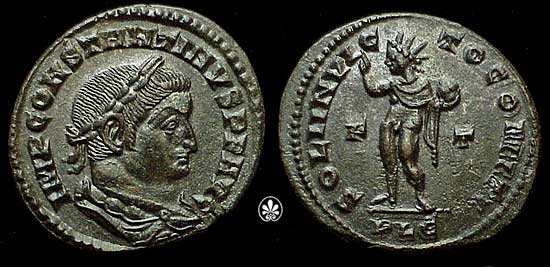
A coin of Emperor Constantine I who converted to Christianity and took the Empire with him. The depiction on the obverse is of Sol Invictus.

A coin of Emperor Constantine I who converted the Roman Empire to Christianity. The depiction on the obverse is of Sol Invictus – a vision of where things were heading?

The deified sun was conflated in this era with the older Greek  god Apollo, whose identity was favoured by the Romanised Celtic peoples from the Danube basin to the Atlantic northwest of Europe, in their own syncretic cults. Such cults throughout the Empire had displaced those of the older Capitoline and Olympian Roman and Greek deities among the general populations, although these still had a civic role to play.

Perhaps the most important, popular and long-running cult of the elder Greek gods was that of Dionysus, whose oldest festival – the Rural Dionysia – coincided with the period of the winter solstice whose Greek month was named in honour of the ancient sea god: Poseidonia. This was a festival of dressing up in the guise of the retinue of the god: men as satyrs or silenoi and women as maenads. It was also, significantly, a festival of the epiphany of Dionysus to mankind, which celebrated the god’s transubstantiation of water into wine and the mysteries of budding nature: themes obviously borrowed into later christianity. At Delphi, there was a tradition that Apollo left to live among the Hyperboreans during the month when Dionysus manifested among the people at this festival, at which there was much singing of popular songs by all classes in Greek society – a tradition surviving in the modern European Christmas singing festivities.

After the third century CE the rise of iconoclastic, literate, literalised and intellectualised religious tendencies in the Hellenized Eastern Empire and North Africa was increasingly to eclipse the western traditions of mysterious figurative mythology, which had been at the cornerstone of European religion for millennia. Apollo, Sol, Belenos, Attis, Dionysus and Adonis became ‘Logos’ – replaced by an intellectual man-god who claimed to be ‘the light of the world’, promising – in return for an oath of allegiance – ‘regeneration’ after death into a divine afterlife, safe from the confusion of life. The perfect model of benevolent Imperial power in fact…

Early Christian writers attest to the disagreement between the supposed Nativity day – one for which there is obviously no precedent in the ‘gospel’ traditions, yet which – as the temporal power of the Christian religion grew – became more important to establish, in order that the ‘church’ might exert leadership over the people and displace the pagan festivities.

The earliest Christian authors from whom we have records and quotations make no reference to a celebration of Christ’s nativity. Origen of Alexandria (245CE) and Arnobius (303CE) both scorn the idea that holy men should have their birthdays celebrated, and imply that this is a practice of sinners.

The earliest reference  from Rome itself to a Nativity festival for Christ held on the 25th of December (the festival of the Rebirth of the Unconquered Sun) is in a document produced for a wealthy Christian named Valentinus in 354CE (‘The Calendar of Philocalus’), of which only copies survive. However, there is evidence that the main focus of the Empire in the East at Constantinople was celebrating the nativity on 6th of January at this time, and it would not be until the advent of the 5th century that the 25th of December would hold sway across all of the main Christian patriarchies (Rome, Constantinople, Antioch, Jerusalem and Alexandria), in the drive for Orthodoxy which followed the establishment of the religion as a state Imperial cult, as well as the religion followed by Christianised kings who established themselves in the ruins of Rome’s collapsed western Empire in Atlantic Europe.
It is interesting why the arguments often veered between dating the nativity on the 6th of January (still favoured by the Armenian Church) or the 25th of December: Other recorded early traditions even put the nativity closer to the summer solstice, although these were roundly dismissed in favour of the midwinter dating, corresponding to the solar rebirth festivals of paganism. One must remember that early Christianity was spread across the vast Roman Empire, and was well established at centres such as Jerusalem, Alexandria, Rome, Constantinople and Antioch before the pagan system was rejected by the Emperors. There was no formal agreement as to the structure of festivities, except where there was literal evidence from scriptures.

Pagan Rome’s Empire and the Hellenized cultures it was enveloping generally exercised a policy of syncretism and acceptance of diversity, whereas the new literature-based Abrahamic monotheism was based upon inclusion/exclusion determined by active profession of faith and the purificatory symbolic act of baptism. Before its imposition as state religion within the Empire, Christianity was a religion of the faithful that need pay no heed to incorporating pagan ideas. As a state religion though, compromises were necessary and the religion ‘swallowed the blue pill’ in order to incorporate more peacefully with humanity and establish itself at the centre of power. Hence the use of the day of the Nativity of Sol Invictus as the celebration of the Nativity of Jesus.

Solar aspects of Epiphany/Theophany:

The indecision between the significance of nativity and epiphany perhaps recognised the importance to Christians of ‘spiritual’ birth or ‘revelation of the godhead’ to the people over the material act of parturition, which after all involved vaginas, body fluids and loco-feminis – ideas considered ‘spiritually unclean’ and somewhat repulsive to patristic religions, and Abrahamic ones in particular. The ‘Epiphany’ represented the cultic dedication of the Christ child to humanity, in the form of his supposed unveiling to the ‘Magi’ in the nativity story. It was a retelling of the Greek myths of the hiding of the infant Zeus from his father Kronos who sought to destroy him, and the visiting of various divine beings to the cave which sheltered him.

Jesus’ circumcision – the Attis/Ouranos myth retold?

Another festival prior to Epiphany celebrated Christ’s initial dedication to the jealous tribal god of Judaea – Yahweh – whose introduction by the post-exilic elites of Judah to the polytheistic semitic world marked a watershed in the eventual decline in the religious diversity of the ancient world of the Europe, Africa and the Middle East. Yahweh demanded absolute obedience from birth, including the marking by genital mutilation of male children, and the circumcision of Jesus was celebrated on the 1st of January, the first day of the first month of a new solar year. This – in Jewish custom – is supposed to occur within 8 days of birth, and is usually accompanied by the child’s naming, so prefigures the development of ‘Logos’ (in the words of John: ‘…The Word became flesh and made his dwelling among us. We have seen his glory, the glory of the One and Only, who came from the Father, full of grace and truth…’ ) and the inevitable Epiphany. There are older precedents for it: in particular, the sacrifice of genitalia by a youthful solar deity was a religious theme not uncommon to more ancient mythologies: The Greeks told the story of the Titan proto-god Kronos (associated with the Roman Saturnalia festival) castrating his child-slaying father Ouranos (the personified sky) with a sickle to spare the children Ouranos had created, and the Phrygians told the myth of their male solar-God Attis castrating himself in a similarly fertile mystic self-sacrifice to the Earth goddess, Cybele. Perhaps the Greek myth of Apollon (Apollo) killing the great Python of Delphi has similar mystic origins, as do the ithyphallic Dionysian, Hermetic and Orphic traditions also popular at the time of the inception of Christianity.

Perihelion and lengthening days:

The period between 1st and 6th of January marks a time when the sun begins to show a definite change in elevation in the sky and days are perceptibly longer. This is also currently the time when the Earth is closest to the Sun in its orbit – the ‘Perihelion’ – when the planet’s southern hemisphere scorches and the northern is tilted into the depths of its winter.

The Solar-Oceanic gods:

This midwinter solstice period also corresponded roughly to the sixth month of the ancient Greek calendar: Poseidonia. Poseidon was one of the oldest Greek gods, being mentioned before the inception of the Olympians in the Linear B texts surviving from the Mycenaean era of the 2nd millennium BCE. He corresponds in this sense to the ‘elder’ god Kronos, who was father of Zeus in Hesiod’s archaic-era ‘Theogony’, and who was ruler of the Golden Age typically celebrated in Rome’s winter solstice celebration: Saturnalia.  The Kronides – monstrous children of Kronos who pepper Greek myths – are the typical adversaries of ancient Greek heroes venturing to the far reaches of the encircling world-river, Okeanos, and Kronos-Poseidon corresponds incredibly closely to the ancient Gaelic Solar-Oceanic god-character Manannán in this regard. As god of the afterlife he was a perfect hypostasis of the Solar Jesus, introduced so successfully and so early among the non-Romanised pagan Gael of the Atlantic West….


The days of Kronos and Saturn

The familiar traditions associated with the celebration of ‘Christmas’ or the ‘Festival of the Nativity of Jesus Christ’ throughout northern Europe are far from Christian in their origin, and many of them are a direct continuation of the festivities of the Saturnalia of ancient Roman culture, which are in turn related to the equivalent ‘Kronia’ of ancient Greek culture. Both of these were introduced to Europe’s barbarian north with the diffusion of these cultures – a process beginning in the latter half of the 1st millennium BCE and culminating with the Roman conquests. Even well into the Christian era, ancient aspects of the seasonal celebration derived from the pagan era continued to be introduced between nations – the ‘Christmas tree’ (an ancient symbol of family) being an example. The essence of the Kronia and Saturnalia was a celebration of a supposed ‘golden age’ of humanity, ruled over by the titan god Kronos, who was known to the Romans as Saturn (probably meaning ‘Fertiliser’, after the Greek word Sathe). In this age, humans were said to have been virtuous and egalitarian – a state which degenerated once Kronos/Saturn was overthrown by Zeus/Jupiter who established the ‘pantheon’ of twelve Olympians to rule over the heavens and the earth. The Attic Greek Kronia was celebrated at ancient Athens around midsummer and was a festivity shared between freemen, slaves, servants and masters in honour of Kronos and the ideals of the Golden Age, and usually involved a ceremonial aspect of (albeit limited) social role-reversal at which the masters sometimes served their servants at a feast, and servants or employees sometimes took on the identity of masters for the celebration. In ancient Rome, Saturnalia was held at midwinter – from the 17th December – and after a similar fashion. With time the festivity was extended to a week or more. It was a time of freedom from work, giving of gifts, the playing of games (dice, knucklebones, board-games etc), giving to the poor and feasting and high-living – a very public celebration enjoyed across all social strata, bringing them (for a short period at least) closer together. It seems, therefore, very similar to modern festivities such as Christmas and Hannukah where similar customs still prevail. Anyone who has sat down to a family midwinter banquet wearing a Christmas paper crown and maybe spun a Hannukah dreidel or two is continuing a European tradition over 2000 years old!

The Hannukah Dreidel is an ancient European custom. Image: Wikimedia Commons (Roland Scheicher).

The Hannukah ‘Dreidel ‘is an ancient European custom. Image: Wikimedia Commons (Roland Scheicher).

Saturnalia (and Kronia) was typically a festival of reversals, the custom of masters serving their servants or slaves being a typical example of this which persisted down to the modern era. Those familiar with my discussions of the ancient ‘Otherworld’ philosophy of Atlantic European cultures (particularly the ‘Celts’) will immediately recognise this as a related theme: the Otherworld was an inversion of our own peopled by the spirits of the departed looking for reincarnation once more in our realm. Where we had plenty they had little and hungered for what we possessed. By treating these spirits with respect and gifts, we might deter their hunger for our material gains. Saturnalia was a method for ceremonially redressing the imbalance implicit in human nature and satiating the needy forces which might, through jealousy (the old ‘evil eye’ concept,) detract from well-being.

“…Meanwhile the head of the slave household, whose responsibility it was to offer sacrifice to the Penates, to manage the provisions and to direct the activities of the domestic servants, came to tell his master that the household had feasted according to the annual ritual custom. For at this festival, in houses that keep to proper religious usage, they first of all honor the slaves with a dinner prepared as if for the master; and only afterwards is the table set again for the head of the household. So, then, the chief slave came in to announce the time of dinner and to summon the masters to the table…” Macrobius, Saturnalia 1.24.22–23 (4thC CE) – trans. by Robert Kaster, Loeb Classical Library.

In ancient Rome, the celebration coincided with the Larentalia – typically observed on December 23rd – a celebration of the Lares or familial ancestral/domestic spirits, and the elder Roman goddess Acca Larentia – the Mater Larum and supposed mother of legendary twins Romulus (Mars-Quirinus) and Remus. These were characters underpinning Rome’s famous founding myths and therefore the whole ‘dark season’ was a memorial of a distant idea of humanity’s foundation and founding sparks in the dark and distant past. The mythology of Saturn is intrinsically linked to that of the far bounds of time and space where he was supposed by the ancients to have been confined in the legendary overthrow of the Titans by the Olympians. His is the dark and misty realm at the bounds of what we now call space-time, usually depicted by the European ancients as at the furthest reaches of the encircling world-river Okeanos which bordered the heavens and Elysium, and stood above Tartarus – a perilous place full of ancient monstrous beings of legend that only the bravest mythical heroes might travel to in their sacred quests. These monsters were always portrayed as children of the offspring of Kronos/Saturn – the ‘Kronides’. The dark season was a time when the departed might be closer and should be paid respect. This darkness was – as I have discussed elsewhere in this blog – a source of refertilisation to the world, and the source for returning life to the ancient Europeans who believed expressly in reincarnation, like their cultural ancestors in Asia. The return of an ancient deposed god to engender equality and celebration among humans is an irrevocable part of these seasonal celebrations which appear to defy time itself, and the continuous shifts in human culture and religion in Europe. In itself it suggests a temporary dissatisfaction with the status quo: ‘Christmas’ remains a resolutely pagan affair.

The pagan roots of St Martin’s day – 11th November

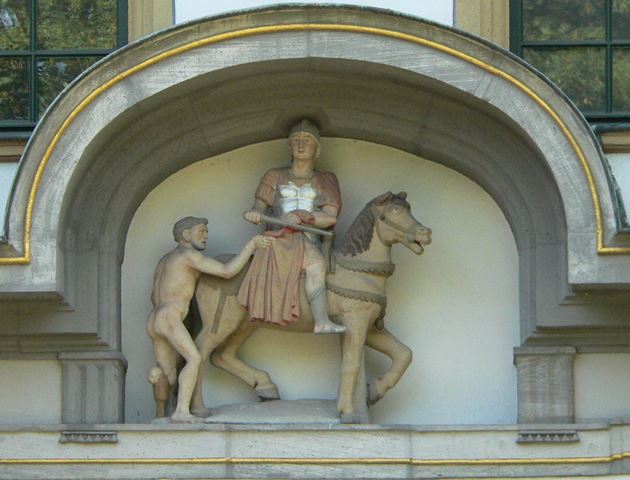
A German statue of St Martin donating his cloak to the poor man.

A German statue of St Martin donating his cloak to the poor man.

In my previous post I discussed the significance of Armistice Day falling on the 11th of November, which is also St Martin’s day: St Martin of Tours (d.397 CE) was a ‘military’ saint of the early Christian church who evangelised northern Gaul, and who is celebrated as one of the more important ‘local’ saints in northern Europe, along with characters such as St Patrick. St Martin’s day falls on the ‘old’ (Julian calendar) All Saints’ Day (‘Hallowe’en’) and is therefore linked to the celebrations of the Celtish quarter-day festival knownamong the Gaels as Samhain, and which is observed in reverence to the souls of the dead.

Processions and ritual begging:

St Martin’s day (and St Martin’s Eve) customs perhaps unsurprisingly share similarities with those of Hallowe’en: In Germany, for instance, the Gripschen or Heischebrauch customs of children going from door to door begging gifts of food, sweets etc in return for songs (Martinsleid) is associated with St Martin’s day (Martinstag). In Germany – as elsewhere in Europe – this custom was also associated with the medieval ‘souling‘ traditions observed variously on All Hallows day (1st November) or All Hallows Eve (31st October) as well as All Souls’ day (2nd November). In ‘souling’ people would go door to door offering prayers for the dead in return for the gift of ‘soul cakes’. This seems to have evolved into the modern Hallowe’en ‘trick or treat’ custom, but was a feature of other festivals of the ‘winter quarter’, such as the Christmastide ‘wassailing’ and ‘guising’ tradition parties of ancient European tradition. Ritual begging was therefore an ancient and important cultural custom, and the idea of receiving divine favour in return for bestowing hospitality on the poor and needy was a key element to religious observances of the Christian and pre-Christian eras (for example, the Roman and Greek festivals of Saturnalia and Kronia).

The most popular legend of St Martin is that of him dividing his soldier’s cloak to share it with a freezing beggar (who was then revealed to him in a vision to have been Christ personified), hence the association of Martin’s festival with begging traditions. In modern Germany and other north European countries, children take part in lantern processions on St Martin’s eve and these are usually led by a man dressed as the saint – often depicted as a Roman soldier with a large cape on horseback. These processions culminate in the St Martin’s bonfires, at which people eat traditional foods and drinks (such as gluwein). Similar festivities in modern Britain occur on 5th November (divested of any Catholic trappings, and often with pyromaniac Protestant iconoclasms). In Ireland bonfire celebrations were formerly held at Samhain. It is evident that they are all based on an older seasonal tradition which has diversified with time and changes to the political and religious landscape.

The spirits of the dead were, before and after the advent of christianity, associated with a hunger for the warmth and fecundity of our world. The act of appeasing the needy and hungry can be thought of in technical terms as assuaging this ‘pull’ from the otherworld which might threaten our imminent ‘crossing over’ to join the dead.

Martin the warrior:

The legend of Martin of Tours given us by Sulpicius Severus (4th/5thC CE) says that he was originally a Danubian noble serving in a Roman cavalry outfit who, through a process of divine revelation, transitions from a physical form of warfare to the spiritual one of the Christian narrative. This in itself is illustrative of the ‘spiritual rebirth’ through which followers of his religion defined themselves – then and now. This confusion of death and life was typical of the ancient pagan European worldview about warfare and death, a view which was personified by Martin’s namesake – the Roman god Mars who (unlike his Greek counterpart Ares) represented chthonic wealth as well as war. That Martinmas comes at time when it is traditional in Europe to make a celebration of agricultural fertility and full winter stores is therefore intriguing.

In the skies, the season is marked by the prominence of the great winter ‘warrior’ (or ‘hunter’) constellation of Orion – imagined as a man holding high a sword and shield. Another interpretation might be a herdsman – cattle were generally moved from pasture into their winter stalls by Martinmas, and the ‘campaigning season’ for warfare was over. The warrior-hunter-herdsman constellation being displayed in the heavens might possibly have been viewed as an indicator that such activities on earth should cease. In Germany another old tradition used to be of herdsmen giving a ritual bundle of branches (the Martinsgerte – ‘Martin’s Switch’) to the farmer at Martinmas, which would be used the next Whitsuntide (Beltain) to drive the cattle to their summer pastures. This may represent the fact that herding was seasonal hired work, and in many places St Martin’s Day was a traditional holiday for herdsmen, who also identified with St George. Whatever the case, wands or switches crop up in many European winter folk-traditions and performances from before the modern age.

Association with horses:

Martin was said to have been of Illyrian birth – from the ‘Danubian’ provinces of the late Roman empire. Eastern Europe and Germania provided many of the elite cavalry units of the Roman army, and from the late 3rd century military men from these regions came to dominate the upper echelons of the Roman military hierarchy, even providing Emperors. This rise of the ‘Equites’ would in turn syncretise with the military traditions of the western Celtic tribes and eventually give rise to the European ‘knights’ of the middle ages. Martin bestrode both such worlds and his iconography demonstrates this. In the Gallo-Roman world he came to evangelise, as well as the Celticised Danubian provinces of the late Empire the cult of Epona – supposedly a Celtic horse-goddess – was prevalent, especially among military elites. This appears to have had a special Danubian flavour added to it in Eastern Europe, where her cult was linked to that of the ancient Greco-Roman Dioskoroi – the twin brothers who were expert horsemen, and whose legend suggested one was human and the other divine. It is possible that Martin’s father was aware of or even participated in such a cult, as he was said not to have been Christian. Mystery cults – particularly that of Mithras – were prevalent among the late Imperial military.

Martin’s figurative rejection of his military calling as one of the Equites (as told by Sulpicius Severus) can be interpreted as a rejection of the figurative cultural importance of the horse among his chosen flock, whose coins before the Roman conquest almost universally depicted the image of the horse along with a multitude of spiritually significant symbols. Severus tells a number of stories of Martin destroying the sacred groves and temples of Gaulish pagans, so the narrative of his hagiography needed to account for this. Tours was a ‘Belgic’ part of Gaul, strongly influenced by the military-spiritual late Iron Age cultural movement which appears to have stimulated the Celtic expansion of the ‘La Téne’ era of the second half of the 1st millennium BCE.

Association with birds:

Apart from the ritualised begging and celebrations of altruism, there is another old custom associated with St Martin’s day, involving birds. This is represented in Germany by the eating of a goose (the Martinsgans) at a special meal in honour of the saint, although duck is the more favoured bird in modern times. The reason given for this custom is based on the hagiography left by Martin’s contemporary, Sulpicius Severus, who declared the saint’s modesty as one of his virtues, illustrating it by the tale that Martin hid in a goose-shed when the crowds at Tours wished to elevate him to the rank of Bishop. The geese proclaimed his presence and he was forced to accept the honour.

Irrespective of the hagiographic legends, it was traditional at this time of the ancient subsistence agriculture cycle of Europe  to slaughter geese and pigs (both of which could be salted down to be preserved for the winter). In German ethno-linguistic regions the Schlachtfest (‘Slaughter Festival’) usually coincided with Martinmas. The tradition of animal slaughter at this period might explain the former custom in parts of Ireland of the Martinmas cockerel, which used to be slaughtered on St Martin’s Eve by bleeding. Sometimes a goose was used. The custom survived well into the 20thC – blood from the bird was dripped at the boundaries, corners and portals of the homestead or farmstead in order to procure luck (or protection from the saint) for the coming year. The bird was then eaten at a special meal (meat was only ever an occasional luxury in former times). This bird-slaughtering tradition evolved into the American settlers’ ‘Thanksgiving’ festival, celebrated on the third Thursday of November. All-Hallows or Martinmas were also traditional festivals at which tithes were traditionally paid to churches, and when servants were hired or released from service, sometimes a time when rents were paid. The ‘functional’ aspects of such festivals were sometimes displaced to Michaelmas – and although not practised on Martinmas, the tradition of a goose-feast at Michaelmas (29th September) was observed in Britain. when rents and tithes were often expected. Perhaps variations in the harvest-period between regions have informed this plasticity.

In the Isle of Man the custom of slaughtering a fowl was formerly celebrated on St Catherine’s day (25th November – a closer analogue of Thanksgiving) when a female hen suffered its fate, and was committed to a ‘solemn’ burial (perhaps made less solemn by the inebriated state of the celebrants) as part of the festivities of the tiny island nation’s St Catherine’s fairs. The meaning of the Manx ‘St Catherine’s Hen’ and its ritual slaughter and burial at a public fair is obscure – it could be anything from a pagan survival to a modern form of anti-clericalism or anti-Catholicism. What is similar, however, is the better-known bird-killing ritual involving the slaughter of a wren on the same island on the 26th December (St Stephen’s Day), suggesting a pre-Christian avian tradition. In avowedly Catholic Ireland this custom also occurred and in both countries (Mannin and Ireland) there were legends suggesting the wren was the personification of a powerful female fairy, leaving us to conclude that the ritual slaughter of a bird during the winter quarter had some religious significance in the ancient Atlantic world.

Returning to St Martin (and the 11th of November), it is worth commenting on some other bird-related associations. Not in the least is the use of the name ‘Martin’ for a class of bird of the family Hirundinidae, including the Swallows, House Martins, Sand Martins etc. These are migratory birds who appear in Europe during the late spring-time, and are usually departed to their over-wintering locations by the 11th of November. Anciently it was believed that, rather than migrating, they in fact slept over winter at the bottom of ponds and rivers. This belief may be based upon the observation of these species regularly skimming down over water in order to drink while ‘on the wing’.  By the same estimation, flocks of migratory plovers coming in to roost and feed on estuarine mudflats often appear to be ‘diving’ into the water. In ancient Rhodes (so the 2ndC CE Greek poet Athenaeus tell us) were beggars known as the Chelidonistai (‘Swallow Men’) who would come around in early springtime with the arrival of the swallows and sing traditional songs in order to earn alms. He mentions another class known to him (Coronistai) who carried a dead crow or raven and also solicited alms through a song. Obviously, there is a parallel with the Christianised medieval traditions of ritualised begging, so important to the Christian narrative. These were celebrated in Swabia (Upper Bavaria) at Whitsuntide (the closest Christian festival to Beltain) by the ‘Waterbird Men’, who performed songs for alms. Frazer (‘The Golden Bough’) quotes various German authors saying how these as also going into the forests to gather oak branches and other greenery, as well as sometimes diving into water, or throwing straw effigies of a large bird into water. In medieval times a wooden bird was displayed in Bavarian churches at Whitsun, evidently to depict Jesus, but possibly part of a Christianised tradition of the pagans. Like the Manx and Irish ‘Wren Boys’ these Whitsuntide parties of young men dressed in white, and wore red sashes. Just which ‘water bird’ species (if any) was intended is unclear – it may be that the placing of the bird in water was the origin of the name. Beltain is 6 months from Samhain – at the other side of winter – and St Martin also enjoyed a more ancient midsummer feast (Martinus aestivus, 4th July). The ‘Martin’s Bird’ (Martinsvögel) in Germany might also refer to an old tradition of a bird-shaped harvest sheaf (possibly even the one once cast into the water at Whitsuntide in Swabia), and is also the name sometimes given to other bird species such as the Black or Greater Spotted Woodpecker, the goose or even the Ladybird (also associated in German legend with Frau Holle).

The symbolism of migratory birds seems ideals for expressing the cycles of death and rebirth. These are best represented in European legends by species such as the Martins and Swifts, the Geese and Swans, and aquatic species such as the Plovers. St Martin was credited with bringing Christianity (which promised renewal not in this world but another one) to much of the notoriously militant, formerly barbarian Romanised cultures of north Europe. His name and military aspect seem like a fitting identity for someone who converted the Gauls from their vestiges of druidism, which taught that the soul flies from the body after death and is renewed in a far-off place before returning again in a new incarnation. Such empirical and spiritual symbolism pervades the legends and folklore of  Celtish and related European cultures, and survives the Christian era – testament to the power of the old and mysterious worldview.

Armistice Day – The Day of the Dead

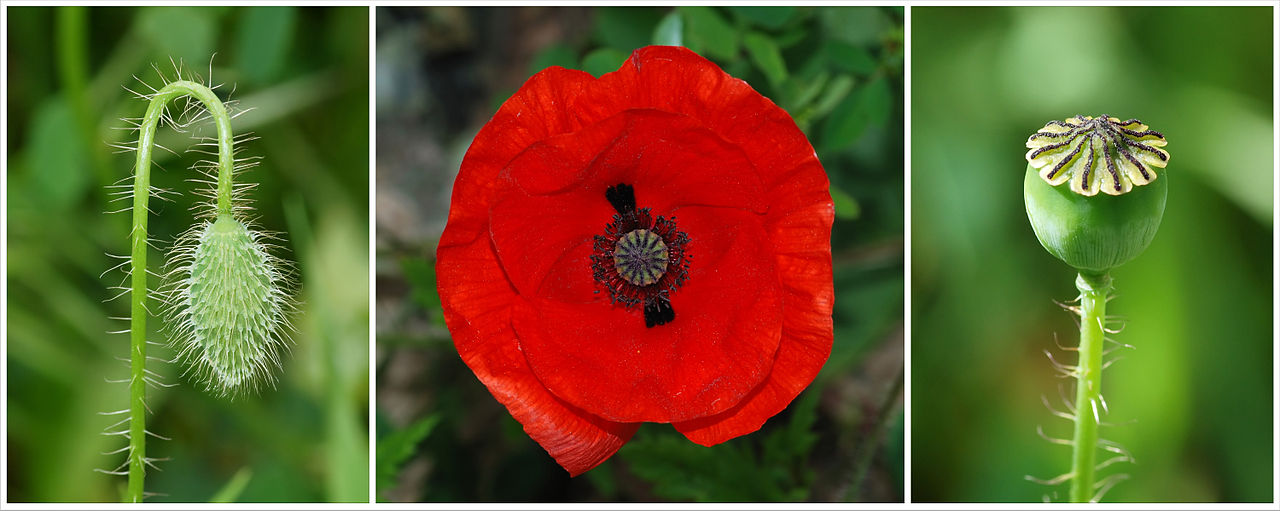
The poppy has represented rebirth since ancient times.

The poppy has represented rebirth since ancient times.

Armistice Day is observed on the date of the momentous ‘Armistice of Compiègne’ – the agreement by which the Allies and Germany formally concluded hostilities of the ‘The Great War’ on the 11th hour of the 11th day of November 1918. It marked a culmination of the collapse of German military might on the western and eastern fronts and a revolutionary overthrow of its domestic political order, enforcing the necessity to surrender. Rather than being a celebration of victory, where the day (and hour) is universally observed, it is in commemoration for the massed ranks of the dead, butchered in unbelievably savage conditions in Europe’s once green and beautiful fields, and among her once majestic, now shattered ancient towns and cities. The date itself is curious. The 11th of November has deep shared meaning to north Europeans for a number of reasons:

St Martin’s Day:

The 11th day of the 11th month of the Gregorian calendar is marked by a popular religious festival in the calendar of Saints of the Roman Catholic church – the Feast of St Martin of Tours, commemorating one of northern Europe’s early Christian proselytes and famous ‘military saint’. The name ‘Martin’ is, of course a reference to Mars – ancient Romes’s chthonic war-god. Christian activists often adopted a name upon receiving their new faith, or upon being inducted into a religious community, and ‘Martin’ is the name given by the late Roman-era Christian writer Sulpicus Severus for this former Roman soldier-turned-ascetic who was nominated as the first Christian bishop of Tours and credited with spread of christianity in pagan northern Gaul, Germany and Britain. His most famous legend tells of him cutting his cloak to give half to a freezing beggar who is supposedly then revealed to him as Christ personified. He is often depicted riding a horse.

The popularity of Martin’s festival (also known in English-speaking regions as Martinmas) is largely because it represented a time of first frosts, when harvests had been gathered and store-rooms were full. In other words, it was the start of winter. Popular festivities and feasting with special foods (e.g. – the traditional Martinmas goose) were/are particularly observed in catholic north Europe, and meld with some strange and distinctly pagan customs – also involving birds: In particular, an Irish custom of beheading a cockerel and dripping its blood at the corners and portals of the homestead to ensure pluck and protection for the coming year. Rather than being a devoutly religious festival, it was also a time of secular celebration with cultural an calendrical associations with another festival, perhaps more widely known to us in modern times:

Hallowe’en, All Saints Day, Samhain: 

Hallowe’en or All Saint’s Day is observed on the 31st October/1st November. It appears to be based upon the old Atlantic ‘cross-quarter-day’ festival known in Irish as Samhain, at which the dead are traditionally remembered at the advent of Winter. Fires are lit and processions of young people go out in the night on exciting and wild adventures invoking the fear of death as part of its celebration. In this way, it mirrors the tamer festivities of the next most popular ‘religious’ festival, which is (of course) St Martin’s day on the 11th of November. Why should this be so?

The period between St Martin’s day and Samhain – some 12 days – corresponds to the calendrical shift between the old Julian calendar and the Gregorian calendar first instituted under the Papal curia in 1582 by Pope Gregory XIII. The Julian calendar (still to this day employed by the Orthodox Christian church in Eastern Europe) was in common use in many parts of northern Europe until the late 18thC when all nations under Protestant influence finally acceded to it. As many traditional festivals were seasonal celebrations, this inevitably led to a deal of inertia in accepting the new calendar: after all, it was the calendar that had changed (to accommodate the church’s need to slow the ‘creep’ of its moveble feasts, based on old Jewish lunar calendrical reckonings – particularly Easter), and not nature. This led to the phenomenon of admixture of features between old and new festivals and thus, the 11th November became Old All-Hallows Day, or Old Samhain, if you will (Shenn Oie’l Sauin or ‘Hop Tu Naa’ to the Manx, who still observe ‘old’ festival days – particularly Old Christmas Day, when some have another feast all over again!).

The means that Armistice Day – St Martin’s Day – is in fact the Old Day of the Dead. Somewhat appropriate, don’t you think?

It is almost certain that circumstances and fate were behind the choice of this day to mark the Armistice for the war which marked the end of ‘Old Europe’ and the true advent of modernity. Curious though that the era of the Gregorian reforms marking the abandonment of the old (pagan era) calendar of Julius Caesar, and marked the start of the cultural, philosophical, technological and social transformations which ‘put the train in motion’ for its cataclysmic 20thC derailment and wreckage. World War 1 was only possible because of the centuries of warfare and accumulation of unstable power under the religiously polarised Christian elites of Europe and their equivocating financiers who played one off against another as they struggled to milk the coffers of Europe’s global Empires of the 16th-20th centuries. A whole generation lost its youth to that final slaughter, and Samhain seems an opportune time to remember them.

Britain’s ‘Bonfire Night’:

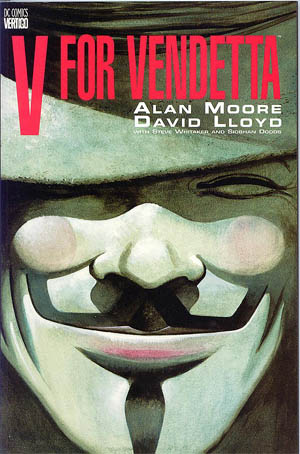
Stuck between Samhain and Martinmas is Britain’s curiously chauvinistic celebration known as ‘Guy Fawkes Night’ or just ‘Bonfire Night’ on the 5th of November. This too is a celebration of death – albeit the death of a personification of Roman Catholicism – in the figure of a man called Guy (‘Guido’) Fawkes whose effigy is burnt on great bonfires on this evening, accompanied by fireworks displays and merriment. Fawkes was a recusant Yorkshire Catholic ‘terrorist’ who was supposedly apprehended as he was about to bomb the Houses of Parliament and King James I on 5th November 1605. It appears that the traditional ‘All-Hallows’ bonfires were transferred to this date for political reasons under the Protestant ascendancy and furor of the 17th century. There is an increasing re-conflation of the two festivals, such that children begin parading the effigies of poor ‘Guy’ on All-Hallows eve – not unusually demonstrating the more typical trappings of ‘Hallowe’en’… Far from being a figure of hatred towards Catholics, though, ‘Guy’ has also evolved into something of an anti-establishment hero, whose image (as ‘sacrificial hero’) not only adorns British bonfires, but the masks of a million political activists the world over, inspired by the popular graphic novel ‘V for Vendetta’ by modern visionaries Alan Moore and David Lloyd.

V_for_vendettax

The period between the 31st of October and the 11th of November seems therefore to be returning to its traditional empirical spiritual (‘ex pagis’ or ‘pagan’) meanings, and moving away from its superficially Christian adornments. It has been a process of death and pain, but then from this new things are born…

Why not celebrate Samhain again this year on the 11th of November in the company of the Host of the Dead, on Old All-Hallows Eve?

‘Root, branch and seed’ – Ancestral tree-analogies in Europe’s pagan past

Europe’s ancient pagan religions had their origins buried deep in a pervasive natural philosophy whose origins can be traced far into the pre-historic archaeological record to the cultures of the Bronze Age and Neolithic periods. This philosophy was one of death, the afterlife, regeneration and links with the ancestors. Not only does it employ the analogies of life-giving springs of water, regenerating serpents and the firmament of putrefaction from which life re-emerges, but also the active growth and re-growth of plants and trees in nature, particularly the nourishing agricultural crops and wild foliage sustaining man and the animals he relied upon. For this reason, the symbolism of the branch and the ear of corn was of particular importance to Europe’s ancient pagan cultures – Celtic, Thracian, Greek and Roman.

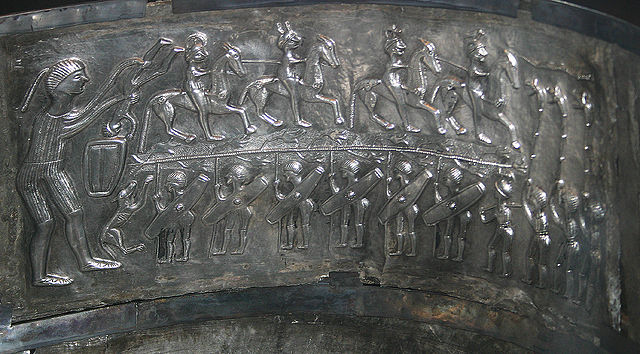
The 'warrior' panel from the interior of the cauldron. Note the branch between the warriors - the flowers look like Henbane. Photo: Malene Thyssen

The ‘celtic warrior’ panel from the interior of the Gundestrup cauldron. Note the branch between the warriors. The ‘flowers’ look like Henbane – herb of the dead. Photo: Malene Thyssen

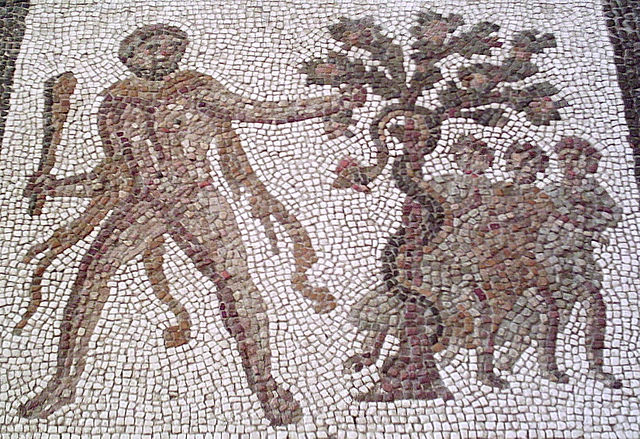
Hercules and the confronts Ladon in the garden of the Hesperides (Roman Hispania)

Hercules confronts Ladon in the garden of the Hesperides (mosaic from Roman Hispania)

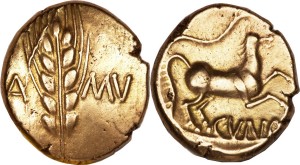
Corn ears on a coin of Cunobellinus (Catuvellauni/Trinovantes) 1stC AD.

Corn ear on a coin of Cunobellinos (Catuvellauni/Trinovantes) 1stC AD. It is possible that Cunobellinos was an initiate of the Greek Eleusinian mysteries, perhaps part of the scheme of Caesar Augustus to ‘Romanise’ the wild pagan elites of north Europe.

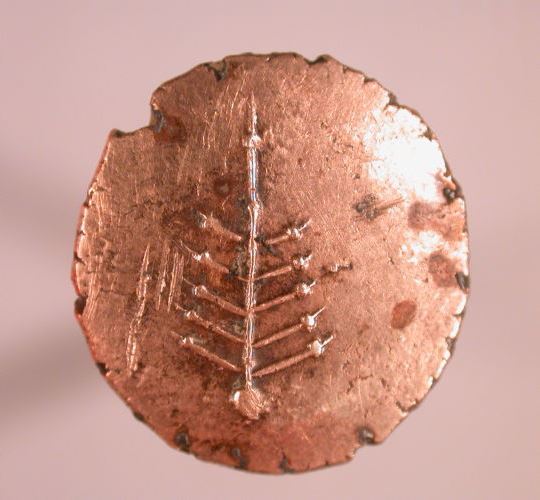
The branch is a particular symbol found on the 'Anted Rig' British celtic gold staters.

The branch is a particular symbol found on the ‘Anted Rig’ British celtic gold staters. Like those of Cunobellinos, they were minted during a time of crisis in the Celtic world, when tribal unity was of utmost importance.

The analogy of the tree is of particular importance, and sacred groves were of great importance to all of Europe’s pagan religions – be they Celtic, Greek, Germanic, Thracian or Roman. Sacred trees remained important to the cosmologies of Europe’s longest-surviving pagan traditions (for instance, Ireland, Scandinavia and the Baltic states) far into the middle ages.

Trees were symbolically  important for the following reasons:

They represented the ‘reflected’ symmetry between the mundane and spirit worlds. The roots below the earth are a reflection of the branches in the air above. The tree was therefore a link between the supra-terranean world and the mysterious chthonic realms into which living matter decayed and from which life seemed to eternally regenerate. ‘As above, so below’, so the saying goes. The idea of the ‘family tree’ depicts the analogy of ancestors and generations. The roots of the ‘family tree’ were the ancestors, the trunk the living patriarchs and matriarchs,  and the branches and fruits the future life and continuity of the family. Trees are analogous with rivers in many ways. The tree’s branching nature shares a very distinct similarity with the patterns exerted upon our landscapes by rivers. The winding nature of great rivers is also analogous to the shape of the snake, and rivers, trees and snakes are distinct in the symbolism of the Otherworld and its flow of interaction with the ‘world of the living’. Trees and plants rely very strongly upon sources of water, and are also prone to being struck by that other great ‘branching’ phenomenon of nature: lightning. Nourished by water welling up from the earth, and destroyed by lighting branching down from the sky – it  is no surprise that the tree is such a potent symbol of the forces connecting the heavens and the earth… Trees are the longest-lived organisms. Trees outlive almost any other species, and are therefore entrusted with the positive faculties of age: wisdom, perseverance and constancy. Trees might witness events spanning the lives of successive generations of humans. They protect and shelter, we build our homes and conveyances from them – they are a source of strength and protection to us. The physical nature of wood changes little after its death. Apart from ceasing to produce leaves and new growth, wood maintains its structural properties much better than other living organisms once it is dead. Well-treated wood lasts millennia, in fact. This property gives it a special place in human consciousness and imagination. The tree represents monarchy. The stout trunk and roots are the cohesive force of monarchy itself, with the topmost branch representing the king or queen and the lesser branches the subjects.

Gods and Robbers: Robin Hood

Undoubtedly the most globally famous of Britain and Ireland’s legendary bandits is the much vaunted Robin Hood of Sherwood Forest. His popularity has much to do with his wide-ranging status as a champion of the disenfranchised, freedom-fighter against oppressors, self-sufficient inhabitant of the marginal wilds, egalitarian redistributor of wealth and adventurer whose legend resonates with a timeless, placeless audience. Of all the mythological outlaws of note, his has most often been linked to the euhemerisation of the land’s oral traditions of older pagan gods, trampled under the march of quill and parchment from the early middle ages. As most people know a few stories about him, in this post I am going to refrain from discussing plots which have little relevance to the underlying meaning.

In truth, evidence about the origins of the myth of ‘Robin Hood’ is somewhat sketchy, and this in itself is complicated by the apparent transformations of the tale in art, song, story and dramatic performance right down to the most modern times. The story seems always to have suited various contemporary propagandistic political and revisionist narratives which have retold it in order to magnify their own contemporary causes through appropriation of the story. More recently, for instance, it has been used to serve both cold-war communist and multiculturalist dogmas. However, the underlying narrative is one of the establishment of justice and economic stability, essentially crystalized in the following framework-myth:

A outlaw man with claims to leadership of the common people (i.e. – national husbandry) is expelled from his community when it comes under the yoke of a wrongful order which is unjust and economically unfair. He goes to live in the wilds where he learns skills that allow him both to survive without recourse to common society and to become a master of his new kingdom – nature itself. The hero gradually makes increasingly bold forays against the invasive new order, and sweeps back into the social spotlight where he dazzles and tricks his way through the obstacles thrown in his path, eventually regaining his rightful position within his society as a trusted hero and leader.

What’s in a name?

The earliest versions of the myths preserved in (15thC) medieval ballads demonstrate Robin more as a commoner, omitting claims of royalty which have been suggested to have come as later additions made possible by the increasing social mobility engendered in phases following both the Black Death and subsequent peasants’ revolts, and then from the dissolution of the monasteries under Henry VIII and the redistribution of land following the fractions of the Protestant Reformation and various wars and revolutions this engendered. The oldest medieval tales often focus more on ‘Lytel Johne’ as the main protagonist, with ‘Robin’ often seeming a touch otherworldly, and therefore (from John’s frustrated perspective), somewhat erratic and untameable. The relationship seems somewhat akin to that between humans and the mythological ‘fairies’ known as ‘Robin Goodfellow’, ‘Brownie’, ‘Phynnodderee’ or ‘Hobthrust’ of folk legends. The name ‘Robin’ is derived from the Latin word for the sanguine colour (red) – ruber. ‘Robin’ is synonymous with the name ‘Robert’, which has a phonetic similarity to the English word ‘robber’, implying a thief and outlaw.

‘Robin Goodfellow’ is the English fairy who is supposed to help with domestic husbandry, and therefore a version of the ancestral household deity once so common in European religions of the Iron Age and earlier. The name is obviously very similar to ‘Robin Hood’, and this brings us to an examination of the ‘Hood’ part of the name: The Old English words ‘Hode’ or ‘Wode’ (they are interchangeable) do not mean ‘hood’ or ‘wood’, but instead refer to ‘wildness’ or ‘madness’, and are therefore related to the name of the Germanic deity ‘Wodan’ or ‘Odin’, not to mention the Germanic fairies referred to as ‘Hodekin’ who may somehow be related. The modern English word ‘Mad’ is a version of the same, ‘M’ and ‘W’ being interchangeable in many Indo-European languages, both Celtic and Germanic. ‘Robin Hood’ therefore probably means ‘Wild Red One’, although ‘Robin God-fellow’ might be another interpretation. The name ‘Robin Artisson’ is given for the spirit associated with Alice Ketil (Kyteler) – an aristocratic (Hiberno-Norman-Norse) woman who was tried by the Bishop of Ossory for heretical pravity, use of magic and consorting (sexually) with a demon at Kilkenny in the early 14thC. The Annales Hiberniae have this to say on the matter:

“…. Ricardus Ledered, episcopus Ossoriensis, citavit Aliciam Ketil, ut se purgaret de heretica pravitate; quae magiae convicta est, nam certo comprobatum est, quendam demonem incubum (nomine Robin Artisson) concubuisse cum ea…”

Accusations and suspicions of heretical paganism seemed to stick to the more recently Christianised Norse-Hibernian elites of the Irish Sea region during the middle ages. The name ‘Artisson’ is a Norse version of the Irish ‘Mac Airt’, meaning ‘Son of the Bear’. This would imply that ‘Robin Artisson’, like Robin Hood was a creature of the wild woods, or maybe even a real man somehow associated with ongoing practices and beliefs in Norman Ireland of the Norse Berserker cult of Odin … perhaps ‘Robin Wode’ would be another name for the same character.

Madness and divinity are close bedfellows! The concept of madness appears to have had a different connotation in ancient times – ‘wildness’ seems more of an appropriate interpretation: close to the state of beasts and the turbulence of the untamed. I have already previously talked about the connections between the Celtic god Belenos, madness, prophecy and battle-fury and the seed of the herb, Henbane (Hyoscyamus Niger/Albus), which was anciently (and still is) called ‘Beleno’. Another connection with madness-inducing plants is alluded to by the name of the Roman god Robigus, who seems more pertinent to this discussion of ‘Robin Wode’: Robigus was one of the rustic (and therefore indigenous, non-oriental/non-Greek) gods worshipped by the Italic Iron Age peoples and on during the Roman Empire. He was the god venerated for the protection of crops from rust disease, much of which was caused by the ergot fungus (Claviceps purpurea) which was a famous cause (along with contamination with the Darnel grass, Lolium temulentum) of madness among those who ingested contaminated grain. Robigo/Robigus was probably related to the chthonic-military Italic god, Mars-Quirinus, whose colour is red (like that of his planet). The Robigalia was celebrated by the Flamen Quirinalis on April 25 (close to Beltain) with the sacrifice of a dog, in order to prevent crop disease. Mars is the most active planet on the ecliptic path – dancing and looping like the merry pranks of Robin Goodfellow and Robin Hood, and any number of legendary equivalents…

Profuse wildness of growth and references to the colour red appears in a number of British plant-names: for instance, we have Herb Robert/’Red Robin’ (the prolific Geranium Robertianum – replete with red stems and pink flowers) and the equally prolific but decidedly un-red ‘Robin-Run-Over-The-Hedge’ (Glechoma Hederacea). There is also ‘Ragged Robin’ – Lychnis flos-cuculi – another pink flower, a lover of acid soils and boglands. The notable north European bird species, Erithacus rubecula the European Robinis perhaps of greater significance in indigenous traditions. An old English rhyme states ‘The Robin and the Wren are God’s two holy men’, and the old Manx wren-hunt ballad or rhyme refers to ‘Robbin the Bobbin’ as the instigator of the wren hunt itself – the wren being the incarnation of the Manx pagan goddess of olden times – Tehi-Tegi, the ‘Fair Chooser’ of the dead… The robin bird, unlike others, is famously inquisitive of human activity, and is sometimes known as ‘the gardener’s friend’. It – like the fairy ‘Robin Goodfellow’ has a semi-wild sympathy with the human race…


Gods and Robbers: Caher Roe

Southeast Ireland claims its own version of the medieval ‘Robin Hood’-styled mythical outlaw-god in the guise of a character known as ‘Caher Roe’. The name literally means the ‘Red Outlaw’ or ‘Red War-Chieftain’ (Irish, Cathair Ruadh – the ‘-th-‘ and ‘-dh’ sounds are aspirated/softened), depending on how one interprets the term ‘Cathair’. He is largely known to us in modernity through Máire MacNeill’s revelatory and seminal 1962 book ‘The Festival of Lughnasa’, in which the author collated many local traditions from across Ireland pertaining to the important hilltop Lughnasa celebrations at the start of harvest. ‘Caher Roe’s Den’ was one such site that MacNeill discusses in relation to this pagan festival of ripened summer fruits and red-tinged moons. The ‘Den’ is (like that of the Welsh ‘Twm Siôn Cati’) a rocky hillside outcrop with a supposedly blocked-up cave on Blackstairs mountain in the Blackstairs range of southern Leinster on the Wexford-Carlow border:

“…A most interesting story is told of Caher Roe’s Den. The country-people identify the Caher Roe who gave his name to it with Cathaoir na gCapall, a young man of the O’Dempsey family of Clanmaliere in Laix. His family forfeited their lands in the seventeenth century and Cathaoir turned rapparee and controlled a widespread organisation for stealing the horses of the new planter gentry, hiding them, disguising them, selling them at distant fairs, and getting money too by ‘finding’ lost animals. His organisation had ramifications through a large part of the country and specially in the lands through which the Barrow flowed. The country-people were sympathetic to him and enjoyed the stories of his adventures and ruses. He was, however, finally brought to trial and hanged at Maryboro in August 1735. Local tradition says that the Den on the slope of Blackstairs was one of his hiding-places, that its precipitate passage leads down into caverns where treasure is hidden, but few have been foolhardy enough to seek it and the entrance has been blocked upto prevent the mountain sheep from falling down into it. It is in Caher Roe’s memory, people say, that the ‘Mountain Patron’ is held. The following story* is told:

One day, when Caher was returning to his Den he met a girl with a pitcher of water. He asked her for a drink and as she was handing it to him, he caught her by the armand pulled her up on his horse. Her loud screams attracted the neighbours. They came around with sticks and pitchforks and succeeded in rescuing the young girl. They followed him to his Den on the mountain top where, after discharging his pistol to them, he sprang headforward into his Den and was not heard of for years afterwards…” ‘The Festival of Lughnasa’ by Máire MacNeill (2nd reprint, Pub. Dundalgan Press, Dublin 2008) pp.226-227 – *the source of the story is UCD Folklore Commission MS 890, pp.498-499.

Needless to say, the tale of Cathaoir na gCapall is treated by MacNeill as apocryphal, as she phrases it as told by ‘the country people’, and the identity of Charles Dempsey with a real ‘Caher Roe’ seems engineered to fit the legend of the Lughnasa site, which is evidently too well-known and visible a site at which to hide, and which is definitely not suitable for stabling horses. She rightly observes that the profile of the folktale she relates is unsympathetic to a man who would otherwise be seen as a folk-hero at any time in Ireland’s history, and the somewhat demonic Caher of this tale seems very much like ‘red-bloody’ Sawney Bean of Gallovidian legend, not mention the wider legends of the ‘fairy horse(man) ‘who abducts people away into rivers and underground caverns… Caher Roe – like Twm and Sawney – appears to be an image of this older legend, transformed in successive oral traditions to suit the religious, social and political changes of the day. Interestingly, 1735 is a date which corresponds with Britain’s passing of  its seminal final ‘Witchcraft Act’ (9 Geo. II c. 5) which was designed to strangle superstition by making it illegal to profess magical beliefs or to accuse others of them. This law was part of a broader protestant ‘enlightenment’ agenda, which had identified superstition with ‘backward’ Celtic cultures and ‘Popery’…

The ‘other’ Caher – Cathair Mór:

Ancient Irish power liked – in the same way as other medieval European dynasties – to link itself to a mythical ancestral past. As such, it sponsored the creation of books which told the stories of these supposed ancestors in order to establish its claim to majesty and rights over the land. One such ancestor was ‘Cathair Mór’ – a legendary High King of Ireland from the pseudo-historical traditions, from whom Leinster clans claimed to descend. He was succeeded in the historical traditions (Lebor Gabála Érenn) by Conn Cétchathach, who evidently shares the ‘Cathair’ title within his own cognomen and was son of Fedlimid Rechtmar, and therefore possibly Cathair’s brother. It is possible that this ‘Caher’ was closer to the legendary root from which the tales of ‘Caher Roe’ evolved.

Like the Welsh aristocracy who battled the English between the 14th and 15th centuries, the Irish Kings of Leinster were also similarly concerned, so it is entirely possible that legends of Caher Roe – like those of Twm Sion Cati extend back to at least the same era, and probably have older mythic roots in the sovereignty-bestowing gods of the pagan age – the ‘sleeping heroes’, supposed to return in times of great need. The O’Kavanagh/Cavanagh (or MacMurrough-Cavanagh) were famous kings of Leinster during the high middle-ages, notable for their ability to withstand or politically handle/acculturate the Anglo-Norman invaders, and to maintain a degree of independence for their region right up until the assaults on indigenous Gaelic culture consequent upon the Tudor invasions of the 16thC. ‘Cavanagh’ are named after St Caomhan (Kevin) of Glendalough – a saint whose legend is linked to the female deity euhemerised as ‘Cathaleen’ or ‘Caitlínn’ in the saint’s mythology – an incarnation of the celtic sovereignty-goddess (otherwise ‘fairy queen’) of whom I have written a fair amount…

Overview:

‘Caher Roe’ appears to be linked to the legends of a number of similar legendary outlaw-figures from the British and Irish islands. These seem to have a curious affinity to the colour red, to inhabit caves associated with heights, and to have a connection to or claim to the sovereignty of the land. They are either heroic or demonic, depending on the political and polemical needs of the era of their tales’ telling…

Gods and Robbers: ‘Twm Siôn Cati’

The Welsh answer to England’s ‘Robin Hood’ legend is that of ‘Twm Siôn Cati’ (pron. ‘Toum Shon Catti’), whose legend has in modern times been popularly located (like that of Scotland’s Sawney Bean and Ireland’s Caher Roe) in the fractious 16th century during the period of unrest following the Protestant Reformation. Modern authors have attempted to give historicity to the character, giving him an air of political legitimacy, not in the least because – unlike Sawney – Twm was a ‘good fellow’.

A ‘historical’ Twm?

The usual modern tale told of the euhemerised ‘historical Twm’  is that he was born Thomas Jones, illegitimate son of Catherine ‘Cati’ Jones of Tregaron and the more regally connected Siôn ap Dafydd ap Madog ap Hywel ‘Moetheu’ (?Matthew) of Porth-y-Ffin (also described as ‘John Wynne of Gwydir’ in some texts), circa 1530. Why this has come to be so often-repeated is solely due to the desire to fix ‘Twm’ with a provenance, either (as in the case of Robin Hood) out of civic pride or to suit the romantic prejudices of authors with theories on the subject, of which there have been a not inconsiderable number. The modern tale seemingly derives from ‘The Adventures and Vagaries of Twm Shon Catti’ by patriotic Welsh romanticist-antiquarian T J Llewelyn Prichard (Pub. Cox, Aberystwyth 1828) and has been enlarged upon to form the current ‘tourist’ myth. However, like with ‘Sawney Bean’ its origins as historical are in dispute: For instance, a play ‘Twm Shon Catty, or, The Welsh Rob Roy’ reviewed in the 1823 edition of the ‘The Drama‘ magazine places Twm as a knight and lord during the reign of Henry IV (d.1413). Evidently, the desire to establish provenance in the confused political landscape following the reformation was again to blame for the metamorphosis of the popular narrative. Thomas Pennant noted in his ‘A Tour in Wales, 1770’ (Vol.2 p.137) that the legend of outlawry associated with the seat of the influential 16thC Wynnes of Gwydir was ascribed to an earlier character, Hoel ap Evan ap Rhys Gethin. The historic Thomas Jones (Hoel’s later ancestor) does not get a mention by Pennant, who evidently had access to Welsh pedigrees when writing this work, again pushing the legend back over the medieval ‘event horizon’ and therefore into the world of legendary historical fantasy where kingship was believed derived either from god, or the blessings of fairies, or both, and sleeping saviours would return to fight the usurpers of the land. This was, of course, the world of the early 15thC and the rebellion of Owain Glyndŵr against English hegemony – a time when Welsh monarchs and gentry became ‘outlaws’ and ‘bandits’ in English polemic tradition. Curiously, the legendary exploits of Twm and Owain seem similar.

The legendary Twm:

The flesh of Twm’s legendary narrative portrays him – like Robin Hood – as a nobleman or popular yeoman-class commoner being consigned to outlawry by malice, misfortune or turn of politics. His outlawry, although  overtly criminal, is tacitly for the common good, and his clever japes, tricks and skillful demonstrations of feats keep him one step ahead of both death and the law. Like in the other ‘outlaw’ myths he inhabits a cave in the wilderness with a female partner where he conducts his heroics (or crimes) until eventually re-entering society to claim his deserved rewards. He therefore fits the character of the ‘legendary wildman’ whose guise in British and Irish folklore frequently crosses over with that of giants in a number of legends (for example, Wade and his wife from Eskdale in North Yorkshire, the Cailleach and her husband from Scotland, Mann and Ireland).

Twm’s supposed cave (‘Ystafell Twm Siôn Cati’) is a popular haunt of tourists seeking after his legend, and is to be found on Dinas Hill on the RSPB Gwenffrwd-Dinas Reserve, near Ystradffin in upper Carmarthenshire, not far from Llandovery. The hill and cave overlooks the confluence of the rivers Towy (Tywi) and Pysgotwr, so in the Atlantic system of paganism before the Christian era, would undoubtedly have had great significance, the River Towy being one of the largest in Wales, being full of the protean and migratory Sea Trout and draining into Carmarthen bay.

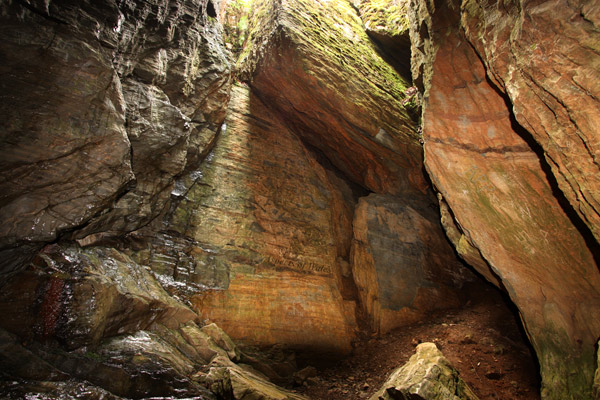
Twm's 'cave'? I've been there - its more like a grotto than a cave...  Image ©Paul Edwards 2011, http://www.aspectsofwales.co.uk/Twmsioncaticave.htm

Twm’s ‘cave’? I’ve been there – its more like a grotto than a cave…
Image ©Paul Edwards 2011, http://www.aspectsofwales.co.uk/Twmsioncaticave.htm

Ystradffin and its environs are connected to the Marian cult which supplanted paganism in the middle ages, and the nearby hilltop church of Llanfair-ar-y-bryn (St Mary on the Hill) bears witness to this. This was a region once deemed important enough by the Romans to have built a road and fort there, perhaps marking it as an older hotspot of banditry than the medieval and early-modern ‘Twm’ legends give credit for. It was, after all, the frontier with the last part of southern Britain to have maintained an indigenous Celtic social structure and religion, making it a breeding ground for early Christianity.

This brings us to the name, ‘Twm Siôn Cati’. Obviously it is reasonable to suggest it is an indigenous mode of naming common to the Celtic world and its love of genealogies and foreshortened nick-names – ‘Tom, son of John and Catherine. Let’s analyse the name:

Twm:

The name ‘Twm’ (Tom) is a Christian name of a legendary early acolyte and proselyte of the Hebrew sage Jesus of Nazareth – Thomas the Twin. Coincidentally Thomas shares his feast day (6th Novemeber) with the Welsh saint Illtyd (Illtud) who was credited with founding one of the first and most vital Christian schools at Llanilltud Fawr (Lantwit Major) during the 6th century. This school has been linked to many of the early Christian missionaries of Britain and Ireland during the sub-Roman period, including Patrick. Thomas the missionary served as a popular saint by which to name children. He is most venerated in Southeast Asia for this reason, and is referred to as the ‘Apostle of the Indians’.

‘Siôn’:

The element Siôn, Sion or Shon is usually supposed to represent the Welsh version of the name ‘John’. However, the phonetic ‘shon’ might also relate to Celtic words for ‘old’ – Welsh=(S)hen, Manx=Shenn, Irish=Sean. It also lies in the phonetic scope of celtic words for ‘blessed’ – Irish= séant, Manx=sheaynt,

‘Cati’:

Although linked in modern legends to a woman called ‘Catherine’ the name ‘Cati’ has a much more interesting past with distinct links in the insular celtic folklore and legends with both rebel-bandits (Scots/Gaelic: Cathair, giving the Irish bandit-name Caher Roe) and a bevy of mysterious magical females going by the name of Caitlin, Cathaleen etc who gave their names to a number of places, not the least of which is Enniskillen, where Caitlin is believed to have once have been a pagan goddess with a sanctuary on the island there. ‘Cathaleen’ is the the female temptress overcome in legends about St Kevin of Glendalough on a lakeside crag (for more information on her, see my other posts on the matter).

This interpretation might imply that legendary Old Twm, the helpful outlaw, was originally believed to have been the son of ‘Cati’, the ‘sitting one’ who presided over ancient shrines on crags overlooking water…


Gods and Robbers: Sawney Bean

‘Gods and Robbers’ – an introduction:

I shall begin this ‘Atlantic Religion miniseries’ by just recapping on some of the mythologising phenomena that have influenced formerly pagan stories and woven them into the christianised narrative framework in Europe.

A number of different polemic and propaganda techniques appear to have been employed in the medieval Christian church’s efforts to incorporate and subsume the many and deeply-rooted European pagan narrative traditions which, even by the 12thC, were apparently deemed sufficient threat to undermine the establishment of the Christian religion and its vast power structures in Europe. The violence and outright warfare of Charlemagne’s 8thC conquest and forced conversion of pagan Saxon tribes, and of the Albigensian and Northern crusades of the 12th and 13th centuries was on the more extreme end of this spectrum, however. The church and its propaganda operatives generally relied more on polemical traditions, largely developed by the early ‘church fathers’ and used by northern missionaries such as Germanus of Auxerre, Ninian, Palladius, Augustine of Britain, and Patrick during the 5thC sub-Roman/early medieval period.

The main methods used for ‘handling’ pagan traditions can be summarised as follows:

1. Demonisation and ‘Monsterisation’: Perhaps the earliest and most basic technique, based on the theories set out by the earliest Christian authors and ‘church fathers’ that all pagan gods were in fact Satan’s evil demons who had been deceiving humanity for centuries. This would have been most prone to causing conflict among the target populations of missionaries as it equated their gods with ‘evil’. A more gradual process of ‘monsterising’ was also employed, which generally de-emphasised the ‘demonic’, and promoted the pagan characters as ‘monstrous’ (and technically then within the extremes of the natural order).

2. Euhemerisation or ‘humanisation’: Slightly more sympathetic and less likely to meet with violent opposition, this techniques was based upon the tendency of pagan nations and cities to deify their ancestors and pseudo-ancestors. It therefore became a ‘softer’ early Christian polemical doctrine to teach pagans that their gods were in fact originally human ancestors who they had formerly simply worshipped  in ‘error’. By this, they ‘humanised’ rather than ‘dehumanised’ pagans and their traditions, and were able to maintain the more deep-seated affections of ancestor-veneration in a Christian context. The gods therefore simply became part of the historical tradition: For this reason, the official genealogies of fervently-Christian 10th and 11thC Anglo-Saxon kings (written down for them by Christian scribes) were therefore able to firmly claim their proto-ancestor as Wodan without any bother! Likewise, the medieval Welsh Hareliean Genealogies did the same with the pagan gods of the ancient Britons. European peoples would give up their gods before they rescinded their ties to their ancestors, so deep was this spiritual link to the past.

3. Demotion and Diminution: The significance of pagan characters from narrative traditions could be demoted while still maintaining their presence in local Christianised traditions. Gods could become more humanised in their legendary forms and abilities, they could be given human parents. Goddesses became ‘fairies’ and ‘mermaids’, or just old ladies living deep in the woods.

4. Sanctification: The pagan characters of myth were often worthy and moral, generous and helpful and it was often more fruitful to portray them under the guise of a Christian ‘saint’, thus maintaining the important moral aspects of pagan tradition which were impossible to attack with demonization or demotion. It also allowed the pagan cultic sites to be employed under the ‘Theodosian’ system of usage-conversion.

5. Marginalisation: This was the siting of pagan mythical characters and traditions outside of the centre of the communities they formerly occupied. It might involve a relocation in both time and/or space, and was often coupled to the processes of humanisation, diminution and demonization.

These techniques inevitably became a part of popular tradition-making, devolved from ecclesiastical influence. The latter process (marginalisation) appears in part to be responsible for the creation of a number of popular ‘Outlaw’ legends throughout the British and Irish islands whose origins seem to be lost deep in the mists of the medieval period, and whose persistence perhaps owes itself to their deeper and more ancient mythical provenance:

‘SAWNEY BEAN’:

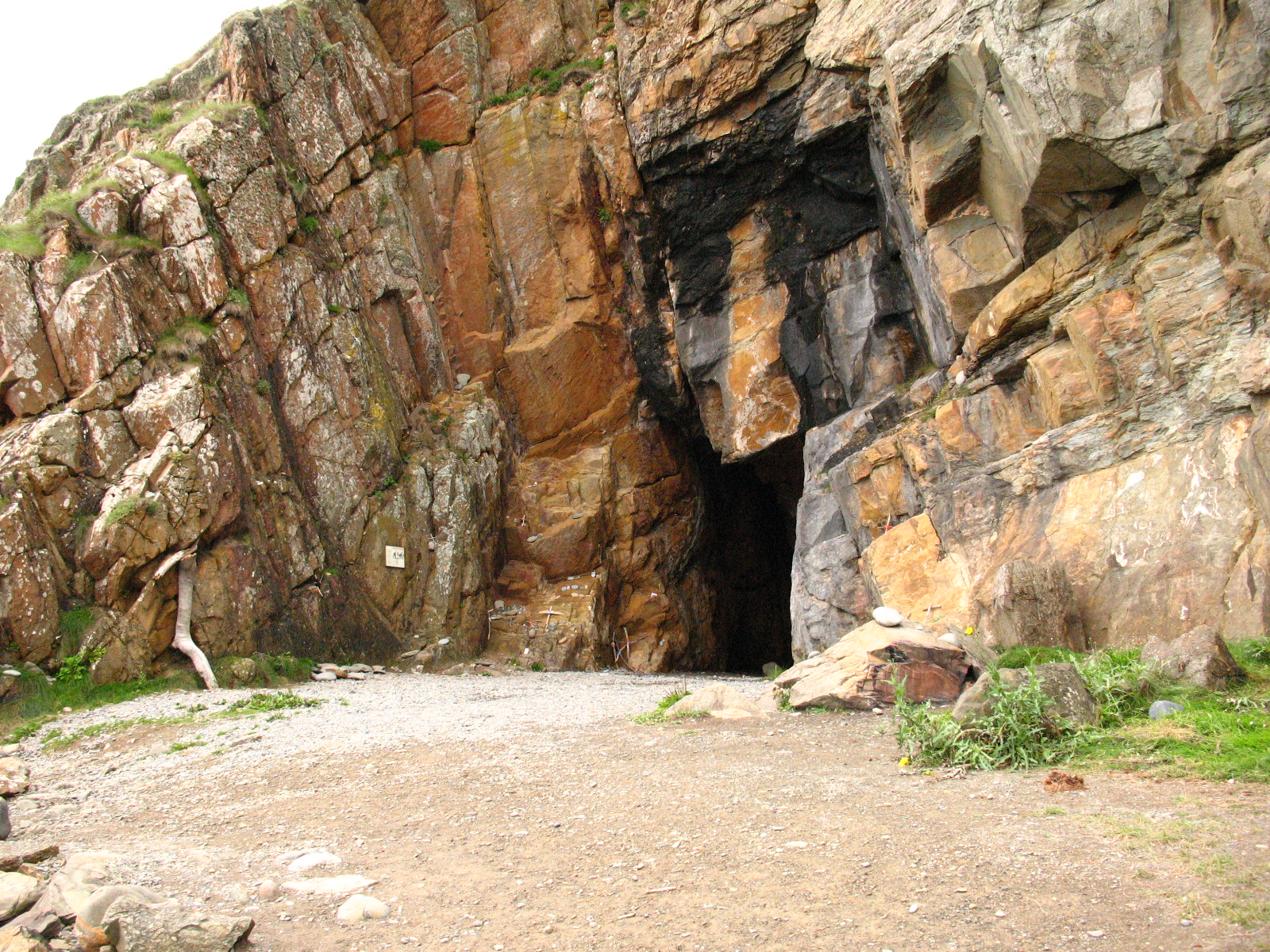
The popular notoriety and stories of the legendary Scottish cannibal-bandit ‘Sawney Bean’ still generates horror, revulsion and tourist dollars in his native homeland. The story goes that ‘Sawney’ (which is a Scots colloquialism of the name ‘Alexander’) ran away from his honest parents, joining forces with an equally evil-minded woman to live a life of crime and hideous cannibalism. They supposedly lived in a cave at Bennane on the Ayr/Galloway coast, on the Firth of Clyde, and had many children who they inculcated into their nefarious ways, sending the clan out to raid, steal and abduct and murder locals, whom they took back to their cave and cannibalised. They were evil in every way: an epitome of horror – robbery, murder, incest and rape were, as it were, their ‘bread and butter’. However, the legend goes that they were captured and taken to Edinburgh where they were tried at the behest of the King of Scotland before being mutilated and burned to death as punishment for their crimes.

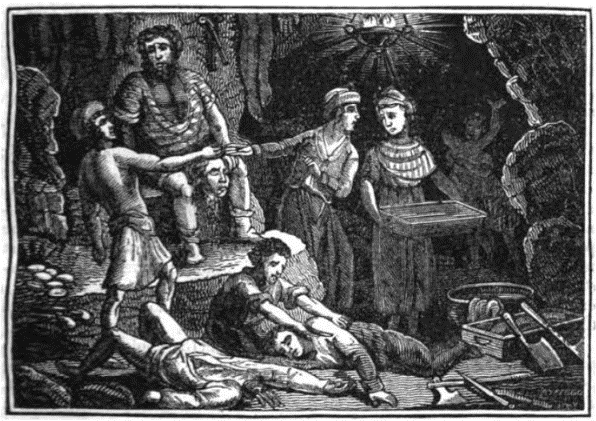
'Sawney Bean' and his clan sit down to supper

‘Sawney Bean’ and his clan sit down to supper

Although the story is dressed up in an air of official historicity, an examination of evidence pertaining to it uncovers many levels of polemical intrigue with elements spanning from the medieval era down to the 18th century, and smacks strongly of the legendary, being difficult to locate to any one period in time. Sawney Bean and his tribe have been described as active in either the 15th, 16th or 17th centuries during the reign of the Stuart kings – it varies somewhat, depending on the telling. His name is sometimes given as ‘Donald Bane’ or ‘Donald Bean’ (‘Fair Donald’) – coincidentally the name of a Gallovidian monarch of the 11th century, linked to MacBeth and Mael Columb. Modern understanding of the tradition has been largely informed by popular interest during the 18thC in the broadsheet press and its often sensationalised reportage of macarbre and bloody crimes and judicial executions. Publications such as London’s popular Newgate Calendar and its derivatives became responsible for an explosion of this subgenre, causing publishers to look past the here and now and take in an interest in historical (and romanticisied) tales of gruesome murderers with which to further scandalise and amuse their readership. Consequently, there was a popular explosion of interest in the Scots legend of the Sawney Bean and his exploits, complete with popular ballads and performances based on the tradition. On account of this, the legend tended to become fixed to a time and to a geographical location in the public consciousness, even though its true provenance was somewhere indeterminate, ‘over the horizon of history’ – perhaps in the otherworld. The 1780 edition of Part 1 of the Calendar covered the years until 1740 and regaled its readers with details of famous murderers on a case-by-case basis. The inclusion of the legendary Sawney alongside more avowedly historic and contemporary characters must perhaps be viewed in the light of the prejudices projected against the Highland Scots and Irish following the Wars of Religion and Jacobite Rebellions. It derived from a number of earlier chapbooks, but as I cannot find prints of these to transcribe, I’ve included the Calendar version here (for a more detailed account of the printed origins see here):

“… SAWNEY BEAN

An incredible Monster who, with his Wife, lived by Murder and
Cannibalism in a Cave. Executed at Leith with his whole Family in
the Reign of James I

THE following account, though as well attested as any historical
fact can be, is almost incredible; for the monstrous and
unparalleled barbarities that it relates; there being nothing that
we ever heard of, with the same degree of certainty, that may be
compared with it, or that shews how far a brutal temper, untamed by
education, may carry a man in such glaring and horrible colours.

Sawney Bean was born in the county of East Lothian, about eight or
nine miles eastward of the city of Edinburgh, some time in the reign
of Queen Elizabeth, whilst King James I governed only in Scotland.
His parents worked at hedging and ditching for their livelihood, and
brought up their son to the same occupation. He got his daily bread
in his youth by these means, but being very much prone to idleness,
and not caring for being confined to any honest employment, he left
his father and mother, and ran away into the desert part of the
country, taking with him a woman as viciously inclined as himself.
These two took up their habitation in a cave, by the seaside on the
shore of the county of Galloway, where they lived upwards of twenty-
five years without going into any city, town, or village.

In this time they had a great number of children and grandchildren,
whom they brought up after their own manner, without any notions of
humanity or civil society. They never kept any company, but among
themselves, and supported themselves wholly by robbing; being,
moreover, so very cruel, that they never robbed anyone whom they did
not murder.   By this bloody method, and their living so retiredly
from the world, they continued such a long time undiscovered, there
being nobody able to guess how the people were lost that went by the
place where they lived. As soon as they had robbed and murdered any
man, woman or child, they used to carry off the carcass to the den,
where, cutting it into quarters, they would pickle the mangled
limbs, and afterwards eat it; this being their only sustenance. And,
notwithstanding, they were at last so numerous, they commonly had
superfluity of this their abominable food; so that in the night time
they frequently threw legs and arms of the unhappy wretches they had
murdered into the sea, at a great distance from their bloody
habitation. The limbs were often cast up by the tide in several
parts of the country, to the astonishment and terror of all the
beholders, and others who heard of it.  Persons who had gone about
their lawful occasions fell so often into their hands that it caused
a general outcry in the country round about, no man knowing what was
become of his friend or relation, if they were once seen by these
merciless cannibals.   All the people in the adjacent parts were at
last alarmed at such a common loss of their neighbours and
acquaintance; for there was no travelling in safety near the den of
these wretches. This occasioned the sending frequent spies into
these parts, many of whom never returned again, and those who did,
after the strictest search and inquiry, could not find how these
melancholy matters happened. Several honest travellers were taken up
on suspicion, and wrongfully hanged upon bare circumstances; several
innocent innkeepers were executed for no other reason than that
persons who had been thus lost were known to have lain at their
houses, which occasioned a suspicion of their being murdered by them
and their bodies privately buried in obscure places to prevent a
discovery. Thus an illplaced justice was executed with the greatest
severity imaginable, in order to prevent these frequent atrocious
deeds; so that not a few innkeepers, who lived on the Western Road
of Scotland, left off their business, for fear of being made
examples, and followed other employments. This on the other hand
occasioned many great inconveniences to travellers, who were now in
great distress for accommodation for themselves and their horses
when they were disposed to refresh themselves and their horses, or
put up for lodging at night. In a word, the whole country was almost
depopulated.   Still the King’s subjects were missing as much as
before; so that it was the admiration of the whole kingdom how such
villainies could be carried on and the perpetrators not discovered.
A great many had been executed, and not one of them all made any
confession at the gallows, but stood to it at the last that they
were perfectly innocent of the crimes for which they suffered. When
the magistrates found all was in vain, they left off these rigorous
proceedings, and trusted wholly to Providence for the bringing to
light the authors of these unparalleled barbarities, when it should
seem proper to the Divine wisdom.

Sawney’s family was at last grown very large, and every branch of
it, as soon as able, assisted in perpetrating their wicked deeds,
which they still followed with impunity.

Sometimes they would attack four, five or six foot
men together, but never more than two if they were on horseback.
They were, moreover, so careful that not one whom they set upon
should escape, that an ambuscade was placed on every side to secure
them, let them fly which way they would, provided it should ever so
happen that one or more got away from the first assailants. How was
it possible they should be detected, when not one that saw them ever
saw anybody else afterwards? The place where they inhabited was
quite solitary and lonesome; and when the tide came up, the water
went for near two hundred yards into their subterraneous habitation,
which reached almost a mile underground; so that when people, who
had been sent armed to search all the places about had passed by the
mouth of their cave, they had never taken any notice of it, not
supposing that anything human would reside in such a place of
perpetual horror and darkness.   The number of the people these
savages destroyed was never exactly known, but it was generally
computed that in the twenty-five years they continued their
butcheries they had washed their hands in the blood of a thousand,
at least, men, women and children. The manner how they were at last
discovered was as follows.   A man and his wife behind him on the
same horse coming one evening home from a fair, and falling into the
ambuscade of these merciless wretches, they fell upon them in a most
furious manner. The man, to save himself as well as he could, fought
very bravely against them with sword and pistol, riding some of them
down, by main force of his horse. In the conflict the poor woman
fell from behind him, and was instantly murdered before her
husband’s face; for the female cannibals cut her throat and fell to
sucking her blood with as great a gust as if it had been wine. This
done, they ripped up her belly and pulled out all her entrails. Such
a dreadful spectacle made the man make the more obstinate
resistance, as expecting the same fate if he fell into their hands.
It pleased Providence, while he was engaged, that twenty or thirty
from the same fair came together in a body; upon which Sawney Bean
and his bloodthirsty clan withdrew, and made the best of their way
through a thick wood to their den.   This man, who was the first
that had ever fallen in their way and came off alive, told the whole
company what had happened, and showed them the horrid spectacle of
his wife, whom the murderers had dragged to some distance, but had
not time to carry her entirely off. They were all struck with
stupefaction and amazement at what he related, took him with them to
Glasgow, and told the affair to the provost of that city, who
immediately sent to the King concerning it.   In about three or four
days after, his Majesty himself in person, with a body of about four
hundred men, set out for the place where this dismal tragedy was
acted, in order to search all the rocks and thickets, that, if possible, they
might apprehend this hellish crew, which had been so long pernicious
to all the western parts of the kingdom.   The man who had been
attacked was the guide, and care was taken to have a large number of
bloodhounds with them, that no human means might be wanting towards
their putting an entire end to these cruelties.   No sign of any
habitation was to be found for a long time, and even when they came
to the wretches’ cave they took no notice of it, but were going to
pursue their search along the seashore, the tide being then out. But
some of the bloodhounds luckily entered this Cimmerian den, and
instantly set up a most hideous barking, howling and yelping; so
that the King, with his attendants, came back, and looked into it.
They could not yet tell how to conceive that anything human could be
concealed in a place where they saw nothing but darkness. Never the
less, as the bloodhounds increased their noise, went farther in, and
refused to come back again, they began to imagine there was some
reason more than ordinary. Torches were now immediately sent for,
and a great many men ventured in through the most intricate turnings
and windings, till at last they arrived at that private recess from
all the world, which was the habitation of these monsters.   Now the
whole body, or as many of them as could, went in, and were all so
shocked at what they beheld that they were almost ready to sink into
the earth. Legs, arms, thighs, hands and feet of men, women and
children were hung up in rows, like dried beef. A great many limbs
lay in pickle, and a great mass of money, both gold and silver, with
watches, rings, swords, pistols, and a large quantity of clothes,
both linen and woollen, and an infinite number of other things,
which they had taken from those whom they had murdered, were thrown
together in heaps, or hung up against the sides of the den.
Sawney’s family at this time, besides him, consisted of his wife,
eight sons, six daughters, eighteen grandsons, and fourteen
granddaughters, who were all begotten in incest.   These were all
seized and pinioned by his Majesty’s order in the first place; then
they took what human flesh they found and buried it in the sands;
afterwards loading themselves with the spoils which they found, they
returned to Edinburgh with their prisoners, all the country, as they
passed along, flocking to see this cursed tribe. When they were come
to their journey’s end, the wretches were all committed to the
Tolbooth, from whence they were the next day conducted under a
strong guard to Leith, where they were all executed without any
process, it being thought needless to try creatures who were even
professed enemies to mankind. The men had their privy-members cut
off and thrown into the fire; their hands and legs were severed from
their bodies; by which amputations they bled to death in some hours.
The wife, daughters and grandchildren, having been made spectators
of this just punishment inflicted on the men, were afterwards burnt
to death in three several fires. They all in general died without
the least signs of repentance; but continued, to the very last gasp
of life cursing and venting the most dreadful imprecations upon all
around, and upon all those who were instrumental in bringing them to
such well merited punishments …”

As it happens, there are no formal records extant of such a trial, which would surely have left its impression given that the monarch, James VI/I, seemingly took great interest in the judicial processes and personally attended a number of public trials. It would appear that the dating given in the Calendar was one of convenience, perhaps designed to suit the political atmosphere and prejudices of the late 18thC. Galloway itself was – during the early 18thC – a hub of the somewhat politicised Irish Sea running trade, and French privateer frigates were given safe haven in the Western Isles during the 7 Years War during the 1750’s and 60’s, so there was good reason why such a negative character might have been depicted hiding out in caves on the Galloway coast.

The cave of Sawney and his clan is most commonly located to Bennane Head, Ayrshire, formerly being in the lands of the distinctly Gaelic Kennedy clan who had ruled over the Carrick district since at least the time of Robert the Bruce. It is certainly capable of housing a group of bandits, but does not fit the description in the Newgate Calendar tale, which forms the basis for modern recollections of the tale in Scotland. It is not in a place which would have been sufficiently remote in ancient times. The cave has sufficient early 16thC provenance and importance to appear on a 1450 writ asserting the rights of Johne Kennedy to the lands at:

“…Bennane and Dalwegene with the Manor Place and Cave of the same togidder with the office of Seargandrye of the said Earledome Carrick and that upon the said Henrye Kennedy his resignation which lands and office he had held hereditarily from James II, dated at Aire febr 13 1450 …” (See: History of the counties of Ayr and Wigton, Volume 2 p.95, by James Paterson; Pub. James Stillie, Edinburgh 1864)

They cave is on a small bay, and could have served use as a warehouse, boathouse or even a defensive shelter, hence its inclusion in the above writ. James Paterson described the remains of a masonry bulwark wall at the head of the cave that was ancient in the 1860’s as well as remains of buildings. The Kennedy clan were eventually caught up in the religious chaos and in-fighting following the Protestant reformation, and the murderous intrigues and regional instabilities between Kennedy and his neighbours only hastened the willingness of the Stuart monarchy to finally begin to break independent Clan economic, military and religious power in the region – power which they had originally fostered.  It is perhaps no surprise that Sawney’s scandalous legend would have been located within these lands for this reason, but the history of banditry, piracy and ‘out groups’ in the West Lowlands has an even older provenance beyond the history of the Pictish and Dalriada kingdoms.

So… what of Sawney Bean in all of this? Evidently, to have inhabited the Bennane (Benand) cave he would have had to have done so with the blessing of the local Kennedy lairds, to whom the cave was evidently important. This makes the legend of a real outlaw unlikely, unless he was one of the Kennedy’s himself. Some regional clans certainly practiced piracy and smuggling down to the 18thC (some might argue they were no more pirates and smugglers than the King’s navy and trade fleets). Cannibalism? It seems like too lurid a detail to be true and almost certainly originates in Scottish polemical propaganda of the intrigue-riddled Shakespearean/Renaissance Age, rather than English efforts at Scots-bashing in the 18th century. ‘Makar’ poet, William Dunbar (Dumbar), might surely have made reference to the legend of Sawney Bean had it been current and associated with the Kennedys as a whole, when flyting his insults at the bard Walter Kennedy, younger brother of the 2nd Lord, John Kennedy of Dunure, in ca. 1503. This famous performance – known as The Flyting of Dumbar and Kennedie was apparently performed in the court of James IV in Edinburgh at the start of the 16thC and makes no reference to cannibalistic crooks, but yet for this is perhaps one of the most delightful pieces of insult-poetry committed to writing during the Renaissance! It was preserved in the Bannatyne Manuscript. Dunbar’s approbations of Kennedy (a clergyman, as befits his ‘second son’ status) are colourful to say the least, twice referring to the priest as ‘cuntbitten’ among a barrage of similar lurid insults.  None the less, Dunbar’s derision at no point makes any reference to his clan’s supposedly cannibalistic tenants, suggesting that if they were historic and associated with Bennane, then they likely came later in the 16thC after Kennedy’s death in 1507. However, this seems highly unlikely to be the case, given the lack of corroborative evidence for what would have been a well-recorded and sensationalised case in its day. Dunbar’s taunts at Kennedy were largely based on his appearance and ‘uncouth’ Gaelic mannerisms, including not a few imputations of paganism. Given the general lack of evidence to back up their existence, the clan of ‘Sawney Bean’ must therefore be considered legendary or mythological. This in turn leaves us with the possibility that more mysterious seeds may have populated the tale…

Was pagan mythology behind the ‘Sawney Bean’ myth?

The association of seaside caves with the mythology of the old Atlantic Religion seems to be a definite subtext in the folklore of the region. Nearly all such caves of any significance in the British and Irish Isles (not to mention Brittany and beyond) have enjoyed a connection to either saints or devils: Such a dichotomy of attribution is in itself highly suggestive of Christian polemic attempting to convert pagan legends into a form congruent with the ‘new order’. Galloway has, further south, a cave near Whithorn that was said to have been used by St Ninian and is still celebrated in association with the saint who is said to have bought christianity to this region at a very early time from Rome.

St Ninian's Cave: No mermaids here - please move along!

St Ninian’s Cave: No mermaids here – please move along!

Sea caves or caves near rivers are more often than not associated with pagan myths. The creation of caves is often related to underground rivers or springs, to which many (especially in limestone areas) owe their existence. They also represented a baser more ancient form of living – a place of resort in times of peril, and the habitation of those outside of the bounds of law and society. This made them the focus of many christianising legends designed to demote pagan ideas.

Sawney or Samhain?

The name ‘Sawney’ is usually believed to be a version of ‘Sandy’ and therefore a colloquialisation of the name ‘Alexander’. However, the name derives ultimately from the west coast of lowland Scotland, which was a predominantly Gaelic-speaking region until the 17th/18thC. This means that it is worth taking a gaelic linguistic approach to the name ‘Sawney Bean’, which contains obvious Gaelic elements (‘Bean’=’Bane’=white/fair). The first part of the name ‘Sawney’ is closest to the Gaelic festival name ‘Samhain’ (pron. ‘Saw-en’). Samhain was the festival of the dead when the souls of the departed (the Sluagh Sidhe) were near at hand, waiting to be carried off to the otherworld. The cave associated with Sawney Bean is located at a place containing aspects of his name – the Bennane‘ – also a gaelic name. ‘Ben’ is, of course, the gaelic word translating as ‘female’ (mna is ‘woman’) and is also applied to the names of mountains. You might recall from my previous posts that there is an association with mysterious aquatic female spirits with headlands and foreshores, not to mention caves all across the Atlantic world from Spain to the Slavic lands. The frightening popular figure of the ‘Halloween Witch’ is perhaps the greatest demonic archetype associated with Hallowe’en/Samhain – this originally referred to a single magical female character, not ‘witches’ in general (which were probably an innovation of the 16th/17thC witch panics). In the Isle of Man, she was called ‘Jinny the Witch’ (‘Yinny’ = Aine) and she was probably also the sorceress of Manx legend known as ‘Tehi-Tegi’ who stole the souls of men and took them into the sea, before transforming into a mystical bird – the wren. Samhain was the period when fertility had been ‘stolen’ away from the world, and the Sawney Bean was also famous for abducting souls and death. Both him and the ‘Samhain Witch’ therefore take on an equally monstrous aspect whose terrifying legends draw them closer together in the legendary consciousness… so much so that Sawney’s wife takes such a role in his legend. Of further linguistic interest, Sawney was sometimes referred to as

Written legends or traditions about ‘Sawney Bean’ are somewhat hard to come by. Most traditions available to study in literature (late 18th and 19thC) seem to have arisen from the Newgate Calendar versions of the tale, which influenced the growth of the tale in popular culture down to modern times. 19thC English author, the wealthy and well-connected politician/lawyer/novelist Robert Plumer-Ward included Sawney Bean in a romantic short story called ‘St Lawrence’ which was printed in many of the literary magazines in the early-mid part of the century. The tale is set in the fictional ‘Castle Campbell’ in Kintyre, in which the laird is forced to tell his visitors of the tale of Sawney Bean after his guests enquire why his servants are nervous of a coming storm. The laird intimates that it was a tradition of the clan is that Sawney’s soul periodically returned to cause severe storms, and that he was a supernatural personage. It is unclear if Ward was simply using literary license or quoting a tradition he had discovered through research – he was a well-connected individual who almost certainly was entertained in Scottish castles with similar stories. Here is a passage which sums up Ward’s use of Sawney in his tale:

“…’Scotland would not be Scotland,’ returned Mr Campbell, ‘if some such appendage had not been added to the tale. In truth, the whole neighbourhood believed that the storm which had closed the sea entrance had been the express work of Providence, for it never happened before. Sawney believed it too and the farmer who took him, being a Campbell who had emigrated to the north of Ireland from this place, he swore as he was led to execution that he would visit it every twenty years, and bring destruction upon all of the name’… “

The implication is that ‘Sawney’ was a spirit who haunted certain members of the widespread clan of Campbell – one of the oldest Gaelic clans, who famously claim ancestry with the tragic Fenian hero Diarmuid O’Duibne, whose legend claims he hid out in a cave with his lover (and wife of Fionn), Grainne, before dying fighting a fierce wild boar. In the Isle of Man one of the names for a mythological fairy-pig was ‘Arkan Sonney’ (Uirceann Sonney) – another hint at the older aspect of ‘Sawney’.

Summary: Sawney Bean was the name of a legendary Gaelic Scottish cannibal-outlaw supposed to have lived with his wife and family hidden in a cave on the Galloway coast. His existence has no historical veracity but his demonization myths were applied politically, both by the Scots (against the Gaelic Scots) and later by the English, to whom he provided a Scottish ‘bogeyman’ figure for the troubled Jacobite era. The name ‘Sawney’ means ‘Alexander’, and was a popular form of the name during the 18thC. However, in the gaelic tongues, ‘Sawn’ could quite reasonably be the word ‘Samhain’ – a name for the festival of the dead, associated with a latterly monstrous magical female character in the Irish sea region. This character is known variously as ‘The Witch’, ‘Cailleach’, ‘Tehi-Tegi’, ‘Jinny’, ‘Ouna/Ona/Una’, ‘Aine’ and ‘Shoney’. It is quite reasonable, therefore, to wonder if ‘Sawney Bean’ has something to do with a demonised, demoted, euhemerised and marginalised aspect of the legend of the Celtic Great Goddess…

Weland, the Swan Children and The Knight of the Swan

Emerging from the mythic and symbolic courtly story traditions of  12th century Europe, a popular and mysterious set of tales were told of children transformed into swans one of whom grows up to become the ‘Chevalier au Cygne’, or ‘Knight of the Swan’ – a questing knight who is conveyed in a boat drawn by a mysterious Swan which feeds him and guides him to his unknown destinations.

The earliest written  rescension of  the origin tale of the knight and his swan-kin comes from the late 12thC text ‘Dolopathos sive de Rege et Septem Sapientibus‘, by the monk Jean de Hauteseille. This was a latin version of a popular eastern story tradition known as ‘The Seven Wise Masters’, possibly acquired through contact with the Muslim empires. The birth of the swan children and the ‘Chevalier au Cygne’ tales merged with the Chansons de Geste traditions dealing with Godfrey de Bouillon, first ruler of the Kingdom of Jerusalem and popular icon of the First Crusade. These portrayed Godfrey as an ancestor of the Swan Knight, Elias, who had originally gained the Duchy of Bouillon after a swan arrived with a boat which conveyed him from his island home to protect the beleaguered Duchess of Bouillon, who then offered he hand in marriage. Further life was given to the legend in Wolfram Von Eschenbach‘s 13thC Arthurian epic, Parzifal, and versions of the story were retold into the 16thC (for example, Robert Copland’s English translation of the French versions in 1512).

Story of the Swan Children:

The essence of the Dolopathos account of the genesis of the swan-children is this: A knight wanders into a mysterious forest while hunting a white stag, where he discovers a mysterious woman by natural spring (an otherworld woman). They fall for each other and make love, and the knight takes her back to his castle where she eventually gives birth to seven children with gold chains around their necks. The knight’s mother is jealous and orders the children to be swapped in the birthing chamber for a litter of puppies, and has a servant take the children to the forest to kill them, where he decides to simply abandon them. The knight is angry that his wife gave birth to puppies and condemns her to buried up to the neck in the earth for seven years. However, the knight then finds that the children are alive and living in the forest and sends a servant to retrieve them. The servant finds the seven children – six boys and one girl – at a lake in the forest. The boys have taken off their gold chains and are swimming on the lake in the form of swans, while their sister – still in human form (wearing her chain) guards their chains. The servant decides to steal the chains and makes off with his loot to have them melted down by a goldsmith. The girl goes back to the castle to seek bread with which to feed her brothers who are now trapped in swan form, and eventually meets her father who has her tell the tale of what happened. The knight retrieves the chains and the boys can regain their human forms, except for one whose chain was broken by the goldsmith. He goes on to serve (or becomes – the source is unclear) the mysterious hero, the Knight of the Swan.

The story of the swan children is a curious bit of imagery, resonating strongly with the pagan mythical story traditions of Ireland (The Children of Lir, The Sickbed of Cuchullain). These feature birds (explicitly swans in the case of Lir’s children) who are bound with chains. However, the motif occurs in not just Irish and French legendary traditions – in the Norse Icelandic Völundarkviða (Poetic Edda), Völundr (Weland) and his two brothers meet and make love to swan-maidens (Valkyries) bathing  in a lake in the forest while hunting. The implication in the genesis story of the Swan Knight is that the ‘Lady of the Fountain’ is herself of an avian aspect, much like Manannan’s wife, Fand, in the Serglige Con Culainn, in which she briefly becomes Cuchullain’s lover and tormentor. The Norse goddess Freyja was attributed with a ‘feather cape’ in the Eddas, and as receiver of ‘half of the slain’ she may herself have been a or the Valkyrie. The greatest similarity with the Knight of the Swan entrée, however, is the Irish tale Clann Lir (‘Children of Lir’): It shares many features with minor differences – in the Irish tale, there are four children (three boys, one girl). Their mother dies and their stepmother is jealous of them and orders a servant to kill them. However, the servant refuses and the stepmother transforms the children into swans by magic. The swans are connected to each other by silver chains. They wander the earth for 900 years until (depending on the version) their deaths are caused when their chains are broken off by a marauder causing them to immediately age and die, or when they hear the tolling of a church bell or are blessed by a priest.

The tale of children turned into birds is actually a widespread folktale motif (Grimm collected a ‘Six Swans’ tale from Germany) and therefore has an Aarne-Thompson classification of type 451. However, the theme of the chains is not so frequent. Obviously, these stories are widely divergent, but what is the underlying significance?

About the Swan Knight himself:

The Knight of the Swan is named variously as Helias or Helyas in the French traditions, and as Loherangrin in Wolfram’s Parzifal. ‘Helias’ sounds a bit like the Greek name for the sun – Helios. Wolfram Von Eschenbach’s character Loherangrin has  the -angrin suffix, somewhat redolent of the Irish words an grian – the sun! As Wolfram was borrowing from Celtic story traditions, this interpretation is theoretically possible. However, there is another perhaps more likely explanation for Helyas/Helias, this being that it derives from a Celtic word for swan, which in Irish is eala. Nevertheless, the links between Weland and the Celtic solar god, Belenos, that I have discussed elsewhere may add weight to the identity of Helias with Helios.

In the Romance of Godfrey de Bouillon, Helias is born to King Oriant of Illefort (‘Strong Isle’), the introductory part of the tale being a rescension of the Swan Children tale. As the Knight of the Swan he is conveyed overseas on his quest by a swan which tows him in a small boat. The swan looks after the knight, who trusts it to take him where his bravery is needed, and where he might find his fortune, a wife and good honour in combat. This applies to both Helias and Loherengrin. The knight is under a tabu or geas that he must not reveal his name to those he meets, and when he breaks it, the swan carries him off. Other Arthurian heroes trot around on horses, but the Chevalier au Cygne stands aside as a water-bourne character. The ‘magic isle’ motif was common to the Celtic tales of Europe’s Atlantic seaboard – for instance, the Breton ‘Isle of Lok’ comes to mind. Perhaps this is the origin of the ‘Loher-‘ prefic of Loherangrin?

The stories are full of themes of captivity – a feature all too familiar to men of the crusader age, whose favoured saint became the chain-loosening St Leonard. The captivity of form in the case of the children, the captivity of knightly obligation, and the captivity of the geas or tabu. The swan – a white bird – is also an otherworldly creature with a propensity for migration and sitting on water, itself one of the gateways to the otherworld. The chains of the swan-children are like an unbreakable link with the otherworld and simultaneously evocative of the art of smithcraft, itself often equated with magic, itself a form of ‘binding’ of unseen powers. This brings us back to the question – already touched on – of the legendary (sometime captive) smith, Weland, known in Ireland as Cuillean…

Link to Weland and Cuillean:

The Poetic Edda’s ‘Lay of Weland’ (Völundarkviða) starts with Völundr (Weland – a prince of elves) and his brothers coming across three swan-maidens bathing in a lake, who they take as lovers. Swans being migratory, the girls eventually take off and Völundr’s brothers go with them leaving him alone. Like Manawydan in the Mabinogion, he takes up the life of a craftsman, which causes him to be kidnapped by King Niðhad who wishes to exploit his metalworking skills and has his hamstrings cut so he cannot run away. He extracts a terrible revenge by killing the king’s sons and making their bones into jewels which he gives the unwitting king and his queen, raping their daughter causing her to become pregnant with his child – presumably the inheritor of  Niðhad’s kingdom. Völundr then flees by flying away through the air. This brutal tale is in itself a warning not to abuse the help on offer from the otherworld’s denizens, and as such contains the same themes as the Arthurian legends and fairy romances of continental Europe during the same period.

Weland’s Wilkinasaga tradition (occurring in the Romance of Dietrich von Bern/Thidrekksaga) depicts him as the son of a character called Wade – a giant who fathers him with a mermaid (haffru). It is essentially the same tale of enslavement by the king and description of Volund’s terrible revenge and escape using wings to fly away. His Gaelic equivalent/counterpart, Cuillean, is – as has been previously suggested – identified with the sea-god, Manannan. This would make Wade and Lir coterminous, and it is evident from the continental traditions of the Knight of the Swan (Helias) that his father was the ruler of an Island and that the knight’s father – like Wade – conceived him with a fairy woman linked to water. The 12thC hagiography of St Patrick by Jocelyn of Furness has him visit the Isle of Man and defeat a flying wizard called Melinus, who I have suggested sounds like Manannan and Merlin compounded. Given the link between Manannan, Cuillean and therefore Weland, this flying aspect adds another level of intrigue.

The depiction of Weland/Volundr in the saga and German romances of Dietrich von Bern of him escaping by flying on wings seems somehow to evoke the swan children. His ability to propel himself over water in a hollowed out tree is another theme from the Dietrich saga which evokes the Knight of the Swan’s self-propelling boat, and also brings to mind the legend of Sceaf and Scylding alluded to in Anglo-Saxon mythic texts and poems.

The word ‘water’ has a linguistic link to the name of Weland’s father – ‘Wade’. This can be seen in the Polish word for water, which is wody and the Russian is the same – voda, from which ‘vodka’ is derived. ‘Wading’ is walking through water and it is even possible that ‘Wotan’ could be linked to water. The Welsh name for Manannan, ‘Manawydan’, might also by the same reckoning contain linguistic connotations of Wade. Even the eponymous relater of the Anglo-Saxon Widsith (Exeter Book ca.10thC CE) might have a relation – being so far-travelled and apparently present (Taliesin-like) at different points in history not possible for a mortal human.

Water was definitely the route by which souls and life in general was believed to transit from the Otherworld. The general belief appears to have been that souls left this world in an aerial form – as birds. It is therefore no surprise that migratory water birds such as swans would come to represent the Otherworld’s intermediary animals par-excellence.

Footnote: The Greeks – Even the ancient Greeks had a myth of the ‘Swan Maidens’ coded into the pre-Olympian mythology of their own traditions. These were the three Graeae daughters of the primal sea-god Phorcys, who appear in the myth of Perseus. They live on an island at the reaches of the world-ocean, Okeanos, (figuratively) in the ‘realm of Kronos’ on the far shores of time, close to the Otherworld itself. Far from being bathing beauties in the Perseus myth, they are aged crones who share one eye between them. They are sisters to the Gorgons, who are also counted among the Phorcydes – monstrous children of the sea, whose numbers include Scylla and Charybdis, Ladon and the Hyda among othersI suppose they were more than capable of transforming themselves into ravishing beauties, as most of the Atlantic ‘woman by the water’ deity archetypes seem to have this ability…