Concordance of Belenos, Manannan, Merlin and Wodan.

Those who follow my blog will know that I have already discussed the linguistic relationship between the Late Iron Age Celtic god, Belenos, and the Slavic, Baltic and North European divinities known from medieval times at least as Veles, Weland/Volundr, Phol, Vili and Velnias. Due to the dynamism and migration of Celtic peoples and culture from the 4thC BCE, Celtic religion (particularly that of the ‘Belgic’ cultural movement) was to stamp its impact from the Black Sea to the westernmost reaches of Iberia and Ireland, taking with it a renewed and potent militarised (possibly fanatical) vision of its gods and philosophies. So why did a separate ‘German’ and ‘Slavic’ identity develop?

Germans and Slavs ‘were’ Celts:

By the advent of the western expansion of the ‘germanic’ Goths and other eastern ‘barbarians’ in the 4thC CE, the remains of the Celtic ‘world’ had been pushed away outside of the bounds of the Roman Empire – into Ireland and Scotland. The tribes referred to by Julius Caesar in the 1stC BCE as Germani had – through the lens of Roman ideation – been somehow defined as ‘different’ to the Celtic peoples, an opinion generally considered to be forged by their cultural and geographic impenetrability and indomitability rather than from any hard evidence of actual difference. By the time of the Gothic migration era (4th-5thC CE) and the collapse of the western Roman Empire there was no longer any concept of Europeans as ‘Celts’. Increasing religious diversification following Romanisation, and then the religious concordance and intolerance emerging under christianity had overwhelmed the spiritual cultural model of Europeans, replacing it with a power-franchise focussed on the East.

Of course, this still left a good deal of non-Romanised regions without Christian influence. Although ‘Celtic’ Ireland and Scotland were evangelised early on (5th-6thC CE) northern Europe (Germania, Scandinavia, the Baltic and Russia) was much later in coming to the table – holding out in places until at least the 14thC CE. It is from these that we find the apparent ‘Belenos’ concordances in the names of some of their important divinities, as preserved in medieval literature and later folklore. These cultures (pagan Anglo-Saxons, Vikings and Slavic Russ) certainly maintained a warlike ‘Belgic’ outlook – at least from the point of view of Christian observers, particularly those at the commencement of the ‘Viking’ raids (which commenced with a particular anti-Christian focus) in the 8thC CE. However, by this period, languages and the names of the divinities had evolved away from their ‘Celtic’ (let’s call them ‘Atlantic’) origins so as to make ‘Germanic’, ‘Slavic’ and ‘Celtic’ mutually exclusive cultural ideas for scholars by the modern era. Political and ethnic federalism and nationalism during the 19th and 20th centuries further demanded separate origins for these cultures.

So what about Ireland and Scotland?

Christian evangelisation of the (by modern standards) ‘typical’ Celtic regions of Ireland and Scotland probably began in at least the 4thC CE, although it is conventionally dated to the late 5thC by later literary sources – the era when ‘Patrick’ is supposed to have convinced all of Ireland’s kings to submit to Christianity. Ireland (and her eastern colonies) subsequently became early medieval Europe’s most important and vibrant intellectual powerhouse for christian religious scholarship and reinterpretation of pagan mythology. She was to send her acolytes into the former Belgic heartlands of Britannia (colonised by pagan Anglo-Saxons) and Francia – the territory of the Gallo-Germanic Franks – to assist with local efforts to impose Christianity, be it by propaganda or the sword.

This process (already discussed in some detail in the blog) meant that Ireland’s pagan mythology (written by Christians) is difficult to interpret at face value, although it is common for many to accept  it (albeit unwisely) as canonical. We know that ‘Belgic’ culture (the impetus behind the 279 BCE attack on Delphi) made it to Ireland – the stories of boastful hero-warriors such as Cuchullain and Finn, and the La Téne style of insular art seem to attest to this. Indeed, the magically and militarily powerful ‘magi’ or druids referred to in medieval accounts of the conversion period are another possible feature of this culture. We suspect that IrishTuatha Dé Danaan characters such as Lugh, Nuada and Ogma were local versions of Gaulish divinities Lugus, Nodens and Ogmios, yet we have no evidence of worship or any idea of their importance from placenames. Indeed, you are more likely to come across places named after the female ‘Cailleach’ or masculine ‘Cuillean’ than any of these continental characters.  Insular and continental evidence of actual religious beliefs and practices among the Celts is – although widespread – largely influenced by Romanisation and difficult to interpret, as we do not know for sure which names were from independent divinities and which were synonyms for individuals. These doubts add validity to following an inductive approach based on place-names, folklore and mythology (including Christian hagiography).

Belenos:

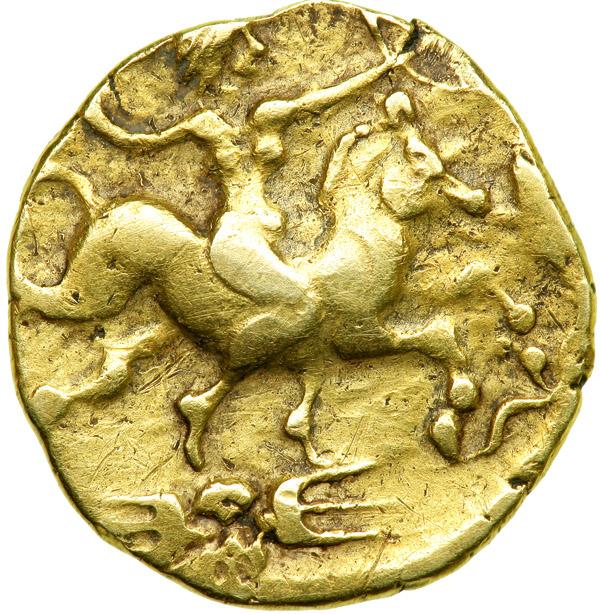
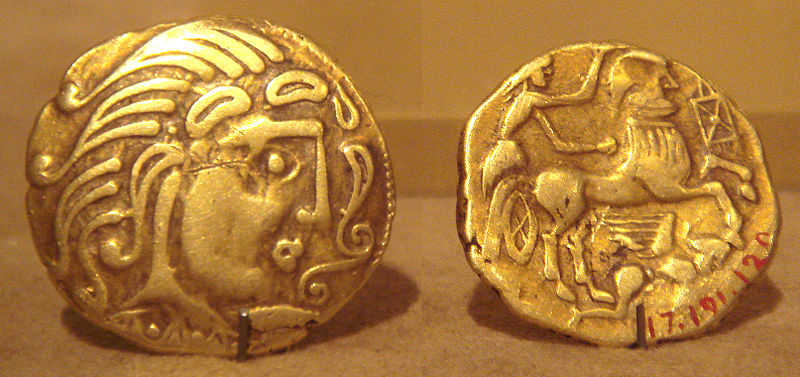
The reason I am taking ‘Belenos’ (Belinus) as an exemplary divinity to examine in the Gaelic context is because of his aspects as a solar god which places him at the highest apex of equivalent Indo-European dedications. He was an important enough divinity that the most important Belgic British tribe of the 1stC BCE-1stC CE – the southeastern Catuvellauni – appear to have been named after him, as were their leaders such as Cassivellaunus and Cunobelinus(‘Wolf/Hound of Bellinus’). Cassivellaunus was referred to as ‘Caswallon’ in medieval Welsh triads, and called ‘son of Beli Mawr (‘Great Beli’). Similarly theophoric names occur in the great warband of 279BCE – part of which was led by a leader called ‘Bolgios’. This attacked through the Balakans into Macedonia before part of it headed to the vastly important shrine of Pythian Apollo at Delphi, and others headed to settle Galatia in Anatolia. The Celts had a special attachment to Apollo, whose name appears to show a similar Indo-European root: A-pollo <> A-bollo. Apollo was a solar renewer as well as a hunter and warrior, and the Greek myths linked him to the mythical ‘Hyperboreans’ – the barbarians of the north who lived close to the monstrous zone, and Okeanos, the world-river. The depiction of Apollo on Greek coins of the Alexandrian age became an important influence upon the imagery depicted on the post-279 ‘Celtic age’ coins of Europe until the Roman conquests.

Although common to western Europe and Britain, the remains of ‘Belenos’ are much harder to identify in Gaelic Ireland and the Highlands and Islands of Scotland. In the 12thC CE, the learned Cistercian abbot and noted hagiographer, Jocelyn of Furness, was commissioned to write a number of hagiographies critical to establishing the primacy of the continental Roman Catholic church over the insular churches, which other contemporary commentators such as Gerald of Wales had implied kept some heathen  or backward usages. Jocelyn was commissioned by Anglo-Norman lord John De Courcy to produce a new hagiography of St Patrick to coincide with the new Anglo-Norman conquest of Ireland. Perhaps as a favour to De Courcy’s friend, ally and brother-in-law King Rognvaldr of the Isle of Man, Jocelyn included traditions from the island of Patrick’s supposed visit there and defeat its ruling wizard, who he calls Melinus.

“… Returning to Hibernia, he touched at the islands of the sea, one whereof, Eubonia–that is, Mannia–at that time subject unto Britain, he by his miracles and by his preaching converted unto Christ.  And among his miracles very conspicuous was this: a certain evil-doer named Melinus, like Simon the magician, asserting himself to be a god, and attempting the air with a diabolical flight, at the prayers of the saint fell headlong, and was dashed in pieces, and so perished …” (Translation from: ‘The Most Ancient Lives of St Patrick, Including the Life by Jocelin, Hitherto Unpublished in America, and His Extant Writings’ by James O’Leary; Pub. New York, 1880 P.J. Kenedy)

Melinus – by the conventions and mutations of Indo-European languages – is also pronouncable as ‘Welinus’ and therefore can become ‘Velinus’, from where we return to the name of the god, ‘Belinus’. Interestingly, the (later) Manx traditions about their pagan wizard-god refer to him as Manannan – the insular Celtic sea-god, although George Waldron (‘An Account of the Isle of Man’, 1734) says it was ‘Merlin’, which itself is very close to Melinus, while invoking the sometimes-mad wizard of the Arthurian romances gaining courtly popularity among northern Europe’s elites during Jocelyn’s era. In fact, Jocelyn’s is not the first reference to this character, whose appearance in Hiberno-Norse era Manx tradition is interesting given the Weland and Velnias traditions of the Scando-Baltic countries from which Mann’s 9thC onwards Viking visitors haled.

The name actually occurs in a couple of earlier Irish traditions linked to Christianisation: the first is the ‘Bishop Mel’ who was supposed to have invested St Brigit with her veil (‘veil’ derives from Latin velum). The other is the pagan robber-prince Mac Caille who Patrick banishes to the Isle of Man, and who eventually becomes the island’s patron saint, Maughold, who seems to have had trouble replacing Manannan in the popular mindset of the Manx people, even down to this modern day. In one of the early medieval Irish lives of Brigit, it is Mac Caille rather than Mel who gives Brigit her veil (the Greek word for which is Calyx, hence ‘Caille’). It looks like the christianisers played fast and loose with language in order to establish their order!

To compound further this mystery, I wish to return to the Norse-Germanic ‘Weland’ who I have previously noted to be identical with the Irish mythological Cuillean. A Manx legend based on the Ulster Cycle stories (and published in Ireland during the 19thC) said that ‘Cullan the Smith’ resided in the Isle of Man and was resorted to by Conchobar Mac Nessa for magic weapons. This suggested he – like Weland – was considered a blacksmith or artificer. If Weland originates in Belenos (as I have suggested) then this makes the names Cuchullain and Cunobelinos identical, as the Irish warrior-hero was named after Cuillean’s hound, who he kills (Ulster Cycle). The Manx mountain of Slieu Whallian is named after him (the ‘K’ sound is lenited), as are a number of mythologically important hills in Scotland and Ireland. In Mann, this hill stands next to the site of the ancient Tynwald hill at St John’s – the site where Manannan was supposed by a 16thC ballad to have been offered green rushes at the annual Tynwald ceremony.

Manannan himself can confidently be described as ‘Lord of the Otherworld’ in Irish mythology, and his eponymously-named islanders would agree with this. He is also portrayed in an immanent manner, rather than as a distant god, and this suggests that he must have been a manifestation of a solar god like Belenos. Like Cuillean or Weland he is a donator of weapons, and as befits a combined solar and otherworld god, his wonderings in the East and travels to the west are features of his mythology. Another important aspect of an otherworld god who travels to and from the world of the dead (reincarnates) is the idea of prophecy and delirium that underpins the oracular beliefs of the ancient world – such as the addled Pythoness who pronounced Apollo’s oracles at Delphi. The properties of amnesia and delirium are common themes of visionary ecstatic states caused by herbs such as Henbane (Hyoscyamus Niger), whose name in a number of European dialects seems to evoke Belenos: Bilsen (German), Pilsen (Czech), Beleno (Spanish). Pedanius Dioscorides (De Materia Medica – Book 4, 1stC CE) called it Herba Apollinaris, and said that the Gauls called it ‘Belenuntia’ or ‘Bilinuntias’: Perhaps this was in the Delphic wine which drove the troops of Brennus mad during their assault on the site of the famous Oracle, as he also calls it ‘Pythonion’ . This brings us to two ‘raging mad’ mythological figures of Europe’s ancient world:

Merlin and Wodin:

In the Germanic languages (Old High German and Old English) the name Wodin, Wotan or Wodan means ‘raging, mad one’. In the 11thC CE, Adam of Bremen described the god thus:  “Wodan, id est furor. ‘Raging’ was therefore an epithet of the highest god, who became known to the later medieval Scandinavians as ‘Odin’ and was (perhaps appropriately) their god of battle and of the dead. The madness implied in the name: ‘Wod’ is also applied to another character of medieval legend – the magician-sage-warrior Merlin recalled by Geoffrey of Monmouth, and the Arthurian romances he helped inspire. Geoffrey’s Merlin was both a prince and a madman who fled into the wilderness in a crazed fugue before his sanity was recovered. The story therefore shares elements of the tale of Odin, who is hinted in the Icelandic Edda stories to have undergone a similar tribulation as some kind of holy rite in order to receive higher knowledge. An Irish tale – of the mad king ‘Suibne Geilt’ – also has certain aspects of Geoffrey’s Merlin tale (‘Vita Merlinii’) and the battle-rages of the Ulster Cycle’s Cuchullain have something of the Odinnic Norse ‘berserker’ about them. But how does ‘Merlin’ link etymologically with Wodin or Wodan?

The Welsh name of ‘Merlin’ is Myrddin – pronounced ‘Merthin’. As ‘M’ sounds can become softened/interchanged to a ‘W’ or ‘V’ in Gaelic and other Indo-European language pronunciations (for a prime example, consider the Latin: Jupiter<>Jovis<>Jouis<>Jouuis) it is perfectly possible to see how ‘Myrddin’ and ‘Wodin’ can have concordance! Another aspect of the Merlin<>Manannan paradox suggested in Jocelyn of Furness’ Vita Patricii and later folklore emerges when we consider the Welsh equivalent of Manannan Mac Lir – Manawydan fab Llyr of the medieval Mabinogion tales. This incorporates the name -Wydan in it, which also seems close enough to ‘Wodan’ to suggest a possible concordance between Belinus, Melinus, Merlin, Manannan and Manawydan, not to mention Weland and Cuillean… Furthermore, the other middle-Welsh legendary character, Gwydion son of Dôn, has a similar name (the ‘G’ is silent).

After the establishment of literacy in Atlantic Europe, which itself followed in the traditions of Christianity, the plasticity of word-sounds became subservient to the orthodoxy and orthography of this tradition, explaining the plethora of different versions of the same name which epigraphy and literature gave to us. Some of these appeared so different that they were considered different…
 

Serpents and dragons in Irish mythology

“… No country in Europe is so associated with the Serpent as Ireland, and none has so many myths and legends connected with the same… “ Irish Druids and Old Irish Religions – James Bonwick, 1894.

Dragons and great serpents are common themes in the mythology of countries across the world, but their roles and meaning appear to differ depending upon the region concerned. In ancient Europe, serpents (the precursors of the more oriental ‘dragons’) were connected to the chthonic otherworld and underworld, and hence to ideas of decay – the earthy beginnings from which new life grows and the diseases and poisons which caused things to return to that state (i.e. – that process called ‘putrefaction’). They were linked to meres and marshes whose mass of rotting vegetation and sourness was a metaphor for death itself. That such marshy areas were filled with tiny worms, eels and wriggling creatures must have proved evidence that the serpentine and the decaying were linked – just as maggots appear to colonise rotting flesh and intestinal worms fill the excrement of most living creatures. This earth, the dung of animals and all manner of rotting vegetation – be it from the sea or the land – was a potent source of chthonic fertility and regeneration, and therefore wealth: a characteristic resplendent in mythological dragons.

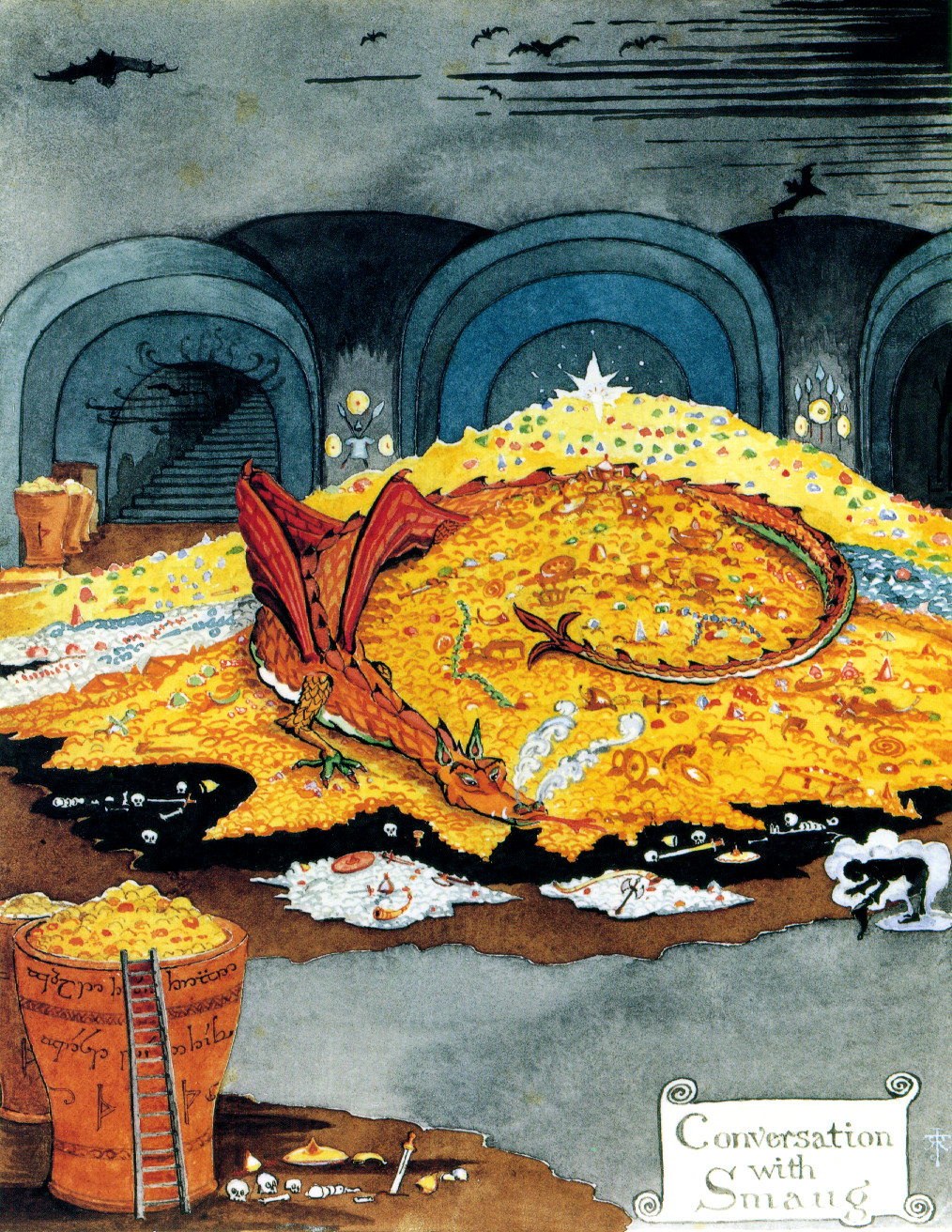
J.R.R.Tolkein 'Conversation with Smaug' (1937)

J.R.R.Tolkein ‘Conversation with Smaug’ (1937)

This ploutic (from ‘Ploutos’ or Hades: Greek god of chthonic wealth) treasure-guarding aspect of serpents and dragons is a feature of the north European mythologies, such as the legends of Sigurd/Siegfried and the Norse peoples. However, the monstrous serpents faced by mythological  ancient Greek heroes such as Hercules, Jason and Perseus also guarded treasures: The serpent Ladon, for example, was the guardian of the golden apples in the Garden of the Hesperides – on an island far to the west, near the setting sun and the realms of Cronos at the limits of Okeanos.

In medieval Irish mythology, such a class of beasts (where actually identifiable as dragons or great worms at all) were more often associated with tales of monstrous peril involving saints and heroes, and were (unsurprisingly) associated with the marshy aquatic realm. Usually referred to by the terns ‘piast’ or ‘péist’ – a ‘pest’ or ‘beast’ – they were often used in christian narratives of the middle ages as dangerous legendary personifications of the Old Order – linked strongly to its religious beliefs connecting water with the underworld or otherworld. Such an example is given in the Middle Irish tales of Acallam na Senórach in which the ancient hero Caeilte supposedly recounts the deeds of the Fianna to St Patrick, and explains that it was once their prerogative to rid the land of serpents and dragons… The narrative of the tale seeks to link such exploits of serpent-expelling with that typically Patrician art:

“…Eochaid Lethderg, King of Leinster, enquired of Caeilte: ‘What cause had Finn and the Fianna that, out of every other monster ye banished out of Ireland, they killed not the reptile we have in the glen of Ros Enaigh?’ Caeilte replied:Their reason was that the creature is the fourth part of Mesgedhra‘s brain, which the earth swallowed there and converted into a monstrous worm.’ …” (Translation: Standish Hayes O’Grady)

Mesgedhra’s brain features in the Ulster Cycle: he was an older king of Leinster killed by Ulster’s hero, Conall Cernach, and his brain was taken and calcined in lime as a gruesome war-trophy (heads were preserved in the Celtic Iron Age as trophies of enemies, although here it may be a bardic narrative allegory). Later, the brain was stolen and used as a weapon by the Connachta warrior Cet mac Mágach, who employed it as a sling-shot against Ulster king Conchobar mac Nessa. This left Conchobar with the brain-stone buried in his head, and it eventually exploded when the wounded Conchobar became angry and (presumably – the mythology is lost) a great worm must have escaped from his cranium… The terrible worm which the Fianna were fain to battle in the Acallam therefore represented a reincarnation of Mesgedhra through the cthonic realms. In the tale, this represented an ancestral blood-feud which the Fianna were loath to disturb. This itself demonstrates a figurative aspect of dragons as an analogy for warfare and vengeance, replete with great danger as well as the chance for enrichment, and potential long-term consequences.

There were in fact many other dragons associated with the tales of Fionn as well as a number of other Irish christian culture-heroes…

In the embattled times following the Flight of the Earls in the early 17thC, Fionn mac Cumhaill was a popular embodiment of the aspirations of Irish Gaeldom: A collection of Fenian lays known as Duanaire Finn was compiled at Louvain (Belgium) in the early 17thC by Aodh Ó Dochartaigh at the behest of exiled Gaelic magnate, Captain Somhairle Mac Domhnaill: A grandson of the renowned northern Gaelic dynast ‘Sorley Boy’, he was fighting the Catholic cause in the continental 30 years war). His wish was evidently to preserve the Fenian traditions among the fading bastions of independent Gaelic culture and power. Of particular interest are his descriptions in the poetic lay known as ‘The Pursuit of Sliabh Druim’ of the dragon-slaying antics of the Fianna:

This tale starts with a description of the Fianna at peace, doing what they love best when not at war: slaughtering game animals. Sliabh Druim provides the scene of their greatest hunting triumph (a veritable ecological disaster) but on progressing on to Lough Cuan, they are accosted by a great péist who announces that he has come from Greece to fight Fionn and his band. Fionn dispatches him, by way of an introduction to a bardic celebration of his history of péist-slaying antics, which in itself reads like a catalogue of Ireland’s loughs, bogs and rivers as it accounts for his slaying of dragons living in Loughs Neagh, Cuillean, Erne, Eiach, Lein, Righ, Sileann, Foyle, Eamhuir, Meilge, Sera, Mask, Laeghaire and Lurgan, as well as river serpents on the Shannon and the Bann, and in a number of glens. It appears that most of Ireland’s waterways and loughs were once well-populated with the reptilian kind, as well as dreadful ‘phantoms’ and ‘cats’ until Fionn had his way with them.

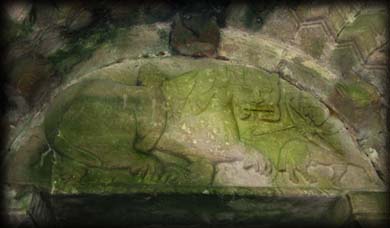
A tympanum from Cormac's Chapel at the Rock of Cashel depicts a Centaur shooting a peist with arrows... Fionn and a dragon?

A tympanum from Cormac’s Chapel at the Rock of Cashel depicts a Centaur shooting a peist with arrows… Fionn and a dragon?

Indeed, if we look at many of the legends regarding those later culture heroes – the saints of early chrsitian Ireland – we come across a number of significant encounters with ‘beasts’: The Cathach of Inniscathaigh was defeated by St Sennan, and the Bruckee was supposedly defeated at Rath Blatmaic in Co. Clare by St MacCreehy. St Caomhin (Kevin) was supposed to have defeated a beast who lived at Glendalough. The 6thC Saint Patrick, was – like the earlier Fianna – also apocryphally famous for casting ‘snakes’ out of Ireland. Such beasts were often implied to be female in Christian tales: The hagiography of St Senán – Amra Senáin – from the Leaba Brecc manuscript (RIA MS 23 P 16), is quite explicit about the Cathach’s sex. Such tales seem designed to identify beasts, serpents or dragons with the true indigenous religion they were replacing. These saints appear, therefore, to have subsumed the role of Fionn as dragon-slayers!

A modern replica of the Cashel Crozier...

A modern replica of the Cashel Crozier…

In christian-era art, the dragon was a recurring theme: The beautiful 13thC Crozier of Cashel (manufactured in or near Limoges, France) depicts an act of serpent-battling, and the hook of the crozier itself depicts a great snake. Another great jewel of medieval Ireland – the Tara Brooch – is decorated with a pin in the shape of tiny serpent, which appears to gnaw upon the jewel’s main body. In spite of the apparent absence of the species Serpentae among Ireland’s native fauna, the ‘serpent’ was, from early times, a well-known symbol in Ireland, as elsewhere in the Atlantic world. Why should this be so?

The 'Tara Brooch' c.700AD.

The ‘Tara Brooch’ c.700AD.

Morphologically, the connection of péists to rivers is easily explained by the serpentine appearance of such streams of water, but Ireland’s interest with serpents doesn’t stop there. In fact, it wasn’t just snakes which might be considered in the class of ‘serpents’ to the ancient mind: Eels, earthworms and any number of wriggling larval creatures and amphibians gave the Irish a ready supply. However, the lack of exemplary reptiles often led to cats, boars, badgers etc taking on the traditional role of the monstrous adversary-guardian for the purposes of mythological tales.

"Why are Herons so-called? Easy to say: They are 'Heros' who kill serpents..." The Greek word for Hero is 'Heron'...

“Why are Herons so-called? Easy to say: They are ‘Heros’ who kill serpents…” The Greek word for Hero is ‘Heron’…

The origin the English word ‘reptile’ is from the ancient Greek class-designator herpeta (sing. herpeton), meaning ‘crawling or creeping animals’. The Latin word ‘serpo‘ (from which we get ‘serpent’) means the same. The study of reptiles and amphibians is thus known by the modern term ‘herpetology’. The ancient class herpeta or serpenta does not necessarily refer only to reptiles and amphibians, but any animal which had a close association with the ground. More specifically, the idea of a ‘serpent’ developed an empirical class-association with worms, maggots, larvae and even ‘serpentine’ fish such as eels – referred to generically by the Latin word vermis, from which the English ‘worm’ is derived. This concordance is indicated by the ancient association between snakes and the power of putrefaction, disease, and gnawing: It is the reason why rats, lice, cockroaches, caterpillars and mice might all be referred to as ‘vermin’. It the reason why ‘wyrm’ was a synonym for dragons as well as snakes in Old English and the Germanic languages, and why gnawing cutaneous fungal infections are still referred to by the English word ‘ringworm’.

The typical ‘péist’ of Irish hagiography – when attributed a sex – was more often than not female. The word péist is usually translated as ‘worm, beast, monster’ (O’Brien), and its variants are peist, piast and biast/biasd – generally employed in the spirit of the ancient Greek and Roman usages: for instance, the Otter was calledbiasd dubhor ‘biasd donn’ in reference to its snaky shape, movement and colour.

The Irish word péist derives from the Latin bestia, meaning ‘beast’. It also connects to the Latin word pestis, meaning either disease, plague, destruction, ruin or death! Other Latin synonyms for ‘beasts’ include ‘Belluae‘ (large fierce animals – possibly after the manner of bulls and stags) and ‘Ferae‘ (large fierce predatory animals). Belluae seems to evoke the idea of war (Bellum), perhaps because armies moved, ate, fought and crapped like a huge animal, and draconine banners and standards were a feature of warfare since ancient times – particularly among the Celtic tribes of SE Europe during the late Iron Age period. The boar replaced the dragon among the NW celts of the same period.

Interestingly, the name for the fungal skin disease ‘ringworm‘ in Middle Irish was ‘frigde’ and in Old Irish ‘frigit’, and in late spoken Manx it was ‘chennney jee‘ (‘teine dé‘, god’s fire – ignis sacer – possibly the dragon’s breath) which by a Joycean ‘commodius vicus of recirculation‘ brings us back to the word and concept of the dragon or the péist, and by a number of associations, to our chthonic mother-goddess, Brigit – she of the sacred flame and the hearth…

The connection between the hearth and the earth is an old one: For starters, the English words are both etymologically linked. It is a place where earth’s produce is burned or prepared to eat – committing it to the recycling forces of nature for another turn. Anciently (and up until fairly recently in many parts of Gaeldom), the domestic hearth was a pit in the ground, so it is no wonder that the hearth and the chthonic otherworld are linked! The hearth fire was a place associated with the spirits of ancestors, and therefore with what became known from the middle-ages as ‘elves’ or ‘fairies’. Dragons attributed with the ability of breathing fire were no doubt a part of this chthonic mythology…

Dragons in the Celtic Iron Age?

There is in fact no evidence to definitively confirm that Celtic peoples of the European Iron Age believed in ‘dragons’. The popular imagination is certainly fired by archaeologists’ descriptions of the ‘dragon scabbards’ (a term popularised by Megaw & Megaw) of the elite Celtic warriors who were so instrumental in warfare during the Hellenistic and late Roman Republican periods. These all have the appearance of serpents or snakes – hardly the chimerical hybrid-forms of ‘dragons’ as we know them, with their aquiline talons, equine heads and wings. Celtic ‘La Tene’ art certainly added a ‘serpentine’ twist to its depiction of all animals, but there are no examples ‘dragons’ in the medieval sense! It is generally accepted that these were later introductions by the migrating warlike Steppes cultures whose peoples and influences flowed into the eastern European parts of the late Roman Empire – Scyhtians, Alans and Huns being examples of such groups. ‘Dragons’ were actually not a ‘Celtic’ phenomenon, but were certainly an influential narrative vehicle used in dealing with pagan themes during Europe’s Christian literary era in the middle-ages. The Viking Edda texts bear witness to this…

Gods of War and Agriculture

The identity of Mars in Roman culture shows a curious transition over the six or so centuries from its establishment as a regional power until its turbulent yet glorious Imperial era. Formed from a synthesis of native Latin, Etruscan, Sabine and Umbrian subcultures under a continuous stream of influence from their Greek and ‘barbarian’ neighbours it was a protean and ever-changing hotbed of innovation in both secular and religious matters. Its gods were therefore just as prone to change, and Mars makes an interesting case study:

Unlike the Greek god Ares, who tended to appear in myths (as befitted Greek warrior culture) as a dangerous quarrelsome outsider, Mars was treated more as an ancestral father-figure for the Romans. Livy (Ab Urbe Condita) recounted his role in Rome’s foundation-myth as father of Romulus and Remus by Rhea Silvia – a priestess of Vesta, identifiable with Vesta herself, otherwise cognate with the ancestral mother deity: Larunda, the Mater Larum. Indeed, Rome’s Etruscan forebears called their god of war Laran, which has similar connotations of the spirits of the departed, known as ‘Lares’. His consort was Turan whose entourage included the Lasas – another archaic name for Lares. Turan was also seemingly associated with birds – a common archetype for souls. She became identified in the Republican era with Venus – Mars’ complementary feminine aspect.

Mars’ agricultural aspect and his link to the ancestral spirits of the Etruscans and Romans is illustrated beautifully in the hymn of the priests known as the Arval Bretheren – the Carmen Arvale – preserved in a temple inscription, and invoking both Mars, the Lares and the fertilising spirits or Semones to bless the fields. The month of March (Martis – named after Mars) marked the sprouting of spring wheat and the beginning of the agricultural season as the weather warmed. Another Roman priesthood – the Salii – celebrated the rites of agricultural Mars, and had their origins back in the ancient Roman kingdom. They carried ancient shields called ancilia, which were kept in Mars’ temple. These were supposedly made by a legendary smith-armourer called Mamurius Veturius, possibly cognate with Mars in the Carmen Arvale under the name Marmor. The connection between the cthonic realm, food and metal seems obvious: the earth renders both. The annual re-forging of nature meant that it would not have been unusual for such a theological connection to have been made between smithcraft and the underworld.

Warfare and metal were likewise connected: War and death also. The annual death and rebirth of nature, and the fertility engendered in soil by dead matter (‘Putrefaction’) were likewise important parts of the same semantic field. In fact, the co-ordinated armies of people required for agricultural endeavours and the tendency for battle to be joined a campo in warfare added to this analogy. Rome and Etruria’s ancient wealth and power depended as much on agriculture as it did warfare, and Roman Mars expressed this idea.

Tied closely to Roman Mars’ semantic field-map are Janus, Mercury, Vulcan and Pluto. Pluto, because of the older connection to the cthonic otherworld and the Lares. Janus and Mercury because of the crossing of boundaries between the worlds, and Vulcan because of the active fiery, reforging aspect of Mars as an agricultural deity.

Elsewhere in Europe where hunting and transhumance and nomadic pastoralism were principle modes of food-production, one might imagine that the ‘herdsman’ aspect of cthonic gods was to the fore, and this indeed proved to be the case. The ‘wild hunt’ of Wotan, Velnias, Volundr, Herla are cases where battle-gods or smith-gods fulfill such roles. Thor was a battler-deity favoured for agricultural protection, as was Hercules.

The Greco-Roman mythological character who was the bestower of wealth was the ‘divine child’ Ploutos/Plutus, an aspect of Plouton/Pluto (related to the Roman gods Dis Pater and Orcus)who was at the heart of the Eleusinian Mysteries, and seems to have had a certain similarity to Cthonic Mars. Plutus was the child of Demeter and the Hero, Iasion, who made love to the goddess in a ‘thrice ploughed field’. The birth of Plutus might therefore have a parallel to the birth of the Etruscans’ ‘divine child’ Tages, who emerged from a ploughed field and gave knowledge of Augury and Haruspicy to the people. Knowledge of Sorcery or any form of Augury was to be found in the province of the dead… Mercury/Hermes was the ‘psychopomp’ responsible for conducting souls to this realm, as well as being the god of trade and pecuniary increase – the gift of Plutus transmitted in his hands back to this world from the Otherworld! Janus was also identified with the archaic member of the first Capitoline Triad, the Sabine god Quirinus, who was sometimes identified as a deified form of Mars’ divine son, Romulus. He ‘stood’ over the gates between the Otherworld and this world, and presumably allowed the two-way interaction between the spirit and elemental worlds to occur. Mars himself was therefore a conduit of masculine vital force from the spirit world which influenced the mundane world in a positive way. He was a keystone for the functions of a number of other gods, and was therefore one of the most important of Roman deities, and was venerated (under this wider identity) more than any other in the Romanised Celtic world…

Celtic Belenos and Balto-Slavic Veles

There is a certain difficulty encountered in equating ‘Celtic’ with ‘Slavic’ gods, particularly because the two ethno-cultural denominations are largely historically and archaeologically independent. A similar problem – perhaps more political – arises from the distinction between ‘Balts’ and ‘Slavs’. Some of the interpretation of the paleology and ethnology of the lands of the peoples who today call themselves ‘Balts‘ and ‘Slavs’ is still coloured by 19th and 20thC academic work beset with ideological political bias framed through artificial ethno-nationalist constructs. These were largely designed to support a federalised atheist communist Empire whose western borders desired such a buttress against western European identity. Nonetheless, in the era of the European Iron-Age, there was much more in common and the cultures and religious practices of peoples of this region would have been less determinately ‘Slavic’ or even ‘Germanic’ as the terms would be understood today…

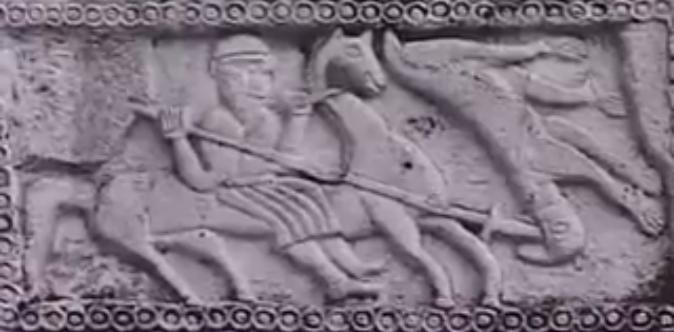
Perun and Veles - aspects of the 'Thracian Horseman' and 'Phrygian Sabazios'?

Croatian depiction of ?Perun and Veles – it demonstrates aspects of the ‘Thracian Horseman’ and ‘Phrygian Sabazios’

Although the pagan mythology of the Slavs is known to us from relatively late (medieval) accounts congruent with some of the pagan Scandinavian cultures, it contains a number of important characters for whom there is reasonable evidence to posit a link to western Europe’s older system of deities. The 12thC ‘Primary Chronicle’ of the Kievan Rus mentions Volos and Perun as the principle gods worshipped by Slavs and Russ before their late conversion during the Viking era:

“…Thus tsars Leo and Alexander made peace with Oleg. After agreeing upon the tribute, they bound themselves by mutual oaths. The tsars kissed the cross, while Oleg and his men took oaths in accordance with Russian law, swearing by their weapons and by their god Perun as well as by Volos, the god of cattle…” (trans. Samuel Cross)

The same Oleg is recorded as visiting sorcerors – the word for which is given as Volkhi. These tell him that he must abandon his favourite horse as it will cause his death, which he assents to and turns it to pasture. The story given is that he then goes to visit it and is told it died, and on visiting its bones a snake emerges from its skull and bites him, causing his death… The relationship between Volkhi, the Scandinavian Volva and the god Volos might be worth mulling over!

Another reference in the Chronicle to Volos and Perun (again in relation to oaths) is a record of a treaty and oath given by the pagan prince Svyatoslav of allegiance to the Byzantine Emperor:

” … And even as I have given oath to the Greek Emperors in company with my boyars and all my subjects, so may we preserve this treaty inviolate. But if we fail in the observance of any of the aforesaid stipulations, either I or my companions, or my subjects, may we be accursed of the god in whom we believe, namely, of Perun and Volos, the god of flocks, and we become yellow as gold, and be slain with our own weapons… ” (trans. Samuel Cross)

Interestingly, Cross translates ‘may we be accursed of the god in whom we believe’ implying the original sense was a singular god with two aspects: Perun and Volos. In fact, later folklore frequently conflates attributes of the two, suggesting this sense may be true.

Baltic Veles:

Marija Gimbutas examined the surviving 19thC Lithuanian and Latvian folklore attached to the spirits of the dead, who were there referred to as vėlės and to whom was attached a ‘leader’ known as Vélnias, Vélinas, or Véls – also used as a synonym for ‘devil’. In fact, an early dictionary of Lithuanian written by an ecclesiastic (Dictionarium Trium Linguarum by Konstanty Szyrwid, 1629) equates Velnias with ‘Piktis‘, another Baltic god-name associated with the ‘devil’, also known as ‘Pikùlas‘, ‘Peckols’ (Prussia) and ‘Patollo‘. These might be an example of the curious and widespread ‘Puck‘ hypostasis, possibly associated with local versions of Perun-Pirkons. The folkloric Vélnias was – like Odin/Wotan – one-eyed and led the troops of vėlės across the skies, causing storms and whirlwinds. He – like Veles – was also linked to herds. The vėlės themselves were – like Gaelic fairies – seen to troop between cemeteries and along their own special ‘paths’. Vélinas was explicitly a god of the hosts of the dead. Gimbutas notes the prevalence of placenames incorporating the name Vélnias that relate to bogs, pools, rivers, fields and forest clearings, suggesting the importance of such places to the local Otherworld mythology.

‘Velchanos’ in Crete:

The ancient Cretan/Minoan god Velchanos has been suggested as the origin for the Roman ‘Vulcan’. The Veles-Perun hypostasis mentioned in the Primary Chronicle of the Kievan Rus seems like it could link to this, particularly if the Weland link is correct. In Crete, he was also known as Zeus-Velchanos. The Latin words for thunderbolt, fulmen and fulgur, seem to have close etymological links to the Vul- prefix of the name Vulcan.

‘Vayl’ in the Isle of Man:

Vaayl‘ or ‘Vael occurs commonly in the Isle of Man (situated between Britain and Ireland) as a local word for ‘Michael’ (the thunder-voiced military archangel, leader of the heavenly hosts). For instance, there is a pagan burial mound referred to as ‘Carn Vael’, situated near the coastal village of Kirk Michael (Keeill Vaayl) – home to some of the syncretic Christian-pagan-era stone crosses and monuments. It is entirely possible that this name was introduced by Baltic settlers in the Viking Age, although convention usually holds to majority being Norwegians. A custom common to Lithuania, Latvia and the Isle of Man was the rolling down hills of burning wheels at Beltain or Midsummer (Manx source: Harold ‘Dusty’ Miller ‘It’s a Fact’). I have discussed the connection between St Michael the Archangel and Belenos elsewhere…

Etymological concordances:

The most obvious etymological link to the Celtic god Belenos is the ‘V’ of ‘Volos’ – a letter seemingly interchangeable with ‘B’ in the ‘Indo-European’ languages. This would suggest Bolos or Beles as a reasonable pronunciation variant of the Slavic divinity. Other versions of the name seem also to appear to in the 9th/10thC CE Old High German ‘Second Meresburg Incantation’:

“… Phol ende uuodan uuorun zi holza. Du uuart demo balderes uolon sin uuoz birenkit. Thu biguol en sinthgunt, sunna era suister; Thu biguol en friia, uolla era suister; Thu biguol en uuodan, so he uuola conda: Sose benrenki, sose bluotrenki, sose lidirenki: Ben zi bena, bluot si bluoda, Lid zi geliden, sose gelimida sin! … ““… Phol and Wodan were riding to the woods, and the foot of Balder’s foal was sprained. So Sinthgunt, Sunna’s sister, conjured it. And Frija, Volla’s sister, conjured it. And Wodan conjured it, as well he could: Like bone-sprain, so blood-sprain, so joint-sprain: Bone to bone, blood to blood, joints to joints, so may they be glued! … “

The names ‘Phol‘ and ‘Volla‘ (uolla, rhymed with uuolla = ‘well’) have sufficient similarity to be considered potentially related. Indeed, the English word for a young horse – ‘foal‘ – has in this context interesting connotations for the Iron Age Celtic coins’ equine/solar imagery, combined with the military sun-child head of Alexander they apparently used to represent Belenos. Going deeper into etymology, the Latin word for a lightly-armoured cavalry skirmisher (a notable form of Celto-Roman auxillary fighter) was Veles, no doubt having a link to the Roman word for warfare: Bellum. The horsemanship of the Dacians (Getae), Thracians, Macedonians and Anatolian peoples was legendary in ancient Europe. In fact, the religious iconography of the Thracian and Phrygian peoples was notable for their depiction of the dragon-slaying horseman figure who would later become incorporated in the image of St George the Dragonslayer, popular among the Slavs.

Another etymological and mythological link between Veles and the ancient ‘Germanic’ world is that to the ‘magical smith’, Weland/Wolund/Wayland/Volundr, who featured prominently in the folklore and legends common to a good number of ethnogeographical pagan cultures in ancient northern Europe. I have discussed the link between Volund, and ‘Vili’ of the Odinnic hypostasis in the Icelandic Eddas, and believe it is worth considering Slavic Veles in the same light.

Another example of this from the Baltic Lithuanians (one of the last European peoples to become officially Christianised in the 14/15thc CE) is the god or divinity called Teliavelis who was recorded in folklore as a ‘blacksmith god’, possibly identical with Vélinas. He has been compared to the Finnic Kalevala god-hero Ilmarinen,and can be linked to the Slavic smith-god referred to as Svarog in the 15thC CE Hypatian Codex. This collection of monkish ephemera claims that Svarog was father of Dažbog (‘giving god’) or the sun – the two are usually thought of as separate. However, the Serbian folklore variant Dabog or Dajbog is sometimes known as Hromi Daba (‘Lame Daba’) and depicted as a distinctly chthonic/demonic character similar to Veles/Velnias, called ‘Shepherd of Wolves’. Lameness (an inability to walk upon the earth) is a trait common to European smith-gods.

Christianity:

Aside from the links to St George (from the ‘Thracian Horseman’), it is widely believed that Slavic Volos/Veles was used as the model for an early Christian saint, popular in the Orthodox Christian community, called Vlas, otherwise Blaise, or Vlasius. St Vlas (whose feast day is 12th February). He is popular in eastern Europe from Macedonia up to Russia, in which regions he has been associated with protection of cattle, in accordance with the Primary Chronicle account. Linda Ivanits (‘Russian Folk Belief’ Pub: Sharpe, New York 1989) notes the tradition of hanging icons of Vlas in cow biers.

like duality seems to explain the Slavic veneration along with George and Vlas all the more. To this observation must be added another: Given the tendency of Indo-European languages to ‘aspirate’ initial consonants, it is also interesting to note how ‘Veles’ can quite easily become a solar ‘Heles‘, implied in the Greek words ‘Helios‘ (a name held by Apollo, also called Phoebus) and, of course the country: ‘Hellas’. The fact that many mountaintop sanctuaries to the Greek god Helios (i.e. – the deified sun) later became dedicated to ‘St. Elias’ (‘the thunderer’), a Christianisation of the monotheism-promoting, Baal-denigrating Hebrew prophet Elijah, invoked by observant Jews at the advent of Sunday in the Havdalah ritual terminating the Shabbat. The Macedonian town with the theophoric name Veles is the site of one such shrine, but there are others. The connection with the sun, thunder and lightning suggests that Perun/Perkunas/Taranis was another aspect of the Veles/Vélinas/Belenos, both of whom took up places in Christianity as modified saints and the devil himself.

This old Serbian Dodola/Dodole (rainmaking) song illustrates the Elijah-Perun link:

Da zarosi sitna rosa,
oj dudula mili Bože!
Oj lija daj Bože daj!
Oj Ilija moj Perune!
Daj Bože daj, daj Ilija daj!
Let fine dew drizzle,
oh dudula dear God!
Oh Elijah give us, God, give!
Oh Elijah, my Perun/Thunder!
Give us, God, give, give, Elijah, give!

Dodola/Dodole was supposed to be Perun’s wife. She is sometimes viewed as a Slavic rain-goddess. The antagonism between Perun and Veles revolved around Perun’s wife being stolen – remember that all rivers were once believed to flow to the otherworld, and the connection between Velnias and water in Lithuania 😉 Elijah functions here quite obviously as the ‘bridging’ function, representing Helios (who travels daily to the underworld in his rotations)…

IN SUMMARY:

– Volos, Veles and Velnias were associated with both the Underworld (realm of the dead) and with herds and hosts, including the hosts of the dead. In the Baltic, Velnias was associated with bogs and pools of water – classic Celtic routes into the Otherworld.

– Veles was closely linked to the ‘thunder god’ Perun (Perkunas or Perkons in the Baltic states) who was a ‘polar antithesis’ of him, possibly representing the forces ‘above’: sky, lightning, the up-thrust of trees, particularly the Quercus or Oak (Try switching the ‘Q’ for ‘P’ after the insular celtic style…). The two were represented in a state of mutual antagonism in some Slavic mythology.

– Veles/Volos may be related to the Germanic smith-god Weland/Volundr. The 9thC second Meresburg charm relates to horses and mentions ‘Phol’ and ‘Volla’. ‘Teliavelis‘ was the name of a Baltic smith-god, and the Slavs had ‘Svarog’ in the same role. A possible association with horses is that smith-gods tended to be crippled, and hence would have used horses to move about. The concept of reincarnation is engendered in the art of smithcraft – a secret fiery re-forging in the otherworld.

– The etymological leap from Vel to Bel is so slight that it would be remiss not to consider a link to Belenos: himself possibly a chthonic war-god, similar to Roman Mars. Likewise the link between Vel and Hel (which would be an aspirated pronunciation of ‘Vel’).

Etruscan religion in the Italic Iron Age

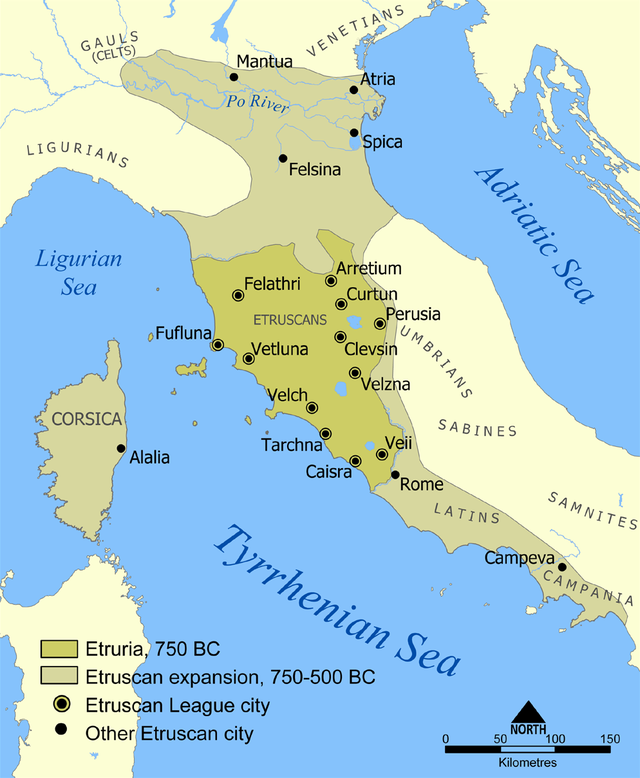
The Etruscan civilisation which dominated northern Italy until the rise of the Roman republic was responsible for contributing significant additions to the religion of one of the great military and cultural powers of the ancient world. It grew out of the 'Villanovan culture', which was itself an ethnic and cultural offshoot of the proto-'celtic' Urnfield Culture of north/central Europe during the Bronze Age. During the 7thC BCE, like other nations and ethnic groups in the Mediterranean region, it came under increasing cultural influence of the Greeks who were expanding their colonies westward via coastal trade and conquest.

640px-Etruscan_civilization_map

Although borrowing aspects of Greek-style immanent polytheist religion and adopting parts of the Olympic pantheon after the 7thC BCE, the Etruscan religious system maintained aspects of its older religious outlook, which by the time of the Roman Republic became identified in particular with a focus on Augury and Haruspicy – the reading of signs from nature and deriving prophecy from the behaviour (and entrails) of animals, and from natural phenomena such as lightning. The Romans referred to this (and the written texts upon which Romans based their augurial practices) as the Etrusca Disciplina, whose precepts became an important part of their religious life.

This particular aspect of Etruscan faith was indeed important: Etruscans were famed for their dedication to religion and required a professional technical priesthood trained in the disciplines of astronomy, natural philosophy (scientia), meteorology, zoology and the gods themselves. In this manner, they appear to have had similarities to the religious specialists among the Gauls and Britons, known to Greeks and Romans as Druids. Like the druids, the Etruscan priesthood were trained in colleges, the most notable late classical example being that opened by the Emperor Claudius in 1stC CE. The powerful influence of this religious system caused it to become the founding model for what would become Roman religious culture, and it therefore unsurprising that Etruscan religion appears to have had a fairly extensive pantheon of gods, albeit that Etruscan culture was formed from autonomous city states, each with their own interpretation of religious practices. These gods seem to have represented a system of immanent polytheism in which all natural phenomena were ascribed a divinity to represent them. However, the Etruscan religious system had three principal gods, named Tinia, Juni and Cel (later supplanted my Menrva). Tinia or Tin was the chief god, Juni his feminine counterpart, and Cel was the 'Earth Mother', perhaps responsible for the subterranean realms (her name evoking tombs and caves – cella). These seem to have evolved into the Roman 'Capitoline Triad' of Jupiter, Juno and Minerva. Under the influence of Greek and other Italic gods, the number of these diversified. However, the art of Augury and Haruspicy was apparently the principle feature of the religion by which the gods' wills were interpreted – Etruscans were natural philosophers par excellence.

Another feature of Etruscan religion which is notable is the fact that it was, by tradition, a revealed faith. The story of this was recounted in 44BCE by Roman author Cicero (De divinatione Book 2; 50-51.23):

“…It is said that, once upon a time, in the countryside of Tarquinii, while the earth was being plowed, a rather deep furrow was dug and suddenly Tages sprang forth and spoke to the man plowing. Now this Tages, according to the books of the Etruscans, is said to have had the appearance of a child, but the wisdom of an elder. When the rustic had gaped at his appearance and had raised a great cry in astonishment, a crowd gathered in a short time, all Etruria assembled at that place. Then he said many things to his numerous listeners, who received all of his words and entrusted them to writing. His whole address was about what is comprised by the discipline of soothsaying (haruspicinae disciplina). Later, as new things were learned and made to refer to those same principles, the discipline grew. We received these things from (the Etruscans) themselves, they preserve these writings, they hold them (as) the source for the discipline…” (Translation: Loeb Classical Library edition)

This tradition has several interesting aspects: Tages was obviously no earthly prophet, but was born from the furrow in a field in a rustic district. This would make him a child of the Etruscan goddess Cel, but also portrays the origins of Etruscan religion as being very indigenous and tied to the ancestral lands of their people. Cicero's account has the peasant gaping in incomprehending wonder while the educated 'townies' write the tiny prophet's words down, suggesting that Etruscan religion was based upon (now lost) canonical texts. Of course, this tale has all the hallmarks of a rustic religion sophisticated by the urbanisation of power in the Italic peninsula during the Iron Age, a process influenced and accelerated by the wealth of the land and commerce with the Greek and Anatolian states. Tarquinii/Tarquinia, founded by the legendary king Tarchon was one of the homelands of Etruscan culture, and therefore 'Tages' (Tarchies – the Etruscan language had no 'g' sound) may well be related as a demoted founder-god.

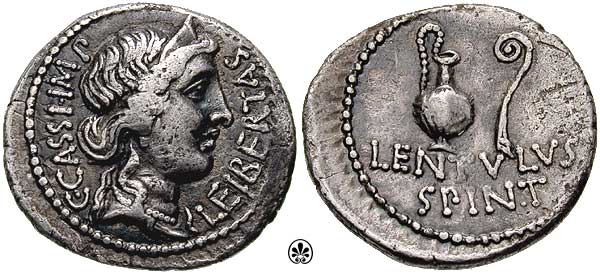
The Etruscan priest-seers are usually represented in Etruscan and Roman art as holding a stave or 'crook' known as a Lituus. This is sometimes depicted as a trumpet very similar to a Gaulish 'Carnyx' – straight with a curved tip. The lituus stave became the model for the Christian bishop's crozier, but its original form is mysterious. It may possibly have been a tool for assisting in the mapping or measurement of the night sky.

Roman Emperors were proud of their Etruscan heritage. This coin depicts the ritual artifacts of an Augur, including the Etruscan 'lituus'. Similar depictions also include a basin instead of the jug, suggesting the use of liquid 'mirrors' in the scrying process...

Roman Emperors were proud of their Etruscan heritage. This coin depicts the ritual artifacts of an Augur, including the Etruscan 'lituus'. Similar depictions also include a basin instead of the jug, suggesting the use of liquid 'mirrors' in the scrying process...

Etruscan cosmology appears to have been quite concerned about the importance of boundaries and divisions in the proper order of things. This probably represented a technical aspect of the need to assign signs and portents based upon where in nature they occurred. For this reason, Roman authors tell us that Etruscan religious teachings state that the gods were ascribed to 16 separate regions in the heavens, and that there were 8 (or 12) great eras of Etruscan history (seculae) the last of which was contemporary to them. The established limits and barriers which organised the Etruscan city-states and the rich agricultural land upon which their civilisation thrived were also of key importance. An account of the Etruscan 'Prophecy of Vegoia' preserved in a Roman treatise on land management known as ‘Corpus agrimensorum Romanorum’ (preserved in a 6thC mss collection) says this about the importance of physical land barriers:

“… Know that the sea was separated from the sky. But when Jupiter claimed the land of Aetruria for himself, he established and ordered that the fields be measured and the croplands delimited. Knowing the greed of men and their lust for land, he wanted everything proper concerning boundaries. And at some time, around the end of the eighth saeculum, someone will violate them on account of greed by means of evil trickery and will touch them and move them [….]. But whoever shall have touched and moved them, increasing his own property and diminishing that of another, on account of his crime he will be damned by the gods. If slaves should do it, there will be a change for the worse in status. But if the deed is sone with the master's consent, very quickly the master will be uprooted and all of his family will perish. The ones who move [the boundaries] will be afflicted by the worst diseases and wounds, and they will feel a weakness in their limbs. Then also the earth will be moved by storms and whirlwinds with frequent destruction, crops will often be injured and will be knocked down by rain and hail, they will perish in the summer heat, they will be felled by mildew. There will be much dissension among people. Know that these things will be done when such crimes are committed. Wherefore be not false or double-tongued. Keep this teaching in your heart…” (Translation quoted from 'The Religion of the Etruscans' Ed. Nancy Thomson de Grummond, Erika Simon; Pub. University of Texas Press 2009)

The Romans obviously took this heart as their annual festivals of the Liminalia and Robigalia seemed designed to celebrate the spirit of this traditional Etruscan prophecy. Vegoia was a female divinity similar to Tages who was quoted in the lost texts of the Etrusca Disciplina. Presumably this prophecy was originally a part of the corpus!

Another important aspect of the Etruscan religion which was followed by Roman religion was the belief in spirits of the dead travelling to and occupying a 'cthonic' or underground location. The cultus of the gods who looked after such realms in Mediterranean pagan cultures were actually deeply rooted to the source of their wealth and success (in both trade and warfare): organised agriculture. This is because of the cycle of death being strongly linked in nature to that of renewal: that which decays fertilises new growth. The ancient domestic ancestral cults linked the presence of the spirits of the departed ancestors with success in the temporal world.

Similar ideas were held by the Greeks and the Celts or barbarians of the 'Atlantic' north. However, one must be careful in how one interprets the idea of the spirits of the dead living in an 'underground' realm: Evidence from all of these cultures seems to suggest that this realm also had a reflected parallel existence to our own, and was also connected to the visible heavens and the concept of the far islands and shores of the world-river, called Okeanos by the Greeks…


The Celtic otherworld in Romanian folk belief

Although largely identifying its modern cultural ethne as ‘Slavic’, Romania’s historical and archaeological past shows that in the ‘Dacian’ Iron Age and late Classical periods its identity was definitely what we today would consider ‘Celtic’. This identity survived until the ethno-cultural engineering of Romanisation, and then the ‘migration period’ displacements of the late 3rdC CE which caused Roman withdrawal in the face of southern migration of Goths and westward migration of Scythic peoples: This introduced the cultural and linguistic foundations nowadays associated with the idea of ‘Slavic’, albeit with an enduring ‘Roman’ identity, preserved in the country’s name. These processes culminated with the early medieval hegemonies of the Caucasus tribes of Avars and Bulgars who eventually formed a stable state which, by fits and starts, had finally Christianised under Byzantine influence by the 9thC CE.

When Herodotus commented upon the Dacians (called ‘Getae’ by the Greeks) in his 5thC BCE Histories, he noted in particular that these peoples believed in the continuity of the soul after death. They were, after all, a people related to the Thracians, among whom the poet-seer Orpheus was supposed to have arisen, providing the European classical world with one of its most important religions, believing firmly in reincarnation. This provided its adherents with a particular map of the Otherworld which modern Celticists can quite easily identify with…

In the modern popular understanding about Romanian folklore, the most influential stories and beliefs surround the dark and fearful aspects of Strigoi – the restless dead who wish to abstract the life-force of the living. These are the model for the modern conception of vampires (and werewolves), and who we nowadays like to think of as humanoids with long sharp canines used to bite and suck the physical blood from peoples’ bodies. The reality (if you can call it that) of the idea of Strigoi is somewhat more complicated, and deeply tied to the ancient beliefs of souls and the otherworld which underpinned the religion of Europe’s Iron Age peoples, possibly extending deeper into antiquity. Characteristically, Strigoi can be either human (‘witches’ – the Italic word for ‘witch’ is ‘Strega’), but they might also be the undying or resurrected dead who seek to abstract human life-force (sometimes as actual blood) and who sicken their victims before finally taking their lives. They can shape-shift into animal forms and pass normally insurmountable physical barriers, and become invisible.

Coupled to the belief in a more sinister Stregoi is the important Romanian myth of the Blajini – the meaning of which translates almost exactly to that same phrase used in Ireland for fairies: ‘Gentle People’. These were spirits supposed to occupy a parallel reflected otherworld which mirrored our own, and at there is still a tradition associated with them, celebrated at Easter, known as Paştele Blajinilor. This festival (often celebrated a week or so after Easter proper) has strong associations with the ancestral dead. Apart from visiting or tending the graves of the departed, it is attached to a custom in which dyed or decorated eggs (often red) were made and eaten in their honour and the shells dropped into rivers to take them to the Blajini (the idea being that they should then know that it was Easter)! Readers of my blog will recognise that this custom is another explicit demonstration of an ancient European belief that all rivers flow to the ‘world-river’ (Apa Sâmbetei to Romanians, Okeanos to the Greeks), which bounds the shores of both our own and the ‘other’ world. Apa Sâmbetei is usually translated or understood as ‘Saturday’s Water‘, but is actually fairly obviously ‘Saturn’s Water‘ since the realm of Saturn or Cronus was in ancient mythology upon the far shores of Okeanos. The term evidently comes through the influence of Trajan’s conquest of the Dacians. Romanian folklore held that the souls of departed travelled through streams and rivers to reach the Otherworld, and this is exactly paralleled in the remains of Celtic pagan beliefs demontrated throughout medieval Irish literature, as I have previously discussed.

More interestingly, another belief attached in traditions to the Blajini was that they continually fasted in the Otherworld in order to sanctify our own world with the divine grace this practice bestows upon christians. They therefore provided a ‘boon’ to humanity, that demanded respect. This is the same belief that Scots minister Robert Kirk described in the Scottish Highlands in his 17thC ‘Secret Commonwealth’ manuscript, concerning the otherworld ‘counterbalance’ – namely when we have plenty, ‘they’ have scarcity!

Both traditions – Strigoi and Blajini – therefore represent different aspects of the same original spirit-belief which so pervaded ‘Celtic’ Europe. They show the idea of the dead living in an inverted state in the otherworld, and whose behaviour towards us seeks to address an imbalance between a mundane and a spiritual existence. However, the ‘reincarnate’ dead who walk the earth again could have no place within the Christian cosmology and folklore except as some fearful ‘evil’ force representing death, darkness, disease and chaos – these evidently evolved to become the Stregoi, whereas the Blajini were ‘allowed’ a continued existence as they largely stayed in the ‘spiritual’ realm beyond the concerns of mundanity, and therefore could not transgress the Christian doctrines to such a degree. In fact, the two ‘archetypes’ are more of a continuity, so that Blajini are sometimes of a more fearful aspect. They are therefore both analogous to the spirits of the Gaelic world, and indeed seem to share the same ancient doctrinal heritage…


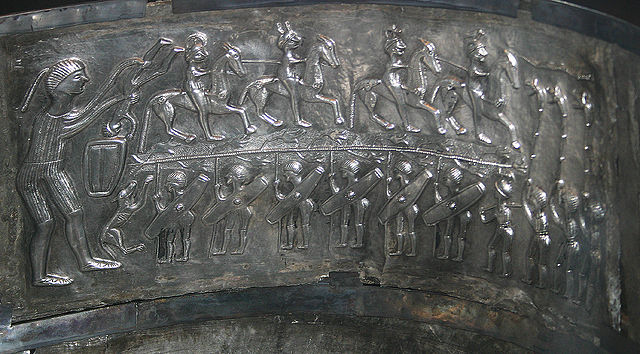
The ‘warrior’ panel of the Gundestrup cauldron

The 'warrior' panel from the interior of the cauldron. Photo: Malene Thyssen

The 'warrior' panel from the interior of the cauldron. Photo: Malene Thyssen

This interior panel from the famous Gundestrup cauldron appears to show a line of seven mail-clad, shield and spear-wielding Celtic warriors advancing in a line from right to left towards a giant warrior who appears to be holding the body of another small warrior over a vessel of some sort. A dog or wolf appears to jump up at his feet. Proceeding from the giant along the upper row, are a line of four finely-arrayed horsemen with elite crested helmets, passing from left to right. Preceding them is a snake. The footsoldiers of the bottom row are followed by three carnyx (boar-headed celtic war-horn) players, whose horns reach up to face the cavalry riding back towards them, and the snake 'flies' above the horn chanters. Separating the rows of footmen and cavlry is a branch from which sprouts foliage or flowers. The metalwork around this is textured, suggesting an aura, a river or a footpath. The 'spears' of the footmen seem to connect with the trunk of the branch.

Symbolism interpreted:

The silver Gundestrup cauldron was probably a ritual deposit in water, pledged to the gods, as it was discovered in pieces in a Danish bog in 1891. Such deposits were an archaeological feature of Europe's 'Atlantic Bronze Age' which were influential upon the Celtic Iron Age cultures of north and central Europe. The organised style of the warriors, their mail suits and war trumpets seem date the cauldron between the 3rdC BCE and the 1stC CE during which time there were broad military and cultural interactions between Celtic tribes of Gaul and those of south and central Europe, explaining the artistic styles (and that of the armour) depicted on the cauldron: In fact, some design elements on the cauldron are so similar to those on objects found in the 'Letnica Hoard' (Bulgaria) to suggest a Gallo-Thracian origin for at least some of the panels. The cauldron shows aspects of both military and spiritual ideas of the afterlife which commentators typically associate with Celtic Iron Age culture.

Our 'warrior' panel shows some key features of a warfare-oriented view of reincarnation:

The footsoldiers:

These are 'ordinary' footsoldiers kitted uniformly for war with shields, spears and chainmail vests. There are seven armed men and three carnyx players. The last of the armed men carries no shield, and may be a youth, as he stands below the topmost 'sprout' of the tree-like design above their heads. They are clearly marching into battle, towards the dog/wolf and the giant figure with his cauldron, who appears to be placing one in or pulling one out of the cauldron. The soldiers are marching in the direction of the roots of the aforementioned tree design. Interestingly, it can be seen that their chainmail hauberks finish at the knee, below which they appear to wear hose and rawhide sandals on their feet, similar to those still in use in Ireland and the Isle of Man into the 19thC.

The giant warrior and his 'cauldron':

The giant warrior's cauldron or vessel appears to be a metaphor for some kind of rebirth promised to the valiant footsoldiers, as proceeding from it in the opposite direction to them are a line of mounted knights with fabulous helmets. The womb-like metaphor for the cauldron as a symbol for rebirth is found in the 'Second Branch' of the medieval Welsh epic tales known as Mabinogion in which the giant, Brân, owns a cauldron which revives the dead. In the case of the Gundestrup cauldron, two things appear to be emerging from this giant's cauldron – glorified warriors and a tree. This has echoes of the Yggdrasil tree mentioned in the 12thC Icelandic accounts of Scandinavian pagan legends: at the base of Yggdrasil were a number of wells from which the lives and fates of men flowed. At the base of the tree, gnawing animals and serpents were found: aspects of the ancient empirical idea of regeneration through putrefaction: these are also represented on the Gundestrup cauldron by the snake and the dog. The message of the panel is that the masculine god of the Otherworld (here portrayed also as a warrior, therefore a 'colleague) promises regeneration to those who glorify themselves in battle, and the new existence may have greater glory, represented by:

The four knights:

Proceeding from the apparent god and his cauldron are four mounted men (knights), remarkable for their elaborate crested helmets. The horses and more beautiful helmets mark them out as part of the warrior elite, and the implication of their appearance in the panel is that valiant footsoldiers might become so great – either through death or attainment. It is notable that there are only four knights, compared to the eight warriors going towards the cauldron (including the man held by the 'god'). Assuming that all of the soldiers on the lower row were looking forward to death in battle, then the panel suggests only four of these seem to have achieved a more glorious reincarnation! This again links to the Norse accounts of beliefs about death of warriors in battle which suggest that only half of the slain went with Odinn to Valhöll. Another interesting concordance.

So what of the other four warriors – what might the panel say about these? We are left with two interesting possibilities:

The first is represented by the animals in the image: first of these are the cavalrymen's horses, which would bring the number of sentient beings up to eight in the top row. The other is the ravenous dog or wolf, who like the crows and carrion birds depicted elsewhere on the cauldron would be features of any battlefield. The folklore of hosts of the restless dead remaining in Atlantic Europe after the Iron Age seems to have relevance here: the Sluagh Sidhe of the Gaelic world, and the 'Wild Hunt' of the Germanic world in particular. It may be that the souls of the unglorified were believed to have been incarnated in the form of the animals who haunt battlefields and the margins of human habitation: the corvidae (crows), vultures, wolves, dogs and foxes. By consuming the flesh of the glorious and providing good deeds in the form of omens and warnings, they might find themselves given a better incarnation in the next life, as well as speeding the recovery of the battlefield etc.

The second possibility of reincarnation is represented by the tree – the ancient metaphor for human generations: 'root, branch and seed'. The panel's design with the tree apparently growing from it suggests the dead are fertilising the regrowth of future generations, perhaps implying the reincarnation of less worthy footsoldiers as humans, ready for another 'go' at attaining greater glory. My feeling, based on the residual folklore and traditions of Europe, is that the truth probably lies somewhere between these two suggestions. The transmigration of souls (described by Roman authors as a central tenet of Gallic/Celtic faith) might lead to a number of outcomes, based variously upon the achievements of individuals in this life: a glorious afterlife, reincarnation as a human, or even a cavalryman's horse, or as a restless ravening creature who plays an important role in the regeneration processes of nature, and who might offer auguries to the living. The calls of ravens and crows, the flight-patterns of birds and the calls and shouts of canines and horses, were all recorded as potential sources of augury in ancient Europe until at least the middle ages.

The snake and the Carnyxes:

The snake has been a symbol of reincarnation for a very long time, based upon their continuous unblinking stare, their shedding their skins, their love of chthonic lairs from which they emerge into daylight, and from their ancient philosophical (morphological) classification along with worms, larvae and maggots as part of natural putrefaction and regenerative processes of nature. The snake is also notable for the visceral, terrifying/transfixing ability it has over its prey, bringing us here to discuss the Carnyx, above which the snake is positioned in the panel. The was the war-trumpet par-excellence of the Celts, whose terrifying cacophonic honking seemed designed to evoke the enraged squeals and bellows of an attacking boar, stag or bull, augmenting the terrifying transfixing effect of soldiers' war-cries upon an enemy. The horn was apparently a potent weapon in itself, designed – like the gaze of the snake – to sap the morale of the enemy.

Summary:

This panel appears to show imagery promising soldiers reincarnation in battle. Their deaths are being 'inverted' into a renewed, more glorious life, and the cauldron and tree act as a central metaphor of regrowth from the well of life, with the dog and snake representing the earthly and allegorical forms of this natural process.


The Icenii, ‘Andraste’ and ‘Andate’

2ndC CE Roman historian Cassius Dio famously mentions details of the ill-fated revolt of the Iceni and their allies against Nero’s legions in southern Britain during 60/61CE. His compendium ‘The Roman History’ may well have relied upon on first-hand accounts of the events of this episode, but Dio uses a certain creative licence regaling us with a rousing speech made by queen Boudica to her people before their battles. Indeed, it largely functions to portray Nero as a weak and effete figure of ridicule, but is of interest to religious historians, as he has the queen call upon a British goddess referred to as ‘Andraste’:

“…When she had finished speaking, she employed a species of divination, letting a hare escape from the fold of her dress; and since it ran on what they considered the auspicious side, the whole multitude shouted with pleasure, and Buduica, raising her hand toward heaven, said: “I thank thee, Andraste, and call upon thee…” (The Roman History, Boook 62 -trans. Bill Thayer)

Whoever Andraste was, she seems to have inspired the Britons with a confidence matched only by the fear which drove the Roman legions to eventually overcome them. Little else is known about Andraste save for this account. However, the reason for this might be because the ‘name’ given by Cassius Dio was a misunderstanding of ‘An Dras De’ – which is simply the Brythonic phrase meaning ‘The Tribal God’, ‘Dras’ being an old Welsh word meaning ‘kindred’. Consider the Irish god known as ‘An Dag De’ – the Dagda – a similar composite term is therefore possible.

Cassius Dio goes on to describe the rampage of revenge and humiliation wreaked upon the hapless Romans at Camulodunum (Colchester) and Londinium (London):

“… Having finished an appeal to her people of this general tenor, Buduica led her army against the Romans; for these chanced to be without a leader, inasmuch as Paulinus, their commander, had gone on an expedition to Mona, an island near Britain. This enabled her to sack and plunder two Roman cities, and, as I have said, to wreak indescribable slaughter. Those who were taken captive by the Britons were subjected to every known form of outrage. The worst and most bestial atrocity committed by their captors was the following. They hung up naked the noblest and most distinguished women and then cut off their breasts and sewed them to their mouths, in order to make the victims appear to be eating them; afterwards they impaled the women on sharp skewers run lengthwise through the entire body. All this they did to the accompaniment of sacrifices, banquets, and wanton behaviour, not only in all their other sacred places, but particularly in the grove of Andate. This was their name for Victory, and they regarded her with most exceptional reverence… “

It is possible that ‘Andraste’ and ‘Andate’ were simply kennings for the same female divinity, but another possibility arises: that Cassius Dio got it wrong, and that ‘Andate’ was actually the male deity known in Ireland as ‘An Dagdae’ or ‘Eochaidh Ollathair. This is reasonably within the bounds of Celtic language pronunciation where consonantal sounds within words are readily dropped. Here is my reasoning:

An Dagda and the Morrigan in Cath Magh Turedh:

A coin of the Gaulish Redones (Brittany) shows the martial female mounted upon a horse: The Morrigan and Dagda?

A coin of the Gaulish Redones (Brittany) shows the martial female mounted upon a horse: The Morrigan and Dagda?

The Irish mythological cycle tale known as Cath Magh Turedh (possibly a composite of different tellings of an original) contains a number of mysterious, poorly elucidated ‘scenes’ featuring the Dagda.

Firstly, it mentions his ‘cauldron of plenty’. Next it mentions his role doing heavy work as a builder of the fortress of Bres of the Fomorians. He seems unusually trusting and a bit simple, and gives some of his vast meal portions away to a man who demands the best part each sitting, causing him to weaken. He forms a triplicity with Lugh and Ogma, and they go to ‘three gods of Danu’ (one of  whom is stated to be the Morrigan) who give weapons to Lugh. Dagda then has sexual intercourse with the Morrigan at a ford of the River Unshin in Connacht, an act of heiros-gamos ensuring the victory of the Tuatha De Dannan in the coming battle with the Fomorians. In another curious scene, with distinct parallels with to the Siege of Troy described in Homer’s Iliad, the Dagda enters the camp of the Fomorians to spy, seemingly in the guise of a horse. The Fomorians force him to eat a prodigious meal (again demonstrating his great equine appetite) so as to dull his wit.

The story continues (CELT version):

“…Then he went away from them to Tráigh Eabha. It was not easy for the warrior to move along on account of the size of his belly. His appearance was unsightly: he had a cape to the hollow of his elbows, and a grey-brown tunic around him as far as the swelling of his rump. He trailed behind him a wheeled fork which was the work of eight men to move, and its track was enough for the boundary ditch of a province. It is called ‘The Track of the Dagda’s Club’ for that reason. His long penis was uncovered. He had on two shoes of horse-hide with the hair outside. As he went along he saw a girl in front of him, a good-looking young woman with an excellent figure, her hair in beautiful tresses. The Dagda desired her, but he was impotent on account of his belly. The girl began to mock him, then she began wrestling with him. She hurled him so that he sank to the hollow of his rump in the ground.

He looked at her angrily and asked, ‘What business did you have, girl, heaving me out of my right way?’ ‘This business: to get you to carry me on your back to my father’s house.’ ‘Who is your father?’ he asked. ‘I am the daughter of Indech, son of Dé Domnann,’ she said. She fell upon him again and beat him hard, so that the furrow around him filled with the excrement from his belly; and she satirized him three times so that he would carry her upon his back. He said that it was a ges for him to carry anyone who would not call him by his name. ‘”What is your name?’ she asked. ‘Fer Benn,’ he said. ‘That name is too much!’ she said. ‘Get up, carry me on your back, Fer Benn.’ ‘That is indeed not my name,’ he said. ‘What is?’ she asked. ‘Fer Benn Brúach,’ he answered. ‘Get up, carry me on your back, Fer Benn Brúach,’ she said. ‘That is not my name,’ he said. ‘What is?’ she asked. Then he told her the whole thing. She replied immediately and said, ‘Get up, carry me on your back, Fer Benn Brúach Brogaill Broumide Cerbad Caic Rolaig Builc Labair Cerrce Di Brig Oldathair Boith Athgen mBethai Brightere Tri Carboid Roth Rimaire Riog Scotbe Obthe Olaithbe
[gap: meaning of text unclear]
Get up, carry me away from here!’ ‘Do not mock me any more, girl,’ he said. ‘It will certainly be hard,’ she said. Then he moved out of the hole, after letting go the contents of his belly, and the girl had waited for that for a long time. He got up then, and took the girl on his back; and he put three stones in his belt. Each stone fell from it in turn—and it has been said that they were his testicles which fell from it. The girl jumped on him and struck him across the rump, and her curly pubic hair was revealed. Then the Dagda gained a mistress, and they made love. The mark remains at Beltraw Strand where they came together.

Then the girl said to him, ‘You will not go to the battle by any means.’ ‘Certainly I will go,’ said the Dagda. ‘You will not go,’ said the woman, ‘because I will be a stone at the mouth of every ford you will cross.’ ‘That will be true,’ said the Dagda, ‘but you will not keep me from it. I will tread heavily on every stone, and the trace of my heel will remain on every stone forever.’ ‘That will be true, but they will be turned over so that you may not see them. You will not go past me until I summon the sons of Tethra from the síd-mounds, because I will be a giant oak in every ford and in every pass you will cross.’ ‘I will indeed go past,’ said the Dagda, ‘and the mark of my axe will remain in every oak forever.’ …”

The scene is certainly saucy, but also weird – almost a retelling of the Dagda’s encounter with the Morrigan in an earlier passage, albeit with more salacious detail. The picture painted of the Dagda is a half-man, half-stallion: His horse-hide brogues, his great round belly, his large penis, his propensity to create lots of dung: all are heavily suggestive of this, as is one of his other names, Eochu Ollathair. The heiros-gamos with a feisty fighty female (similar to Fand in Serglige Con Chullain) is again used to precede a victory in battle. What is more, the marks of his hoof/foot upon rocks appears to be a reference to cup-marks, bullauns and petrosomatoglyphs of feet, common to the archaeology of the Atlantic world.

The suggestion that can be drawn from this is that victory was ensured by the sexual coupling of the Otherworld masculine god and the worldy goddess. Dagda represents, as the horse, the fertility, power and energy on offer from the Otherworld, albeit a force that was a bit simple. The Morrigan was the warrior aspect of the feminine triplicity – their combination would allow peace to be determined through warfare. Lugh (the battlefield hero of the Cath Maigh Tured) was the active warrior aspect of the masculine triplicity, and Ogmios was the wise thinking part.

Gold stater of the Gaulish Parisii c.1stC BCE. The horse has a human face, and the charioteer appears female. The image is warlike.

Gold stater of the Gaulish Parisii c.1stC BCE. The horse has a human face, and the charioteer appears female. The image is warlike.

The horse seems so prevalent on Europe’s late Iron Age celtic coinage that it must have had special importance, beyond just being a copy of the coins of those Macedonian-Thracian leaders of the Hellenic world – the horse-loving ‘Phillip’ and, of course, the solar warrior-king, Alexander whose legend was celebrated among the proud warriors of the Celtic world. By invoking the Morrigan aspect of the triple-goddess (the tribal ancestor or sovereignty queen, who Cassius Dio called ‘Andraste’), Boudica set her on a course for her liason with the peace-lord of the Otherworld, a drama possibly acted out in the groves of ‘Andate’ by the seemingly victorious Britons, shortly before General Paulinus reappears bearing the ‘Gorgon’s Head’, taken on Anglesey…


L’Ankou – Gaelic parallels with the Breton death-spirit

‘Ankou’ is the personification of death’s assistant (a psychopomp) from Breton folklore, and a figure which reached greater prominence here than in any other of the modern ‘Celtic’ nations. It was noted by folklorist Walter Evans-Wentz in his 1911 book The Fairy Faith in Celtic Countries, that L’Ankou and The Dead appeared to provide the equivalent role to the Aes Sidhe of Gaelic folklore – a parallel which provides us with some interesting questions as to the nature of Celtic spirit-beliefs:

“… Without setting down here in detail numerous other death-legends which we have collected, we may now note how much the same are the powers and nature of the dead and spirits in Brittany, and the power and nature of the fairy races in Celtic Britain and Ireland. Thus the Breton dead strike down the living just as fairies are said to do; the Ankou who is a king of the dead, and his subjects, like a fairy king and fairies, have their own particular paths or roads over which they travel in great sacred processions; and exactly as fairies, the hosts of the dead are in possession of the earth on November Eve, and the living are expected to prepare a feast and entertainment for them of curded-milk, hot pancakes, and cider, served on the family table covered with a fresh white table-cloth, and to supply music. The Breton dead come to enjoy this hospitality of their friends; and as they take their places at the table the stools are heard to move, and sometimes the plates; and the musicians who help to entertain them think that at times they feel the cold breath of the invisible visitors…”

(The Fairy Faith in Celtic Countries by Walter Evans-Wentz; Pub. Henry Frowde, Oxford University Press, 1911; p.218)

He goes on to note ‘Every parish in the uncorrupted parts of Brittany has its own Ankou, who is the last man to die in the parish during the year‘. Wentz’s source, the respected Breton folklorist Anatole Le Braz, wrote a book about Ankou, called La Légende de la Mort () and had this to say about it:

The Ankou is the henchman of Death (oberour ar maro) and he is also known as the grave yard watcher, they said that he protects the graveyard and the souls around it for some unknown reason and he collects the lost souls on his land. The last dead of the year, in each parish, becomes the Ankou of his parish for all of the following year. When there has been, in a year, more deaths than usual, one says about the Ankou: War ma fé, heman zo eun Anko drouk. (“on my faith, this one is a nasty Ankou”).

Wentz drew parallels with the Gaelic beliefs in people ‘taken’ to fairyland, but unfortunately did not establish much else by the way of concordance with this supposedly ‘Brythonic’, and in terms of surviving folklore, specifically Breton belief. It is therefore my aim here to demonstrate that Ankou did indeed have its Gaelic equivalents, whose memory became lost due to the influence of christianity and the 19thC romantic movement:

Ankou, depicted on a carving at the ossuary of the chapel of St Joseph at Ploudiry, Brittany.

Ankou, depicted on a carving at the ossuary of the chapel of St Joseph at Ploudiry, Brittany. Note the ‘elf-arrow’ it appears to wield!

Ankou in the Isle of Man and Scotland:

The Manx – a nation whose linguistic and cultural roots lie firmly in the ‘Gaelic’ world – maintained an independent tradition which corresponds closely with that of L’Ankou. However, in examining this it is first necessary to go ‘back’ to Brittany and examine the word ‘Ankou’ itself:

The standard English definition or translation usually given for the Breton word ‘Ankou’ is ‘the agony’, originally proposed in a ‘pirated’ (uncredited) 1860 English translation (Breton Legends – Pub. London 1860, Burns and Lambert) of the folklore collected and published in French by Théodore Claude Henri, vicomte Hersart de la Villemarqué – a noted Breton dictionarian and philologist. ‘An-‘ is the definite article, and ‘-Kou’ is usually (in English translations) supposed to mean ‘agony’. However, this etymology is speculative at best, as the ‘kou’ suffix as a sound can have a number of meanings within the scope of the historical linguistics of the celtic languages. Indeed, the 1821 Breton-French dictionary of Jean-François-Marie-Maurice-Agatha Le Gonidec tellingly uses the word Kouer to mean ‘peasant’, of which more presently.

Fockleyr Manninagh as Baarlagh – the 1863 dictionary (based partly upon an earlier manuscript of John Kelly from the late 18thC) published by the Manx Society contains the following interesting entry:

Keimagh s. pl. -ee, A spirit which is supposed to haunt and guard the churchyard stiles.

Also, the word Cughtagh:

Cughtagh s. pl. cughteeA fairy, a sprite, a spirit of the houghs* …

*AR: Hough in this context refers to a rough, rocky place or a cliff 

Both entries are followed by the interesting usage example ‘Ny keimee as ny cughtee’ of which the authors say no more, but which appears to be a reference to a popular Manx charm for stopping blood, a version of which can be found in William Harrison’s ‘Mona Miscellany’ (Manx Society Volume 16, Pub. Isle of Man, 1869).

The idea of the last deceased watching over the graveyard appears to have been common to the Highlands and Islands of Scotland – Donald MacPherson called it the Faire Chloidh in his book ‘Melodies from the Gaelic, and Original Poems; with Notes on the superstitions of the Highlanders &c’ (Pub. Thomas and George Underwood, London 1824), p.202:

FAIRE CHLOIDH, (THE GRAVE WATCH.)

It was the duty of the spirit of the last person interred, to stand sentry at the grave-yard gate, from sun-set until the crowing of the cock, every night, until regularly relieved. This, sometimes, in thinly inhabited parts of the country, happened to be a tedious and severe duty ; and the duration of the Faire Chloidh gave the deceased’s surviving friends, sometimes, much uneasiness.

The Manx ‘Keimagh’ and ‘Cughtagh’ spirits share a link of sorts to the grave, vagrancy, caves or shelters: This can be seen from the fact that the Manx wordcughhas connotations of dirt, filth and dung, and a link between this and the cave, mound or hole-dwelling spirit is also found in the word Cughlin, meaning a vagrant’s doss-hole or a mean filthy shelter, another Manx word for which is Kemmyrk. Recall that the Breton word Kouer, means ‘peasant’ and consider the restless vagrant properties ascribed to the spirits of the dead and a few ideas might start to form about the origins and meaning behind these archaic terms and the ‘Ankou’ itself.

The Manx word Keim or Keym (from which Keimagh is derived) is the same as the Irish céim, meaning ‘step’ in the same sense as it occurs in English – as a verb and a noun. The stile at old churchyard gates was often a slab of stone which those entering the church precinct would be required step over (and scrape your shoes on) in order to enter hallowed ground. It is common for the ‘m’ sound in Celtic languages to transform into a ‘w’ in pronunciation meaning that a ‘keimagh’ might easily become a ‘keiwagh’. By the same laws of linguistics, -gh-, -ch-, and -th- will lose any pretensions to consonantal pronunciation when occuring inside words.

This puts us in the interesting position of being forced to examine another similarly named spirit from the Gaelic world – Scotland’s An Ciuthach (pronounced ‘Kewach’), a being mentioned as a hairy spirit haunting caves in Volume 3 of John F. Campbell’s ‘Popular Tales of the West Highlands’ (p.55), in a folk-tale based on the story of the Pursuit of Diarmuid and Graine by Fionn Mac Cumhaill.

The Gaelic word ‘cuthach’, means ‘mad’ or ‘raging’ and fits with the portrayal of a marginal ‘wild-man’ who lives underground, and also with the Manx words ‘cugh’ and ‘cughlin’, associated with the filthy ‘Merlinesque’ state of the wild divine, a familiar sight in medieval Ireland, Britain and France where holy men often lived in a state of wild squalor. It should be obvious by now that the Breton word ‘Ankou’ had distinct similarities with the Gaelic ‘An Ciuth’ or ‘An Cuth’, ‘kou’ meaning a state of frantic restlessness, rather than ‘agony’. This fits the etymology of the Breton word for peasant: Kouer – a class of person living in mean conditions and continually working to survive.

The Irish Dullahán and the Gruagachs:

The ‘Dullahán’is the Irish legendary personification of death, usually represented as a skeletal headless horseman. The name possibly signifies ‘black one’ or ‘gloomy one’ (Dubhlachán?), probably on account of the lividity of the dead, and his appearance in popular tradition was to foretoken death. His earliest literary mention is in the writings of Charles Vallancey (‘Prospectus of a Dictionary of the language of the Aire Coti, or Ancient Irish’, Pub. Graisberry & Campbell, Dublin, 1802), who recounts that the Irish peasantry would be in fear of hearing the Dullahan or ‘Wullahan’ dragging his chains through the streets at night. Like the Ankou, it was often associated with a horse or coach and horses.


The Ankou is therefore quite possibly the ‘Wild Hunter’ who leads the Sluagh Sidhe! Was Fionn Mac Cumhaill, really originally Finn-Mac-‘Kou’-al? 

The ‘wild man’ archetype has much to say about where we developed from, and about the processes by which nature is regenerated from its own ‘putrefaction’.


There are important relationships in empirical human culture between dirt, ordure and decayed matter and the regeneration of new life. To live ‘wild’ is to live in comfort with this kind of state. Such symbolism no doubt informs the apparent associations between death, the spirit world and reincarnation that underpin the ancient European beliefs. The idea anciently used to express this was termed putrefaction, and important doctrine of the natural philosophy of Europeans until the scientific age introduced new paradigms.

The British and Irish age of Romanticism started in earnest during the ‘Enlightenment’ era of the late 17th and 18thC with the researches and writings of Roderick O’Flaherty, John Toland, Edward Llhuyd, and James MacPherson, and it continued with the emergence of renewed interest in the pagan past seen in the writings of Edward Williams (Iolo Morganwg), and in the fading customs, beliefs and lifestyles of the defeated Highland peoples documented for popular consumption by authors such as Walter Scott. Romanticism provided a vision of indigenous pagan beliefs still remaining among the peasantry, albeit in a form designed for the tastes and prejudices of educated and wealthy elites. Wavering paradoxically between apparent veneration of quaint rustic traditions and a visceral disgust of its ‘gloomy’ and ‘unenlightened’ superstitions, Romanticism would unfortunately often prove the undoing of much of what it fawned over: by swelling interest in ‘old-fashioned’ customs it ultimately encouraged the aspirational rural poor to resent becoming ‘quaint’ objects of fascination for the middle classes seeking relief from industrialised realities. By the late 1800s many Gaelic speakers had consequently rejected their traditional culture and sought to emulate modernity.

A romanticised view of what the rural poor ought to believe therefore eventually trickled down to influence their ideas: The traditions characterised as ‘gloomy’, ‘dismal’ and ‘unseemly’ – usually dealing with aspects of death, sex and disease – would become increasingly displaced. 

Putrefaction as an essential cultural idea behind abundance and regeneration among rural peoples was probably finally defeated when people stopped putting shit on their crops and used chemicals in its place… This was the era of mass-slaughter and industrial warfare, which reached its first full and horrific manifestation in the First World War.

‘Fairy Paths’ in the Gaelic world

The belief in Ireland (and elsewhere) that certain fairies were restless and compelled to wander from place to place caused a superstitious belief in ‘fairy paths’. These typically connected the various places where fairies were believed to haunt – their hills and raths, and ‘dancing grounds’ or meadows. People tended to avoid building on these perceived routes, as illustrated by the following folktale from The Fireside Stories of Ireland by Patrick Kennedy (Pub. Dublin 1870, McGlashan & Gill) pp.142-143:

THE FAIRIES’ PASS

It is known that the hill folk in their nightly excursions, and in the visits of one tribe to another, go in a straight line, gliding as it were within a short distance of the ground, and if they meet any strange obstacles in their track they bend their course above them, or at one side, but always with much displeasure. A farmer named Finglas, a stranger to the old ways of the country, took this farm and was not at all satisfied with the accommodation offered by the old farm house and yard.There was neither cow-house nor stable, except an excuse for such conveniences at the end of the yard. He would have new buildings made at the side, and dug out the foundation at once, but was warned that the Fairies Pass lay directly across the bawn, and that it would excite their sovereign displeasure to find stable or barn or cow-house in their way. Unhappily, Finglas, though married to a Roman Catholic wife, was himself a benighted Presbyterian, and as such a contemner of all reverence due to the Good People. But see, the result of pretending to be wiser than your neighbours: Scarcely were the buildings thatched and the cows and horses installed in their niches when the wisdom of the old people became evident. One animal after another without apparent cause began to refuse its food, languished, and died. In vain was recourse made to the most skilful cattle doctors. Their medicines proved naught, and fairy men or women would have nothing to do with the devoted beasts – they were on the Fairies Path. Not until three fourths of his cattle were slain by the elf bolts was Finglas overruled, and at last persuaded to construct new buildings at the end of the bawn.

The ‘lesson’ illustrated by such a typical tale of ‘fairy paths’ is not too dissimilar to those associated with fairy hills and raths/forts, and likewise of the ‘fairy grounds’ or lawns where they were supposed to hold their revels: Humans had better be careful, lest the ever-hungry Otherworld exert its frightening ‘abstracting’ influence over the offender. The great survey of Irish oral folklore organised by the Coimisiún Béaloideasa Éireann during the early-mid 20thC was to uncover many similar tales.

However, the paths taken by the People of Peace were not always limited to these actual or imagined routes connecting landscape features. In many ‘celtic’ regions, there is a belief that the invisible ones cannot cross running water directly, and this has apparently led to spirits being associated with certain ‘fairy bridges’ such as those found in the Isle of Man. The famous Norwegian folktale of the three ‘Billy Goats Gruff’ and the troll who lived under the bridge may have some bearing on this local tradition.

The Kewaigue (Oakhill) 'Fairy Bridge' in the Isle of Man. It was built off the main track by about 30 yards, and sits mysteriously among the trees...

The Kewaigue (Oakhill) ‘Fairy Bridge’ in the Isle of Man. It was built off the main track by about 30 yards, and sits mysteriously among the trees…

By the same logic, boundary walls (particularly those with ‘hallowed’ ground, such as burial grounds and churchyards) were considered another place where spirits were more likely to be concentrated and encountered. Likewise, certain boundary lines and walls between property gained similar attributions, sometimes depending upon the land use and ownership.

‘Fairy Holes’ and boundaries in the Isle of Man:

A ‘fairy hole’ was a hole in an earth or stone hedge where three property boundaries coalesced. Manx people who used to have a strong belief in fairies, would toss a stone (usually a quartz pebble) into one of these after spitting upon it, in the hope that the spirit world would take their illness or bad luck from them. The belief appears to have been based upon an idea that fairies travelled along walls and boundaries between land divisions.

3rd Report of the Manx Archaeological Survey – Andreas. Manx Natural History and Antiquarian Society, 1911:” … At a corner formed by the boundary fences of the three Quarterlands of Keeill Tushtag, Braust and Ballaquane, was a ” Fairy-hole, ” or hollow in the top of the earthen embankment, about 12 in. diam. We were told that “any one wanting a cure would put in a stone with a spit,” the object no doubt being to identify it more particularly with his own person, so that his own malady or affliction should pass into it. That this was so, and that the malady was capable of being conveyed to another, is made clear by the fact that our informant’s father had once taken one of the stones out of the Fairy Hole and become very ill ; he did not recover till he had returned it… “

This belief that fairies travelled along walls and other boundaries (such as streams and rivers) probably arose from the fact that in former times (possibly since the establishment of christianity), such boundaries were regularly walked and the property they enclosed blessed by the clergy in a ceremony known as rogation, designed to repel evil influences (demons etc) and promote fertility. Such boundaries were liminal places, existing ‘between’ such nebulous human ideas of ownership and supposed sanctity, in which spiritual entities might find a place to manifest. This idea appears slightly different to the Irish one previously mentioned in which fairies troop between their allotted hills and forts. However, this does not mean that the Manx people had, on the whole, radically different ideas about fairies to Irish or Scots people: Fairies were believed to have habitations and places of retreat between which they travelled. They were believed more mobile and active at certain times of day (dusk and nightime), and of the year (Samhain, Beltane). Encounters with them at these places risked the health and sanity of humans and their property, and ‘apotropaic’ measures would be taken to ameliorate any potential harm or fear.

The difference in what was considered a ‘fairy path’ was influenced as much by the customs and politics of land tenure and boundary definitions as by medieval religious customs and the arrangements of ancient manmade structures. Ancient trackways could become ‘fairy paths’, and in Ireland’s flat boglands, these would inevitably be constructed in straight lines between prominent areas of high ground, which unsurprisingly were associated with mysterious and ancient human structures. Tribal boundaries within the Gaelic world at the advent of Chrisitianity were based around the needs for transhumance pastoralism with central defensive positions coupled to more elevated retreats. In the Isle of Man, which (like parts of Ireland, the Hebrides and West Highlands of Scotland) experienced Norse settlement in the middle ages, land was traditionally divided into small estates based upon an allodial system of freeholds. These were increasingly incorporated into more extensive ‘feudal’ estates following the Norman conquests and expansion of continental monasticism. The impositions of English and British expansionism from the Early Modern period onwards further upset these traditional land boundaries and usages. The combination of these different historical and cultural boundary changes all had a deep influence upon the fairy beliefs associated with liminal and marginal places…