Similarities in Greco-Roman and Gaelic myth

Although the mythology of the material and intellectual cultures we know as 'Greco-Roman' is Europe's oldest inscribed tradition, that of Ireland and the 'insular Celts' must come next, albeit the written form of it is from a much later date. In particular, it often excels and exceeds the Greek material by its apparent strangeness and stylised 'otherness', yet as a source of pagan myth it needs – like the Norse sagas and Edda texts – to be treated very carefully as it is told by christians, unlike the Greek and Roman material which comes from pagans.

Nonetheless, the Christians did not have much in the way of myth to call their own, except for the 'Old Testament' materials and the early saints' lives, many of which were based on pagan tales, in their style and often in their narrative content: These were essential to pad out its own religious narratives and replace (or at least displace) the contents of the potent oral-transmission culture with a literature-based alternative.

It is worth noting a number of things about southern-European pagan religious culture, however, before framing a debate of paganism vs christianity in terms of oral transmission culture vs. literary culture: Firstly, it is worth remembering that – since the advent of the Hellenistic era in the 5thC BCE – that literary culture became an important stalwart of Greco-Roman societies, and seems to have become a primary mode by which people came to understand their religion. There were certainly traditional aspects to the culture to a late period, but by the advent of christianity, this was being displaced. The role of the priesthood and attendants in many of the most important temples was generally fulfilled as a fixed term civil office by the worthies of Greek and Roman society, so – unlike the traditional and esoteric forms of learning that Gaul (and Britain's) professional priesthood had to undergo, these offices were losing their mystery. Mystery remained the province of cult-centres such as Eleusis, Delphi and the island of Samothrace, and the discourse-communities of the Philosophers – the Neo-Platonists, Hermeticists and Gnostics who thrived in the late-classical world after the advent of Christianity and who pre-figured its rise. It is telling that classical paganism's most complete and (in scope) extensive theogonic text – the Dionysiaca of Nonnus of Persepolis in Egypt – was written by an author whose output later included a commentary on the christian Gospel of John. To understand this is to understand where the impetus for Christianisation was focussed in the less-literate climes of northwest Europe, such as Ireland, in the 5th/6thC CE.

Whereas some of our oldest surviving literature from the pagan world is religious, this aspect of the genre was in mortal decline in parallel to the rise in interest in philosophy and the 'mysteries' from the advent of the Hellenic period. By placing literacy in the hands of a few – a trained elite (after the model perhaps of the barbarian, Egyptian and Eastern peoples) – christianity would place itself at the heart of the new models of kingship appearing in the 'barbarian' world following the collapse of the Roman franchise in the west.

There are many similarities between the written medieval Irish myths and Greek legends. The reasons for this might be fourfold:

1. That the Irish believed in a shared widely-known and ancient cosmic worldview, populated with similar characters and themes to those of ancient Greece and southern Europe, and the Christian authors recorded this from traditional orally-transmitted narratives.

2. That literate monks used Greek and Roman (or Romano-British) myths to flesh out a written Irish narrative which did not otherwise exist – a kind of 'new age' eclecticism.

3. That Irish and Greek myths developed separately, yet shared similarities determined by (a) the culture and traditions/techniques of storytelling and (b) empirical reactions to natural phenomena.

4. A synthesis of points 1-3.

Obviously, the most likely answer is point 4 – we simply do not have enough evidence to support points 1-3 independently, but we have good evidence that all of them have been contributing explanations. I shall now present a number of Irish myths/mythic characters and their apparent Greco-Roman counterparts and let you decide for yourselves:

Cú Chulainn:

The archetypal indefatigable warrior super-hero of the 'Ulster Cycle' stories – Cú Chulainn – seems to have a particular similarity to Herakles or Hercules: He is the son of a god, associated with blacksmith-craftsmen (Cullain). Cullain seems to relate to the Greek 'earth-born' proto-blacksmiths known as the (Idaean) Dactyls, of whom Herakles was sometimes considered one. was a supreme warrior, a lover of goddesses (Fand, wife of Manannán mac Lir) and his nemesis is a goddess (the Morrigan). He is a performer of fantastic tricks and sporting feats, yet forever tied to the whims of his king and his gods. He lives fast and dies young – a true aspect of the Celtic warrior ideal. is also a 'king's champion' warrior archetype – a dog on a leash, as befits his name. He sometimes comes across as bombastic, brash, sometimes clumsy and insensitive – a bit of a lummox at times, and then at others, clever and dextrous, and light on his feet. Like Herakles, he travels to far-off islands and does battle with the weird as well as the mundane, performing 'feats' along the way.

One way in which Cú Chullain differs from Herakles is that Herakles was a folk-hero responsible for taming and conquering the wild and chaotic forces for the good of humanity. In the 'Ulster Cycle', Cú Chullain typically acts on behalf of the interests of his liege lord – like the other famous Greek warrior-strongman Achilles. This perhaps reflects the fact that these Irish legends (like their later French and British 'Arthurian' traditions) were often designed for telling at the courts of elite rulers, and therefore suited the value-system of this milieu. In folk-myths, Fionn and Cú Chullain often take on much more gigantic proportions and attributes.

The Battle of Maige Tuired:

This is the 'showdown' scene of the Irish mythological cycle stories in which the Tuatha Dé Danann, the Fir Bolg and the Fomorians are pitted against one another for supremacy of Ireland. The Fomoire are usually described as a race of sea giants in Irish mythology, and the Manx word Foawr (from 'Fomor') means 'Giant'. They seem similar to the aquatic Titans of Greek myth and the Cath Maige Tuired is like an Irish version of the Greek Titanomachy – the battle and overthrow of the Titans by the Olympian Gods, with whom the TDD share a certain similarity. Similar legends exist from Norse myth – the primal giants here are the Frost Giants: Titans at -40 Celsius! Of course, the bizarre cannibalistic and incestuous Greek narratives of the Titans are absent from the CMT and the 'Book of Invasions' stories which present more of a heroic pseudo-historical dynastic struggle. Tolkein borrowed heavily from the imagery of the battles of Maige Tuired in constructing his battle scenes in Lord of the Rings.

Giants and primordial helpers:

The landscape of Atlantic Europe – particularly those regions where Greco-Roman and later christian culture was slow to assert itself – is riddled with ancient mythology of primordial giants who supposedly played some important roles in determining the shape of the landscape – mountains, fjords, rivers, lakes, plains and great rocks. The same was true of the mythology of the Archaic period and Bronze Age of southern Europe – in particular the mythologies of ancient Greece, but we can discount these as playing a late originating role in the folklore of northern and northwestern legends due to the lack of impact of these material and cultural civilisations in these zones.

The Greek giants and Titans were 'Earth-Born' (Gygas – after Ge/Gaia, the personified Earth). The pagan Norse word used for giants in the middle ages was Gygr – existing into the more modern periods in the Scots Gyre and Faroese Gyro. The Manx equivalent of the Scots Brownie, Uirisk and Grogach legend was the Phynnodderee, 'Dooiney Oie' ('Night Man') or Glashtin – a being considered gigantic, primitive, coarse and animalistic in appearance who helped householders and warmed himself by the hearth at night when humans slept. His local legends seem, curiously, to conflate him with both Fionn mac Cumhaill and even Cú Chullain and, when not explicitly named, with the activities ascribed elsewhere in the Atlantic world to other giants – specified or unspecified. This is a representation of the archetypal earth-born ancestor, and is a particularly important and wide-ranging link between northern and southern pagan mythology which appears to have a commonality stretching way back into the Bronze Age. Herakles was also an aspect of this.

The Otherworld:

Both Greek and Irish myths portray the Otherworld as a location reachable by a westward journey over the great ocean. The legendary Greek islands of Elysium, the Hesperides/Erytheia and Ogygia, and the 'Islands of the Blessed' or 'Fortunate Isles' have their Irish equivalents in the many names of Gaelic mythology's magical western islands which were also considered the resort of departed souls: Mag Mell, Tír na nÓg, Tír na mBeo, Tír Tairngire, Tír fo Thuinn, Ildathach , Hy Brasil, Tech Duinn and Emain Ablach. These places are sometimes explicitly islands, sometimes under the sea, sometimes of a hybrid type that emerges (and just as soon disappears) from the sea.

Like in the Greek legends, the otherworld is also represented as a chthonic realm – beneath the earth. Like the Greeks, the Irish seem to have believed that the rivers of the world joined a 'world river', and that it re-manifested from the otherworld by piercing back though the earth as springs of water. Like the Greeks and Latins of southern Europe, and their fellow Bronze Age and Iron Age era 'Celtic' peoples further north and west they considered springs of water to be important and holy – no doubt for this reason. Sidhe mounds or Fairy Hills were the traditional 'home' of Irish (and to a lesser extent, Manx and Scottish fairies). They were sometimes considered to be the sources of rivers returning from the otherworld. Mountains and artificial mounds had similar associations in Ireland. In a flat landscape, a mound is something akin to an island – a consideration when addressing the 'otherworld inversion' belief that permeates Atlantic European folklore.

An interesting aspect of the Greco-Roman myth is how there seems to be a plasticity in portraying the otherworld 'places' (Elysium, for example) as both meadows or gardens and simultaneously as islands bordering Okeanos. This same conflation appears to represented quite strongly in the old Irish story 'The Voyage of Bran mac Febail' where he is conveyed to the otherworld islands over a sea which gradually appears to become a meadow.

Mermaids and Sirens:

The idea of female (and male) entities who lured men to stay with them in the watery or otherworld realms are common to both Greek and Gaelic myths. The 'Sirens' occur in Greek myths such as Homer's Odyssey and the Argonautica ('Jason/Iason and the Argonauts'). They were sometimes depicted as half-bird, half-female inhabiting islands surrounded by huge rocks and high cliffs, luring sailors to their deaths on the treacherous shores with their beautiful songs. Calypso, the daughter of Atlas on Ogygia also fits the enchanting-island maiden archetype, and although was not considered one of the Sirenai, seems part of the same mythos. Even the Gorgons tempted brave Perseus to their realm, and from his 'killing' of Medusa there was a magical birth (of Pegasus and Chrysaor).

In Atlantic Celtic mythology, this function was the province of alluring beautiful mermaids – usually half-human, half-fish in their conception but sometimes 'seal people' (e.g. – Selkies). The Isle of Man's version of the Cailleach – Caillagh y Groamagh was supposed to fly in from the sea in the form of a bird at Imbolc/La'a Bride, and she may be another aspect of the beautiful fairy maiden called 'Tehi-Tegi' who in Manx legends lures men into the sea or a river to drown them, before flying away in the form of a wren (sometimes a bat!). The Gaelic (Irish/Gallovidian) Merrow was sometimes known as Suire which sounds very much like a version of 'Siren' although this may be in reference to known Greek myths, and this type of mermaid was associated with a feather hat or cape. Crofton Croker's 'Fairy Legends and Traditions of the South of Ireland' is worth reading for a summary on the Merrows.

Harpies and Sidhe Gaoithe:

There was an explicit belief in former times in Ireland, Scotland and the Isle of Man that sudden gusts of wind were caused by the actions of spirits and fairies. Indeed, this was a feature of the demonology of medieval Christian Europe, and may well link back to the ancient Greek beliefs that the Harpies were responsible for the same. They were depicted (again) as half-woman, half bird or as winged female entities and were personifications of storm-winds. The Cailleach Bheara of the Scottish Highlands and Islands had a similar association, and was sometimes considered a female-avian who flapped her wings to make the winter storms. In the Isle of Man, the (not uncommon) tornados were sometimes supposed to be caused by a fairy known as Yn Gilley Vooar ny Gheay – 'Big Boy O' the Wind'.

River Nymphs and Sea Nymphs:

Perhaps subjoined to the mermaid legends, it is notable that the Greeks and the Irish personified their rivers with female spirits or entities. Evidence of this comes from the Dindseanchas legends and those of the so-called 'landscape-sovereignty' goddesses, otherwise referred to as Bean Sidhe, no doubt because river-drainage areas in mountainous landscapes tend to map and define territories. Greco-Roman mythology venerated such female water deities, and this tendency was also found in the European celtic world in the late Iron Age (although much of our evidence here comes after the period of Romanisation). Again, the 'Cailleach' personification from folklore seems to combine many of these functions (Harpies, Sirens, Nymphs etc) into the form of this single protean Titaness. Likewise, the Moura Encantada of the Iberian peninsula and the Marie Morgane of Brittany as well as the 'Lady of the Fountain' (or lake) of Arthurian lays and romances.

Summary:

It is apparent that ancient European paganism was a universal system of philosophy and 'science' illustrated through traditions of the arts: story, poetry, song, pictures, dances and drama. Every possible phenomenon seems to have been addressed by assigning mythology to it, and the boundary between the spiritual and the secular did not really exist – instead there was a continuum. The southern European civilisations emerging from the Bronze Age with a more oriental perspective, eventually coming to consider themselves 'better' and more 'enlightened' than their 'barbarian' cousins (and ancestors) in northeastern and northwest Europe, and due to warfare and incursions of these 'barbarians' between the 5thc BCE and the 1stC CE (and beyond), and due also to the dependence on written knowledge, a perception derived that their religious and spiritual beliefs were 'different', when in fact they had a shared root.
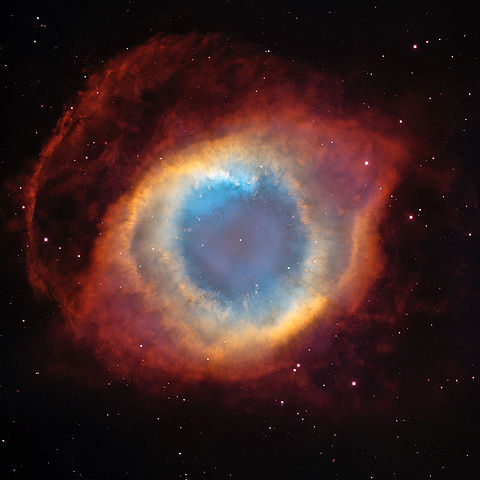
 

The Evil Eye in ancient Atlantic Europe, ‘101’.

The eye was once considered the one organ which could express the divine light of the soul. In the ancient world a perfected soul was believed to reside in the heavens as a star...

The eye was once considered the one organ which could express the divine light of the soul. In the ancient world a perfected soul was believed to reside in the heavens as a star…

The eye is a curious organ.

As well as receiving light, it appears at times to emit it also. This can be illustrated by the way that nocturnal predators’ eyes appear to glow (actually from reflected light), but there is another ‘light’ of the eye: that which, curiously, seems to disappear from it at the moment of death. This is the ‘spark’ or ‘twinkle’ of the eye whose intensity and quality we perceive to enhance and alter when we laugh, flirt or are excited to enthusiasm or anger. This phenomenon perhaps explained the theory of vision common to the ancient world – that known as the theory of ‘extromission’.

Extromission theory believed that the eye emitted light. Light itself was believed in ancient times to be a higher emanation of the philosopical element of fire, and to the ancient peoples it took two forms for which the Latin words ‘Lumen’ and ‘Lux/Lucis’ came into use. Lumen was mundane light – that emitted by candles, or the sunlight coming through windows and was closest to ‘elemental’ Fire. Lux however represented light in its higher spiritual or intellectual form – the divine light, the light of spiritual and philosophical illumination. Plato explains this in his account of the creation of human bodies from the Dialogue of Timaeus:

“…And so in the vessel of the head, they first of all put a face in which they inserted organs to minister in all things to the providence of the soul, and they appointed this part, which has authority, to be by nature the part which is in front. And of the organs they first contrived the eyes to give light, and the principle according to which they were inserted was as follows: So much of fire as would not burn, but gave a gentle light, they formed into a substance akin to the light of every-day life; and the pure fire which is within us and related thereto they made to flow through the eyes in a stream smooth and dense, compressing the whole eye, and especially the centre part, so that it kept out everything of a coarser nature, and allowed to pass only this pure element. When the light of day surrounds the stream of vision, then like falls upon like, and they coalesce, and one body is formed by natural affinity in the line of vision, wherever the light that falls from within meets with an external object. And the whole stream of vision, being similarly affected in virtue of similarity, diffuses the motions of what it touches or what touches it over the whole body, until they reach the soul, causing that perception which we call sight. But when night comes on and the external and kindred fire departs, then the stream of vision is cut off; for going forth to an unlike element it is changed and extinguished, being no longer of one nature with the surrounding atmosphere which is now deprived of fire: and so the eye no longer sees, and we feel disposed to sleep. For when the eyelids, which the gods invented for the preservation of sight, are closed, they keep in the internal fire; and the power of the fire diffuses and equalises the inward motions; when they are equalised, there is rest, and when the rest is profound, sleep comes over us scarce disturbed by dreams; but where the greater motions still remain, of whatever nature and in whatever locality, they engender corresponding visions in dreams, which are remembered by us when we are awake and in the external world. And now there is no longer any difficulty in understanding the creation of images in mirrors and all smooth and bright surfaces. For from the communion of the internal and external fires, and again from the union of them and their numerous transformations when they meet in the mirror, all these appearances of necessity arise, when the fire from the face coalesces with the fire from the eye on the bright and smooth surface. And right appears left and left right, because the visual rays come into contact with the rays emitted by the object in a manner contrary to the usual mode of meeting; but the right appears right, and the left left, when the position of one of the two concurring lights is reversed; and this happens when the mirror is concave and its smooth surface repels the right stream of vision to the left side, and the left to the right. Or if the mirror be turned vertically, then the concavity makes the countenance appear to be all upside down, and the lower rays are driven upwards and the upper downwards…” Plato – Timaeus 4thC BCE

It is evident from this that Plato considered the pupil of the eye a ‘filter’ to remove the Lumen element of light so that the meaning (information) conveyed in the Lux could be made available for the soul to consider! He considered vision and sensation an interaction between emanations of the soul and emanations of the universe. The Greek word for soul, mind, spirit and consciousness is  ψυχή – ‘psyche‘. The 5thC BCE playwright-‘philosopher’, Epicharmus of Kos, is quoted as saying “It is the psyche that sees, it is the psyche that hears, all the rest is deaf and blind”.

As an organ believed capable of emanation, not just reception, it is of no surprise that beliefs developed suggesting that the gaze of the eye can cause harm. Humans are acutely adjusted to the significance of the manner in which others look at them – a look can convey love, contempt, and any one of a number of other emotions or communications. Aside from the reaction of the perceiver of a gaze, the active principle of light extromission believed in by the ancient Greeks and others allowed that the eye emitted a spiritual force, and if this was evilly intended it would interact with that which it perceived in a harmful way. The most famous mythological account of a harmful gaze was that of the Gorgon – Medusa – whose gaze turned men to stone…

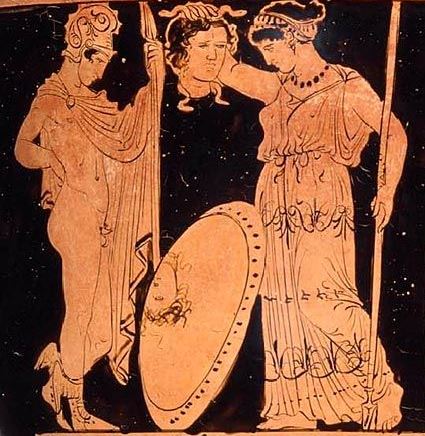
Perseus presents the head of Medousa to an obviously jealous Athena (Aine). Note there are only two snakes protruding from the Gorgon's head...

Perseus presents the head of Medousa to pleased-looking (jealous?) Athena. Note there are only four snakes protruding from the Gorgon’s head – the topmost two resemble horns…

That the gaze of Medusa could turn men to stone was a paradoxical inversion of the eye’s connection to light and thus the philosophical ‘element’ of fire. As Plato expressed it, fire and earth (of which stone was an expression) were the principle diametrically opposed elements of creation, and air and water were those which linked the two fundamental elements in a fourfold system. In Empedocles’ reckoning, the root-element Earth would correspond closest to the consolidating principle of ‘Love’ and Fire to the dissipating principle he called ‘Strife’ – the two contesting forces ascribed to the universe. Medusa’s gaze of stone, rather than light was perhaps a feminine idea of ancient established solidity. The flashing fiery gaze of love was the daimon that inspired the Trojan War, at the advent of Greek (and Roman) oral history’s ‘time of memory’. Being in love might be more dangerous than the stare of Medusa! Plato’s dialogue ‘Symposium‘ examines this theme in more detail.  Lizards and snakes, being considered ‘cold and dry’ by the ancient elemental reckoning, were  linked to the element of Earth and the cold distant chthonic and oceanic realms – the legendary Basilisk, like the snake, could seemingly transfix its prey (‘turn to stone’) with its unblinking stare. Legends are circumlocutive expressions of higher truths and maps of the heavens, as well as good stories…

Yet another European mythological figure with a ‘dangerous eye’ is from the Irish ‘Mythological Cycle’ medieval texts: Balor of the Fomorians, the probable inspiration for Tolkein’s Sauron, whose name also elicits something of the scaly-haired Medusa, or perhaps the legendary Basilisk. The legendary Irish ‘Fomorians‘ were – akin to the Greek Titanes (of whom Medusa was one) – considered a race of giants associated with the sea. They, like the Titans, probably haunted the ancient shores of furthest Okeanos (perhaps even as far as Tory Island!): far away in time and space in the ‘time before memory’…

From the 6thC CE, the western Christian church increasingly began to classify for its adherents the ‘sins’ which it believed were the spiritual errors that led its followers away from God: These were “superbia, avaritia, invidia, ira, luxuria, gula & pigritia” – the ‘seven deadly sins’ of pride, avarice, envy, wrath, lust, gluttony, and sloth. Of these, the majority were deemed ‘sins of the flesh’ or ‘material sins’. However, two were ‘sins of the soul’, namely envy and pride.

   Sins of the Soul were therefore deemed to be those which occupied a spiritual dimension and affected the world in spiritual ways. Envy (Latin: Invidia – ‘in vision’) corresponds exactly to the power known as the Evil Eye. By the ancient extromsission theory of vision the light of the soul illuminated what it perceived as a ‘ray’, and an evil soul would therefore have a negative invidious influence upon what it perceived. Likewise, the common belief that spiritual beings operated in spiritual ways is the foundation for the belief in old Atlantic Europe that ‘fairies’ envied the goods and children of people and wished to spirit them away… The supposed sin of the adversarial Christian spirit called ‘Satan’ or ‘Lucifer’ and his troop of rebel angels was that of pride.

The ‘Evil Eye’ belief in the Gaelic provinces of Ireland, Scotland and the Isle of Man remained important until the late 19th century. It evolved (perhaps as a result of widespread ‘witchcraft’ paranoias of the 16th-18th centuries) to engender two forms: The first (and oldest) belief was that it was a passive force derived from latent human foibles of jealousy (innate sinfulness). The more sinister form of the belief was that which believed the ‘Bad Eye’ to be the actual mode of witchcraft by which magical/spiritual harm could be done by a marginal and jealous socially-disempowered person. In Gaelic areas, there are as many records of belief in the possible abduction of vital forces by fairies as there were by supposed ‘witches’ or even by jealous neighbours. This may be a main reason why there were so few reports of judicial or popular murder of people for ‘witchcraft’ or ‘sorcery’: The alleged ‘perpetrators’ were generally not believed prosecutable in court on account of their lack of corporeality, and/or could not be ascribed the criminal concept of mens rea.

The Gaelic ‘Evil Eye’ belief manifested to observers between the 16th and 20th centuries as the apparent desire by people to offer a blessing on any thing which they had expressed admiration of. People feared that they might passively or unintentionally cause harm. They also obviously feared that their admiration might invite blame if something went wrong. The fact that people who own something that invites envy are prone to that other ‘spiritual sin’ of pride compounds the social aspects of the belief. Ontologically, the message is ‘pride comes before a fall’, or before a loss. The proud are envied, and the envy is ultimately a force which opposes them. Morally, this suggests that modest-living and modest-speaking is the ideal which invites the least trouble in life… This ideal was to become an important cultural shibboleth of many old Atlantic European subsistence cultures, now fallen victim to certain malign aspects of modernity.


‘The Hairy Helper’ – folklore of the Brownies.

The belief that there are omnipresent providential spirits that can help or hinder humans is one that pervades cultures across the globe. To some, these represent the spirits of ancestors, to others the spirits of places and land features, to others the frightening forces of chaos seeking to test our resolve. In European cultures, these are represented as a sometimes confused and conflated set of beliefs and traditions in ‘fairies’, ‘elves’, ‘goblins’ and so forth, that handed down to modern times have become contradictory and perhaps meaningless, but in former times were of great importance in navigating the perils of this life and the next.

Fairy traditions come in two main flavours – those about beings encountered in mysterious, marginal, frightening and liminal places far from the comforts and sureties of home – the stuff of good stories. The other comprise of a set of beliefs about fairies or elves interact with us right at the heart of our households and in our daily lives – the stuff of aphorism and custom. In the latter category we place the ‘hobgoblins’ – domestic spirits akin to the Lares once venerated in Roman households, who go under many regional names, but generally follow the same pattern: Brownie, Lubber, Kobold and Goblin, Urisk, Gruagachs, Robin Goodfellows, Hobs, Domovoi, Phooka, Phynnodderee, Glashtin, Dooiney Oie, Tylwth Teg, Mooinjer Veggey, Tomte, Nisse – the list goes on. It is about this class of beliefs that I am going to discuss.

The most primitivist form of the house-fairy myth comes from its expression in Scotland, Northern England and the Isle of Man, where they were portrayed as hairy, semi-wild, slightly stupid and powerful beasts who would help householders with the work of day-to-day survival in return for a bowl of milk or some similar simple form of sustenance which would customarily be left for them at night. Peasants living a subsistence lifestyle would be certain to leave offerings  to these beings in order to gain the favours of the Otherworld in their efforts. Just why such beings had an animalistic aspect is interesting:

Certainly, most of man’s helpers – if not other men – were the beasts whom they had domesticated to their cause, so it is logical from this respect that a Brownie, Gruagach, Phynnodderee or Urisk had a similar half-animal appearance. However, the significance of hairiness went way beyond the primitive and animalistic … The hairy ‘wild man’ had aspects of fecundity and fertility to him that represented the sprouting of nature from the body of the earth. It was also a more ancient allegory for the rays of the sun and tongues of flame from fire…

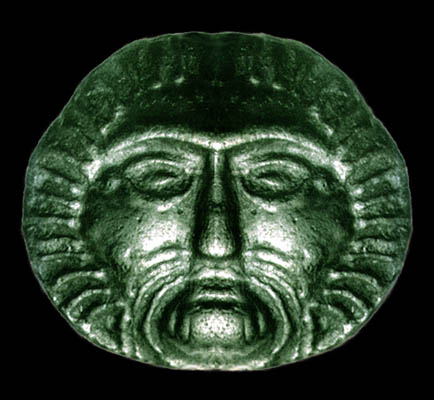
The worship of solar deities such as Apollo, Dionysus/Bacchus, Hercules, Ammon-Ra and the Celtic Belenos was as much about veneration of the seasonal cycle driven by the sun and the earth’s proximity to its heat as it was about a big fiery glowing orbs in the sky.  Sun-worship was ultimately about transience, changeability and -ultimately – reincarnation. The flowing ‘hair’ of animals such as lions, horses, the bristles of the boar and the flowing locks of a barbarian warrior were a popular representation of this force – the planet’s great fertilising power, represented by the ancient Celtic ‘Grannus Apollo’ figures.

Each winter in Europe, the Earth – like a person as their life progressed – grew old and sparse. As humans were an intimate part of the Earth, they followed her patterns, and they used their own experience to relate to that of the Earth. The baldness and coldness of winter was contrasted to the sprouting youth and vigour of spring and summer when the Earth regrew its ‘hair’ – the foliage and vegetation that re-sprouted from the body of the ground. Hairiness was therefore also an important and naturalistic metaphor for this growth.

The ‘help’ offered by the Brownies and their kin was also a metaphor for the learned experiences passed on between generations in a cultural based upon oral transmission. As such, Brownies might be considered the helpful spirits of those who have gone before – those who had grown out of the very soil of the land. They were therefore quite obviously a manifestation of ‘ancestral’ spirits, and were believed to congregate (as families tended to do on night time evenings) around the hearth of the house – a symbol of continuity, which was customarily kept burning in perpetuity in the Gaelic provinces (it was considered bad luck to let the fire go out completely). Bowls of water or milk, and food was left out at night ‘for the fairies’, who typically (being creatures of the inverted Otherworld) visited at night, which was their daytime.

The ‘man-beast’ nature of these spirits was represented in the winter ‘guising’ traditions (e.g. – the Scandinavian Julbocken or dolly or as a disguised person in an goat costume). It was unlucky to offer a Brownie (or Phynnodderee, or Domovoi) clothes, because (to paraphrase the words of Robert Kirk) ‘When we have plenty, they have little, and so to the contrary’.

In fact, the word ‘Goblin’ (a ‘class name’ for the ‘Brownie’ beings comes from the Celtic/PIE root ‘Gabbal’, meaning ‘horse’. The horse occurs along with the other profound solar images of the sun-wheel and the head of the ‘glorious golden warrior’ on most of the Celtic coins of the Iron Age. In Irish myth, the helpful but horny Dagda appears to have been a representative of this spiritual role. The Nixie and the Kelpie were perhaps other aspects of this spiritual role, when the helper also became the conveyer to the realm of the dead.

Belenos and St Michael the Archangel?

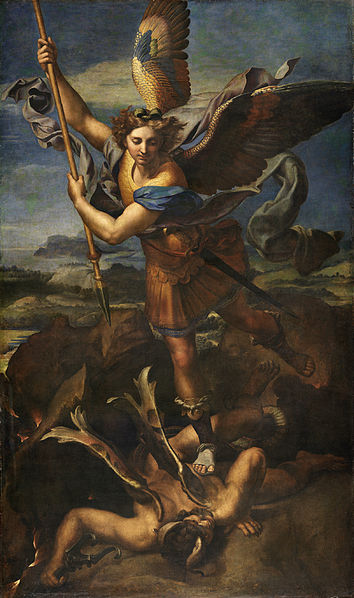
One curiosity of Atlantic European Christianity is the existence in its collegium of venerated ‘saints’ of a figure with no earthly beginnings whatsoever: St. Michael the Archangel.

Saint Michael the Satan-slayer, as depicted by Raphael.

Saint Michael the Satan-slayer, as depicted by Raphael.

As the Taxiarch of the heavenly battle host, he occurs firstly in the Darnel-induced visions of the Hebrew Book of Daniel (Daniel 10, to be precise, where he reassures the Hebrews that they as a nation will be protected from the depredations of their Persian captors):

“…Then I lifted up mine eyes, and looked, and behold a certain man clothed in linen, whose loins were girded with fine gold of Uphaz: His body also was like the beryl, and his face as the appearance of lightning, and his eyes as lamps of fire, and his arms and his feet like in colour to polished brass, and the voice of his words like the voice of a multitude…” (KJV)

Michael appears again in the equally hallucinogenic Christian Book of Revelation written by John of Patmos, and leads the War in Heaven.

“…And there was war in heaven: Michael and his angels fought against the dragon…”

It is obvious that in the late -classical period such a character would have had a certain appeal to Central and Northern Europe’s newly Christianised warrior-cultures who venerated their departed heroes religiously, and had complex story traditions recounting their deeds. If you believe St Patrick, the Irish worshipped ‘Idola’ – visions or images – and from the designs of Celtic coins, it is quite possible that Celtic religion was something of a visionary cult.

The idea of a winged, victorious warrior is by no means an invention of the Hebrews, however. The older Egyptian and Babylonian Empires were responsible for this cultural iconography which entered the western Mediterranean sphere during the Hellenistic period, from where it eventually spread into the ‘barbarian’ world of Europe’s Celts.

During the period of Roman expansion into the lands of the Danubian and Rhineland Celts, and thereafter into Gaul and Britannia, the coins of the Celtic kings began to pick up on the iconography of the ‘winged’ human or animal form. In particular, this can be seen in those produced by the Belgic cultures – in particular the Atrebates, Trinovantes and Catuvellauni of eastern Britain during the 1stC BCE and 1stC CE who played such a major role in the Romanisation of Britain and northern Gaul. Of particular note are the coins of Commius, Cassivellaunus, Addedomarus, Tincomarus, Tasciovanus and his son Cunobelinus, which all show signs of Roman acculturation through their use of visual motifs such as the use of imagery of Pegasus,  the winged Victoria, and the Eleusinian head of Corn. In so doing, they were copying the iconography that their sons had become accustomed to while in fosterage/hostagery in the Roman curia.

Winged icons of shining deities would find their true Renaissance in the coming Christian era, when angels as warriors of light would replace the icon of the mercurial shining warrior god so beloved of the Celts.

The appearance of places named after ‘Michael’ was already well under way by the early middle ages: In Ireland, the early southern monastic island settlement of Skellig Michael was a key place in this process. St Michaels’ Mount in Cornwall and Mont St Michel in Brittany were another two significant places with religious importance. Diodorus of Sicily, writing in the 1stC CE referred to the metal-mining and smelting heartland of Cornwall by the name Belerion, suggesting a theophoric name based on Belen(os):

“…The inhabitants of that part of Britain which is called Belerion are very fond of strangers and from their intercourse with foreign merchants are civilised in their manner of life. They prepare the tin, working very carefully the earth in which it is produced. The ground is rocky but it contains earthy veins, the produce of which is ground down, smelted and purified. They beat the metal into masses shaped like astralgi and carry it off to a certain island off Britain called Ictis…”

Ictis is believed to refer to St Michael’s Mount near Marazion.

Further to the northwest, another important metal-producing place was the Isle of Man (called Manavia Insula by Ptolemy in the 2ndC CE). Here the concept of the  ‘Angel Michael’ was – as elsewhere – introduced into the popular imagination by Christian monks and priests. To the Manx, the name was converted to ‘Vaayl’. The ‘v’ sound could represent a transition from a name starting with ‘b’ or ‘m’ in the Celtic languages. This makes us consider if the original name was in fact ‘Mel’ or ‘Bel’… The name of this Island’s prime saint, ‘Maughold’, is a version of ‘Mayl’ (referred to as ‘Mel’ in the Brigitine hagiographies). The 12thC hagiographer Jocelyn of Furness told a legend of St Patrick defeating a flying wizard called ‘Melinus’ on the Isle of Man. ‘Melyn’ is the Welsh word for ‘yellow’, and sounds something like the Latin word ‘Malin’, referring to the tide. ‘Creg Malin’ in the Isle of Man overlooks St Patrick’s Isle where Jocelyn probably portrayed his imaginary showdown between christianity and the crusty Simon-Magus imitating wizard. This legend of Melinus actually equates directly to the Manx traditions of Manannan, who they claimed was the original ruler overtunrned by Patrick.  The 18thC English writer George Waldron commented that he had been told that ‘Merlin’ was said to be the legendary wizard-ruler, echoing Jocelyn, albeit with an extra ‘r’ and it is to be noted that ‘Merlin’ and ‘Mercury’ are not too dissimilar as names... the plot thickens!

So, Merlin, ‘Melin’ and ‘Belin’ are linguistically not too far from each other. Also, the tendency of Celtic languages to switch the P/B (‘P-Celtic’) sound with the C/K/Q (‘Q-Celtic’) sound make an association of ‘Belen(us)’ with the legendary ‘Cuillean’ a distinct possibility.

‘Cuillean’ was a legendary Irish/Manx smith and metal-smelter who occurs in the legends and placename-lore of Ireland, Mann and Scotland. If we are to link this character to ‘Belenus’ then it is worth noticing the names ‘Cunobelenus’ and ‘Cuchullain’ are exactly equivalent. Also the ‘germanic’ name of the legendary smith-figure ‘Weland’, with the addition of a Gaelic ‘k’ guttural becomes ‘kWeland’ so is actually an equivalent of ‘Chuillean’, or in the Welsh – ‘Gwyllion’. Slieve Gullion in Armagh, Ireland, and Slieu Whallian and Ard Whallan in the Isle of Man are name after him – possibly also ‘Schiehallion’ in Scotland. All of these places have interesting legends attached to them. Ireland also has its share of ‘giant’ or saint-stories with the name ‘Mal’ or ‘Mel’ attached – Mal Bay in County Clare being an example that comes to mind.

So… Belenus is the same ‘person’ as the smith/wright/craftsman Cuillean/Wayland?   The association of Belenus with Mercury, Mars and Apollo in the Romano-Celtic world has a direct relationship with his identity as a craftsman. Like his various hypostases – Lugus among the continental Celts, and Lleu Llaw Gyffes and Manawydan fab Lir in the Mabinogion, he is a maker of things (shoes – like the Irish Leprachaun) – a forger with the fire of the sun and spiritual ‘fire’ of the Otherworld…

Going back to those famous Belgic rulers of ancient Britain in the 1st centuries BC and CE, an appraisal of their names (as well as their numismatic iconography) shows a deep attraction to the god Belenus. Firstly, and most obviously there is Cunobelenus – the ‘Hound/Wolf of Belenus’. Next the tribe of the Catuvellauni – ‘Seat of Belenus’ and their leader Cassivellaunus (‘Stronghold of Belenus’ – defeated by Caesar in his first invasion). The name of the tribal King Tasciovanus (1stC BCE) also had distinct connections to the name of Celtic ancestor gods that Tacitus cites in his book Germania: Tuisto/Tuisco and Mannus (hence, possibly, ‘Tuisco-Vannus’). All of these are probably related to ‘Beli’ – the bristling, bellicose Sun God of the Celts whose icon was sometimes portrayed as a Boar, the horse with its hair streaming or as the combative rutting ‘Stag-Warrior’: Cernunnos.… In fact, etymologically the word for ‘hair’ in the Indo-European languages has similarity to the word for ‘war’ and ‘beauty’. To use Latin as our example, we have Pillus, Bellum, and Bellus: When considering the imagery of Bellenus as ‘Apollo Grannus’, this relationship becomes quite clear – especially in the context of the aesthetics of a proudly adorned warrior race such as the Celts…. It is no wonder they appropriated the horned image of Alexander as ‘Amon-Ra-Apollo’ which he began to use after liberating Egypt from Persian rule while in his youthful prime.

St Michael the Archangel served as a ‘placeholder’ for the ‘folk-memory’ of this important religious figure of the Celts.

A 'solar warrior'

A ‘solar warrior’


Gaelic Polytheism? (Opening a can of worms)

It has become conventional to believe that the Gaels practised a polytheistic form of religion which was partly subsumed or wholly supplanted by Christianity at the coming of St Patrick. However, there are a number of problems with such an interpretation that I would like to address.

Firstly, the contemporary sources we have about actual pagan practises in Ireland are almost non-existent, and most of what we know was written long after the establishment of the new religion. The massive efforts to convert the 4thC Roman Empire from fragmenting polytheism to ‘one-over-all’, top-down theocratic rule started with Emperor Constantine I and his immediate successors. This relied upon propaganda and arguments produced by Christian scholars and apologists operating within the polytheist Mediterranean regions of the empire over the preceding 200 years, and which functioned as a model, a ‘manual’ and a ‘road map’ for propagating Roman christianity across the reaches of its contracting Empire and – in the case of Ireland, way beyond. The spread of Christianity was achieved not by proselytizing rhetoric, but by the conversion and alliance of the church with tribal leaders and their elite inner circles. Once this was complete, the worldview of these rulers’ subjects needed to be changed by coercion, propaganda and cultural revisionism. Bearing in mind that we know that early Irish Christian missionaries travelled to the continent and to Rome to receive their instruction, we must consider how the euhemerist ‘continental’ model for replacing polytheism (operating in earnest from the time of the Emperor Theodosius onwards) influenced their reinvention of the pagan past in order to swing people to christianity. The implication that the Tuatha Dé Danann (as opposed to the síd) were believed in as gods should therefore be viewed with suspicion: The ‘Tuatha’ begin to appear in middle-medieval literature presented variously as former gods, ancestors and historic personages (albeit with a very otherworldly countenance) – much in the same way that continental Christians portrayed pagan gods as deified historic humans in order to demote them. They may well have been created as part of a ‘continental schema’ for imposing Christianity.

Secondly, the conversion of Ireland apparently occurred with surprising ease in a country that had showed little signs of being culturally Romanised. This begs the interpretation that the new religion was therefore possibly not such a titanic shift in worldview as it appeared to have been on the continent. In fact it could even have been considered a ‘paradigm-shift’ or evolution of a system to which it had certain similarities, rather than a wholesale replacement of a complicated pantheon. It certainly ‘hit the floor running’, allowing the Irish to lead with confidence in the christianisation and re-christianisation of the rest of northern Europe. If there had been a hugely ‘other’ and complex polytheistic religion in operation this might not have been so easy, especially as Ireland (so far as we know) didn’t have a religious system that – like that at the heart of the Roman empire – underwent an ‘intellectual gravitational collapse’ after absorbing too many external beliefs. Irish legends in the medieval corpus of texts frequently allude to the pagan Irish prefiguring the coming of christianity, a feature I am not aware of from other cultures.

Thirdly, there is little evidence from folk-tales and traditions supporting the theory of the Tuatha Dé Danann being the former gods. The interpretation of a passage in the presumed 5th-6thC ‘Hymn of Fiacc’ (considered to be an early primary source) may account for this:

On the land of Erin there was darkness;
The Tuatha (Peoples) adored the síd;
They believed not
In the true Deity of the true Trinity.

What exactly the síd are or were is complicated and has no satisfactory resolution from the study of  medieval literature alone. The name was later used for burial and ceremonial mounds, fairy mansions and for the fairies themselves. The TDD were ascribed síd-mounds as homes in the later written myths.

Story traditions from Ireland, Scotland and Mann, often focus on An Cailleach, Fionn mac Cumhaill, Manannan and various other giants and spirits who take on some spectacular and god-like properties in mythological accounts. These are joined by legends of their Christian successors – the saints with their often fantastical and god-like properties. Although there is ample archaeological evidence of supra-regional worldview homogeneity since the Neolithic era, the placenames with pagan origin do not back up the theory that the Tuatha Dé Danann were the gods of the Gael. Where we do have surviving traditions of gods, the most notable is Manannán mac Lir who even today is known to Manx people as ‘their’ god. Medieval literary references to the mysterious gods or idols Crom Cruach or Cenn Croithi (both sounding like epithets rather than proper names) and later folkloric ones to Crom Dubh seem to have little relevance to the literary Tuatha Dé Danann traditions, which monks and/or Christian filidh seemed to use in their suspiciously euhemerist historical revision of paganism. These names (Crom Cruach etc) are linked to assemblies at land-loci: particular plains/fields, or hilltop locations.

SO… if there is a chance that the Gaels were not polytheists, then what were they? The resolution of this question necessarily takes us back to understanding what paganism in general was, and the following is my own personal definition:

Paganism is an allegorical system of spiritual and material philosophy informing the art of survival in a given environment, expressed and transmitted through the mnemonic and dialectic mediums of story, song, aphorism, art and dramatic performance.

If Caesar’s Gallic and British Druids were matched by the magi of the Irish, then  philosophy might be the core value at the heart of the religion, an opinion expressed by the writer on philosophers Diogenes Laertius closer to the time of Ireland’s Christian epiphany. Philosophy was to the ancient world what ‘science’ is to the modern: a technical system that described the universe in both material and allegorical/spiritual terms. Philosophy sought to delineate the indescribable, and the arts provided a non-didactic ‘fuzzy’ medium with which higher truths could be defined without the inevitable destruction that occurs with explicitness. The written word tends to ‘fix’ concepts that are otherwise plastic and ever-changing, thus limiting its conceptual usefulness in establishing doctrines. The Mediterranean approach was to assign a god or spirit to these phenomena and to make statuary images of them which expressed this nature. They also tended to write about them. Both processes produced fixed images of ‘gods’ and created the polytheistic pantheon we know so well. However, the pre-Roman Atlantic Europeans apparently shunned this approach. Their devotion was to images and wordly things (‘idola* et inmunda’) according to Patrick himself (Confessio). (*The definition of ‘idola’ being debateable, as it is a latin usage of a greek word ‘eidola’ meaning ‘image’ orapparition‘ and not necessarily meaning ‘idol’ as in ‘statue or graven image’.)

We have to somehow reconcile the folkloric remainders of what appears to be original practical aspects of Gaelic or Atlantic paganism (with its strong traditions about fairies and their leaders, second sight and the ‘evil eye’) with the literary accounts of the middle ages and evidence from archaeology, place names etc. Analysis of the propaganda techniques used to replace the traditions of the old system has revealed a veritable smorgasbord of euhemerisation, demotion, transformation, canonisation/sanctification and demonization permeating the Christian-era literature and folklore of Europe, making a recovery of the reality of the old pagan system through literature and folklore a difficult but always rewarding task.

Returning to my second point above – the apparent rapidity of conversion – it is worth lingering over the prefigurative literature which alludes to some form of continuity between the pagan and christian systems: The hagiographic legends of Patrick from the Book of Armagh and middle Irish tales such as Altrom Tige Dá Medar (from the Book of Fermoy) state that the way was laid for christianity when the druids prophesised a new order before Patrick arrived, or – in the case of ATDM, Manannán himself is the prophet! Charles MacQuarrie (‘The Waves of Manannan’) makes the case for this god as a pagan exemplar of the Bible’s Yahweh/Jehovah, albeit with a perhaps milder and more sympathetic and less judgemental disposition!

In the Isle of Man, where Manannán is still portrayed as a former king and ancestor as well as an actual current popular god we can see how this process reached its important and unfinished conclusion.

So why choose this overlord of the blessed Isles as the ‘next best’ as an exemplar to the christian god? In Altrom Tige Dá Medar he is cast as overlord of the Tuatha Dé Danann (TDD) whose orders they unquestioningly follow. In spite of this, it is actually quite difficult to include him as a member of the TDD, as he seems to stand apart from them in so many ways. That he should have been chosen for such an explicit euhemerisation in Cormac’s glossary and on the Isle of Man suggests a prominence and equivalence that goes beyond that of the TDD. That a belief in him as lord of the fairy otherworld persisted in folk tradition, along with the strong otherworld ‘fairy’ and ‘second sight’ beliefs I have discussed previously, and the recurring theme of a landscape-associated ‘fairy queen’ suggests that these may well have been core parts of Gaelic paganism.

In the Isle of Man, Manannán is ascribed an immanent presence on the summit of the mountain known as South Barrule, where an ancient hilltop enclosure (‘Cashtal Manannan‘) filled with circular stone ‘beds’ or ‘hut circles’ used to be employed by trysting couples at the festival of Luanys (Lunása – 1st August) as a site for proving love, lust and fertility. The mists which frequently crown the mountain as well as shrouding the whole Island are commonly referred to by most locals as ‘Manannan’s Cloak’. It is somewhat surprising then, that there are comparatively few other places in the Isle of Man named after the god, unless you accept that the whole island itself is eponymous with him.

   Perhaps more interesting are the sneaky profusion of ancient place-names here in this special place that allude to a character of Gaelic folklore with a much more typically immanent presence and connection with the creation and husbandry of the landscape – the Cailleach (Manx: Caillagh) and her various incarnations and epithets as the Fairy Queen. From the hill of ‘Cronk y Berry’ (Eng: Hillberry, Ir: Cnoc Bheara) to the promontory of Gob ny Cally in Maughold and the ancient farm estate of Ballacallin in German the island is peppered with places whose names evoke the giant magical female characters also found in Irish and Scots as well as Welsh mythology, albeit often in ancient and corrupted forms: ‘Chibbyr Unya’ (Aine’s Well), the parish of Santan (‘Saint Anne’ = ‘Seatainne’), ‘Lhing Berrey Dhone’ (‘Pool of Ox-Bheara’, Maughold – there is an ancient Manx folksong about an Ox-stealing ‘witch’, in which it appears that the word Donn has been corrupted. She butchered the Ox in this pool by tradition). There is a ‘Caillagh’s (‘Nun’s’) Chair’ coastal feature on the MArine Drive side of Douglas Head, quite close to a mysterious cliff-cave (now bricked up). The ancient originally Brigitine nunnery of Douglas Priory lies in the shadow of the hill – a continuation of the goddess worship in a pagan guise… Another cave known as ‘Lag Eevl’ (after the Irish Fairy Queen, Aoibheal) in Kirk German, and the hill facing Cronk y Berry known as ‘Cronk y Vill’ or ‘Honey Hill’ have a similar provenance. Add to this the similarly-named hills of ‘Ardwhallin’ (pron. ‘Ardcwhullin’) and the mount of Slieu Whallian (‘Slieve Chullain’) which sits above the Tynwald assembly site and you soon get the idea that Manannan’s presence as an immanent former deity of the island might need to be challenged! The Caillagh was believed to be the Sibyl of the Island and was remembered in recorded folk traditions as late of the 20thC as the source of many prophecies, including one prefiguring the TT Races (which charge deosil around the Island’s central spine of hills). Manannan’s Cloak may once (from the profusion of places named after her) have been the ‘Veil of the Cailleach’…

All this has left me considering if the Gaelic pagan religion was in fact effectively dualistic and ancestor-based? My conclusion is that Manannán was the masculine (solar) polarity who presided over the spiritual Otherworld and the future, terminally and cyclically estranged from the Cailleach who was the elemental ancestress-Creatrix whose body is the earth/elements itself, renewed in the annual cycle. Manannán is a Sun god, NOT a Sea god! There is much circumstantial evidence to support this proposition – in fact, so much more than supports a polytheist interpretation that I find it hard to place a pantheon, except as a philosophical ‘exploding’ of the interactions of these two fundamental characters of Gaelic (and Brythonic) traditions (after the model of Plato’s Timaeus, which I will post on soon). From the Second Sight and Otherworld traditions explained by Robert Kirk, Martin Martin etc to the ancestral-creation myths involving the Cailleach and fairy queen(s) of Ireland and the various half-human wild spirits such as Brownie, Fionn, Phynodderee and Cuchullain, all point towards a binary interpretative system that does not in any way efface with a Tuatha Dé Danann ‘pantheon’.

Fionnysus?

Scholars seemed to have remained intrigued by similarities between Irish and ancient Greek mythology since the advent of Irish literature in the early medieval period, down to the modern day: The monastic writers of the medieval periods, the brilliant Ruaidhrí Ó Flaithbheartaigh (who titled his 17thC history of Ireland Ogygia after Homer and Plutarch’s mystic isle) to the eccentric Charles Vallancey in the 18thC, and the eccentric and brilliant James Joyce of the 20th – all have been able to draw parallels.

Care needs to be taken in approaching the subject as it was, after all,  a hallmark of medieval and early modern Renaissance learning to draw parallels with Europe’s classical ‘golden age’.  National histories and mythologies from across Europe have therefore attracted similar comparisons at one time or another. Nevertheless, the Irish mythological landscape bears perhaps the closest resemblance in its content and complexity to that of ancient Greece. The Greek mythology served to illustrate an understanding of the universe by assigning spiritual entities to all of its functions, and in this regard is similar to every other ‘pagan’ system of learning which coded knowledge into an elaborate prosaic, artistic, poetic, dramatic repository of tradition, supported by dialectic traditions.

Fionn mac Cumhaill recurs as one of the key popular figures and vehicles of the ancient Irish traditions. I would like to discuss similarities in function shared by Fionn and his legendary Greek counterpart, Dionysus.

Dionysus (Bacchus) was revered in Europe’s Eastern Mediterranean provinces since the Bronze Age. Although most often characterised as a god of wine and intoxication, a wider reading of his cultural function reveals that he was equally associated with the convocations and group-efforts of human beings. Whether it be feasting or revels, hunting or adventure expeditions, war-bands, public theatre or the large-scale religious rituals and the mystery cults – Dionysus was often the key spiritual figure. His position as an ‘outsider’ to the Olympian tradition (which possibly post-dated him) was incorporated easily into the diversifying and expanding world of the Greek archaic and Hellenic ages. Many of his traditions were supposed to have been related by the poet Orpheus, and it is apparent that we have a number of links here to Ireland’s Fionn legends.

Fionn, like Dionysus, was a troop-leader whose tales are usually related in traditions by his poet-son Oisín or another of his followers. In his legends he feasts, hunts, fights and travels, and – like his counterpart Cuchullain – is often fractious, destructive, sometimes somewhat simple and erratic. Some of the traditions about him (e.g. – ‘Compert Mongan’) deal with his death and reincarnation – similar to Dionysus in the Orphic mysteries. Fionn is also ascribed a semi-divine parentage in some traditions. Dionysus’ Orphic name, Zagreus,  is interpreted as meaning ‘hunter’ or ‘capturer’ – perhaps alluding to his underworld/psychopomp functions in the Dionysiac mysteries.

Fionn, as leader of the Fianna can therefore be seen to serve a similar narrative function to Dionysus. His connection to the Sluagh of disincarnate souls has never been made explicit in Gaelic (Atlantic) literature, but a connection between the Fianna and the ‘Fairy Host’ is implicit in regional folklore. Finally, the Isle of Man’s Phynnodderee – a mythological half-man, half-beast who helps householders – shares Fionn’s name and attributes in many Manx folk traditions, which otherwise reference a giant called ‘Finn MacCool’.

The last (but by no means the least) connection to Dionysus/Bacchus is that ‘Fion’ is the Irish word for wine!

Slainte!

Plutarch’s account of Cronus worship in the Atlantic north

Here is an important part of a chapter from the Moralia of the 1st/2ndC CE Greek philosopher Plutarch, in which his narrators discuss a fascinating tradition of the worship of Cronus on an island somewhere off or in the archipelagos of northwest Europe. They then go on to digress on the  Orphic mysteries…

From: ‘Concerning the Face  Which Appears in the Orb of the Moon’

26 …Almost before I had finished, Sulla broke in. “Hold on, Lamprias,” he said, “and put to the wicket of your discourse lest you unwittingly run the myth aground, as it were, and confound my drama, which has a different setting and a different disposition. Well, I am but the actor of the piece, but first I shall say that its author began for our sake — if there be no objection — with a quotation from Homer:

An isle, Ogygia, lies far out at sea,

a run of five days off from Britain as you sail westward; and three other islands equally distant from it and from one another lie out from it in the general direction of the summer sunset. In one of these, according to the tale told by the natives, Cronus is confined by Zeus, and the antique Briareus, holding watch and ward over those islands and the sea that they call the Cronian main, has been settled close beside him. The great mainland, by which the great ocean is encircled, while not so far from the other islands, is about five thousand stades from Ogygia, the voyage being made by oar, for the main is slow to traverse and muddy as a result of the multitude of streams. The streams are discharged by the great land-mass and produce alluvial deposits, thus giving density and earthiness to the sea, which has been thought actually to be congealed. On the coast of the mainland Greeks dwell about a gulf which is not smaller than the Maeotis and the mouth of the Caspian sea. These people consider and call themselves continentals and the inhabitants of this land islanders because the sea flows around it on all sides; and they believe that with the peoples of Cronus there mingled at a later time those who arrived in the train of Heracles and were left behind by him and that these latter so to speak rekindled again to a strong, high flame the Hellenic spark there which was already being quenched and overcome by the tongue, the laws, and the manners of the barbarians. Therefore Heracles has the highest honours and Cronos the second. Now when at intervals of thirty years the star of Cronus, which we call ‘Splendent’ but they, our author said, call ‘Night-watchman,’ enters the sign of the Bull, they, having spent a long time in preparation for the sacrifice and the expedition, choose by lot and send forth a sufficient number of envoys in a correspondingly sufficient number of ships, putting aboard a large retinue and the provisions necessary for men who are going to cross so much sea by oar and live such a long time in a foreign land. Now when they have put to sea the several voyagers meet with various fortunes as one might expect; but those who survive the voyage first put in at the outlying islands, which are inhabited by Greeks, and see the sun pass out of sight for less than an hour over a period of thirty days, — and this is night, though it has a darkness that is slight and twilight glimmering from the west. There they spend ninety days regarded with honour and friendliness as holy men and so addressed, and then winds carry them across to their appointed goal. Nor do any others inhabit it but themselves and those who have been dispatched before them, for, while those who have served the god together for the stint of thirty years are allowed to sail off home, most of them usually choose to settle in the spot, some out of habit and others because without toil or trouble they have all things in abundance while they constantly employ their time in sacrifices and celebrations or with various discourse and philosophy, for the nature of the island is marvellous as is the softness of the circumambient air. Some when they intend to sail away are even hindered by the divinity which presents itself to them as to intimates and friends not in dreams only or by means of omens, but many also come upon the visions and the voices of spirits manifest. For Cronus himself sleeps confined in a deep cave of rock that shines like gold — the sleep that Zeus has contrived like a bond for him —, and birds flying in over the summit of the rock bring ambrosia to him, and all the island is suffused with fragrance scattered from the rock as from a fountain; and those spirits mentioned before tend and serve Cronus, having been his comrades what time he ruled as king over gods and men. Many things they do foretell of themselves, for they are oracular; but the prophecies that are greatest and of the greatest matters they come down and report as dreams of Cronus, for all that Zeus premeditates Cronus sees in his dreams and the titanic affections and motions of his soul make him rigidly tense until sleep restores his repose once more and the royal and divine element is all by itself, pure and unalloyed. Here then the stranger was conveyed, as he said, and while he served the god became at his leisure acquainted with astronomy, in which he made as much progress as one can by practising geometry, and with the rest of philosophy by dealing with so much of it as is possible for the natural philosopher. Since he had a strange desire and longing to observe the Great Island (for so, it seems, they call our part of the world), when the thirty years had elapsed, the relief-party having arrived from home, he saluted his friends and sailed away, lightly equipped for the rest but carrying a large viaticum in golden beakers. Well, all his experiences and all the men whom he visited, encountering sacred writings and being initiated in all rites — to recount all this as he reported it to us, relating it thoroughly and in detail, is not a task for a single day; but listen to so much as is pertinent to the present discussion. He spent a great deal of time in Carthage inasmuch as Cronus receives great honour in our country, and he discovered certain sacred parchments that had been secretly spirited off to safety when the earlier city was being destroyed and had lain unnoticed in the ground for a long time. Among the visible gods he said that one should especially honour the moon, and so he kept exhorting me to do, inasmuch as she is sovereign over life and death, bordering as she does upon the meads of Hades.

27 When I expressed surprise at this and asked for a clearer account, he said: ‘Many assertions about the gods, Sulla, are current among the Greeks, but not all tom are right. So, for example, although they give the right names to Demeter and Cora, they are wrong in believing that both are together in the same region. The fact is that the former is in the region of earth and is sovereign over terrestrial things, and the latter is in the moon and mistress of lunar things. She has been called both Cora and Phersephonê, the latter as being a bearer of light and Cora because that is what we call the part of the eye in which is reflected the likeness of him who looks into it as the light of the sun is seen in the moon. The tales told of the wandering and the quest of these goddesses Econtain the truth <spoken covertly>, for they long for each other when they are apart and they often embrace in the shadow. The statement concerning Cora that now she is in the light of heaven and now in darkness and night is not false but has given rise to error in the computation of the time, for not throughout six months but every six months we see her being wrapped in shadow by the earth as it were by her mother, and infrequently we see this happen to her at intervals of five months, for she cannot abandon Hades since she is the boundary of Hades, as Homer too has rather well put it in veiled terms:

But to Elysium’s plain, the bourne of earth.

Where the range of the earth’s shadow ends, this he set as the term and boundary of the earth. To this point rises no one who is evil or unclean, but the good are conveyed thither after death and there continue to lead a life most easy to be sure though not blesséd or divine until their second death.

28 And what is this, Sulla? Do not ask about these things, for I am going to give a full explanation myself. Most people rightly hold man to be composite but wrongly hold him to be composed of only two parts. The reason is that they suppose mind to be somehow part of soul, thus erring no less than those who believe soul to be part of body, for in the same degree as soul is superior to body so is mind better and more divine than soul. The result of soul and body commingled is the irrational or the affective factor, whereas of mind and soul the conjunction produces reason; and of these the former is source of pleasure and pain, the latter of virtue and vice. In the composition of these three factors earth furnishes the body, the moon the soul, and the sun furnishes mind to man for the purpose of his generation even as it furnishes light to the moon herself. As to the death we die, one death reduces man from three factors to two and another reduces him from two to one; and the former takes place in the earth that belongs to Demeter (wherefore “to make an end” is called “to render one’s life to her” and Athenians used in olden times to call the dead “Demetrians”), the latter in the moon that belongs to Phersephonê, and associated with the former is Hermes the terrestrial, with the latter Hermes the celestial.While the goddess here dissociates the soul from the body swiftly and violently, Phersephonê gently and by slow degrees detaches the mind from the soul and has therefore been called “single-born” because the best part of man is “born single” when separated off by her. Each of the two separations naturally occurs in this fashion: All soul, whether without mind or with it, when it has issued from the body is destined to wander in the region between earth and moon but not for an equal time. Unjust and licentious souls pay penalties for their offences; but the good souls must in the gentlest part of the air, which they call “the meads of Hades,” pass a certain set time sufficient to purge and blow away the pollutions contracted from the body as from an evil odour. Then, as if brought home from banishment abroad, they savour joy most like that of initiates, which attended by glad expectation is mingled with confusion and excitement. For many, even as they are in the act of clinging to the moon, she thrusts off and sweeps away; and some of those souls too that are on the moon they see turning upside down as if sinking again into the deep. Those that have got up, however, and have found a firm footing first go about like victors crowned with wreaths of feathers called wreaths of steadfastness, because in life they had made the irrational or affective element of the soul orderly and tolerably tractable to reason; secondly, in appearance resembling a ray of light but in respect of their nature, which in the upper region is buoyant as it is here in ours, resembling the ether about the moon, they get from it both tension and strength as edged instruments get a temper, for what laxness and diffuseness they still have is strengthened and becomes firm and translucent. In consequence they are nourished by any exhalation that reaches them, and Heraclitus was right in saying: “Souls employ the sense of smell in Hades.”

29 First they behold the moon as she is in herself: her magnitude and beauty and nature, which is not simple and unmixed but a blend as it were of star and earth. Just as the earth has become soft by having been mixed with breath and moisture and as blood gives rise to sense-perception in the flesh with which it is commingled, so the moon, they say, because it has been permeated through and through by ether is at once animated and fertile and at the same time has the proportion of lightness to heaviness in equipoise. In fact it is in this way too, they say, that the universe itself has entirely escaped local motion, because it has been constructed out of the things that naturally move upwards and those that naturally move downwards. This was also the conception of Xenocrates who, taking his start from Plato, seems to have reached it by a kind of superhuman reasoning. Plato is the one who declared that each of the stars as well was constructed of earth and fire bound together in a proportion by means of the two intermediate natures, for nothing, as he said, attains perceptibility that does not contain an admixture of earth and light; but Xenocrates says that the stars and the sun are composed of fire and the first density, the moon of the second density and air that is proper to her, and the earth of water and air and the third kind of density and that in general neither density all by itself nor subtility is receptive of soul. So much for the moon’s substance. As to her breadth or magnitude, it is not what the geometers say but many times greater. She measures off the earth’s shadow with few of her own magnitudes not because it is small but she more ardently hastens her motion in order that she may quickly pass through the gloomy place bearing away the souls of the good which cry out and urge her one because when they are in the shadow they no longer catch the sound of the harmony of heaven. At the same time too with wails and cries the souls of the chastised then approach through the shadow from below. That is why most people have the custom of beating brasses during eclipses and of raising a din and clatter against the souls, which are frightened off also by the so‑called face when they get near it, for it has a grim and horrible aspect. It is no such thing, however; but just as our earth contains gulfs that are deep and extensive, one here pouring in towards us through the Pillars of Heracles and outside the Caspian and the Red Sea with its gulfs, so those features are depths and hollows of the moon. The largest of them is called “Hecatê’s Recess,” where the souls suffer and exact penalties for whatever they have endured or committed after having already become Spirits; and the two long ones are called “the Gates”, for through them pass the souls now to the side of the moon that faces heaven and now back to the side that faces earth. The side of the moon towards heaven is named “Elysian plain,” the hither side “House of counter-terrestrial Phersephonê.”

30 Yet not forever do the Spirits tarry upon the moon; they descend hither to take charge of oracles, they attend and participate in the highest of the mystic rituals, they act as warders against misdeeds and chastisers of them, and they flash forth as saviour a manifest in war and on the sea. For any act that they perform in these matters not fairly but inspired by wrath or for an unjust end or out of envy they are penalized, for they are cast out upon earth again confined in human bodies. To the former class of better Spirits the attendants of Cronos said that they belong themselves as did aforetime the Idaean Dactyls in Crete and the Corybants in Phrygia as well as the Boeotian Trophoniads in Udora and thousands of others in many parts of the world whose rites, honours, and titles persist but whose powers tended to another place as they achieved the ultimate alteration. They achieve it, some sooner and some later, once the mind has been separated from the soul. It is separated by love for the image in the sun through which shines forth manifest the desirable and fair and divine and blessed towards which all nature in one way or another yearns, for it must be out of love for the sun that the moon herself goes her rounds and gets into conjunction with him in her yearning to receive from him what is most fructifying. The substance of the soul is left upon the moon and retains certain vestiges and dreams of life as it were; it is this that you must properly take to be the subject of the statement

Soul like a dream has taken wing and sped,

for it is not straightway nor once it has been released from the body that it reaches this state but later when, divorced from the mind, it is deserted and alone. Above all else that Homer said his words concerning those in Hades appear to have been divinely inspired.

Thereafter marked I mighty Heracles — His shade; but he is with the deathless god. . .

In fact the self of each of us is not anger or fear or desire just as it is not bits of flesh or fluids either but is that which we reason and understand; and the soul receives the impression of its shape through being moulded by the mind and moulding in turn and enfolding the body on all sides, so that, even if it be separated from either one for a long time, since it preserves the likeness and the imprint it is correctly called an image. Of these, as has been said, the moon is the element, for they are resolved into it as the bodies of the dead are resolved into earth. This happens quickly to the temperate souls who had been fond of a leisurely, unmeddlesome, and philosophical life, for abandoned by the mind and no longer exercising the passions for anything they quickly wither away. Of the ambitious and the active, the irascible and those who are enamoured of the body, however, some pass their time as it were in sleep with the memories of their lives for dreams as did the soul of Endymion; but, when they are excited by restlessness and emotion and drawn away from the moon to another birth, she forbids them <to sink towards earth> and keeps conjuring them back and binding them with charms, for it is no slight, quiet, or harmonious business when with the affective faculty apart from reason they seize upon a body. Creatures like Tityus and Typho and the Python that with insolence and violence occupied Delphi and confounded the oracle belonged to this class of souls, void of reason and subject to the affective element gone astray through delusion; but even these in time the moon took back to herself and reduced to order. Then when the sun with his vital force has again sowed mind in her she receives it and produces new souls, and earth in the third place furnishes body. In fact, the earth gives nothing in giving back after death all that she takes for generation, and the sun takes nothing but takes back the mind that he gives, whereas the moon both takes and gives and joins together and divides asunder in virtue of her different powers, of which the one that joins together is called Ilithyia and that which divides asunder Artemis. Of the three Fates too Atropos enthroned in the sun initiates generation, Clotho in motion on the moon mingles and binds together, and finally upon the earth Lachesis too puts her hand to the task, she who has the largest share in chance. For the inanimate is itself powerless and susceptible to alien agents, and the mind is impassable and sovereign; but the soul is a mixed and intermediate thing, even as the moon has been created by god a compound and blend of the things above and below and therefore stands to the sun in the relation of earth to moon.’

This,” said Sulla, “I heard the stranger relate; and he had the account, as he said himself, from the chamberlains and servitors of Cronus. You and your companions, Lamprias, may make what you will of the tale.”

These passages detail an Atlantic cult of ‘Cronus’ whose initiates spend 30 years in service – the same period Caesar quoted for the druids. They also perform peregrinations from their central territory, where Cronus is believed interred in a cavern in the earth. Plutarch states this place to be Ogygia – an island supposed in Greek myth to have been inhabited by Atlas (Atlantis) and his daughter Calypso, who imprisoned Oddyseus for 7 years – a period of time typical to Irish fairy abduction myths written in the middle ages. Irish myths sometimes portray the magical islands associated with Manannan in such a way – including the Isle of Man.  The name ‘Ogygia’ is connected to the Gyges or ‘giants’ of whom the Titans seem to be the main class in Greek myth. The names of Okeanos and Ogyges have been linked, and Plutarch’s account seems to back up this identity, perhaps conflating Cronus, Okeanos and Atlas/Atlantis under the same identity…

The text also discusses the flight of souls to the moon, which Plutarch describes as being near to Hades in the context of this chapter. Surely he is not describing a purely Greek myth? To the Greeks Hades’ realm is a chthonic underworld place, sitting above the pit of Tartarus…


Moral philosophy and the Atlantic European ‘Otherworld’

The ‘otherworld’ of the Atlantic Europeans appears to have been the keystone of a system of moral philosophy that existed as a dominant cultural force until the 19th century CE. This moral philosophy was founded firmly in an ancient supra-regional (northern and western European) pagan religion – one that the orientalist Greco-Roman state religions and subsequently their religious inheritor – christianity – had systematically  attempted to displace and replace from the 4th century BC onwards. This religion and culture almost certainly pre-dated the cultural or ethnic impact of the Halstatt and La Teine ‘celtic’ material cultures, but it has subsequently become attached to them and their ‘celtic’ afterglow in the minds of the modern European kindred across the globe.

What was this ‘Otherworld’?

It had many identities expressed in Atlantic popular across a broad swathe of time: In once sense it functioned as a location in which the dramatic and instructional narratives of mythology were played out. In another it was a place where a soul or spirit of a dead or living person might travel to visit or to reside. It might be a place that was distant – the endpoint of a journey – or a place intrusively near to us yet still alien and strange. Its denizens could be at once both very similar to us and yet somehow very different. If one word could sum it up, it would be this: contradiction. At the heart of this contradiction was a fundamental belief that the otherworld somehow mirrored our own. It was a reflection – as if in water or a mirror – that existed in a spiritual form and acted as a counterbalance to the material forces of the world. This belief is in fact traceable in all cultures across the planet, and is a part of empirical (ie – pagan) spirituality.

The confusing, contradictory nature of the otherworld might make it difficult to understand and easy to dismiss, yet the essential paradoxes of these beliefs are in fact their strength and key to the otherworld doctrine. Just as an understanding of indeterminacy and multiple parallel possibilities is the glue that holds together our modern understanding of the subatomic world (and increasingly of the macrocosm), so the otherworld functioned in a similar fashion for the pre-literate, anti-literate and illiterate cultures of the ancient European world down into modern times.

Who was in the otherworld?

When we had plenty in our world, the poor and hungry otherworld denizens were considered jealous of our material wealth (our cattle and kine), and we were poor and needy they might offer us stupendous wealth. and fabulous treasures. They might interrupt our peace and harmony with chaotic acts of cruelty. They could appear as splendidly as they could grotesquely. The people of the otherworld offered a reflection of humanity in all its states, and therefore functioned as a moral anchor that helped us tread the middle path between this world and the next.

As such, it appears that it was believed that each human had a reflection in the ‘other place’ (read Robert Kirk, Martin Martin et al for a 17thC account of how prevalent the beliefs were in the highlands and islands of Scotland). In times of impending peril, this reflection might manifest visibly to people with the ability of  ‘second sight’, and act or appear in a manner which presaged an event that would befall the earthly counterpart. It was called a ‘fetch’ or ‘living ghost’, and a striking account is given by the 14thC monk Ranulph Higden (in ‘Polychronicon’) of the belief in the Isle of Man.

Similar attributes are given to ‘fairies’ in folktales who often presage events in this world through their actions and behaviours. The implication from Robert Kirk’s accounts of highland fairy beliefs is that fairies and fetches are somehow the same, although he himself did not pretend to understand how this was so, except to imply and comment upon a belief that spirits – like the world and its seasons – were continually reincarnated, and lived a long time moving between different places and forms as they went. Ghosts, scal phantoms, fairies, Tuatha de Danann etc may all refer to different statuses occupied by eternal souls in their life cycles.

Spirits were believed to be constituted by that classical ‘fifth element’ – ether, ‘lux’, ‘spirit’ or subtle light. The mundane world was believed to founded, composed and constituted by four philosophical ‘elements’: earth, water, air and fire. Fire was closest in nature to this ‘ether’ which was itself believed to be a form of light, and the substance which all gods and spirits were supposed to be made from.  ‘Spirit’ or ‘ether’ was supposed to be able to represent all of the four mundane worldly qualities – this is why the ancients believed it to be the substance of the ‘otherworld’. This worldview dominated ancient European cultures as late as the 17th century CE after which the anti-pagan paradigms of monotheism couched in Enlightenment era science did away with it as a main force.

Where was the otherworld?

To answer this depends upon reconciling a number of apparent contradictions about location. In medieval Irish prose-tales, ‘otherwordl’ locations such as Mag Mell, Tir Taingaire or Tir nan Og etc are typified as existing in the west, often as distant islands full of magical folk. In the case of Tech Duin and the Isle of Man, these are very real and visible islands, for which ‘west’ is relative. At the same time, the otherworld might also be encountered underground in the Sid mounds, or at liminal points in the landscape, the seasons or the day. Our night-time appears to represent the working daytime of those denizens we call spirits, elves and fairies. People took care never to speak ill of fairies as they were frequently belieed to be very much nearby. The otherworld is therefore both near and distant. Recalling the description I just gave of the ancient ‘elemental’ philosophy, one might say that the world was perfused and pervaded by ‘spirit’ which was the framework around which the mundane elements worked.

The otherworld’s moral philosophy:

How did ‘fairies’ influence behaviour and maintain a moral code without recourse to written statutes? By acting as a counter-ballast to actions in the mundane world. It was ‘Newton’s laws of motion’ and the ‘first law of thermodynamics’ expressed in the timeless empiricism of European pagan spirituality:

Take too much from this world, and the otherworld will come for its portion.

Tread a middle path and the otherworld will treat you the same.

The poor and humble are wealthy and great in the next life.

From decay comes generation.

All of these ideas hinged upon the otherworld/afterlife doctrine of cyclical continuity. We know that ancient Greek philosophers such as Pythagoras and others were influenced by the ‘philosophers’ of the Atlantic Europeans, otherwise known as druids. They later wrote about this and admitted it (eg – Diogenes Laertius).

We have to ask ourselves to what degree these ideas were pervading contemporary philosophers among the Hellenized peoples of the Mediterranean, middle east and asia minor during the early Roman Empire: Jesus of Nazareth in particular, whose own story and philosophies and eventual act of self-sacrifice appear to mimic the practices the Romans were busy trying to stamp out in Gaul, Britannia etc.

I shall finish with the words of Pliny (1stC AD) who had this to say about the druids:

…we cannot too highly appreciate our debt to the Romans for having put an end to this monstrous cult, whereby to murder a man was an act of the greatest devoutness, and to eat his flesh most beneficial.

He could just as likely have been referring to another religion that was  just starting out among a group of philosophical Hellenic Jews in the middle east…

St. Kentigern – a christianised pagan tale?

Kentigern, often known as Mungo, was a saint of the early medieval Christian church who was supposed to have lived in the 6th century and to have been responsible for christianising the ancient Cumbric British Kingdom of Strathclyde, now a part of Scotland.

The region of Strathclyde forms the southern gateway to the Scottish Highlands, and is formed by the plains and foothills surrounding the great River Clyde which discharges into the Irish Sea, and was therefore an important region in the historic interplay between the various cultures of this region during the first millennium, including the peoples of the Scottic Dalriada provinces, Gallovidians, Picts, Cumbrians and peoples of Rheged and later the Anglians and Norse settlers. Its capital city of Glasgu (Glasgow) was supposedly founded by Mungo.

Most of what we know of him is dependent upon the hagiographic writing of the great 12thC Cistercian Abbott, Jocelyn of Furness, who was instrumental in assisting with the mission of the continental (Norman) church to establish dominance and the episcopal system in the northwest Atlantic provinces and who translated Gaelic hagiographical traditions into latinate ones to suit the new ‘Anglo’-Norman world. Jocelyn provided new saints’ lives for Patrick (who supposedly originated in Strathclyde) as well as Mungo/Kentigern. His patrons for the work on Patrick were John de Courcy, and probably also his ally – the King of Mann and the Isles, Godred Olafsson whose sister Auffrica had married de Courcy, and who had assisted in the Norman lord’s conquest of Ulster and the subsequent consolidation of Ireland’s religious power under a post-Gregorian reformed episcopacy. For the work on Kentigern, his sponsor was the Norman Abbott Jocelyn of Melrose who was also Bishop of Glasgow, Strathclyde’s principle town.

The coat of arms of Glasgow depicts the miracles of St Kentigern (Mungo)

The coat of arms of Glasgow depicts the miracles of St Kentigern (Mungo)

Jocelyn’s Life of Kentigern starts with an apology for the problems he encounters in interpreting the various gaelic language traditions of the saint he a had gathered in order to flesh out a text already being developed by the bishop of Glasgow. The stories he gathered were mainly from Strathclyde and from St Asaph’s in Wales: all important ports, along with Furness, in the Irish Sea region. Many of these tales he implies were improper and contained too many elements of heathenism, ‘contrary to certain doctrine and catholic faith’ to use the narrators own words. In fact, it is fairly clear from reading the Furness monk’s work that there is plenty of pagan material still within it, as well as much promoting the other seats of the new continental religious power and spirit of the Gregorian Reforms of church probity and religious rigor that underpinned the Cistercian worldview of the 12th and 13th centuries. His aim was obviously to rid the tale of aspects of what he perceived as syncretic heathenism in the Gaelic forms of Kentigern’s life so as ‘to season with Roman salt what had been ploughed by barbarians’.

Before I embark upon my commentary of the pagan aspects of this legendary text, I urge readers to take a look at a recent translation of the work by Cynthia Whiddon Green.

The first aspect I’d like to examine is the ‘origin story’: This is one of a fallen and rejected heathen woman Thaneu – fallen both in Jocelyn’s medieval Christian moral sense and fallen also in the physical sense that she was apparently thrown off a cliff at the top of Traprain Law in Lothian. The tale mirrors the biblical narrative of the Cistercians’ favourite ‘mother goddess’ – Mary,  with Mungo’s mother pregnant through an illicit extra-marital union with a nebulous and unspecified paternal donor. For such a ‘crime’ her father, the King of Lothian, has her thrown off a crag on Dumpelder (Traprain Law) but she is carried softly down to the ground, as if by wings. She is then cast adrift in the ocean in a coracle – her fate dependent upon the spirit of the seas. It so happens she drifts ashore near to an early Christian centre of learning run by St Servanus/Serf, and she builds a fire for herself on the shore and gives birth to a boy – Mungo – before being discovered by the monks.

Those astute in the folklore originating from Atlantic paganism will recognise that these motifs are to be found in many of the ‘syncretic’ literary and folktales that survive from Ireland, Scotland, the Isle of Man etc. Conception by spirits of magical children, the leapss and falls of giants, the casting adrift of sacred children and female personages who come ashore to figuratively give birth. The narrative is one based in the seasonal drama, and passage of the sun across the sky.  The female character (Thanue) is the Earth Goddess and the male (Mungo) represents the Sun/Son – in the story, the Sun is born out of the land in the east and travels west towards the Atlantic ocean into Strathclyde. The theme of a magical character washing ashore occurs in the Isle of Man’s Caillagh y Groamagh legend attached to Bridget’s day or Imbolc as it is sometimes known. The same theme is used in the Bethu Brigdhe hagiography of Bridget which mentions the bandit-turned-saint Machaldus (Maughold) being cast into the sea and washing up in the Isle of Man. Thanue is therefore a character replacing Bride-Aine, but what of her son?

The fact that Mungo enters his floruit (recorded life) from the sea and spends an awful lot of time in water and controlling water during the rest of his hagiography is highly suggested of the solar deity motif, identifying him with reasonable certainty as a hypostasis for the shining god Manannan who strides so actually godlike among the lesser characters of many of the euhemerist legends of medieval Irish literature and later folk tradition.  Even his name seems to refer to ‘Man’ in the form of ‘Mun’, just like Mongan mac Fiachna in the Irish Manannan legends. Mungo = Manannan.

Christian narratives did their best to replace the dualist Atlantic god and goddess with a masculine counterpart, particularly after the Brigitine church period, so Mungo subsumes the roles of both in the rest of the Vita. Here is a list of some of the features of Jocelyn’s tale which illustrate the pagan legends he was trying to weave in:

1. He emerges from the sea and has power over the waters.

2. He has the power to resurrect (e.g. – the little ‘red bird’ of St Serf – either a Robin or a Wren).

3. He has a magical branch (hazel or holly – the gaelic names can be confused) with which he keeps Serf’s eternal holy flames burning.

4. He resurrects a man who describes being conveyed back from the afterlife by a man of shining fiery light.

5. He conveys the dead to their resting place (the bullock cart is an interesting celestial motif)

7. Like the Cailleach of highland legend, while living as a ‘Culdee’ he exerts control over flocks of deer and wolves, who he treats like cattle, and hitches to his plough.

8. He spends an inordinate amount of time dousing himself in water and radiating holy light. When others are asleep he is awake praying – the Otherworld Inversion.

9. He disappears from the world in winter to fast. His food is the underground parts of dormant plants.

10. He sleeps in a stone sarcophagus and wears goat skins. There are a number of references to paganism in medieval and later literature which attest to ‘saints’ or spirits living in stone sarcophagi covered in water. Brownie/Phynnodderee/Glastig was a hairy half-human.

11. He is associated with a magical white boar, a special ram, and bullocks.

12. He finds a ring in the belly of a salmon. This motif also occurs in a number of traditional ‘fairy tales’ and medieval irish otherworld literature. For example, the Irish legend of Macaldus, the English fairy tale ‘The Fish and the Ring’ and the Irish Tain Bo Fraich. The Salmon returning is a motif of the returning year and the ring also – the goddess name Aine signifies a ring as well.

There are quite a few more referenes which emerge upon careful study of Jocelyn’s work, but these are the most important! Read the text and see what you think…

The fate of the early Irish Brigitine church

We know from the earliest surviving hagiographic literature from Ireland (written by Cogitosus, Abbot of Kildare some time in the 7thC) that the original Irish ‘Brigitine’ monastic movement was probably one of the first forms of organised christianity that flourished in Ireland, sociologically interesting in that their communities or ‘abbeys’ apparently combined chapters of both male and female ascetics. These abbeys and their leaders are generally accepted to have been places where the children of the local aristocracy would be fostered to the care of the new political and spiritual forces influencing Ireland and Britain in the period, offering opportunities for learning and travel. It appears to have preceded the ‘Patrician’ movement which established its retrospective dominance in the ensuing four centuries of Uí Néill ascendancy, leading to Patrick becoming seen as the main patron saint of Ireland. Even by the 12th century, monastic writer Gerald of Wales was able to comment (perhaps to highlight in his eyes its need for reform) upon the strange setup at Kildare with its holy enclosures, sacred meadows and sanctuary with its eternal flame.

Cogitosus claimed that there had been an explosion of Brigitine missions and Abbeys in his own lifetime that had spread across Ireland, yet it is somewhat difficult to ascertain what and where all of these were. We can be certain that some of these were taken over by the subsequent movements of the male-centred order of Finnian and his students, perhaps in continuity of the Brigitines’ probable appropriation of goddess-centred sanctuaries for their own establishments. Indeed, the language and forms of popular legend and hagiography about characters such as Cóemgen (St Kevin of Glendalough) and Senán mac Geircinn (St Sennan of Scattery Island) contain coded references to deposed female characters and conquered ‘beasts’ – typical motifs used in dealing with indigenous paganism. It is very likely that these Irish early-christian religious institutions were established at the sites of former pagan shrines, and that many if not most of these were associated with well-springs, islands in sacred lakes and rivers and river-crossings, as well as fertile meadowlands – the typical sites of earthly goddess-worship and legends. The attributes of <Christian Brigit> in the accounts by Cogitosus and from later texts such as the Bethu Brighde were loquaciousness, fecundity, hospitality, healing powers, associations with fire and light, and some mechanical miracles.

With this in mind, Cormac’s Glossary (probably 10thC) had this to say about Brigit (trans. by John O’Donovan, Ed. Whitley Stokes):

“Brigit i.e. a poetess, daughter of the Dagda. This is Brigit the female sage, or woman of wisdom, i.e. Brigit the goddess whom poets adored, because very great and very famous was her protecting care. It is therefore they call her goddess of poets, by this name. Whose sisters were Brigit the female physician (woman of leech craft), Brigit the female smith (woman of smith work), from whose names with all Irishmen a goddess was called Brigit.”

The passage is remarkable as it makes a specific reference to a pagan Brigit and claims this was the name by which all the goddesses of Ireland were once called by the Irish! She is referenced as a creatrix through the Smith-association, a mistress of nature’s healing bounty, and an exciter of the human imagination in expressing the things of the world. Explicitly in the Sanais Chormac, she is a triple goddess of the sort seen in the characters of the Matronaes depicted in some of the statuary and bas-relief traditions of late Iron Age Atlantic European cultures: Mother goddesses perhaps representing the three generative seasons of the year…

Brigitine monasticism is likely to have taken over the reigns of traditional goddess-worship in Irish society during the 5th/6th centuries (if not earlier), and then to have been supplanted by a male-centred order under the acolytes of her supposed contemporary Finnian of Clonard (attrib. 5th/6thC) who promoted a non-feminine regime magnifying the missions of Palladius and Patrick (sometimes now referred to as the ‘two Patricks’) as the main forebears of Irish christianity. Finnian is the character that the ‘second wave’ of Irish saints depend upon for their education at his great school. However, we must necessarily question whether these religious establishments that began to cascade as far as Ireland’s westernmost extremes and into Scotland, Mann, Wales and Cornwall before leaping to the continent, were based upon pre-existing (possibly syncretic) Brigitine sites.  There is no explicit evidence to demonstrate this, but much that is oblique or indirect, as formerly commented on.

One particularly interesting piece of literary evidence from the 15thC Book of Fermoy (roughly contemporary with Chaucer) contains an explicitly Christianised version of an older tale also known as ‘The Wooing of Etain’ (earliest surviving version is from the early 12thC), but referred to in this context as Altram Tige Da Medar (‘The Fosterage of the House of the ?Two Pails’). It is set in the pseudo-historical world of the ‘Gebala Eirenn’ mythos, and tells of the warrior tribes of Tuatha De Danann and their ruler Manannan who settles them in various Sid mansions and governs them with the laws of the Otherworld. In this tale, the fairy Eithne (apparently the same character as the earlier Etain, possibly also a version of the name ‘Aine’) has an inverted ‘otherworldly’ encounter with a christian priest and his church after being abstracted from her friends while batheing in the Boyne and becomes fostered by him and becomes a Christian!

You can read a copy of it here: @MaryJones

Readers may recognise ‘Eithne’ or ‘Ethniu’ (‘Enya’) as a character who makes a number of appearances in the mythological cycle tales – as the mother of the hero Lugh. Here she is daughter of a minor Tuatha Dé Danann (TDD) noble called Dicu, fostered by Aengus, and Manannan is portrayed – curiously – as the (Christian) god-fearing ruler of the TDD who tries to bring a new rule of law and order to the fairy tribe to whom he grants their Sidhe mansions or hills. The narrative hands to Eithne (for which we might also read (C)ethlinne or ‘Aine’) the role as the first TDD to become a Christian – fostered by one of Patrick’s priests. It is almost analogous to the early Bridget hagiographies in this regard – building a sympathetic or syncretic bridge between the pagan past and the Christian future which the Book of Fermoy’s 15thC aristocratic patrons must have enjoyed.  Manannan also fulfils the function of ‘Christian Godsend’ that Charles MacQuarrie suggests in his ‘Waves of Manannan’ thesis – an acceptable pagan analogy of the Christian god, who the narrator has Manannan hail and recommend in his role as benevolent otherworld leader of the TDD:

‘…The nobles inquired of Manannan where Ealcmar would find rest. ‘I know not’, said Manannan, ‘and no prophet or sage in the whole world knows, but the one God almighty knows.’ …. ‘

The displacement of Brigitine syncretism became a significant ambition of narrative traditions from the 6/7thC and therefore appears to have continued as late as the 15th century. After all, heresy was always the main home enemy of western christianity and from the 15th century would evolve into something known as the ‘witch craze’ where pagan folk-traditions would eventually under intense scrutiny by both the religious AND secular authorities and become a victim of the polemic of popular culture.