The Gaesatae

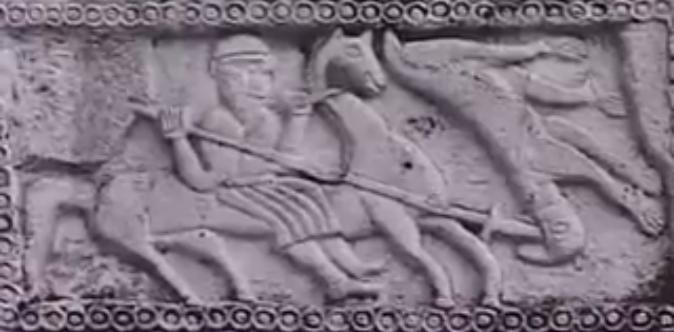
The Gaesatae were a Celtic mercenary force derived from ‘about the Alps and on to the Rhone’ (i.e. – Transalpine Gaul) who were recorded as joining the combined armies of Cisalpine Gauls including the Boii, Taurisci and Insubres in an attempted attack on the Roman Republic in the late stages of the 3rdC BCE. Like the other Celtic ‘tribes’ seen in the post-4thC BCE Europe (during the ‘La-Téne’ material culture period) they were a group based around military exploits rather than of familial and geo-cultural origins. Of particular interest was their tendency (like the later Norse Berserkr warriors) to go into battle naked, except for their weapons and shields. This tactic – also noted to be practised by the Galatians and other factions of central European Celts following the 4th/3rdC expansion. It was likely to have allowed them to be highly mobile, to demonstrate their apparent bravery (or fanaticism) to their enemies, and no doubt to intimidate with their magnificent physiques – a point not lost upon Greek historian Polybius. The image of the naked Gaesatae or Galatian warrior has therefore been a romantic and enduring one, not in the least because of the powerful statuary image of a dying Gaulish warrior, naked except for his neck torc, that survives from ancient Rome – possibly being a copy of a Hellenistic original from the 3rdC BCE.
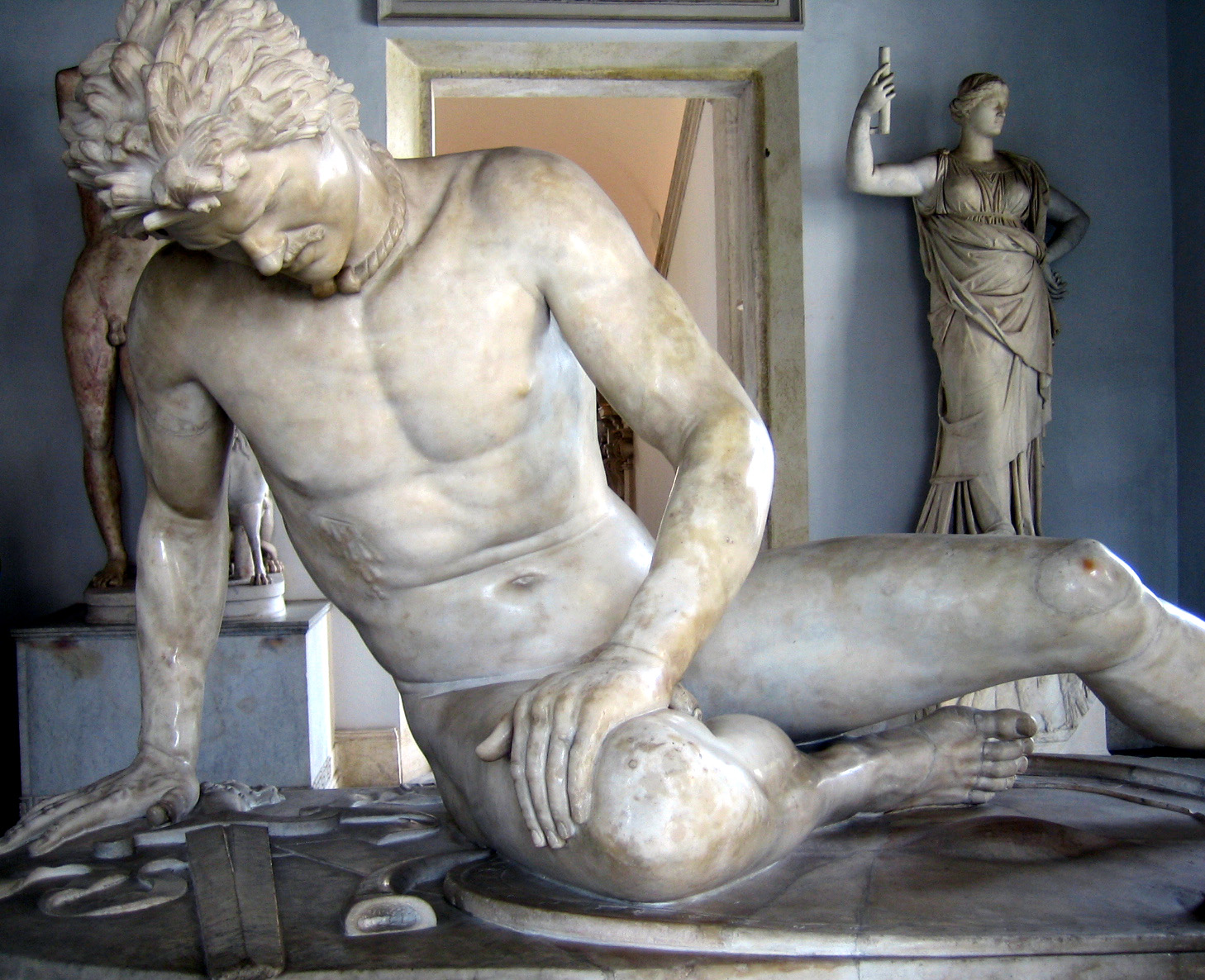
The 'Dying Gaul' or 'Dying Galatian' from the Capitoline Museum.

The ‘Dying Gaul’ or ‘Dying Galatian’ from the Capitoline Museum.

Although linked to the 3rdC BCE Gaulish campaigns against the crumbling Macedonian Empire, the image of the ‘Dying Gaul’ may in fact derive from the Battle of Telamon of 225BCE, fought between the Romans and invading factions of federated Celtic tribes in northern Italy. The Greco-Roman historian Polybius (Histories 2:28 2ndC BCE) recalled the fighting style of the Gaesatae during this event:

“… The Celts had stationed the Alpine tribe of the Gaesatae to face their enemies on the rear, and behind them the Insubres; on their front they had placed the Taurisci, and the Cispadane tribe of the Boii, facing the legions of Gaius. Their waggons and chariots they placed on the extremity of either wing, while the booty they massed upon one of the hills that skirted the road, under the protection of a guard. The army of the Celts was thus double-faced, and their mode of marshalling their forces was effective as well as calculated to inspire terror. The Insubres and Boii were clothed in their breeches and light cloaks; but the Gaesatae from vanity and bravado threw these garments away, and fell in in front of the army naked, with nothing but their arms; believing that, as the ground was in parts encumbered with brambles, which might possibly catch in their clothes and impede the use of their weapons, they would be more effective in this state. At first the only actual fighting was that for the possession of the hill: and the numbers of the cavalry, from all three armies, that had joined in the struggle made it a conspicuous sight to all. In the midst of it the Consul Gaius fell, fighting with reckless bravery in the thick of the battle, and his head was brought to the king of the Celts. The Roman cavalry, however, continued the struggle with spirit, and finally won the position and overpowered their opponents. Then the foot also came to close quarters…”

The Romans had good cause to worry about this army – not in the least because of the success of the Celts in the Balkans, Macedonia, Greece and Anatolia within the last 100 years, but perhaps more so because of the successful attack on Rome by Brennus of the Senones during the 4thC BCE, and the support of Celtic tribes which did so much for Hannibal’s success in the Punic Wars. The Gaulish warbands had a reputation for military fanaticism and bravery born from their religious ideologies. The naked and fearsome Gaesatae, perhaps more prepared for man-to-man combat, were – however – ultimately no match for the javelins, arrows and darts that rained down upon them at Telamon, and ultimately fell before this onslaught. Just like in 279BCE their ‘king’ or leader (who had, like his men, no doubt pledged his life to the Otherworld Lord, Belenos) committed suicide rather than face capture or defeat. Rome’s eventual success at the battle marked the watershed of Celtic hegemony in northern Italy and the Balkans and would lead to a period of rapid extension of Roman influence towards the East, during which Celtic tribes would more frequently find their fortunes fighting on the winning side as auxiliaries. As Rome became more powerful and wealthy, the Celtic warrior followed the gold, and his religious outlook became Romanised…

Thoughts on the Gaesatae:

Polybius – like other Greek and Roman authors before and after him – commented upon the proud nature of the Celtic warrior in order to both honour them as enemies, but also to magnify the Roman soldiers who overcame the worthy adversary. The Gaesatae were evidently not a tribal ethnic group, but – like the Scoridisci and other central and ‘Belgic’ groups – a ‘fighting nation’ drawn from diverse backgrounds. This must have been a particular ‘La Téne’ era phenomenon: Warband groups had attracted young males (and females) from the 4thC BCE, to participate in such exploits as the Punic Wars, the invasion of Rome led by Brennus of the Senones, and the invasions of the Balkans, Macedonia, Greece and Anatolia by the combined armies of the 3rdC BCE. These had specific impacts upon the outlook and fighting style of European barbarian (Celtic) warriors and their subsequent cultural evolutions, not in the least due to the cash injections that their success provided to specific areas of industry:

1. The promotion of a warrior cult which saw death as a brief transition through the Otherworld, or a permanent place in the Celtic notion of ‘Elysium’ as a future ‘hero-helper’ of the people. This promoted a fearlessness and fanaticism which gave these warriors a widespread reputation without which the Roman Republic and Empire (who employed them as mercenaries and allies) would not have succeeded.

2. The stimulation of a weapons and armour industry and tradition within the Balkans and Eastern Europe (e.g. – chainmail and the longsword) which would give birth to the future armoury traditions of the middle ages, supplying technology to both Europe and the East.

3. The idea of the highly-mobile, rapid-response infantry and cavalry army created from across tribal boundaries. These warbands – like the legendary Irish Fianna – provided Celtic society with an outlet for their warlike ways which could remove aggression and conflict from home-soil and export it to bring back wealth and plunder. The Roman Empire thrived upon its ability to deploy legions of Celts and other similarly-motivated foreigners to do their ‘dirty-work’ and relied upon the military developments of Celtic Europe between the 5th and 1stC BCE in determining the format of its conquering armies. In a way, it is possible to consider that the Roman legions took their lead (as well as many of their men) from the militarist fanaticism of the Celtic world.

4. The wealth from the 4th and 3rdC BCE Celtic warband conquests was a potent stimulus to culture and trade, as well as migration and mobility of cultural groups. The ‘Scoridisci’ culture of Eastern Europe was a remnant of the 3rdC BCE wars and expansions, as was the Galatae Celtic groups in Anatolia (modern Turkey). The Belgae of northern Europe, the Volcae-Tectosages, and the Boii people of northern Europe and Cisalpine Gaul were all important trans-ethnic groups who had cultural origins in such martial exploits during the La-Téne period.

The supposed ethnic-tribal group (according to the Romans) of northern Europe known as the ‘Belgae’ were almost certainly a part of this movement which blurred ethnic and linguistic boundaries, and whose cultural influence extended from west of the Rhine to the Atlantic and the British Isles. However, these fell into decline after the 1stC CE following on from the Roman conquests, their identities dissolving with Romanisation, and their warlike culture (like that of the Scottish Highlanders after the 18thC) being employed in the imperial army in a cunning piece of cultural engineering. However, there is no reason to suspect that the culture did not continue beyond the limits of Roman influence in Scandinavia, Germany, northern Britain and Ireland. Due to linguistic and other reasons, the Romans did not identify these peoples with the potent ‘Gaulish’ Celts and their fanatical druid-led religious system. There are many reasons to suspect that they held the same religious and cultural views, however – the powerful image posed by the naked Viking Era Odinist Berserker being one such reason, along with the many parallels I have already discussed.
 

Hallucinosis, battle-fury and oracles of the divine

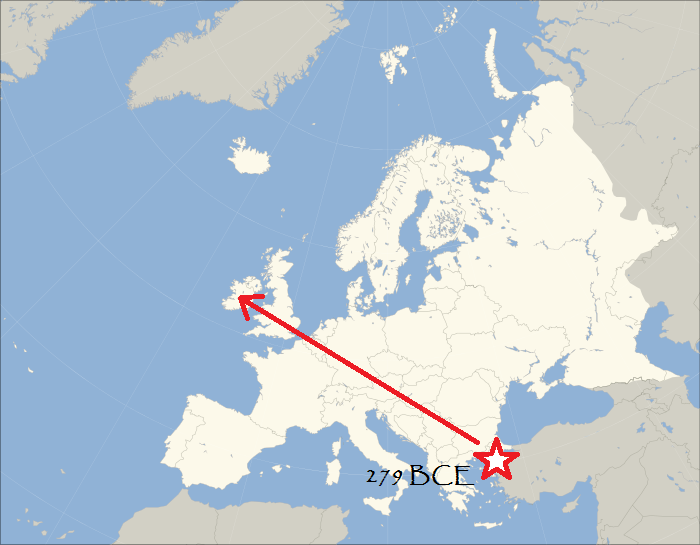
When the Gaulish warlord Brennus led his army through the Greek defences at Thermopylae and into a full-on assault on Delphi in 279BC, he was attacking perhaps the most important and wealthy religious centre of ancient Greece, notable for its oracular priestesses who apparently communed with the solar god Apollo in order to answer the questions of suppliants. These suppliants came from across the known world and beyond, and bought great wealth and honour to the sanctuary and its city, deep in the Greek highlands. Although there are no surviving contemporary records of this exceptional assault by the Celtic army, the 1stC Gallo-Roman author Gnaeus Pompeius Trogus of the Vocontii of Gallia Narbonensis wrote about the attack some 200 years later in his ‘Phillipic History‘ (of the Macedonian dynasty and its aftermath) which survives in a slightly later Epitome by Roman author, Justin. Given the role of southern Gauls in tne campaign (the Volcae Tectosages Belgic group settled or returned there after the event – reputedly with great wealth) it seems that Pompeius Trogus’ account is worth paying attention to, albeit embellished with the idea that those who attack holy sites pay with their lives… In Book 25 of Justin’s ‘Epitome’, we learn the following:

“… The Gauls, when the land that had produced them was unable, from their excessive increase of population, to contain them, sent out three hundred thousand men, as a sacred spring, to seek new settlements. Of these adventurers part settled in Italy, and took and burnt the city of Rome; and part penetrated into the remotest parts of Illyricum under the direction of a flight of birds (for the Gauls are skilled in augury beyond other nations) making their way amidst great slaughter of the barbarous tribes, and fixed their abode in Pannonia. They were a savage, bold, and warlike nation, and were the first after Hercules (to whom that undertaking procured great admiration for his valour, and a belief in his immortality), to pass the unconquered heights of the Alps, and places uninhabitable from excess of cold. After having subdued the Pannonians, they carried on various wars with their neighbours for many years. Success encouraging them, they betook themselves, in separate bands, some to Greece, and some to Macedonia, laying waste all before them with the sword. Such indeed was the terror of the Gallic name, that even kings, before they were attacked, purchased peace from them with large sums of money…”

He goes on to describe the defeat and death of the Macedonian king Ptolemy Keraunos and his army by the theophorically-titled Celtic warlord, Belgius. Another Gaulish chieftain, Brennus, appears to have then entered the fray to acquire his own share of the wealth of the crumbling Empire’s homelands:

“…In the meantime Brennus, under whose command a part of the Gauls had made an irruption into Greece, having heard of the success of their countrymen, who, under the leadership of Belgius, had defeated the Macedonians, and being indignant that so rich a booty, consisting of the spoils of the east, had been so lightly abandoned, assembled an army of a hundred and fifty thousand foot and fifteen thousand horse, and suddenly invaded Macedonia. As he was laying waste the fields and villages, Sosthenes met him with his army of Macedonians in full array, but being few in number, and in some consternation, they were easily overcome by the more numerous and powerful Gauls; and the defeated Macedonians retiring within the walls of their cities, the victorious Brennus, meeting with no opposition, ravaged the lands throughout the whole of Macedonia. Soon after, as if the spoils of mortals were too mean for him, he turned his thoughts to the temples of the immortal gods, saying, with a profane jest, that “the gods, being rich, ought to be liberal to men.” He suddenly, therefore, directed his march towards Delphi, regarding plunder more than religion, and caring for gold more than for the wrath of the deities, “who,” he said, “stood in no need of riches, as being accustomed rather to bestow them on mortals.”

The temple of Apollo at Delphi is situate on Mount Parnassus, on a rock steep on all sides. A concourse of people, who, collecting from the parts around, through veneration for the majesty of the god, settled on the rock, formed a city there. Thus, not walls, but precipices, not defences formed by the hand, but by nature, protect the temple and the city; so that it is utterly uncertain whether the strength of the place, or the influence of the deity residing in it, attracts more admiration. The central part of the rock falls back in the shape of an amphitheatre; and, in consequence, if ever shouts are raised, or if the noise of trumpets is mingled with them, the sound, from the rocks echoing and re-echoing to one another, is heard many times repeated, and louder than it was made at first. This effect, on those who are ignorant of its cause, and are struck with wonder at it, produces a greater awe of the power of the god. In the winding of the rock, about half way up the hill, there is a small plain, and in it a deep fissure in the ground, which is open for giving oracles; for a cold exhalation, driven upwards by some force, as it were by a wind, produces in the minds of the priestesses a certain madness, and compels them, filled with the influence of the god, to give answers to such as consult them. Hence many rich presents of kings and nations are to be seen there, which, by their magnificence, testify the grateful feelings of those that have paid their vows, and their belief in the oracles given by the deity.

Brennus, when he came within sight of the temple, deliberated for some time, whether he should at once make an attempt upon it, or should allow his soldiers, wearied with their march, a night to refresh themselves. The captains of the Emanus and Thessalorus, who had joined him for a share in the booty, advised that “no delay should be made,” while the enemy were unprovided for defence, and the alarm at their coming still fresh; that in the interval of a night, the courage of the enemy would perhaps revive, and assistance come to them; and that the approaches, which were now open, might be blocked up. But the common soldiers, when, after a long endurance of scarcity, they found a country abounding with wine and other provisions, had dispersed themselves over the fields, rejoicing as much at the plenty as if they had gained a victory, and leaving their standards deserted, wandered about to seize on everything like conquerors. This conduct gave some respite to the Delphians. At the first report that the Gauls were approaching, the countrypeople are said to have been prohibited by the oracle from carrying away their corn and wine from their houses. The salutariness of this prohibition was not understood, until, through this abundance of wine and other provisions being thrown in the way of the Gauls, as a stop to their progress, reinforcements from their neighbours had time to collect. The Delphians, accordingly, supported by the strength of their allies, secured their city before the Gauls, who clung to the wine-skins, on which they had seized, could be recalled to their standards. Brennus had sixty-five thousand infantry, selected from his whole army; of the Delphians there were not more than four thousand; in utter contempt of whom, Brennus, to rouse the courage of his men, pointed to the vast quantity of spoil before them, declaring that the statues, and four-horse chariots, of which a great number were visible at a distance, were made of solid gold, and would prove greater prices when they came to be weighed than they were in appearance.

The Gauls, animated by these assertions, and disordered, at the same time, with the wine which they had drunk the day before, rushed to battle without any fear of danger. The Delphians, on the other hand, placing more confidence in the god than in their own strength, resisted the enemy with contempt, and, from the top of the hill, repelled the Gauls as they climbed up, partly with pieces of rock, and partly with their weapons. Amidst this contest between the two, the priests of all the temples, as well as the priestesses themselves, with their hair loose, and with their decorations and fillets, rushed, trembling and frantic, into the front ranks of the combatants, exclaiming that “the god was come; that they had seen him leap down into his temple through the opening roof; that, while they were all humbly imploring aid of the deity, a youth of extraordinary beauty, far above that of mortals, and two armed virgins, coming from the neighbouring temples of Diana and Minerva, met them; that they had not only perceived them with their eyes, but had heard also the sound of a bow and the rattling of arms;” and they therefore conjured them with the strongest entreaties, “not to delay, when the gods were leading them on, to spread slaughter among the enemy, and to share the victory with the powers of heaven.” Incited by these exhortations, they all rushed eagerly to the field of battle, where they themselves also soon perceived the presence of the divinity; for a part of the mountain, broken off by an earthquake, overwhelmed a host of the Gauls and some of the densest bodies of the enemy were scattered abroad, not without wounds, and fell to the earth. A tempest then followed, which destroyed, with hail and cold, those that were suffering from bodily injuries. The general Brennus himself, unable to endure the pain of his wounds, ended his life with his dagger. The other general, after punishing the advisers of the war, made off from Greece with all expedition… “

Pausanias (Description of Greece, 2ndC CE) added greater detail to his own version of the story, claiming that the disorder that led to the apparent defeat of Brennus and his army was caused by an apparent outbreak of madness within the Gaulish camp which caused them to fight among themselves…

“… At the beginning of the fight the Gauls offered a spirited resistance, especially the company attached to Brennus, which was composed of the tallest and bravest of the Gauls, and that though they were shot at from all sides, and no less distressed by the frost, especially the wounded men. But when Brennus himself was wounded, he was carried fainting from the battle, and the barbarians, harassed on all sides by the Greeks, fell back reluctantly, putting to the sword those who, disabled by wounds or sickness, could not go with them.

They encamped where night overtook them in their retreat, and during the night there fell on them a “panic.” For causeless terrors are said to come from the god Pan. It was when evening was turning to night that the confusion fell on the army, and at first only a few became mad, and these imagined that they heard the trampling of horses at a gallop, and the attack of advancing enemies; but after a little time the delusion spread to all.

So rushing to arms they divided into two parties, killing and being killed, neither understanding their mother tongue nor recognizing one another’s forms or the shape of their shields. Both parties alike under the present delusion thought that their opponents were Greek, men and armour, and that the language they spoke was Greek, so that a great mutual slaughter was wrought among the Gauls by the madness sent by the god…”

gauls_fighting

Considering both accounts, we can see that Brennus’ previously highly disciplined and motivated army arrived at Delphi after a string of significant earlier victories, and plundered (or were given) some wine and subsequently fell into disarray, eventually being repelled. Both accounts agree on a certain amount of chaos breaking out, but Pausanias states that the Gauls suffered a mass outbreak of some kind of hallucinatory and delusional psychosis and paranoia. Assuming that he is not speaking figuratively of the weapons of the god Apollo (divine madness) it would appear that the Gauls were affected by the Delphian wine, which was obviously no ordinary wine…

Herba Appolinaris:

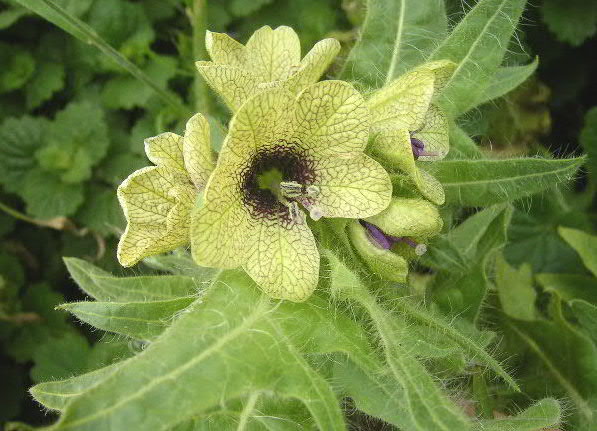
Hyoscyamus Niger

Hyoscyamus Niger

It is likely that Brennus’ army (or a significant part of it) fell prey to the effects of wine laced with the mind-bending herb Hyoscyamus Niger, known in English as Henbane, in Spanish as Beleno, and in German as Bilsenkraut. The ancients (eg – Pedanius Dioscorides (De Materia Medica, Book 4, 1stC CE, also Pliny the Elder)  knew it as Herba Appolinaristhe herb of Apollo. In fact, Dioscorides tells us of the many names for it across the known world:

It is also called dioscyamos, pythonion, adamas, adamenon, hypnoticum, emmanes, atomon, or dithiambrion; Pythagoras and Osthenes call it xeleon, Zoroastres, tephonion, the Romans, inanaoentaria, some, Apollinaris, the Magi, rhaponticum, the Egyptians, saptho, the Thuscans, phoebulonga, the Gauls, bilinuntiam, and the Dacians, dieliam.

That Dioscorides gives the Gaulish word as ‘Bilinuntiam’ is often taken as indicative of a concordance between the gods Apollo and the Celtic deity Belenos, and thus it would seem of interest to those who are intrigued by the genesis of the cultural movement of the Celtic ‘tribes’ referred to under the umbrella term Belgae who were somehow linked to the events of 279BC. Dioscorides’ reference to the name ‘pythonian’ for Hyoscyamus also appears to be a reference to this oracular usage, although the myth maintained at Delphi was that priestesses inhaled the exhalations of an ancient vent in the ground, no doubt supposed to conduct the fumes of the decaying corpse of the giant Python killed by Apollo. The fact that Henbane is also known as ‘Stinking Henbane’ due to its unpleasant odour adds to the likelihood that it was responsible for the mind-bending oracles of the Pythia.

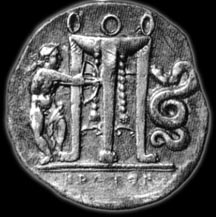
Greek tetradrachm depicting Apollo the archer with the Python and the Delphic tripod

Greek tetradrachm depicting Apollo the archer with the Python and the Delphic tripod

Toxicity of Hyoscyamus goes from mild drunkenness to a total confusion, agitation and frenzy, and from there easily into overdosage and death. Obviously, the Pythia (priestesses of the Apollonian oracle) would have been experts at dosing themselves, and must have possessed a standardised preparation which they consumed. It is possible that they could have inhaled the vapours from burning seeds, but given the accounts of Pausanias and Pompeius Trogus/Justin about the chaos that afflicted Brennus’ army in 279BC it is just as likely that they consumed it in wine. Pausanias’ comment that Brennus died of drinking undiluted wine could well be an allusion to this, in fact. Pompeius Trogus states that the leaders at Delphi ordered that the Gauls be given free access to the wine and food of the city, so a deliberate poisoning may well have occurred…

Berserkers?:

The reputation for bravery and ferocity of some Celtic warriors was commented on by a number of Roman authors – not in the least to allow themselves to congratulate their own soldiers for defeating them. The same ferocity among ‘barbarian’ warriors next receives comment when Christian Europeans encountered the warring aspect of their pagan neighbours from the north during the ‘Viking’ era, this time in the form of the ‘Berserkr‘ (lit. ‘Bear Skin’) warriors. These were men who had dedicated themselves to Odin, their god of battle. The Anglo-Saxon equivalent was Wodan – a name recognisably connected with the Old/Middle English word ‘Wod(e)’, meaning madness or frenzy. It has been suggested that Henbane is a likely drug that could have been used to induce a visionary or frenzied state in Berserkr warriors, and evidence of Henbane seeds among possessions buried in pagan graves (eg – Fyrkat, Denmark) has been used to reinforce this suggestion (although to my mind they could equally have been used for preventing sea-sickness!). Further to this, there was a tradition in Germany and Bohemia of brewing beer using Henbane, suggesting that ‘Pilsener’ was a name fortuitously apprehended by the burghers of Plzen in Bohemia with which to brand their own pseudo-eponymous mass-produced beer in the 19thC, albeit without the ‘Pilsenkraut’ additives. Bohemia, was of course named after the Celtic Boii tribal federation who were undoubtedly involved in the Balkan, Greek and Anatolian Celtic campaigns of the 4th/3rdC BCE.

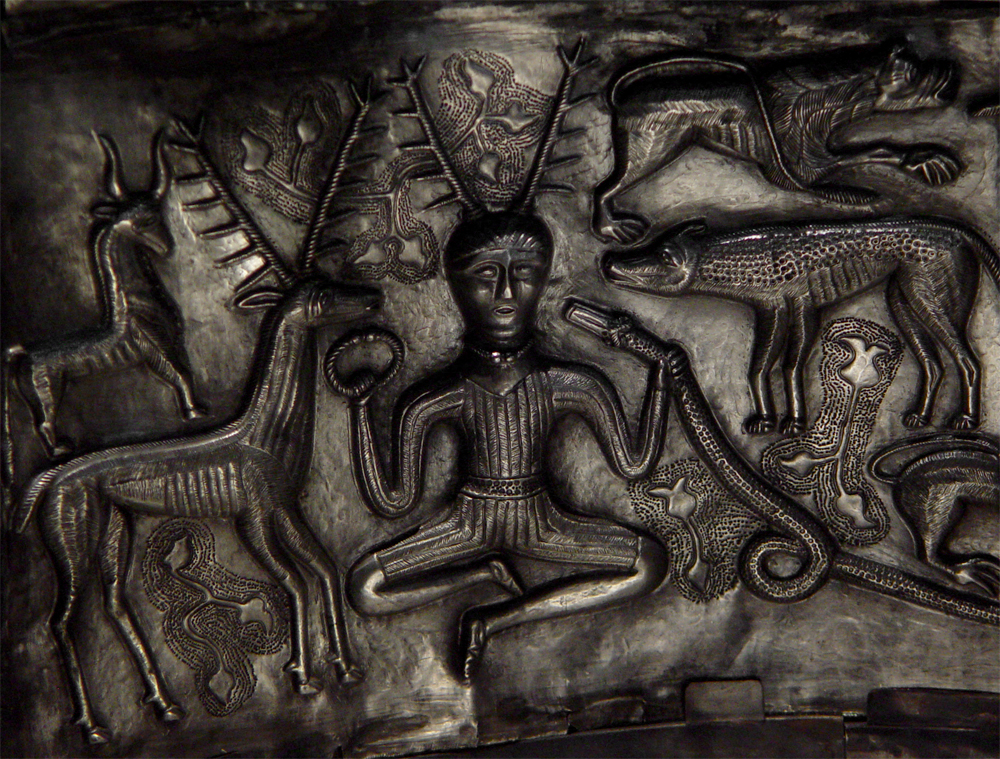
The 'visionary' man holding a torc and serpent (Gundestrup cauldron - late Celtic iron age). Compare this image to the Delphian tetradrachm above...

The ‘visionary’ man holding a torc and serpent (Gundestrup cauldron – late Celtic iron age). Compare this image to the Delphian tetradrachm above…

Bearing in mind my suggested concordances of the Celtic god Belenos with a number of medieval-era late pagan gods and mythological characters from northern and eastern Europe, the association with Apollo, and similarities between the Pythonian myth and the conception of the pagan Scandinavian universe from the Icelandic Edda texts, a picture begins to emerge of the survival and transformation of an Iron Age visionary religion which reached its height in the 3rdC BCE and which survived Romanisation in the Germanic, Slavic and Scandinavian regions…


The Fisher King: Belenos in the Arthurian tales?

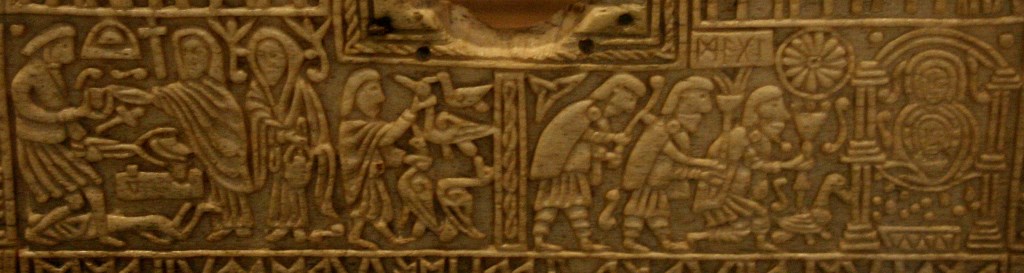
Panel from the 8thC Anglo-Saxon 'Franks' Casket' depicting the juxtaposition of pagan mythology and Christian. On the left - the injured smith-king Weyland receives a visit from three (Valkyrie) women. On the right, Mary and the baby Jesus receive the three male Magi. Note the items carries by the Magi and consider the court of the Fisher King...

Panel from the 8thC Anglo-Saxon 'Franks' Casket' (British Museum) depicting the juxtaposition of pagan mythology and Christian. On the left - the injured smith-king Weyland makes a cup for three ?Valkyrie-women. On the right, Mary and the baby Jesus receive the three male Magi. Note the items carries by the Magi: a ?weapon, a torch and a cup...


The Arthurian tales and fairy lays of the 12th-15thC centuries are curious amalgams of contemporary chivalric and courtly Christian culture with much older pagan themes, with which they seem to abound. Those that survive as an identifiable part of the medieval corpus (starting with Geoffrey of Monmouth) were written down between the 12th and 15th centuries, and formed a tradition that was added to, re-versified, modified and expanded. That they were based upon themes and characters from indigenous folk-traditions of the post-Roman, pre-Christian European world is certain, although they would form a very contemporary tradition in their time, and their allegories were equally at home in the fevered era of the crusades and chivalry as they would have been in the 1stC BC before Rome crashed militarily and culturally into the heady and otherworldly domains of the peoples who identified themselves with the term 'Belgae', and from among whom these legends appear to have grown in oral traditions. As in Ireland, the Christian imperative in Britain and northern Europe was to assail these potent bastions of bardic culture in which the spiritual and philosophical worldview of late Iron Age celts were encoded, and convert them to a literary or suitably contemporary oral-narrative form which suited Christian culture – especially in the warlike post-Roman, post-Carolingian world which had evolved from the 'Belgic' culture.

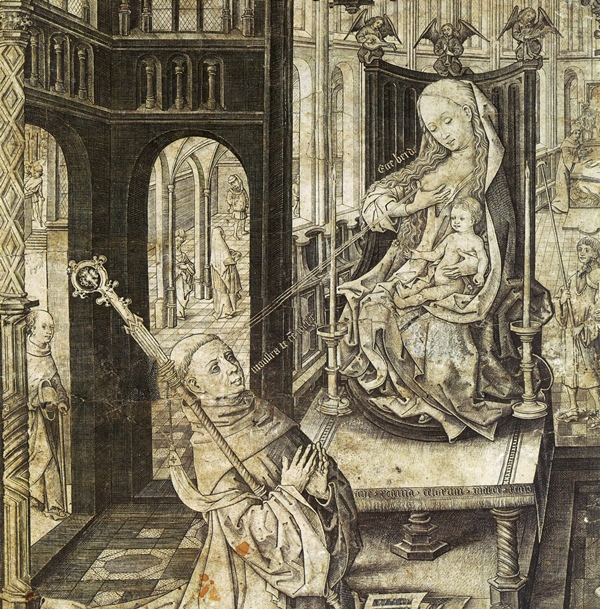
Although mentions of 'Arthur' (and his older variant names) exist before the 1100's, it is during the 12thC that a tradition of written tales begins to coalesce around him and a cast of recognisable supporting characters that takes shape as what we recognise as 'Arthurian' legends. The cultural crucible was stoked by the influence of Troubadour culture (possibly an extension or development of older celtic bardic traditions) from Occitania in the more Romanised south of France, and the militarised chivalric and pious culture in the north of France centred on Normandy, which had developed among settlements of lately-Christianised Danes (warlike post-Belgic pagans until the 10thC). The Troubadours' lyrical traditions of courtly love emphasised feminine power and mystery in an era in which this had long been suppressed, and although it probably did little to change womens' position in life it suited the era during which reformed monasticism was promoting increased veneration of Mary, mother of Jesus, and portraying her allegorically as a fountain of rejuvenation. The Lady of the Lake, the Lady of the Fountain and similar otherworldly females all appear in the Arthurian tales and fairy 'Lays' of this era, and seem to correspond to such contemporary 'Maryology' – a heady mix of pagan goddess veneration and Christian euhemerisation and appropriation of powerful indigenous narratives.

The authors and redactors of the medieval romances and lays in the Arthurian literary tradition wrote across a period spanning some 400 years, and almost wholly for a learned elite audience. Oral tradition would have been part of the cultural pillar supporting and uniting communities and reinforcing a sense of tribal identity and connection to traditional lands. In the Arthurian tales, this was invoked by the elites so as to reinforce their sense of shared-origin and common-purpose with their subjects. Such a connection was important in places like Britain which had seen successive waves of invasion and settlement by neighbouring peoples, most notably that of the Romans, Anglo-Saxons and Normans. As with all invading cultures, these appropriated and modified indigenous traditions to suit their claims to legitimacy, hence the style of Arthurian literature. As a result of this and active processes among the religious to 'euhemerise' and consign pagan ideas to a pseudo-historical or literary tradition, the old gods of Europe changed their faces and names as the traditions developed.


Timeline of significant 'Arthurian' literature (by no means complete!):

12thC: Geoffrey of Monmouth (History of the Kings of Britain, Life of Merlin, Prophecies of Merlin), Chrétien de Troyes, Marie de France, Béroul, Wace, Thomas of Britain, Robert de Boron, Eilhart von Oberge, Ulrich von Zatzikhoven.

13thC: (Wolfram von Eschenbach) 'Parzifal', (Anon.) 'Lancelot-Grail cycle' (or 'Vulgate Cycle'), (Anon.) Post-Vulgate cycle.

14thC: The 'Welsh Romances' (assoc. with the Mabinogion)


The Fisher King:

The 'Fisher King' or 'Wounded King' from the grail series of Arthurian tales is perhaps one of the more intriguing of the otherworldly regal male characters of the traditions. His first explicit appearance is in Chrétien de Troyes' 'Perceval, the Story of the Grail' from the late 12thC, where he is the 'Grail King' of the land of Logres, keeper of a mystical lance and a grail (plate or bowl), not then identified with any form of holy Christian relic from the biblical 'Last Supper': that would come later – after the Third Crusade tried to reconquer the 'holy lands' far away in the Middle East, as well as the introduction of the principle of transubstantiation of the communion wine and host. Chretien's 'Perceval' is fragmentary and incomplete, but was sufficiently popular and valuable to have been recopied and added to by a number of subsequent authors in an attempt to 'round off' the narrative and make sense of it.

In Chretien's version, the young and inexperienced Perceval is invited to stay at the castle of a wounded and indolent fisherman-king, whose aged father (also wounded) shares the castle with him. At a banquet a mysterious procession enters bearing a number of mystical objects which are paraded in front of Perceval: a graal/grail (dish or vessel), a bleeding lance, and a candelabra (see the Franks' Casket panel above!). The performance and the meaning of it is lost on Chrétien's Perceval, who returns to Arthur's court where a prophetic/fatalistic 'loathly lady' (ie – the narrative representation of the pagan Cailleach) appears and explains that had he solved the mystery he would have healed the wounded king and his lands.

As Chretien offers no satisfactory conclusion in his own surviving work to the tale of Perceval, others expanded upon his themes – either through reference to an original oral narrative tradition or using their own creative skills – we cannot be certain which. An analogy of the tale with similar themes (although not referring directly to a 'grail' or 'Fisher King') occurs in the Middle Welsh tale Peredur son of Efrawg – a romance appended to the 'Mabinogion' tales. Robert de Boron's 12thC 'Joseph d'Arimathie' introduces the Christianised version of the Grail, placing the 'Bron the Rich Fisher' (ie – the Fisher King) as last in a line of Grail guardians originating with Joseph of Arimithea – supposed to have come to Britain with the Grail in which he was supposed to have collected Jesus' blood: This fitted the Crusader theme entirely!

The Fisher King is Belenos?

In truth, we know very little about the Celtic solar deity Belenos, so equating him with the Fisher King has its problems. However, the theme of death and rebirth underlies the Grail mystery, just as it did the religion of the ancient Europeans, and the Sun is the most explicit exemplar of the principle. The wounds of the Fisher King, and/or his father are expressions of human mortality, just as his 'healing' from the 'dolorous stroke' represents reincarnation.

Interior panel from the late Iron Age Gundestrup cauldron depicting a giant warrior rejuvenating soldiers in some kind of vessel, making them into mounted  knights.

Interior panel from the late Iron Age Gundestrup cauldron depicting a giant warrior rejuvenating soldiers in some kind of vessel, making them into mounted knights.


Other clues lie in the names given to the King: The anonymous 13thC authors of the 'Lancelot-Grail' cycle expanded upon the 'Grail' stories and added a couple of interesting name-details: the 'Fisher King', they say, was named 'Pelles' and the 'Wounded King' was called 'Pellehan' or 'Pellam'. Like the Slavic god Veles, the Lithuanian Velinas and the Germanic Weland, these names seem to contain elements of the older 'Belenos' (in this case through the other common Celtic/Indo-European language consonantal switch of the 'B' and 'P' sounds.) The slightly later 'Post-Vulgate Cycle' versions of the Grail tale (also by an un-named author) and Sir Thomas Mallory's 15thC 'Morte D'Arthur' refer to a 'Sir Balin' who was responsible for causing the wound of the Fisher King (the 'Dolorous Stroke') and hence the sickness of his land, using a lance – perhaps unsurprisingly in the Christianised legends identified with the 'Spear of Longinus', supposed to have been the one that pierced the side of 'Christ'. In Robert de Boron's late 12thC Grail epic 'Joseph d'Arimathie', the Fisher King (here called the 'Rich Fisher') is called Bron – a name which has caused some scholars to comment on the similarity with the character Bendigeidfran ('Bran the Blessed') from the Welsh Mabinogion. Bran is a giant who possesses a healing cauldron, and who is mortally injured by decapitation yet whose head continues to talk. Bran means 'raven' – a bird strongly associated with the souls of the dead and reincarnation in Celtic and Norse (ie – late Belgic culture) mythology.

Holy Wounds and Healing Vessels:

The 'Holy Wound' apparently suffered by the Fisher King characters in Grail mythology is used as an allegory for the poor state of their lands: why else would the King catch his own food? The 'bleeding lance' theme introduced into literature by Chretien represents an injured virility, something akin to the bleeding stag with a broken antler who had lost the season's rutting combat, but will endure with hope that the next year promises dominance of the herd. The mystery of the image invoked by Chretien revolves around the question of whether the lance runs with the blood of its adversary, or if it is the lance itself that bleeds? In a solar sense, the 'wounding' of the land comes with the onset of winter, during which the sun – like the Fisher King – seems enfeebled. This invokes the necessity of death to encourage life. Interestingly, the 12th/13thC Norse Prose Edda myth of Volundr (Weyland/Weland) claims that he is wounded and cannot walk – this is confirmed by the imagery of Weyland on the earlier 8thC Franks' Casket…


However, it was the grail itself which took greater precedence in the later tales: the receiver of the 'sacrificial' blood of the Christian narratives, for which the 'wounded king' was to become an important allegory. The 'ladies of the fountains' of earlier tales – explicit references to the pagan goddesses we see depicted upon ancient Celtic stelae – were to merge with the 'Marian' goddess-philosophies of the more pious Christian eras. This process was reaching its height in the 12thC when the Arthurian tales were being written down.


However, the Arthurian 'Fisher King' is portrayed as a king down on his luck and wounded who requires redemption and healing through questing knights who seek the Grail. This means that he is never a direct analogy for Jesus, who was generally portrayed as a triumphal and all-powerful redeemer during the medieval period. In fact, the 'Fisher King' seems more akin to Shakespeare's version of Geoffrey of Monmouth's 'King Leir/Lear' or perhaps the wild Merddyn (Merlin) or his Irish equivalent Suibhne: slightly unhinged, somehow wounded, and a bit less than divine. The famous late-classical British/Irish Christian leader Pelagius (4th-5thC CE) seems to have shared the same opinion about Christ and rejected the idea of 'original sin', but was rebutted by his continental colleagues who expunged his doctrine that Jesus himself was somehow human! Even the name Pelagius is itself evocative of Pel- or Bel-: Celtic Christians were arch employers of the mythology of their own indigenous religious background.

Triadic nature of the Fisher King:

The Fisher King (who lives with his aged father – also wounded) is actually part of a 'triad' if one includes the redeeming young knights such as Perceval, Lancelot or Galahad who unlock the secret of Grail and the Lance, and who heal the King's wounds. These themselves are reflexes of the character who wounds the Fisher King: another knight of Arthur's court called Sir Balin, whose name is a more explicit invocation of Belenos. Galahad is the grandson of the Wounded King in the Lancelot-Grail cycle, where Pelles (the younger Fisher King) contrives to have Lancelot bed his daughter Elaine. This technically ensures his eventual healing, again demonstrating the complex themes of continuity and reincarnation. The triadic divinities of the Atlantic Europeans often incorporate a 'father-son-virgin youth' or 'crone-mother-virgin youth' type of schema, and this is witnessed with the Fisher King.

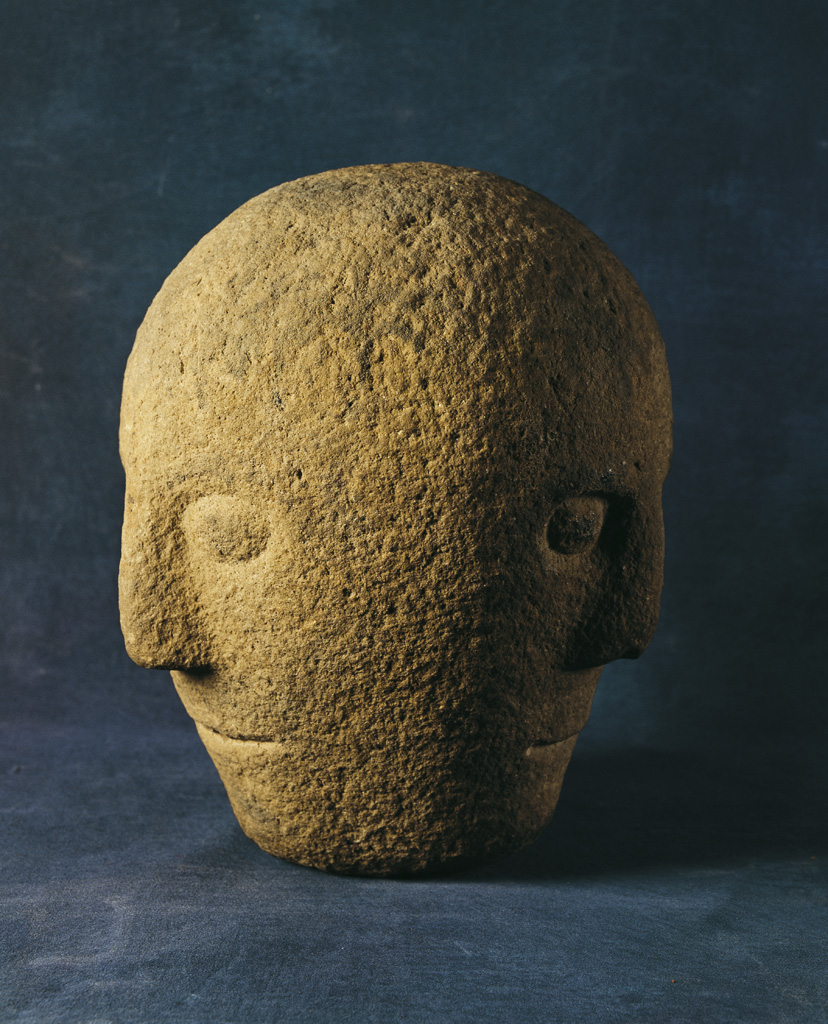
Triadic divinites: The 'Corleck Head' (National Museum of Ireland) has three faces - you can only ever see two when looking at it side-on! This is an expression of the mystery hinted at in the character of the Fisher King.

Triadic divinites: The 'Corleck Head' (National Museum of Ireland) has three faces - you can only ever see two when looking at it side-on! This is an expression of the mystery hinted at in the character of the Fisher King.

The character's important mystical nature, his association with death and renewal, his various names and triadic nature are all clues to his identity with the great solar god of the Otherworld. Manannan (son of Leir) is the same.


Concordance of Belenos, Manannan, Merlin and Wodan.

Those who follow my blog will know that I have already discussed the linguistic relationship between the Late Iron Age Celtic god, Belenos, and the Slavic, Baltic and North European divinities known from medieval times at least as Veles, Weland/Volundr, Phol, Vili and Velnias. Due to the dynamism and migration of Celtic peoples and culture from the 4thC BCE, Celtic religion (particularly that of the ‘Belgic’ cultural movement) was to stamp its impact from the Black Sea to the westernmost reaches of Iberia and Ireland, taking with it a renewed and potent militarised (possibly fanatical) vision of its gods and philosophies. So why did a separate ‘German’ and ‘Slavic’ identity develop?

Germans and Slavs ‘were’ Celts:

By the advent of the western expansion of the ‘germanic’ Goths and other eastern ‘barbarians’ in the 4thC CE, the remains of the Celtic ‘world’ had been pushed away outside of the bounds of the Roman Empire – into Ireland and Scotland. The tribes referred to by Julius Caesar in the 1stC BCE as Germani had – through the lens of Roman ideation – been somehow defined as ‘different’ to the Celtic peoples, an opinion generally considered to be forged by their cultural and geographic impenetrability and indomitability rather than from any hard evidence of actual difference. By the time of the Gothic migration era (4th-5thC CE) and the collapse of the western Roman Empire there was no longer any concept of Europeans as ‘Celts’. Increasing religious diversification following Romanisation, and then the religious concordance and intolerance emerging under christianity had overwhelmed the spiritual cultural model of Europeans, replacing it with a power-franchise focussed on the East.

Of course, this still left a good deal of non-Romanised regions without Christian influence. Although ‘Celtic’ Ireland and Scotland were evangelised early on (5th-6thC CE) northern Europe (Germania, Scandinavia, the Baltic and Russia) was much later in coming to the table – holding out in places until at least the 14thC CE. It is from these that we find the apparent ‘Belenos’ concordances in the names of some of their important divinities, as preserved in medieval literature and later folklore. These cultures (pagan Anglo-Saxons, Vikings and Slavic Russ) certainly maintained a warlike ‘Belgic’ outlook – at least from the point of view of Christian observers, particularly those at the commencement of the ‘Viking’ raids (which commenced with a particular anti-Christian focus) in the 8thC CE. However, by this period, languages and the names of the divinities had evolved away from their ‘Celtic’ (let’s call them ‘Atlantic’) origins so as to make ‘Germanic’, ‘Slavic’ and ‘Celtic’ mutually exclusive cultural ideas for scholars by the modern era. Political and ethnic federalism and nationalism during the 19th and 20th centuries further demanded separate origins for these cultures.

So what about Ireland and Scotland?

Christian evangelisation of the (by modern standards) ‘typical’ Celtic regions of Ireland and Scotland probably began in at least the 4thC CE, although it is conventionally dated to the late 5thC by later literary sources – the era when ‘Patrick’ is supposed to have convinced all of Ireland’s kings to submit to Christianity. Ireland (and her eastern colonies) subsequently became early medieval Europe’s most important and vibrant intellectual powerhouse for christian religious scholarship and reinterpretation of pagan mythology. She was to send her acolytes into the former Belgic heartlands of Britannia (colonised by pagan Anglo-Saxons) and Francia – the territory of the Gallo-Germanic Franks – to assist with local efforts to impose Christianity, be it by propaganda or the sword.

This process (already discussed in some detail in the blog) meant that Ireland’s pagan mythology (written by Christians) is difficult to interpret at face value, although it is common for many to accept  it (albeit unwisely) as canonical. We know that ‘Belgic’ culture (the impetus behind the 279 BCE attack on Delphi) made it to Ireland – the stories of boastful hero-warriors such as Cuchullain and Finn, and the La Téne style of insular art seem to attest to this. Indeed, the magically and militarily powerful ‘magi’ or druids referred to in medieval accounts of the conversion period are another possible feature of this culture. We suspect that IrishTuatha Dé Danaan characters such as Lugh, Nuada and Ogma were local versions of Gaulish divinities Lugus, Nodens and Ogmios, yet we have no evidence of worship or any idea of their importance from placenames. Indeed, you are more likely to come across places named after the female ‘Cailleach’ or masculine ‘Cuillean’ than any of these continental characters.  Insular and continental evidence of actual religious beliefs and practices among the Celts is – although widespread – largely influenced by Romanisation and difficult to interpret, as we do not know for sure which names were from independent divinities and which were synonyms for individuals. These doubts add validity to following an inductive approach based on place-names, folklore and mythology (including Christian hagiography).

Belenos:

The reason I am taking ‘Belenos’ (Belinus) as an exemplary divinity to examine in the Gaelic context is because of his aspects as a solar god which places him at the highest apex of equivalent Indo-European dedications. He was an important enough divinity that the most important Belgic British tribe of the 1stC BCE-1stC CE – the southeastern Catuvellauni – appear to have been named after him, as were their leaders such as Cassivellaunus and Cunobelinus(‘Wolf/Hound of Bellinus’). Cassivellaunus was referred to as ‘Caswallon’ in medieval Welsh triads, and called ‘son of Beli Mawr (‘Great Beli’). Similarly theophoric names occur in the great warband of 279BCE – part of which was led by a leader called ‘Bolgios’. This attacked through the Balakans into Macedonia before part of it headed to the vastly important shrine of Pythian Apollo at Delphi, and others headed to settle Galatia in Anatolia. The Celts had a special attachment to Apollo, whose name appears to show a similar Indo-European root: A-pollo <> A-bollo. Apollo was a solar renewer as well as a hunter and warrior, and the Greek myths linked him to the mythical ‘Hyperboreans’ – the barbarians of the north who lived close to the monstrous zone, and Okeanos, the world-river. The depiction of Apollo on Greek coins of the Alexandrian age became an important influence upon the imagery depicted on the post-279 ‘Celtic age’ coins of Europe until the Roman conquests.

Although common to western Europe and Britain, the remains of ‘Belenos’ are much harder to identify in Gaelic Ireland and the Highlands and Islands of Scotland. In the 12thC CE, the learned Cistercian abbot and noted hagiographer, Jocelyn of Furness, was commissioned to write a number of hagiographies critical to establishing the primacy of the continental Roman Catholic church over the insular churches, which other contemporary commentators such as Gerald of Wales had implied kept some heathen  or backward usages. Jocelyn was commissioned by Anglo-Norman lord John De Courcy to produce a new hagiography of St Patrick to coincide with the new Anglo-Norman conquest of Ireland. Perhaps as a favour to De Courcy’s friend, ally and brother-in-law King Rognvaldr of the Isle of Man, Jocelyn included traditions from the island of Patrick’s supposed visit there and defeat its ruling wizard, who he calls Melinus.

“… Returning to Hibernia, he touched at the islands of the sea, one whereof, Eubonia–that is, Mannia–at that time subject unto Britain, he by his miracles and by his preaching converted unto Christ.  And among his miracles very conspicuous was this: a certain evil-doer named Melinus, like Simon the magician, asserting himself to be a god, and attempting the air with a diabolical flight, at the prayers of the saint fell headlong, and was dashed in pieces, and so perished …” (Translation from: ‘The Most Ancient Lives of St Patrick, Including the Life by Jocelin, Hitherto Unpublished in America, and His Extant Writings’ by James O’Leary; Pub. New York, 1880 P.J. Kenedy)

Melinus – by the conventions and mutations of Indo-European languages – is also pronouncable as ‘Welinus’ and therefore can become ‘Velinus’, from where we return to the name of the god, ‘Belinus’. Interestingly, the (later) Manx traditions about their pagan wizard-god refer to him as Manannan – the insular Celtic sea-god, although George Waldron (‘An Account of the Isle of Man’, 1734) says it was ‘Merlin’, which itself is very close to Melinus, while invoking the sometimes-mad wizard of the Arthurian romances gaining courtly popularity among northern Europe’s elites during Jocelyn’s era. In fact, Jocelyn’s is not the first reference to this character, whose appearance in Hiberno-Norse era Manx tradition is interesting given the Weland and Velnias traditions of the Scando-Baltic countries from which Mann’s 9thC onwards Viking visitors haled.

The name actually occurs in a couple of earlier Irish traditions linked to Christianisation: the first is the ‘Bishop Mel’ who was supposed to have invested St Brigit with her veil (‘veil’ derives from Latin velum). The other is the pagan robber-prince Mac Caille who Patrick banishes to the Isle of Man, and who eventually becomes the island’s patron saint, Maughold, who seems to have had trouble replacing Manannan in the popular mindset of the Manx people, even down to this modern day. In one of the early medieval Irish lives of Brigit, it is Mac Caille rather than Mel who gives Brigit her veil (the Greek word for which is Calyx, hence ‘Caille’). It looks like the christianisers played fast and loose with language in order to establish their order!

To compound further this mystery, I wish to return to the Norse-Germanic ‘Weland’ who I have previously noted to be identical with the Irish mythological Cuillean. A Manx legend based on the Ulster Cycle stories (and published in Ireland during the 19thC) said that ‘Cullan the Smith’ resided in the Isle of Man and was resorted to by Conchobar Mac Nessa for magic weapons. This suggested he – like Weland – was considered a blacksmith or artificer. If Weland originates in Belenos (as I have suggested) then this makes the names Cuchullain and Cunobelinos identical, as the Irish warrior-hero was named after Cuillean’s hound, who he kills (Ulster Cycle). The Manx mountain of Slieu Whallian is named after him (the ‘K’ sound is lenited), as are a number of mythologically important hills in Scotland and Ireland. In Mann, this hill stands next to the site of the ancient Tynwald hill at St John’s – the site where Manannan was supposed by a 16thC ballad to have been offered green rushes at the annual Tynwald ceremony.

Manannan himself can confidently be described as ‘Lord of the Otherworld’ in Irish mythology, and his eponymously-named islanders would agree with this. He is also portrayed in an immanent manner, rather than as a distant god, and this suggests that he must have been a manifestation of a solar god like Belenos. Like Cuillean or Weland he is a donator of weapons, and as befits a combined solar and otherworld god, his wonderings in the East and travels to the west are features of his mythology. Another important aspect of an otherworld god who travels to and from the world of the dead (reincarnates) is the idea of prophecy and delirium that underpins the oracular beliefs of the ancient world – such as the addled Pythoness who pronounced Apollo’s oracles at Delphi. The properties of amnesia and delirium are common themes of visionary ecstatic states caused by herbs such as Henbane (Hyoscyamus Niger), whose name in a number of European dialects seems to evoke Belenos: Bilsen (German), Pilsen (Czech), Beleno (Spanish). Pedanius Dioscorides (De Materia Medica – Book 4, 1stC CE) called it Herba Apollinaris, and said that the Gauls called it ‘Belenuntia’ or ‘Bilinuntias’: Perhaps this was in the Delphic wine which drove the troops of Brennus mad during their assault on the site of the famous Oracle, as he also calls it ‘Pythonion’ . This brings us to two ‘raging mad’ mythological figures of Europe’s ancient world:

Merlin and Wodin:

In the Germanic languages (Old High German and Old English) the name Wodin, Wotan or Wodan means ‘raging, mad one’. In the 11thC CE, Adam of Bremen described the god thus:  “Wodan, id est furor. ‘Raging’ was therefore an epithet of the highest god, who became known to the later medieval Scandinavians as ‘Odin’ and was (perhaps appropriately) their god of battle and of the dead. The madness implied in the name: ‘Wod’ is also applied to another character of medieval legend – the magician-sage-warrior Merlin recalled by Geoffrey of Monmouth, and the Arthurian romances he helped inspire. Geoffrey’s Merlin was both a prince and a madman who fled into the wilderness in a crazed fugue before his sanity was recovered. The story therefore shares elements of the tale of Odin, who is hinted in the Icelandic Edda stories to have undergone a similar tribulation as some kind of holy rite in order to receive higher knowledge. An Irish tale – of the mad king ‘Suibne Geilt’ – also has certain aspects of Geoffrey’s Merlin tale (‘Vita Merlinii’) and the battle-rages of the Ulster Cycle’s Cuchullain have something of the Odinnic Norse ‘berserker’ about them. But how does ‘Merlin’ link etymologically with Wodin or Wodan?

The Welsh name of ‘Merlin’ is Myrddin – pronounced ‘Merthin’. As ‘M’ sounds can become softened/interchanged to a ‘W’ or ‘V’ in Gaelic and other Indo-European language pronunciations (for a prime example, consider the Latin: Jupiter<>Jovis<>Jouis<>Jouuis) it is perfectly possible to see how ‘Myrddin’ and ‘Wodin’ can have concordance! Another aspect of the Merlin<>Manannan paradox suggested in Jocelyn of Furness’ Vita Patricii and later folklore emerges when we consider the Welsh equivalent of Manannan Mac Lir – Manawydan fab Llyr of the medieval Mabinogion tales. This incorporates the name -Wydan in it, which also seems close enough to ‘Wodan’ to suggest a possible concordance between Belinus, Melinus, Merlin, Manannan and Manawydan, not to mention Weland and Cuillean… Furthermore, the other middle-Welsh legendary character, Gwydion son of Dôn, has a similar name (the ‘G’ is silent).

After the establishment of literacy in Atlantic Europe, which itself followed in the traditions of Christianity, the plasticity of word-sounds became subservient to the orthodoxy and orthography of this tradition, explaining the plethora of different versions of the same name which epigraphy and literature gave to us. Some of these appeared so different that they were considered different…


Serpents and dragons in Irish mythology

“… No country in Europe is so associated with the Serpent as Ireland, and none has so many myths and legends connected with the same… “ Irish Druids and Old Irish Religions – James Bonwick, 1894.

Dragons and great serpents are common themes in the mythology of countries across the world, but their roles and meaning appear to differ depending upon the region concerned. In ancient Europe, serpents (the precursors of the more oriental ‘dragons’) were connected to the chthonic otherworld and underworld, and hence to ideas of decay – the earthy beginnings from which new life grows and the diseases and poisons which caused things to return to that state (i.e. – that process called ‘putrefaction’). They were linked to meres and marshes whose mass of rotting vegetation and sourness was a metaphor for death itself. That such marshy areas were filled with tiny worms, eels and wriggling creatures must have proved evidence that the serpentine and the decaying were linked – just as maggots appear to colonise rotting flesh and intestinal worms fill the excrement of most living creatures. This earth, the dung of animals and all manner of rotting vegetation – be it from the sea or the land – was a potent source of chthonic fertility and regeneration, and therefore wealth: a characteristic resplendent in mythological dragons.

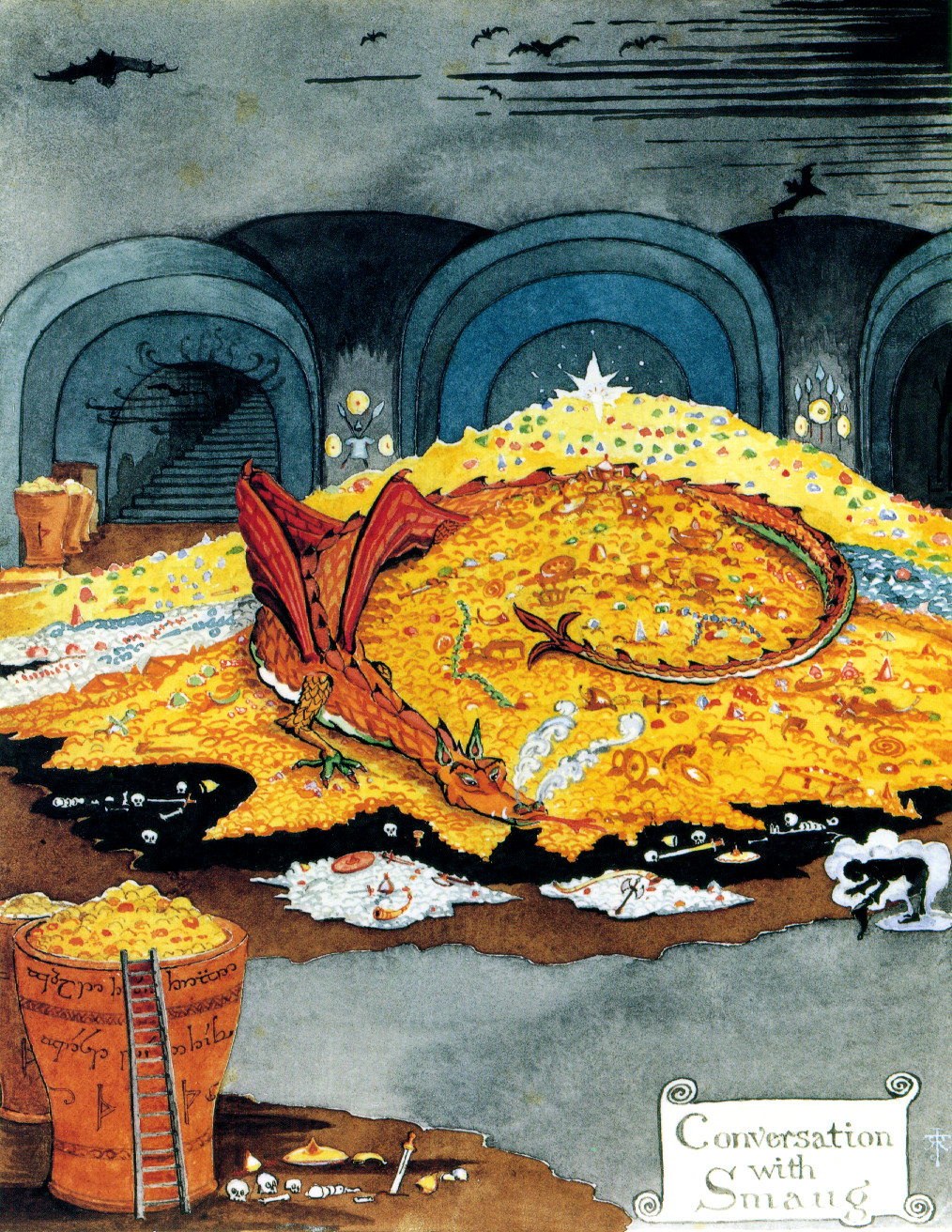
J.R.R.Tolkein 'Conversation with Smaug' (1937)

J.R.R.Tolkein ‘Conversation with Smaug’ (1937)

This ploutic (from ‘Ploutos’ or Hades: Greek god of chthonic wealth) treasure-guarding aspect of serpents and dragons is a feature of the north European mythologies, such as the legends of Sigurd/Siegfried and the Norse peoples. However, the monstrous serpents faced by mythological  ancient Greek heroes such as Hercules, Jason and Perseus also guarded treasures: The serpent Ladon, for example, was the guardian of the golden apples in the Garden of the Hesperides – on an island far to the west, near the setting sun and the realms of Cronos at the limits of Okeanos.

In medieval Irish mythology, such a class of beasts (where actually identifiable as dragons or great worms at all) were more often associated with tales of monstrous peril involving saints and heroes, and were (unsurprisingly) associated with the marshy aquatic realm. Usually referred to by the terns ‘piast’ or ‘péist’ – a ‘pest’ or ‘beast’ – they were often used in christian narratives of the middle ages as dangerous legendary personifications of the Old Order – linked strongly to its religious beliefs connecting water with the underworld or otherworld. Such an example is given in the Middle Irish tales of Acallam na Senórach in which the ancient hero Caeilte supposedly recounts the deeds of the Fianna to St Patrick, and explains that it was once their prerogative to rid the land of serpents and dragons… The narrative of the tale seeks to link such exploits of serpent-expelling with that typically Patrician art:

“…Eochaid Lethderg, King of Leinster, enquired of Caeilte: ‘What cause had Finn and the Fianna that, out of every other monster ye banished out of Ireland, they killed not the reptile we have in the glen of Ros Enaigh?’ Caeilte replied:Their reason was that the creature is the fourth part of Mesgedhra‘s brain, which the earth swallowed there and converted into a monstrous worm.’ …” (Translation: Standish Hayes O’Grady)

Mesgedhra’s brain features in the Ulster Cycle: he was an older king of Leinster killed by Ulster’s hero, Conall Cernach, and his brain was taken and calcined in lime as a gruesome war-trophy (heads were preserved in the Celtic Iron Age as trophies of enemies, although here it may be a bardic narrative allegory). Later, the brain was stolen and used as a weapon by the Connachta warrior Cet mac Mágach, who employed it as a sling-shot against Ulster king Conchobar mac Nessa. This left Conchobar with the brain-stone buried in his head, and it eventually exploded when the wounded Conchobar became angry and (presumably – the mythology is lost) a great worm must have escaped from his cranium… The terrible worm which the Fianna were fain to battle in the Acallam therefore represented a reincarnation of Mesgedhra through the cthonic realms. In the tale, this represented an ancestral blood-feud which the Fianna were loath to disturb. This itself demonstrates a figurative aspect of dragons as an analogy for warfare and vengeance, replete with great danger as well as the chance for enrichment, and potential long-term consequences.

There were in fact many other dragons associated with the tales of Fionn as well as a number of other Irish christian culture-heroes…

In the embattled times following the Flight of the Earls in the early 17thC, Fionn mac Cumhaill was a popular embodiment of the aspirations of Irish Gaeldom: A collection of Fenian lays known as Duanaire Finn was compiled at Louvain (Belgium) in the early 17thC by Aodh Ó Dochartaigh at the behest of exiled Gaelic magnate, Captain Somhairle Mac Domhnaill: A grandson of the renowned northern Gaelic dynast ‘Sorley Boy’, he was fighting the Catholic cause in the continental 30 years war). His wish was evidently to preserve the Fenian traditions among the fading bastions of independent Gaelic culture and power. Of particular interest are his descriptions in the poetic lay known as ‘The Pursuit of Sliabh Druim’ of the dragon-slaying antics of the Fianna:

This tale starts with a description of the Fianna at peace, doing what they love best when not at war: slaughtering game animals. Sliabh Druim provides the scene of their greatest hunting triumph (a veritable ecological disaster) but on progressing on to Lough Cuan, they are accosted by a great péist who announces that he has come from Greece to fight Fionn and his band. Fionn dispatches him, by way of an introduction to a bardic celebration of his history of péist-slaying antics, which in itself reads like a catalogue of Ireland’s loughs, bogs and rivers as it accounts for his slaying of dragons living in Loughs Neagh, Cuillean, Erne, Eiach, Lein, Righ, Sileann, Foyle, Eamhuir, Meilge, Sera, Mask, Laeghaire and Lurgan, as well as river serpents on the Shannon and the Bann, and in a number of glens. It appears that most of Ireland’s waterways and loughs were once well-populated with the reptilian kind, as well as dreadful ‘phantoms’ and ‘cats’ until Fionn had his way with them.

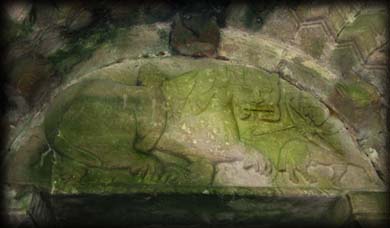
A tympanum from Cormac's Chapel at the Rock of Cashel depicts a Centaur shooting a peist with arrows... Fionn and a dragon?

A tympanum from Cormac’s Chapel at the Rock of Cashel depicts a Centaur shooting a peist with arrows… Fionn and a dragon?

Indeed, if we look at many of the legends regarding those later culture heroes – the saints of early chrsitian Ireland – we come across a number of significant encounters with ‘beasts’: The Cathach of Inniscathaigh was defeated by St Sennan, and the Bruckee was supposedly defeated at Rath Blatmaic in Co. Clare by St MacCreehy. St Caomhin (Kevin) was supposed to have defeated a beast who lived at Glendalough. The 6thC Saint Patrick, was – like the earlier Fianna – also apocryphally famous for casting ‘snakes’ out of Ireland. Such beasts were often implied to be female in Christian tales: The hagiography of St Senán – Amra Senáin – from the Leaba Brecc manuscript (RIA MS 23 P 16), is quite explicit about the Cathach’s sex. Such tales seem designed to identify beasts, serpents or dragons with the true indigenous religion they were replacing. These saints appear, therefore, to have subsumed the role of Fionn as dragon-slayers!

A modern replica of the Cashel Crozier...

A modern replica of the Cashel Crozier…

In christian-era art, the dragon was a recurring theme: The beautiful 13thC Crozier of Cashel (manufactured in or near Limoges, France) depicts an act of serpent-battling, and the hook of the crozier itself depicts a great snake. Another great jewel of medieval Ireland – the Tara Brooch – is decorated with a pin in the shape of tiny serpent, which appears to gnaw upon the jewel’s main body. In spite of the apparent absence of the species Serpentae among Ireland’s native fauna, the ‘serpent’ was, from early times, a well-known symbol in Ireland, as elsewhere in the Atlantic world. Why should this be so?

The 'Tara Brooch' c.700AD.

The ‘Tara Brooch’ c.700AD.

Morphologically, the connection of péists to rivers is easily explained by the serpentine appearance of such streams of water, but Ireland’s interest with serpents doesn’t stop there. In fact, it wasn’t just snakes which might be considered in the class of ‘serpents’ to the ancient mind: Eels, earthworms and any number of wriggling larval creatures and amphibians gave the Irish a ready supply. However, the lack of exemplary reptiles often led to cats, boars, badgers etc taking on the traditional role of the monstrous adversary-guardian for the purposes of mythological tales.

"Why are Herons so-called? Easy to say: They are 'Heros' who kill serpents..." The Greek word for Hero is 'Heron'...

“Why are Herons so-called? Easy to say: They are ‘Heros’ who kill serpents…” The Greek word for Hero is ‘Heron’…

The origin the English word ‘reptile’ is from the ancient Greek class-designator herpeta (sing. herpeton), meaning ‘crawling or creeping animals’. The Latin word ‘serpo‘ (from which we get ‘serpent’) means the same. The study of reptiles and amphibians is thus known by the modern term ‘herpetology’. The ancient class herpeta or serpenta does not necessarily refer only to reptiles and amphibians, but any animal which had a close association with the ground. More specifically, the idea of a ‘serpent’ developed an empirical class-association with worms, maggots, larvae and even ‘serpentine’ fish such as eels – referred to generically by the Latin word vermis, from which the English ‘worm’ is derived. This concordance is indicated by the ancient association between snakes and the power of putrefaction, disease, and gnawing: It is the reason why rats, lice, cockroaches, caterpillars and mice might all be referred to as ‘vermin’. It the reason why ‘wyrm’ was a synonym for dragons as well as snakes in Old English and the Germanic languages, and why gnawing cutaneous fungal infections are still referred to by the English word ‘ringworm’.

The typical ‘péist’ of Irish hagiography – when attributed a sex – was more often than not female. The word péist is usually translated as ‘worm, beast, monster’ (O’Brien), and its variants are peist, piast and biast/biasd – generally employed in the spirit of the ancient Greek and Roman usages: for instance, the Otter was calledbiasd dubhor ‘biasd donn’ in reference to its snaky shape, movement and colour.

The Irish word péist derives from the Latin bestia, meaning ‘beast’. It also connects to the Latin word pestis, meaning either disease, plague, destruction, ruin or death! Other Latin synonyms for ‘beasts’ include ‘Belluae‘ (large fierce animals – possibly after the manner of bulls and stags) and ‘Ferae‘ (large fierce predatory animals). Belluae seems to evoke the idea of war (Bellum), perhaps because armies moved, ate, fought and crapped like a huge animal, and draconine banners and standards were a feature of warfare since ancient times – particularly among the Celtic tribes of SE Europe during the late Iron Age period. The boar replaced the dragon among the NW celts of the same period.

Interestingly, the name for the fungal skin disease ‘ringworm‘ in Middle Irish was ‘frigde’ and in Old Irish ‘frigit’, and in late spoken Manx it was ‘chennney jee‘ (‘teine dé‘, god’s fire – ignis sacer – possibly the dragon’s breath) which by a Joycean ‘commodius vicus of recirculation‘ brings us back to the word and concept of the dragon or the péist, and by a number of associations, to our chthonic mother-goddess, Brigit – she of the sacred flame and the hearth…

The connection between the hearth and the earth is an old one: For starters, the English words are both etymologically linked. It is a place where earth’s produce is burned or prepared to eat – committing it to the recycling forces of nature for another turn. Anciently (and up until fairly recently in many parts of Gaeldom), the domestic hearth was a pit in the ground, so it is no wonder that the hearth and the chthonic otherworld are linked! The hearth fire was a place associated with the spirits of ancestors, and therefore with what became known from the middle-ages as ‘elves’ or ‘fairies’. Dragons attributed with the ability of breathing fire were no doubt a part of this chthonic mythology…

Dragons in the Celtic Iron Age?

There is in fact no evidence to definitively confirm that Celtic peoples of the European Iron Age believed in ‘dragons’. The popular imagination is certainly fired by archaeologists’ descriptions of the ‘dragon scabbards’ (a term popularised by Megaw & Megaw) of the elite Celtic warriors who were so instrumental in warfare during the Hellenistic and late Roman Republican periods. These all have the appearance of serpents or snakes – hardly the chimerical hybrid-forms of ‘dragons’ as we know them, with their aquiline talons, equine heads and wings. Celtic ‘La Tene’ art certainly added a ‘serpentine’ twist to its depiction of all animals, but there are no examples ‘dragons’ in the medieval sense! It is generally accepted that these were later introductions by the migrating warlike Steppes cultures whose peoples and influences flowed into the eastern European parts of the late Roman Empire – Scyhtians, Alans and Huns being examples of such groups. ‘Dragons’ were actually not a ‘Celtic’ phenomenon, but were certainly an influential narrative vehicle used in dealing with pagan themes during Europe’s Christian literary era in the middle-ages. The Viking Edda texts bear witness to this…

279: Brennus and the mystery of the undiluted wine…

Three bowls do I mix for the temperate: one to health, which they empty first; the second to love and pleasure; the third to sleep. When this bowl is drunk up, wise guests go home. The fourth bowl is ours no longer, but belongs to violence; the fifth to uproar; the sixth to drunken revel; the seventh to black eyes; the eighth is the policeman’s; the ninth belongs to biliousness; and the tenth to madness and the hurling of furniture. (Eubulus, Greek playwright, 4thC BCE – quoted by Athenaeus in ‘Deipnosophists’ 2.37c)

Pausanias, the famous Greek travel writer of the 2ncC CE,  claimed that the leader of the military assault of the Celtic general Brennus on the oracle-sanctuary of Apollo at Delphi in Greece in 279BCE died following his defeat (engendered by the wrath of Apollo and the bravery of some doubty Greeks), after drinking ‘unmixed’ (undiluted) wine:

…Brennus’ wounds left him no hope; they say out of fear of his countrymen and even more out of shame as the cause of all their sufferings in Greece, he died deliberately by drinking unmixed wine

Having formed a massive federation of warriors from across Celtdom (then stretching from the Alantic west coasts to the Pannonian basin) their leaders, including (among others) Brennus, Acichorius and Bolgios, surged with them through the Balkans into Thrace, Macedonia and northern Greece. Brennus’ cohorts crashed through the Greek defences at Thermopylae and made for the bejewelled ‘holy cow’ of the holy oracle of Pythian Apollo at Delphi on Mount Parnassos. Their intention was undoubtedly to gain booty and prestige, but the religious importance of such a target – one of the most important of the ancient world – must not be underestimated.

Pausanias had few kind words for these Celts whom he describes (400 years later) unsympathetically as a cunning, fanatical, chaotic, and brutal baby-murdering horde – the epitome of barbarians to the average Greek. His account of Brennus’ attempted attack on Delphi is full of somewhat fantastical detail relating how Apollo caused earthquakes, lightning storms, frost and snow to thwart the barbarians before driving them insane and causing them to attack one another. Suffering attacks from the Phocians and Aetolians, Brennus is injured and the army is driven into retreat. As he describes the Celtic approach to Delphi, however, Pausanias’ account seems devolve from the historical into a mythical depiction of the Greek god and the land itself repelling the Celts, leaving a suspicion that the outcome of the real event was skirted around: None of the Greek military engagements appear to be decisive – according to Pausanias, the claimed victory was more due to fantastical events – the wrath of the gods:

” …All the day the barbarians were beset by calamities and terrors of this kind. But the night was to bring upon them experiences far more painful. For there came on a severe frost, and snow with it; and great rocks slipping from Parnassus, and crags breaking away, made the barbarians their target, the crash of which brought destruction, not on one or two at a time, but on thirty or even more, as they chanced to be gathered in groups, keeping guard or taking rest…

… At sunrise the Greeks came on from Delphi… At the beginning of the fight the Gauls offered a spirited resistance, especially the company attached to Brennus, which was composed of the tallest and bravest of the Gauls, and that though they were shot at from all sides, and no less distressed by the frost, especially the wounded men. But when Brennus himself was wounded, he was carried fainting from the battle, and the barbarians, harassed on all sides by the Greeks, fell back reluctantly, putting to the sword those who, disabled by wounds or sickness, could not go with them.

They encamped where night overtook them in their retreat, and during the night there fell on them a “panic.” For causeless terrors are said to come from the god Pan. It was when evening was turning to night that the confusion fell on the army, and at first only a few became mad, and these imagined that they heard the trampling of horses at a gallop, and the attack of advancing enemies; but after a little time the delusion spread to all.

So rushing to arms they divided into two parties, killing and being killed, neither understanding their mother tongue nor recognizing one another’s forms or the shape of their shields. Both parties alike under the present delusion thought that their opponents were Greek, men and armour, and that the language they spoke was Greek, so that a great mutual slaughter was wrought among the Gauls by the madness sent by the god… “

His account of a rout and defeat occuring before Delphi could be sacked is also somewhat at odds with others from within the Roman world (eg – Strabo) which suggest that Delphi may indeed have been laid waste and some of its gold taken back as far as Tolosa (Toulouse) in Gallia Narbonensis by the Volcae-Tectosages. Nonetheless, Brennus died in the retreat, by his own acts or omissions – that much seems certain. The other classical historian, Justin (Marcus Junianus Justinus‘Epitome of the Phillipic history of Pompeius Trogus’, Book 24), who is our other (and perhaps Pausanias’) source for Brennus’ assault, agrees largely in its detail, except to say that Brennus took his own life with a dagger. That the suicide came about through the consumption of alcohol is, however, stressed in the accounts:

” … Brennus, when he came within sight of the temple, deliberated for some time, whether he should at once make an attempt upon it, or should allow his soldiers, wearied with their march, a night to refresh themselves. The captains of the Emanus and Thessalorus, who had joined him for a share in the booty, advised that “no delay should be made,” while the enemy were unprovided for defence, and the alarm at their coming still fresh; that in the interval of a night, the courage of the enemy would perhaps revive, and assistance come to them; and that the approaches, which were now open, might be blocked up. But the common soldiers, when, after a long endurance of scarcity, they found a country abounding with wine and other provisions, had dispersed themselves over the fields, rejoicing as much at the plenty as if they had gained a victory, and leaving their standards deserted, wandered about to seize on everything like conquerors. This conduct gave some respite to the Delphians. At the first report that the Gauls were approaching, the countrypeople are said to have been prohibited by the oracle from carrying away their corn and wine from their houses. The salutariness of this prohibition was not understood, until, through this abundance of wine and other provisions being thrown in the way of the Gauls, as a stop to their progress, reinforcements from their neighbours had time to collect. The Delphians, accordingly, supported by the strength of their allies, secured their city before the Gauls, who clung to the wine-skins, on which they had seized, could be recalled to their standards. Brennus had sixty-five thousand infantry, selected from his whole army; of the Delphians there were not more than four thousand; in utter contempt of whom, Brennus, to rouse the courage of his men, pointed to the vast quantity of spoil before them, declaring that the statues, and four-horse chariots, of which a great number were visible at a distance, were made of solid gold, and would prove greater prices when they came to be weighed than they were in appearance.

The Gauls, animated by these assertions, and disordered, at the same time, with the wine which they had drunk the day before, rushed to battle without any fear of danger. The Delphians, on the other hand, placing more confidence in the god than in their own strength, resisted the enemy with contempt, and, from the top of the hill, repelled the Gauls as they climbed up, partly with pieces of rock, and partly with their weapons. Amidst this contest between the two, the priests of all the temples, as well as the priestesses themselves, with their hair loose, and with their decorations and fillets, rushed, trembling and frantic, into the front ranks of the combatants, exclaiming that “the god was come; that they had seen him leap down into his temple through the opening roof; that, while they were all humbly imploring aid of the deity, a youth of extraordinary beauty, far above that of mortals, and two armed virgins, coming from the neighbouring temples of Diana and Minerva, met them; that they had not only perceived them with their eyes, but had heard also the sound of a bow and the rattling of arms;” and they therefore conjured them with the strongest entreaties, “not to delay, when the gods were leading them on, to spread slaughter among the enemy, and to share the victory with the powers of heaven.” Incited by these exhortations, they all rushed eagerly to the field of battle, where they themselves also soon perceived the presence of the divinity; for a part of the mountain, broken off by an earthquake, overwhelmed a host of the Gauls and some of the densest bodies of the enemy were scattered abroad, not without wounds, and fell to the earth. A tempest then followed, which destroyed, with hail and cold, those that were suffering from bodily injuries. The general Brennus himself, unable to endure the pain of his wounds, ended his life with his dagger… “

(Translation: John Selby Watson, 1853)

Justin’s account was an abridged version of a more extensive history written by 1stC BCE Gallo-Roman author, Gnaeus Pompeius Trogus, of the Vocontii in Gallia Narbonensis – a province with associations with the Volcae-Tectosages and hence with ancestral knowledge of the assault on Delphi. Gallia Narbonensis was settled by the Greeks before the coming of the Romans in the 2ndC BCE.Reading between the lines of Trogus and Justin’s account, one can see that Delphi – an undefended city – appears to have tried to appease Brennus by giving wine and food to his troops, the consequences of which become apparent. It then attacked them and drove them off, although not necessarily without some serious loot.

So what about the curious reference to ‘unmixed wine’?

‘Unmixed wine’ sounds like a barbarian treat – the Greeks considered it ‘hard liquor’. We know from many sources that it was an important commodity among the feasting warrior-culture of the Celts, who – like their  various European cousins – had a historic reputation for a love of the celebratory consumption of alcohol. Dilution of this drink would certainly have diminished its euphoriant qualities and kept them closer to Eubulus’ idealised and civilised first three bowls. Celtic warriors were, however, members of an adrenaline-fuelled, fearless and sensationalist culture – definitely a ‘six bowls’ and up kind of people if contemporary accounts are to be believed!

The possibility of a store of ‘special’ hallucinogenic wine used in sacred Dionysiac rites or by the oracular Pythias priestesses being plundered from Delphi by the unwitting warriors might account for Pausanias’ story of the violent hallucinatory confusion which came upon Brennus’ encampment, although Justin/Trogus cites drunkenness causing ill-discipline. In the first case, we might take it that Brennus possibly even died of a drug overdose during a celebratory feast, or was murdered by a colleague, rather having committed suicide…

The health problems and political problems resulting from the of over-consumption of wine was apparently a perennial problem for the banqueting and borgeoise elites of any society, and the barbarian warrior lords such as Brennus and the (later, arguably more famous) Hunnic warchief, Attila, might be considered case-studies of alcoholic mischief among barbarian chieftains. Attila (according to the unsympathetic Jordanes , in his book Getica, 6thC CE) apparently died ?vomiting blood from his nose – a demise almost certainly a result (if true) of his lifestyle, coupled with the stresses of leadership.

…He had given himself up to excessive joy at his wedding, and as he lay on his back, heavy with wine and sleep, a rush of superfluous blood, which would ordinarily have flowed from his nose, streamed in deadly course down his throat and killed him, since it was hindered in the usual passages. Thus did drunkenness put a disgraceful end to a king renowned in war… (Getica Ch.59)

The account, although not contemporary, has unusual detail and may be based upon a composite of earlier accounts. Brennus (if you believe Pausanias) may have suffered a similar fate, if the comment about his use of ‘unmixed’ wine is an allusion to personal alcoholic peril: the Dionysian/Apollonian diseases of madness and in-fighting are all faintly alluded to in Pausanias’ account of his death.

The Gauls’ apparent target-icon, Alexander III (‘The Great’) of Macedonia, was indeed also said to have died following a number of heavy drinking-sessions in the palace of Nebuchadnezzar at Babylon in 323BCE. Although fever was the likely cause, the proximity of alcohol to the onset of the illness is notable in the famous account of Greek historian Arrian, which itself was based upon contemporary court accounts. The ‘party atmosphere’ and over-consumption of booze no doubt fostered the divisions among the heirs to his empire – a factor not lost on narrative traditions describing the subsequent demise of later warrior enterprises.

“…A few days later he (Alexander) had performed the divine sacrifices (those prescribed for good fortune and others suggested by the priests) and was drinking far into the night with some friends. He is said to have distributed sacrificial victims and wine to the army by detachments and companies. Some state that he wanted to leave the drinking-party and go to bed, but then Medius met him, the most trusty of his Companions, and asked him to a party, for he promised that it would be a good one…
…The Royal Diaries tell us that he drank and caroused with Medius. Later he rose, had a bath and slept. He then returned to have dinner with Medius and again drank far into the night. Leaving the drinking, he bathed, after which he had a little to eat and went to sleep there. The fever was already on him…”

The perilous health of celebrant warrior-chiefs seems to have been a major theme determining the fate of the ancient world, so much so that the ‘Primary Chronicle’ of the Kievan Rus (who were one of the last major eastern European powers to be Christianised during the 10th-11thC CE) contains the following allusion to it in an oath: In this, the pagan Slavic magnate, Svlyatoslav, promises not to attack the interests of the Christian emperors of Constantinople:

” … And even as I have given oath to the Greek Emperors in company with my boyars and all my subjects, so may we preserve this treaty inviolate. But if we fail in the observance of any of the aforesaid stipulations, either I or my companions, or my subjects, may we be accursed of the god in whom we believe, namely, of Perun and Volos, the god of flocks, and we become yellow as gold, and be slain with our own weapons… ” (trans. Samuel Cross)

This could almost be an invocation of the famous hepatically-challenged fates of proud Brennus or even Alexander or Attila, all of whom are suggested to have succumbed (no doubt with many of their ‘flocks’) to the jaundiced curse of gold, and seeking to become equal with the sun: excessive feasting, alcoholism and the in-fighting that can only be engendered within such a toxic atmosphere…


Who were the Belgae?

The Belgae (originators of the name of the modern country of Belgium) were a fascinating and influential ethnic-cultural group of tribes with a dominant political and ideological presence among northern Europe’s ‘Celtic’ peoples before and after Romanisation, in the period spanning the 2ndC BCE to the 4thC CE. Their territories at the time of Julius Caesar’s Gallic conquest extended in an area covering roughly the lands between the Seine and the mouth of the Rhine – parts of modern day France, Belgium, the Netherlands and Germany. In Book 5, Chapter 12 of his Comentarii de Bello Gallico, Caesar states that the southeastern British tribes were ruled by descendants of the Belgae, explaining the fact that Belgic tribal names were found in Britain, for instance the Atrebates, and even the Menapii who were recorded in Ireland by 2ndC CE by Greco-Egyptian geographer Ptolemy as the Manapi and from whom Co. Fermanagh is possibly named, possibly even also the Isle of Man (once known as Menapia/Monavia):

The interior portion of Britain is inhabited by those of whom they say that it is handed down by tradition that they were born in the island itself: the maritime portion by those who had passed over from the country of the Belgae for the purpose of plunder and making war; almost all of whom are called by the names of those states from which being sprung they went thither, and having waged war, continued there and began to cultivate the lands. The number of the people is countless, and their buildings exceedingly numerous, for the most part very like those of the Gauls: the number of cattle is great. They use either brass or iron rings, determined at a certain weight, as their money. (trans. W. A. McDevitte and W. S. Bohn.)

Caesar states that the Belgae, in particular the western branch known as Bellovaci, were of a particularly fearsome and unsympathetic nature in regard to the Romans. Indeed, their resistance played an important part in the final stages of his conquest of northern Gaul, when they formed an alliance with both the British and Armorican tribes, whose cross-channel neighbours were again ‘Belgae’, according to Ptolemy. Influential 20thC Irish scholar T.F. O’Rahilly even suggested that the Fir Bolg mentioned in the Lebor Gabála Érenn might be a branch of this widely-spread Iron Age ‘tribal group’ supplanted by Goidelic peoples from Spain in the 1stC BCE. It appears that the ‘Belgae’ were an influential bunch!

In assessing the origins of tribes calling themselves ‘Belgae’, however, there is an important cultural movement among Iron Age Europeans that needs to be examined. This hinges on the events in the immediate aftermath of the death of Alexander The Great, perhaps also triggered by displacements caused by tribal movements from northern Europe. The culmination of this was the (infamous if you were Greek) events of 279BCE, which saw an invasion by a federation of massed Gaulish war-bands through the Balkans and the homelands of the Macedonian-Greek Empire of Alexander, penetrating right down into the Greek and Anatolian heartlands. This movement appears to have had a fundamental impact upon the warrior-culture of western Europe’s Celtic elites who absorbed the iconography of deified Alexander as Apollo, Mars/Ares and Ammon/Zeus/Jupiter and spread it back into NW Europe, famously represented in their magnificent coinage. The leaders and heroes of this famous invasion included the theophorically named Bolgios, who – as far as we know – survived the campaign and would have had sufficient prestige to then rule as a tribal dynast. The Gaulish tribe known as the Volcae-Tectosages were one of several whose creation appears to have resulted from this pan-Gallic enterprise, and who returned to the Gaulish homelands in the west, so it is possible that the Belgae might have been another cultural group or part of a Pan-Gallic movement who participated in this great warrior event. The names Volcae and Belgae/Bolgae in fact appear to be synonyms or variants of the same tribal designation, incorporating the name of the Pan-European god Belenos or Volos/Veles/Velnias who appears to have shared the same solar-martial aspects as the deified (at least by the Celts) Macedonian Warrior-King who conquered most of the known world… The Romans and Greeks would hereafter comment upon a fanatical, boastful and decapitation-obsessed faction when talking about Celtic barbarians – something akin to the modern Sunni Muslim ISIS/ISIL and Al-Qaeda movements.

From Galatia to Galway: The NW thrust of 'Belgic' culture after 279.

From Galatia to Galway: The NW thrust of ‘Belgic’ culture after 279.

By Caesar’s time (1stC BCE), he was able to identify separate Belgae and Volcae, the latter being placed in the Hercynian forest, as well as Gallia Narbonensis (the Volcae Tectosages and Volcae Arecomici):

“… And there was formerly a time when the Gauls excelled the Germans in prowess, and waged war on them offensively, and, on account of the great number of their people and the insufficiency of their land, sent colonies over the Rhine. Accordingly, the Volcae Tectosages, seized on those parts of Germany which are the most fruitful around the Hercynian forest, (which, I perceive, was known by report to Eratosthenes and some other Greeks, and which they call Orcynia), and settled there. Which nation to this time retains its position in those settlements, and has a very high character for justice and military merit; now also they continue in the same scarcity, indigence, hardihood, as the Germans, and use the same food and dress.. ” Comentarii de Bellum Gallicum, Book 6.

The Hercynian forest described by Caesar stretched from the lands of the Helvetii, eastward along the Danube into Dacia and Pannonia – modern Romania. This was a kind of Roman mental ‘event horizon’ which they failed to gather the will to cross after a history of disastrous military campaigns, resulting in the development of something of a ‘pseudo-ethnicity’ of ‘Germanii’ to describe the peoples living beyond it, even though contemporary sources such as Posidonius considered tribes such as the Boii (whose homelands included parts of Germania as far as the Baltic) to be ‘Celts’ – a belief supported by archaeological evidence. I might also add my own observations on the aspects of the Celtic solar war-god, Belenos, found in later Germanic, Slavic and Baltic cultures…

In short, my theory is this: The ‘Belgae’ were a manifestation of a cultural-religious movement that was an expression of the Celtic ‘war-band’ culture which sought the glory of Alexander and Delphic Apollo (who they identified with their main god, Belenos) and invaded and settled in Greece and Anatolia in the 3rdC BCE. This internationalist and warrior-centric culture transcended local ethnicity and introduced a fundamental ideological change among the Celtic/Germanic peoples of NW Europe which subsequently influenced their religious, military and philosophical outlook and had great influence upon their mercantile and numismatic culture. ‘Bel’, ‘Vel’ or ‘Belenos’ was the god most venerated in this culture who gave his name to this cultural movement which spread from Greece and the Balkans, up through the La Tene heartlands, up the Rhine and into Britain and Ireland over the next 4 centuries….

This ‘southeast-northwest cultural corridor’ of influence appears to have been the fostering ground of both religious and secular power in the post-Roman era, as the Belgic territories of the Suessiones (focussed on modern Soissons) eventually became a heartland of the Germanic Frankish kingdoms, the Christianisation of which Irish missionaries were to play such an important role in, sowing the seeds of the superb Carolingian Empire and thus medieval European Christendom…

The Belgae were possibly the main reason that Julius Caesar and the subsequent Roman Emperors invaded northern Europe. They were promoters of a religious system which was fanatical: it knew no fear, promised reincarnation and had a distinct warrior-cult which enticed men to challenge the temporal authority of Rome. This movement had (for the Romans at least) a historical root in the humiliating sack of Rome by Brennus of the Senones and his army of Cisalpine Gauls in the 4thC BCE. That this cultural movement extended well into the very much un-Romanised Germania Superior regions where the very ‘Belgic’ (and Thracian) ‘Gundestrup Cauldron’ was discovered must surely make us examine why ‘Germanic’ paganism is not considered similar to the religions of Europe’s Atlantic pagan Celts…

Celtic Belenos and Balto-Slavic Veles

There is a certain difficulty encountered in equating ‘Celtic’ with ‘Slavic’ gods, particularly because the two ethno-cultural denominations are largely historically and archaeologically independent. A similar problem – perhaps more political – arises from the distinction between ‘Balts’ and ‘Slavs’. Some of the interpretation of the paleology and ethnology of the lands of the peoples who today call themselves ‘Balts‘ and ‘Slavs’ is still coloured by 19th and 20thC academic work beset with ideological political bias framed through artificial ethno-nationalist constructs. These were largely designed to support a federalised atheist communist Empire whose western borders desired such a buttress against western European identity. Nonetheless, in the era of the European Iron-Age, there was much more in common and the cultures and religious practices of peoples of this region would have been less determinately ‘Slavic’ or even ‘Germanic’ as the terms would be understood today…

Perun and Veles - aspects of the 'Thracian Horseman' and 'Phrygian Sabazios'?

Croatian depiction of ?Perun and Veles – it demonstrates aspects of the ‘Thracian Horseman’ and ‘Phrygian Sabazios’

Although the pagan mythology of the Slavs is known to us from relatively late (medieval) accounts congruent with some of the pagan Scandinavian cultures, it contains a number of important characters for whom there is reasonable evidence to posit a link to western Europe’s older system of deities. The 12thC ‘Primary Chronicle’ of the Kievan Rus mentions Volos and Perun as the principle gods worshipped by Slavs and Russ before their late conversion during the Viking era:

“…Thus tsars Leo and Alexander made peace with Oleg. After agreeing upon the tribute, they bound themselves by mutual oaths. The tsars kissed the cross, while Oleg and his men took oaths in accordance with Russian law, swearing by their weapons and by their god Perun as well as by Volos, the god of cattle…” (trans. Samuel Cross)

The same Oleg is recorded as visiting sorcerors – the word for which is given as Volkhi. These tell him that he must abandon his favourite horse as it will cause his death, which he assents to and turns it to pasture. The story given is that he then goes to visit it and is told it died, and on visiting its bones a snake emerges from its skull and bites him, causing his death… The relationship between Volkhi, the Scandinavian Volva and the god Volos might be worth mulling over!

Another reference in the Chronicle to Volos and Perun (again in relation to oaths) is a record of a treaty and oath given by the pagan prince Svyatoslav of allegiance to the Byzantine Emperor:

” … And even as I have given oath to the Greek Emperors in company with my boyars and all my subjects, so may we preserve this treaty inviolate. But if we fail in the observance of any of the aforesaid stipulations, either I or my companions, or my subjects, may we be accursed of the god in whom we believe, namely, of Perun and Volos, the god of flocks, and we become yellow as gold, and be slain with our own weapons… ” (trans. Samuel Cross)

Interestingly, Cross translates ‘may we be accursed of the god in whom we believe’ implying the original sense was a singular god with two aspects: Perun and Volos. In fact, later folklore frequently conflates attributes of the two, suggesting this sense may be true.

Baltic Veles:

Marija Gimbutas examined the surviving 19thC Lithuanian and Latvian folklore attached to the spirits of the dead, who were there referred to as vėlės and to whom was attached a ‘leader’ known as Vélnias, Vélinas, or Véls – also used as a synonym for ‘devil’. In fact, an early dictionary of Lithuanian written by an ecclesiastic (Dictionarium Trium Linguarum by Konstanty Szyrwid, 1629) equates Velnias with ‘Piktis‘, another Baltic god-name associated with the ‘devil’, also known as ‘Pikùlas‘, ‘Peckols’ (Prussia) and ‘Patollo‘. These might be an example of the curious and widespread ‘Puck‘ hypostasis, possibly associated with local versions of Perun-Pirkons. The folkloric Vélnias was – like Odin/Wotan – one-eyed and led the troops of vėlės across the skies, causing storms and whirlwinds. He – like Veles – was also linked to herds. The vėlės themselves were – like Gaelic fairies – seen to troop between cemeteries and along their own special ‘paths’. Vélinas was explicitly a god of the hosts of the dead. Gimbutas notes the prevalence of placenames incorporating the name Vélnias that relate to bogs, pools, rivers, fields and forest clearings, suggesting the importance of such places to the local Otherworld mythology.

‘Velchanos’ in Crete:

The ancient Cretan/Minoan god Velchanos has been suggested as the origin for the Roman ‘Vulcan’. The Veles-Perun hypostasis mentioned in the Primary Chronicle of the Kievan Rus seems like it could link to this, particularly if the Weland link is correct. In Crete, he was also known as Zeus-Velchanos. The Latin words for thunderbolt, fulmen and fulgur, seem to have close etymological links to the Vul- prefix of the name Vulcan.

‘Vayl’ in the Isle of Man:

Vaayl‘ or ‘Vael occurs commonly in the Isle of Man (situated between Britain and Ireland) as a local word for ‘Michael’ (the thunder-voiced military archangel, leader of the heavenly hosts). For instance, there is a pagan burial mound referred to as ‘Carn Vael’, situated near the coastal village of Kirk Michael (Keeill Vaayl) – home to some of the syncretic Christian-pagan-era stone crosses and monuments. It is entirely possible that this name was introduced by Baltic settlers in the Viking Age, although convention usually holds to majority being Norwegians. A custom common to Lithuania, Latvia and the Isle of Man was the rolling down hills of burning wheels at Beltain or Midsummer (Manx source: Harold ‘Dusty’ Miller ‘It’s a Fact’). I have discussed the connection between St Michael the Archangel and Belenos elsewhere…

Etymological concordances:

The most obvious etymological link to the Celtic god Belenos is the ‘V’ of ‘Volos’ – a letter seemingly interchangeable with ‘B’ in the ‘Indo-European’ languages. This would suggest Bolos or Beles as a reasonable pronunciation variant of the Slavic divinity. Other versions of the name seem also to appear to in the 9th/10thC CE Old High German ‘Second Meresburg Incantation’:

“… Phol ende uuodan uuorun zi holza. Du uuart demo balderes uolon sin uuoz birenkit. Thu biguol en sinthgunt, sunna era suister; Thu biguol en friia, uolla era suister; Thu biguol en uuodan, so he uuola conda: Sose benrenki, sose bluotrenki, sose lidirenki: Ben zi bena, bluot si bluoda, Lid zi geliden, sose gelimida sin! … ““… Phol and Wodan were riding to the woods, and the foot of Balder’s foal was sprained. So Sinthgunt, Sunna’s sister, conjured it. And Frija, Volla’s sister, conjured it. And Wodan conjured it, as well he could: Like bone-sprain, so blood-sprain, so joint-sprain: Bone to bone, blood to blood, joints to joints, so may they be glued! … “

The names ‘Phol‘ and ‘Volla‘ (uolla, rhymed with uuolla = ‘well’) have sufficient similarity to be considered potentially related. Indeed, the English word for a young horse – ‘foal‘ – has in this context interesting connotations for the Iron Age Celtic coins’ equine/solar imagery, combined with the military sun-child head of Alexander they apparently used to represent Belenos. Going deeper into etymology, the Latin word for a lightly-armoured cavalry skirmisher (a notable form of Celto-Roman auxillary fighter) was Veles, no doubt having a link to the Roman word for warfare: Bellum. The horsemanship of the Dacians (Getae), Thracians, Macedonians and Anatolian peoples was legendary in ancient Europe. In fact, the religious iconography of the Thracian and Phrygian peoples was notable for their depiction of the dragon-slaying horseman figure who would later become incorporated in the image of St George the Dragonslayer, popular among the Slavs.

Another etymological and mythological link between Veles and the ancient ‘Germanic’ world is that to the ‘magical smith’, Weland/Wolund/Wayland/Volundr, who featured prominently in the folklore and legends common to a good number of ethnogeographical pagan cultures in ancient northern Europe. I have discussed the link between Volund, and ‘Vili’ of the Odinnic hypostasis in the Icelandic Eddas, and believe it is worth considering Slavic Veles in the same light.

Another example of this from the Baltic Lithuanians (one of the last European peoples to become officially Christianised in the 14/15thc CE) is the god or divinity called Teliavelis who was recorded in folklore as a ‘blacksmith god’, possibly identical with Vélinas. He has been compared to the Finnic Kalevala god-hero Ilmarinen,and can be linked to the Slavic smith-god referred to as Svarog in the 15thC CE Hypatian Codex. This collection of monkish ephemera claims that Svarog was father of Dažbog (‘giving god’) or the sun – the two are usually thought of as separate. However, the Serbian folklore variant Dabog or Dajbog is sometimes known as Hromi Daba (‘Lame Daba’) and depicted as a distinctly chthonic/demonic character similar to Veles/Velnias, called ‘Shepherd of Wolves’. Lameness (an inability to walk upon the earth) is a trait common to European smith-gods.

Christianity:

Aside from the links to St George (from the ‘Thracian Horseman’), it is widely believed that Slavic Volos/Veles was used as the model for an early Christian saint, popular in the Orthodox Christian community, called Vlas, otherwise Blaise, or Vlasius. St Vlas (whose feast day is 12th February). He is popular in eastern Europe from Macedonia up to Russia, in which regions he has been associated with protection of cattle, in accordance with the Primary Chronicle account. Linda Ivanits (‘Russian Folk Belief’ Pub: Sharpe, New York 1989) notes the tradition of hanging icons of Vlas in cow biers.

like duality seems to explain the Slavic veneration along with George and Vlas all the more. To this observation must be added another: Given the tendency of Indo-European languages to ‘aspirate’ initial consonants, it is also interesting to note how ‘Veles’ can quite easily become a solar ‘Heles‘, implied in the Greek words ‘Helios‘ (a name held by Apollo, also called Phoebus) and, of course the country: ‘Hellas’. The fact that many mountaintop sanctuaries to the Greek god Helios (i.e. – the deified sun) later became dedicated to ‘St. Elias’ (‘the thunderer’), a Christianisation of the monotheism-promoting, Baal-denigrating Hebrew prophet Elijah, invoked by observant Jews at the advent of Sunday in the Havdalah ritual terminating the Shabbat. The Macedonian town with the theophoric name Veles is the site of one such shrine, but there are others. The connection with the sun, thunder and lightning suggests that Perun/Perkunas/Taranis was another aspect of the Veles/Vélinas/Belenos, both of whom took up places in Christianity as modified saints and the devil himself.

This old Serbian Dodola/Dodole (rainmaking) song illustrates the Elijah-Perun link:

Da zarosi sitna rosa,
oj dudula mili Bože!
Oj lija daj Bože daj!
Oj Ilija moj Perune!
Daj Bože daj, daj Ilija daj!
Let fine dew drizzle,
oh dudula dear God!
Oh Elijah give us, God, give!
Oh Elijah, my Perun/Thunder!
Give us, God, give, give, Elijah, give!

Dodola/Dodole was supposed to be Perun’s wife. She is sometimes viewed as a Slavic rain-goddess. The antagonism between Perun and Veles revolved around Perun’s wife being stolen – remember that all rivers were once believed to flow to the otherworld, and the connection between Velnias and water in Lithuania 😉 Elijah functions here quite obviously as the ‘bridging’ function, representing Helios (who travels daily to the underworld in his rotations)…

IN SUMMARY:

– Volos, Veles and Velnias were associated with both the Underworld (realm of the dead) and with herds and hosts, including the hosts of the dead. In the Baltic, Velnias was associated with bogs and pools of water – classic Celtic routes into the Otherworld.

– Veles was closely linked to the ‘thunder god’ Perun (Perkunas or Perkons in the Baltic states) who was a ‘polar antithesis’ of him, possibly representing the forces ‘above’: sky, lightning, the up-thrust of trees, particularly the Quercus or Oak (Try switching the ‘Q’ for ‘P’ after the insular celtic style…). The two were represented in a state of mutual antagonism in some Slavic mythology.

– Veles/Volos may be related to the Germanic smith-god Weland/Volundr. The 9thC second Meresburg charm relates to horses and mentions ‘Phol’ and ‘Volla’. ‘Teliavelis‘ was the name of a Baltic smith-god, and the Slavs had ‘Svarog’ in the same role. A possible association with horses is that smith-gods tended to be crippled, and hence would have used horses to move about. The concept of reincarnation is engendered in the art of smithcraft – a secret fiery re-forging in the otherworld.

– The etymological leap from Vel to Bel is so slight that it would be remiss not to consider a link to Belenos: himself possibly a chthonic war-god, similar to Roman Mars. Likewise the link between Vel and Hel (which would be an aspirated pronunciation of ‘Vel’).

Mountain Mothers: Cybele, the Sybils and the Cailleach

Another great ‘oriental’ influence upon the development of Roman state religion (apart from the Etruscan contribution) during the 1st millennium BCE was the ‘importation’ of the cultic oracular ‘Sybilline Books’ which were consulted in order to assist the state with important decisions. The acquisition of these works was originally ascribed to the legendary (Etruscan) last king of Rome, Tarquinius Superbus, some time in the 6thC BCE, and after the development of the Republic they were kept in the possession of the Senate, and were used to assist decisions and determine possible outcomes. The collection was undoubtedly curated, researched and added to with reference to the various important Apollonian oracles across the eastern mediterranean region, including those at Cumae, Dodona, Delphi, and the Anatolian sites near to the supposed site of Troy* on the Hellespont, from which the original books were supposed to have originated. Although now lost (and at various times in their history, destroyed and recovered) we know that these books contained details of prophetic visions and utterances originating in the cultic goddess-oracles of the archaic world whose female seers were known as the Sybils.

The originating Sybil was supposed, as mentioned, to have been the Hellespontine Sybil who presided over the Apollonian oracle at Gergis in the NW Anatolian *Troad region, and were supposedly received upon Mount Ida nearby. From here, the works were copied and passed to other sibylline oracles, first Erythraea and then eventually to the Greek colony at Cumae, near Naples and from here, apparently to Rome at the advent of the founding of the Republic. The Cumaean Sibyl was an important character in Virgil’s Aeneiad, establishing an oriental Trojan provenance for the Romans’ ancestors, allowing them to incorporate the trappings of Greek civilisation and religion. In the story, she guides the Trojan Aeneas to Hades to meet with his father who blesses his future endeavours as founder of the Roman peoples. The Sibylline Books were therefore possibly a bolster to Roman pseudo-history, providing a religio-political bridge to the intellectual power and influence of the Greek near east. The Etruscan religious books were probably of a more nativist slant, and therefore less capable of such a trans-national religious vision fitting Rome’s future ambitions…

The books were consulted in times of great need, and from deductions made from these ritual interpretative readings, further developments to Rome’s increasingly complicated religious scene often resulted. Of particular interest was the suggestion during the Second Punic wars (205-204BCE) that the Roman state adopt the worship of the Greco-Phrygian goddess Cybele (Kubilya) from the ancient mid-Anatolian highland town of Pessinus (an area settled by Gaulish tribes in the 3rdC BCE) where she had a principle cult-centre, possibly since the 2nd millenium BCE. A small black stone idol (possibly the remains of a meteorite) was removed and taken to Rome where it was introduced as the goddess with much ceremony, and – bizarrely – it appears that the stone was displayed in a cavity in her new statue where the face should have been!… Cybele was linked to the Troad ‘Mount Ida’ by the Roman epithet Magna Mater Idaea, linking to the old Greek myths of the hiding of infant Zeus from Cronus in a mountain cave, either by Gaia or Rhea (both aspects of the ancient European female divine force), although the ‘mute-faced’ Roman depiction evokes an apparent reference to the mute Mater Larum. The names ‘Sybil’ and ‘Cybele’ also share a distinct similarity, and were used interchangeably, identifying chthonic priestesses with the great goddess…

The 1stC BCE Roman Epicurean poet-philosopher Titus Lucretius Carus described a procession of the goddess and her priesthood in book 2 of his De rerum natura in which he refers to the ‘silent blessing’ of the goddess as well as certain ceremonials related to it and the Greek myth of the hiding of the god-child Zeus. In this he makes a profound statement regarding the place of Magna Mater in pagan religion (translation John Selby Watson, 1890):

The old and learned poets of the Greeks sung that she, in
her seat on her chariot, drives two lions yoked together ; sig-
nifying that the vast earth hangs in the open space of the air,
and that one earth cannot stand upon another earth. They
added the lions, because any offspring, however wild, ought to
be softened, when influenced by the good offices of parents.
And they surrounded the top of her head with a mural crown,
because the earth, fortified in lofty places, sustains cities ; dis-
tinguished with which decoration the image of the divine
mother is borne, spreading terror, through the wide world.
Her various nations, according to the ancient practice of their
worship, call the Idaean mother, and assign her bands of
Phrygians as attendants, because they say that from those
parts corn first began to be produced, and thence was diffused
over the globe of the earth. They assign to her also the
Galli ; because they wish to intimate that those, who have
violated the sacred-respect due to their mother, and have been
found ungrateful to their fathers, are to be thought unworthy
to bring living offspring into the realms of light. Distended
drums, and hollow cymbals, resound in their hands around the
goddess ; and their horns threaten with a hoarse noise, while
the hollow pipe excites their minds with Phrygian notes.
And they carry weapons outstretched before them, as signs
of violent rage, which may alarm with terror the undutiful
minds and impious hearts of the crowd, struck with the power
of the goddess.

As soon, therefore, as, riding through great cities, she,
being dumb, bestows a silent blessing on mortals, they strew
the whole course of the road with brass and silver, enriching
her with munificent contributions ; while they diffuse a shower
of roses, overshadowing the mother and her troop of attend-
ants. Here the armed band, whom the Greeks call by the
name of Phrygian Curetes, dance round vigorously with ropes,
and leap about to their tune, streaming with blood. Shaking
the terrible crests on their heads as they nod, they represent
the Dictaean Curetes, who are formerly said, in Crete, to have
concealed that famous infant-cry of Jupiter, when the armed
youths, in a swift dance around the child, struck, in tune,
their brazen shields with their brazen spears, lest Saturn,
having got possession of him, should devour him, and cause
an eternal wound in the heart of his mother. Either for this
reason, therefore, armed men accompany the great mother ;
or else because the priests thus signify that the goddess ad-
monishes men to be willing to defend the land of their country
with arms and valour, and to prepare themselves to be a pro-
tection and honour to their parents.

These parents, though celebrated as being fitly and excel-
lently contrived, are yet far removed from sound reason. For
the whole race of the gods must necessarily, of itself, enjoy
its immortal existence in the most profound tranquillity, far
removed and separated from our affairs; since, being free from
all pain, exempt from all dangers, powerful itself in its own
resources, and wanting nothing of us, it is neither propitiated
by services from the good, nor affected with anger against
the bad.

The earth, indeed, is at all times void of sense, but, because
it contains the primary elements of many things, it brings
forth many productions, in many ways, into the light of the
sun. If any one, then, shall resolve to call the sea Neptune,
and corn Ceres, and chooses rather to abuse the name of Bac-
chus, than to utter the proper appellation of wine ; let us
concede that such a one may pronounce the orb of the earth
to be the mother of the gods, provided that it still be allowed
to remain its real self…

The ‘silent’ aspect of Cybele’s public face may well have been because the sibylline priestesses ‘spoke’ with the voice of Apollo. The divine music of the Kuretes was supposed to be an ‘analogy’ to the voice of the crying god Zeus/Jupiter, masking its sound from Cronus/Saturn in the ancient creation myths. Ovid’s description of Jupiter cutting out the tongue of the Mater Larum evokes this too… a curious syncresis of ideas and traditions.

The introduction of the cult of Magna Mater was hardly a novelty to the wider Roman and Greek world, the Greeks having celebrated Phrygian Cybele for a number of centuries before her official adoption in Rome. In fact, the Phrygians were not even the originators of this particular Aegaean goddess-hypostasis, as the cult of Rhea at Mount Ida on Crete undoubtedly had origins back in the Minoan era. Furthermore, the important temple complex and mystery cult on the Thracian island of Samothrace in the northern Aegaean carried on its own veneration of a similar goddess with similar iconography and mythology, but known originally as Axiérosand apparently associated with a male consort and a pair of divine  sons. It absorbed aspects of the worship of Demeter and Dionysus and the chthonic mysteries of the Greeks. The Roman cult acted to reinforce an older indigenous mythical religious tradition as well as establish a ‘spiritual corridor’ to the supposed ancestral Trojan homelands of the Greeks and Romans in the Hellespont.

So, what of the Cailleach?

Surviving thousands of miles away and thousands of years in time from the homelands and heartlands of the Anatolian mother-goddess, the tradition of the prophetic ‘Great Mother’ appears to have continued in the ‘Gaelic fringe’ of northwest Britain and Ireland – an area never conquered or settled by the pagan Roman empire. She does this in the form of an aged female character known as the ‘Cailleach’, ‘Calliagh’ or ‘Caillagh’, who is associated from the southwest tip of Ireland up into the far highlands of Scotland with mountains, nature, the weather and the power of prophecy. There are so many fragmentary myths and landscape features associated with her in these regions that it is apparent that she held a supra-regional importance from ancient times, well before the coming of christianity. These legends often associate her with the seasonal cycles, and the creation of features of the landscape, as well as guardianship over the flocks of beasts, natural springs and rivers. She is sometimes described as the ‘Queen of the Fairies’, sometimes portrayed as an ultimate ancestress, ruling the world since the ‘time before memory’. Like the black rock representing the face of the statue of Magna Mater in Rome, she is even occasionally described as having a black or blue face (even the ‘Black Annis’ legend from Leicestershire in England has this feature). One of her names in the Isle of Man – ‘Caillagh y Groamagh‘ – even implies a state of mute silence, ‘Groamagh translating as the English word ‘sullen’, which itself is related to ‘silent’ (Kelly’s Manx Dictionary).  The Manx ‘Caillagh’ was a traditional utterer of prophecies, the substance of which were kept as oral traditions, as they were in the Ireland and Scotland. Further connection to the ancient Cybele cult of Rome and the Aegean might also be found in the curious Manx folksong which talked about a bull-stealing witch who is sought among the mountains, where she hides behind stone doors, As y lhiack er e kione –  ‘with a stone on her head’… (if you follow the link, you will note I have corrected WW Gill’s translation.)

It is not my intention to digress on the totality of Cailleach legends in order to prove a link, but needless to say, the evidence of an ancient Earth-Goddess in the British and Irish Isles is compelling, and shows more than a few similarities with Lucretius’ fearsome mute Earth divinity…


tbc!

The ‘Sith’ – Fairies in the medieval Celtic world

We have heard from Caesar and other Roman writers that the Druids of Atlantic Europe used to teach that the soul was recycled into another body after death (metempsychosis), and that this was one of the core doctrines of the Atlantic Religion. Rome swept up through Gaul and Britannia during the 1stC BCE and the 1stC CE actively purging the religion and replacing it with its own new ‘Gallo-Roman’ and ‘Romano-British’ interpretations of religion, the evidence for which we have from multiple epigraphic (inscriptional) sources.

Following the collapse of paganism within the Roman Empire caused by its over-extension and loss of contact with original precepts, Rome’s leaders chose a monotheistic middle-eastern religion to prop up the apical nature of the Imperium. This system could not sustain its grip upon the western parts of its territories, and it subsequently withdrew from these and moved its centre of power to Constantinople. This left the western religious landscape in a state of flux, which Christian religious leaders were keen to exploit.

Britannia – nominally Christian in the 5thC CE – was, following a re-expansion of the peoples and ideas suppressed by the Romans, invaded and dominated by potent pagan cultures (themselves Romanised pagans) from the Atlantic coasts of what is now Germany and Denmark, invited by Romanised christian Britons to restore order. As it appeared that Britannia had reverted to paganism, there was a shift of focus in the Christian evangelical mission to the non-Romanised districts of the East Atlantic Archipelago: Ireland, the Hebrides and Scotland. One of the most famous missionaries during this period was a (Romano-) British man known as ‘Patricius’ or ‘Patrick’ (‘Father’).

Ireland and much of Scotland, Wales and the Isle of Man were largely untouched by the Roman re-invention of paganism during the Imperial era. For this reason, when Christianity arrived it had more flexibility in determining how it was to replace the old religious ways of Druidism. Even though it was written a couple of centuries after Patrick’s arrival in Eirenn, Tírechán’s 7th/8thC account of his conquest (recorded in the Book of Armagh) suggests that the native Irish believed in ‘Side’ and ‘Gods of the Earth’, based upon the his description of the reaction of some native princesses worshipping at a pagan holy well when Patrick and his followers suddenly arrive:

Et quo cumque essent

aut qua cumque forma

aut qua cumque plebe

aut qua cumque regione non cognouerunt

sed illos uiros side

aut deorum terrenorum

aut fantassium estimauerunt

“..and they did not know from what place or of what shape or from which people or from what region they were, but they thought they were men of the Sid or gods of the earth or apparitions…”

The standard explanations of the term ‘Side’/’Sid’ or ‘Sidhe’ (pronounced both as ‘Sith’ and ‘Shee’ and somewhere in between) is ‘Peace’, suggesting a state cognate with death. The term was also used in relation to the ancient man-made mounds that pepper the landscape of Ireland. In fact, as we shall see, the Atlantic belief was one where the Sid were a race whose existence was an opposite state to that of the living. Tírechán in fact draws a distinction between the ‘Side’ and gods when describing the women’s attempts to rationalise the appearance of the strangely attired men.

   That Patrick spent a considerable amount of time lurking at pagan sites and preaching to surprised potential converts is attested elsewhere in the fragmentary early medieval literature and accounts of him. The oldest Patrician text (other than the supposedly autobiographical Confessions) is known as the Hymn of Fiacc, which probably dates from the 7th or 8thC CE albeit citing a tradition and author contemporary to Patrick (a Christianised Bard called Fiacc). It describes the saint spending his time at pagan sites, spending the nights in ponds and the days on mountains, and sleeping on rocks in order to achieve his goals. This suggests such places to be the key pagan holy sites. The Old Irish Hymn (originally copied into mss hymnbooks) also refers to the Side or ‘fairies’:

for tūaith Hérenn bái temel

tūatha adortais síde

On the people of Erin there was darkness;

    The Tuatha adored the Side;

The terms ‘Sid’ and ‘Side’ have been glossed or explained in various copies of these ancient medieval texts as idla (from the Greek: Eidola = Apparitions) . Between the 16th and early 18th centuries, English, Scots and Irish author-observers (eg – Edmund Spenser, WIlliam Camden, Rory O’Flaherty, Robert Kirk, Martin Martin and George Waldron) were commenting on the popular belief in the fairies (or Sidhe/Sith) and visions of apparitions in the old ‘Celtic’ (Atlantic) provinces: Ireland, Scotland, the Hebrides and the Isle of Man. Theirs were a valuable look into the beliefs of a pre-industrial world, essentially unchanged in many of its traditional mannerisms, lifestyles and beliefs since the era of Patrick, Fiacc and Tírechán…