Balor of the ‘Evil Eye’

Another famous character of Irish pagan mythology is Balor. He appears to exist as an adversarial character, and leader of the Fomorian race who were supposed to have occupied Ireland before the Tuatha Dé Danann and the humans opposed and replaced them in the medieval pseudo-historical myths, such as those in the famous Lebor Gabála Érenn. His main attribute was a ‘piercing’ (birugderc) , ‘destructive’ (milledach) or ‘poisonous’(neimnech) eye which could, depending on the tradition do anything from making men helpless in battle to blasting, blighting and destroying. This property is often linked to the popular ‘evil eye’ mythology once so common to Europe, and still current in much of Africa and Asia. Balor was supposedly killed by his own semi-divine warrior-grandchild, Lugh, who himself was said to have been fostered by Manannán mac Lir. As such, Balor appears to have been an inspiration for Sauron in Tolkein’s ‘Lord of the Rings’, chosen perhaps because he operated as a hypostasis for an ‘evil god’ in medieval and early-modern myths. He even operated as a political representation of Ireland’s oppressors in some traditions, and his showdown with Lugh is a popular folktale.

So … who or what was this character really supposed to be? The key to understanding him correctly is understanding the idea of the ‘evil eye’ as it pertains to Atlantic European mythology. The Evil Eye, Bad Eye or Destructive Eye was a phenomenon known in particular from its recorded incidence among peoples from the Scottish Highlands and Islands, the Isle of Man and Ireland between the 17th and 20th centuries.

The essence of the Gaelic evil eye belief was that the eye emitted a spiritual force (spirit was anciently considered an ethereal form of light) which could alter what it looked at (touched). This idea (the ‘extromission’ of light from the eye) was known from classical antiquity, and discussed in both scientific and religious theory by medieval European authors such as Robert Grosseteste and Thomas Aquinas. Pride and envy were considered the ‘spiritual’ sins and operated through spirit and thus light, which was considered the substance from which spirit was made. The force of the Evil Eye was supposed to be driven by the ‘deadly sin’ of envy, and caused a loss of vitality and well-being in the subject of the envious gaze: it was a metaphysical interpretation of how the spiritual ‘sin’ of envy (literally translating as ‘in vision’) worked as a malign force which could change things at a distance. It could be a passive force (whereas ‘witchcraft‘ or sorcery was considered an active process), and this distinction was perhaps one of the reasons why the Gaelic peoples (preoccupied by fairies and the ‘bad eye’) did not prosecute witchcraft as a general rule. The ‘Evil Eye’ and its associated otherworld theory was the explanation for misfortune! And the ‘Evil Eye’ was a force by which those ‘spiritual’ beings – the fairies – exerted their power on this world. They envied our ‘substance’ and ‘worth’ and tried to take it from us… they abducted our healthy children and left us their unhealthy ones… they sickened and blighted: It was the mode by which the ‘Otherworld’ interacted with ours!

Considering this, we must now turn our attention to the Gaelic Lord of the OtherworldManannán mac Lir – who ruled the world beneath the sea and behind the horizon where the sun sets. As ruler of this inverted place and we must consider if he might in fact be identifiable with the ‘Balor’ character of Irish myth – a sea-ruler who originally (in some traditions such as the Manx) held the sovereignty of the Land, and whose eye chose the lives to be transferred to the Otherworld… Balor is associated with Tory Island off Donegal, and his ‘race’ is supposed by the medieval writings to have come from the sea. Traditions tell that he was grandfather or father of Lugh (who eventually killed him) and that Lugh was fostered by Manannán, so there is a reasonable argument in suggesting that Balor may be a part of the Manannán hypostasis.

The early Welsh Arthurian tale known as Culwch and Olwen features a central character with features similar to Balor – the giant Ysbaddaden Bencawr. The description of him sounds a little like that of Balor in the Irish tale Cath Maige Tuired (Battles of Moytura) in that he is of a giant size and had eyes (or an eye) so huge that they required great forked sticks to open his eyelids. This begs the question of wether the character is a bardic metaphor or a character nested deep in popular mythology. Other similarities include the possession of a desirable daughter over whom heroes fight – with Balor it is Eithne and with Ysbaddaden it is Olwen.

The concepts of decay and death have stronger ‘evil’ or ‘unclean’ connotations for  christians, yet in religious cultures with a belief in reincarnation they are loaded with more positive connotations. This begs the question of why and to whom Balor’s eye was supposed to be ‘evil’? This is not explicit in the descriptions of the ‘Second Battle of Magh Tuired’, in which Balor’s eye is said to be Birugderc – piercing. The ‘evil’ appelation is one of the narrative tales of his behaviour and of christian tradition, such as that collected in the early 19thC by John O’Donovan from Donegal and Tory, and from those of the other folklore records, including those of the goverment-sponsored Folklore Commission (Coimisiún Béaloideasa Éireann) from the 1930’s onwards, now curated by University College Dublin.
The Atlantean Sea God

Plato, speaking in ca.360BCE of a supposedly historic lost western island-civilisation he called ‘Atlantis’, placed the worship of their founder, the Greek sea god Poseidon (Neptune to the Romans), at the centre of this culture. His accounts have no historical or geographical merit, except that they talk of a potent civilisation of united kingdoms founded on a shared spiritual vision, existing beyond the ‘Pillars of Herakles’. Setting aside the contemporary ‘Clash of the Titans’ style Ancient Greek colouring of Plato’s telling (he was seeking to link the supposed glory of Atlantis with his own state of Athens), the geographically-closest essential match we can find that has any kind of vague archaeological symmetry with Plato’s fable is that of the Atlantic European civilisation of the Neolithic and Bronze Age, which placed its imprint on the landscape from Portugal up to Scandinavia. In Plato’s day it would have been inconceivable to Athenians that the legend of Atlantis might relate to the culture of those hairy uncouth illiterate barbarians to the North and West!

Many modern scholars have dismissed the discussion of Atlantis in the dialogues of Critias and Timaeus as pure invention, devoid of anything but metaphysical truths and object lessons. After all, there is no geographical evidence of such a place as Atlantis, and the theories relating to cataclysmic Mediterranean volcanic eruptions do not fit with the Atlantic specification of the Platonic tale. In fact, the same criticism might be levelled at any other oral tradition handed down, and Plato admits that it is an oral tradition he is conveying. The codification of truth in oral tradition is in fact a more complex discipline to understand, and none of the academic rejections of the historicity of Plato’s Atlantis fable argue from the point of view of this discipline.

I have already discussed in previous blog entries how there is a legendary association between the sea and the world of the dead in many Atlantic European traditions, and how the disappearance of the sun into the ocean in the west and its rising again in the land to the East has probably influenced the fundamental belief in reincarnation as mentioned by 2000 year old Roman and Greek sources about Atlantic European religion, and supported by elements in later local folklore. The idea of a key ‘Sea God’ (rather than an Olympian or Semitic mountain god) is therefore a potent one that must be one of the ‘truths’ woven into Plato’s Atlantis oral tradition. We shall therefore examine this Atlantic ‘Sea God’ in greater detail:

The most definite character surviving in the pagan legends from before the invasion of the Roman and Middle Eastern Religions (Christianity, Catharism, Judaism, Islam) is that of Manannán mac Lir, who is remembered in the legends of Ireland, Wales (as Manawydan fab Lir), Scotland and the Isle of Man (where he is still is portrayed as the principle ancestor-god!). His extent or identity is therefore limited to the ‘Celtic’ Northwest of Europe – the chief god of the more eastern Scandinavian peoples, appears from medieval literary sources to have been Óðinn (Odin), who was known to the more southerly Germanic peoples as Woden or Wodan, and does not appear on superficial inspection of the evidence to have a particular connection with the oceans – moreso the wilds and forests of the East. I shall examine the truth (or otherwise) of this later.

Manannán is represented in the various ancient Irish tales as a Lord of the Otherworld with connections to the sea, as can be expected from an Atlantic theology. This is most strong in the aforementioned Voyage of Bran, and in the Ulster Cycle tale of Serglige Con Culainn (The Sickbed/Wasting Sickness of Cú Chulainn) he is again portrayed as the Lord of Mag Mell. Where he appears in Irish tales, it is usually as otherworld Lord and donor of magical gifts and appears to share an identity with many of the characters of Irish literary legend such as the Dagda, Elatha, Ogma, Lugh and of Aengus Óg (who may represent his youthful aspect). Christian tellers of tales and scribal authors in the middle ages appear to have used the Greco-Roman style of the ‘exploded pantheon’ to explain Irish pagan history, which folklore evidence seems at somewhat at odds with. A prime example of the obfuscation of Manannan comes from his identity as it evolved in the Isle of Man:

In the Isle of Man, folk tradition (including an old ballad possibly dating back to 1507, called Mannanan Beg Mac y Leirr) hales him as the proto-ancestor of the Manx to whom they once paid homage by an annual tithe, still enacted nowadays as part of the annual midsummer Tynwald festival. Manx ideas about Manannan echo medieval Irish descriptions (eg – Cormac’s Glossary) which portray him in a ‘euhemerised’ fashion as a great seafarer/pirate/magician who once resided in and ruled over the Island. To the Manx he appears to have taken the mantle of a Mountain God who lived atop the great fortress hill of South Barrule – more akin to Jehovah than a sea lord, possibly the result of attempts by local Christian clergy and laity to portray him as an earthly alternative to the more feminine land-goddess apparently once venerated by Atlantic pagans! (George MacQuarrie’s ‘Waves of Manannan’ is worth a read as he expands this theory). The Manx Manannan is definitely at odds with the otherworldy one of ancient Irish legends, and the absence of many land features in the Isle of Man named after him, compared to those named after the pagan goddess give testament to this. However this does not detract from the fact that many Manx people today will reply ‘Manannan’ when you ask who the god of the Island is! What other European nation still has a popular pagan god? 😉 There is even a fisherman’s prayer to Manannan that was collected by folklorist Sophia Morrison and published in Volume 1 of the Proceedings of the Isle of Man Natural History and Antiquarian Society (1906-1915):

Mannan beg Mac-y-Lir, fer vannee yn   Ellan,   

Dy bannee shin as nyn moatey.   

Mie goll nagh as ny share chiet stiagh,   

As bio as marroo ‘sy vaatey.  

“Mannan beg Mac-y-Lir,

who blessed the Island,      

Bless us and our boats,   

Good going out, and better coming in,   

With live and with dead in the boat.”

Although echoing a similar prayer to St Patrick it stands alone as an example of pagan or perhaps nationalist devotion, Morrison claimed it to be from a Peel (the island’s western fishing port) woman who was nearly 100 years old who had claimed it to have been used by her grandfather! Note the Manx use of ‘Mannan’ or ‘Mannin’ is interchangeable with ‘Manannan’, ‘Mannin’ being the name of the Island which was supposed to have been named after the God. Some Norwegian fishermen were still apparently offering up prayers to ‘Njor the Merman’* during the 18th and 19th centuries – a late reference to belief in the Vanir god Njörðr and evidence that people in dangerous marginal professions spread their luck among many baskets, and don’t place their faith in the usual socially-accepted agencies. (*Collected by Halldar O. Opedal in Odda, Hordaland, Norway during the 19thC – related by Georges Dumézil in ‘Gods of the Ancient Northmen’, 1973).

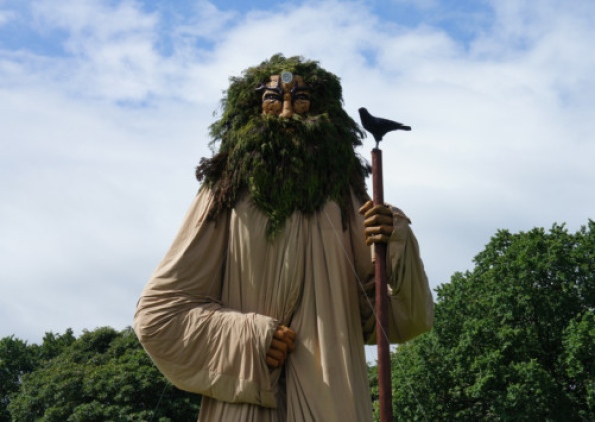
A contemporary Manx sculpture of Manannan displayed at a local music festival

A contemporary Manx sculpture of Manannan

Njörðr is possibly the same deity as the ‘Nerthus’ mentioned by the Roman historian Tacitus (responsible for the second or third-hand literary account of the defeat of the Druids on the Island of Mona in the 1stC AD) –  Njörð is pronounced ‘Nyerth’ or ‘Nerth’. Tacitus’ Nerthus is described as a goddess of the Atlantic or Baltic Germanic tribes, whose cult image was annually taken from its sea-island sanctuary in procession among the peoples on a wain drawn by heifers during a certain festival period at which iron objects were locked away and no warfare was carried out. At the end of this according to Tacitus’ (again, second or third-hand account), the wain and the image of the goddess was immersed in a lake and its male attendants died.  Jörð was the feminised portrayal of the Earth (it is the origin of that word in English) in later Germanic and Scandinavian legends – Tacitus refers to Nerthus as ‘Terram matrem’ (mother earth).

Njörðr has a reasonably strong legendary association with the sea and was said (in the Prose Edda text Gylfaginning) to live in a heavenly place called Nóatún, meaning ‘ship enclosure’. In the Poetic Edda  poem Vafþrúðnismál, it is stated that he will survive Raganorok and be reunited with the Vanir, suggesting an afterlife existence in the Scandinavian religious schema. He is associated with wealth, fertility, benignity – much like his son Freyr – and in one tale he was married to the mountain giantess Skaði – a daughter of the jötunn (giant) Þjazi whose attributes included the ability to take the shape of giant eagle. (Skaði and Njörðr’s daughter Freyja’s feathered cloak appears in other tales and gives the ability to shape-shift into the form of a bird!). After the Aesir kill her father, Skaði is allowed to choose Njörðr as a husband, apparently deciding on account of his beautiful feet (presumably being a sea-loving god they are clean and smooth), but they disagree about their favourite place to live –  Njörð wishes to stay near to the sea and Skaði longs for her father’s mountainous province of Þrymheimr.

In the Poetic and Prose Eddas, Njörðr is recorded as being the father of the male and female twins Freyr and Freya (literally ‘Lord’ and ‘Lady’) – described as leaders of the race of gods known as ‘Vanir’, who originate in ‘Vanaheim’. Although it is never stated that Skaði is their mother, it is strongly implied. As we shall explore later, the theme of an estranged otherworld sea-god and his female earthly-mountainous consort was a key theme in Atlantic Paganism further West, and the Vanir tradition of Scandinavian paganism ultimately derives from this.

In the Lokasenna poem of the ‘Poetic Edda’ texts, Loki states that Njörðr came to live as a hostage among the Aesir race of gods from the west (stanza 34) after the first ‘Aesir-Vanir War’ (an account of which occurs in the Völuspá). The mixing of the ‘Aesir’ and ‘Vanir’ in Norse legends is a curious aspect of late Scandinavian Atlantic Paganism, and we need to consider how theirSea God’ Njörðr relates to Manannán Mac Lir. Are they the related to the gods of the Western Atlanteans? I’ll do this in another post to follow….

tbc

Otherworld inversions in ‘The Voyage of Bran’

The Old Irish (circa 8thC CE) literary account of the tale of a fairy woman’s invitation to hero Bran mac Febail to visit the otherworld ‘Isle of Women’ (Tír na mBan) is one of the most important containing an appearance by the enigmatic character of Manannán mac Lir (also referred to as Moninnán in the text), who was in the tale described as the Lord of the Otherworld and later also supposed to have been the Irish ‘god of the sea’, or even the founding and protector god of the Isle of Man.

In the first part of the story, an otherworld woman appears unbidden in the fortress of a legendary king named Bran Mac Febal. She bears a silver apple branch laden with blossoms which she says comes from a tree in the otherworld and hands it to Bran before reciting an ‘aisling’-style visionary account of the otherworld which inspires him to set out in search of it. This account tells how this world consists of a great island (or islands) in the west and hints that it is a mirror-reflection of our world. She predicts the liminal moment in his voyage at which he will see Manannán and at which point he will know he has arrived in the Otherworld (Kuno Meyer translation):

 At sunrise   there will come
   A fair man illumining level lands;
   He rides upon the fair sea-washed plain,
   He stirs the ocean till it is blood.

The liminal point of ‘sunrise’ is actually here the sunset of the corporal world, and she alludes to this in her description of the sea turning to ‘blood’, with the reddening sunset. It is probable that the reddening of the sea was interpreted as a figurative indication of the host of the dead going beneath the waves into the inverted Otherworld.

In the second part of the narrative (dealing with the journey), the following stanzas describe the actual moment when Bran is met and addressed by Manannán ,who rides across the waves on a chariot accompanied by a host of souls who Bran cannot see (i.e. – conducting the dead into the land beneath the waves):

Bran deems it a wondrous pleasure to travel in his coracle over a clear sea, while for me, the chariot in which I am is driving from afar over a flowery plain.

What is clear sea for the prowed ship in which Bran is, is a many flowered Mag Meall for me in a two-wheeled chariot.

Over a clear sea Bran beholds many breaking waves. I myself behold flawless red-topped flowers on Mag Mon.

Sea horses glisten in summer throughout the prospects which Bran can roam with his eye. Flowers pour forth a stream of honey in the land of Manannán mac Lir.

The sheen of the sea on which you are, the brightness of the ocean over which you voyage: it has strewn forth yellow and green; it is solid earth.

Speckled salmon leap from the womb of the white sea which you behold: they are calves, they are lovely lambs…

… Though you should see but a single chariot-rider on the many-flowered Mag Meall, on its bosom, besides him, are many steeds which you do not see.

(Translation from Early Irish Lyrics by Gerard Murphy, 2007 reprint of the 1956 first edition; I also refer the reader to the Kuno Meyer transaltions which are available online.)

By contrasting the great plain of the sea, with the great plain of his otherworld domains of Mag Meall (Honeyed Plain) or Mag Mon (Plain of ?Sports/?Delights), Manannán draws Bran (and the reader) into the Otherworld in a smooth transition that eases across the boundary between both worlds almost imperceptibly. The ensuing descriptions he gives tell of the feasting and beauty of the fairy inhabitants of this place.

    The sea, of course, is where the sun appears to Atlantic peoples to descend into in the west every day, and for this reason, Manannán is therefore depicted in this tale as the lord of the parallel world of the afterlife, where sea is land and vice versa.

 This otherworld is named in the poem (either in whole or in its part) by various names, including: Emain, Emne, Ciúin, Aircthech, Mag Findargat, Mag Argatnél, Mag Réin, Mag Mon, Mag Meal, Ildathach and Tír mBan. The diversity of names used in Celtic tales of the otherworld sometimes suggests it to be more of a western archipelago, reflecting that of the eastern Atlantic seaboard: Ireland, Britain and the Hebrides etc. However, by ascribing many names to one idea gives a special status to something magical – an indefinability that prevents its overthrow by literality. This represents the struggle between oral pagan tradition and literary Christian absolutism.

The themes of conflict between the pagan and the Christian are bubbling just below the surface throughout the poetry and prose of the ‘Voyage of Bran’. When the ‘fairy woman’ or Manannán holds the stage, they give a very persuasive account of the spirits of the otherworld, who are said to be without original sin and full of virtue. There is no indication that the Christian scribe(s) and interpreters of the tale and its poetic stanzas are seeking to Christianise the otherworld – the ultimate goal is to consign it to history, or to the world of fantasy and story:

Once the author or scribe finishes dealing with the pagan and fairy themes, the poetic stanzas go on to address christian themes of the afterlife almost as if the transcriber of the pre-historic oral versions is guilty about such content. An interlineal note in one of the surviving manuscripts of the tale even contains a supplication to the christian god: arca fuin dom Dia – ‘I ask forgiveness of my God’. The style is therefore the same as in the ‘Lament of the Sentuine Berri’, which similarly descends into expressions of Christian scribal anxieties over the apparently pagan content: Both pieces contain core doctrinal aspects of the two main characters at the heart of the pre-christian Atlantic religion.

Ancient Irish literature and legends are full of motifs of the masculine hero being inspired by the dreamy visions of a powerful otherworld female, who also frequently functions in such legends as the one who bestows sovereignty and male temporal power. The ‘Voyage of Bran’ is no exception, but where it is exceptional is that it deals with the less common theme of the god-like Manannán (or Moninnán). In the Voyage he seems to function as a walk-on part or herald who welcomes Bran to his kingdom and conducts him through the otherworld showing its sights and impressing upon him the ‘principle of inversion’ regarding the nature of the otherworld. When reconsidering the introductory stanzas spoken by the ‘fairy woman’ in Bran’s fortress in the human world, it is quite possible to conclude that Manannán’s masculine appearance in the otherworld is an inverted reflection of the fairy woman who inspires Bran while in the ‘Land of Men’: In the ‘Land of Women’ the Fairy woman becomes a Man! Such a principle appears to have powered a pagan understanding which balanced the importance of the role of the masculine and feminine, the living and the dead, night and day, summer and winter and so forth… It was a religious philosophy designed to seek harmony between the apparently polar forces of the universe.

Atlantis? … or Atlantic?

“…For many generations, as long as the divine nature lasted in them, they were obedient to the laws, and well-affectioned towards the god, whose seed they were; for they possessed true and in every way great spirits, uniting gentleness with wisdom in the various chances of life, and in their intercourse with one another. They despised everything but virtue, caring little for their present state of life, and thinking lightly of the possession of gold and other property, which seemed only a burden to them; neither were they intoxicated by luxury; nor did wealth deprive them of their self-control; but they were sober, and saw clearly that all these goods are increased by virtue and friendship with one another, whereas by too great regard and respect for them, they are lost and friendship with them. By such reflections and by the continuance in them of a divine nature, the qualities which we have described grew and increased among them…”

The above quote is from Plato’s narrator Critias (4thC BCE) on the people of ‘Atlantis’, who the ancient Egyptians claimed were the children and followers of Poseidon and who were supposed to have once lived ‘beyond the Pillars of Herakles’ – an ancient name for the Straights of Gilbraltar. (Translation by Benjamin Jowett.)