The pagan roots of St Martin’s day – 11th November

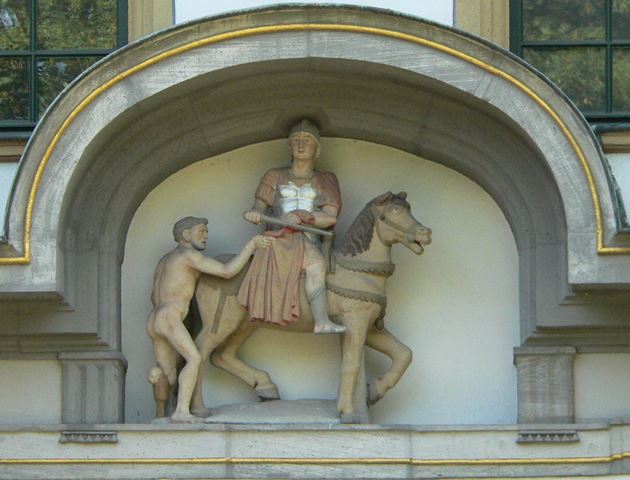
A German statue of St Martin donating his cloak to the poor man.

A German statue of St Martin donating his cloak to the poor man.

In my previous post I discussed the significance of Armistice Day falling on the 11th of November, which is also St Martin’s day: St Martin of Tours (d.397 CE) was a ‘military’ saint of the early Christian church who evangelised northern Gaul, and who is celebrated as one of the more important ‘local’ saints in northern Europe, along with characters such as St Patrick. St Martin’s day falls on the ‘old’ (Julian calendar) All Saints’ Day (‘Hallowe’en’) and is therefore linked to the celebrations of the Celtish quarter-day festival knownamong the Gaels as Samhain, and which is observed in reverence to the souls of the dead.

Processions and ritual begging:

St Martin’s day (and St Martin’s Eve) customs perhaps unsurprisingly share similarities with those of Hallowe’en: In Germany, for instance, the Gripschen or Heischebrauch customs of children going from door to door begging gifts of food, sweets etc in return for songs (Martinsleid) is associated with St Martin’s day (Martinstag). In Germany – as elsewhere in Europe – this custom was also associated with the medieval ‘souling‘ traditions observed variously on All Hallows day (1st November) or All Hallows Eve (31st October) as well as All Souls’ day (2nd November). In ‘souling’ people would go door to door offering prayers for the dead in return for the gift of ‘soul cakes’. This seems to have evolved into the modern Hallowe’en ‘trick or treat’ custom, but was a feature of other festivals of the ‘winter quarter’, such as the Christmastide ‘wassailing’ and ‘guising’ tradition parties of ancient European tradition. Ritual begging was therefore an ancient and important cultural custom, and the idea of receiving divine favour in return for bestowing hospitality on the poor and needy was a key element to religious observances of the Christian and pre-Christian eras (for example, the Roman and Greek festivals of Saturnalia and Kronia).

The most popular legend of St Martin is that of him dividing his soldier’s cloak to share it with a freezing beggar (who was then revealed to him in a vision to have been Christ personified), hence the association of Martin’s festival with begging traditions. In modern Germany and other north European countries, children take part in lantern processions on St Martin’s eve and these are usually led by a man dressed as the saint – often depicted as a Roman soldier with a large cape on horseback. These processions culminate in the St Martin’s bonfires, at which people eat traditional foods and drinks (such as gluwein). Similar festivities in modern Britain occur on 5th November (divested of any Catholic trappings, and often with pyromaniac Protestant iconoclasms). In Ireland bonfire celebrations were formerly held at Samhain. It is evident that they are all based on an older seasonal tradition which has diversified with time and changes to the political and religious landscape.

The spirits of the dead were, before and after the advent of christianity, associated with a hunger for the warmth and fecundity of our world. The act of appeasing the needy and hungry can be thought of in technical terms as assuaging this ‘pull’ from the otherworld which might threaten our imminent ‘crossing over’ to join the dead.

Martin the warrior:

The legend of Martin of Tours given us by Sulpicius Severus (4th/5thC CE) says that he was originally a Danubian noble serving in a Roman cavalry outfit who, through a process of divine revelation, transitions from a physical form of warfare to the spiritual one of the Christian narrative. This in itself is illustrative of the ‘spiritual rebirth’ through which followers of his religion defined themselves – then and now. This confusion of death and life was typical of the ancient pagan European worldview about warfare and death, a view which was personified by Martin’s namesake – the Roman god Mars who (unlike his Greek counterpart Ares) represented chthonic wealth as well as war. That Martinmas comes at time when it is traditional in Europe to make a celebration of agricultural fertility and full winter stores is therefore intriguing.

In the skies, the season is marked by the prominence of the great winter ‘warrior’ (or ‘hunter’) constellation of Orion – imagined as a man holding high a sword and shield. Another interpretation might be a herdsman – cattle were generally moved from pasture into their winter stalls by Martinmas, and the ‘campaigning season’ for warfare was over. The warrior-hunter-herdsman constellation being displayed in the heavens might possibly have been viewed as an indicator that such activities on earth should cease. In Germany another old tradition used to be of herdsmen giving a ritual bundle of branches (the Martinsgerte – ‘Martin’s Switch’) to the farmer at Martinmas, which would be used the next Whitsuntide (Beltain) to drive the cattle to their summer pastures. This may represent the fact that herding was seasonal hired work, and in many places St Martin’s Day was a traditional holiday for herdsmen, who also identified with St George. Whatever the case, wands or switches crop up in many European winter folk-traditions and performances from before the modern age.

Association with horses:

Martin was said to have been of Illyrian birth – from the ‘Danubian’ provinces of the late Roman empire. Eastern Europe and Germania provided many of the elite cavalry units of the Roman army, and from the late 3rd century military men from these regions came to dominate the upper echelons of the Roman military hierarchy, even providing Emperors. This rise of the ‘Equites’ would in turn syncretise with the military traditions of the western Celtic tribes and eventually give rise to the European ‘knights’ of the middle ages. Martin bestrode both such worlds and his iconography demonstrates this. In the Gallo-Roman world he came to evangelise, as well as the Celticised Danubian provinces of the late Empire the cult of Epona – supposedly a Celtic horse-goddess – was prevalent, especially among military elites. This appears to have had a special Danubian flavour added to it in Eastern Europe, where her cult was linked to that of the ancient Greco-Roman Dioskoroi – the twin brothers who were expert horsemen, and whose legend suggested one was human and the other divine. It is possible that Martin’s father was aware of or even participated in such a cult, as he was said not to have been Christian. Mystery cults – particularly that of Mithras – were prevalent among the late Imperial military.

Martin’s figurative rejection of his military calling as one of the Equites (as told by Sulpicius Severus) can be interpreted as a rejection of the figurative cultural importance of the horse among his chosen flock, whose coins before the Roman conquest almost universally depicted the image of the horse along with a multitude of spiritually significant symbols. Severus tells a number of stories of Martin destroying the sacred groves and temples of Gaulish pagans, so the narrative of his hagiography needed to account for this. Tours was a ‘Belgic’ part of Gaul, strongly influenced by the military-spiritual late Iron Age cultural movement which appears to have stimulated the Celtic expansion of the ‘La Téne’ era of the second half of the 1st millennium BCE.

Association with birds:

Apart from the ritualised begging and celebrations of altruism, there is another old custom associated with St Martin’s day, involving birds. This is represented in Germany by the eating of a goose (the Martinsgans) at a special meal in honour of the saint, although duck is the more favoured bird in modern times. The reason given for this custom is based on the hagiography left by Martin’s contemporary, Sulpicius Severus, who declared the saint’s modesty as one of his virtues, illustrating it by the tale that Martin hid in a goose-shed when the crowds at Tours wished to elevate him to the rank of Bishop. The geese proclaimed his presence and he was forced to accept the honour.

Irrespective of the hagiographic legends, it was traditional at this time of the ancient subsistence agriculture cycle of Europe  to slaughter geese and pigs (both of which could be salted down to be preserved for the winter). In German ethno-linguistic regions the Schlachtfest (‘Slaughter Festival’) usually coincided with Martinmas. The tradition of animal slaughter at this period might explain the former custom in parts of Ireland of the Martinmas cockerel, which used to be slaughtered on St Martin’s Eve by bleeding. Sometimes a goose was used. The custom survived well into the 20thC – blood from the bird was dripped at the boundaries, corners and portals of the homestead or farmstead in order to procure luck (or protection from the saint) for the coming year. The bird was then eaten at a special meal (meat was only ever an occasional luxury in former times). This bird-slaughtering tradition evolved into the American settlers’ ‘Thanksgiving’ festival, celebrated on the third Thursday of November. All-Hallows or Martinmas were also traditional festivals at which tithes were traditionally paid to churches, and when servants were hired or released from service, sometimes a time when rents were paid. The ‘functional’ aspects of such festivals were sometimes displaced to Michaelmas – and although not practised on Martinmas, the tradition of a goose-feast at Michaelmas (29th September) was observed in Britain. when rents and tithes were often expected. Perhaps variations in the harvest-period between regions have informed this plasticity.

In the Isle of Man the custom of slaughtering a fowl was formerly celebrated on St Catherine’s day (25th November – a closer analogue of Thanksgiving) when a female hen suffered its fate, and was committed to a ‘solemn’ burial (perhaps made less solemn by the inebriated state of the celebrants) as part of the festivities of the tiny island nation’s St Catherine’s fairs. The meaning of the Manx ‘St Catherine’s Hen’ and its ritual slaughter and burial at a public fair is obscure – it could be anything from a pagan survival to a modern form of anti-clericalism or anti-Catholicism. What is similar, however, is the better-known bird-killing ritual involving the slaughter of a wren on the same island on the 26th December (St Stephen’s Day), suggesting a pre-Christian avian tradition. In avowedly Catholic Ireland this custom also occurred and in both countries (Mannin and Ireland) there were legends suggesting the wren was the personification of a powerful female fairy, leaving us to conclude that the ritual slaughter of a bird during the winter quarter had some religious significance in the ancient Atlantic world.

Returning to St Martin (and the 11th of November), it is worth commenting on some other bird-related associations. Not in the least is the use of the name ‘Martin’ for a class of bird of the family Hirundinidae, including the Swallows, House Martins, Sand Martins etc. These are migratory birds who appear in Europe during the late spring-time, and are usually departed to their over-wintering locations by the 11th of November. Anciently it was believed that, rather than migrating, they in fact slept over winter at the bottom of ponds and rivers. This belief may be based upon the observation of these species regularly skimming down over water in order to drink while ‘on the wing’.  By the same estimation, flocks of migratory plovers coming in to roost and feed on estuarine mudflats often appear to be ‘diving’ into the water. In ancient Rhodes (so the 2ndC CE Greek poet Athenaeus tell us) were beggars known as the Chelidonistai (‘Swallow Men’) who would come around in early springtime with the arrival of the swallows and sing traditional songs in order to earn alms. He mentions another class known to him (Coronistai) who carried a dead crow or raven and also solicited alms through a song. Obviously, there is a parallel with the Christianised medieval traditions of ritualised begging, so important to the Christian narrative. These were celebrated in Swabia (Upper Bavaria) at Whitsuntide (the closest Christian festival to Beltain) by the ‘Waterbird Men’, who performed songs for alms. Frazer (‘The Golden Bough’) quotes various German authors saying how these as also going into the forests to gather oak branches and other greenery, as well as sometimes diving into water, or throwing straw effigies of a large bird into water. In medieval times a wooden bird was displayed in Bavarian churches at Whitsun, evidently to depict Jesus, but possibly part of a Christianised tradition of the pagans. Like the Manx and Irish ‘Wren Boys’ these Whitsuntide parties of young men dressed in white, and wore red sashes. Just which ‘water bird’ species (if any) was intended is unclear – it may be that the placing of the bird in water was the origin of the name. Beltain is 6 months from Samhain – at the other side of winter – and St Martin also enjoyed a more ancient midsummer feast (Martinus aestivus, 4th July). The ‘Martin’s Bird’ (Martinsvögel) in Germany might also refer to an old tradition of a bird-shaped harvest sheaf (possibly even the one once cast into the water at Whitsuntide in Swabia), and is also the name sometimes given to other bird species such as the Black or Greater Spotted Woodpecker, the goose or even the Ladybird (also associated in German legend with Frau Holle).

The symbolism of migratory birds seems ideals for expressing the cycles of death and rebirth. These are best represented in European legends by species such as the Martins and Swifts, the Geese and Swans, and aquatic species such as the Plovers. St Martin was credited with bringing Christianity (which promised renewal not in this world but another one) to much of the notoriously militant, formerly barbarian Romanised cultures of north Europe. His name and military aspect seem like a fitting identity for someone who converted the Gauls from their vestiges of druidism, which taught that the soul flies from the body after death and is renewed in a far-off place before returning again in a new incarnation. Such empirical and spiritual symbolism pervades the legends and folklore of  Celtish and related European cultures, and survives the Christian era – testament to the power of the old and mysterious worldview.
Solar aspects of European gods: Kronos, Janus, Neptunus, Dionysus, Mars, Apollo and Manannan

In the Bronze Age Mediterranean, a profusion of small mobile island-based cultures and vigorous sea-borne trading nations coupled with the developing ‘city’ polities fostered a diversification of European pagan philosophies. In the eastern Mediterranean, these were dominated by the Greek and Phoenician cultures.

Contact with the religiously sophisticated ancient Egyptian and Babylonian civilisations caused a continuous flow of ‘oriental’ cultural and religious ideas (including writing) into the west and the north.

These processes would inevitably lead to a fragmentation and sub-specialisation of the empirical principle of a ‘solar hypostasis god’ (and complimentary earth goddess) into multiple divinities, bearing (perhaps unsurprisingly) many different names. The persistence and re-integration of such divinities into the religious landscape of the dominant cultures of the Classical era Greeks and then the Hellenised Romans led to the demotion or promotion of these gods as part of a hierarchical ‘pantheon’, as well as a ‘familiarisation’, ‘temporalisation’ and ‘spacialisation’ of their existence in mythical traditions, based upon the apparent similarity/relation of one to the other, the age of their traditions and their location of origin. Thus the ‘Solar God’ archetype came to associated with a diverse set of gods, but most importantly: Kronos/Saturn, Poseidon/Neptunus, Dionysus/Bacchus, Mars, Apollo (worshipped by the Romans under his Greek name) and Janus (for whom there was no Greek alternative).

These identities seem to have often aggregated under a unified entity: ‘Zeus’ and ‘Jupiter’ (‘God’ and ‘Father God’) whom the mythological traditions tied up with the formal duties of ‘ruler’ of the others. He was a sky god – grandson (according to tradition) of the deified sky: Ouranus or Uranus. The mythological formality of the ‘ruler’ god, left little subtlety for expression of divine higher truths, and Zeus/Jupiter spent a mythological life doing what kings do: Lounging around, fornicating, making war, punishing miscreants and putting on spectacular displays of power and majesty. The cultic ‘mysteries’ were left to the subservient aspects of the ‘masculine’ solar divinity, who had developed many faces by the 1st millennium BC:

Kronos or Saturn:

Perhaps the most succinct appraisal of this god (borrowing from lost works of Nigidius) comes to us from the brilliant early 5thC CE pagan Greco-Roman author Macrobius Theodosius (‘Macrobius’), and his great work titled Saturnalia – one of the most significant late-classical treatises dealing with pagan mythology. It was written during a period when christianity was being actively incorporated over the shell of the receding pagan world of Rome’s great Empire, and it is possible that Macrobius himself was Christian, and wished to examine the underlying philosophical elements of paganism in order to unite the two in continuity. Of Kronos, he had this to say:

“… Κρóνος (Kronos) is the same as χρóνος (Khronos – time): for as much as the mythographers offer different versions of Saturn in their tales, the physical scientists (‘physici’ – philosophers) restore to him a certain likeness to the truth. They say that he cut off the genitals of his father, Heaven, and that when these were cast into the sea Venus was engendered, taking the name Aphrodite from the foam from which she was formed. They take this to mean that when chaos existed, time did not, since time is a fixed measurement computed from the rotation of the heavens. Hence Κρóνος, who I said was χρóνος, is thought to have been born from heaven (caelo) itself. Because the seeds for engendering all things after heaven flowed down from heaven, and because the elements that fill the world took their start from those seeds, when the world was complete in all its parts and members, the process of bringing forth seeds from heaven for the creation of the elements came to an end at a fxed moment in time, since a full complement of elements had by then been created. The capacity for engendering living things in an unbroken sequence of reproduction was transferred from water to Venus, so that all things would thenceforth come into being through the intercourse of male and female…” (Saturnalia, Book 1, 8.6-8.8, trans. Kaster, Loeb Classical Library)

The castration of the sky (Ouranos/Uranus) by it’s titanic son, Kronos, is therefore the first act producing the male:female dipole upon which the god:goddess conception hinges. The ancients equated the stars of heaven with souls and these are portrayed in the Kronian myth as the seeds spilling from the castrated genitals of the sky into the oceans. Macrobius explains that the Roman word for Kronos, Saturn, is an epithet derived from a Greek word for the penis: σαθη (sathê), from which the Dionysian ‘satyrs’ are named. Charles Darwin’s greatest offence to protestant Victorian society was, it appears, simply to have suggested that the ancient Greek pagans had the right idea about evolution and sex after all! Unseemly!

Macrobius suggests that Kronos is a solar god on account of his genesis of the cycles of time – marked to us by the turning of the days, months and years, which underpin the cycles of fertility in the world. Kronos himself was therefore possibly supposed to represent the sun, representing the first star whose heat nourishes the life on earth. Indeed, his mythological devouring and regurgitation of his divine offspring (the Olympian gods) adds further credence to the destructive and life-giving aspects of the sun. The reason Kronos was not usually considered as an immanently-presiding god, was because his birth and creation of life fixes him at the start of time, where he is doomed to stay in myth and definition: cast on the far shores of Oceanus. As an originator god, Saturn was both the ancestral deity and provider of fertility, celebrated at the annual winter Saturnalia (Rome) or Kronia (Greece) with which Christianity collocated its nativity festival at the winter solstice, when the sun was deemed to be spending most of its time in the Otherworld. The otherworld was both the retreat of dead souls, and the source of returning fertility, which Macrobius noted was engendered on the world through water, into which the sun appears to plunge nightly from western coastal regions. The solar aspect of Kronos are therefore remarkable.

Janus/Ianus:

Janus (after whom the month of January gets its name) was one of the typically Roman gods, who we generally remember as being the one with two faces, ‘looking forwards and backwards in time’. Like with the Greek hearth goddess Hestia, it was customary to invoke Janus first at religious rites of other Roman gods. Macrobius has the following to say:

” … Some claim that Janus is shown to be the sun and has his two-fold nature because both heavenly doorways are in his power, as he opens the day by rising and closes it by setting; and further that when some god’s rite is being celebrated, he is called upon first so that he might open the way to the god to whom the sacrifice is being made, as though sending suppliants’ prayers on to the gods through his own gateways. Hence, too, his likeness is commonly represented keeping the number 300 in its right hand and 65 in its left, to indicate the measure of the year, which is the sun’s chief function… ” (Saturnalia, Book 1, 9.9-9.10, trans. Kaster, Loeb Classical Library)

Macrobius is able to associate Janus with both Diana (the ‘lunar’ huntress whose brother was ‘solar’ Apollo, and who was known to the Greeks as both Artemis and Hecate, among other names) and Juno, wife of Jupiter and chief goddess (known to the Greeks as the scheming and jealous Hera, consort of Zeus). Indeed ‘Janus’ and ‘Juno’ have the appearance of a ‘matrimonial’ or ‘gender-twin’ god-pair similar to, for example Freyr and Freyja. Although Artemis/Diana is depicted as a ‘virgin’ goddess, this status is mystically equated with maximum sexual fertility potential, and Macrobius explains that Diana was considered a feminine part of the god, whose dual-nature is so apparent, arguing that ‘Diana’ is ‘Ianus’ with a super-added ‘D’. As the visible faces of the Roman and Greek gods were in reality fronts or ‘masks’ of their deeper mysteries, he may well be correct.

Janus was therefore a god of gateways and openings, as well as a somewhat daemonic entity, who – somewhat like Mercury or Hermes – carried messages from the mundane to the divine. The gates of the god’s temple were propped open in times of war, and the public reason for this was made into a story involving an early war between the Romans and the Sabines when Janus was said to have mysteriously opened Rome’s closed gate, and sent a torrent of boiling water at the Sabines from his temple, saving the city. Deeper reasons may link to the cult of the afterlife in which both Saturn and Janus played a part – the doors were probably opened to admit souls of dead warriors to the precincts of the god. The god’s statuary attributes (apart from his two faces) were the rod and the key, denoting measurement (?of lives, time, space) and the key (signifying the unlocking of thresholds). It was widely believed that worship of the god preceded the establishment of Rome itself, making Janus one of the rare and antique indigenous gods not borrowed from the Greeks. His cult is shrouded in a good deal of mystery, and his attributes seem to link him closely to Kronos/Saturn, who he may have been the original indigenous version of.

Mars/Quirinus:

Mars and/or Quirinus were – like Janus – aspects of an indigenous Sabine-Etruscan-Latin deity whose veneration appears to have preceded the influence of the Greeks. His Greek counterpart, Ares, was not equivalent – Mars was more of a chthonic deity of abundance-through-strife, whereas Ares was a colder divinity representing violence. Implicit in the idea of Mars was symbolic struggle of nature, and the renewal offered by death. He was therefore closer in conception to Ares’ brother, Apollo, who was identical in practical respects to the Greek solar god, Helios: the sun burns, and the sun renews.

The custom of opening the doors of the temple of Janus in times of war seems to link him to the cult of Mars as a war-god. In fact, Janus was also known as Janus Quirinus suggesting a syncresis. Quirinus was also cited as the deified ancestor-founder of Rome: Romulus. The priest of Quirinus (the Flamen Quirinalis) presided over a number of ancient chthonic-ancestor cult practices, most important of which were the Larentalia (23rd December – associated with the Saturnalia, no less) the late-April celebration of vegetative growth of crops called Robigalia (Robigus was evidently a jealous chthonic ancestral spirit who craved the goodness of grain, and was credited with causing soot and ergot etc) and the Consualia Aestiva in August after harvest was gathered (in honor of Consus, guardian of grain stores). ‘Larentia‘ was a consort of ‘Romulus’ in Rome’s founding myths – she was the ‘Mater Larum’ or guardian of ancestral souls: again an incarnation of the Great Goddess, just as her consort (Quirinus) is the founding male part of the equation. The god Portunus was also worshipped as a protector of storehouses and gateways, indicating he was somehow related to both Quirinus and Janus.

‘Mars Quirinus’ was the god’s epithet in times of peace, and ‘Mars Gradivas’ in times of war, at least in Republican times when he used to be part of the early ‘Capitoline Triad’ of Jupiter, Mars and Quirinus. This was why the principle Flamens (high priests) of the state religion were the Flamen Dialis, Flamen Martialis and Flamen Quirinalis. The ‘Triad’ (based on an older Celtic-style triune deity) eventually changed to Jupiter, Minerva and Juno – reflecting, perhaps, Greek religious tastes.

Poseidon/Neptune:

Poseidon is considered to have been the prime deity of the Mycenaean civilisation from which classical Greek civilisation developed. Neptune was his Roman counterpart, an Italic god of not just the sea but lakes and rivers, who was generally conflated with Greek Poseidon by the 4thC BCE. As the ‘brother’ of Zeus he ruled over the earth and the waters which flowed on and through it. Their other brother, Hades, ruled the cthonic underworld, and Zeus was master of the sky and heavens. This in itself a ‘solar’ triform god hypostasis.

As well as being associated with the waters (and their sculpting force upon the land, believed to include earthquakes) Poseidon/Neptune was the main god associated with horses, both legendary and mundane. These animals were strongly associated with solar mythology, and the sun was depicted as being conveyed in a four-horse quadriga chariot. Waves are figuratively depicted as white horses. The celtic peoples believed the horse would carry you to the otherworld, and their late Iron Age coinage uses the image of the horse and the sun more than any other symbolism.

The Roman god Portunus (mentioned above) was also related to Neptune, in that he was appealed to in order to ensure naval victory, and was a god of ports, harbours and gateways. The sea or water represented a ‘crossing over’ to ancient minds – the sun disappeared into it, and death was assured to those who stayed submerged in it. There might possibly be an older (possibly even non-italic) shared origin for Portunus and Neptune, and they share names with similar sounds. The Irish mythological character Nechtain (mentioned in Dindsenchas as husband of Bóand) might be a celtic version of Neptune (with the P<>Q/K sound transfer) – his magical well in his palace of Síd Nechtain was the mystical source of the River Boyne (Bóand). Other linguistic aspects of note that link the name to horses and water are the ‘Neck’ spirits of north European folklore, otherwise known as ‘water horses’ or ‘kelpies’.

Dionysus/Bacchus:

The epiphanic Dionysus was an important solar god who represented the aspect of sun-driven vegetative growth and in particular, the ecstasy-inducing produce of the vine. He was a central figure of a number of important mystery cults, and was known to the Romans under one of his other names – Bakkhos or Bacchus. His cult may have originated further north in Europe or the Near East, and in Thrace he was known as Sabazios, and shared aspects of Apollo. In fact, at Delphi in Greece (Hellas) he sat in for Apollo once a year when the sun god was deemed to be taking a holiday among the noble barbarians of Hyperborea, somewhere beyond the river Eridanus, site of an infamous mythological accident suffered by the chariot of Helios, whose son Phaeton took it on an ill-starred joyride. Like the sun, Dionysus was portrayed as coming from the east, leading some to posit that he had eastern origins, but this is not necessarily the case. The cult of Dionysos was not just an orgiastic celebration of fertility, but a mystical expression of the connection between death and new life. Aspects of it were borrowed into the mythology of christianity – for instance, the motif of death and rebirth comes from the mythology of Dionysus, particularly in the Orphic mysteries. Unlike the ‘hero’ gods of Greek, Roman and Thracian religion who were depicted armed with weapons, Dionysus flourished the thyrsus – a stave topped with a pine cone, deliberately suggestive of the phallus. His mythical retinue consisted of ‘wise Silenus’, the ithyphallic Satyrs and the crazed retinue of the female maenads.

Dionysus was not just a god, but a ‘prophet’ through whom the mysteries of life and death could be addressed periodically. He was somewhat unobtainable, except through throwing oneself into the wild aspects of his rites. Temples dedicated to him were a late feature of the Roman empire, and in Greece his most significant structures were his open air theatres.

Apollo:

The ‘purest’ or most overt solar god was Apollo, who might be thought of as the youthful god of new dawn. Often cultically portrayed with a bow, arrows and lyre (perhaps signifying the rays of the rising sun), he was also depicted with his chthonic adversary, the serpent Python, which his mythology describes him slaying. This Apollonian myth is also echoed in the myths of semi-mortal Herakles/Hercules who meets the serpent Ladon in the garden of the Hesperides, while seeking the golden apples of immortality. The symbolism was the conquest of death, and it is easy to see the parallels with Dionysus. Along with the Thracian Sabazios, Hercules, Apollo and Dionysus appear to have resonated with the Celts much more than other gods of the Greek and Roman pantheons, and influenced their imagery and religious practices during the syncretic eras between the 3rdC BCE and 3rdC CE.  Unlike Dionysus, Apollo’s was generally seen as a more stable and providential presence. His widespread presence in syncretic-era Celtic shrines attests to the importance of the solar godhead in these cultures.

A note on Hades/Pluto:

Hiding in the shady realms of the Greco-Roman underworld of the dead, it is hard to consider Hades as a ‘solar’ deity, yet the darkness – an inverted state of the sun’s light is itself an aspect of that light. It is therefore important to consider Hades a part of the ‘solar’ god-hypostasis. Indeed, to the Greeks he was part of the triform Olympian brotherhood of Zeus-Poseidon-Hades who ruled over the earth’s aspects: Zeus had the skies and heavens, Poseidon the earth and waters, and Hades the underworld realms.

The Atlantic solar god:

In Irish mythology, the ‘sea’ god Manannán mac Lir shows all of the characteristics of a sun-god. From his ‘epiphanic’ arrivals bearing gifts and challenges in tales such as Echtra Cormaic maic Airt (‘The Deeds of Cormac, son of Art’) to his mysterious psychopompic departures to the Otherworld in the poem Immram Brain maic Febail (‘Voyage of Bran, son of Febhal’), he typifies the solar archetypes which informed the worship of Europe’s ancient solar god-hypostasis. To the Atlantic Celts, the sun’s visible disappearance far away into the great western ocean maintained an implied marine aspect to their sun-god, who being born again every morning in the east, was also god of the Otherworld. Manannán seems to incorporate multiple aspects of the Mediterranean deities under one guise – Zeus, Poseidon, Hades and Apollo in particular. It is likely that Manannán was an elegant expression of (were it not for the Goddess) monotheistic godhood behind Ireland’s apparently rapid transit from paganism to being at the cutting edge of the medieval Christian world.

Of course, ‘Manannán’ was only one name or epithet for the solar god among the Irish celts. and the character appears under other guises across Europe. In fact Manannán’s character in his Irish legends is explicitly that of a shape-shifter and master of disguise. His wizardly abilities identify him with similar god-like characters such as Merlin and Wodan/Odin, as I have discussed previously. To the warlike Iron Age celts he was best-known as ‘Belenos‘ – the god to whom warriors pledged their lives in battle, and who promised them reincarnation. Under the epithet ‘Cernunnos‘, he was depicted as a fighting fertility god, with imagery redolent of the battling, rutting beast. Called ‘Esus‘ he was cultified as the branch-cutting god – another warlike image symbolic of killing, typical to the La Téne age, and a possible link to the Norse ‘Aesir’. Called ‘Teutates’ or ‘Andraste’ he was signified as a tribal ancestor-originator. As ‘Taranis‘, he was the energising regenerator whose ‘wheel’ image was an overt symbol of the sun which promised regeneration to come. Under christianity he became represented as the warrior-angel St Michael, Christianised as ‘Malo‘, ‘Mel’ or a multitude of other saints, and demonised as any number of legendary pseudo-historic evil kings, giants, goblins and devils. Due to the weaving of Roman paganism into continental and British celtic cultures, he was deeply buried in layers of syncretism, of which christianity was the most recent incarnation. Whatever guise the god took, he kept his most complete and fascinating literary and mythological identity in Ireland’s Manannán: the Atlantic otherworld solar god.

Sirona – another syncretic guise of the Celtic ‘Great Goddess’

Sirona was another mask worn by the Roman-era Celtic (ie – Atlantic) ‘Great Goddess’. We know of her name because of epigraphic evidence found associated with statues of her image, often at 2ndC CE religious sites associated with springs of water. Her name ought properly be written tSirona (as would be the  case in modern Irish) as the initial vowel sound of her name is the celtic languages’ dentalised ‘s’, pronounced something like ‘ts-‘ and because of this the name was sometimes written Đirona or Thirona.

The most significant areas of her cult stretched from the east of France, and eastward to the waters of the upper Danube in southern Germany, Austria and Hungary. She seems to have been affiliated with hot springs, and was consequently found linked to a solar male god such as Apollo-Borvo or Apollo-Grannus, and both were associated with healing. The name of Sirona is found as far west as Brittany (Amorica) but has not yet been found in Britain – the Britons named their syncretic deity at the great springs in Bath Sulis-Minerva.

Because of the ages-old association of mineral-rich hot springs with healing, Sirona’s imagery borrows from the Apollonian family of Greek gods and goddesses, in particular that of Hygeia, daughter of Apollo’s medical son Aesculapias. The syncretic-era statues of Sirona often show her twined with a snake after the manner of her Greek counterpart. Remember, the Celtic peoples of Europe were not late-comers to Greek philosophical, religious and cultural influence: they had at least 600 years of exposure to Greek religion before the era of their conquest and assimilation by the Romans. The Romans also relied upon Greek religious philosophy to underpin their own version of it, and Apollo was perhaps the most influential of Greek gods.


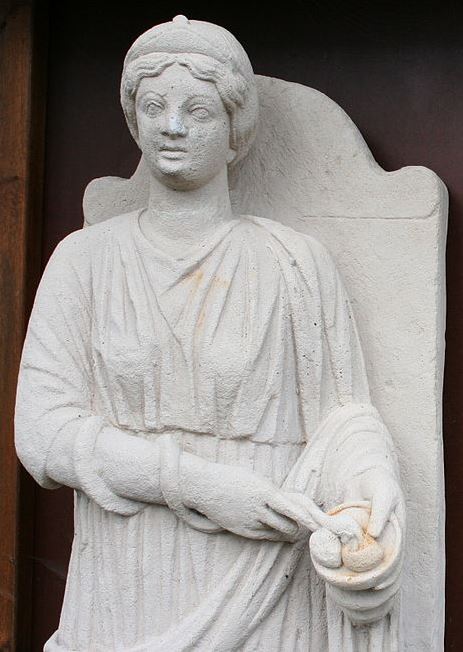
The Sirona statue from the temple discovered at Hochscheid, Moselle, Germany. Note the snake coiled on her arm, eating from a patera of three eggs.

Modern replica of the Sirona statue from the temple discovered at Hochscheid, Moselle, Germany. Note the snake coiled on her arm, eating from a patera of three eggs.

The iconography of Sirona tended to depict her as a young woman wearing a long gown (sometimes she was half-naked) with a diadem on her head. A snake was often coiled around her right arm, and she sometimes held a patera containing three eggs in her other hand. The snake in the Hochscheid example appears to be either guarding or interested in eating the eggs, and the combination of these two together is redolent of the ‘Orphic Egg’ of the ancient Thracian/Greek mysteries. Other features of her imagery indicate further references to the chthonic mystery cults, including ears of corn, associated with Demeter and the Eleusinian Mysteries.

Linguistic aspects of Sirona’s name:

It has been speculated based upon linguistic evidence that Sirona was a ‘star’ goddess. The ancient Transalpine Gaulish word for ‘star’ was ‘sirom‘, related to the Latin word ‘Sidus‘ (from which we get the word ‘Sidereal’). For the Greeks the word was ‘Aster’. The initial ‘tS’ sound of Sirona was a metathesis to ‘sT-‘. ‘Sirona’ could therefore have derived from ‘Sterona’. To derive the Greek ‘Asteria’ (the name of Hecate’s Titaness mother), the word is preceded by the Celtic ‘definite article’ (‘the’), which was pronounced ‘a’, giving ‘Asteria’ or ‘Asterona’. The diadem on the head of the Hochscheid statue is usually cited as support for this theory of naming. However, modern Gaelic orthography may have preserved some early Celtic language conventions: In particular the ‘tS’ and ‘sT’ metathesis. This makes us, by necessity, examine another word which may relate to the name of Sirona, and has been linked to Bridget – Ireland’s goddess of smithcraft: This is the Gaelic word ‘tSaoir’, which means ‘craftsman’ or ‘smith’, and which is demonstrated in Gaelic family names such as ‘MacTeer’ or ‘Teare’, and the Irish mythological name of the ‘Gobban tSaor’. These, of course, relate to Bridget ‘Goddess of Smithcraft’… So ‘Sirona’ might have nothing to do with stars and more to do with the mysteries of nature’s secret re-forging, as suggested by her snake and eggs and veneration at sacred springs.  


The ‘Great Mother’ – Cybele, Rhea and the Cailleach

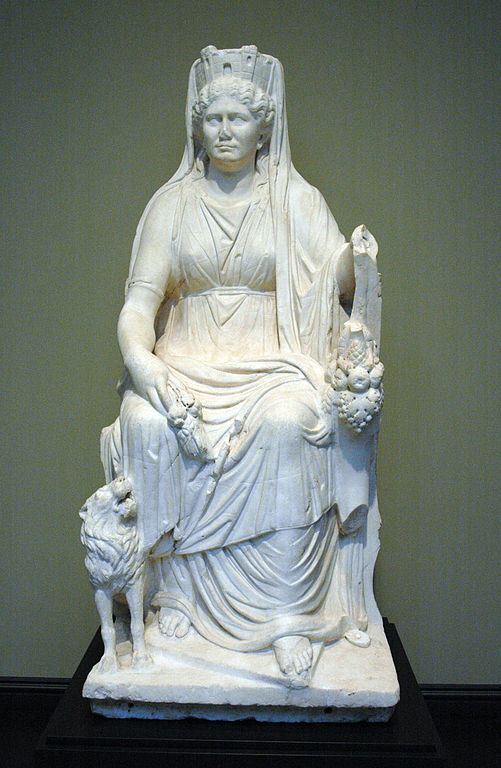
The folklore and fairy-tales of Ireland, Scotland and the Isle of Man maintain a memory of an important female character whose prominence and mystery outstrips all others of these regions. Known as the ‘Cailleach’ (pron. kal-yack), her mythology portrayed her as an ancient forebear of humanity – perhaps so old that her body, her existence, her very essence appears as one with the landscape, which she is credited with creating. On account of her age she is ascribed great knowledge of things past, but also in many traditions claims knowledge of what will come to pass in the future. She is a mistress of herds, an industrious worker, but somewhat reclusive and prone to be found in wild, out-of-the-way places – particularly mountain-tops. She clearly relies on no male partner, although in some tales she is associated with one – albeit in a somehow estranged manner. Students of ancient European paganism might well recognise in her the image of whom the Romans referred to as Magna Mater – the Great Goddess from Anatolia’s Phrygian highlands, known as Cybele who was identical with the Greek ‘Mother of the Gods’, Rhea, wife of old Kronos himself.

501px-Cybele_Getty_Villa_57_AA_19

The Phrygian ‘Great Goddess’ was said to have originated among the Thracians who, according to Herodotus,  were once known as Bryges and crossed over into Asia Minor to occupy its central uplands. She was said in some sources to be the mother of the god Sabazios, the ‘wild horseman’ who became identified with the Greek Dionysos. It is of interest that the sacred rites of both Phrygian Cybele (who remained identified in Thracia as both Cottys (‘the sitter’?) and Bendis) and the Greek Dionysos consisted of wild orgia involving ecstatic dances, processions, the use of intoxicants and sacred rhythmic music involving drums, cymbals, flutes and horns. Participants emphasised the mysteries of nature’s chthonic fertility and recurring constancy. Whereas the Dionysia were typically led by female celebrants, the rites of Cybele were led by a priesthood of castrated eunuchs who took on the roles of women. In spite of this, the similarities were striking and point towards a common older religion, whose origins lay as much within Europe as they did in Indo-European Asia.

Cybele was particularly associated with cult centres in the Anatolian highlands – her shrines (like those of the Persians, Medes and many Celtic peoples) occurring on mountains. The same was true of Rhea, whose main shrine on Crete was situated high on Mount Ida: it was here she was supposed to have hidden the infant Zeus from his cannibalistic father Kronos. The other Mount Ida – in the Phrygian Troad – was sacred to Cybele. Other oracle sites from Greece to Asia Minor were located at high altitude – Delphi being a notable and famous example, which was apparently an oracle to Gaia/Ge before it became sacred to the ‘divine son of light’, Apollo. Mount Fengari on the island of Samothrace (‘Samos of Thrace’) was another site for the oracular cult of the Great Mother of the Gods, whereas on the island of Samos off the Lydian-Ionian coast of Asia Minor, the cult of Hera (a linguistic metathesis of ‘Rhea’) held sway.

When Rome officially adopted the cult of Cybele towards the end of the Punic Wars (3rdC BCE) it was at the behest of the oracular cult of the Sibylline priestesses who appear to have functioned as part of a network of Apollonian oracles across the ancient Mediterranean world, extending from Ionia in western Asia Minor. These appear to have had more ancient links with the worship of the Great Goddess than history generally leads us to believe – perhaps on account of the identity between the ever-youthful Apollo, and Cybele’s divine consort, Attis. The phonetic similarities of the words ‘Sybil’ (originally Greek) and ‘Cybele’ point towards a more ancient link, that the Roman Republic’s dominant and Hellenophile Patrician statesmen perhaps believed they needed to remind their peoples of during the crisis. Presumably, there was a connection between the ecstatic celebratory rites of Cybele and the ecstatic visionary states of the ancient Sybils, although the secret and initiatory aspects of the cults of these gods must leave much open to speculation.

Returning to the northwest shores of Atlantic Europe, is seems quite apparent that there must be some connection between Cybele/Rhea and the craggy old crone of Gaelic myth who seems to share these important mountain-loving and oracular attributes. We have no definite archaeological evidence pointing to the worship of Cybele or Rhea in Roman Britain, and the fact that the ‘Cailleach’ mythology comes from lands which largely fell outside of Rome’s direct cultural influence suggests that the Cailleach legends possibly evolved in-situ and before the coming of Christianity.

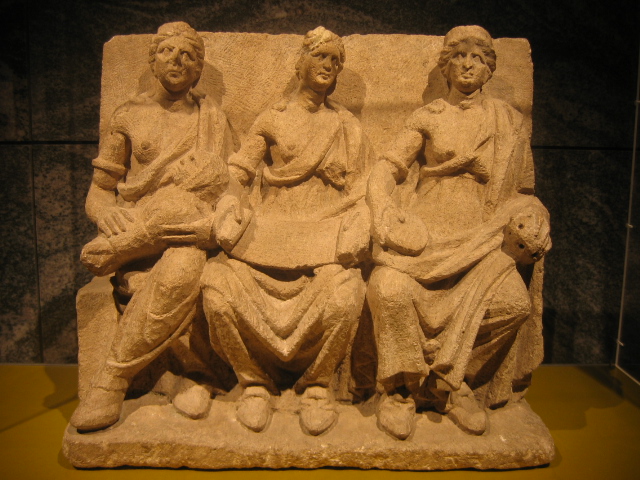
That there was certainly Bacchic/Dionysian and Mithraic cult practised among the Roman-Britons: we can be certain of this from archaeology, but there was no evidence of Cybele, which was apparently a city-cult at Rome. Instead, the closest ‘maternal’ divinities we come across are those known as the Matres or Nutrices – typically represented as a trio of seated women variously nursing or holding bowls or cornucopias. A number of stelae or carved stone panels depicting them survive, and they were also a feature seen in other Romanised Celtic provinces of Europe – perhaps bought to Britain by auxiliary troops serving in the legions.

A Romano-Gallic 'matres' statue from Germany.

A Romano-Gallic ‘matres’ statue from Germany.

The same as depicted on a stela from the Roman fort at Housesteads, GB.

The same as depicted on a stela from the Roman fort at Housesteads, GB.

Apart from their seated pose, they have little else in common with the iconography of Cybele. However, the ‘Celtic Triplicity’ of their form must be considered to be a significant North European religious element. This idea (seemingly copied into Christianity) held that gods had three aspects, and were often depicted ‘3-in-1’. However these triune females still don’t on the surface exhibit any relation to the Cailleach myths from un-Romanised areas of Britain and Ireland.

It is possible, one might suppose, that mythology may have diffused out into these ‘peripheral’ areas and taken root, but it is much more likely that the Cailleach legends evolved in-situ rather than being introduced by continental legionaries. What seems more likely is that the Cailleach mythology formed under the same empirical pre-Roman, pre-Hellenic religious worldview that underpinned the origins of Cybele in Thracia and Phrygia – a worldview that significantly preceded the European Iron Age. This may have had its roots way back in the pre-metal ages when evidence of a widespread religious ideology begins to be demonstrated in the remains of stone and wood temple structures and burial sites with structural commonalities that occur in the archaeological record across Europe. Alternatively, the origins of metalworking in Asia Minor in the Chalcolithic period (c.4000 BC onwards) may have brought the goddess with this technological culture… The connection of Irish and Manx Cailleach legends to those of Cuillean the Smith (Weland to the northeastern Europeans) may indicate this to be true.

Sabazios – the ‘other’ Thracian god.

The Thracian/Phrygian god Sabazios is well-attested in ancient Europe, but little – if any – mythology is known about him, not in the least because Thrace (modern Bulgaria) was not a literate culture before its Hellenisation, Romanisation and later Christianisation. Another fact might be because his worship (where it is attested outside of Thrace) appears to have been part of a ‘mystery cult’ where mythology was imparted as secrets to initiates and was not – in common with the greater part of the more ancient Greek, Italic, Celtic and Pontic/Phrygian traditions – part of a common orally-transmitted mythical corpus of knowledge.

We know that the cult of Sabazios was popular in late archaic and Classical Greece, and that it was later to spread throughout the Roman empire. We also know that it showed a good deal of syncretism with the cult of Dionysus/Bacchus, and that two were sometimes considered to be the same god, albeit that the connection of Dionysus/Bacchus to wine was more explicit among the Greeks and Romans while the cult of Sabazios appears to have emphasized the fertility aspects common to the two.

Dionysus/Bacchus and Sabazios were both gods whose cultic worship and festivals typically surrounded the event of the ‘arrival’ (epiphany) of the god and his band of animalistic male and wild human female attendants among the people, associated with ritual cries announcing the god’s coming. In fact, in the Attic cult of Dionysus (practiced at Athens and Delphi) the ‘Bacchic cries’ to the god and his retinue, according to the great 4thC BCE Athenian statesman-author Demosthenes (in his book ‘The Crown’), appear to refer to a ‘foreign’ Sabazios as well as the Phrygian consort-god Attis, suggesting that the cult was considered as something ‘other’ or ‘alien’, at least to men like Demosthenes, who was seeking to denigrate an opponent when he said:

“… On attaining manhood you abetted your mother in her initiations and the other rituals, and read aloud from the cultic writings …You rubbed the fat-cheeked snakes and swung them above your head, crying Euoi saboi and hues attes, attes hues… ”

The cry was called ‘Sabasmos‘ according to the 10thC CE Byzantine encylopedia known as the Suda, which stated (perhaps echoing earlier observations by Clement of Alexandria) that the cults of Sabazios, Bacchus and Dionysus were effectively the same.

Demosthenes’ ancient account refers to a cult of women that involved the carrying of snakes as part of its rituals. Another important part of the ritual or cult was intoxication: the placing of a krater of wine was a part of the ritual of arrival demonstrated on ancient Greek illustrations. The ritual ecstasy of the female band of celebrant-priestesses known as the Maenads who accompanied the god may have been due to factors other than alcohol-intoxication, however. Foremost among these were the group hysteria of the event, heightened by dance and chanting, but perhaps another important factor in the excitement was blood – from the ritual slaughter of an animal or animals, said in some accounts to have been ritually (and primally) rended physically apart by the Maenads in sacrifice to the god. All of these events typically preceded the showpiece ‘arrival’ of the god’s image and his accompanying band of Maenads and disguised male performers dressed as animals, satyrs etc. This would have been followed by feasting and jollity, after which the Dionysia were typified (in the Greek world, at least) by the production of great plays and dramas – a hallmark of Attic culture, from which we have the plays of Aristophanes and other greats of classical drama.

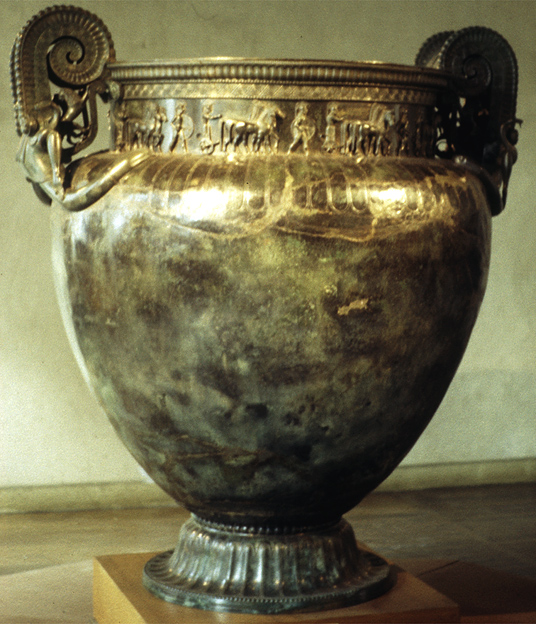
The 'Vix Krater' - an equisite Greek bronze krater buried in the grave of a Gaulish noblewoman c.500BCE. Elaborate kraters were a central symbol of Dionysiac and Sabazian cult worship.

The ‘Vix Krater’ – an exquisite Greek bronze krater buried in the grave of a Gaulish noblewoman c.500BCE. Elaborate kraters were a central symbol of Dionysiac and Sabazian cult worship.

The Thracian and Phrygian (ie – Anatolian) Sabazios emerged from a slightly different religious tradition, but appears to a have merged successfully with the Greek and Roman traditions of Dionysus-Bacchus. In fact, the Dionysiac religion in the Greek cultural world has (rightly or wrongly) generally been considered somewhat ‘different’ to the Olympian traditions, being considered much more of a ‘barbaric’ form of ‘mystery cult’ and generally felt to be somewhat alien and exotic – under the influence of more eastern traditions. This may be a typically ‘Hellenic’ view, however: Greeks of this era (5thC BCE > early Common Era) had a tendency to deride their own ‘primitive’ past and consign such aspects of their indigenous cultural history to the ‘barbaric’ world of Thrace, Phrygia and (of course) the ‘Celts’. The explosion of Hellenic influence and the rise of the Roman Republic on its coat-tails exposed the Greco-Roman world to a plethora of exotic influences, the most favourable of which they found in the Near East. For this reason, these cultures began to ‘orientalise’ and absorb the religious cultures of Thrace and Phrygia, which after the 3rdC BCE were a melting pot also incorporating Celtic and Eastern beliefs. The official acceptance of the Phrygian cults of Attis and the Magna Mater, Cybele, were a prime example of this process, but the older mystery-cults of Orphism and Sabazios-Dionysus had a longer history of influence, which along with the chthonic mystery cult at Eleusis and on the island of Samothrace were testament to the diverse interactions occurring in European paganism. The exoticism and potential for disorder of the Bacchic rites in Rome were accompanied during the late Roman Republic by no small degree of official anxiety, perhaps due to the fact that the state exercised little control over such matters. The adoption of Phrygian Cybele into the official cult of Rome marked the end of the second Punic War, and was perhaps a useful buffer against the more chaotic but no less exotic Bacchanalia. It was following this that the Romans increasingly appear to have shown an interest in the cult of Sabazios (Rome had a temple of ‘Jupiter Sabazios’), which perhaps offered a more conservative aspect of the Dionysiac-Bacchic cult. Rome’s ambitions by the 3rdC BCE lay in the East and her strategy of expansion was achieved as much through cultural incorporation and franchise as by military might.

Thracian/Phrygian Sabazios:

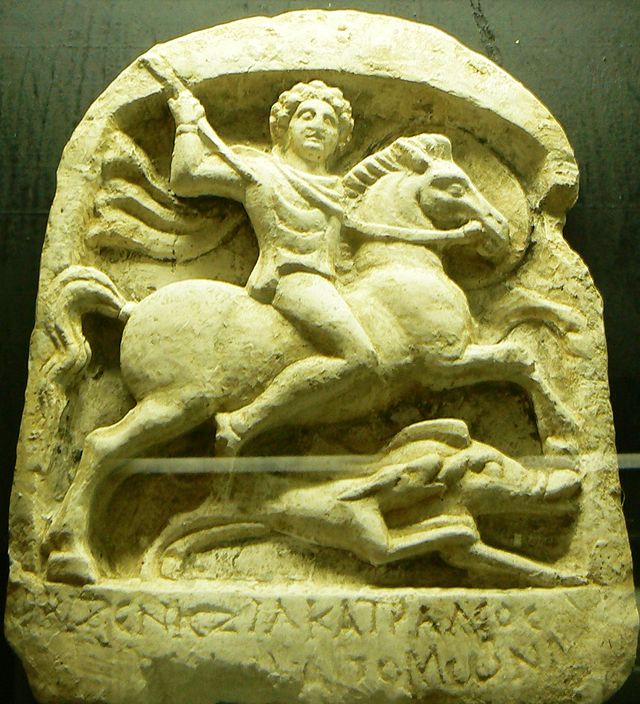
Having mentioned the apparent syncretism of Sabazios with Dionysus during the Hellenic era, it is worth noting the indigenous Thracian and Phrygian aspects of the cult to draw a distinction. As this was (on the whole) a mystery cult and was not written about by indigenous authors, we only have limited epigraphic and artistic (sculptural) evidence to call upon, and most of this during the period of Roman influence following the 2nC BCE. The most common Phrygian and Thracian imagery associated with Sabazios are stone stelae depicting him as a horseman – not a feature seen in Dionysian imagery, except where we see the god’s accomplice Silenus mounted on an Ass. The ‘Thracian Horseman’ is depicted as active and young, and usually shown wearing a billowing cloak and armed with a lance. His image is usually accompanied by some adversarial animals: most often a snake twined around a tree, and sometimes by lions and other wild beasts. Apart from his mount and his weapon, the imagery correlates strongly with that often seen with the archetypal Greek mythical Hero, Hercules. The serpent-slaying hero-role is also seen with Greek Apollo, and it appears that the syncretism between these characters as well as the Centaur Chiron and the god Hermes was a strong feature stamped upon Thracian and Phrygian religion, as well as that of the Celts whose ideas had mingled with theirs during the ‘La Téne’ cultural period. Indeed, when the Romans invaded the Balkans and pushed for Anatolia they were met by combined Thracian, Dacian and ‘Celtic’ forces, whose cavalry was a remarkable and obviously elite part of their fighting style and source of much success until Rome finally defeated and incorporated them into their own armies. The regional prowess of cavalry warfare was at its greatest with the Macedonian Hero-King Alexander, whose father bore the name ‘Phillip’ (‘lover of horses’) and whose cavalry swept aside all opposition in his great surge of conquest during the 4th and 3rdC’s BCE. This was perhaps the spiritual origin of Europe’s medieval mounted warrior elites, and the image of the mounted Thracian Sabazios was used for that of Christianity’s interloper ‘St. George’:

A typical 'Thracian Horseman' image of Sabazios

A typical ‘Thracian Horseman’ image of Sabazios, here hunting a boar – yet another ‘fanged’ chthonic creature representing plenty and growth. The board was a particularly ‘celtic’ image, whereas the serpent was more ‘Greek’ or ‘Eastern’…

The Thracian Horseman image obviously relates to a hero-god, and the name ‘Thracian Heros’ is also applied to the icon-image, one of which is inscribed to ‘Heros Karabazmos’, which name incorporates the ‘-baz-‘ of ‘Sabazios’. To the Thracians, Phrygians and Celts (who used the horse imagery extensively in their otherworldly coins after the 4thC BCE) the ‘Heros’ character represented fertility through the closeness of death: similar to the ancient Etruscan/Roman Mars as well as the all-popular Hercules. In fact, it is worth comparing the iconography of Hercules with that of the Thracian Heros:

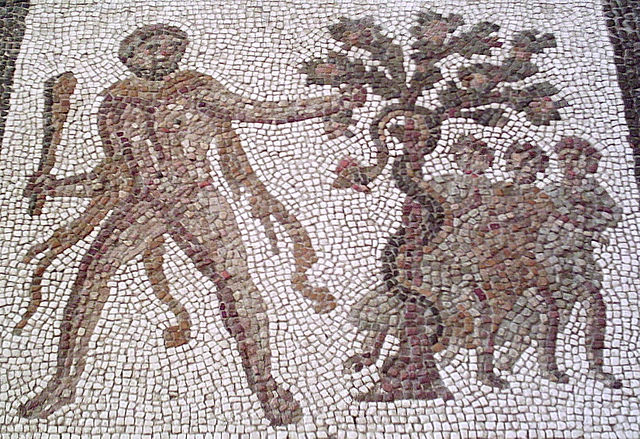
Armed Hercules confronts the Serpent Ladon in the garden of the Hesperides (Roman Hispania)

Armed Hercules confronts the Serpent Ladon in the garden of the Hesperides (Roman Hispania)

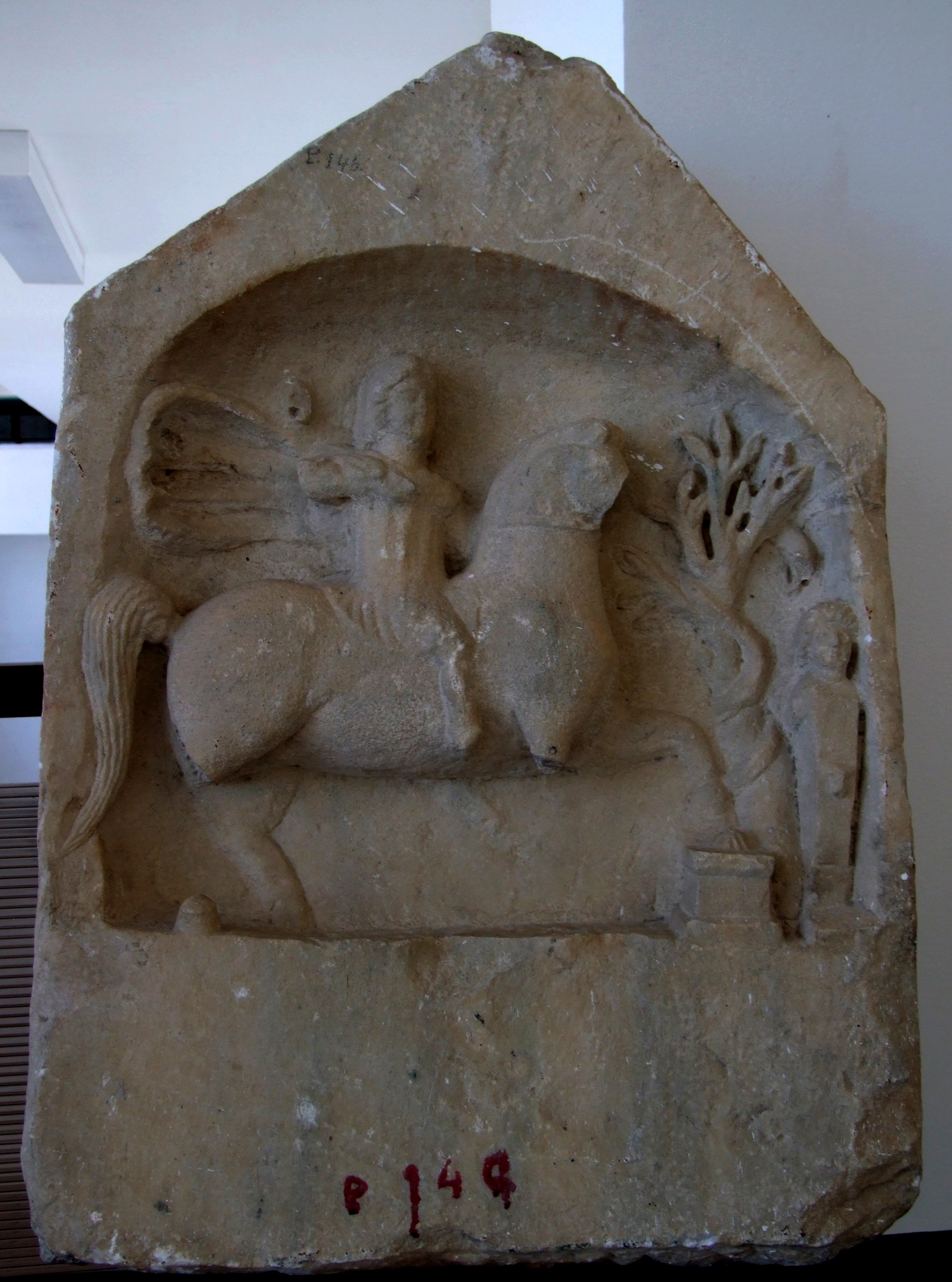
And now, here’s the Thracian ‘Heros’ to compare. Note the ‘phallic Herma’ to the right of the tree – these were a feature of Dionysiac and Sabazian worship:

Thracian_Horseman_Histria_Museum

The mythology regarding the ‘horseman’ must have incorporated much of that common to the Herculaean and Apollonian myths as well as the Dionysian aspects of Sabazios. not to mention the martial aspects of gods such as Mars. The icon of the galloping helpful horseman ‘coming from’ the underworld where it has been victorious over the serpents and demons incorporates all of these in a more simplified and much more fundamental and portable manner.

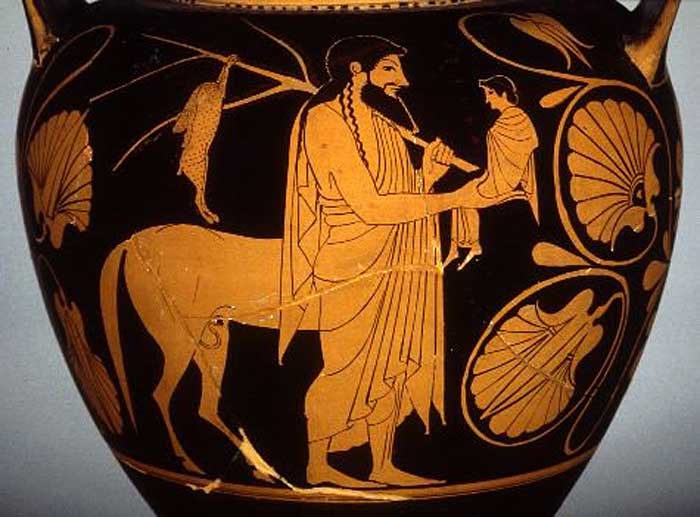
Chiron the hunter - teacher of Greek heros. Are him and Sabazios one and the same? Perhaps the Minotaur too?

Chiron the hunter – teacher of Greek heros. Are him and Sabazios one and the same? Perhaps the Minotaur too?

The coins of Celtic tribes in the Balkans such as the Scordisci and Bastarnae demonstrate a syncretic incorporation of such imagery in their appropriations and modification of Greek designs, and this propagated throughout the Celtic world as far as Britain by the 1stC CE. Often the warlike rider is female in the Celtic numismatic images – particularly so during times of conflict with Rome. It finally seems to have been mollified into the form of the benign ‘Epona’ by the early common era when Rome had broken the fanatical and wizardly backbone of wild Celtic culture:

Cuddly mother Epona - the original Celtic form would have bought your head on a plate, not food!

Cuddly mother Epona – the original Celtic form would have bought your head on a plate, not food!

Sabazios in Rome:

As previously mentioned, the cult of the Thracian-Phrygian god Sabazios met with some degree of popularity in the Roman Empire. Apart from a few religious stelae, the most prominent artefacts from the cult are the bronze-alloy votive ‘hands’ discovered in places such as Herculaneum and even as far north as modern Belgium. These hands are know as the ‘Hand of Sabazios’, and generally display a gesture which appears to have been adopted by the early Christian church, and is still used by priests in blessings to this day. Here are some examples:

Hand of Sabazios (British Museum)

Hand of Sabazios (British Museum)

The hands take a variety of forms, with some common elements:

1. Most depict the fingers in the gesture shown in the image.

2. All have a pine-cone (or possibly even a hop-flower) either balanced upon the thumb or grasped between thumb and forefinger. In a few cases, these appears to be more explicitly depicted as the Orphic Egg, in one case holding the image of the Thracian Heros with his horse, lance and serpent adversary within. Although Thrace was a beer-drinking culture, hops were not known to have been used as a beer additive until after the medieval period.

3. All have a serpent or basilisk (serpent with a cock’s comb: lit. ‘king of serpents’) representing the chthonic ideal. Other ‘serpentae’ or ‘herpetae’ such as frogs, turtles and lizards frequently accompany this.

4. Most depict a mother lying with her child on the wrist part of the design. This may be an allusion to Ariadne, wife of Dionysus in the Cretan-Greek version of the myth. The birth and rebirth of ‘Dionysus’ were central parts of the Orphic mystery-legend, and Orphism was ascribec by the Greeks to Thrace.

5. Most depict the Dionysian Krater and bowls or cups.

6. Most depict a ram’s head, sometimes that of a bull, upon which the god places his foot in depictions. This is redolent of the sacrifice of animals at the Dionysia.

7. Many depict a miniature figure of Sabazios himself as a bearded man sat against the extended index and middle finger of the hand. He is sometimes crowned with lunar ‘horns’.

Other iconcography commonly associated with these hands include: The Caduceus or wand of the god Hermes/Mercury (think of the serpent on the tree in the Thracian Heros images), a set of scales, a perched eagle, vines and sometimes ritual objects such as a sacrificial knife and a lituus (ceremonial wand). One example of the hand has a bracelet to which human and animal penises are attached by chains! These hands were believed to have been mounted upon poles at ceremonies

Apart from the hands, the cult of Jupiter-Sabazios is also represented on a few ancient stelae recovered from the Roman world. Here is one particularly fine example from Roman Illyria (modern Albania) depicting what appears to be the Phrygian gods Cybele and Attis – maybe even Selene and Endymion or Artemis and Apollo – (who actually hold a pole with a hand on it!), as well as ploutic father Sabazios himself, as well as the usual icons found on the hands and ‘Thracian Heros’ stelae:

sabazios

The overwhelming fertility aspects of the cult are well-demonstrated, and the warlike aspects of the Thracian god have been removed. Even Mercury appears at the base of the serpent-tree to grant his blessing! Observant readers might begin to see how Julius Caesar’s comments about ‘Dis Pater’ being worshipped by the Gauls point to a more ancient and once-widespread cult which emerged from Bronze Age Europe and had influence from far Britain and Ireland right through to the Near East. Just a peak over the common ‘barbarian’ yet mythologically sophisticated event-horizon of our ancient ancestors….

Gods of War and Agriculture

The identity of Mars in Roman culture shows a curious transition over the six or so centuries from its establishment as a regional power until its turbulent yet glorious Imperial era. Formed from a synthesis of native Latin, Etruscan, Sabine and Umbrian subcultures under a continuous stream of influence from their Greek and ‘barbarian’ neighbours it was a protean and ever-changing hotbed of innovation in both secular and religious matters. Its gods were therefore just as prone to change, and Mars makes an interesting case study:

Unlike the Greek god Ares, who tended to appear in myths (as befitted Greek warrior culture) as a dangerous quarrelsome outsider, Mars was treated more as an ancestral father-figure for the Romans. Livy (Ab Urbe Condita) recounted his role in Rome’s foundation-myth as father of Romulus and Remus by Rhea Silvia – a priestess of Vesta, identifiable with Vesta herself, otherwise cognate with the ancestral mother deity: Larunda, the Mater Larum. Indeed, Rome’s Etruscan forebears called their god of war Laran, which has similar connotations of the spirits of the departed, known as ‘Lares’. His consort was Turan whose entourage included the Lasas – another archaic name for Lares. Turan was also seemingly associated with birds – a common archetype for souls. She became identified in the Republican era with Venus – Mars’ complementary feminine aspect.

Mars’ agricultural aspect and his link to the ancestral spirits of the Etruscans and Romans is illustrated beautifully in the hymn of the priests known as the Arval Bretheren – the Carmen Arvale – preserved in a temple inscription, and invoking both Mars, the Lares and the fertilising spirits or Semones to bless the fields. The month of March (Martis – named after Mars) marked the sprouting of spring wheat and the beginning of the agricultural season as the weather warmed. Another Roman priesthood – the Salii – celebrated the rites of agricultural Mars, and had their origins back in the ancient Roman kingdom. They carried ancient shields called ancilia, which were kept in Mars’ temple. These were supposedly made by a legendary smith-armourer called Mamurius Veturius, possibly cognate with Mars in the Carmen Arvale under the name Marmor. The connection between the cthonic realm, food and metal seems obvious: the earth renders both. The annual re-forging of nature meant that it would not have been unusual for such a theological connection to have been made between smithcraft and the underworld.

Warfare and metal were likewise connected: War and death also. The annual death and rebirth of nature, and the fertility engendered in soil by dead matter (‘Putrefaction’) were likewise important parts of the same semantic field. In fact, the co-ordinated armies of people required for agricultural endeavours and the tendency for battle to be joined a campo in warfare added to this analogy. Rome and Etruria’s ancient wealth and power depended as much on agriculture as it did warfare, and Roman Mars expressed this idea.

Tied closely to Roman Mars’ semantic field-map are Janus, Mercury, Vulcan and Pluto. Pluto, because of the older connection to the cthonic otherworld and the Lares. Janus and Mercury because of the crossing of boundaries between the worlds, and Vulcan because of the active fiery, reforging aspect of Mars as an agricultural deity.

Elsewhere in Europe where hunting and transhumance and nomadic pastoralism were principle modes of food-production, one might imagine that the ‘herdsman’ aspect of cthonic gods was to the fore, and this indeed proved to be the case. The ‘wild hunt’ of Wotan, Velnias, Volundr, Herla are cases where battle-gods or smith-gods fulfill such roles. Thor was a battler-deity favoured for agricultural protection, as was Hercules.

The Greco-Roman mythological character who was the bestower of wealth was the ‘divine child’ Ploutos/Plutus, an aspect of Plouton/Pluto (related to the Roman gods Dis Pater and Orcus)who was at the heart of the Eleusinian Mysteries, and seems to have had a certain similarity to Cthonic Mars. Plutus was the child of Demeter and the Hero, Iasion, who made love to the goddess in a ‘thrice ploughed field’. The birth of Plutus might therefore have a parallel to the birth of the Etruscans’ ‘divine child’ Tages, who emerged from a ploughed field and gave knowledge of Augury and Haruspicy to the people. Knowledge of Sorcery or any form of Augury was to be found in the province of the dead… Mercury/Hermes was the ‘psychopomp’ responsible for conducting souls to this realm, as well as being the god of trade and pecuniary increase – the gift of Plutus transmitted in his hands back to this world from the Otherworld! Janus was also identified with the archaic member of the first Capitoline Triad, the Sabine god Quirinus, who was sometimes identified as a deified form of Mars’ divine son, Romulus. He ‘stood’ over the gates between the Otherworld and this world, and presumably allowed the two-way interaction between the spirit and elemental worlds to occur. Mars himself was therefore a conduit of masculine vital force from the spirit world which influenced the mundane world in a positive way. He was a keystone for the functions of a number of other gods, and was therefore one of the most important of Roman deities, and was venerated (under this wider identity) more than any other in the Romanised Celtic world…

Mountain Mothers: Cybele, the Sybils and the Cailleach

Another great ‘oriental’ influence upon the development of Roman state religion (apart from the Etruscan contribution) during the 1st millennium BCE was the ‘importation’ of the cultic oracular ‘Sybilline Books’ which were consulted in order to assist the state with important decisions. The acquisition of these works was originally ascribed to the legendary (Etruscan) last king of Rome, Tarquinius Superbus, some time in the 6thC BCE, and after the development of the Republic they were kept in the possession of the Senate, and were used to assist decisions and determine possible outcomes. The collection was undoubtedly curated, researched and added to with reference to the various important Apollonian oracles across the eastern mediterranean region, including those at Cumae, Dodona, Delphi, and the Anatolian sites near to the supposed site of Troy* on the Hellespont, from which the original books were supposed to have originated. Although now lost (and at various times in their history, destroyed and recovered) we know that these books contained details of prophetic visions and utterances originating in the cultic goddess-oracles of the archaic world whose female seers were known as the Sybils.

The originating Sybil was supposed, as mentioned, to have been the Hellespontine Sybil who presided over the Apollonian oracle at Gergis in the NW Anatolian *Troad region, and were supposedly received upon Mount Ida nearby. From here, the works were copied and passed to other sibylline oracles, first Erythraea and then eventually to the Greek colony at Cumae, near Naples and from here, apparently to Rome at the advent of the founding of the Republic. The Cumaean Sibyl was an important character in Virgil’s Aeneiad, establishing an oriental Trojan provenance for the Romans’ ancestors, allowing them to incorporate the trappings of Greek civilisation and religion. In the story, she guides the Trojan Aeneas to Hades to meet with his father who blesses his future endeavours as founder of the Roman peoples. The Sibylline Books were therefore possibly a bolster to Roman pseudo-history, providing a religio-political bridge to the intellectual power and influence of the Greek near east. The Etruscan religious books were probably of a more nativist slant, and therefore less capable of such a trans-national religious vision fitting Rome’s future ambitions…

The books were consulted in times of great need, and from deductions made from these ritual interpretative readings, further developments to Rome’s increasingly complicated religious scene often resulted. Of particular interest was the suggestion during the Second Punic wars (205-204BCE) that the Roman state adopt the worship of the Greco-Phrygian goddess Cybele (Kubilya) from the ancient mid-Anatolian highland town of Pessinus (an area settled by Gaulish tribes in the 3rdC BCE) where she had a principle cult-centre, possibly since the 2nd millenium BCE. A small black stone idol (possibly the remains of a meteorite) was removed and taken to Rome where it was introduced as the goddess with much ceremony, and – bizarrely – it appears that the stone was displayed in a cavity in her new statue where the face should have been!… Cybele was linked to the Troad ‘Mount Ida’ by the Roman epithet Magna Mater Idaea, linking to the old Greek myths of the hiding of infant Zeus from Cronus in a mountain cave, either by Gaia or Rhea (both aspects of the ancient European female divine force), although the ‘mute-faced’ Roman depiction evokes an apparent reference to the mute Mater Larum. The names ‘Sybil’ and ‘Cybele’ also share a distinct similarity, and were used interchangeably, identifying chthonic priestesses with the great goddess…

The 1stC BCE Roman Epicurean poet-philosopher Titus Lucretius Carus described a procession of the goddess and her priesthood in book 2 of his De rerum natura in which he refers to the ‘silent blessing’ of the goddess as well as certain ceremonials related to it and the Greek myth of the hiding of the god-child Zeus. In this he makes a profound statement regarding the place of Magna Mater in pagan religion (translation John Selby Watson, 1890):

The old and learned poets of the Greeks sung that she, in
her seat on her chariot, drives two lions yoked together ; sig-
nifying that the vast earth hangs in the open space of the air,
and that one earth cannot stand upon another earth. They
added the lions, because any offspring, however wild, ought to
be softened, when influenced by the good offices of parents.
And they surrounded the top of her head with a mural crown,
because the earth, fortified in lofty places, sustains cities ; dis-
tinguished with which decoration the image of the divine
mother is borne, spreading terror, through the wide world.
Her various nations, according to the ancient practice of their
worship, call the Idaean mother, and assign her bands of
Phrygians as attendants, because they say that from those
parts corn first began to be produced, and thence was diffused
over the globe of the earth. They assign to her also the
Galli ; because they wish to intimate that those, who have
violated the sacred-respect due to their mother, and have been
found ungrateful to their fathers, are to be thought unworthy
to bring living offspring into the realms of light. Distended
drums, and hollow cymbals, resound in their hands around the
goddess ; and their horns threaten with a hoarse noise, while
the hollow pipe excites their minds with Phrygian notes.
And they carry weapons outstretched before them, as signs
of violent rage, which may alarm with terror the undutiful
minds and impious hearts of the crowd, struck with the power
of the goddess.

As soon, therefore, as, riding through great cities, she,
being dumb, bestows a silent blessing on mortals, they strew
the whole course of the road with brass and silver, enriching
her with munificent contributions ; while they diffuse a shower
of roses, overshadowing the mother and her troop of attend-
ants. Here the armed band, whom the Greeks call by the
name of Phrygian Curetes, dance round vigorously with ropes,
and leap about to their tune, streaming with blood. Shaking
the terrible crests on their heads as they nod, they represent
the Dictaean Curetes, who are formerly said, in Crete, to have
concealed that famous infant-cry of Jupiter, when the armed
youths, in a swift dance around the child, struck, in tune,
their brazen shields with their brazen spears, lest Saturn,
having got possession of him, should devour him, and cause
an eternal wound in the heart of his mother. Either for this
reason, therefore, armed men accompany the great mother ;
or else because the priests thus signify that the goddess ad-
monishes men to be willing to defend the land of their country
with arms and valour, and to prepare themselves to be a pro-
tection and honour to their parents.

These parents, though celebrated as being fitly and excel-
lently contrived, are yet far removed from sound reason. For
the whole race of the gods must necessarily, of itself, enjoy
its immortal existence in the most profound tranquillity, far
removed and separated from our affairs; since, being free from
all pain, exempt from all dangers, powerful itself in its own
resources, and wanting nothing of us, it is neither propitiated
by services from the good, nor affected with anger against
the bad.

The earth, indeed, is at all times void of sense, but, because
it contains the primary elements of many things, it brings
forth many productions, in many ways, into the light of the
sun. If any one, then, shall resolve to call the sea Neptune,
and corn Ceres, and chooses rather to abuse the name of Bac-
chus, than to utter the proper appellation of wine ; let us
concede that such a one may pronounce the orb of the earth
to be the mother of the gods, provided that it still be allowed
to remain its real self…

The ‘silent’ aspect of Cybele’s public face may well have been because the sibylline priestesses ‘spoke’ with the voice of Apollo. The divine music of the Kuretes was supposed to be an ‘analogy’ to the voice of the crying god Zeus/Jupiter, masking its sound from Cronus/Saturn in the ancient creation myths. Ovid’s description of Jupiter cutting out the tongue of the Mater Larum evokes this too… a curious syncresis of ideas and traditions.

The introduction of the cult of Magna Mater was hardly a novelty to the wider Roman and Greek world, the Greeks having celebrated Phrygian Cybele for a number of centuries before her official adoption in Rome. In fact, the Phrygians were not even the originators of this particular Aegaean goddess-hypostasis, as the cult of Rhea at Mount Ida on Crete undoubtedly had origins back in the Minoan era. Furthermore, the important temple complex and mystery cult on the Thracian island of Samothrace in the northern Aegaean carried on its own veneration of a similar goddess with similar iconography and mythology, but known originally as Axiérosand apparently associated with a male consort and a pair of divine  sons. It absorbed aspects of the worship of Demeter and Dionysus and the chthonic mysteries of the Greeks. The Roman cult acted to reinforce an older indigenous mythical religious tradition as well as establish a ‘spiritual corridor’ to the supposed ancestral Trojan homelands of the Greeks and Romans in the Hellespont.

So, what of the Cailleach?

Surviving thousands of miles away and thousands of years in time from the homelands and heartlands of the Anatolian mother-goddess, the tradition of the prophetic ‘Great Mother’ appears to have continued in the ‘Gaelic fringe’ of northwest Britain and Ireland – an area never conquered or settled by the pagan Roman empire. She does this in the form of an aged female character known as the ‘Cailleach’, ‘Calliagh’ or ‘Caillagh’, who is associated from the southwest tip of Ireland up into the far highlands of Scotland with mountains, nature, the weather and the power of prophecy. There are so many fragmentary myths and landscape features associated with her in these regions that it is apparent that she held a supra-regional importance from ancient times, well before the coming of christianity. These legends often associate her with the seasonal cycles, and the creation of features of the landscape, as well as guardianship over the flocks of beasts, natural springs and rivers. She is sometimes described as the ‘Queen of the Fairies’, sometimes portrayed as an ultimate ancestress, ruling the world since the ‘time before memory’. Like the black rock representing the face of the statue of Magna Mater in Rome, she is even occasionally described as having a black or blue face (even the ‘Black Annis’ legend from Leicestershire in England has this feature). One of her names in the Isle of Man – ‘Caillagh y Groamagh‘ – even implies a state of mute silence, ‘Groamagh translating as the English word ‘sullen’, which itself is related to ‘silent’ (Kelly’s Manx Dictionary).  The Manx ‘Caillagh’ was a traditional utterer of prophecies, the substance of which were kept as oral traditions, as they were in the Ireland and Scotland. Further connection to the ancient Cybele cult of Rome and the Aegean might also be found in the curious Manx folksong which talked about a bull-stealing witch who is sought among the mountains, where she hides behind stone doors, As y lhiack er e kione –  ‘with a stone on her head’… (if you follow the link, you will note I have corrected WW Gill’s translation.)

It is not my intention to digress on the totality of Cailleach legends in order to prove a link, but needless to say, the evidence of an ancient Earth-Goddess in the British and Irish Isles is compelling, and shows more than a few similarities with Lucretius’ fearsome mute Earth divinity…


tbc!

European paleo-religion: Mater Larum, Holda and Huldra

Ancient Italic religion before christianity is often associated with the hierarchical and immanent-polytheist Olympian model of gods introduced with the economic, cultural and military expansion of the Greek states during the first half of the 1st millenium BCE. This followed closely with the increasing focus of power and settlement upon towns and cities, and a new emphasis upon commoditisation which would reach its zenith with the growth of Rome and its famous Republic, and fall apart after 400 years of Empire. However, the religion of ancient Rome had its roots in a more simplified, animistic and rural spirit and ancestor-based religion common to much larger swathes of Europe extending far into the north and back into the 2nd millenium BCE and beyond…

The traces of this more ancient animistic faith are seen clearly in the form of the disincarnate spirits known as Lares, Manes and Lemures (otherwise Lases, Genii, Daimones, Nymphs, Naiades, etc) whose immanence permeated all households, roads, boundaries, buildings, natural springs, lakes, trees and groves, rocks and bushes in the minds of everyday people. With the growth of powerful city-states, these spirits underwent various phases of promotion, demotion, conflation, renaming and reinvention and added to the already bloating pantheon of divine and semi-divine legendary personages and deified humans that would eventually mark the ultimate collapse of paganism in the face of the stripped, portable and reductionist literal religious philosophies flowing back from the Hellenised Near East. However, the belief in immanent spirits and ancestral gods seemingly refused to die even though the major gods fell away, leaving Europe with rich parallel traditions of animism in the form of folklore about fairies, elves, ghosts, mysterious wild females and man-beasts which persisted alongside monotheism until modern times.

In the literate and artistically creative milieu of the Italic peninsula of the archaic and classical periods, we are lucky to have literary, epigraphic and depictional evidence relating to these animistic beliefs, and in particular to the disincarnate spirits known as Lares or Lases who were at the core of the ancient domestic religion, based in the independent, subsistence tribal cultures of the past. These, like the more modern European ‘fairies’, developed various synonyms and identities based upon their status in relation to individual families, tribes, ethnic groups, places and shifts in power and cultural influence. As regional versions of them amalgamated some became demoted in status, while others grew in stature, this process becoming anchored in the power of the Roman Republic. This produced, from a number of anciently more important divinities, an Olympian hierarchy (important to expression of state power) with a subservient ‘rustic’ pantheon of lesser spirits.

A Lare was what we might call a genius locus – a spirit with a specific haunt. In the ancient world, a spirit was an incorporeal living creature made of what the Greeks called aither or aether, which could be known only by the mind. Gods were deemed the same, and therefore gods and spirits were a philosophical system for describing the mechanisms by which the corporeal elements were excited into life and motion. In Mediterranean immanent polytheism, it was therefore possible for all phenomena to have a god or spirit attached to them. In Roman culture, the Larvae and Lemures were restless and dangerous forms of Lares, whereas Lares themselves were usually spirits in a state of helpful and benevolent equilibrium with mankind. They were ancestral spirits of humans, also known as Dii Penates or Manes, who maintained a presence among the haunts of the living: a form of collective memory, representing the skill and knowledge of ancestors, passed down among the living. Households had shrines to them, and these must have evolved into tribal group-expressions as Lares also had communal shrines encountered in rural and urban districts, at crossroads and along highways. They also had formal worship as part of the greater state-religion, of which more shortly. Festivities associated with these immanent ancestral spirits included the famous Saturnalia and associated Compitalia, the Liminalia, Feralia, Ambarvalia and Lemuria, as well as other rustic celebrations such as the Robigalia. These aspects of the tutelary and protective ancestral genius locus seem to underpin some of the agrarian Etruscan legends I have commented on in other posts. This aspect of italic paleo-religion may have been preserved in Roman culture in the form of the ancient priestly collegia known as the Fratre Arvales (Arval Bretheren) as well as the Augurs and Haruspices. The Arvals held solemn annual rites designed to sanctify agricultural production, ensuring the feeding of city dwellers and thus ultimately the wealth and power of state. This was a chthonic cult appealing to the earthly forces, among whom the dead traditionally resided: a connection to the ancient paleo-religion with its emphasis on death and regeneration. This was such an important tradition that during the period of the Roman Empire, the Emperor himself was always one of the 12 Arval priests, the others being selected patricians who held their office for life. As these priests were not trained specialists like the Augurs, their temple preserved inscriptions of aides-memoires of some of their ritual chants, from which we know the following (Old Latin) ‘Carmen Arvale’ :

Enos Lases iuuate, enos Lases iuuate, enos Lases iuuate

neue lue rue Marmar sins incurrere in pleores
satur fu, fere Mars, limen sali, sta berber
Semunis alternei advocapit conctos
enos Marmor iuuato
enos Marmor iuuato
enos Marmor iuuato
triumpe! triumpe! triumpe! triumpe! triumpe!

This invocation of the Lares (using the archaic form ‘Lases’), Mars/Marmor and the ‘Semunis’ (fertility spirits?) in an important ritual to sanctify agricultural production (90%+ of provincial Roman citizens were agronomists) shines a fascinating light upon older Roman religion. You might ask, for instance: ‘Why Mars? Surely he was a war god?’… Well, for the Romans, Mars was as much a protector and stabiliser during the Republican and early Imperial eras, as he was a symbol for aggressive conquest (during the expansionist era of the Empire). Militarised Romans tended to associate the virile masculine element with warfare rather than that traditionally associated with aspects of nature and animal husbandry during the springtime (Mars’ month is known to us as ‘March’). For the Celts, this symbolism of the fertile war-god was illustrated in the form of the rutting stag or bull with adorned horns, such as is illustrated by the god ‘Cernunnos’ on the French ‘Pillar des Nautes’ and the medieval Irish accounts of the ‘Tain Bo Culainge’ with its ‘rutting’ warriors in their riverside showdowns etc.

The Arvals’ main cult of devotion was to the goddess called Dia or Dea Dia – apparently a female version of the masculine god-principle Dio (Zeus, Jupiter = Dio Pater), otherwise identified with Juno, and also known as Mater Larum – ‘Mother of the Lares’. Juno was, of course, Mars’ mother in Roman myth, so it is no wonder that the Arvals invoked him along with the Lares. This would make Juno (as ‘Mater Larum’) akin to the later Gaelic conception of the ‘Fairy Queen’, as the hypostasis corresponds so closely with later Celtic conceptions of fairies. However, this similarity with later folklore from the historically ‘non-Romanised’ north European world does not stop with the Irish and British Atlantic fringe, but that of the Scandinavians and Germans too:

The evidence for this link comes through a tale told by a single surviving Roman source – the great poet and mythographer, Ovid (1stC BCE/CE), who told a tale about the Mater Larum in his account of Roman festivals known as Fasti. He uses her synonym Lara, claiming her to have been a Naiad (water/spring/river) nymph conducted by Mercury to the gates of the underworld for the sin of betraying Zeus’ love secrets to Juno (of whom she appears to be a ‘hypostasis’). Jupiter apparently orders her tongue cut out as punishment, but Mercury falls in love with her and has intercourse en route to the chthonic realm, where she gives birth to twins (of unspecified gender) – the first Lares. Consequent to her punishment, she became known as Muta or Dea Tacita – the ‘silent goddess’ of the dead. The ‘silence’ is that of the grave – that great keeper of secrets – and her children are hidden in the secret recesses and crevices of liminal places: hearths, crossroads, storerooms (Penates) and so forth.

This account by Ovid of ‘silent’ Lara and her concealed children is curiously similar to the legends which persisted in the (unromanised) German and Scandinavian worlds of a female character known by various names: Holda, Hulder/Huldra, Holle, Hylde. She was the mother of the elves who (in Icelandic and Norwegian Christian tradition) hid her children from God, ashamed by their earthy dirty appearance… The following Christianised account is taken from ‘Icelandic Legends’ by Jón Arnason, (translated by George E. J. Powell and Eiríkur Magnusson) Pub: London, R. Bentley, 1864, pp.19-22:

‘The Genesis of the Hid-Folk’: Once upon a time, God Almighty came to visit Adam and Eve. They received him with joy, and showed him every- thing they had in the house. They also brought their children to him, to show him, and these He found promising and full of hope. Then He asked Eve whether she had no other children than these whom she now showed him. She said ” None.” But it so happened that she had not finished washing them all, and, being ashamed to let God see them dirty, had hidden the unwashed ones. This God knew well, and said therefore to her, ” What man hides from God, God will hide from man.” These unwashed children became forthwith invisible, and took up their abode in mounds, and hills, and rocks. From these are the elves descended, but we men from those of Eve’s children whom she had openly and frankly shown to God. And it is only by the will and desire of the elves themselves that men can ever see them.

The English word ‘Hidden’ translates directly to Hylde/Huld etc in the Germanic tongues. It is immediately apparent that the folklore is immediately comparable to Ovid’s Roman account. It is possible that the ‘Romanised’ Germanic tribes may have introduced this myth into the streams of Scandinavian folklore over the subsequent centuries, but it would be hard to justify, given the obvious religious independence of these regions at the advent of the Christian Roman Empire. What is more likely is that the ancestral cult of the ancient Europeans was widespread and influenced the Italic peoples before the Etruscan and Roman cultures developed and flourished. It is possible that the two important ‘prophetic’ and ‘revelatory’ Etruscan ancestor-divinities, Vegoia and Tages, were the ‘children’ of Lara: Etruscan ‘Mars’ was called ‘Laran’ 😉

The ‘sacred twins’ conceived in a grove between a god and lesser divinity are a continuous theme of Greco-Roman religion: The mythological founders of Rome – Romulus and Remus were supposedly begat by Mars upon Rhea Silvia (said to be a sexually-errant Vestal virgin, but whose name evokes a Dryadic Titaness). Rhea Silvia cast the boys adrift on the Tiber but they were rescued and suckled by a she-wolf (the wolf was Mars’ animal), before being fostered by a woman with the name Acca Larentia, otherwise known as Dea Dia! Castor and Pollux/Polydeukes likewise had a similar furtive beginning when their mother Leda was accosted by a god (Zeus) disguised as a swan, and they seem to be connected – along with Romulus and Remus – to the origin-tale of the ancestral Lares as mentioned by Ovid. This suggests an amalgam of various versions of an older myth with aspects also seen in Irish and Scandinavian mythology. Another example would be the hiding by Gaia (Earth) of young Zeus from his devouring father, Cronus, on Rhea’s sacred Cretan mountain: Mount Ida – perhaps one of the older root-myths of the others…

Another aspect of the ‘Mater Larum’ that needs to be addressed in the form of the fascinating goddess known to the Greeks as Hestia, and to the Italics/Latins as Vesta: She was the virgin sovereign goddess of the domestic hearth, and therefore a candidate to be associated with the ancient domestic cult of the Lares. We know this because Cicero tells us the following (De Natura Deorum 2. 27 (trans. Rackham) – 1stC BCE) :

“…The name Vesta comes from the Greeks, for she is the goddess whom they call Hestia. Her power extends over altars and hearths, and therefore all prayers and all sacrifices end with this goddess, because she is the guardian of the innermost things. Closely related to this function are the Penates or household gods…”

Her cult was associated (as was that of the virgin Bridget at Kildare in Ireland in the 12thC) with the celebration of a hearth with an ‘eternal flame‘. This links quite closely to the Gaelic ideas of fairies/ancestors and the hearth in places like the Isle of Man which persisted down to the 19th/20thC CE. The ‘Getae’ (the Celtic Dacians, ancestors of the Romanians) conquered by Trajan in the 2ndC CE were said by Diodorus Siculus (1stC BCE) to worship ‘Hestia’. Ovid describes Vesta as the third sister of a triad including Juno (Hera) and Ceres (Demeter), implying that she actually represents the fire-cored Earth itself, hence her round domed temple in Rome which suggested the form of the globe of the planet. This copied the form of the Prytaneum at Athens, and was reflected in the design of the Pantheon. He further states that there were no statues of her at her temple – she being represented solely by the eternal flame kept burning there, tended by her famous virgin priestesses. Of interest to Gaelic folklore, is that Hestia or Vesta’s fire was re-kindled with a ritual of friction (an evocation of sexual intercourse) between two pieces of wood, similar to that apparently used for the May/Beltain bonfires (see elsewhere on the blog)… Herein lies a mystery about the ‘virginity’ of Vesta: Far from being a ‘chaste’ force, she is actually a representation of the full sexual potential of the feminine – the flames being a worldly allegory of unconquerable lust and fertile intent. The tales of ‘rape’ and ‘indiscretion’ concerning the genesis of the three sets of ‘divine twins’ at the core of popular Greco-Roman (and Irish, Welsh, Breton and Scaninavian) religious myths are simply an expression of the inevitable transgression of this ‘pure’ state of lust which characterises inevitable natural forces. Vesta or Hestia was therefore also the original ‘Mater Larum’, and actually one of the most fundamental and important goddess-aspects!