Mountain Mothers: Cybele, the Sybils and the Cailleach

Another great ‘oriental’ influence upon the development of Roman state religion (apart from the Etruscan contribution) during the 1st millennium BCE was the ‘importation’ of the cultic oracular ‘Sybilline Books’ which were consulted in order to assist the state with important decisions. The acquisition of these works was originally ascribed to the legendary (Etruscan) last king of Rome, Tarquinius Superbus, some time in the 6thC BCE, and after the development of the Republic they were kept in the possession of the Senate, and were used to assist decisions and determine possible outcomes. The collection was undoubtedly curated, researched and added to with reference to the various important Apollonian oracles across the eastern mediterranean region, including those at Cumae, Dodona, Delphi, and the Anatolian sites near to the supposed site of Troy* on the Hellespont, from which the original books were supposed to have originated. Although now lost (and at various times in their history, destroyed and recovered) we know that these books contained details of prophetic visions and utterances originating in the cultic goddess-oracles of the archaic world whose female seers were known as the Sybils.

The originating Sybil was supposed, as mentioned, to have been the Hellespontine Sybil who presided over the Apollonian oracle at Gergis in the NW Anatolian *Troad region, and were supposedly received upon Mount Ida nearby. From here, the works were copied and passed to other sibylline oracles, first Erythraea and then eventually to the Greek colony at Cumae, near Naples and from here, apparently to Rome at the advent of the founding of the Republic. The Cumaean Sibyl was an important character in Virgil’s Aeneiad, establishing an oriental Trojan provenance for the Romans’ ancestors, allowing them to incorporate the trappings of Greek civilisation and religion. In the story, she guides the Trojan Aeneas to Hades to meet with his father who blesses his future endeavours as founder of the Roman peoples. The Sibylline Books were therefore possibly a bolster to Roman pseudo-history, providing a religio-political bridge to the intellectual power and influence of the Greek near east. The Etruscan religious books were probably of a more nativist slant, and therefore less capable of such a trans-national religious vision fitting Rome’s future ambitions…

The books were consulted in times of great need, and from deductions made from these ritual interpretative readings, further developments to Rome’s increasingly complicated religious scene often resulted. Of particular interest was the suggestion during the Second Punic wars (205-204BCE) that the Roman state adopt the worship of the Greco-Phrygian goddess Cybele (Kubilya) from the ancient mid-Anatolian highland town of Pessinus (an area settled by Gaulish tribes in the 3rdC BCE) where she had a principle cult-centre, possibly since the 2nd millenium BCE. A small black stone idol (possibly the remains of a meteorite) was removed and taken to Rome where it was introduced as the goddess with much ceremony, and – bizarrely – it appears that the stone was displayed in a cavity in her new statue where the face should have been!… Cybele was linked to the Troad ‘Mount Ida’ by the Roman epithet Magna Mater Idaea, linking to the old Greek myths of the hiding of infant Zeus from Cronus in a mountain cave, either by Gaia or Rhea (both aspects of the ancient European female divine force), although the ‘mute-faced’ Roman depiction evokes an apparent reference to the mute Mater Larum. The names ‘Sybil’ and ‘Cybele’ also share a distinct similarity, and were used interchangeably, identifying chthonic priestesses with the great goddess…

The 1stC BCE Roman Epicurean poet-philosopher Titus Lucretius Carus described a procession of the goddess and her priesthood in book 2 of his De rerum natura in which he refers to the ‘silent blessing’ of the goddess as well as certain ceremonials related to it and the Greek myth of the hiding of the god-child Zeus. In this he makes a profound statement regarding the place of Magna Mater in pagan religion (translation John Selby Watson, 1890):

The old and learned poets of the Greeks sung that she, in
her seat on her chariot, drives two lions yoked together ; sig-
nifying that the vast earth hangs in the open space of the air,
and that one earth cannot stand upon another earth. They
added the lions, because any offspring, however wild, ought to
be softened, when influenced by the good offices of parents.
And they surrounded the top of her head with a mural crown,
because the earth, fortified in lofty places, sustains cities ; dis-
tinguished with which decoration the image of the divine
mother is borne, spreading terror, through the wide world.
Her various nations, according to the ancient practice of their
worship, call the Idaean mother, and assign her bands of
Phrygians as attendants, because they say that from those
parts corn first began to be produced, and thence was diffused
over the globe of the earth. They assign to her also the
Galli ; because they wish to intimate that those, who have
violated the sacred-respect due to their mother, and have been
found ungrateful to their fathers, are to be thought unworthy
to bring living offspring into the realms of light. Distended
drums, and hollow cymbals, resound in their hands around the
goddess ; and their horns threaten with a hoarse noise, while
the hollow pipe excites their minds with Phrygian notes.
And they carry weapons outstretched before them, as signs
of violent rage, which may alarm with terror the undutiful
minds and impious hearts of the crowd, struck with the power
of the goddess.

As soon, therefore, as, riding through great cities, she,
being dumb, bestows a silent blessing on mortals, they strew
the whole course of the road with brass and silver, enriching
her with munificent contributions ; while they diffuse a shower
of roses, overshadowing the mother and her troop of attend-
ants. Here the armed band, whom the Greeks call by the
name of Phrygian Curetes, dance round vigorously with ropes,
and leap about to their tune, streaming with blood. Shaking
the terrible crests on their heads as they nod, they represent
the Dictaean Curetes, who are formerly said, in Crete, to have
concealed that famous infant-cry of Jupiter, when the armed
youths, in a swift dance around the child, struck, in tune,
their brazen shields with their brazen spears, lest Saturn,
having got possession of him, should devour him, and cause
an eternal wound in the heart of his mother. Either for this
reason, therefore, armed men accompany the great mother ;
or else because the priests thus signify that the goddess ad-
monishes men to be willing to defend the land of their country
with arms and valour, and to prepare themselves to be a pro-
tection and honour to their parents.

These parents, though celebrated as being fitly and excel-
lently contrived, are yet far removed from sound reason. For
the whole race of the gods must necessarily, of itself, enjoy
its immortal existence in the most profound tranquillity, far
removed and separated from our affairs; since, being free from
all pain, exempt from all dangers, powerful itself in its own
resources, and wanting nothing of us, it is neither propitiated
by services from the good, nor affected with anger against
the bad.

The earth, indeed, is at all times void of sense, but, because
it contains the primary elements of many things, it brings
forth many productions, in many ways, into the light of the
sun. If any one, then, shall resolve to call the sea Neptune,
and corn Ceres, and chooses rather to abuse the name of Bac-
chus, than to utter the proper appellation of wine ; let us
concede that such a one may pronounce the orb of the earth
to be the mother of the gods, provided that it still be allowed
to remain its real self…

The ‘silent’ aspect of Cybele’s public face may well have been because the sibylline priestesses ‘spoke’ with the voice of Apollo. The divine music of the Kuretes was supposed to be an ‘analogy’ to the voice of the crying god Zeus/Jupiter, masking its sound from Cronus/Saturn in the ancient creation myths. Ovid’s description of Jupiter cutting out the tongue of the Mater Larum evokes this too… a curious syncresis of ideas and traditions.

The introduction of the cult of Magna Mater was hardly a novelty to the wider Roman and Greek world, the Greeks having celebrated Phrygian Cybele for a number of centuries before her official adoption in Rome. In fact, the Phrygians were not even the originators of this particular Aegaean goddess-hypostasis, as the cult of Rhea at Mount Ida on Crete undoubtedly had origins back in the Minoan era. Furthermore, the important temple complex and mystery cult on the Thracian island of Samothrace in the northern Aegaean carried on its own veneration of a similar goddess with similar iconography and mythology, but known originally as Axiérosand apparently associated with a male consort and a pair of divine  sons. It absorbed aspects of the worship of Demeter and Dionysus and the chthonic mysteries of the Greeks. The Roman cult acted to reinforce an older indigenous mythical religious tradition as well as establish a ‘spiritual corridor’ to the supposed ancestral Trojan homelands of the Greeks and Romans in the Hellespont.

So, what of the Cailleach?

Surviving thousands of miles away and thousands of years in time from the homelands and heartlands of the Anatolian mother-goddess, the tradition of the prophetic ‘Great Mother’ appears to have continued in the ‘Gaelic fringe’ of northwest Britain and Ireland – an area never conquered or settled by the pagan Roman empire. She does this in the form of an aged female character known as the ‘Cailleach’, ‘Calliagh’ or ‘Caillagh’, who is associated from the southwest tip of Ireland up into the far highlands of Scotland with mountains, nature, the weather and the power of prophecy. There are so many fragmentary myths and landscape features associated with her in these regions that it is apparent that she held a supra-regional importance from ancient times, well before the coming of christianity. These legends often associate her with the seasonal cycles, and the creation of features of the landscape, as well as guardianship over the flocks of beasts, natural springs and rivers. She is sometimes described as the ‘Queen of the Fairies’, sometimes portrayed as an ultimate ancestress, ruling the world since the ‘time before memory’. Like the black rock representing the face of the statue of Magna Mater in Rome, she is even occasionally described as having a black or blue face (even the ‘Black Annis’ legend from Leicestershire in England has this feature). One of her names in the Isle of Man – ‘Caillagh y Groamagh‘ – even implies a state of mute silence, ‘Groamagh translating as the English word ‘sullen’, which itself is related to ‘silent’ (Kelly’s Manx Dictionary).  The Manx ‘Caillagh’ was a traditional utterer of prophecies, the substance of which were kept as oral traditions, as they were in the Ireland and Scotland. Further connection to the ancient Cybele cult of Rome and the Aegean might also be found in the curious Manx folksong which talked about a bull-stealing witch who is sought among the mountains, where she hides behind stone doors, As y lhiack er e kione –  ‘with a stone on her head’… (if you follow the link, you will note I have corrected WW Gill’s translation.)

It is not my intention to digress on the totality of Cailleach legends in order to prove a link, but needless to say, the evidence of an ancient Earth-Goddess in the British and Irish Isles is compelling, and shows more than a few similarities with Lucretius’ fearsome mute Earth divinity…


tbc!
Etruscan religion in the Italic Iron Age

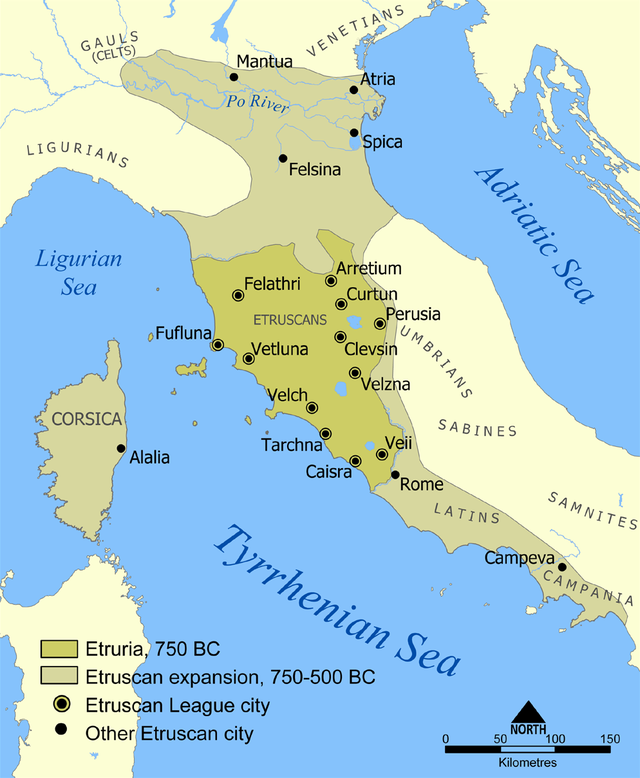
The Etruscan civilisation which dominated northern Italy until the rise of the Roman republic was responsible for contributing significant additions to the religion of one of the great military and cultural powers of the ancient world. It grew out of the 'Villanovan culture', which was itself an ethnic and cultural offshoot of the proto-'celtic' Urnfield Culture of north/central Europe during the Bronze Age. During the 7thC BCE, like other nations and ethnic groups in the Mediterranean region, it came under increasing cultural influence of the Greeks who were expanding their colonies westward via coastal trade and conquest.

640px-Etruscan_civilization_map

Although borrowing aspects of Greek-style immanent polytheist religion and adopting parts of the Olympic pantheon after the 7thC BCE, the Etruscan religious system maintained aspects of its older religious outlook, which by the time of the Roman Republic became identified in particular with a focus on Augury and Haruspicy – the reading of signs from nature and deriving prophecy from the behaviour (and entrails) of animals, and from natural phenomena such as lightning. The Romans referred to this (and the written texts upon which Romans based their augurial practices) as the Etrusca Disciplina, whose precepts became an important part of their religious life.

This particular aspect of Etruscan faith was indeed important: Etruscans were famed for their dedication to religion and required a professional technical priesthood trained in the disciplines of astronomy, natural philosophy (scientia), meteorology, zoology and the gods themselves. In this manner, they appear to have had similarities to the religious specialists among the Gauls and Britons, known to Greeks and Romans as Druids. Like the druids, the Etruscan priesthood were trained in colleges, the most notable late classical example being that opened by the Emperor Claudius in 1stC CE. The powerful influence of this religious system caused it to become the founding model for what would become Roman religious culture, and it therefore unsurprising that Etruscan religion appears to have had a fairly extensive pantheon of gods, albeit that Etruscan culture was formed from autonomous city states, each with their own interpretation of religious practices. These gods seem to have represented a system of immanent polytheism in which all natural phenomena were ascribed a divinity to represent them. However, the Etruscan religious system had three principal gods, named Tinia, Juni and Cel (later supplanted my Menrva). Tinia or Tin was the chief god, Juni his feminine counterpart, and Cel was the 'Earth Mother', perhaps responsible for the subterranean realms (her name evoking tombs and caves – cella). These seem to have evolved into the Roman 'Capitoline Triad' of Jupiter, Juno and Minerva. Under the influence of Greek and other Italic gods, the number of these diversified. However, the art of Augury and Haruspicy was apparently the principle feature of the religion by which the gods' wills were interpreted – Etruscans were natural philosophers par excellence.

Another feature of Etruscan religion which is notable is the fact that it was, by tradition, a revealed faith. The story of this was recounted in 44BCE by Roman author Cicero (De divinatione Book 2; 50-51.23):

“…It is said that, once upon a time, in the countryside of Tarquinii, while the earth was being plowed, a rather deep furrow was dug and suddenly Tages sprang forth and spoke to the man plowing. Now this Tages, according to the books of the Etruscans, is said to have had the appearance of a child, but the wisdom of an elder. When the rustic had gaped at his appearance and had raised a great cry in astonishment, a crowd gathered in a short time, all Etruria assembled at that place. Then he said many things to his numerous listeners, who received all of his words and entrusted them to writing. His whole address was about what is comprised by the discipline of soothsaying (haruspicinae disciplina). Later, as new things were learned and made to refer to those same principles, the discipline grew. We received these things from (the Etruscans) themselves, they preserve these writings, they hold them (as) the source for the discipline…” (Translation: Loeb Classical Library edition)

This tradition has several interesting aspects: Tages was obviously no earthly prophet, but was born from the furrow in a field in a rustic district. This would make him a child of the Etruscan goddess Cel, but also portrays the origins of Etruscan religion as being very indigenous and tied to the ancestral lands of their people. Cicero's account has the peasant gaping in incomprehending wonder while the educated 'townies' write the tiny prophet's words down, suggesting that Etruscan religion was based upon (now lost) canonical texts. Of course, this tale has all the hallmarks of a rustic religion sophisticated by the urbanisation of power in the Italic peninsula during the Iron Age, a process influenced and accelerated by the wealth of the land and commerce with the Greek and Anatolian states. Tarquinii/Tarquinia, founded by the legendary king Tarchon was one of the homelands of Etruscan culture, and therefore 'Tages' (Tarchies – the Etruscan language had no 'g' sound) may well be related as a demoted founder-god.

The Etruscan priest-seers are usually represented in Etruscan and Roman art as holding a stave or 'crook' known as a Lituus. This is sometimes depicted as a trumpet very similar to a Gaulish 'Carnyx' – straight with a curved tip. The lituus stave became the model for the Christian bishop's crozier, but its original form is mysterious. It may possibly have been a tool for assisting in the mapping or measurement of the night sky.

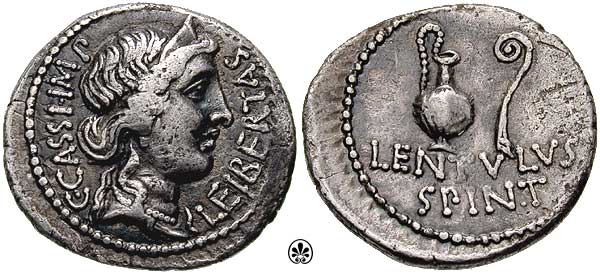
Roman Emperors were proud of their Etruscan heritage. This coin depicts the ritual artifacts of an Augur, including the Etruscan 'lituus'. Similar depictions also include a basin instead of the jug, suggesting the use of liquid 'mirrors' in the scrying process...

Roman Emperors were proud of their Etruscan heritage. This coin depicts the ritual artifacts of an Augur, including the Etruscan 'lituus'. Similar depictions also include a basin instead of the jug, suggesting the use of liquid 'mirrors' in the scrying process...

Etruscan cosmology appears to have been quite concerned about the importance of boundaries and divisions in the proper order of things. This probably represented a technical aspect of the need to assign signs and portents based upon where in nature they occurred. For this reason, Roman authors tell us that Etruscan religious teachings state that the gods were ascribed to 16 separate regions in the heavens, and that there were 8 (or 12) great eras of Etruscan history (seculae) the last of which was contemporary to them. The established limits and barriers which organised the Etruscan city-states and the rich agricultural land upon which their civilisation thrived were also of key importance. An account of the Etruscan 'Prophecy of Vegoia' preserved in a Roman treatise on land management known as ‘Corpus agrimensorum Romanorum’ (preserved in a 6thC mss collection) says this about the importance of physical land barriers:

“… Know that the sea was separated from the sky. But when Jupiter claimed the land of Aetruria for himself, he established and ordered that the fields be measured and the croplands delimited. Knowing the greed of men and their lust for land, he wanted everything proper concerning boundaries. And at some time, around the end of the eighth saeculum, someone will violate them on account of greed by means of evil trickery and will touch them and move them [….]. But whoever shall have touched and moved them, increasing his own property and diminishing that of another, on account of his crime he will be damned by the gods. If slaves should do it, there will be a change for the worse in status. But if the deed is sone with the master's consent, very quickly the master will be uprooted and all of his family will perish. The ones who move [the boundaries] will be afflicted by the worst diseases and wounds, and they will feel a weakness in their limbs. Then also the earth will be moved by storms and whirlwinds with frequent destruction, crops will often be injured and will be knocked down by rain and hail, they will perish in the summer heat, they will be felled by mildew. There will be much dissension among people. Know that these things will be done when such crimes are committed. Wherefore be not false or double-tongued. Keep this teaching in your heart…” (Translation quoted from 'The Religion of the Etruscans' Ed. Nancy Thomson de Grummond, Erika Simon; Pub. University of Texas Press 2009)

The Romans obviously took this heart as their annual festivals of the Liminalia and Robigalia seemed designed to celebrate the spirit of this traditional Etruscan prophecy. Vegoia was a female divinity similar to Tages who was quoted in the lost texts of the Etrusca Disciplina. Presumably this prophecy was originally a part of the corpus!

Another important aspect of the Etruscan religion which was followed by Roman religion was the belief in spirits of the dead travelling to and occupying a 'cthonic' or underground location. The cultus of the gods who looked after such realms in Mediterranean pagan cultures were actually deeply rooted to the source of their wealth and success (in both trade and warfare): organised agriculture. This is because of the cycle of death being strongly linked in nature to that of renewal: that which decays fertilises new growth. The ancient domestic ancestral cults linked the presence of the spirits of the departed ancestors with success in the temporal world.

Similar ideas were held by the Greeks and the Celts or barbarians of the 'Atlantic' north. However, one must be careful in how one interprets the idea of the spirits of the dead living in an 'underground' realm: Evidence from all of these cultures seems to suggest that this realm also had a reflected parallel existence to our own, and was also connected to the visible heavens and the concept of the far islands and shores of the world-river, called Okeanos by the Greeks…


The Celtic otherworld in Romanian folk belief

Although largely identifying its modern cultural ethne as ‘Slavic’, Romania’s historical and archaeological past shows that in the ‘Dacian’ Iron Age and late Classical periods its identity was definitely what we today would consider ‘Celtic’. This identity survived until the ethno-cultural engineering of Romanisation, and then the ‘migration period’ displacements of the late 3rdC CE which caused Roman withdrawal in the face of southern migration of Goths and westward migration of Scythic peoples: This introduced the cultural and linguistic foundations nowadays associated with the idea of ‘Slavic’, albeit with an enduring ‘Roman’ identity, preserved in the country’s name. These processes culminated with the early medieval hegemonies of the Caucasus tribes of Avars and Bulgars who eventually formed a stable state which, by fits and starts, had finally Christianised under Byzantine influence by the 9thC CE.

When Herodotus commented upon the Dacians (called ‘Getae’ by the Greeks) in his 5thC BCE Histories, he noted in particular that these peoples believed in the continuity of the soul after death. They were, after all, a people related to the Thracians, among whom the poet-seer Orpheus was supposed to have arisen, providing the European classical world with one of its most important religions, believing firmly in reincarnation. This provided its adherents with a particular map of the Otherworld which modern Celticists can quite easily identify with…

In the modern popular understanding about Romanian folklore, the most influential stories and beliefs surround the dark and fearful aspects of Strigoi – the restless dead who wish to abstract the life-force of the living. These are the model for the modern conception of vampires (and werewolves), and who we nowadays like to think of as humanoids with long sharp canines used to bite and suck the physical blood from peoples’ bodies. The reality (if you can call it that) of the idea of Strigoi is somewhat more complicated, and deeply tied to the ancient beliefs of souls and the otherworld which underpinned the religion of Europe’s Iron Age peoples, possibly extending deeper into antiquity. Characteristically, Strigoi can be either human (‘witches’ – the Italic word for ‘witch’ is ‘Strega’), but they might also be the undying or resurrected dead who seek to abstract human life-force (sometimes as actual blood) and who sicken their victims before finally taking their lives. They can shape-shift into animal forms and pass normally insurmountable physical barriers, and become invisible.

Coupled to the belief in a more sinister Stregoi is the important Romanian myth of the Blajini – the meaning of which translates almost exactly to that same phrase used in Ireland for fairies: ‘Gentle People’. These were spirits supposed to occupy a parallel reflected otherworld which mirrored our own, and at there is still a tradition associated with them, celebrated at Easter, known as Paştele Blajinilor. This festival (often celebrated a week or so after Easter proper) has strong associations with the ancestral dead. Apart from visiting or tending the graves of the departed, it is attached to a custom in which dyed or decorated eggs (often red) were made and eaten in their honour and the shells dropped into rivers to take them to the Blajini (the idea being that they should then know that it was Easter)! Readers of my blog will recognise that this custom is another explicit demonstration of an ancient European belief that all rivers flow to the ‘world-river’ (Apa Sâmbetei to Romanians, Okeanos to the Greeks), which bounds the shores of both our own and the ‘other’ world. Apa Sâmbetei is usually translated or understood as ‘Saturday’s Water‘, but is actually fairly obviously ‘Saturn’s Water‘ since the realm of Saturn or Cronus was in ancient mythology upon the far shores of Okeanos. The term evidently comes through the influence of Trajan’s conquest of the Dacians. Romanian folklore held that the souls of departed travelled through streams and rivers to reach the Otherworld, and this is exactly paralleled in the remains of Celtic pagan beliefs demontrated throughout medieval Irish literature, as I have previously discussed.

More interestingly, another belief attached in traditions to the Blajini was that they continually fasted in the Otherworld in order to sanctify our own world with the divine grace this practice bestows upon christians. They therefore provided a ‘boon’ to humanity, that demanded respect. This is the same belief that Scots minister Robert Kirk described in the Scottish Highlands in his 17thC ‘Secret Commonwealth’ manuscript, concerning the otherworld ‘counterbalance’ – namely when we have plenty, ‘they’ have scarcity!

Both traditions – Strigoi and Blajini – therefore represent different aspects of the same original spirit-belief which so pervaded ‘Celtic’ Europe. They show the idea of the dead living in an inverted state in the otherworld, and whose behaviour towards us seeks to address an imbalance between a mundane and a spiritual existence. However, the ‘reincarnate’ dead who walk the earth again could have no place within the Christian cosmology and folklore except as some fearful ‘evil’ force representing death, darkness, disease and chaos – these evidently evolved to become the Stregoi, whereas the Blajini were ‘allowed’ a continued existence as they largely stayed in the ‘spiritual’ realm beyond the concerns of mundanity, and therefore could not transgress the Christian doctrines to such a degree. In fact, the two ‘archetypes’ are more of a continuity, so that Blajini are sometimes of a more fearful aspect. They are therefore both analogous to the spirits of the Gaelic world, and indeed seem to share the same ancient doctrinal heritage…


L’Ankou – Gaelic parallels with the Breton death-spirit

‘Ankou’ is the personification of death’s assistant (a psychopomp) from Breton folklore, and a figure which reached greater prominence here than in any other of the modern ‘Celtic’ nations. It was noted by folklorist Walter Evans-Wentz in his 1911 book The Fairy Faith in Celtic Countries, that L’Ankou and The Dead appeared to provide the equivalent role to the Aes Sidhe of Gaelic folklore – a parallel which provides us with some interesting questions as to the nature of Celtic spirit-beliefs:

“… Without setting down here in detail numerous other death-legends which we have collected, we may now note how much the same are the powers and nature of the dead and spirits in Brittany, and the power and nature of the fairy races in Celtic Britain and Ireland. Thus the Breton dead strike down the living just as fairies are said to do; the Ankou who is a king of the dead, and his subjects, like a fairy king and fairies, have their own particular paths or roads over which they travel in great sacred processions; and exactly as fairies, the hosts of the dead are in possession of the earth on November Eve, and the living are expected to prepare a feast and entertainment for them of curded-milk, hot pancakes, and cider, served on the family table covered with a fresh white table-cloth, and to supply music. The Breton dead come to enjoy this hospitality of their friends; and as they take their places at the table the stools are heard to move, and sometimes the plates; and the musicians who help to entertain them think that at times they feel the cold breath of the invisible visitors…”

(The Fairy Faith in Celtic Countries by Walter Evans-Wentz; Pub. Henry Frowde, Oxford University Press, 1911; p.218)

He goes on to note ‘Every parish in the uncorrupted parts of Brittany has its own Ankou, who is the last man to die in the parish during the year‘. Wentz’s source, the respected Breton folklorist Anatole Le Braz, wrote a book about Ankou, called La Légende de la Mort () and had this to say about it:

The Ankou is the henchman of Death (oberour ar maro) and he is also known as the grave yard watcher, they said that he protects the graveyard and the souls around it for some unknown reason and he collects the lost souls on his land. The last dead of the year, in each parish, becomes the Ankou of his parish for all of the following year. When there has been, in a year, more deaths than usual, one says about the Ankou: War ma fé, heman zo eun Anko drouk. (“on my faith, this one is a nasty Ankou”).

Wentz drew parallels with the Gaelic beliefs in people ‘taken’ to fairyland, but unfortunately did not establish much else by the way of concordance with this supposedly ‘Brythonic’, and in terms of surviving folklore, specifically Breton belief. It is therefore my aim here to demonstrate that Ankou did indeed have its Gaelic equivalents, whose memory became lost due to the influence of christianity and the 19thC romantic movement:

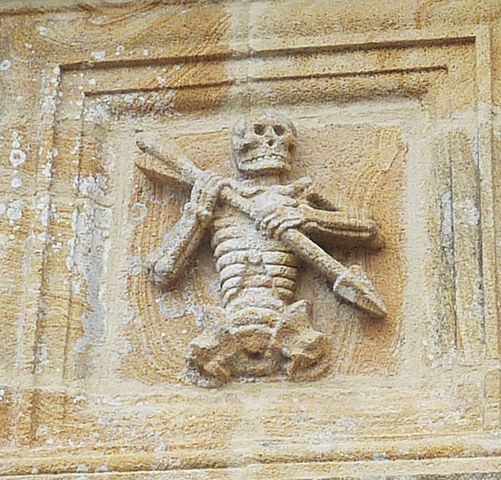
Ankou, depicted on a carving at the ossuary of the chapel of St Joseph at Ploudiry, Brittany.

Ankou, depicted on a carving at the ossuary of the chapel of St Joseph at Ploudiry, Brittany. Note the ‘elf-arrow’ it appears to wield!

Ankou in the Isle of Man and Scotland:

The Manx – a nation whose linguistic and cultural roots lie firmly in the ‘Gaelic’ world – maintained an independent tradition which corresponds closely with that of L’Ankou. However, in examining this it is first necessary to go ‘back’ to Brittany and examine the word ‘Ankou’ itself:

The standard English definition or translation usually given for the Breton word ‘Ankou’ is ‘the agony’, originally proposed in a ‘pirated’ (uncredited) 1860 English translation (Breton Legends – Pub. London 1860, Burns and Lambert) of the folklore collected and published in French by Théodore Claude Henri, vicomte Hersart de la Villemarqué – a noted Breton dictionarian and philologist. ‘An-‘ is the definite article, and ‘-Kou’ is usually (in English translations) supposed to mean ‘agony’. However, this etymology is speculative at best, as the ‘kou’ suffix as a sound can have a number of meanings within the scope of the historical linguistics of the celtic languages. Indeed, the 1821 Breton-French dictionary of Jean-François-Marie-Maurice-Agatha Le Gonidec tellingly uses the word Kouer to mean ‘peasant’, of which more presently.

Fockleyr Manninagh as Baarlagh – the 1863 dictionary (based partly upon an earlier manuscript of John Kelly from the late 18thC) published by the Manx Society contains the following interesting entry:

Keimagh s. pl. -ee, A spirit which is supposed to haunt and guard the churchyard stiles.

Also, the word Cughtagh:

Cughtagh s. pl. cughteeA fairy, a sprite, a spirit of the houghs* …

*AR: Hough in this context refers to a rough, rocky place or a cliff 

Both entries are followed by the interesting usage example ‘Ny keimee as ny cughtee’ of which the authors say no more, but which appears to be a reference to a popular Manx charm for stopping blood, a version of which can be found in William Harrison’s ‘Mona Miscellany’ (Manx Society Volume 16, Pub. Isle of Man, 1869).

The idea of the last deceased watching over the graveyard appears to have been common to the Highlands and Islands of Scotland – Donald MacPherson called it the Faire Chloidh in his book ‘Melodies from the Gaelic, and Original Poems; with Notes on the superstitions of the Highlanders &c’ (Pub. Thomas and George Underwood, London 1824), p.202:

FAIRE CHLOIDH, (THE GRAVE WATCH.)

It was the duty of the spirit of the last person interred, to stand sentry at the grave-yard gate, from sun-set until the crowing of the cock, every night, until regularly relieved. This, sometimes, in thinly inhabited parts of the country, happened to be a tedious and severe duty ; and the duration of the Faire Chloidh gave the deceased’s surviving friends, sometimes, much uneasiness.

The Manx ‘Keimagh’ and ‘Cughtagh’ spirits share a link of sorts to the grave, vagrancy, caves or shelters: This can be seen from the fact that the Manx wordcughhas connotations of dirt, filth and dung, and a link between this and the cave, mound or hole-dwelling spirit is also found in the word Cughlin, meaning a vagrant’s doss-hole or a mean filthy shelter, another Manx word for which is Kemmyrk. Recall that the Breton word Kouer, means ‘peasant’ and consider the restless vagrant properties ascribed to the spirits of the dead and a few ideas might start to form about the origins and meaning behind these archaic terms and the ‘Ankou’ itself.

The Manx word Keim or Keym (from which Keimagh is derived) is the same as the Irish céim, meaning ‘step’ in the same sense as it occurs in English – as a verb and a noun. The stile at old churchyard gates was often a slab of stone which those entering the church precinct would be required step over (and scrape your shoes on) in order to enter hallowed ground. It is common for the ‘m’ sound in Celtic languages to transform into a ‘w’ in pronunciation meaning that a ‘keimagh’ might easily become a ‘keiwagh’. By the same laws of linguistics, -gh-, -ch-, and -th- will lose any pretensions to consonantal pronunciation when occuring inside words.

This puts us in the interesting position of being forced to examine another similarly named spirit from the Gaelic world – Scotland’s An Ciuthach (pronounced ‘Kewach’), a being mentioned as a hairy spirit haunting caves in Volume 3 of John F. Campbell’s ‘Popular Tales of the West Highlands’ (p.55), in a folk-tale based on the story of the Pursuit of Diarmuid and Graine by Fionn Mac Cumhaill.

The Gaelic word ‘cuthach’, means ‘mad’ or ‘raging’ and fits with the portrayal of a marginal ‘wild-man’ who lives underground, and also with the Manx words ‘cugh’ and ‘cughlin’, associated with the filthy ‘Merlinesque’ state of the wild divine, a familiar sight in medieval Ireland, Britain and France where holy men often lived in a state of wild squalor. It should be obvious by now that the Breton word ‘Ankou’ had distinct similarities with the Gaelic ‘An Ciuth’ or ‘An Cuth’, ‘kou’ meaning a state of frantic restlessness, rather than ‘agony’. This fits the etymology of the Breton word for peasant: Kouer – a class of person living in mean conditions and continually working to survive.

The Irish Dullahán and the Gruagachs:

The ‘Dullahán’is the Irish legendary personification of death, usually represented as a skeletal headless horseman. The name possibly signifies ‘black one’ or ‘gloomy one’ (Dubhlachán?), probably on account of the lividity of the dead, and his appearance in popular tradition was to foretoken death. His earliest literary mention is in the writings of Charles Vallancey (‘Prospectus of a Dictionary of the language of the Aire Coti, or Ancient Irish’, Pub. Graisberry & Campbell, Dublin, 1802), who recounts that the Irish peasantry would be in fear of hearing the Dullahan or ‘Wullahan’ dragging his chains through the streets at night. Like the Ankou, it was often associated with a horse or coach and horses.


The Ankou is therefore quite possibly the ‘Wild Hunter’ who leads the Sluagh Sidhe! Was Fionn Mac Cumhaill, really originally Finn-Mac-‘Kou’-al? 

The ‘wild man’ archetype has much to say about where we developed from, and about the processes by which nature is regenerated from its own ‘putrefaction’.


There are important relationships in empirical human culture between dirt, ordure and decayed matter and the regeneration of new life. To live ‘wild’ is to live in comfort with this kind of state. Such symbolism no doubt informs the apparent associations between death, the spirit world and reincarnation that underpin the ancient European beliefs. The idea anciently used to express this was termed putrefaction, and important doctrine of the natural philosophy of Europeans until the scientific age introduced new paradigms.

The British and Irish age of Romanticism started in earnest during the ‘Enlightenment’ era of the late 17th and 18thC with the researches and writings of Roderick O’Flaherty, John Toland, Edward Llhuyd, and James MacPherson, and it continued with the emergence of renewed interest in the pagan past seen in the writings of Edward Williams (Iolo Morganwg), and in the fading customs, beliefs and lifestyles of the defeated Highland peoples documented for popular consumption by authors such as Walter Scott. Romanticism provided a vision of indigenous pagan beliefs still remaining among the peasantry, albeit in a form designed for the tastes and prejudices of educated and wealthy elites. Wavering paradoxically between apparent veneration of quaint rustic traditions and a visceral disgust of its ‘gloomy’ and ‘unenlightened’ superstitions, Romanticism would unfortunately often prove the undoing of much of what it fawned over: by swelling interest in ‘old-fashioned’ customs it ultimately encouraged the aspirational rural poor to resent becoming ‘quaint’ objects of fascination for the middle classes seeking relief from industrialised realities. By the late 1800s many Gaelic speakers had consequently rejected their traditional culture and sought to emulate modernity.

A romanticised view of what the rural poor ought to believe therefore eventually trickled down to influence their ideas: The traditions characterised as ‘gloomy’, ‘dismal’ and ‘unseemly’ – usually dealing with aspects of death, sex and disease – would become increasingly displaced. 

Putrefaction as an essential cultural idea behind abundance and regeneration among rural peoples was probably finally defeated when people stopped putting shit on their crops and used chemicals in its place… This was the era of mass-slaughter and industrial warfare, which reached its first full and horrific manifestation in the First World War.

Fairy Doctors, Sluagh Sidhe and Fianna

In the 5thC a crack commando unit was sent to purgatory by St Patrick for a crime they didn’t commit. These men promptly escaped from a maximum security stockade into the Gaeltacht underground. Today, still wanted by the church, they survive as soldiers of fortune. If you have a problem – if no one else can help – and if you can find them – maybe you can hire: The F-Team

The idea of a group of heroes who battle the monstrous, the fateful and the chaotic at the boundaries of safe everyday existence is a pervasive feature of European mythology, extending back for as long as stories have been recorded. In the Gaelic language zones, perhaps the most important representatives of this legendary theme are Fionn mac Cumhaill and his Fianna.Through their battles (and romantic encounters) with the magical denizens of legend, and their willingness to lay down their lives and suffer to do this, they become heroes who benefit the people, and their stories are marked by an enduring fondness.

What struck me as interesting about the aforementioned story of Aleisoun Pearsoun (put to death for witchcraft in Fife in 1588) was that her ‘story’ of how she acquired her powers seems to mirror and include aspects of that of the legendary Fianna:

1. She – like Fionn – joins a fairy band who take her on a wild adventure.

2. She ‘marries’ (has a sexual initiation) with a fairy she meets in the wilds. Fionn’s paramour was a woman in the form of a deer who he catches when hunting. Their magical son (poetry) is Oisin (‘Little Deer’).

3. She is tested with great adversity by the Otherworld denizens, who make her ill, but is given magical weapons with which to combat them.

4. She overcomes and returns with knowledge of its secrets, and becomes a warrior against the perils of the Otherworld (disease).

In fact, hers is not a dissimilar story to that of traditional Gaelic folk-healer characters such as Biddy Early (Ireland 19thC) and elsewhere besides. It is a feature pertinent to stories of ‘shamans’ and ‘medicine men’ etc from around the pre-modernised world.

The Fianna and the Sluagh Sidhe:

The fact that the ‘wild band’ or ‘fairy cavalcade’ in Gaelic folk-belief would have had something to do with Fionn and the Fianna often seems implicit, but it is quite rare to see this connection made explicitly in pre-20thC folklore accounts. Aleisoun Pearsoun’s fairy-band were apparently capable of both mirth and malice, which is a possibly a fair description of the legendary antics of the warlike Fianna. Nonetheless, apart from her kindred spirits who protect her, the cavalcade seem mostly harmful, and it is in understanding how to deal with this harm that she understands how to cure diseases. For this reason, we must turn our attention to the chaotic harmful fairy cavalcade, referred to in folklore as the Sluagh Sidhe or Sluagh Sith/Slieu Shee.

‘Sluagh Sidhe’ translates literally as ‘Fairy Host’ or ‘Fairy Army’. Robert Kirk (c.1690) provided one of the earliest accounts of the belief in these fairy hosts:

“… Moreover, this Life of ours being called a Warfair, and God’s saying that at last there will be no Peace to the Wicked, our bussie and silent Companions also being called Siths, or People at Rest and Quiet, in respect of us; and withall many Ghosts appearing to Men that want this Second Sight, in the very Shapes, and speaking the same Language, they did when incorporate and alive with us; a Matter that is of ane old imprescriptible Tradition, (our Highlanders making still a Distinction betwixt Sluagh Saoghalta and Sluagh Sith, averring that the Souls goe to the Sith when dislodged;)… “

As can be seen, Kirk gave two forms supernatural ‘Sluagh’, An Sluagh Saoghalta meaning, literally, ‘The Temporal/Earthly Host’. Kirk himself offers no translation to explain what he calls ‘Sluagh Saoghalta’ (‘Slooa Sheelta’) and uses the term only once. The implication from his fairy narrative is that one host is ‘spiritual’ and the other ‘of the mundane world’, probably meaning those ‘left behind’ due to sinfulness during their lives and more prone to the brutish acts that characterised a difficult existence. So far as I have been able to find out, there are few other references to ‘Sluagh Saoghalta’ from recorded folklore, it being more of a term used in Gaelic christian literature, so let us focus on the Sluagh Sidhe/Sith, a term which probably encompasses both ideas:

Source: Popular tales of the West Highlands, orally collected, Vol. 3 – John Francis Campbell, Pub: Edmonston and Douglas, 1862; pp.340-341

“….A doctor told this anecdote—

“Do you see that kind of shoulder on the hill? Well, a man told me that he was walking along there with another who used to “go with the fairies,” and he said to him—

“‘ I know that they are coming for me this night. If they come, I must go with them; and I shall see them come, and the first that come will make a bow to me, and pass on; and so I shall know that they are going to take me with them.’

“‘Well,’ said the man, ‘we had not gone far when the man called out, ‘Tha iad so air tighin.’ These are come. I see a number of ‘ sluagh’ the people; and now they are making bows to me. And now they are gone.’ And then he was quiet for a while. Then he began again; and at last he began to cry out to hold him, or that he would be off.

“Well,” said the doctor, “the man was a bold fellow, and he held on by the other, and he began to run, and leap, and at last (as the man told me) he was fairly lifted up by the ‘sluagh,’ and taken away from him, and he found him about a couple of miles further on, laid on the ground. He told him that they had carried him through the air, and dropped him there. And,” said the doctor, “that is a story that was told me as a fact, a very short time ago, by the man whom I was attending.”

Not far off I was told this in a house full of people, all of whom knew the story, and seemed to believe it implicitly.”

This account was corroborated by Alexander Carmichael (Carmina Gaedelica Volume 2, pp.3301-331) – as usual, my emphases:

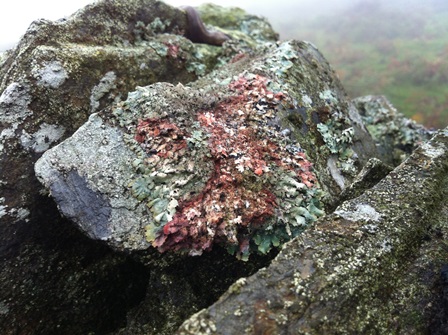
Sluagh – ‘Hosts’, the spirit world – the ‘hosts’ are the spirits of mortals who have died. The people have many curious stories on this subject. According to one informant, the spirits fly about “n’an sgrioslaich mhor, a sios agusa suas air uachdar an domhain mar na truidean’ – ‘In great clouds, up and down the face of the world like the starlings, and come back to the scenes of their earthly transgressions’. No soul of them is without the clouds of earth, dimming the brightness of the works of God, nor can any make heaven until satisfaction is made for the sins on earth. In bad nights, the hosts shelter themselves, ‘ fo gath chuiseaga bheaga ruadha agus bhua-ghallan bheaga bhuidhe’ ‘behind little russet docken stems and little yellow ragwort stalks’. They fight battles in the air as men do on the earth. They may be heard and seen on clear frosty nights, advancing and retreating, retreating and advancing, against one another. After a battle, as I was told in Barra, their crimson blood may be seen staining rocks and stones. ‘Fuil nan sluagh’, the blood of the hosts is the beautiful red ‘crotal’ of the rocks, melted by frost.

Crotal_Blood

These spirits used to kill cats and dogs, sheep and cattle, with their unerring venemous darts. They commanded men to follow them, and men obeyed, having no alternative.

It was these men of earth who slew and maimed at the bidding of their spirit-masters, who in return ill-treated them in a most pitiless manner. ‘Bhiodh iad ’gan loireadh agus ’gan loineadh agus ’gan luidreadh anus gach lod, lud agus lon’–They would be rolling and dragging and trouncing them in mud and mire and pools. ‘There is less faith now, and people see less, for seeing is of faith. God grant to thee and to me, my dear, the faith of the great Son of the lovely Mary.’ This is the substance of a graphic account of the ‘sluagh,’ given me in Uist by a bright old woman, endowed with many natural gifts and possessed of much old lore. There are men to whom the spirits are partial, and who have been carried off by them more than once. A man in Benbecula was taken up several times. His friends assured me that night became a terror to this man, and that ultimately he would on no account cross the threshold after dusk. He died, they said, from the extreme exhaustion consequent on these excursions. When the spirits flew past his house, the man would wince as if undergoing a great mental struggle, and fighting against forces unseen of those around him. A man in Lismore suffered under precisely similar conditions. More than once he disappeared mysteriously from the midst of his companions, and as mysteriously reappeared utterly exhausted and prostrate. He was under vows not to reveal what had occurred on these aerial travels.

I took down several stories of persons who went with the ‘hosts.’ Here is one of the stories of the ‘hosts’ summarised:–The beautiful daughter of a king of France was taken up by the ‘hosts,’ and carried about in the air, over lands and seas, continents and islands, till they came to the little island of Heistamal, behind Creagorry, in Benbecula, where they laid her down in such an injured state that she died from the hard treatment; not, however, till she had told about the lands to which she had been carried, and of the great hardships she had endured while travelling through space. The people of the island buried the princess where she was found.

The ‘sluagh’ are supposed to come from the west; and therefore, when a person is dying, the door and the windows on the west side of the house are secured to keep out the malicious spirits. In Ross-shire, the door and windows of a house in which a person is dying are opened, in order that the liberated soul may escape to heaven. In Killtarlity, when children are being brought into the world, locks of chests and of doors are opened, this being supposed, according to traditional belief, to facilitate childbirth.

These Hebridean and Highland accounts concur with records of similar beliefs from Ireland and the Isle of Man. The Sluagh Sidhe were dangerous, vengeful and often angry – they were represented (as Aleisoun Pearsoun was informed) by gusts of wind which marked their passing. These fairy ‘blasts’ might burn your skin with ignis sacer or boils or other visible cutaneous conditions. They strike you with fairy darts rendering you sick, or paralysed down one side (a ‘stroke’, the name still used in medicine today). They might also carry you away in a state of delirium to a place you had no intention of being – you would be ‘taken‘ by them, sometimes into their own fairy world!

The Sluagh Sidhe/Sith were – like the Fianna of ancient Ireland – bands of souls who roamed the world outside of the laws of settled everyday life. They were dangerous and liminal, yet potentially helpful and – in the fairy faith discussed by Kirk and other commentators – could redeem themselves, sometimes by sharing the knowledge of how to ‘heal’ the harm they cause, and from there could pass to a different place – in the west, beyond the sunset.

A Fairy Doctor was a specialist who understood these modes of harm caused by these Fairy Hosts. He or she also understood the ‘principle of inversion’ which governed how we and the otherworld interacted together, and was able to intervene or advise in redressing this balance.

St Latiaran of Cullen (Cuillinn)

Cullen or Cullin is a small village about four miles south of the Kerry border, near the town of Millstreet in the old Barony of Dulhallow, Co. Cork. It is home to an old ‘holy well’ dedicated to an Irish female saint known as ‘Latiaran’ or ‘Laitiaran’ (sometimes spelled ‘Lateerin’ in older english books), also known as ‘Laserian’. This last version has an interesting concordance with another supposed early male saint, associated with smithily-named St Gobban of Leighlin (Co. Carlow): This was his brother ‘St Molaise’ (St Molashog), also known as ‘St Laserian’. Whether hearking from Cullen or the bosom of Gobban, all of these saints have a curious set of accretions to do with blacksmiths. Latiaran herself is stranger still as she (and her sisters) do not seem to have an official place in Ireland’s various historic calendars of saints, and have all the trappings of Christianised aspects of a/the feminine triple-deity. 

The popular story about Laitiaran of Cullen, recorded by travellers there in the early 19thC was that the saint once lived in the village, from where she would regularly travel across the old bog-causeways to visit her two holy sisters. Such was her piety, she refused to keep her hearth-fire burning in continuity (a pagan custom/superstition), but would instead go daily to the blacksmith’s forge in the village to get a ‘seed’ for the fire, which she carried home in her apron or cloak, and which miraculously did not burn it. However, one day, she let her sanctity slip a little when the blacksmith complemented her on her shapely legs or feet, and a lapse into vanity caused her to take a peek and see if he was indeed right. The ember burned through her apron and singed her ankle, the result being that she cursed the smith, to the effect that ‘there never was a blacksmith in Cullin thereafter’.

This is yet another striking example of the christianisation of an important part of the original Gaelic pagan mythos. The name, Cuillin, is that of the legendary blacksmith from whom Cuchullain was named, and with whom I have suggested a strong etymological and legendary link to the Germanic character Weland/Wayland. The imposition of a female saint into such a tale involving this character is also seen at Slieve Gullion in Armagh. You might recall the the pagan Brighid was associated with ‘smithcraft’. But what more about ‘Lateerin’?

She is one of three regional sister-saints : Laiser, Inghean Buidhe and Latiaran, sometimes also given as Craobh/Crobh Dearg, Latiaran, and Gobnait. Assuming craobh dearg is the original meaning, ‘red branch’ – something the local legends of Cullen would disapprove of! Gobnait’s name is redolent of gobban (blacksmith), and her feast day in the Martyrology of Oengus is 11th February (Imbolc). This is really fascinating. The mystery deepens when we realise that Latiarin’s pattern day was/is held at the well on July 25th, or the nearest Sunday (or both!) corresponding to the pagan festival of Lughnasa, as detailed in Maire MacNeil‘s amazing book, ‘The Festival of Lughnasa’. The pattern of Ingean (or ‘Ineen’) Bhuidhe was (unsurprisingly) celebrated near the start of May at the local settlement at ‘Bull Ridge’ of Dromtariff, while that at the well of Cill Lasaer (who presumably is identical with Gobnait) was at the ‘start of spring’ (early February, Imbolc), and was held at Boherbue (Bóthar Buí = Yellow Road).  

The anglophone part of her name, ‘-teer-‘, appears to be from the Gaelic word saor/tsaoir, meaning ‘smith’ or ‘craftsman’, and ‘teerin’ could therefore quite conceivably signify the ‘smith’s daughter’. Laitiaran is the modern Irish orthographic spelling, which perhaps belies the name’s true origins as an attempt to obfuscate a piece of important Irish pagan lore… Astute readers might recognise that the names ‘Lasaer’ /’Lasair’ and ‘Lateer’ are pretty much the same, derived from the prefix ‘La-‘ and the Irish word for blacksmith – saor . Bui, is also a name of the Cailleach Bera in the famous ‘Lament’ poem, not to mention part of the name of Boherbue/Boherboy nearby.

This intrigued MacNeil deeply, although she did not make the linguistic association of ‘Latiaran’ with blacksmiths. She did however notice the possible connection between the triad of divine females and the passage from the Book of Leinster which describes Badb, Macha and Anand, from the last of whom it says the nearby Paps of Anu were named… She also wondered if the nearby Lughnasa hill of Taur might have been the lost ‘Tara’ of Munster, Teamhair Luachra. This theory is especially intriguing given the fire-kindling, Bealtaine associations of the other Royal Teamhair.

What are the other local links with blacksmiths and fire?

 The old Barony of Duhallow in northern Cork contains the aforementioned villages of Boherbue and Cullen, but is also notable for some of its other placenames such as Banteer, whose name contains an overt suggestion of ‘Female Smith’ (‘Bean tSaor’). In fact, County Cork itself has a fair share of legends regarding a famous hallowed Blacksmith-Builder-Craftsman, the Gobban Saor.  


Norse Sea-Giants in more detail…

Giants and monsters have a special connection to the sea in Norse mythology – just like the Titans in ancient Greek mythology. They represent the unconquerable and titanic forces of nature. As characters in stories, their great size can be considered an expression of the large shadows cast by distant things with the low sun behind them – as happens as it passes into the ocean on the western horizon of the Atlantic. The main characters in these tales of oceanic titans are Thor, Loki and Aegir:

Thor wrestling the Midgard Serpent (painting by Füssli, 1788).

Thor with Hymir wrestling Loki’s son – the Midgard Serpent (painting by Füssli, 1788).

The 13thC CE, Icelandic christian scholar Snorri Sturluson wrote a mythological ‘theogonic’ dialogue on poetry called Skáldskaparmál (“language of poetry”) in which the primal sea-giant Ægir, also known as Gymir (a version of ‘Hymir’) or Hlér, discusses kennings and mythology with the Æsir god, Bragi, after the style of the poetic Edda composition Alvissmal. That Snorri chose these two as characters in the dialogue is interesting, moreso because of they seem to represent the two ‘Platonic’ aspects of what to the ancients was knowable – the first: nature and the elements (Ægir), understandable through sense, and the second: the gods and spiritual things – knowable through the mind, and therefore the province of poetry and philosophy (Bragi). In Alvissmal, it is a wise earth deity – a dwarf/dvergar called Alviss (‘All-Wise’) who instructs Thor on poetic kennings. In Skáldskaparmál, however, it is the ‘sea’ (Aegir) talking…

Aegir is also the host of the feast at the centre of the important poetic Edda story Lokasenna (Codex Regius): This is the tale of a feast of the gods and elves, hosted by Aegir, whose hospitality (and his ale and mead) is considered sacrosanct to the gods, who become angry when troublesome giant/god Loki starts drunkenly abusing the guests. This episode assures Loki’s imprisonment and Promethean-Orphic torture by the gods (he must endure the poison dripping from the fangs of a serpent ) until the showdown of Ragnarok. Aegir’s legendary cauldron or brewing pan seems to provide a link between the elements and the mind, and Lokasenna (the ultimate drunken social meltdown) provides an amusing view of how leisure and strife were never far away from each other in the Viking world. The poetic Edda version from the Codex Regius says Aegir was also called Gymir, and ‘Hymir’ is the giant with mighty caudron/brewing-pan who is Thor’s host and companion when he goes fishing for the giant Midgard Serpent in the poetic Edda tale of Hymiskviða (Codex Regius). Hymir, Gymir and Aegir are probably the same mythological sea-giant.

Aegir was said to be one of three sons of the giant-ancestor Fornjótr (described as an ancient king of the magical north),the other two being Logi (fire) and Kári (wind).  Fornjótr might in literally mean ‘First Giant’. The compounding of his watery son’s name with ‘-gir’ is redolent of the word ‘Gyr’ (eg – Gygr) and theirefore of the Greek words Gigantes and Gygas, representing the larger than life ancestral deities of ancient Greek myth. Ægir might even be a Norse version of and the sea-giant Geryon, who had three bodies. This association with the elements (water in Aegir’s case) comes from the Skáldskaparmál kennings of the primal elemental forces:

“…How should the wind be periphrased? Thus: call it son of Fornjót, Brother of the Sea and of Fire, Scathe or Ruin or Hound or Wolf of the Wood or of the Sail or of the Rigging…”

The only classical element missing from the ÆgirKáriLogi triad is earth (jörð), usually represented in Norse myth and kennings as the eponymous giantess Jörð – ‘wife of Odin’. The Earth is feminine – like in the Greek Gaia/Ge. It is obvious from both ancient Greek and Norse mythology that the ‘giants’ bear names with suffixes which connect them intimately with ‘mother earth’: Gigantes (‘Born of Gaia/Ge’) and Jötnar (‘Born of Jörð’).

Aegir’s other name or kenning is given as Hlér, which seems incredibly close to the Irish/Welsh/Manx name for the sea: Lir/Ller/Lear of whom the legendary Sea God Manannán/Manawydan was the son. In the most important 14thC Icelandic manuscript collection, Flateyjarbók, the following is said of Aegir/Hlér and his family:

“…There was a man called Fornjót. He had three sons; one was Hlér, another Logi, the third Kári; he ruled over winds, but Logi over fire, Hlér over the seas…”

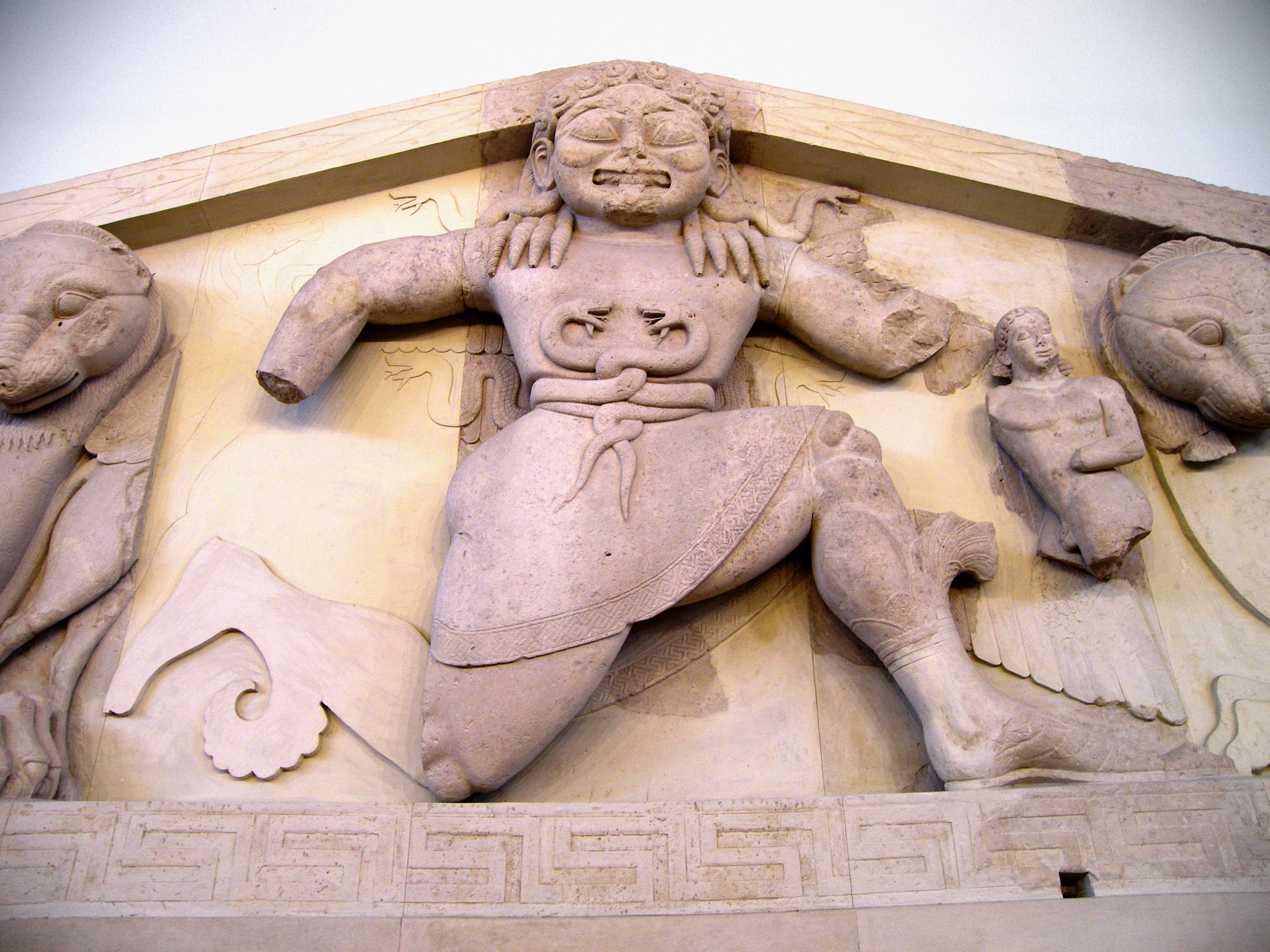
The connection between Logi and the Norse ‘god’ figure Loki is uncertain. The names certainly seem similar, and Loki is definitely one of the Jötnar, being portrayed in the Edda myths as something of an uncontrollable ambiguous shape-shifter as well as a father (or even a mother) of monsters and magical horses. One might even compare him to the role of the Gorgons in Greek myth – a frightful challenge to be overcome by initiates into the mysteries of life, death and the otherworld. Logi represents fire – perhaps one of the most untameable and dangerous, yet useful ‘elements’ – and Loki represents a similar aspect of chaos in his oppositional and inductive roles in the Eddas. He, in fact, comes across as a character the Christian (and Muslim) narrative would assign to their ‘evil god’ – Satan – otherwise known as God’s right-hand man in the Hebrew Book of Job.

Another ‘giant’ of note in Norse myth who is tied closely to Aegir and Loki in surviving narratives is the god Þórr (Thor), whose name seems to be cognate with the word Thurs (þurs) which is another Germanic word for a giant/titan. In the Icelandic mythologies recorded in the Christian era from orally-transmitted traditional pagan poetic and story traditions, Thor is associated with great strength and battles with giants and monsters using his great hammer Mjölnir which represents both a weapon and a tool. His traditional role in Germanic societies is as a protector and battler with the elements akin to the Greek Herakles (a fact not lost on the 1stC CE Roman author and historian Tacitus), and he seems to have an agricultural/fertility aspect on account of this. This connects him to the folk-legends of similarly enthusiastic (but not too bright) ‘helpful fairies’ – Brownies, Glaistigean, Phynnodderee, the hammer-wielding Leprechauns and the ‘Hobthrust‘ of northern England…

The poetic Edda composition called Hymiskviða is a tale of Thor being sent by Aegir to fetch a giant brewing-pan or cauldron from Hymir – the giant who lives ‘at the edge of Heaven’. Hymir is said to be Aegir’s father, and Aegir also goes by the name Gymir, of which ‘Hymir’ is an aspirated pronunciation. Thor ends up going on a perilous fishing expedition with Hymir, during which Odin’s son manages to land the Midgard Serpent, Loki’s son Jörmungandr who encircles the Earth biting his tailHymir considers it very bad news when Thor bashes the serpent over the head before letting it slide (presumably lifeless) back under the waves… It can be seen here that the same consistent association occurs between oceanic Titans and sea monsters in medieval pagan Norse myths.  The outcome of the story is that Thor obtains the brewing pan that will make the ‘poisonous’ ale or mead that spurs Loki to sow discord among the gods in Lokasenna. The killing of Jörmungandr and the breakdown of order with Loki and the giants/monsters presages the Ragnarok… This imagery appears upon a number of incised stones of the Viking era (including Cumbria and the Isle of Man, as well as in Scandinavia), providing corroborative evidence of its importance in Scandinavian-influenced Atlantic mythology.

There is much to be identified between the Norse myths and the Irish and Welsh. For instance, the theme of sea-giants and a ‘fatal feast’ featuring a caudron that determines the world’s outcome is seen in the Welsh Mabinogion tales, and the Irish tales ‘Bricriu’s Feast’ (Fled Bricrenn) and ‘The Destruction of Da Derga’s Hostel’ (Togail Bruidne Derga) among others. They appear to be different figurative ‘branches’ of the same ancient tree whose roots are nourished by ‘world-river’,


Similarities in Greco-Roman and Gaelic myth

Although the mythology of the material and intellectual cultures we know as 'Greco-Roman' is Europe's oldest inscribed tradition, that of Ireland and the 'insular Celts' must come next, albeit the written form of it is from a much later date. In particular, it often excels and exceeds the Greek material by its apparent strangeness and stylised 'otherness', yet as a source of pagan myth it needs – like the Norse sagas and Edda texts – to be treated very carefully as it is told by christians, unlike the Greek and Roman material which comes from pagans.

Nonetheless, the Christians did not have much in the way of myth to call their own, except for the 'Old Testament' materials and the early saints' lives, many of which were based on pagan tales, in their style and often in their narrative content: These were essential to pad out its own religious narratives and replace (or at least displace) the contents of the potent oral-transmission culture with a literature-based alternative.

It is worth noting a number of things about southern-European pagan religious culture, however, before framing a debate of paganism vs christianity in terms of oral transmission culture vs. literary culture: Firstly, it is worth remembering that – since the advent of the Hellenistic era in the 5thC BCE – that literary culture became an important stalwart of Greco-Roman societies, and seems to have become a primary mode by which people came to understand their religion. There were certainly traditional aspects to the culture to a late period, but by the advent of christianity, this was being displaced. The role of the priesthood and attendants in many of the most important temples was generally fulfilled as a fixed term civil office by the worthies of Greek and Roman society, so – unlike the traditional and esoteric forms of learning that Gaul (and Britain's) professional priesthood had to undergo, these offices were losing their mystery. Mystery remained the province of cult-centres such as Eleusis, Delphi and the island of Samothrace, and the discourse-communities of the Philosophers – the Neo-Platonists, Hermeticists and Gnostics who thrived in the late-classical world after the advent of Christianity and who pre-figured its rise. It is telling that classical paganism's most complete and (in scope) extensive theogonic text – the Dionysiaca of Nonnus of Persepolis in Egypt – was written by an author whose output later included a commentary on the christian Gospel of John. To understand this is to understand where the impetus for Christianisation was focussed in the less-literate climes of northwest Europe, such as Ireland, in the 5th/6thC CE.

Whereas some of our oldest surviving literature from the pagan world is religious, this aspect of the genre was in mortal decline in parallel to the rise in interest in philosophy and the 'mysteries' from the advent of the Hellenic period. By placing literacy in the hands of a few – a trained elite (after the model perhaps of the barbarian, Egyptian and Eastern peoples) – christianity would place itself at the heart of the new models of kingship appearing in the 'barbarian' world following the collapse of the Roman franchise in the west.

There are many similarities between the written medieval Irish myths and Greek legends. The reasons for this might be fourfold:

1. That the Irish believed in a shared widely-known and ancient cosmic worldview, populated with similar characters and themes to those of ancient Greece and southern Europe, and the Christian authors recorded this from traditional orally-transmitted narratives.

2. That literate monks used Greek and Roman (or Romano-British) myths to flesh out a written Irish narrative which did not otherwise exist – a kind of 'new age' eclecticism.

3. That Irish and Greek myths developed separately, yet shared similarities determined by (a) the culture and traditions/techniques of storytelling and (b) empirical reactions to natural phenomena.

4. A synthesis of points 1-3.

Obviously, the most likely answer is point 4 – we simply do not have enough evidence to support points 1-3 independently, but we have good evidence that all of them have been contributing explanations. I shall now present a number of Irish myths/mythic characters and their apparent Greco-Roman counterparts and let you decide for yourselves:

Cú Chulainn:

The archetypal indefatigable warrior super-hero of the 'Ulster Cycle' stories – Cú Chulainn – seems to have a particular similarity to Herakles or Hercules: He is the son of a god, associated with blacksmith-craftsmen (Cullain). Cullain seems to relate to the Greek 'earth-born' proto-blacksmiths known as the (Idaean) Dactyls, of whom Herakles was sometimes considered one. was a supreme warrior, a lover of goddesses (Fand, wife of Manannán mac Lir) and his nemesis is a goddess (the Morrigan). He is a performer of fantastic tricks and sporting feats, yet forever tied to the whims of his king and his gods. He lives fast and dies young – a true aspect of the Celtic warrior ideal. is also a 'king's champion' warrior archetype – a dog on a leash, as befits his name. He sometimes comes across as bombastic, brash, sometimes clumsy and insensitive – a bit of a lummox at times, and then at others, clever and dextrous, and light on his feet. Like Herakles, he travels to far-off islands and does battle with the weird as well as the mundane, performing 'feats' along the way.

One way in which Cú Chullain differs from Herakles is that Herakles was a folk-hero responsible for taming and conquering the wild and chaotic forces for the good of humanity. In the 'Ulster Cycle', Cú Chullain typically acts on behalf of the interests of his liege lord – like the other famous Greek warrior-strongman Achilles. This perhaps reflects the fact that these Irish legends (like their later French and British 'Arthurian' traditions) were often designed for telling at the courts of elite rulers, and therefore suited the value-system of this milieu. In folk-myths, Fionn and Cú Chullain often take on much more gigantic proportions and attributes.

The Battle of Maige Tuired:

This is the 'showdown' scene of the Irish mythological cycle stories in which the Tuatha Dé Danann, the Fir Bolg and the Fomorians are pitted against one another for supremacy of Ireland. The Fomoire are usually described as a race of sea giants in Irish mythology, and the Manx word Foawr (from 'Fomor') means 'Giant'. They seem similar to the aquatic Titans of Greek myth and the Cath Maige Tuired is like an Irish version of the Greek Titanomachy – the battle and overthrow of the Titans by the Olympian Gods, with whom the TDD share a certain similarity. Similar legends exist from Norse myth – the primal giants here are the Frost Giants: Titans at -40 Celsius! Of course, the bizarre cannibalistic and incestuous Greek narratives of the Titans are absent from the CMT and the 'Book of Invasions' stories which present more of a heroic pseudo-historical dynastic struggle. Tolkein borrowed heavily from the imagery of the battles of Maige Tuired in constructing his battle scenes in Lord of the Rings.

Giants and primordial helpers:

The landscape of Atlantic Europe – particularly those regions where Greco-Roman and later christian culture was slow to assert itself – is riddled with ancient mythology of primordial giants who supposedly played some important roles in determining the shape of the landscape – mountains, fjords, rivers, lakes, plains and great rocks. The same was true of the mythology of the Archaic period and Bronze Age of southern Europe – in particular the mythologies of ancient Greece, but we can discount these as playing a late originating role in the folklore of northern and northwestern legends due to the lack of impact of these material and cultural civilisations in these zones.

The Greek giants and Titans were 'Earth-Born' (Gygas – after Ge/Gaia, the personified Earth). The pagan Norse word used for giants in the middle ages was Gygr – existing into the more modern periods in the Scots Gyre and Faroese Gyro. The Manx equivalent of the Scots Brownie, Uirisk and Grogach legend was the Phynnodderee, 'Dooiney Oie' ('Night Man') or Glashtin – a being considered gigantic, primitive, coarse and animalistic in appearance who helped householders and warmed himself by the hearth at night when humans slept. His local legends seem, curiously, to conflate him with both Fionn mac Cumhaill and even Cú Chullain and, when not explicitly named, with the activities ascribed elsewhere in the Atlantic world to other giants – specified or unspecified. This is a representation of the archetypal earth-born ancestor, and is a particularly important and wide-ranging link between northern and southern pagan mythology which appears to have a commonality stretching way back into the Bronze Age. Herakles was also an aspect of this.

The Otherworld:

Both Greek and Irish myths portray the Otherworld as a location reachable by a westward journey over the great ocean. The legendary Greek islands of Elysium, the Hesperides/Erytheia and Ogygia, and the 'Islands of the Blessed' or 'Fortunate Isles' have their Irish equivalents in the many names of Gaelic mythology's magical western islands which were also considered the resort of departed souls: Mag Mell, Tír na nÓg, Tír na mBeo, Tír Tairngire, Tír fo Thuinn, Ildathach , Hy Brasil, Tech Duinn and Emain Ablach. These places are sometimes explicitly islands, sometimes under the sea, sometimes of a hybrid type that emerges (and just as soon disappears) from the sea.

Like in the Greek legends, the otherworld is also represented as a chthonic realm – beneath the earth. Like the Greeks, the Irish seem to have believed that the rivers of the world joined a 'world river', and that it re-manifested from the otherworld by piercing back though the earth as springs of water. Like the Greeks and Latins of southern Europe, and their fellow Bronze Age and Iron Age era 'Celtic' peoples further north and west they considered springs of water to be important and holy – no doubt for this reason. Sidhe mounds or Fairy Hills were the traditional 'home' of Irish (and to a lesser extent, Manx and Scottish fairies). They were sometimes considered to be the sources of rivers returning from the otherworld. Mountains and artificial mounds had similar associations in Ireland. In a flat landscape, a mound is something akin to an island – a consideration when addressing the 'otherworld inversion' belief that permeates Atlantic European folklore.

An interesting aspect of the Greco-Roman myth is how there seems to be a plasticity in portraying the otherworld 'places' (Elysium, for example) as both meadows or gardens and simultaneously as islands bordering Okeanos. This same conflation appears to represented quite strongly in the old Irish story 'The Voyage of Bran mac Febail' where he is conveyed to the otherworld islands over a sea which gradually appears to become a meadow.

Mermaids and Sirens:

The idea of female (and male) entities who lured men to stay with them in the watery or otherworld realms are common to both Greek and Gaelic myths. The 'Sirens' occur in Greek myths such as Homer's Odyssey and the Argonautica ('Jason/Iason and the Argonauts'). They were sometimes depicted as half-bird, half-female inhabiting islands surrounded by huge rocks and high cliffs, luring sailors to their deaths on the treacherous shores with their beautiful songs. Calypso, the daughter of Atlas on Ogygia also fits the enchanting-island maiden archetype, and although was not considered one of the Sirenai, seems part of the same mythos. Even the Gorgons tempted brave Perseus to their realm, and from his 'killing' of Medusa there was a magical birth (of Pegasus and Chrysaor).

In Atlantic Celtic mythology, this function was the province of alluring beautiful mermaids – usually half-human, half-fish in their conception but sometimes 'seal people' (e.g. – Selkies). The Isle of Man's version of the Cailleach – Caillagh y Groamagh was supposed to fly in from the sea in the form of a bird at Imbolc/La'a Bride, and she may be another aspect of the beautiful fairy maiden called 'Tehi-Tegi' who in Manx legends lures men into the sea or a river to drown them, before flying away in the form of a wren (sometimes a bat!). The Gaelic (Irish/Gallovidian) Merrow was sometimes known as Suire which sounds very much like a version of 'Siren' although this may be in reference to known Greek myths, and this type of mermaid was associated with a feather hat or cape. Crofton Croker's 'Fairy Legends and Traditions of the South of Ireland' is worth reading for a summary on the Merrows.

Harpies and Sidhe Gaoithe:

There was an explicit belief in former times in Ireland, Scotland and the Isle of Man that sudden gusts of wind were caused by the actions of spirits and fairies. Indeed, this was a feature of the demonology of medieval Christian Europe, and may well link back to the ancient Greek beliefs that the Harpies were responsible for the same. They were depicted (again) as half-woman, half bird or as winged female entities and were personifications of storm-winds. The Cailleach Bheara of the Scottish Highlands and Islands had a similar association, and was sometimes considered a female-avian who flapped her wings to make the winter storms. In the Isle of Man, the (not uncommon) tornados were sometimes supposed to be caused by a fairy known as Yn Gilley Vooar ny Gheay – 'Big Boy O' the Wind'.

River Nymphs and Sea Nymphs:

Perhaps subjoined to the mermaid legends, it is notable that the Greeks and the Irish personified their rivers with female spirits or entities. Evidence of this comes from the Dindseanchas legends and those of the so-called 'landscape-sovereignty' goddesses, otherwise referred to as Bean Sidhe, no doubt because river-drainage areas in mountainous landscapes tend to map and define territories. Greco-Roman mythology venerated such female water deities, and this tendency was also found in the European celtic world in the late Iron Age (although much of our evidence here comes after the period of Romanisation). Again, the 'Cailleach' personification from folklore seems to combine many of these functions (Harpies, Sirens, Nymphs etc) into the form of this single protean Titaness. Likewise, the Moura Encantada of the Iberian peninsula and the Marie Morgane of Brittany as well as the 'Lady of the Fountain' (or lake) of Arthurian lays and romances.

Summary:

It is apparent that ancient European paganism was a universal system of philosophy and 'science' illustrated through traditions of the arts: story, poetry, song, pictures, dances and drama. Every possible phenomenon seems to have been addressed by assigning mythology to it, and the boundary between the spiritual and the secular did not really exist – instead there was a continuum. The southern European civilisations emerging from the Bronze Age with a more oriental perspective, eventually coming to consider themselves 'better' and more 'enlightened' than their 'barbarian' cousins (and ancestors) in northeastern and northwest Europe, and due to warfare and incursions of these 'barbarians' between the 5thc BCE and the 1stC CE (and beyond), and due also to the dependence on written knowledge, a perception derived that their religious and spiritual beliefs were 'different', when in fact they had a shared root.


Terror and Beauty from the far shores…

The stylised Gorgon from the pediment of the 6thC BCE Temple of Artemis, Corfu. Was she the Greek version of the 'loathly lady' myths of the north?

The stylised Gorgon from the pediment of the 6thC BCE Temple of Artemis, Corfu. Was she the Greek version of the 'loathly lady' myths of the European north?

To the ancient peoples of Europe, the realm of the dead and of heaven lay deep in the west on the path of the setting sun. This exceeded the bounds of the known world of the Mediterranean and was presumed to lie beyond the extent of the Titanic Atlantic Ocean, believed to represent the extent of the 'world river', Okeanos. Plato (Athens, 4thC BCE) describes the mysterious point where earth and heaven meet in his 'last words of Socrates' dialogue known as Phaedo (trans. Benjamin Jowett) :

“…Also I believe that the earth is very vast, and that we who dwell inthe region extending from the river Phasis to the Pillars of Heracles,along the borders of the sea, are just like ants or frogs about amarsh-pool, and inhabit a small portion only, and that many others dwell inmany like places. For I should say that in all parts of the earththere are hollows of various forms and sizes, into which the water andthe mist and the air collect; and that the true earth is pure and inthe pure heaven, in which also are the stars-that is the heavenwhich is commonly spoken of as the ether, of which this is but thesediment collecting in the hollows of the earth…”

His description of the 'frogs' and the pond is an echo of contemporary Athenian playwright Aristophanes' famous Dionysiac play of the c.405 BCE known as 'The Frogs' when the god Dionysus crosses the river Styx to visit Hades, and rather than being regaled by the shades of the departed from within the water, he is annoyed by a chorus of frogs. The connection between water, and the seemingly grotesques yet miraculous aspects of both death and rebirth was not lost in the ancient European worldview, of which the Greeks were to create the earliest written sophistication:

One of our oldest written sources on ancient Greek mythology, Hesiod ('Theogony'), says that the most archetypal race of Greek monsters, the Gorgons, lived on an island at the furthest extent of the western ocean, supposedly near the island of the Hesperides. This puts them in the realm of Cronos (Saturn) at the far shores of the world-river Okeanos, near Homer's famous island of Ogygia from the Oddyssey. Ogygia in Homer was domicile of the titan Atlas (also called Atlantis) and his daughter Calypso, whose charms almost took Oddyseus away from the land of the living. The name Ogygia (Hy Gyges?) is based upon the greek word gygas, meaning 'born of Ge (Gaia/Ge – the Earth)', often interpreted as 'Giants' (Gigantes) and possibly linked with the name Gorgós (dreadful)…

Accordingly, the Titans of greek myth were viewed as primordial, earth-born giant in stature and monstrously alien. They were supposedly banished in a succession war with their children, the Olympian gods, and the various Greek theogonies suggest these marginal realms were at the farthest reaches of the 'time before memory' of oral-culture mythology – on the shores of the world river Okeanos at the edge of the heavens.

The relation ship between the chthonic underworld of Hades and Tartarus is based upon the fact that the oceans are the deepest places, and the Atlantic far more so that the Mediterranean. The beings of this realm partook of the primal, cthonic 'elements' of Water and Earth. Even the Hebrew Book of Genesis (first compiled 5thC BCE) borrowed this conception…

The children of the Titans were often monstrous, for example: Python, Scylla, Medusa, Charybdis, Cereberus, Ekhidna, the Hydra, Chimera, Geryon, Cetus and the Graeae. Sometimes they were beautiful too, like the titaness Calypso, and Pegasus and Krysaor who were the children born of the neck of Medusa. The mysterious realm of the oceans, has always delivered both beauty and terror to mankind!

Although encountered in Greek mythology in various parts of the Mediterranean, it was not, however, it was not from this comparatively mild 'frogpond' that these creatures and Old Gods derived, but the mighty Atlantic, beyond the 'Pillars of Heracles' or the Straights of Gilbraltar, at the extremes of Okeanos in the Atlantic west. During the era of the Roman expansion into northern Europe, the misty, cold and terrifying reaches of the British Isles, Ireland and the North Sea might well have been at the very brink of this terrifying alien realm… to the ancient world, if you wished to get to Ogygyia and the Hesperides, you went to the furthest navigable islands (Britain and Ireland), and then just went a little further!

In mythology, the monstrous is often depicted as a trial to be overcome by a hero (or 'initiate'). In northern Europe, the aquatic 'loathly lady' traditions of the Melusine, the tale of how Conn Cétchathach gained the High Kingship of Ireland, and Chaucer's 15thC 'Wife of Bath's Tale' are examples of such a tradition. In Greek myth, the story of Perseus and Medusa might be seen as a version of the same principle:

Gorgons:

The most famous monsters of the Greek and Roman world were arguably the three snake-haired Gorgons, who were said to be the daughters of Phorcys (a hypostasis subordinate to Poseidon). These were also the sisters of another divine female triad of Greek myth, the Graeae – the grey, aged and withered, one-eyed Cailleach-like Okeanid nymphs said in some myths to guard the approaches to the Hesperides, Ogygia etc and (redolent of the Norse Valkyries and the Irish Children of Lir) to have part of the form of swans. In the myth of Perseus, the hero is dispatched on an apparent suicide mission by evil King Polydectes to kill and gain the head of the only mortal Gorgon, Medusa, whose gaze turned men to stone. Polydectes fully expected the young hero to die in the task, so that he might marry Perseus' mother, but he survives his 'initiation' and triumphs from it. The Gods Athena, Hades, Zeus and Hermes donate magical weapons and aids for the task, setting Perseus on a perilous course to success. He tricks the Graeae at the approaches, and enters the grey and misty realms to stalk his prey… Upon decapitating Medusa, the magical horse Pegasus is born from her neck – a bizarre conception, fit only for these distant and magical realms of the Titans. Perseus rides the flying horse, saves the maiden Andromeda from being devoured by the sea monster Cetus and rides off into the sunset with the girl.

The characters of the Perseus-Medusa mythology all occupy a portion of the heavens as a group of related constellations named after the characters: Pegasus, Cetus, Perseus, Andromeda, in close proximity to the other 'aquatic' constellations of the zodiac – Pisces, Aquarius and curious Capricorn. This group contains two particular stars which express the curious behaviour of having a cyclical variable intensity, namely the 'blinking' eye of Medusa: Algol (period repeats every 2 days) – seen in the constellation of Perseus, and the longer-period Mira Ceti on the neck of Cetus, whose period is 11 months. Both these stars appear to 'come and go', a feature which must have had particular implications to ancient peoples who believed a star was a perfected heavenly soul. Mythology was sometimes designed to record information about the skies!

By 'killing' Medusa on the far western shores of Okeanos, Perseus immediately helps her 'give birth' to his conveyor back from the Otherworld (Pegasus – whose feet create springs of water on land), and mysterious Chrysaor – the 'golden blade' suggesting agriculture: both aspects of continuity in a culture which believed in reincarnation. By 'kissing' the 'loathly lady', the beauty of regeneration might occur…

Chrysaor, Kallirhoe and Geryon:

Two miraculous children were born at the moment of Medusa's beheading: The winged horse Pegasus ('Creator of Pegai (springs)'?), and the golden boy Chrysaor ('Golden Blade'). Pegasus became the companion and steed of the warrior-hero Perseus, but the mysterious Chrysaor was credited only (so far as we know) with the paternity of another monstrous being: the giant three-bodied cowherd Geryon on whom the legendary strongman-warrior Heracles/Hercules was supposed to have conducted his Tain or cattle-raid. Pegasus and Chrysaor have distinct echoes of the Atlantic Europe's 'fairy helpers' – the 'fairy horse' and the 'brownie'.

Geryon was supposedly born to his father of the Okeanid nymph Kallirhoe who occupied the island of Erytheia, and was said by some later classical authors (Diodorus) have also lived on the mountainous slopes of Atlantic Iberia. Like the tripliform Celtic deities, he was supposed to have been a giant with three bodies.

“From Medusa, daughter of Gorgon, and Neptunus [Poseidon], were born Chrysaor and horse Pegasus; from Chrysaor and Callirhoe, three-formed Geryon.”Pseudo-Hyginus, Fabulae 151 (2ndC CE) – Trans. Grant.

His home was the far-west 'red island' of Erytheia in the mystical Hesperides (equivalent by name and association with the 'Arthurian' Avalon, and Irish Emain Abhlach), no doubt the reason his cattle also had coats the colour of the setting sun – the predominant colour of the flowers in Atlantic Europe after the Summer Equinox and also, notably, the colour of the running blood of the dead… He was once allegedly defeated by Hercules, who stole his cows. The constellations Orion (the 'stick-waver') and Boötes (the 'cowherd') might even be considered cosmic aspects of the legend behind Geryon, on account of the location of his myth – at the boundary of the Otherworld… the heavens near to that great nourishing sky-river, the Milky Way. The 'cattle' of Geryon are a motif for the spirits of the dead, like Aristophanes 'Frogs' and 'Birds' and Hercules taking of them is an expression of the role of the psychopompic gods: Manannan, Dionysus, Hermes/Mercury etc.

The Hesperides:

The mythical garden of the Hesperides lay somewhere in the mythological west – either beyond the Atlas mountains and Libya (home of the setting winter sun) or further out beyond the Atlantic ocean at 'Okeanos' far shore' (summer sunset), depending on the accounts. It was the site of goddess Hera's magical apple tree, whose golden fruit imparted divine knowledge (or chaos and warfare when placed in the hands of Eris!), and the three nymphs known as the 'Hesperides' were its guardians. It features in the myths of Perseus (the nymphs tell him where to find Medusa) and of Heracles (who steals the apples). These nymphs were supposed by some sources to be the daughters of Hesperus – personification of the 'evening star' (Venus) known as 'Hesperus' to the Greeks ('Vesper' to the Romans). Venus, being close to the sun, and relatively close to Earth often appears in the sun's train ('evening star') or vanguard ('morning star') as it traverses the ecliptic path. The Greeks, of course, named the planet Venus after Plato's muse Aphrodite.

Not trusting the Hesperides with her precious apples, Hera (a notoriously jealous sort of person) is supposed to have set the dragon Ladon to guard it, and he coils around the base of the apple tree's trunk. This is somewhat redolent of the Norse myth of the Midgard serpent coiled around the world tree, and the constellation Draco was said by Hyginus ancient account of the constellations to represent Ladon.

The exact 'identity' of the 'Island of the Hesperides' itself is somewhat mysterious – is it Ogygia or Erytheia? Or somewhere else, even? Erytheia is sometimes given as the name of one of the Hesperides, so this may link to Geryon and his herd of red cows. Conceptually, of course, this does not matter – the 'island' has no corporal existence, but an important spiritual one. The apples were a bridal gift of Gaia (the Earth) to Hera. The Irish and British also had a legend of an 'Isle of Apples' – Avalon and Emain Abhlach.

Hercules eyes up Hera's 'bridal gift' - perhaps the Hesperides are a tripliform expression of Zeus' wife?...

Hercules eyes up Hera's 'bridal gift' - perhaps the Hesperides are a tripliform expression of Zeus' wife?... The imagery is somewhat phallic!

The location of the Titans and their monstrous offspring at the far reach of Okeanos in ancient European mythology made them occupy the liminal 'crossing place' between the mundane world and the heavens. It is a place simultaneously distant in both space and time, ruled over by its Titan king, Cronus, whose 'star' (the planet Saturn) takes so long to traverse its ponderous path (as if an old Boddagh of a man) when compared to our nearer planets. If this 'crossing place' seemed distant and somehow unobtainable except through an extreme journey and a trial of nerve, the spiritual realm of the heavens on the other side was paradoxically immanent and of the 'here and now'. The meaning of this 'crossing over' point and a belief that the traffic here was bidirectional became a feature of the ancient initiatory mystery cults of Eleusis and the 'Orphic' mysteries and was a key part of the mythology of the barbarians of Atlantic Europe, preserved in their own rich traditions…


Taliesin’s description of the world in ‘Vita Merlini’

The Monk and the Magician

The Monk and the Magician

Geoffrey of Monmouth – ‘Vita Merlini’: The speech of the bard Taliesin about the order of the heavens and the earth: Trans. John Jay Perry (University of Illinois, 1925)

“…Out of nothing the Creator of the world produced four [elements] that they might be the prior cause as well as the material for creating all things when they were joined together in harmony: the heaven which He adorned with stars and which stands on high and embraces everything like the shell surrounding a nut; then He made the air, fit for forming sounds, through the medium of which day and night present the stars; the sea which girds the land in four circles, and with its mighty refluence so strikes the air as to generate the winds which are said to be four in number; as a foundation He placed the earth, standing by its own strength and not lightly moved, which is divided into five parts, whereof the middle one is not habitable because of the heat and the two furthest are shunned because of their cold.  To the last two He gave moderate temperature and these are inhabited by men and birds and herds of wild beasts.  He added clouds to the sky so that they might furnish sudden showers to make the fruits of the trees and of the ground grow with their gentle sprinkling.  With the help of the sun these are filled like water skins from the rivers by a hidden law, and then, rising through the upper air, they pour out the water they have taken up, driven by the force of the winds.  From them come rain storms, snow, and round hail when the cold damp wind breathes out its blasts which, penetrating the clouds, drive out the streams just as they make them.  Each of the winds takes to itself a nature of its own from its proximity to the zone where it is born.  Beyond the firmament in which He fixed the shining stars He placed the ethereal heaven and gave it as a habitation to troops of angels whom the worthy contemplation and marvellous sweetness of God refresh throughout the ages.  This also He adorned with stars and the shining sun, laying down the law by which the star should run within fixed limits through the part of heaven entrusted to it.  He afterwards placed beneath this the airy heavens, shining with the lunar body, which throughout their high places abound in troops of spirits who sympathize or rejoice with us as things go well or ill.  They are accustomed to carry the prayers of men through the air and to beseech God to have mercy on them, and to bring back intimations of God’s will, either in dreams or by voice or by other signs, through doing which they become wise.  The space beyond the moon abounds in evil demons, who are skilled to cheat and deceive and tempt us; often they assume a body made of air and appear to us and many things often follow.  They even hold intercourse with women and make them pregnant, generating in an unholy manner. So therefore He made the heavens to be inhabited by three orders of spirits that each one might look out for something and renew the world from the renewed seed of things….”

This is a great vision of the spiritual realms of the heavens delivered from the mouth of Taliesin in Geoffrey’s ‘Life of Merlin’ from the 12thC. Geoffrey was Bishop of St Asaph in Wales, and friends with Jocelyn of Furness who seems to have incorporated aspects of the ‘Merlin’ story into his own ‘Life of St Mungo’. Both were keen to retell local Pagan mythology within a pseudohistorical Christianised framework, and to do it in a way that would influence popular culture, consigning ancient ‘religious truths’ into the realms of fantasy, and helping reinforce the foundations of European christianity.

Taliesin was a ‘bard’s bard’ – a literary character who was a verbal expert, historian, fount of knowledge and a storyteller. His account is almost the same as that you would have heard in ancient Athens in the 4thC BCE and stayed consistent across Europe until the start of the ‘Early Modern’ period of European history in the 17thC.