Fairy Doctors, Sluagh Sidhe and Fianna

In the 5thC a crack commando unit was sent to purgatory by St Patrick for a crime they didn’t commit. These men promptly escaped from a maximum security stockade into the Gaeltacht underground. Today, still wanted by the church, they survive as soldiers of fortune. If you have a problem – if no one else can help – and if you can find them – maybe you can hire: The F-Team

The idea of a group of heroes who battle the monstrous, the fateful and the chaotic at the boundaries of safe everyday existence is a pervasive feature of European mythology, extending back for as long as stories have been recorded. In the Gaelic language zones, perhaps the most important representatives of this legendary theme are Fionn mac Cumhaill and his Fianna.Through their battles (and romantic encounters) with the magical denizens of legend, and their willingness to lay down their lives and suffer to do this, they become heroes who benefit the people, and their stories are marked by an enduring fondness.

What struck me as interesting about the aforementioned story of Aleisoun Pearsoun (put to death for witchcraft in Fife in 1588) was that her ‘story’ of how she acquired her powers seems to mirror and include aspects of that of the legendary Fianna:

1. She – like Fionn – joins a fairy band who take her on a wild adventure.

2. She ‘marries’ (has a sexual initiation) with a fairy she meets in the wilds. Fionn’s paramour was a woman in the form of a deer who he catches when hunting. Their magical son (poetry) is Oisin (‘Little Deer’).

3. She is tested with great adversity by the Otherworld denizens, who make her ill, but is given magical weapons with which to combat them.

4. She overcomes and returns with knowledge of its secrets, and becomes a warrior against the perils of the Otherworld (disease).

In fact, hers is not a dissimilar story to that of traditional Gaelic folk-healer characters such as Biddy Early (Ireland 19thC) and elsewhere besides. It is a feature pertinent to stories of ‘shamans’ and ‘medicine men’ etc from around the pre-modernised world.

The Fianna and the Sluagh Sidhe:

The fact that the ‘wild band’ or ‘fairy cavalcade’ in Gaelic folk-belief would have had something to do with Fionn and the Fianna often seems implicit, but it is quite rare to see this connection made explicitly in pre-20thC folklore accounts. Aleisoun Pearsoun’s fairy-band were apparently capable of both mirth and malice, which is a possibly a fair description of the legendary antics of the warlike Fianna. Nonetheless, apart from her kindred spirits who protect her, the cavalcade seem mostly harmful, and it is in understanding how to deal with this harm that she understands how to cure diseases. For this reason, we must turn our attention to the chaotic harmful fairy cavalcade, referred to in folklore as the Sluagh Sidhe or Sluagh Sith/Slieu Shee.

‘Sluagh Sidhe’ translates literally as ‘Fairy Host’ or ‘Fairy Army’. Robert Kirk (c.1690) provided one of the earliest accounts of the belief in these fairy hosts:

“… Moreover, this Life of ours being called a Warfair, and God’s saying that at last there will be no Peace to the Wicked, our bussie and silent Companions also being called Siths, or People at Rest and Quiet, in respect of us; and withall many Ghosts appearing to Men that want this Second Sight, in the very Shapes, and speaking the same Language, they did when incorporate and alive with us; a Matter that is of ane old imprescriptible Tradition, (our Highlanders making still a Distinction betwixt Sluagh Saoghalta and Sluagh Sith, averring that the Souls goe to the Sith when dislodged;)… “

As can be seen, Kirk gave two forms supernatural ‘Sluagh’, An Sluagh Saoghalta meaning, literally, ‘The Temporal/Earthly Host’. Kirk himself offers no translation to explain what he calls ‘Sluagh Saoghalta’ (‘Slooa Sheelta’) and uses the term only once. The implication from his fairy narrative is that one host is ‘spiritual’ and the other ‘of the mundane world’, probably meaning those ‘left behind’ due to sinfulness during their lives and more prone to the brutish acts that characterised a difficult existence. So far as I have been able to find out, there are few other references to ‘Sluagh Saoghalta’ from recorded folklore, it being more of a term used in Gaelic christian literature, so let us focus on the Sluagh Sidhe/Sith, a term which probably encompasses both ideas:

Source: Popular tales of the West Highlands, orally collected, Vol. 3 – John Francis Campbell, Pub: Edmonston and Douglas, 1862; pp.340-341

“….A doctor told this anecdote—

“Do you see that kind of shoulder on the hill? Well, a man told me that he was walking along there with another who used to “go with the fairies,” and he said to him—

“‘ I know that they are coming for me this night. If they come, I must go with them; and I shall see them come, and the first that come will make a bow to me, and pass on; and so I shall know that they are going to take me with them.’

“‘Well,’ said the man, ‘we had not gone far when the man called out, ‘Tha iad so air tighin.’ These are come. I see a number of ‘ sluagh’ the people; and now they are making bows to me. And now they are gone.’ And then he was quiet for a while. Then he began again; and at last he began to cry out to hold him, or that he would be off.

“Well,” said the doctor, “the man was a bold fellow, and he held on by the other, and he began to run, and leap, and at last (as the man told me) he was fairly lifted up by the ‘sluagh,’ and taken away from him, and he found him about a couple of miles further on, laid on the ground. He told him that they had carried him through the air, and dropped him there. And,” said the doctor, “that is a story that was told me as a fact, a very short time ago, by the man whom I was attending.”

Not far off I was told this in a house full of people, all of whom knew the story, and seemed to believe it implicitly.”

This account was corroborated by Alexander Carmichael (Carmina Gaedelica Volume 2, pp.3301-331) – as usual, my emphases:

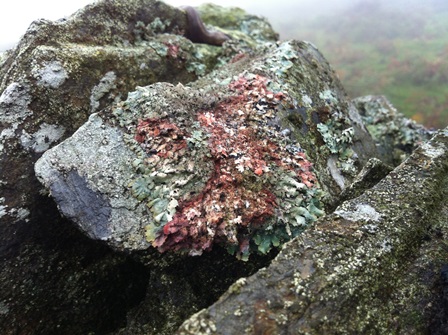
Sluagh – ‘Hosts’, the spirit world – the ‘hosts’ are the spirits of mortals who have died. The people have many curious stories on this subject. According to one informant, the spirits fly about “n’an sgrioslaich mhor, a sios agusa suas air uachdar an domhain mar na truidean’ – ‘In great clouds, up and down the face of the world like the starlings, and come back to the scenes of their earthly transgressions’. No soul of them is without the clouds of earth, dimming the brightness of the works of God, nor can any make heaven until satisfaction is made for the sins on earth. In bad nights, the hosts shelter themselves, ‘ fo gath chuiseaga bheaga ruadha agus bhua-ghallan bheaga bhuidhe’ ‘behind little russet docken stems and little yellow ragwort stalks’. They fight battles in the air as men do on the earth. They may be heard and seen on clear frosty nights, advancing and retreating, retreating and advancing, against one another. After a battle, as I was told in Barra, their crimson blood may be seen staining rocks and stones. ‘Fuil nan sluagh’, the blood of the hosts is the beautiful red ‘crotal’ of the rocks, melted by frost.

Crotal_Blood

These spirits used to kill cats and dogs, sheep and cattle, with their unerring venemous darts. They commanded men to follow them, and men obeyed, having no alternative.

It was these men of earth who slew and maimed at the bidding of their spirit-masters, who in return ill-treated them in a most pitiless manner. ‘Bhiodh iad ’gan loireadh agus ’gan loineadh agus ’gan luidreadh anus gach lod, lud agus lon’–They would be rolling and dragging and trouncing them in mud and mire and pools. ‘There is less faith now, and people see less, for seeing is of faith. God grant to thee and to me, my dear, the faith of the great Son of the lovely Mary.’ This is the substance of a graphic account of the ‘sluagh,’ given me in Uist by a bright old woman, endowed with many natural gifts and possessed of much old lore. There are men to whom the spirits are partial, and who have been carried off by them more than once. A man in Benbecula was taken up several times. His friends assured me that night became a terror to this man, and that ultimately he would on no account cross the threshold after dusk. He died, they said, from the extreme exhaustion consequent on these excursions. When the spirits flew past his house, the man would wince as if undergoing a great mental struggle, and fighting against forces unseen of those around him. A man in Lismore suffered under precisely similar conditions. More than once he disappeared mysteriously from the midst of his companions, and as mysteriously reappeared utterly exhausted and prostrate. He was under vows not to reveal what had occurred on these aerial travels.

I took down several stories of persons who went with the ‘hosts.’ Here is one of the stories of the ‘hosts’ summarised:–The beautiful daughter of a king of France was taken up by the ‘hosts,’ and carried about in the air, over lands and seas, continents and islands, till they came to the little island of Heistamal, behind Creagorry, in Benbecula, where they laid her down in such an injured state that she died from the hard treatment; not, however, till she had told about the lands to which she had been carried, and of the great hardships she had endured while travelling through space. The people of the island buried the princess where she was found.

The ‘sluagh’ are supposed to come from the west; and therefore, when a person is dying, the door and the windows on the west side of the house are secured to keep out the malicious spirits. In Ross-shire, the door and windows of a house in which a person is dying are opened, in order that the liberated soul may escape to heaven. In Killtarlity, when children are being brought into the world, locks of chests and of doors are opened, this being supposed, according to traditional belief, to facilitate childbirth.
These Hebridean and Highland accounts concur with records of similar beliefs from Ireland and the Isle of Man. The Sluagh Sidhe were dangerous, vengeful and often angry – they were represented (as Aleisoun Pearsoun was informed) by gusts of wind which marked their passing. These fairy ‘blasts’ might burn your skin with ignis sacer or boils or other visible cutaneous conditions. They strike you with fairy darts rendering you sick, or paralysed down one side (a ‘stroke’, the name still used in medicine today). They might also carry you away in a state of delirium to a place you had no intention of being – you would be ‘taken‘ by them, sometimes into their own fairy world!

The Sluagh Sidhe/Sith were – like the Fianna of ancient Ireland – bands of souls who roamed the world outside of the laws of settled everyday life. They were dangerous and liminal, yet potentially helpful and – in the fairy faith discussed by Kirk and other commentators – could redeem themselves, sometimes by sharing the knowledge of how to ‘heal’ the harm they cause, and from there could pass to a different place – in the west, beyond the sunset.

A Fairy Doctor was a specialist who understood these modes of harm caused by these Fairy Hosts. He or she also understood the ‘principle of inversion’ which governed how we and the otherworld interacted together, and was able to intervene or advise in redressing this balance.
St Latiaran of Cullen (Cuillinn)

Cullen or Cullin is a small village about four miles south of the Kerry border, near the town of Millstreet in the old Barony of Dulhallow, Co. Cork. It is home to an old ‘holy well’ dedicated to an Irish female saint known as ‘Latiaran’ or ‘Laitiaran’ (sometimes spelled ‘Lateerin’ in older english books), also known as ‘Laserian’. This last version has an interesting concordance with another supposed early male saint, associated with smithily-named St Gobban of Leighlin (Co. Carlow): This was his brother ‘St Molaise’ (St Molashog), also known as ‘St Laserian’. Whether hearking from Cullen or the bosom of Gobban, all of these saints have a curious set of accretions to do with blacksmiths. Latiaran herself is stranger still as she (and her sisters) do not seem to have an official place in Ireland’s various historic calendars of saints, and have all the trappings of Christianised aspects of a/the feminine triple-deity. 

The popular story about Laitiaran of Cullen, recorded by travellers there in the early 19thC was that the saint once lived in the village, from where she would regularly travel across the old bog-causeways to visit her two holy sisters. Such was her piety, she refused to keep her hearth-fire burning in continuity (a pagan custom/superstition), but would instead go daily to the blacksmith’s forge in the village to get a ‘seed’ for the fire, which she carried home in her apron or cloak, and which miraculously did not burn it. However, one day, she let her sanctity slip a little when the blacksmith complemented her on her shapely legs or feet, and a lapse into vanity caused her to take a peek and see if he was indeed right. The ember burned through her apron and singed her ankle, the result being that she cursed the smith, to the effect that ‘there never was a blacksmith in Cullin thereafter’.

This is yet another striking example of the christianisation of an important part of the original Gaelic pagan mythos. The name, Cuillin, is that of the legendary blacksmith from whom Cuchullain was named, and with whom I have suggested a strong etymological and legendary link to the Germanic character Weland/Wayland. The imposition of a female saint into such a tale involving this character is also seen at Slieve Gullion in Armagh. You might recall the the pagan Brighid was associated with ‘smithcraft’. But what more about ‘Lateerin’?

She is one of three regional sister-saints : Laiser, Inghean Buidhe and Latiaran, sometimes also given as Craobh/Crobh Dearg, Latiaran, and Gobnait. Assuming craobh dearg is the original meaning, ‘red branch’ – something the local legends of Cullen would disapprove of! Gobnait’s name is redolent of gobban (blacksmith), and her feast day in the Martyrology of Oengus is 11th February (Imbolc). This is really fascinating. The mystery deepens when we realise that Latiarin’s pattern day was/is held at the well on July 25th, or the nearest Sunday (or both!) corresponding to the pagan festival of Lughnasa, as detailed in Maire MacNeil‘s amazing book, ‘The Festival of Lughnasa’. The pattern of Ingean (or ‘Ineen’) Bhuidhe was (unsurprisingly) celebrated near the start of May at the local settlement at ‘Bull Ridge’ of Dromtariff, while that at the well of Cill Lasaer (who presumably is identical with Gobnait) was at the ‘start of spring’ (early February, Imbolc), and was held at Boherbue (Bóthar Buí = Yellow Road).  

The anglophone part of her name, ‘-teer-‘, appears to be from the Gaelic word saor/tsaoir, meaning ‘smith’ or ‘craftsman’, and ‘teerin’ could therefore quite conceivably signify the ‘smith’s daughter’. Laitiaran is the modern Irish orthographic spelling, which perhaps belies the name’s true origins as an attempt to obfuscate a piece of important Irish pagan lore… Astute readers might recognise that the names ‘Lasaer’ /’Lasair’ and ‘Lateer’ are pretty much the same, derived from the prefix ‘La-‘ and the Irish word for blacksmith – saor . Bui, is also a name of the Cailleach Bera in the famous ‘Lament’ poem, not to mention part of the name of Boherbue/Boherboy nearby.

This intrigued MacNeil deeply, although she did not make the linguistic association of ‘Latiaran’ with blacksmiths. She did however notice the possible connection between the triad of divine females and the passage from the Book of Leinster which describes Badb, Macha and Anand, from the last of whom it says the nearby Paps of Anu were named… She also wondered if the nearby Lughnasa hill of Taur might have been the lost ‘Tara’ of Munster, Teamhair Luachra. This theory is especially intriguing given the fire-kindling, Bealtaine associations of the other Royal Teamhair.

What are the other local links with blacksmiths and fire?

 The old Barony of Duhallow in northern Cork contains the aforementioned villages of Boherbue and Cullen, but is also notable for some of its other placenames such as Banteer, whose name contains an overt suggestion of ‘Female Smith’ (‘Bean tSaor’). In fact, County Cork itself has a fair share of legends regarding a famous hallowed Blacksmith-Builder-Craftsman, the Gobban Saor.  


Fairies at Beltane – friend or foe?

Continuing my Beltane theme, I aim in this post to examine the role ascribed in pre-modern folklore to fairies and witches during these festivities.

Beltane (Bealtaine, Beltain, Bealtuinn, Boaldyn etc) was another period in the annual cycle of the Atlantic peoples when the spirit world was supposed to be closer to our own (another was Samhain/Sauin), and for this reason certain rituals and customs were observed in regard to these spirits.

The power of vegetative growth and movement of animals is potently evident during this festival and many of the Beltane rituals, as well as being a celebration of this fertility, were designed to sain and protect it from antagonistic forces. The three spiritual forces defined by folklore as posing a potential threat at Beltane were fairies, witches and the Evil Eye, although the second and third may be considered similar. These might prove harmful in different ways:

Protection from Fairies?

Fairies were considered a threat in that they were deemed to be jealous of human abundance (see my commentary on Robert Kirk’s essay for a discussion of this), easy to anger/offend by the ignorant and particularly pervasive at Beltane, as at the other Gaelic (cross-)’quarter days’. Kirk, writing in the late 17thC in the Scottish highlands, expressed the reason why people might fear fairies in a time of abundance with the following succinct explanation:

“…When we have plenty, they have scarcity, and on the contrarie…”

Thomist (after medieval philosopher Thomas of Aquino) views on spirits underpinned much of the theological worldview of Christian Europe after the 13thC. These defined the sins of envy (invidia) and pride (superbia) as spiritual and therefore the only ones incorporal spirits were capable of. This neatly encapsulated the Christian bibilical narrative of the ‘fall’ of proud satan, who envied god. The agents of evil in the Christian worldview were the demons who conducted the will of higher (or lower!) spiritual agents; As ‘fallen angels’ they shared the sins of ‘Lucifer’. This concordance with fairies is obvious, and folk-narratives often reinforce it by claiming fairies and elves to be ‘fallen angels’ in line with Christian doctrine.


Maintaining the ‘otherworld balance’ was a core aspect of traditional Gaelic and Atlantic European culture – modesty was the watchword for a happy life: Attain too much and the otherworld will take it; You would speak with guarded modesty about things you admire, and be cautious with praise lest it invites alarm that you might ‘attract’ forces from the otherworld… Such customs persist among the Gaels to this day, and in other traditional peoples such as the Scandinavians. The Swedes and Norwegians entertain the concept of lagom, for instance, which translates roughly as ‘modest sufficiency’ or ‘just enough’. The Danes have ‘hygge‘ – a term expressing the comfort of the ‘middle way’. Similar concepts pervade other Atlantic cultures.


Witches’ (persons practicing magic designed to steal/transfer vital force) appear to have been a human conception of the same idea. It is often unclear in Gaelic folklore if there is any specific distinction made between the two forces. Why was this so? The strong presence of the Cailleach/Fairy Queen in Gaelic folk-myths placed the personification of the ‘magical hag’ in a context of fairytales and allegory rather than immanent threat.This was coupled with the failure of a judicial witch-panic to take hold in any degree in Gaelic heartlands between the 16th and 18th centuries. Added to this, in the Gaelic world, the process of ‘bewitching’ was more likely to be seen as a passive process anyone might be capable of, on account of the prevalent belief that a jealous eye (an droch shùil) could abstract vigour and fertility from people, animals, property and land. This seen more as a human foible, rather than as an act of service to the devil, and in areas with a stronger conservative and traditional view of religion, the social opinion was that it was a spiritual crime, deserving a spiritual punishment. ‘Witchcraft’ – either by a jealous eye or by abstracting magic – was just another method people used to try and survive: It – like fairies – was a fact of life that informed the apotropaic customs associated with the liminal festivals of the Celtic year.


So… more properly, it is best to see Beltane as a time when it was considered prudent to protect oneself, one’s household and one’s possessions from abstracting forces.


I have mentioned that yellow flowers were said to have been scattered outside houses to protect against fairies at Beltane. However, the decoration of thresholds with specific plants also has other connotations – to distract a jealous eye or as a form of welcome to spirits.

This ‘diversionary’ strategy is a widespread tactic employed in dealing with the ‘evil eye’, as anyone who has looked at fishing boats or doorways in many Mediterranean countries, where symbols are used for this purpose. Floral decorations would be equally effective in the Gaelic conception of distracting the Evil Eye and therefore witchcraft. In fact, fairies being notoriously jealous creatures, the flowers may work upon them the same way, rather than acting as garlic does to vampires…

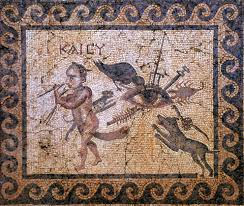
Roman era mosaic of a happy Lare protected from sharp and venomous things by the apotropaic Eye symbol

Roman era mosaic of a happy household spirit (Lare) protected from sharp and venomous things by the apotropaic Eye symbol

Flowers have the appearance of the eye, which would allow them to function in such a manner…

Welcoming fairies:

There is, however, yet another aspect to the flower-strewing customs that mark the Beltane season, which as I have previously commented, shares a kinship and plasticity with the festivities of Easter and Midsummer/St John’s day. The traditions of strewing greenery have a distinct air of welcoming to them also, particularly where (as in the Isle of Man) rushes and Yellow Flag Irises were sometimes strewn in doorways (See: ‘Manx Reminiscences’ John Clague). One late-19thC  Manx poet, Edward Faragher of Cregneish, expressed this positive opinion of the fairies as follows (From ‘Manx Notes and Queries’ by Charles Roeder, for whom Faragher acted as collector of local folklore):

The Fairy Queen—the old folk said—
Was going round on old May-night
When all mankind was gone to bed,
And in the flowers did delight.

She kindly blessed each little cot,
Where yellow flowers did appear:
If there were none – she blessed them not
But gave bad luck through all the year.

I still remember on May-day,
Those flowers scatter’d in Cregnaish,
But since the Queen is gone away
No flowers at the door we place.

Faragher’s reference to a ‘grace and favour’ visit by the Fairy Queen on May Eve has few other direct corroborations in Manx folklore, however. Certainly, the island’s Fairy King, Manannan, was (and is still) celebrated at midsummer (the Germanic Walpurgisnacht) and welcomed with green rushes and sprigs of Artemesia vulgaris (Mugwort, Bollan Bane, Bollan-Feaill-Eoin), but as with much of the post-Christian world, the feminine seems to have been suppressed, or at least to have followed the Island’s tendency to amonarchial feudal republicanism.

Nevertheless, the association of Beltane Eve with potential visitations by potent females (human or fairy, royal or otherwise) was a consistent feature of concern in folklore, also a feature of Imbolc/Candlemass/St Brigit’s Eve and Samhain/Hallowe’en/Holllantide/Sauin/Hop-tu-naa. 

A good example of the May greenery persisting as a ‘welcoming’ rather than apotropaic tradition is seen in the relaxed and joyous collecting and parading of May-crowns/May-bushes and the well-dressing and rush-bearing ceremonies that were once in evidence across the north-western counties of England – many similar to those found in the Gaelic world, it would seem. These seem distinctly redolent of the happy customs once seen at the Lughnasa/Luanys/Lammas festivity harvest-homes. The happy and optimistic nature of Beltane seems to preclude it as a time of fearful apotropaic activity, although it was certainly considered a time of vulnerability. The same can be said about the birth of a new child, when extra care is taken…


The meanings of Beltane

Following on from my last thematic post, I wish to discuss some of the deeper meanings behind the festival of Beltane, known in Irish as Bealtaine, and Manx as Boaldyn. I have employed the English spelling 'Beltane' when talking in the general sense, simply because this is the language I use.

A Manx Crosh Cuirn

A Manx Crosh Cuirn

It really is an old festival, proceeding from times when religion was generated from the landscape, seasons, survival and memories – not from books. The empirical observations of nature's great mechanism assigned particular periods where change was apparent a specific importance, and Beltane was one of these.

It represents the surge of trees into full leaf, the arching and dividing of shoots to form branched plants, and the appearance of swarms of insects. Climatically it is warm and wet – the ideal generative conditions for nature to surge into full life. The response to this growth is visible in the behaviour and migrations of wild animals, and reflected in the procedures of transhumance when it is safe to move animals to upland pastures. It is perhaps not surprising that the groups of stars or constellations in which the sun is noted to travel during this period have ancient names which correspond closely to agricultural animals – Aries (the ram), Taurus (the bull), the Pleiades (plovers) and mysterious Cetus (see my earlier post about Iron Age coins). None of these will be visible in daytime in the sun's glare (except perhaps Taurus and the Pleiades just after sunset), and are hidden below the horizon at night! Boötes ('The Herdsman' -home of the bright star Arcturus) and Virgo ('The Young Woman' whose brightest star is Spica which represents a fertilised ear of corn) are visible rising on the ecliptic path to the southeast as the sun sets on Beltane eve, however… The 'meaning' of these constellations appears to have been assigned on the basis of the seasonal events they attend.

Irish Bealtaine customs:

According to William Robert Wilde, (Irish Popular Superstitions, Pub. McGlashan, Dublin 1852) the pre-famine celebration and customs of the Lá Buidhe Bealtaine included the following:

1. Bealtaine bonfires: Usually lit on May eve. He says that the embers would sometimes be taken away to peoples homes to light their own fires, and the ashes considered lucky and curative. Wilde records the burning of horse skulls and animal bones on the fires, as well as the May bush.

2. The May Bush: A decorated uprooted bush or small tree which was carried around ceremonially by youthful celebrants. It was burned on the bonfire.

3. He describes stories of parties of young character-actors similar to those of the Manx 'Summer Queen' and her troop.

4. May Flowers: Like in the Isle of Man, the Bearnan Bealtaine or Marsh Marigold (Caltha palustris) was a principle apotropaic Mayflower. Any other yellow wildflowers would be used to decorate houses and doorways etc.

5. Household superstitions: Wilde describes a superstition that it was unlucky to give fire or milk from the house at Bealtaine. He associates this with making the household vulnerable to fairies. Curiously, this superstition applies to Easter in the Isle of Man.

6. Spring wells and dew: A number of superstitions existed about the power held in the dew of May morning. Going to a person's land and skimming the dew was considered an attempt to transfer/steal its productivity. The same applies to skimming someone's well or spring. Conversely, wells were resorted to for ablutions and drinking first thing on May morning, and girls would also try and wash themselves in the dew of May morning.

7. May balls: Aside from dances and frolics, Bealtaine was also sometimes associated with spherical balls: One of these was a large football, kicked about as part of a May 'wide-game', and another was a custom of carrying a decorated ball suspended from a pole.

The book was a misty-eyed look back at pre-famine Ireland, and it is evident from its tone that Wilde perceived the famine to have caused a cultural collapse of traditional customs. He was correct, of course, and the latter half of the 19thC was marked by a rise in the power and influence of the Roman Catholic church which sought to fill the void of the decimated culture with its own cultural 'produce'.

Apart from the aspects of fun attached to former Bealtaine celebrations, it is worth examining in more detail the meanings of the customs Wilde and others have described.

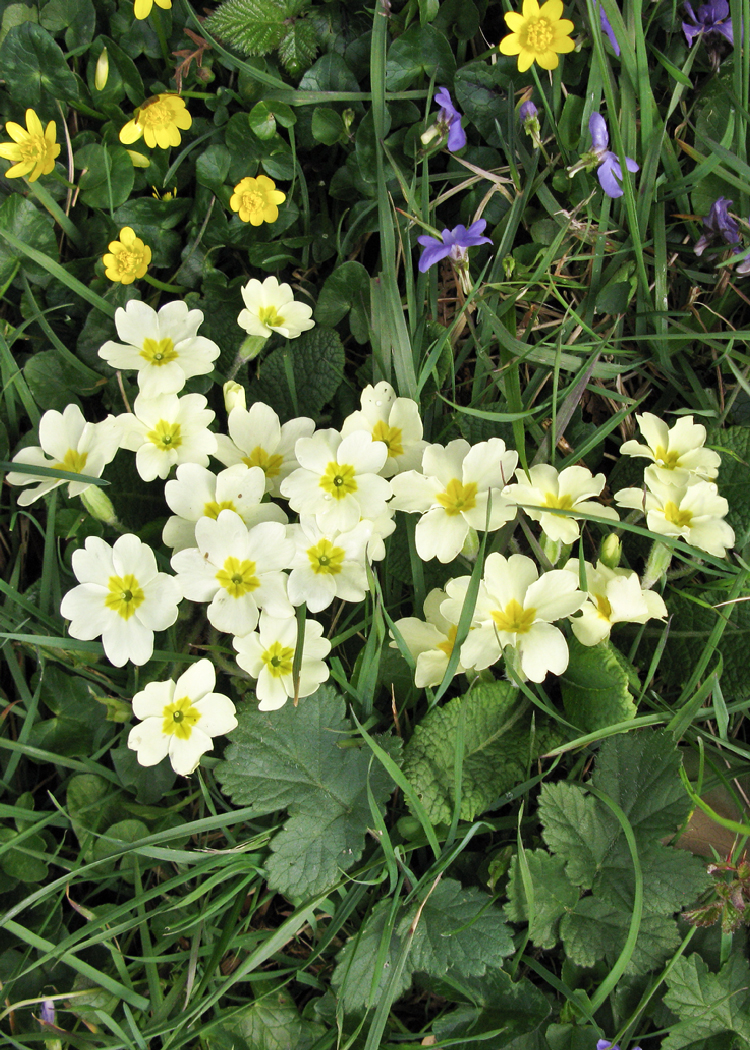
Primrose_IMG_1803_2009_04 copy (1)

Water, trees and fertility:

The similitude between water and the plant life that relies upon it to survive permeated the empirical (i.e. – pagan) philosophies of Atlantic Europe. The physical patterns traced by the branches, stems and roots plants are similar to the shapes of river deltas. Plants 'spring' up from the ground in the season named in honour of this – just like water has a similar tendency to gush forth. The 'flood' of greenery at Beltane is analogous to the floods of rivers and the ocean tides. It was anciently believed that dew was created by the moon whose cold light was supposed to create moisture. Furthermore it was believed that its disappearance from the leaves of plants as the morning progressed constituted a 'drinking in' of its goodness. Grass and its dew, spring-wells, and the flow of milk from cattle were considered analogous parts of the same systematic (spiritual) process of conveying life and goodness.

Moisture along with heat were considered the pre-requisites for generating life.

Fire and continuity:

The May fires and hearth-customs were another important part of the fertility/continuity philosophy of Beltane. The custom of creating frictional fires such as the Tein-eigin, particularly when the sun is transiting across the virile spring constellations of Taurus and Aries is an interesting evocation of sexual intercourse. The 'eternal flame' once apparently common to early Celtic Christian monasteries was an aspect of something pagan, and the hearth-kindling traditions and beliefs about ancestors (fairies) and their relation to the hearth are important features of the Atlantic Religion. The hearth is the heart of a household, and a witness to generations of occupants. Open air hearths (e.g. – the Fulachtai Fiadh) were a feature of pagan ceremonials, there being good evidence for this from archaeology and literature. These represented the 'tribal hearth' and had significance to Bealtaine in Ireland, in particular at places like Tara (where Muirchu says Patrick extinguished the sacred fire at 'Easter' time) and at Uisneach. These fires, used to rekindle the fires of the tribe were a powerful unifying force in ancient Gaelic culture, and the ability to host them was the province of kings or high-kings whose 'spark' (married to the 'wood' of the feminine earth) was the inspiration and generation of the Tuatha. Perhaps the 'May Bush' was figurative for the sovereignty goddess, and its burning a form of heiros gamos?

Confusion with Midsummer?

There are a number of independent written accounts from the 19thC which suggest that Midsummer fires in Ireland, Scotland and the Isle of Man were also called 'Beltane' or 'Beltein' fires. The original entry in Sanas Chormaic describes two fires, usually interpreted to mean twin fires, between which cattle were driven. This was said to have been the case in the Isle of Man by William Harrison in his 'Mona Miscellany' (Manx Society Volume 16, Pub. 1869), althougn he could have been quoting the authority of O'Flaherty. However, the entry may be a reference to two early summer fires, held individually on 31st April and at midsummer.

The original texts in the various copies of Sanas Chormaic do not give a date for the festivity, which was glossed in by O'Donovan on the basis of an apparently continuous tradition centred on the 1st of May. It might be that midsummer fires were a christianised form of Beltane which became conflated later on, but midsummer bonfires were a pretty certain pagan activity as well.

Fertile Bridget:

The astronomical event of sunset at Beltane eve sees the constellation Virgo rising in the southeastern horizon. She is preceded by the roaring fiery Lion that is Leo who is bathed in the warmth of the setting sun (assuming you don't live in the Isle of Man where it is probably raining!). Those familiar with the Norse and Germanic mythologies will know that Freyja was the goddess of love among the Scandinavians, and was depicted in Icelandic mythology as having a chariot drawn by cats (Snorra Edda, 'Gylfaginning').This is evidently a reference to these two constellations, and the association of Beltain with love and fertility must somehow be related to Freyja. St Bridget is associated not with Beltane, but with Imbolc (1st February), but the year is young in February and 'Saint' Bridget was a virgin according to the myths of her desexualised religion. So what is the relationship between the Norse Freyja and the Gaelic conception of the year as a woman? Those familiar with my writings might recall I have previously commented upon the similarity between the names of Bridget and Freyja: This is most evident in the Manx versions of Bride's name: Breeshey and Vreeshey, pronounced 'Breesha' or 'Vreesha', even 'Braysha' or 'Vraysha'….

Etymologies of 'Beltane':

Conventional interpretation divides the wordsound into two parts: 'Bel-' and '-tane'. The oldest written forms were beiltine and biltine (Sanas Chormaic).

The prefix has been variously described as a reference to a god called 'Bel' (a popular idea in the 17th, 18th and 19th centuries), the word for 'mouth' or 'opening' (bealach), 'health' (beatha), prosperity (bail), food (bia/bea), fold/enclosure (baile/balla) and tree (bile). The Manx version 'Boal' has aspects of bovine animals (boa) and bowls (bol-). The suffix '-tane' is usually related to fire (teine) but might also relate to territory or a district (tain – derivation being 'tanistry' and the Germanic word 'thegn' or 'thane'), a cattle-herd or drove or war spoils (táin)or even water (tain). The Manx pronounce the suffix '-thane', but other regional pronunciations vary the 't' sound from hard 't' to 'tch'. As all have accrued meaning that can be freely related to folklore about Beltane it is hard to come to a firm conclusion.

'Fires of Bel' and 'Cattle Fires' are both etymologies that have been suggested in the past, as is 'opening to fire' (from 'bealach' and 'teine' – meaning the hot months of summer). It might also mean 'Cattle-drove of Bel', 'Enclosure of Land' or perhaps more likely: 'Health/Prosperity of Land', or 'Tree Fire' both of which seem to fit the more fundamental aspects of the celebration.


Concordance in Norse/Germanic and Irish mythology

Pagan mythology evolves in response to the environment which gave birth to it, so it is perhaps unsurprising that mythology along Europe’s Atlantic climes should share much in the way of similarity. In this post, I seek to discuss some of these

Odinn and Manannan:

Legends about Odinn and Manannan demonstrate a number of obvious correlations. They are both wise. They are well-travelled. The look after the souls of those who have passed on. They are rulers of the Otherworld. They possess magical abilities and magical artifacts, which they donate to heroes in stories. They can change their appearance and are shapeshifters. They both ride a magical horse.

Odinn (whose German name Woden means madman) appears to have suffered from episodic bouts of madness or wondering, and although madness is not an explicit theme with Manannan, travel and wondering appears to be. The fact that Manannan appears to have been somewhat conflated with Merlin (who Geoffrey of Monmouth made explicitly unhinged) is of particular interest. He is described as ‘Melinus’ by Geoffrey’s euhemerist colleague-at-arms Jocelyn of Furness, and is also called ‘Merlin’ by early 18thC author George Waldron. Other famously mad tree-dwellers from Irish myth include king ‘Suibne Geilt‘, and from the Fenian mythology the interestingly love-mad Diarmuid Ui Duibne (finally caught hiding in a tree). Diarmuid is paralleled by another Fenian myth with a character who loves Fionn’s intended woman and ‘takes flight’, called Derg Corra . He, like Diarmuid is hunted down by Fionn using his (‘Odinnic’) divinatory power and finally discovered hiding in a tree, seemingly out of his mind. The Eddas refer to Odinn hanging himself from the world tree in order to get divine knowledge, which is a theme linking Fionn to another character from Germanic mythology:

Sigurd and Fionn:

The motif of the dwarf-mentor and the killing and cooking of an otherworld creature is familiar to both the Irish story known as ‘The Boyhood Deeds of Fionn’ (Irish: Macgnímartha Finn) and the poetic Edda narrative known as the Völsungasaga. In the saga version, Sigurd kills the dragon Fafnir and gains understanding of the language of birds when he inadvertently licks his finger while roasting Fafnir’s heart for the dwarf Regin who desires this knowledge. In the Fenian version, of course, Fionn is cooking the Salmon of Wisdom for the dwarf-druid Finnegas when he does the same. Both of these tales may represent a narrative theme popular in their day as both written texts have been located to the 12th/13thC, but then again – they may be from an older oral tradition!

Finn, Cuchullain and Thor:

Thor and his battles against giants and monsters are one of the key hero-myths of the Icelandic Eddas. Like the ancient Greek figure of Heracles, he transcends what is normally acheivable in his fight against the forces of chaos. The same role is represented in Irish mythology by the ‘larger than life’ heros Cuchullain and Fionn mac Cumhaill, although when compared to the Eddas and Greek myths, the overt ‘sacred’ nature of their narrative importance has been obscured by christianisation of their stories.

Wayland, Chullain and the Gobban Saor:

The ‘hero-smith’ narrative is widespread throughout Irish mythology and placenames, yet the legends have suffered (like those of the Cailleach) from significant demotion or erasure during the inscription of the traditional narrative tales of the pagan world. This makes them all the more intriguing! A similar problem seems to exist with the Wayland legends, in fact.

Magical wells returning water from the Otherworld:

The Icelandic Prose Edda and the Irish Dindshenchas texts from the middle ages both contain explicit references to the mysterious flow of rivers to and from the Otherworld. In the Eddaic version (Snorra Edda), the ‘Otherworld’ source of waters is from the antlers of the stag Eikthyrnir who stands over Valhalla, and whose streams flow down to the bottom of the tree into the well Hvergelmir which is the source of all the world’s rivers and nourishes the roots of the tree. In the Irish sources, the Otherworld streams flow back into secret wells in fairy mounds, emerging as the springs originating the Rivers Boyne and Shannon, which themselves flow into the ‘world-river’ which laps on the shores of the Blessed Isles. As well as being an aquatic analogy, these appear to be describing the ancient belief in the transmigration of souls! This is an important aspect of the ancient Atlantic religion.

Mystical Trees:

The Yggdrasil is the great ‘world-tree’ of Icelandic Eddaic mythology, which was based on the ancestral beliefs of the Danes, Swedes, Norwegians etc who settled in Iceland before the advent of Christianity in the Scandinavian world. It represents an abstract effigy of the idea of human generations, and nourishing rivers  – roots, trunk, branches and leaves. It also acts as an abode for the metaphorical animals representing this kind of fertility, who are strongly associated with regeneration and rivers by their appearance: stags (with their branching antlers) and serpents (whose bodies mimic the appearance of rivers and who shed their skins and are ‘reborn’). Ireland, being ‘freed’ of serpents by St Patrick, naturally also has a number of serpent legends that deal with the pre-Christian era and during the period of Christianisation, but the imagery of the tree and the river was and is important. The tendency of trees to both depict the shape of and attract lightning, no doubt explains their link to ‘thunder gods’ such as Donar/Thunor/Thor and Roman deities such as Jupiter.

A large number of ‘fairy hills’, stone circles and ‘holy wells’ in Ireland seems to be associated with an ancient thorn tree. The Rowan also has great importance in the Gaelic world (particularly Scotland and the Isle of Man) and one is featured in the Fenian myths as being a sacred possession of a giant called Searbhan in the Tóraigheacht Dhiarmada agus Ghráinne.

Ireland – like the Germanic regions pillaged by the tree-felling St Boniface – has an history of special trees, and their demise was detailed in the medieval texts. These may be figurative or actual – the truth is (as with the Boniface account) unclear. The great tree at  Maigh Adhair was recorded in the Irish annals as a sacred tree associated with the inauguration of Munster clan chiefs: Brian Bóruma and his relatives, in particular. There were others besides, including Bile Tortan, Craeb Daithi and Bile Uisneg,many of which were (like Yggdrasil) ashes…


Norse Sea-Giants in more detail…

Giants and monsters have a special connection to the sea in Norse mythology – just like the Titans in ancient Greek mythology. They represent the unconquerable and titanic forces of nature. As characters in stories, their great size can be considered an expression of the large shadows cast by distant things with the low sun behind them – as happens as it passes into the ocean on the western horizon of the Atlantic. The main characters in these tales of oceanic titans are Thor, Loki and Aegir:

Thor wrestling the Midgard Serpent (painting by Füssli, 1788).

Thor with Hymir wrestling Loki’s son – the Midgard Serpent (painting by Füssli, 1788).

The 13thC CE, Icelandic christian scholar Snorri Sturluson wrote a mythological ‘theogonic’ dialogue on poetry called Skáldskaparmál (“language of poetry”) in which the primal sea-giant Ægir, also known as Gymir (a version of ‘Hymir’) or Hlér, discusses kennings and mythology with the Æsir god, Bragi, after the style of the poetic Edda composition Alvissmal. That Snorri chose these two as characters in the dialogue is interesting, moreso because of they seem to represent the two ‘Platonic’ aspects of what to the ancients was knowable – the first: nature and the elements (Ægir), understandable through sense, and the second: the gods and spiritual things – knowable through the mind, and therefore the province of poetry and philosophy (Bragi). In Alvissmal, it is a wise earth deity – a dwarf/dvergar called Alviss (‘All-Wise’) who instructs Thor on poetic kennings. In Skáldskaparmál, however, it is the ‘sea’ (Aegir) talking…

Aegir is also the host of the feast at the centre of the important poetic Edda story Lokasenna (Codex Regius): This is the tale of a feast of the gods and elves, hosted by Aegir, whose hospitality (and his ale and mead) is considered sacrosanct to the gods, who become angry when troublesome giant/god Loki starts drunkenly abusing the guests. This episode assures Loki’s imprisonment and Promethean-Orphic torture by the gods (he must endure the poison dripping from the fangs of a serpent ) until the showdown of Ragnarok. Aegir’s legendary cauldron or brewing pan seems to provide a link between the elements and the mind, and Lokasenna (the ultimate drunken social meltdown) provides an amusing view of how leisure and strife were never far away from each other in the Viking world. The poetic Edda version from the Codex Regius says Aegir was also called Gymir, and ‘Hymir’ is the giant with mighty caudron/brewing-pan who is Thor’s host and companion when he goes fishing for the giant Midgard Serpent in the poetic Edda tale of Hymiskviða (Codex Regius). Hymir, Gymir and Aegir are probably the same mythological sea-giant.

Aegir was said to be one of three sons of the giant-ancestor Fornjótr (described as an ancient king of the magical north),the other two being Logi (fire) and Kári (wind).  Fornjótr might in literally mean ‘First Giant’. The compounding of his watery son’s name with ‘-gir’ is redolent of the word ‘Gyr’ (eg – Gygr) and theirefore of the Greek words Gigantes and Gygas, representing the larger than life ancestral deities of ancient Greek myth. Ægir might even be a Norse version of and the sea-giant Geryon, who had three bodies. This association with the elements (water in Aegir’s case) comes from the Skáldskaparmál kennings of the primal elemental forces:

“…How should the wind be periphrased? Thus: call it son of Fornjót, Brother of the Sea and of Fire, Scathe or Ruin or Hound or Wolf of the Wood or of the Sail or of the Rigging…”

The only classical element missing from the ÆgirKáriLogi triad is earth (jörð), usually represented in Norse myth and kennings as the eponymous giantess Jörð – ‘wife of Odin’. The Earth is feminine – like in the Greek Gaia/Ge. It is obvious from both ancient Greek and Norse mythology that the ‘giants’ bear names with suffixes which connect them intimately with ‘mother earth’: Gigantes (‘Born of Gaia/Ge’) and Jötnar (‘Born of Jörð’).

Aegir’s other name or kenning is given as Hlér, which seems incredibly close to the Irish/Welsh/Manx name for the sea: Lir/Ller/Lear of whom the legendary Sea God Manannán/Manawydan was the son. In the most important 14thC Icelandic manuscript collection, Flateyjarbók, the following is said of Aegir/Hlér and his family:

“…There was a man called Fornjót. He had three sons; one was Hlér, another Logi, the third Kári; he ruled over winds, but Logi over fire, Hlér over the seas…”

The connection between Logi and the Norse ‘god’ figure Loki is uncertain. The names certainly seem similar, and Loki is definitely one of the Jötnar, being portrayed in the Edda myths as something of an uncontrollable ambiguous shape-shifter as well as a father (or even a mother) of monsters and magical horses. One might even compare him to the role of the Gorgons in Greek myth – a frightful challenge to be overcome by initiates into the mysteries of life, death and the otherworld. Logi represents fire – perhaps one of the most untameable and dangerous, yet useful ‘elements’ – and Loki represents a similar aspect of chaos in his oppositional and inductive roles in the Eddas. He, in fact, comes across as a character the Christian (and Muslim) narrative would assign to their ‘evil god’ – Satan – otherwise known as God’s right-hand man in the Hebrew Book of Job.

Another ‘giant’ of note in Norse myth who is tied closely to Aegir and Loki in surviving narratives is the god Þórr (Thor), whose name seems to be cognate with the word Thurs (þurs) which is another Germanic word for a giant/titan. In the Icelandic mythologies recorded in the Christian era from orally-transmitted traditional pagan poetic and story traditions, Thor is associated with great strength and battles with giants and monsters using his great hammer Mjölnir which represents both a weapon and a tool. His traditional role in Germanic societies is as a protector and battler with the elements akin to the Greek Herakles (a fact not lost on the 1stC CE Roman author and historian Tacitus), and he seems to have an agricultural/fertility aspect on account of this. This connects him to the folk-legends of similarly enthusiastic (but not too bright) ‘helpful fairies’ – Brownies, Glaistigean, Phynnodderee, the hammer-wielding Leprechauns and the ‘Hobthrust‘ of northern England…

The poetic Edda composition called Hymiskviða is a tale of Thor being sent by Aegir to fetch a giant brewing-pan or cauldron from Hymir – the giant who lives ‘at the edge of Heaven’. Hymir is said to be Aegir’s father, and Aegir also goes by the name Gymir, of which ‘Hymir’ is an aspirated pronunciation. Thor ends up going on a perilous fishing expedition with Hymir, during which Odin’s son manages to land the Midgard Serpent, Loki’s son Jörmungandr who encircles the Earth biting his tailHymir considers it very bad news when Thor bashes the serpent over the head before letting it slide (presumably lifeless) back under the waves… It can be seen here that the same consistent association occurs between oceanic Titans and sea monsters in medieval pagan Norse myths.  The outcome of the story is that Thor obtains the brewing pan that will make the ‘poisonous’ ale or mead that spurs Loki to sow discord among the gods in Lokasenna. The killing of Jörmungandr and the breakdown of order with Loki and the giants/monsters presages the Ragnarok… This imagery appears upon a number of incised stones of the Viking era (including Cumbria and the Isle of Man, as well as in Scandinavia), providing corroborative evidence of its importance in Scandinavian-influenced Atlantic mythology.

There is much to be identified between the Norse myths and the Irish and Welsh. For instance, the theme of sea-giants and a ‘fatal feast’ featuring a caudron that determines the world’s outcome is seen in the Welsh Mabinogion tales, and the Irish tales ‘Bricriu’s Feast’ (Fled Bricrenn) and ‘The Destruction of Da Derga’s Hostel’ (Togail Bruidne Derga) among others. They appear to be different figurative ‘branches’ of the same ancient tree whose roots are nourished by ‘world-river’,


Similarities in Greco-Roman and Gaelic myth

Although the mythology of the material and intellectual cultures we know as 'Greco-Roman' is Europe's oldest inscribed tradition, that of Ireland and the 'insular Celts' must come next, albeit the written form of it is from a much later date. In particular, it often excels and exceeds the Greek material by its apparent strangeness and stylised 'otherness', yet as a source of pagan myth it needs – like the Norse sagas and Edda texts – to be treated very carefully as it is told by christians, unlike the Greek and Roman material which comes from pagans.

Nonetheless, the Christians did not have much in the way of myth to call their own, except for the 'Old Testament' materials and the early saints' lives, many of which were based on pagan tales, in their style and often in their narrative content: These were essential to pad out its own religious narratives and replace (or at least displace) the contents of the potent oral-transmission culture with a literature-based alternative.

It is worth noting a number of things about southern-European pagan religious culture, however, before framing a debate of paganism vs christianity in terms of oral transmission culture vs. literary culture: Firstly, it is worth remembering that – since the advent of the Hellenistic era in the 5thC BCE – that literary culture became an important stalwart of Greco-Roman societies, and seems to have become a primary mode by which people came to understand their religion. There were certainly traditional aspects to the culture to a late period, but by the advent of christianity, this was being displaced. The role of the priesthood and attendants in many of the most important temples was generally fulfilled as a fixed term civil office by the worthies of Greek and Roman society, so – unlike the traditional and esoteric forms of learning that Gaul (and Britain's) professional priesthood had to undergo, these offices were losing their mystery. Mystery remained the province of cult-centres such as Eleusis, Delphi and the island of Samothrace, and the discourse-communities of the Philosophers – the Neo-Platonists, Hermeticists and Gnostics who thrived in the late-classical world after the advent of Christianity and who pre-figured its rise. It is telling that classical paganism's most complete and (in scope) extensive theogonic text – the Dionysiaca of Nonnus of Persepolis in Egypt – was written by an author whose output later included a commentary on the christian Gospel of John. To understand this is to understand where the impetus for Christianisation was focussed in the less-literate climes of northwest Europe, such as Ireland, in the 5th/6thC CE.

Whereas some of our oldest surviving literature from the pagan world is religious, this aspect of the genre was in mortal decline in parallel to the rise in interest in philosophy and the 'mysteries' from the advent of the Hellenic period. By placing literacy in the hands of a few – a trained elite (after the model perhaps of the barbarian, Egyptian and Eastern peoples) – christianity would place itself at the heart of the new models of kingship appearing in the 'barbarian' world following the collapse of the Roman franchise in the west.

There are many similarities between the written medieval Irish myths and Greek legends. The reasons for this might be fourfold:

1. That the Irish believed in a shared widely-known and ancient cosmic worldview, populated with similar characters and themes to those of ancient Greece and southern Europe, and the Christian authors recorded this from traditional orally-transmitted narratives.

2. That literate monks used Greek and Roman (or Romano-British) myths to flesh out a written Irish narrative which did not otherwise exist – a kind of 'new age' eclecticism.

3. That Irish and Greek myths developed separately, yet shared similarities determined by (a) the culture and traditions/techniques of storytelling and (b) empirical reactions to natural phenomena.

4. A synthesis of points 1-3.

Obviously, the most likely answer is point 4 – we simply do not have enough evidence to support points 1-3 independently, but we have good evidence that all of them have been contributing explanations. I shall now present a number of Irish myths/mythic characters and their apparent Greco-Roman counterparts and let you decide for yourselves:

Cú Chulainn:

The archetypal indefatigable warrior super-hero of the 'Ulster Cycle' stories – Cú Chulainn – seems to have a particular similarity to Herakles or Hercules: He is the son of a god, associated with blacksmith-craftsmen (Cullain). Cullain seems to relate to the Greek 'earth-born' proto-blacksmiths known as the (Idaean) Dactyls, of whom Herakles was sometimes considered one. was a supreme warrior, a lover of goddesses (Fand, wife of Manannán mac Lir) and his nemesis is a goddess (the Morrigan). He is a performer of fantastic tricks and sporting feats, yet forever tied to the whims of his king and his gods. He lives fast and dies young – a true aspect of the Celtic warrior ideal. is also a 'king's champion' warrior archetype – a dog on a leash, as befits his name. He sometimes comes across as bombastic, brash, sometimes clumsy and insensitive – a bit of a lummox at times, and then at others, clever and dextrous, and light on his feet. Like Herakles, he travels to far-off islands and does battle with the weird as well as the mundane, performing 'feats' along the way.

One way in which Cú Chullain differs from Herakles is that Herakles was a folk-hero responsible for taming and conquering the wild and chaotic forces for the good of humanity. In the 'Ulster Cycle', Cú Chullain typically acts on behalf of the interests of his liege lord – like the other famous Greek warrior-strongman Achilles. This perhaps reflects the fact that these Irish legends (like their later French and British 'Arthurian' traditions) were often designed for telling at the courts of elite rulers, and therefore suited the value-system of this milieu. In folk-myths, Fionn and Cú Chullain often take on much more gigantic proportions and attributes.

The Battle of Maige Tuired:

This is the 'showdown' scene of the Irish mythological cycle stories in which the Tuatha Dé Danann, the Fir Bolg and the Fomorians are pitted against one another for supremacy of Ireland. The Fomoire are usually described as a race of sea giants in Irish mythology, and the Manx word Foawr (from 'Fomor') means 'Giant'. They seem similar to the aquatic Titans of Greek myth and the Cath Maige Tuired is like an Irish version of the Greek Titanomachy – the battle and overthrow of the Titans by the Olympian Gods, with whom the TDD share a certain similarity. Similar legends exist from Norse myth – the primal giants here are the Frost Giants: Titans at -40 Celsius! Of course, the bizarre cannibalistic and incestuous Greek narratives of the Titans are absent from the CMT and the 'Book of Invasions' stories which present more of a heroic pseudo-historical dynastic struggle. Tolkein borrowed heavily from the imagery of the battles of Maige Tuired in constructing his battle scenes in Lord of the Rings.

Giants and primordial helpers:

The landscape of Atlantic Europe – particularly those regions where Greco-Roman and later christian culture was slow to assert itself – is riddled with ancient mythology of primordial giants who supposedly played some important roles in determining the shape of the landscape – mountains, fjords, rivers, lakes, plains and great rocks. The same was true of the mythology of the Archaic period and Bronze Age of southern Europe – in particular the mythologies of ancient Greece, but we can discount these as playing a late originating role in the folklore of northern and northwestern legends due to the lack of impact of these material and cultural civilisations in these zones.

The Greek giants and Titans were 'Earth-Born' (Gygas – after Ge/Gaia, the personified Earth). The pagan Norse word used for giants in the middle ages was Gygr – existing into the more modern periods in the Scots Gyre and Faroese Gyro. The Manx equivalent of the Scots Brownie, Uirisk and Grogach legend was the Phynnodderee, 'Dooiney Oie' ('Night Man') or Glashtin – a being considered gigantic, primitive, coarse and animalistic in appearance who helped householders and warmed himself by the hearth at night when humans slept. His local legends seem, curiously, to conflate him with both Fionn mac Cumhaill and even Cú Chullain and, when not explicitly named, with the activities ascribed elsewhere in the Atlantic world to other giants – specified or unspecified. This is a representation of the archetypal earth-born ancestor, and is a particularly important and wide-ranging link between northern and southern pagan mythology which appears to have a commonality stretching way back into the Bronze Age. Herakles was also an aspect of this.

The Otherworld:

Both Greek and Irish myths portray the Otherworld as a location reachable by a westward journey over the great ocean. The legendary Greek islands of Elysium, the Hesperides/Erytheia and Ogygia, and the 'Islands of the Blessed' or 'Fortunate Isles' have their Irish equivalents in the many names of Gaelic mythology's magical western islands which were also considered the resort of departed souls: Mag Mell, Tír na nÓg, Tír na mBeo, Tír Tairngire, Tír fo Thuinn, Ildathach , Hy Brasil, Tech Duinn and Emain Ablach. These places are sometimes explicitly islands, sometimes under the sea, sometimes of a hybrid type that emerges (and just as soon disappears) from the sea.

Like in the Greek legends, the otherworld is also represented as a chthonic realm – beneath the earth. Like the Greeks, the Irish seem to have believed that the rivers of the world joined a 'world river', and that it re-manifested from the otherworld by piercing back though the earth as springs of water. Like the Greeks and Latins of southern Europe, and their fellow Bronze Age and Iron Age era 'Celtic' peoples further north and west they considered springs of water to be important and holy – no doubt for this reason. Sidhe mounds or Fairy Hills were the traditional 'home' of Irish (and to a lesser extent, Manx and Scottish fairies). They were sometimes considered to be the sources of rivers returning from the otherworld. Mountains and artificial mounds had similar associations in Ireland. In a flat landscape, a mound is something akin to an island – a consideration when addressing the 'otherworld inversion' belief that permeates Atlantic European folklore.

An interesting aspect of the Greco-Roman myth is how there seems to be a plasticity in portraying the otherworld 'places' (Elysium, for example) as both meadows or gardens and simultaneously as islands bordering Okeanos. This same conflation appears to represented quite strongly in the old Irish story 'The Voyage of Bran mac Febail' where he is conveyed to the otherworld islands over a sea which gradually appears to become a meadow.

Mermaids and Sirens:

The idea of female (and male) entities who lured men to stay with them in the watery or otherworld realms are common to both Greek and Gaelic myths. The 'Sirens' occur in Greek myths such as Homer's Odyssey and the Argonautica ('Jason/Iason and the Argonauts'). They were sometimes depicted as half-bird, half-female inhabiting islands surrounded by huge rocks and high cliffs, luring sailors to their deaths on the treacherous shores with their beautiful songs. Calypso, the daughter of Atlas on Ogygia also fits the enchanting-island maiden archetype, and although was not considered one of the Sirenai, seems part of the same mythos. Even the Gorgons tempted brave Perseus to their realm, and from his 'killing' of Medusa there was a magical birth (of Pegasus and Chrysaor).

In Atlantic Celtic mythology, this function was the province of alluring beautiful mermaids – usually half-human, half-fish in their conception but sometimes 'seal people' (e.g. – Selkies). The Isle of Man's version of the Cailleach – Caillagh y Groamagh was supposed to fly in from the sea in the form of a bird at Imbolc/La'a Bride, and she may be another aspect of the beautiful fairy maiden called 'Tehi-Tegi' who in Manx legends lures men into the sea or a river to drown them, before flying away in the form of a wren (sometimes a bat!). The Gaelic (Irish/Gallovidian) Merrow was sometimes known as Suire which sounds very much like a version of 'Siren' although this may be in reference to known Greek myths, and this type of mermaid was associated with a feather hat or cape. Crofton Croker's 'Fairy Legends and Traditions of the South of Ireland' is worth reading for a summary on the Merrows.

Harpies and Sidhe Gaoithe:

There was an explicit belief in former times in Ireland, Scotland and the Isle of Man that sudden gusts of wind were caused by the actions of spirits and fairies. Indeed, this was a feature of the demonology of medieval Christian Europe, and may well link back to the ancient Greek beliefs that the Harpies were responsible for the same. They were depicted (again) as half-woman, half bird or as winged female entities and were personifications of storm-winds. The Cailleach Bheara of the Scottish Highlands and Islands had a similar association, and was sometimes considered a female-avian who flapped her wings to make the winter storms. In the Isle of Man, the (not uncommon) tornados were sometimes supposed to be caused by a fairy known as Yn Gilley Vooar ny Gheay – 'Big Boy O' the Wind'.

River Nymphs and Sea Nymphs:

Perhaps subjoined to the mermaid legends, it is notable that the Greeks and the Irish personified their rivers with female spirits or entities. Evidence of this comes from the Dindseanchas legends and those of the so-called 'landscape-sovereignty' goddesses, otherwise referred to as Bean Sidhe, no doubt because river-drainage areas in mountainous landscapes tend to map and define territories. Greco-Roman mythology venerated such female water deities, and this tendency was also found in the European celtic world in the late Iron Age (although much of our evidence here comes after the period of Romanisation). Again, the 'Cailleach' personification from folklore seems to combine many of these functions (Harpies, Sirens, Nymphs etc) into the form of this single protean Titaness. Likewise, the Moura Encantada of the Iberian peninsula and the Marie Morgane of Brittany as well as the 'Lady of the Fountain' (or lake) of Arthurian lays and romances.

Summary:

It is apparent that ancient European paganism was a universal system of philosophy and 'science' illustrated through traditions of the arts: story, poetry, song, pictures, dances and drama. Every possible phenomenon seems to have been addressed by assigning mythology to it, and the boundary between the spiritual and the secular did not really exist – instead there was a continuum. The southern European civilisations emerging from the Bronze Age with a more oriental perspective, eventually coming to consider themselves 'better' and more 'enlightened' than their 'barbarian' cousins (and ancestors) in northeastern and northwest Europe, and due to warfare and incursions of these 'barbarians' between the 5thc BCE and the 1stC CE (and beyond), and due also to the dependence on written knowledge, a perception derived that their religious and spiritual beliefs were 'different', when in fact they had a shared root.


The Evil Eye in ancient Atlantic Europe, ‘101’.

The eye was once considered the one organ which could express the divine light of the soul. In the ancient world a perfected soul was believed to reside in the heavens as a star...

The eye was once considered the one organ which could express the divine light of the soul. In the ancient world a perfected soul was believed to reside in the heavens as a star…

The eye is a curious organ.

As well as receiving light, it appears at times to emit it also. This can be illustrated by the way that nocturnal predators’ eyes appear to glow (actually from reflected light), but there is another ‘light’ of the eye: that which, curiously, seems to disappear from it at the moment of death. This is the ‘spark’ or ‘twinkle’ of the eye whose intensity and quality we perceive to enhance and alter when we laugh, flirt or are excited to enthusiasm or anger. This phenomenon perhaps explained the theory of vision common to the ancient world – that known as the theory of ‘extromission’.

Extromission theory believed that the eye emitted light. Light itself was believed in ancient times to be a higher emanation of the philosopical element of fire, and to the ancient peoples it took two forms for which the Latin words ‘Lumen’ and ‘Lux/Lucis’ came into use. Lumen was mundane light – that emitted by candles, or the sunlight coming through windows and was closest to ‘elemental’ Fire. Lux however represented light in its higher spiritual or intellectual form – the divine light, the light of spiritual and philosophical illumination. Plato explains this in his account of the creation of human bodies from the Dialogue of Timaeus:

“…And so in the vessel of the head, they first of all put a face in which they inserted organs to minister in all things to the providence of the soul, and they appointed this part, which has authority, to be by nature the part which is in front. And of the organs they first contrived the eyes to give light, and the principle according to which they were inserted was as follows: So much of fire as would not burn, but gave a gentle light, they formed into a substance akin to the light of every-day life; and the pure fire which is within us and related thereto they made to flow through the eyes in a stream smooth and dense, compressing the whole eye, and especially the centre part, so that it kept out everything of a coarser nature, and allowed to pass only this pure element. When the light of day surrounds the stream of vision, then like falls upon like, and they coalesce, and one body is formed by natural affinity in the line of vision, wherever the light that falls from within meets with an external object. And the whole stream of vision, being similarly affected in virtue of similarity, diffuses the motions of what it touches or what touches it over the whole body, until they reach the soul, causing that perception which we call sight. But when night comes on and the external and kindred fire departs, then the stream of vision is cut off; for going forth to an unlike element it is changed and extinguished, being no longer of one nature with the surrounding atmosphere which is now deprived of fire: and so the eye no longer sees, and we feel disposed to sleep. For when the eyelids, which the gods invented for the preservation of sight, are closed, they keep in the internal fire; and the power of the fire diffuses and equalises the inward motions; when they are equalised, there is rest, and when the rest is profound, sleep comes over us scarce disturbed by dreams; but where the greater motions still remain, of whatever nature and in whatever locality, they engender corresponding visions in dreams, which are remembered by us when we are awake and in the external world. And now there is no longer any difficulty in understanding the creation of images in mirrors and all smooth and bright surfaces. For from the communion of the internal and external fires, and again from the union of them and their numerous transformations when they meet in the mirror, all these appearances of necessity arise, when the fire from the face coalesces with the fire from the eye on the bright and smooth surface. And right appears left and left right, because the visual rays come into contact with the rays emitted by the object in a manner contrary to the usual mode of meeting; but the right appears right, and the left left, when the position of one of the two concurring lights is reversed; and this happens when the mirror is concave and its smooth surface repels the right stream of vision to the left side, and the left to the right. Or if the mirror be turned vertically, then the concavity makes the countenance appear to be all upside down, and the lower rays are driven upwards and the upper downwards…” Plato – Timaeus 4thC BCE

It is evident from this that Plato considered the pupil of the eye a ‘filter’ to remove the Lumen element of light so that the meaning (information) conveyed in the Lux could be made available for the soul to consider! He considered vision and sensation an interaction between emanations of the soul and emanations of the universe. The Greek word for soul, mind, spirit and consciousness is  ψυχή – ‘psyche‘. The 5thC BCE playwright-‘philosopher’, Epicharmus of Kos, is quoted as saying “It is the psyche that sees, it is the psyche that hears, all the rest is deaf and blind”.

As an organ believed capable of emanation, not just reception, it is of no surprise that beliefs developed suggesting that the gaze of the eye can cause harm. Humans are acutely adjusted to the significance of the manner in which others look at them – a look can convey love, contempt, and any one of a number of other emotions or communications. Aside from the reaction of the perceiver of a gaze, the active principle of light extromission believed in by the ancient Greeks and others allowed that the eye emitted a spiritual force, and if this was evilly intended it would interact with that which it perceived in a harmful way. The most famous mythological account of a harmful gaze was that of the Gorgon – Medusa – whose gaze turned men to stone…

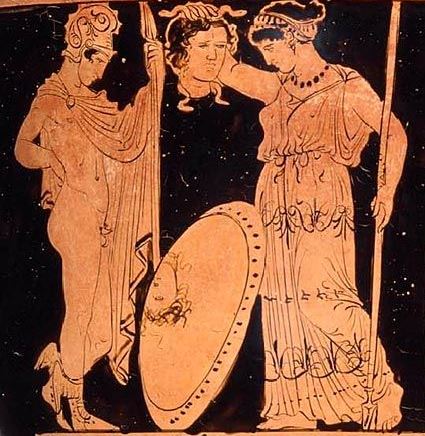
Perseus presents the head of Medousa to an obviously jealous Athena (Aine). Note there are only two snakes protruding from the Gorgon's head...

Perseus presents the head of Medousa to pleased-looking (jealous?) Athena. Note there are only four snakes protruding from the Gorgon’s head – the topmost two resemble horns…

That the gaze of Medusa could turn men to stone was a paradoxical inversion of the eye’s connection to light and thus the philosophical ‘element’ of fire. As Plato expressed it, fire and earth (of which stone was an expression) were the principle diametrically opposed elements of creation, and air and water were those which linked the two fundamental elements in a fourfold system. In Empedocles’ reckoning, the root-element Earth would correspond closest to the consolidating principle of ‘Love’ and Fire to the dissipating principle he called ‘Strife’ – the two contesting forces ascribed to the universe. Medusa’s gaze of stone, rather than light was perhaps a feminine idea of ancient established solidity. The flashing fiery gaze of love was the daimon that inspired the Trojan War, at the advent of Greek (and Roman) oral history’s ‘time of memory’. Being in love might be more dangerous than the stare of Medusa! Plato’s dialogue ‘Symposium‘ examines this theme in more detail.  Lizards and snakes, being considered ‘cold and dry’ by the ancient elemental reckoning, were  linked to the element of Earth and the cold distant chthonic and oceanic realms – the legendary Basilisk, like the snake, could seemingly transfix its prey (‘turn to stone’) with its unblinking stare. Legends are circumlocutive expressions of higher truths and maps of the heavens, as well as good stories…

Yet another European mythological figure with a ‘dangerous eye’ is from the Irish ‘Mythological Cycle’ medieval texts: Balor of the Fomorians, the probable inspiration for Tolkein’s Sauron, whose name also elicits something of the scaly-haired Medusa, or perhaps the legendary Basilisk. The legendary Irish ‘Fomorians‘ were – akin to the Greek Titanes (of whom Medusa was one) – considered a race of giants associated with the sea. They, like the Titans, probably haunted the ancient shores of furthest Okeanos (perhaps even as far as Tory Island!): far away in time and space in the ‘time before memory’…

From the 6thC CE, the western Christian church increasingly began to classify for its adherents the ‘sins’ which it believed were the spiritual errors that led its followers away from God: These were “superbia, avaritia, invidia, ira, luxuria, gula & pigritia” – the ‘seven deadly sins’ of pride, avarice, envy, wrath, lust, gluttony, and sloth. Of these, the majority were deemed ‘sins of the flesh’ or ‘material sins’. However, two were ‘sins of the soul’, namely envy and pride.

   Sins of the Soul were therefore deemed to be those which occupied a spiritual dimension and affected the world in spiritual ways. Envy (Latin: Invidia – ‘in vision’) corresponds exactly to the power known as the Evil Eye. By the ancient extromsission theory of vision the light of the soul illuminated what it perceived as a ‘ray’, and an evil soul would therefore have a negative invidious influence upon what it perceived. Likewise, the common belief that spiritual beings operated in spiritual ways is the foundation for the belief in old Atlantic Europe that ‘fairies’ envied the goods and children of people and wished to spirit them away… The supposed sin of the adversarial Christian spirit called ‘Satan’ or ‘Lucifer’ and his troop of rebel angels was that of pride.

The ‘Evil Eye’ belief in the Gaelic provinces of Ireland, Scotland and the Isle of Man remained important until the late 19th century. It evolved (perhaps as a result of widespread ‘witchcraft’ paranoias of the 16th-18th centuries) to engender two forms: The first (and oldest) belief was that it was a passive force derived from latent human foibles of jealousy (innate sinfulness). The more sinister form of the belief was that which believed the ‘Bad Eye’ to be the actual mode of witchcraft by which magical/spiritual harm could be done by a marginal and jealous socially-disempowered person. In Gaelic areas, there are as many records of belief in the possible abduction of vital forces by fairies as there were by supposed ‘witches’ or even by jealous neighbours. This may be a main reason why there were so few reports of judicial or popular murder of people for ‘witchcraft’ or ‘sorcery’: The alleged ‘perpetrators’ were generally not believed prosecutable in court on account of their lack of corporeality, and/or could not be ascribed the criminal concept of mens rea.

The Gaelic ‘Evil Eye’ belief manifested to observers between the 16th and 20th centuries as the apparent desire by people to offer a blessing on any thing which they had expressed admiration of. People feared that they might passively or unintentionally cause harm. They also obviously feared that their admiration might invite blame if something went wrong. The fact that people who own something that invites envy are prone to that other ‘spiritual sin’ of pride compounds the social aspects of the belief. Ontologically, the message is ‘pride comes before a fall’, or before a loss. The proud are envied, and the envy is ultimately a force which opposes them. Morally, this suggests that modest-living and modest-speaking is the ideal which invites the least trouble in life… This ideal was to become an important cultural shibboleth of many old Atlantic European subsistence cultures, now fallen victim to certain malign aspects of modernity.


‘The Hairy Helper’ – folklore of the Brownies.

The belief that there are omnipresent providential spirits that can help or hinder humans is one that pervades cultures across the globe. To some, these represent the spirits of ancestors, to others the spirits of places and land features, to others the frightening forces of chaos seeking to test our resolve. In European cultures, these are represented as a sometimes confused and conflated set of beliefs and traditions in ‘fairies’, ‘elves’, ‘goblins’ and so forth, that handed down to modern times have become contradictory and perhaps meaningless, but in former times were of great importance in navigating the perils of this life and the next.

Fairy traditions come in two main flavours – those about beings encountered in mysterious, marginal, frightening and liminal places far from the comforts and sureties of home – the stuff of good stories. The other comprise of a set of beliefs about fairies or elves interact with us right at the heart of our households and in our daily lives – the stuff of aphorism and custom. In the latter category we place the ‘hobgoblins’ – domestic spirits akin to the Lares once venerated in Roman households, who go under many regional names, but generally follow the same pattern: Brownie, Lubber, Kobold and Goblin, Urisk, Gruagachs, Robin Goodfellows, Hobs, Domovoi, Phooka, Phynnodderee, Glashtin, Dooiney Oie, Tylwth Teg, Mooinjer Veggey, Tomte, Nisse – the list goes on. It is about this class of beliefs that I am going to discuss.

The most primitivist form of the house-fairy myth comes from its expression in Scotland, Northern England and the Isle of Man, where they were portrayed as hairy, semi-wild, slightly stupid and powerful beasts who would help householders with the work of day-to-day survival in return for a bowl of milk or some similar simple form of sustenance which would customarily be left for them at night. Peasants living a subsistence lifestyle would be certain to leave offerings  to these beings in order to gain the favours of the Otherworld in their efforts. Just why such beings had an animalistic aspect is interesting:

Certainly, most of man’s helpers – if not other men – were the beasts whom they had domesticated to their cause, so it is logical from this respect that a Brownie, Gruagach, Phynnodderee or Urisk had a similar half-animal appearance. However, the significance of hairiness went way beyond the primitive and animalistic … The hairy ‘wild man’ had aspects of fecundity and fertility to him that represented the sprouting of nature from the body of the earth. It was also a more ancient allegory for the rays of the sun and tongues of flame from fire…

The worship of solar deities such as Apollo, Dionysus/Bacchus, Hercules, Ammon-Ra and the Celtic Belenos was as much about veneration of the seasonal cycle driven by the sun and the earth’s proximity to its heat as it was about a big fiery glowing orbs in the sky.  Sun-worship was ultimately about transience, changeability and -ultimately – reincarnation. The flowing ‘hair’ of animals such as lions, horses, the bristles of the boar and the flowing locks of a barbarian warrior were a popular representation of this force – the planet’s great fertilising power, represented by the ancient Celtic ‘Grannus Apollo’ figures.

Each winter in Europe, the Earth – like a person as their life progressed – grew old and sparse. As humans were an intimate part of the Earth, they followed her patterns, and they used their own experience to relate to that of the Earth. The baldness and coldness of winter was contrasted to the sprouting youth and vigour of spring and summer when the Earth regrew its ‘hair’ – the foliage and vegetation that re-sprouted from the body of the ground. Hairiness was therefore also an important and naturalistic metaphor for this growth.

The ‘help’ offered by the Brownies and their kin was also a metaphor for the learned experiences passed on between generations in a cultural based upon oral transmission. As such, Brownies might be considered the helpful spirits of those who have gone before – those who had grown out of the very soil of the land. They were therefore quite obviously a manifestation of ‘ancestral’ spirits, and were believed to congregate (as families tended to do on night time evenings) around the hearth of the house – a symbol of continuity, which was customarily kept burning in perpetuity in the Gaelic provinces (it was considered bad luck to let the fire go out completely). Bowls of water or milk, and food was left out at night ‘for the fairies’, who typically (being creatures of the inverted Otherworld) visited at night, which was their daytime.

The ‘man-beast’ nature of these spirits was represented in the winter ‘guising’ traditions (e.g. – the Scandinavian Julbocken or dolly or as a disguised person in an goat costume). It was unlucky to offer a Brownie (or Phynnodderee, or Domovoi) clothes, because (to paraphrase the words of Robert Kirk) ‘When we have plenty, they have little, and so to the contrary’.

In fact, the word ‘Goblin’ (a ‘class name’ for the ‘Brownie’ beings comes from the Celtic/PIE root ‘Gabbal’, meaning ‘horse’. The horse occurs along with the other profound solar images of the sun-wheel and the head of the ‘glorious golden warrior’ on most of the Celtic coins of the Iron Age. In Irish myth, the helpful but horny Dagda appears to have been a representative of this spiritual role. The Nixie and the Kelpie were perhaps other aspects of this spiritual role, when the helper also became the conveyer to the realm of the dead.

Belenos and St Michael the Archangel?

One curiosity of Atlantic European Christianity is the existence in its collegium of venerated ‘saints’ of a figure with no earthly beginnings whatsoever: St. Michael the Archangel.

Saint Michael the Satan-slayer, as depicted by Raphael.

Saint Michael the Satan-slayer, as depicted by Raphael.

As the Taxiarch of the heavenly battle host, he occurs firstly in the Darnel-induced visions of the Hebrew Book of Daniel (Daniel 10, to be precise, where he reassures the Hebrews that they as a nation will be protected from the depredations of their Persian captors):

“…Then I lifted up mine eyes, and looked, and behold a certain man clothed in linen, whose loins were girded with fine gold of Uphaz: His body also was like the beryl, and his face as the appearance of lightning, and his eyes as lamps of fire, and his arms and his feet like in colour to polished brass, and the voice of his words like the voice of a multitude…” (KJV)

Michael appears again in the equally hallucinogenic Christian Book of Revelation written by John of Patmos, and leads the War in Heaven.

“…And there was war in heaven: Michael and his angels fought against the dragon…”

It is obvious that in the late -classical period such a character would have had a certain appeal to Central and Northern Europe’s newly Christianised warrior-cultures who venerated their departed heroes religiously, and had complex story traditions recounting their deeds. If you believe St Patrick, the Irish worshipped ‘Idola’ – visions or images – and from the designs of Celtic coins, it is quite possible that Celtic religion was something of a visionary cult.

The idea of a winged, victorious warrior is by no means an invention of the Hebrews, however. The older Egyptian and Babylonian Empires were responsible for this cultural iconography which entered the western Mediterranean sphere during the Hellenistic period, from where it eventually spread into the ‘barbarian’ world of Europe’s Celts.

During the period of Roman expansion into the lands of the Danubian and Rhineland Celts, and thereafter into Gaul and Britannia, the coins of the Celtic kings began to pick up on the iconography of the ‘winged’ human or animal form. In particular, this can be seen in those produced by the Belgic cultures – in particular the Atrebates, Trinovantes and Catuvellauni of eastern Britain during the 1stC BCE and 1stC CE who played such a major role in the Romanisation of Britain and northern Gaul. Of particular note are the coins of Commius, Cassivellaunus, Addedomarus, Tincomarus, Tasciovanus and his son Cunobelinus, which all show signs of Roman acculturation through their use of visual motifs such as the use of imagery of Pegasus,  the winged Victoria, and the Eleusinian head of Corn. In so doing, they were copying the iconography that their sons had become accustomed to while in fosterage/hostagery in the Roman curia.

Winged icons of shining deities would find their true Renaissance in the coming Christian era, when angels as warriors of light would replace the icon of the mercurial shining warrior god so beloved of the Celts.

The appearance of places named after ‘Michael’ was already well under way by the early middle ages: In Ireland, the early southern monastic island settlement of Skellig Michael was a key place in this process. St Michaels’ Mount in Cornwall and Mont St Michel in Brittany were another two significant places with religious importance. Diodorus of Sicily, writing in the 1stC CE referred to the metal-mining and smelting heartland of Cornwall by the name Belerion, suggesting a theophoric name based on Belen(os):

“…The inhabitants of that part of Britain which is called Belerion are very fond of strangers and from their intercourse with foreign merchants are civilised in their manner of life. They prepare the tin, working very carefully the earth in which it is produced. The ground is rocky but it contains earthy veins, the produce of which is ground down, smelted and purified. They beat the metal into masses shaped like astralgi and carry it off to a certain island off Britain called Ictis…”

Ictis is believed to refer to St Michael’s Mount near Marazion.

Further to the northwest, another important metal-producing place was the Isle of Man (called Manavia Insula by Ptolemy in the 2ndC CE). Here the concept of the  ‘Angel Michael’ was – as elsewhere – introduced into the popular imagination by Christian monks and priests. To the Manx, the name was converted to ‘Vaayl’. The ‘v’ sound could represent a transition from a name starting with ‘b’ or ‘m’ in the Celtic languages. This makes us consider if the original name was in fact ‘Mel’ or ‘Bel’… The name of this Island’s prime saint, ‘Maughold’, is a version of ‘Mayl’ (referred to as ‘Mel’ in the Brigitine hagiographies). The 12thC hagiographer Jocelyn of Furness told a legend of St Patrick defeating a flying wizard called ‘Melinus’ on the Isle of Man. ‘Melyn’ is the Welsh word for ‘yellow’, and sounds something like the Latin word ‘Malin’, referring to the tide. ‘Creg Malin’ in the Isle of Man overlooks St Patrick’s Isle where Jocelyn probably portrayed his imaginary showdown between christianity and the crusty Simon-Magus imitating wizard. This legend of Melinus actually equates directly to the Manx traditions of Manannan, who they claimed was the original ruler overtunrned by Patrick.  The 18thC English writer George Waldron commented that he had been told that ‘Merlin’ was said to be the legendary wizard-ruler, echoing Jocelyn, albeit with an extra ‘r’ and it is to be noted that ‘Merlin’ and ‘Mercury’ are not too dissimilar as names... the plot thickens!

So, Merlin, ‘Melin’ and ‘Belin’ are linguistically not too far from each other. Also, the tendency of Celtic languages to switch the P/B (‘P-Celtic’) sound with the C/K/Q (‘Q-Celtic’) sound make an association of ‘Belen(us)’ with the legendary ‘Cuillean’ a distinct possibility.

‘Cuillean’ was a legendary Irish/Manx smith and metal-smelter who occurs in the legends and placename-lore of Ireland, Mann and Scotland. If we are to link this character to ‘Belenus’ then it is worth noticing the names ‘Cunobelenus’ and ‘Cuchullain’ are exactly equivalent. Also the ‘germanic’ name of the legendary smith-figure ‘Weland’, with the addition of a Gaelic ‘k’ guttural becomes ‘kWeland’ so is actually an equivalent of ‘Chuillean’, or in the Welsh – ‘Gwyllion’. Slieve Gullion in Armagh, Ireland, and Slieu Whallian and Ard Whallan in the Isle of Man are name after him – possibly also ‘Schiehallion’ in Scotland. All of these places have interesting legends attached to them. Ireland also has its share of ‘giant’ or saint-stories with the name ‘Mal’ or ‘Mel’ attached – Mal Bay in County Clare being an example that comes to mind.

So… Belenus is the same ‘person’ as the smith/wright/craftsman Cuillean/Wayland?   The association of Belenus with Mercury, Mars and Apollo in the Romano-Celtic world has a direct relationship with his identity as a craftsman. Like his various hypostases – Lugus among the continental Celts, and Lleu Llaw Gyffes and Manawydan fab Lir in the Mabinogion, he is a maker of things (shoes – like the Irish Leprachaun) – a forger with the fire of the sun and spiritual ‘fire’ of the Otherworld…

Going back to those famous Belgic rulers of ancient Britain in the 1st centuries BC and CE, an appraisal of their names (as well as their numismatic iconography) shows a deep attraction to the god Belenus. Firstly, and most obviously there is Cunobelenus – the ‘Hound/Wolf of Belenus’. Next the tribe of the Catuvellauni – ‘Seat of Belenus’ and their leader Cassivellaunus (‘Stronghold of Belenus’ – defeated by Caesar in his first invasion). The name of the tribal King Tasciovanus (1stC BCE) also had distinct connections to the name of Celtic ancestor gods that Tacitus cites in his book Germania: Tuisto/Tuisco and Mannus (hence, possibly, ‘Tuisco-Vannus’). All of these are probably related to ‘Beli’ – the bristling, bellicose Sun God of the Celts whose icon was sometimes portrayed as a Boar, the horse with its hair streaming or as the combative rutting ‘Stag-Warrior’: Cernunnos.… In fact, etymologically the word for ‘hair’ in the Indo-European languages has similarity to the word for ‘war’ and ‘beauty’. To use Latin as our example, we have Pillus, Bellum, and Bellus: When considering the imagery of Bellenus as ‘Apollo Grannus’, this relationship becomes quite clear – especially in the context of the aesthetics of a proudly adorned warrior race such as the Celts…. It is no wonder they appropriated the horned image of Alexander as ‘Amon-Ra-Apollo’ which he began to use after liberating Egypt from Persian rule while in his youthful prime.

St Michael the Archangel served as a ‘placeholder’ for the ‘folk-memory’ of this important religious figure of the Celts.

A 'solar warrior'

A ‘solar warrior’