Commentary on Bethu Brigte

stbrigid2

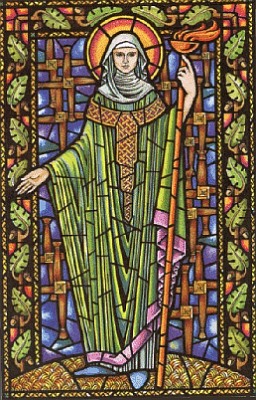
Bride, Brighid, Brigit, Bridget and Brigte – all names of this important Irish holy figure linked to Kildare and generally supposed to have been active in the 5th and 6th centuries coeval with the mission of Patrick. She was contemporary to the early (more accurately post-Patrician) christianising process in Ireland and there are very cogent theories that she was a Christianisation of a pagan Goddess, which I intend to explore.

One of the earliest written records we have of her in the Irish language is a hagiographical text composed by unknown monks during the 9th century, based on the earlier Latin texts, and copied into manuscript collections by Abbeys and collectors: This is known as ‘Bethu Brigte’ (from Oxford University: MS Rawlinson B 512)It is full of magical details and is obviously designed to portray Brigit as an ally and contemporary of Patrick, a fact missing from the older Latin hagiographies….

I have reproduced here the CELT translation, taken from: Bethu Brigte. Donnchadh Ó hAodha (ed),  First edition. Pub.  Dublin Institute for Advanced Studies, Dublin (1978) … with my own interlineal notes for your interest… (please note that the start and end of the original text are incomplete;)

1

. . .The miracles were published abroad. One day in that place Broicsech went to milk and she leaves nobody in her house except the holy girl who was asleep. They saw that the house had caught fire behind them. The people run to its aid, thinking that they would not one house-post against another. The house is found intact and the girl asleep and her face like . . . And Brigit is revered [there] as long as it may exist (?).

AP: The name of Brigit’s mother: Broicsech may be a derived from the act of pot-cooking, as befits her position as a slave. The source of the fire would be the hearth of the house, the focus of influence for a pagan goddess. The presence of a ‘sacred hearth’ that was never allowed to be extinguished, along with a sacred meadow, and a sacred enclosure that no man could pass were observations of the saint’s sanctuary at Kildare made by Giraldus Cambrensis during the 12th century, following the Anglo-Norman invasions. The Niamhog of Inniskea was an ‘idol’ reverenced by the islanders as late as the 19th century, and it was supposed to protect a house from fire.

2

On a certain day the druid was asleep and he saw three clerics wearing white hooded garments baptizing (the above-mentioned) Brigit, and one of the three said to him, ‘Let Brigit be your name for the girl.’

AP: The ‘three men in white’ are implied to be Patrick and his attendants, echoing the description of Tirechan in the Book of Armagh: The text claims that God wants the girl to be given the pagan name Brigit.  

3

The druid and the female slave and her child were at Loch Mescae, and the druid’s mother’s brother was there too; the latter was a Christian. When they were there at midnight the druid was watching the stars and he saw a fiery column rising out of the house, from the precise spot where the slave and her daughter were. He woke his mother’s brother and he saw it also, and the latter said that she was a holy girl. ‘That is true’, said he, ‘if I were to relate to you all her deeds.’

AP: These Christian slaves are probably British in origin, gained by the raids by the Irish on sub-Roman Wales, England and Scotland. The text describes Brigit’s father – a druid/magus – watching the stars and making auguries, and gives validity to these powers as they proclaim the girl as a Christian saint! The druid and his uncle appear to begin to convert their beliefs…

4

On another occasion when the druid and his mother’s brother were in a house and the girl asleep, wherever her mother was, they heard the low voice of the girl in the side of the house, and she had not yet begun to speak. ‘Look for us’, said the druid to his maternal uncle, ‘how our girl is, for I do not dare to do so since I am not a Christian.’ He saw her lying in a crossvigil and she was praying. ‘Go again’, said the druid, ‘and ask her something this time, for she will say something to you now.’ He goes and addressed her. ‘Say something to me, girl’, said he. The girl then spoke two words to him: ‘This will be mine, this will be mine.’ The maternal uncle of the druid did not understand that. ‘Reveal [it] to us’, said he to the druid, ‘for I do not understand [it].’ ‘You will be very displeased with it’, said the druid. ‘This is what she has said’, said the druid, ‘this place will be hers till the day of doom.’ The maternal uncle of the druid shrank for the idea of (?) Brigit’s holding the land. The druid said, ‘Truly it shall be fulfilled. This place will be hers although she go with me to Munster’.

AP: Another vision of the future to the figurative pagan father, Dubthach (a name used as a hypostasis for similar characters in other early Irish Christianisation narratives). Brigit (the daughter of a slave, not supposed to inherit) claims the land of her father (an tribal leader or aristocrat)… ‘This to me’ (or its Irish and Manx equivalents) were the words supposedly spoken by well- and field-skimming witches in 19thC folklore accounts!


p.21

5

When it was time to wean her the druid was anxious about her; anything he gave her [to eat] she vomited at once, but her appearance was none the worse. ‘I know’, said the druid, ‘what ails the girl, [it is] because I am impure.’ Then a white red-eared cow was assigned to sustain her and she became well as a result.

AP: A curious syncresis – fairy or otherworld animals were supposed to be white with red ears in ancient Irish folklore! This passage appears to represent Brigit’s need for spiritual sustenance. The authors appear to make no difference between the Christian heaven and the Irish Otherworld in this interesting passage.

6

Thereafter the druid went to Munster, to be precise into Úaithne Tíre. There the saint is fostered. After a time she says to her fosterer: ‘I do not desire to serve here, but send me to my father, where he may come to meet me.’ This was done and her father Dubthach brought her away to his own patrimony in the two plains of Uí Fhailgi. She remained there among her relatives, and while still a girl performed miracles.

AP: This passage appears to show that Brigit and her father were more powerful than her fosterer, and perhaps simply exists to reinforce a historic primacy. It is she that decides that she does not wish to be fostered at this location (perhaps because it was anti-Christian?).

7

Then she was taken to a certain virgin to be fostered by her. It is Brigit who was cook for her afterwards. She used to find out the number of guests that would come to her fostermother, and whatever the number of guests might be the supply of bread did not fail them during the night.

AS: This passage again evokes the spiritual power of fecundity of the hearth that Brigit represents, a position that appears to be a pagan attribution to the Goddess.

8

Once her fostermother was seriously ill. She was sent with another girl to the house of a certain man named Báethchú  to ask for a drink of ale for the sick woman. They got nothing from Báethchú . . . They came to a certain well. She brought three vessels’ full therefrom. The liquid was tasty and intoxicating, and her fostermother was healed immediately. God did that for her.

AP: She changes water from a spring well (a pagan theme) into wine (a Christian one). Alcoholic beverages were the safest drink, and therefore most suitable for the sick.

9

One day Dubthach made her herd pigs. Robbers stole two of the boars. Dubthach went in his chariot from Mag Lifi and he met them and recognized his two boars with them. He seizes the robbers and bound a good mulct for his pigs on them. He brought his two boars home and said to Brigit: ‘Do you think you are herding the pigs well?’ ‘Count them’, said she. He counts them and finds there numbers complete.

AP: She is without reproach by a pagan druid! Dubthach fines the robbers, but he apparently has no right to this ‘tithe’ as God has made sure his fine was unlawful… This is an indictment of the pagan leader.

10

On a certain day a guest came to Dubthach’s house. Her father entrusted her with a flitch of bacon to be boiled for the guest. A hungry dog came up to which she gave a fifth part of the bacon. When this had been consumed she gave another [fifth]. The guest, who was looking on, remained silent as though he was overcome by sleep. On returning home again the father finds his daughter. ‘Have you boiled the food well?’, said her father. ‘Yes’, said she. And he himself counted [them] and found [them intact]. Then the guest tells Dubthach what the girl had done. ‘After this’, said Dubthach, ‘she has performed more miracles than can be


p.22

recounted.’ This is what was done then: that portion of food was distributed among the poor.

AP: The Druid begins to practice Christian charity!

11

On another occasion after that an old pious nun who lived near Dubthach’s house asked Brigit to go and address the twenty-seven Leinster saints in one assembly. It was just then that Ibor the bishop recounted in the assembly a vision which he had seen the night before. ‘I thought’, said he, ‘that I saw this night the Virgin Mary in my sleep, and a certain venerable cleric said to me: ‘This is Mary who will dwell among you’.’ Just then the nun and Brigit came to the assembly. ‘This is the Mary who was seen by me in a dream.’ The people of the assembly rose up before her and went to converse with her. They blessed her. The assembly was held where now is Kildare, and there Ibor the bishop says to the brethren: ‘This site is open to heaven, and it will be the richest of all in the whole island; and today a girl, for whom it has been prepared by God, will come to us like Mary.’ It happened thus.

AP: This is the passage which appears to give credence to the conflation of Brigit with Mary. She became known as the ‘Mary of Ireland’ or ‘Mary of the Gael’ (Carmichael). It is probable that ‘Mary’ refers to ‘Berry’, ‘Beara’, ‘mBoire’, ‘Muire’, ‘Morrigan’, ‘Mourie’ etc – epithets of the Goddess which survived in folklore.  

12

Another time thereafter she wished to visit her mother who was in slavery in Munster, and her father and fostermother would scarcely allow her to go. She went however. Her mother was at that time in . . . engaged in dairy work away from the druid, and she was suffering from a disease of the eye. Brigit was working in her stead, and the druid’s charioteer was herding the cattle; and every churning she made, she used to divide the produce into twelve portions with its curds, and the thirteenth portion would be in the middle and that was greater than every other portion. ‘Of what advantage to you deem that to be?’, said the charioteer. ‘Not hard’, said Brigit. ‘I have heard that there were twelve apostles with the Lord, and he himself the thirteenth. I shall have from God that thirteen poor people will come to me one day, the same number as Christ and his apostles.’ ‘And why do you not store up some of the butter?’ said the charioteer, ‘for that is what every dairy-worker does.’ ‘It is difficult for me’, said Brigit, ‘to deprive Christ of his own food.’ Then baskets were brought to her to be filled from the wife of the druid. She had only the butter of one and a half churnings. The baskets were filled with that and the guests, namely the druid and his wife, were satisfied. The druid said to Brigit: ‘The cows shall be yours and let you distribute the butter among the poor, and your mother shall not be in service from today and it shall not be necessary to buy her, and I shall be baptized and I shall never part from you.’ ‘Thanks be to God’, said Brigit.

AP: Women’s work, again! This description  of dairying applies to the old principle of the ‘baker’s dozen’ in bread-making but applied to making butter: Fascinatingly it was still a practice of dairying women in the Isle of Man into the 20th century, would always place a pat of butter from the churning on the wall of the dairy ‘for the fairies’. Butter was a vital part of the diet in the Atlantic world – high rainfall and warmer oceanic climates made Ireland and Mannin prime dairying regions. SOfar, Brigit’s work is that of a young woman: minding the hearth, cooking, fetching water, making beer, milking, making butter. The druid frees her mother from servitude, gives her the freedom of her cattle (the goddess at Beltain), and agrees to be baptized. The story now enters another phase in the ‘three ages of woman’…

13

On one occasion Dubthach brought Brigit to the king of Leinster, namely Dúnlang, to sell her as a serving slave, because her stepmother


p.23

had accused her of stealing everything in the house for clients of God. Dubthach left her in his chariot to mind it on the green of the fort and he leaves his sword with her. She gave it to a leper who came to her. Dubthach said to the king: ‘Buy my daughter from me to serve you, for her manners have deserved it.’ ‘What cause of annoyance has she given?’, said the king. ‘Not hard’, said Dubthach. ‘She acts without asking permission; whatever she sees, her hand takes.’ Dubthach on returning questions her about that precious sword. She replied: ‘Christ has taken it.’ Having learned that, he said: ‘Why, daughter, did you give the value of ten cows to a leper? It was not my sword, but the king’s.’ The girl replied: ‘Even if I had the power to give all to Leinster, I would give it to God.’ For that reason the girl is left in slavery. Dubthach returned to his home. Wonderful to relate, the virgin Brigit is raised by divine power and placed behind her father. ‘Truly, Dubthach’, said the king, ‘this girl can neither be sold nor bought.’ Then the king gives a sword to the virgin, and . . .After the afore-mentioned miracles they return home.

AP: It comes time to place her into service… The King of Leinster recognises Brigit’s holiness and returns her to her father along with a replacement sword (a gift of nobility placed in her hands).

14

Shortly afterwards a man came to Dubthach’s house to woo Brigit. His name was Dubthach moccu Lugair. That pleased her father and her brothers. ‘It is difficult for me’, said Brigit, ‘I have offered up my virginity to God. I will give you advice. There is a wood behind your house, and there is a beautiful maiden [therein]. She will be betrothed to you, and this is how you will recognize it: You will find an enclosure wide open and the maiden will be washing her father’s head and they will give you a greater welcome, and I will bless your face and your speech so that whatever you say will please them.’ It was done as Brigit said.

AP: Brigit rejects the pagan prince, but arranges a satisfactory marriage for him. This is allegorical for the power of the church in shaping temporal power and alliance.

15

Her brothers were grieved at her depriving them of the bride-price. There were poor people living close to Dubthach’s house. She went one day carrying a small load for them. Her brothers, her father’s sons, who had come from Mag Lifi, met her. Some of them were laughing at her; others were not pleased with her, namely Bacéne, who said: ‘The beautiful eye which is in your head will be betrothed to a man though you like it or not.’ Thereupon she immediately thrusts her finger into her eye. ‘Here is that beautiful eye for you’, said Brigit. ‘I deem it unlikely’, said she, ‘that anyone will ask you for a blind girl.’ Her brothers rush about her at once save that there was no water near them to wash the wound. ‘Put’, said she, ‘my staff about this sod in front of you.’ That was done. A stream gushed forth from the earth. And she cursed Bacéne and his descendants, and said: ‘Soon your two eyes will burst in your head.’ And it happened thus.

AP: This passage is an important recognition of the ‘Cailleach’ figure which Brigit was to replace: she loses one eye rather, becoming alike to the poets’ representation of the Hag. She also creates a spring well from the earth at the point of this act – wells were closely linked to cures for the eyes in ancient Atlantic folklore. The clarity of water and the clarity of the healthy eye were linked, and the ‘Evil Eye’ is a thing of envy (or even love and lust) – for this reason Brigit plucks out her own eye in this passage.


p.24

16

Dubthach said to her: ‘Take the veil then, my daughter, for this is what you desire. Distribute this holding to God and man.’ ‘Thanks be to God’, said Brigit.

AS: The parent finally accepts the new vocation.

17

On a certain day she goes with seven virgins to take the veil to a foundation on the side of Cróchán of Bri Éile, where she thought that Mel the bishop dwelt. There she greets two virgins, Tol and Etol , who dwelt there. They said: ‘The bishop is not here, but in the churches of Mag Taulach.’ While saying this they behold a youth called Mac Caille, a pupil of Mel the bishop. They asked him to lead them to the bishop. He said: ‘The way is trackless, with marshes, deserts, bogs and pools.’ The saint said: ‘Extricate us [from our difficulty].’ As they proceeded on their way, he could see afterwards a straight bridge there.

AP: This is an expression of Brigit as one who guides lost travellers. Manx fishermen used to cast the palatal bone of the Bollan Wrasse to achieve such an augury – this was probably one of the oceanic forms associated with the goddess: it was a fish who tended the wrack. The ‘veil’ as well as the name ‘Mac Caille’ reminds us of the Cailleach. The Manx word for ‘veil’ or ‘covering’ is Breid. Bride. Brighde. Brigit….

18

The hour of consecration having arrived, the veil was raised by angels from the hand of Mac Caille, the minister, and is placed on the head of saint Brigit. Bent down moreover during the prayers she held the ash beam which supported the altar. It was afterwards changed into acacia, which is neither consumed by fire nor does it grow old through centuries. Three times the church was burned down, but the beam remained intact under the ashes.

AP: Mac Caille may be the same character as the Manx saint ‘Maughold’. The Isle of Man had a nunnery dedicated to St Brigid and its 12thC Viking king was involved with the Anglo-Norman invasion of Ireland during which there was a translation and centralisation of relics of the patron saints of Ireland: Patrick, Brigid and Colmcille… There is another reference in this passage to resistance to fire, and the local Ash beam is converted to (fireproof) Acacia – a Middle-Eastern or African tree, described in the Bible (Exodus) as the material employed in the construction of the tabernacle and its shrines, hence the use here.

19

The bishop being intoxicated with the grace of God there did not recognise what he was reciting from his book, for he consecrated Brigit with the orders of a bishop. ‘This virgin alone in Ireland’, said Mel, ‘will hold the Episcopal ordination.’ While she was being consecrated a fiery column ascended from her head.

AP: The column of fire is mentioned again! Brigit is ordained with apostolic primacy… quite unusual for a woman. Was the compositor of this hagiography a woman?

20

Afterwards the people granted her a place called Ached hÍ in Saltus Avis. Remaining there a little while, she persuaded three pilgrims to remain there and granted them the place. She performed three miracles in that place, namely: The spring flowed in dry land, the meat turned into bread, the hand of one of the three men was cured.

AP: Ached hÍ in Saltus Avis = (?) Island on the plain of the leaping birds: a composite Irish/Latin name. It seems to describe a Crannog… Brigit creates a well, converts meat (a pagan sacrificial offering) to bread, and cures the sick.

21

Once at Eastertide: ‘What shall we do?’, said Brigit to her maidens. ‘We have one sack of malt. It were well for us to prepare it that we might not be without ale over Easter. There area moreover seventeen churches in Mag Tailach. Would that I might keep Easter for them in the matter of ale on account of the Lord whose feast it is, that they might have drink although they should not have food. It is unfortunate for us only that we have no vessels.’ That was true. There was one vat in the house and two tubs. ‘They are good; let it be prepared(?).’


p.25

This is what was done: the mashing in one of the tubs, in the other it was put to ferment; and that which was put to ferment in the second tub, the vat used to be filled from it and taken to each church in turn, so that the vat kept on coming back, but though it came back quickly that which was in the tub was ale. Eighteen vatfuls had come from the one sack, and what sufficed for herself over Easter. And there was no lack of feasting in every single church from Easter Sunday to Low Sunday as a result of that preparation by Brigit.

AP: The pagan tales tell of ever-renewing cauldrons and goblets: this is a Brigitine re-visioning of this theme!

22

A woman from Fid Éoin who was a believer gave her a cow on that Easter Day. There were two of them driving the cow, namely the woman and her daughter. They were not able however to drive their cow . . . They had lost their calf as they were coming through the wood. They besought Brigit then. That prayer availed them; their cow leads the way before them to the settlement where Brigit was. ‘This is what we must do’, said Brigit to her maidens, ‘for this is the first offering made to us since occupying this hermitage, let it be taken to the bishop who blessed the veil on our head.’ ‘It is of little benefit to him’, said the maidens, ‘the cow without the calf.’ ‘That is of no account’, said Brigit. ‘The little calf will come to meet its mother so that it will be together they will reach the enclosure.’ It was done thus as she said.

AP: The cow with calf produces milk… This is the first reference to Brigit herself being involved with droving. The passage deals with the springtime fertility of cattle and onset of milking, as well as the primacy of the celebration of Easter to Christians. There is an allegory here that the faithful must bring their children to the fold, as well…

23

On the same Easter Sunday there came to her a certain leper from whom his limbs were falling, to ask for a cow. ‘For God’s sake, Brigit, give me a cow.’ ‘Grant me a respite’, said Brigit. ‘I would not grant you’, said he, ‘even the respite of a single day.’ ‘My son, let us await the hand of God’, said Brigit. ‘I will go off’, said the leper. ‘I will get a cow in another stead although I obtain it not from you.’ ‘. . .’, said Brigit, ‘and if we were to pray to God for the removal of your leprosy, would you like that?’, ‘No’, said he, ‘I obtain more this way than when I shall be clean.’ ‘It is better’, said Brigit, ‘. . . and you shall take a blessing [and] shall be cleansed.’ ‘All right then’, said he, ‘for I am sorely afflicted.’ ‘How will this man be cleansed?’, said Brigit to her maidens. ‘Not hard, O nun. Let your blessing be put on a mug of water, and let the leper be washed with it afterwards.’ It was done thus and he was completely cured. ‘I shall not go’, said the leper, ‘from the cup which has healed me — I shall be your servant and woodman.’ Thus it was done.

AP: The ‘leper’ becomes the servant after receiving healing. Christianity promoted itself as a healing religion, this being the main biblical power of the apostles. The passage gives the goddess-saint power to bless water for healing. ‘Leprosies’ was a biblical term for diseases inflicted by God – typically ‘cutaneous’ (skin) or visible disorders. The ‘blast’ and the ‘stroke’ from a spiritual agency were two names from Atlantic folklore that described such diseases (‘leprosies’ in the biblical/medieval sense, rather than Hansen’s Disease per se) and these were more often ascribed to fairies rather than the Christian god in folklore accounts!

Brigit’s healing escapades increase now she is a young woman, reflecting the biblical ministry of Jesus once he came of age…

24

On the following day, Monday, Mel came to Brigit to preach and say Mass for her between the two Easters. A cow had been brought to her on that day also and it was given to Mel the bishop, the other cow having been taken. Ague assails one of Brigit’s maidens and she was


p.26

given Communion. ‘Is there anything you might desire?’, said Brigit. ‘There is’, said she. ‘If I do not get some fresh milk, I shall die at once.’ Brigit calls a maiden and said: ‘Bring me my own mug, out of which I drink, full of water. Bring it without anyone seeing it.’ It was brought to her then, and she blessed it so that it became warm new milk, and the maiden was immediately completely cured when she tasted of it. So that those are the two miracles simultaneously, i.e. the changing of water to milk and the cure of the maiden.

AP: Transforming water into healing milk is a transformation of the ‘water-into-wine’ biblical passage into an Irish context! Milk and buttermilk was a popular healing drink down to modern times. It has a maternal, nourishing metaphysical association, so is fitting for the female saint to distribute it. Medieval religious depictions of Mary feeding milk from her breasts to the faithful are worth considering as equivalent. It is even faintly possible that such ‘Maryology’ (for example that promoted by the Cistercian monks throughout Europe from the 12thC) might have been derived from Ireland’s syncretic Brigitine faith…

25

On the following day, Tuesday, there was a good man nearby who was related to Brigit. He had been a full year ailing. ‘Take for me today’, said he, ‘the best cow in my byre to Brigit, and let her pray to God for me, to see if I shall be cured.’ The cow was brought, and Brigit said to those who brought it: ‘Take it immediately to Mel.’ They brought it back to their house and exchanged it for another cow unknown to their sick man. That was related to Brigit, who was angry at the deceit practised on her. ‘Between a short time from now and the morning’, said Brigit, ‘wolves shall eat the good cow which was given into my possession and which was not brought to you’, said she to Mel, ‘and they shall eat seven oxen in addition to it.’ That was related then to the sick man. ‘Go’, said he, ‘take to her seven oxen of choice of the byre.’ It was done thus. ‘Thanks be to God’, said Brigit. ‘Let them be taken to Mel to his church. He has been preaching and saying Mass for us these seven days between the two Easters; a cow each day to him for his labour, it is not greater than what he has given; and take a blessing with all eight, a blessing on him from whom they were brought’, said Brigit. When she said that he was healed immediately.

AP: Easter again linked to healing (of sins, by Jesus’ supposed sacrifice). The giving of tithes – dues to the holy men – seems to be a subtext implied here. Cows and oxen were the wealth of the Irish lords.

26

During the time between the two Easters Brigit suffered greatly from a headache. ‘That does not matter’, said Mel. ‘When we go to visit our first settlement in Tethbae, Brigit and her maidens will go with us. There is a wonderful physician in Mide, namely Aed mac Bricc. He will heal you.’ It was then she healed two paralytic virgins of the Fothairt.

AP: Aed Mac Bricc was pa atron saint of the Uí Néill. Mide = Meath, which came under the dominance of the Clann Cholmáin (a branch of the Uí Néill) in the 5thC. Kildare was part of their territories…

27

Then two blind Britons with a young leper of the sept of Eocchaid came and pray with importunity  to be healed. Brigit said to them: ‘Wait a while.’ But they said, ‘You have healed the infirm of your own people and you neglect the healing of foreigners. But at least heal our boy who is of your people.’ And by this the blind are made to see and the leper is cleansed.

AP: Christianity preached ‘illumination’ and cleansing of the harm caused by the beam of evil once believed to have been emitted from the jealous or proud eye. This passage implies that the Christian mission must be spread back East.

28

Low Sunday approached. ‘I do not think it fortunate now’, said


p.27

Brigit to her maidens, ‘not to have ale on Low Sunday for the bishop who will preach and say Mass.’ As soon as she said that, two maidens went to the water to bring in water and they had a large churn for the purpose, and Brigit was not aware of this. When they came back again, Brigit saw them there. ‘Thanks be to God’, said Brigit. ‘God has given us beer for our bishop.’ The nuns became frightened then. ‘May God help us. O maiden.’ ‘Whatever foolish thing I said, I have not said anything evil, O nuns.’ ‘The water which was brought inside, because you have blessed it, God did what you desired and immediately it was changed into ale with the smell of wine from it, and better ale was never set to brew in the [whole] world.’ The one churn was sufficient [for them] with their guests and the bishop.

AP: Yet again, an emphasis upon the creation of health-giving drinks from water.

29

On the Monday after Low Sunday Brigit went in her chariot and her maidens along with her and the two bishops and Mel and Melchú into the plain of Mide to a physician, and that they might go afterwards into the plain of Tethbae to visit a foundation which Mel and Melchú had there. On Tuesday at nightfall they turn aside to the house of a certain Leinsterman of the Uí Brolaig. He received them and out of respect and kindness he entertained the holy Brigit and the bishops. That good man and his wife complained. The wife said: ‘All the children I have given birth to have died, except two daughters and they are dumb since the day of their birth.’ She goes to Ath Firgoirt. The holy Brigit falls in the middle of the ford, the horses being frightened for some unknown reason, and the saint’s head was dashed against a stone and was injured on top, and it richly stained the waters with the blood which was shed. The holy Brigit said to one of the two dumb girls: ‘Pour the water mixed with blood about your neck in the name of God.’ And she did so and said: ‘You have healed me. I give thanks to God’. ‘Call you sister’, said Brigit to the girl who had been healed. ‘Come here, sister’, said she. ‘I shall come indeed’, said her companion, ‘and though I go I have already been healed. I bowed down in the track of the chariot and I was cured.’ ‘Go home’, said Brigit to the girl, ‘and ye shall again bring forth as many male children as have died on you.’ They were delighted at that. And that memorable stone often heals many. Any head with a disease of the head which is placed on it returns from it cured. It was then they met the learned leech, Aed mac Bricc. ‘ . . .’, said the bishop, ‘the head of the holy maiden.’ He touched it and with these words addresses the virgin: ‘The vein of your head, O virgin, has been touched by a physician who is much better than I am.’

AP: This passage recalls a pagan one from the Metrical Dindsenchas when Boand dashes her head. It was also used as a motif in the hagiographical Life of St Declan – he dashes his head against a rock which thereafter was supposed to have healing properties by pilgrims down to the modern day. This is a theme with other precedents in legends and hagiography from Ireland in the post-pagan period… There is also a connection between stones, river fords and heads – possibly a vague reference to idol worship that had been replaced.

30

They go to Tethbae, to the first settlements of the bishops, namely Ardagh. The king of Tethbae was feasting nearby. A churl in the king’s house had done a terrible thing. He let fall a valuable goblet belonging to the king, so that it smashed to pieces against the table in front of the


p.28

king. The vessel was a wonderful one, it was one of the rare treasures of the king. He seized the wretch then, and there was nothing for him but death. One of the two bishops comes to beseech the king. ‘Neither shall I give him to anybody’, said the king, ‘nor shall I give him in exchange for any compensation, but he shall be put to death.’ ‘Let me have from you’, said the bishop, ‘the broken vessel.’ ‘You shall have that’, said the king. The bishop then brought it in his arms to Brigit, relating everything to her. ‘Pray to the Lord for us that the vessel may be made whole.’ She did so and restored it and gave it to the bishop. The bishop comes on the following day with his goblet to the king and [says]: ‘If your goblet should come back to you make whole’, said the bishop, ‘would the captive be released?.’ ‘Not only that, but whatever gifts he should desire, I would give him.’ The bishop shows him the vessel and speaks these words to the king: ‘It is not I who performed this miracle, but holy Brigit’.

AP: The goblet/cauldron/vessel motif returns…

31

When Brigit’s fame had resounded throughout Tethbae, there was a certain pious virgin in Tethbae from whom a message was sent in order that Brigit might go and speak to her, namely Bríg daughter of Coimloch. Brigit went and Bríg herself arose to wash her feet. There was a pious woman ailing at that time. While they were washing Brigit’s feet, that sick person who was in the house sent a maiden to bring her out of the tub some of the water which was put over Brigit’s feet. It was brought to her then and she put it about her face and she was completely cured at once; and after being ailing for a year, she was the only servant that night. When their dishes were put in front of them, Brigit began to watch her dishes intently. ‘May it be fitting for us’, said Bríg, ‘O holy maiden, what do you perceive on your dish?’, ‘I see Satan sitting on the dish in front of me’, said Brigit. ‘If it is possible’, said Bríg, ‘I should like to see him.’ ‘It is possible indeed’, said Brigit, ‘provided that the sign of the cross goes over your eyes first; for anyone who sees the devil and does not bless himself first or . . ., will go mad.’ Bríg blesses herself then and sees that fellow. His appearance seemed ugly to her. ‘Ask, O Brigit’, said Bríg, ‘why has he come.’ ‘Grant an answer to men’, said Brigit. ‘No, O Brigit’, said Satan, ‘you are not entitles to it, for it is not to harm you that I have come.’ ‘Answer me then’, said Bríg, ‘what in particular has brought on to this dish?.’ The demon replied: ‘I dwell here always with a certain virgin, with whom excessive sloth has given me a place.’ And Bríg said, ‘Let her be called.’ When she who was called came: ‘Sain her eyes’, said Bríg, ‘so that she may see him whom she has nourished in her own bosom.’ Her eyes having been sained, she beholds the awful monster. Brigit says to the maiden, now terrified with fear and trembling: ‘Behold you see him whom you have cherished for many years and seasons’. ‘O holy maiden,’ said Bríg, ‘that


p.29

he may never enter this house again.’ ‘He shall not enter this house’, said Brigit, ‘till the day of doom.’ They partake of their food and return thanks to God.

AP: This passage is interesting on a number of levels: Firstly, it deals with the practice of foot-washing as an honorary – something of ancient biblical provenance. It also touches upon an Atlantic belief that dust trodden by people might hold a connection to forms of sin or the Evil Eye and loss of substance: In the Isle of Man, such spiritual or magical assaults were once dealt with universally by procuring such dust and disposing of it in various fashions! Brigit sees Satan in the bowl of water, suggesting both an aspect of this principle at the same time as a divinatory practice of staring into the mirror-reflection of water (ie – seeing the inverted otherworld!). Needless to say, the evil is banished by thesaint’s growing power…

32

Once she was hurrying on the bank of the Inny. There were many apples and sweet sloes in that church. A certain nun gave her a small gift in a basket of bark. When she brought [it] into the house, lepers came at once into the middle of the house to beg of her. ‘Take’, said she, ‘yonder apples’, Then she who had presented the apples [said]: ‘I did not give the gift to lepers.’ Brigit was displeased and said: ‘You act wrongly in prohibiting gifts to the servants of God; therefore your trees shall never bear any fruit.’ And the donor, on going out, sees that all at once her garden bore no fruit, while shortly before it had abundant fruits. And it remains barren for ever, except for foliage.

AP: The saint bestows barrenness as well as fecundity: woe to those who don’t donate to the church! Of interest, the Gaelic words for a church and for a stand of trees are very similar… Here it is implied that a church itself was a source of fruit. This could be an allegorical swipe at a particular institution. Hagiography was a very political art form – one that was sponsored by the Uí Néill dynasties above all others!

33

Another virgin brought her apples and sweet sloes in large quantities. She gave [them] immediately to some lepers who were begging. ‘She who brought it will be sound’, said Brigit. ‘O nun, bless me and my garden.’ ‘May God indeed bless’, said Brigit, ‘that big tree yonder which I see in your garden; may there be sweet apples on it, and sweet sloes as to one third; and that twofold fruit shall not be lacking from it and its offshoots.’ And thus it was done. As the nun went into her garden she saw the alder tree with its fruit, and sweet sloes on it as to one third.

AP: Again, this seems like an allegorical passage with a political undertone.

34

In a certain place, namely Aicheth Fir Leth, two lepers followed Brigit. Great jealousy [of each other] took hold of them. They began to quarrel, but their hands and feet grew stiff. Seeing this, Brigit said: ‘Do penance’. They did so. Not only did she release them, but she healed them of their leprosy.

AP: Jealousy = Envy. One of the ‘spiritual sins’. The use of ‘lepers’ and ‘servants’ or ‘followers’ seems interchangeable and suggests that all are sinners, whose sin gives them a disease. Brigit is the physician for these followers. Remember, ‘leprosy’ in a medieval or biblical context doesn’t necessarily mean the disease caused by Mycobacterium leprae!

35

It was then that two virgins came to Brigit that she might go with them to consecrate their foundation and house along with them. Induae and Indiu were their names. On the way they met a youth [who had come] to speak to the nuns with whom Brigit was going. ‘I have come to you’, said he, ‘from this ill person, that a chariot might be brought to him, so that he might die in the same enclosure with you.’ ‘We have no chariot’, said the nuns. ‘Let my chariot be brought to him’, said Brigit. That is what was done then. They were waiting till matins, until the sick man came. Lepers come to them afterwards in the morning. ‘O Brigit’, said they, ‘give us your chariot, for the sake of Christ.’ ‘Take [it]’, said Brigit, ‘[but] grant us a respite, O ye clients


p.30

of God, so that we may bring the sick man first of all to our house which is quite near us.’ ‘We will not grant’, said they, ‘even the respite of a single hour, unless our chariot is being taken from us anyway.’ ‘Take [it] anyway’, said Brigit. ‘What shall we do’, said the nuns, ‘with our sick man?.’ ‘Not hard’, said Brigit. ‘Let him come with us on foot.’ That is what was done then; he was completely cured on the spot.

AP: It has been commented on by scholars and archaeologists that descriptions from early Irish literature of heroes or saints riding in chariots has not been backed up with archaeological discoveries of such equipment. However, ‘absence of evidence is not evidence of absence’. The Old Irish term for a chariot was ‘carpat’ from the Latin term carpentum, used in reference to the lightweight chariots of the British and continental Celts of the Iron Age. These were the provenance of the aristocracy, who were sometimes referred to in Irish texts as cairptech. Here dying Irish nobleman wishes to be conveyed by chariot to Brigit, which she afterwards donates to some more lepers! 

36

It was then that she washed the feet of the nuns of Cúl Fobair, and healed four of them while washing them, namely a paralytic one, a blind one, a leper and a possessed one.

AP: All of the diseases afflicting these nuns are typical religious fare that had overtones of fairy disease in later Irish folklore: (in order) – the Fairy Stroke, the Evil Eye, the Fairy Blast and one ‘taken’ by fairies! I assume the ‘paralytic’ nun was neither drunk on the copious amounts of booze that the clergy used to make, not suffering from some form of repressed hysterical disorder…

37

It was then that she healed the dumb paralytic at the house of Mac Odráin. It happened that Brigit and the dumb boy were left alone. Some destitute people having come and desired a drink, the holy Brigit looked for the key of the kitchen and did not find it. Being ignorant of the boy’s affliction, she addresses him thus: ‘Where is the key?’, And by this the dumb paralytic boy speaks and ministers.

AP: Again, as with other diseases mentioned in this text, the boy’s ‘dumbness’ must be considered allegorical, especially as it mentions his ministry after being given the ‘gift’ of speech by Brigit upon receiving the key to the kitchen. 

38

Shortly afterwards at the beginning of summer: ‘Verily’, said Mel and Melchú to Brigit, ‘it has been related to us that Patrick is coming from the south of Ireland into Mag mBreg. We will go to speak to him. Will you go?.’ ‘I will’, said Brigit, ‘so that I may see him and speak to him, and that he may bless me.’ As they set out, a certain cleric with a great amount of chattels and a following pursues them on the way, to ask [them] to accompany him into Mag mBreg. ‘It is a matter of urgency for us’, said Mel, ‘that our cleric may not escape us.’ ‘Let me find this out from you’, said Brigit, ‘the place in which we will meet in Mag mBreg, and I will wait for this pitiable gathering.’ Brigit waited afterwards for the migratory band. ‘There are twenty maidens with me [coming] along the road’, said Brigit, ‘give them some of the burdens.’ The wretched ones say: ‘Not so let it be done, for you have conferred a greater boon on us, since in your company the road is safe for us’. ‘Are there not two carts [coming] along the road?’, said Brigit. ‘Why is it not they which carry the loads?.’ For she had not looked to see what was in them. Since Brigit entered religion, she never looked aside but only straight ahead. ‘There is a brother of mine’, said the cleric, ‘in one of the carts, who has been paralysed for fourteen years. There is a sister of mine in the other who is blind.’ ‘That is a pity’, said Brigit. They came that night to a certain stream, called the Manae. They all ate that night save only Brigit. On the morrow she healed the two sick people who were along with her, and the loads were put into the carts; and they returned thanks to God.


p.31

39

It was then she healed the household of a plebean on the edge of the sea. Thus it was done. A certain man was working in a cow-pasture, of whom the saint asked why he was working alone. He said: ‘All my family is ill.’ Hearing this, she blessed some water and immediately healed twelve sick members of the man’s family.

40

They come then to Tailtiu. Patrick was there. They were debating an obscure question there, namely a certain woman came to return a son to a cleric of Patrick’s household. Brón was the cleric’s name. ‘How has this been make out?’, said everyone. ‘Not hard’, said the woman. ‘I had come to Brón to have the veil blessed on my head and to offer my virginity to God. This is what my cleric did, he debauched me, so that I have borne him a son.’ As they were debating, Brigit came towards the assembly. Then Mel said to Patrick: ‘The holy maiden Brigit is approaching the assembly, and she will find out for you by the greatness of her grace and the proximity of her miracles whether this is true or false; for there is nothing in heaven or earth which she might request of Christ, which would be refused her. This then is what should be done in this case’, said Mel. ‘She should be called apart out of the assembly about this question, for she will not perform miracles in the presence of holy Patrick.’ Brigit came then. The host rises up before her. She is summoned apart out of the assembly immediately to address the woman, and the clerics excepting Patrick accompany her. ‘Whose yonder child?’, said Brigit to the woman. ‘Brón’s’, said the woman. ‘That is not true’, said Brigit. Brigit made the sign of the cross over her face, so that her head and tongue swelled up. Patrick comes to them then in that great assembly-place. Brigit addresses the child in the presence of the people of the assembly, though it had not yet begun to speak. ‘Who is your father’, said Brigit. The infant replied: ‘Brón the bishop is not my father but a certain low and ill-shaped man who is sitting in the outermost part of the assembly; my mother is a liar.’ They all return thanks to God, and cry out that the guilty one be burned. But Brigit refuses, saying: ‘Let this woman do penance.’ This was done, and the head and tongue lost their swelling. The people rejoiced, the bishop was liberated, and Brigit was glorified.

AP: Brigit holds her own in front of the foreign assembly and gets a bishop off the hook. She causes the mother of the child to suffer what appears to be an attack of angioedema or anaphylaxis in order to shut her up, and then makes her baby tell that another man is in fact the father (it was supposed that the innocent cannot lie, just as we generally suppose today that infants cannot speak…).

41

At the end of the day everybody went apart out of the assembly for hospitality. There was a good man living on the bank of the river called Seir. He sent his slave to the assembly to call Brigit, saying to his household: ‘The holy maiden who performed the wonderful miracle in the assembly-place today, I want her to consecrate my house tonight.’ He welcomed her. ‘Let water be put on our hands’, said her maidens


p.32

to Brigit, ‘here is our food.’ ‘It is of no use now’, said Brigit. ‘For the Lord has shown me that this is a heathen home, with the one exception only of the slave who summoned us. On that account I shall not eat now.’ The good man finds this out, namely that Brigit was fasting until he should be baptized. ‘I have said indeed’, said he, ‘that Patrick and his household would not baptize me. For your sake, however, I will believe’, [said he] to Brigit. ‘I do not mind provided that you be baptized’, said Brigit. ‘There is not a man in orders with me. Let someone go from us to Patrick, so that a bishop or priest may come to baptize this man.’ Brón came and baptized the man with all his household at sunrise. They eat at midday. They return thanks. They come to holy Patrick. Patrick said: ‘You should not go about without a priest. Your charioteer should always be a priest.’ And that was observed by Brigit’s abbesses up to recent times.

AP: Only priests can baptize – Patrick recommends that from now on Brigit goes about with a priest. This is a tacit acceptance of her as an agent for his mission to convert the houses of the aristocracy of Ireland, in particular the lands of the Southern Uí Néill

42

After that she healed the old peasant woman who was placed in the shadow of her chariot at Cell Shuird in the south of Brega.

43

She healed the possessed man . . . who had gone round the borders. He was brought to Brigit afterwards. Having seen her, he was cured.

AP: Another soul ‘taken’ by the fairies is ‘found’ in Christ…

44

Brigit went afterwards to Cell Lasre. Lassar welcomed her. There was a single milch ewe there which had been milked, and it was killed for Brigit. As they were [there] at the end of the ay, they saw Patrick coming towards the stead. ‘May God help us, O Brigit’, said Lassar. ‘Give us your advice.’ Brigit replied: ‘How much have you?’, She said,: ‘There is no food except twelve loaves, a little milk which you have blessed and a single lamb which has been prepared for you’. This is what [they do]: They all go into her refectory, both Patrick and Brigit, and they were all satisfied. And Lassar gave her her church, and Brigit is venerated there.

AP: Another example of ‘Bread and Fishes’ ministry, which paints the saint with powers exactly equivalent to those of the biblical Jesus! It does not appear that it was considered in any way heretical to do so – she was portrayed as a ‘Female Christ’, to all intents and purposes!

45

She remained the next day in Cell Lasre. A certain man of Kells by origin (?), whom his wife hated, came to Brigit for help. Brigit blessed some water. He took it with him and, his wife having been sprinkled [therewith], she straightaway loved him passionately.

AP: The making of Love Philtres is condemned as a pagan practice by the Penitential of Finnian (said to derive from Finnian of Clonard in the 6thC). Here we see the saint usurping this ability from common people – the church was keeping ‘magic’ for itself and out of the hands of its flock.

46

A certain pious virgin sent to Brigit, in order that Brigit might go to visit her. Fine was her name. From her Cell Fhine was named. She went and remained there. One day wind and rain, thunder and lightning set in. ‘Which of you, O maidens, will go today with our


p.33

sheep into this terrible storm?’, All the maidens were equally reluctant. Brigit answered: ‘I love very much to pasture sheep.’ ‘I do not want you to go’, said Fine. ‘Let my will be done’, said Brigit. She went then and chanted a verse while going:

    1. Grant me a clear day for Thou art a dear friend, a kingly youth; for the sake of Thy mother, loving Mary, ward off rain, ward off wind.
    2. My king will do [it] for me, Rain will not fall till the night, On account of Brigit today, Who is going here to the herding.

She stilled the rain and the wind.

AP: This final passage of the surviving text begins to deal with Brigit’s usurped functions as a guardian of flocks and controller of the weather: roles subsumed from what we know from later folklore constituted the Cailleach archetype or ‘goddess’!

The text appears in general to deal with the tripartite forms of womanhood, girl<>woman<>dotage/seniority, although the last part of her life-story is lost. This threefold division was the same as that of the Atlantic goddess herself, who was a regenerating figurative representation of the seasons and nature. It was the purpose of the legend of ‘Saint Brigit’ to replace that of this ‘Fairy Queen’ in a way that the male ‘Patrick’ could not.

(c) 2013 Atlantean Perspective. 
Converting paganism to hagiography in the post-classical Atlantic world

After the Theodosian edicts were enacted throughout the easternn and western Roman Empire in 439 CE, the official process of re-using pagan religious sites as Christian places of worship began in earnest. As paganism was a nature-landscape-ancestor-based religion, this process necessitated the re-interpretation of the oral history associated with these sites as well seeking a Christian narrative to replace that of the pagans at each site. Consequently it must have been fairly difficult for Christian officials to implement, as the laws gave little if any guidance as to how this might be achieved, save that sites, buildings and structures ought to be preserved for use by Christians. Having made paganism illegal, the laws were designed with Christianisation in mind, intended not to alienate potential converts. They were enacted with the metropolitan Romanised lifestyles of the southern Europeans in mind, and although the metropolitan centres of the British Isles were de facto Romanised by this period, these were islands in a pagan landscape that had its roots in a religion quite different to that of the southerners.

What evolved over subsequent centuries was a slow assimilation of the principles, histories and legends of those that frequented and relied upon them in maintaining the spiritual dimension of their lifestyles. This appears to have been achieved by the propagandistic method of coding these principles etc into popular stories about ‘saints’ – Christian antecedent heroes who were supposed to have bought this far-off religion to the peoples of Atlantic Europe. The greatest success (perhaps unsurprisingly) in re-envisioning Atlantic paganism came out of Ireland, where there had been no significant Romanisation and miscegenation, thus allowing a more sensitive and cohesive approach to the Christianisation of pagan peoples. The repercussions of the end of the western Empire meant that Ireland was to provide the stable ideological base and models for establishing the conversion of much of Atlantic Europe: This would be subtly syncretic, and whereas Kings and nobles (and their metropolitan followers) were expected to follow a pious continental model of Roman Catholic christianity and abandon the trappings of paganism, their peoples were largely to be allowed to keep their feet in both worlds, although were nominally seen as christian.

The stories of local saints’ lives that started to be generated from the 4-5th centuries onwards are therefore full of pagan details, as are various legends associated with the former pagan shrines they inherited. These were often written down for the use of clergy in establishing the canon for oral legend, which would still be the cultural mode of the vast majority (95%+) of illiterate ordinary people. Some of these have survived to modern times in written form, whereas others remain only in oral folklore. As many are realising, they contain a very significant amount of information for those seeking to recover the traditional religion of the Atlantic Europeans.

The main operators who pushed this process – and almost made it official – are the Irish monks of the 5th-6th centuries and their inheritors of the 7th-9th centuries who consolidated this approach. Of all of the names of the most significant chancellors of this new university of syncretisation, surely the most significant were those of Finnian of Clonard and his students (including the ‘Twelve Apostles of Ireland’) who propagated a network of Abbeys throughout Ireland. Finnian’s great British compatriot and apparent co-worker was Cadog of Llancarfan, who appears to have taken care of business on the eastern shores of the Irish Sea.  It is almost certain that the majority of these religious men were the brothers and sires of local tribal leaders if not kings themselves (Cadog was a king and Colmcille was a prince, for example) and therefore had access to the learned classes who were repositories of pagan knowledge and traditional learning. Although Finnian’s immediate fore-runners such as Patrick were often credited with Christianisation in Ireland, it was this next generation which were to provide the propaganda which pushed the Christian narrative back beyond the horizon of its advent and begin to replace paganism in earnest among ordinary people by using a concerted scheme. Although it had its origins in Britain, the Anglo-Saxon incursions and post Empire collapse of Britain pushed the emphasis of Christianisation into Ireland, Mann etc. This scheme, once established, then appears to have cascaded back outwards into Wales, Devon, Cornwall, Somerset, the Hebrides and the Isle of Man, western Scotland and Brittany during the 5th and 6th centuries, after which time the pagan invaders and settlers were becoming influenced by the international power and benefits of the Christian church, which continued the glory of the Roman imperium, modelled on Augustine of Hippo‘s allegorical and historically aspirational treatise known as ‘The City of God‘.

The historicity of these Atlantic holy men and women is often difficult to ascertain, and many of the sources that name them are much later than the supposed dates of their ministry. In addition, the details of their lives (where recorded in manuscripts or folklore) are often so full of fantastical or pagan details that we sometimes have to wonder if their existence was only required to be legendary. All of the saints operated under assumed pseudonyms, adding to their mystery, and perhaps their effectiveness as faceless vessels of the new order….

In some of my further postings I will detail a few of these and start to bring the pieces of the jigsaw to the table…

Textualising the Atlantean Bardic World

Written annals surviving from the middle ages and early modern periods tend to employ the arrival of St Patrick as an historical ‘event horizon’ for the establishment of a Christian civitas of history and law in Ireland. Given that literacy followed hand-in-glove with christianity and that – until a very late period – the literate were generally the Christian elite, it follows that our interpretation of the cultural and historical veracity of such sources must be cautious at best.

One example comes from the Annals of Ulster, which commence with two important events: the coming of Patrick during the reign of Emperor Theodosius in 433, followed (after a few entries dealing with O’Neill primacy) by a statement against the year 438 : “The Senchas Már was written”. These events stamp the conversion of Irish religion and law into a form with written primacy – an ‘event’ important to the annalists, as it marks the transition of power from pre-Roman learned memorisers (the Druids, Brehons and Bards) to the Romanised literary system of power and precedent, controlled by the church. This was the selfsame church who had positioned itself at the side of the new model of kingship and land-dominance it had created, replacing the tribal systems of Iron Age Europe which had latterly been destabilised by mass-migration under the Roman Imperium.
Although monkish annals like to fix events on a historical timeline as fait accompli, it is wrong to take them at face value: Ireland probably did not wholly christianise with the coming of Patrick, and it is likely that christianity (perhaps in a form deemed too heretical to admit to) was present there long before Patrick, and that paganism survived for a fairly long time after him. Likewise, the statement in the Annals of Ulster about the codification of Breast Law (the memorised legal traditions of the traditional Brehon judges) into the Senchas Már text has little evidence to suggest a fundamental change occurred in Irish and Gaelic legal culture: We know for a fact that when the Isle of Man (which was culturally and linguistically closest to Ulster) ceded to the rule of the English Stanley potentates in 1405, its laws were still memorised ‘Breast Laws’ kept by oral tradition, in spite of the presence of a significant contingent of clergy and a number of Abbeys from an early period. The commissioning and writing of annals has been shown to serve a purpose of establishing a ‘historical’ argument for the primacy of the secular and religious sponsors of the work. Through the processes of continuous editing and re-copying Annals might evolve a stable and progressive timeline leading to the present, and such a work could be used to settle political disputes in favour of the sponsors – the church in particular.

Of the literature produced in Ireland by Christian scribes, Annals are perhaps the driest and most functional. Other popular forms of literature (other than copies of the gospels and the bible) produced in Ireland’s monasteries included hagiographies (stories of saints’ lives) and the transcriptions of various forms of oral culture knowledge, including laws and secular or pagan stories, which – typical to the artistic/poetic mode typifying oral culture – functioned as a synthesis of history, entertainment and education. Knowledge of the treasure trove of tradition of a pre-literate oral-culture society allowed the literate Christians to challenge the power structure of paganism and effectively replace it with their own model. In Ireland, which was probably ethnically and territorially more conservative (having not partaken to any large degree of the Pax Romana before the collapse of the western empire) this was a necessary method of Christianisation – almost unique in Europe until the pagan Scandinavians became introduced to the same principals. Elsewhere, migration was the cultural upsetter allowing Christianisation to proceed replacing as it did.

The vast majority of ‘Bardic’ knowledge pertaining to pagan religion would have been displaced and indelibly altered when it was transformed into its literary Christian context. The processes for achieving this were convoluted and evolved over a period of time, presumably between the 5th and 10th centuries. Simply banning paganism was impossible, as it pervaded every aspect of the peoples’ worldview and lives, and provided all of the signposts and models to explain the universe. Christianity and Judaism held no models explaining the movement of stars, the meaning of tides and seasons, the reasons why certain plants were useful; they held no history of the Atlantic peoples – simply those of dusty desert tyrants and the ancestors of other races in far-off lands.

The essential doctrines of christianity that would be impressed upon the pagans were that their gods and spirits were in fact devils, opposed to a single ‘true’ god from the middle east whose existence these devils had formerly kept people in ignorance. What is more, this god had created a son here on earth (but a long way from Ireland) who had been put to death in payment for the evil deeds and ignorance of humanity. By accepting this imported ‘truth’ it was supposed that adherents would find favour with this one God and earn a place in an eternal afterlife. This must have been so alien to the Irish that they must have laughed out loud in disbelief when confronted by the early continental and Mediterranean proselytes. Unlike in Britannia and Europe, the collapse of the pagan Roman empire was no argument in favour of christianity to the Irish, as they had not integrated the Roman belief system into their culture and had a perfectly functional religious model of their own.

When christianity did start to make inroads into the lives of pagans was when it started targeting and in fact creating an emerging new model of kingship that was propagated throughout post-Roman Europe. The religion ignored the people and their innate philosophies and targeted their leaders and lawmakers, beginning a drawn-out process of trickle-down acceptance backed up by the threat of power. By necessity, this subtle process would pursue a policy of replacement: like-for-like. It would also gradually subvert and alter the conception and memories of the true nature of paganism, using the following techniques:

1. Creating in stories a ‘pantheon’ of pagan gods similar to the Roman and Greek model, thus allowing the rhetorical methods of continental christianity to be applied. These ‘gods’ were given a history and context that implied they were euhemerised people from history falsely worshipped as a result of encouragement by demons.

2. Combining pagan stories elaborating the reality and functions of the deities into those of local saints. Pagan creation stories for landscape features, plants, animals and features of nature had their attributions transferred to saints.

3. Creating pseudo-historical accounts of the past history of Ireland that gave a middle-eastern or oriental provenance to the Irish.

4. Replacing the empirical human doctrine of ancestral spirits and reincarnation of souls with fairy-beliefs, producing an extra-doctrinal category of spirits ambivalent in their nature between Christianity’s angels and demons.

The model worked so well in Ireland, that Irish clerics and their ideas became vital to the christianising efforts of the rulers of the Anglo-Saxons and the Franks, as well as of the Scandinavians from the 9th century onwards.

So … the Irish mythological cycles, the Welsh ‘Mabinogion’, the Scandinavian ‘Edda’ legends and the other famous mythologies of the ancient north Europeans are products of a concerted campaign of cultural subversion by Christians seeking to obfuscate the true nature of paganism as it once existed in these regions. This process was started by the pagan Romans who sought to replace the worldview of those they conquered with one sympathetic to theirs.

Balor of the ‘Evil Eye’

Another famous character of Irish pagan mythology is Balor. He appears to exist as an adversarial character, and leader of the Fomorian race who were supposed to have occupied Ireland before the Tuatha Dé Danann and the humans opposed and replaced them in the medieval pseudo-historical myths, such as those in the famous Lebor Gabála Érenn. His main attribute was a ‘piercing’ (birugderc) , ‘destructive’ (milledach) or ‘poisonous’(neimnech) eye which could, depending on the tradition do anything from making men helpless in battle to blasting, blighting and destroying. This property is often linked to the popular ‘evil eye’ mythology once so common to Europe, and still current in much of Africa and Asia. Balor was supposedly killed by his own semi-divine warrior-grandchild, Lugh, who himself was said to have been fostered by Manannán mac Lir. As such, Balor appears to have been an inspiration for Sauron in Tolkein’s ‘Lord of the Rings’, chosen perhaps because he operated as a hypostasis for an ‘evil god’ in medieval and early-modern myths. He even operated as a political representation of Ireland’s oppressors in some traditions, and his showdown with Lugh is a popular folktale.

So … who or what was this character really supposed to be? The key to understanding him correctly is understanding the idea of the ‘evil eye’ as it pertains to Atlantic European mythology. The Evil Eye, Bad Eye or Destructive Eye was a phenomenon known in particular from its recorded incidence among peoples from the Scottish Highlands and Islands, the Isle of Man and Ireland between the 17th and 20th centuries.

The essence of the Gaelic evil eye belief was that the eye emitted a spiritual force (spirit was anciently considered an ethereal form of light) which could alter what it looked at (touched). This idea (the ‘extromission’ of light from the eye) was known from classical antiquity, and discussed in both scientific and religious theory by medieval European authors such as Robert Grosseteste and Thomas Aquinas. Pride and envy were considered the ‘spiritual’ sins and operated through spirit and thus light, which was considered the substance from which spirit was made. The force of the Evil Eye was supposed to be driven by the ‘deadly sin’ of envy, and caused a loss of vitality and well-being in the subject of the envious gaze: it was a metaphysical interpretation of how the spiritual ‘sin’ of envy (literally translating as ‘in vision’) worked as a malign force which could change things at a distance. It could be a passive force (whereas ‘witchcraft‘ or sorcery was considered an active process), and this distinction was perhaps one of the reasons why the Gaelic peoples (preoccupied by fairies and the ‘bad eye’) did not prosecute witchcraft as a general rule. The ‘Evil Eye’ and its associated otherworld theory was the explanation for misfortune! And the ‘Evil Eye’ was a force by which those ‘spiritual’ beings – the fairies – exerted their power on this world. They envied our ‘substance’ and ‘worth’ and tried to take it from us… they abducted our healthy children and left us their unhealthy ones… they sickened and blighted: It was the mode by which the ‘Otherworld’ interacted with ours!

Considering this, we must now turn our attention to the Gaelic Lord of the OtherworldManannán mac Lir – who ruled the world beneath the sea and behind the horizon where the sun sets. As ruler of this inverted place and we must consider if he might in fact be identifiable with the ‘Balor’ character of Irish myth – a sea-ruler who originally (in some traditions such as the Manx) held the sovereignty of the Land, and whose eye chose the lives to be transferred to the Otherworld… Balor is associated with Tory Island off Donegal, and his ‘race’ is supposed by the medieval writings to have come from the sea. Traditions tell that he was grandfather or father of Lugh (who eventually killed him) and that Lugh was fostered by Manannán, so there is a reasonable argument in suggesting that Balor may be a part of the Manannán hypostasis.

The early Welsh Arthurian tale known as Culwch and Olwen features a central character with features similar to Balor – the giant Ysbaddaden Bencawr. The description of him sounds a little like that of Balor in the Irish tale Cath Maige Tuired (Battles of Moytura) in that he is of a giant size and had eyes (or an eye) so huge that they required great forked sticks to open his eyelids. This begs the question of wether the character is a bardic metaphor or a character nested deep in popular mythology. Other similarities include the possession of a desirable daughter over whom heroes fight – with Balor it is Eithne and with Ysbaddaden it is Olwen.

The concepts of decay and death have stronger ‘evil’ or ‘unclean’ connotations for  christians, yet in religious cultures with a belief in reincarnation they are loaded with more positive connotations. This begs the question of why and to whom Balor’s eye was supposed to be ‘evil’? This is not explicit in the descriptions of the ‘Second Battle of Magh Tuired’, in which Balor’s eye is said to be Birugderc – piercing. The ‘evil’ appelation is one of the narrative tales of his behaviour and of christian tradition, such as that collected in the early 19thC by John O’Donovan from Donegal and Tory, and from those of the other folklore records, including those of the goverment-sponsored Folklore Commission (Coimisiún Béaloideasa Éireann) from the 1930’s onwards, now curated by University College Dublin.

Divine Sons: Mongán, Fionn and Cúchulainn

Mongán is a character who appears in medieval Irish myth literature in connection to both Manannán Mac Lir and the Cailleach. This relationship appears in one of the versions of the various Mongán tales found in the manuscript collection known as the ‘Book of Fermoy’ (Royal Irish Academy: MS 23 E 29): ‘Compert Mongáin ocus Serc Duibe-Lácha do Mongán’ (‘The Conception of Mongan and Dub-Lacha’s Love for Mongan’), appended to the story The Voyage of Bran both of which were translated together by Kuno Meyer.

The tale starts with a visit by the Irish King Fiachna Finn to the sick king of ‘Lochlann’ (either Scotland or Scandinavia), Eolgarg Mor, who sends his men to beg the ‘Caillech Dub’ for her magical cow, the flesh of which would heal him. This she agrees to do, on the condition that Fiachna stands surety with his life and honour that Eolgarg will make good. He doesn’t and the Cailleach comes to Fiachna and demands he make war on Lochlann, and he obliges her, although his assault is initially thwarted by Eolgarg who unleashes battalions of deadly poisonous sheep (!) against the Irish, killing many of them. Manannán Mac Lir then appears to Fiachna and gives him a magical hound to defeat the Scots and their deadly sheep, sleeping with Fiachna’s wife into the bargain and conceiving him a magical son called Mongán whom he spirits off to the Otherworld to teach him wizadry and shape-shifting abilities under his fosterage until the boy matures. Meanwhile, Fiachna is killed through the treachery of one of his ambitious retainers and the peace of Ireland is disturbed, so the people of Ulster implore Manannán to restore Mongán, which he eventually does.

To radically shorten the rest of the story to its bare essentials, Mongán then goes around Ireland using his magical abilities to sleep with queens and to induce kings to sleep with the Cailleach by making her appear as a young woman – at one point he even kills her, but true to form she reappears later in the narrative as ‘Cuimne of the Mill’ and seduces the King of Leinster. The tale seems to be a vehicle to demonstrate the power of the Otherworld over that of men – particularly in regard to the choice of sovereigns, which was the traditional role of the Fairy Queen or Cailleach.

The two Otherworld characters of the narrative are the Cailleach and Manannán, and their natures are made clear in the telling of the story: She is both beautiful and ugly, young and old, the decider of fate, and – like the seasons – dies and is reborn. He comes from beyond and shifts his form to influence events. Mongán is his divine son, and begins to function exactly like him in the world of men, causing Manannán to drop out of the plot. He even appears to be the power that transforms the Cailleach from old hag to attractive bride! This ‘loathly lady’ motif recurs often in medieval fairy literature, for instance in Chaucer’s ‘Wife of Bath’s Tale’.

The Compert Mongáin tale has several slightly different versions in Irish manuscripts which appear to be from different dates, so is therefore possibly important to the canon of recorded pagan belief that Christians needed to be aware of in order to combat the ancient faith. Other tellings even hint that Mongán and Finn Mac Cumhall are one and the same (Mongán’s earthly father was Fiachna Finn), and there is even a suggestion that Manannán and Cailte the warrior (and foster-son of Finn in the Fenian legends) might somehow be related! Wasn’t Mongán himself also the foster-son of Manannán, and then functions as an incarnation of his foster-father in the stories? It is a complex and intriguing tradition dealing with reincarnation, possibly made moreso by scribes who perhaps did not understand the narratives or who wished that listeners would not understand the elements of it…

Mongán functions as a ‘divine son’ – a link between kingship and the otherworld, whose assumption of earthly sovereignty is mirrored by his assumption of his father’s powers. He is identified in one tradition with the magical warrior-adventurer Finn, and the question needs to be asked how this character relates to that of the magical warrior Cúchulainn…

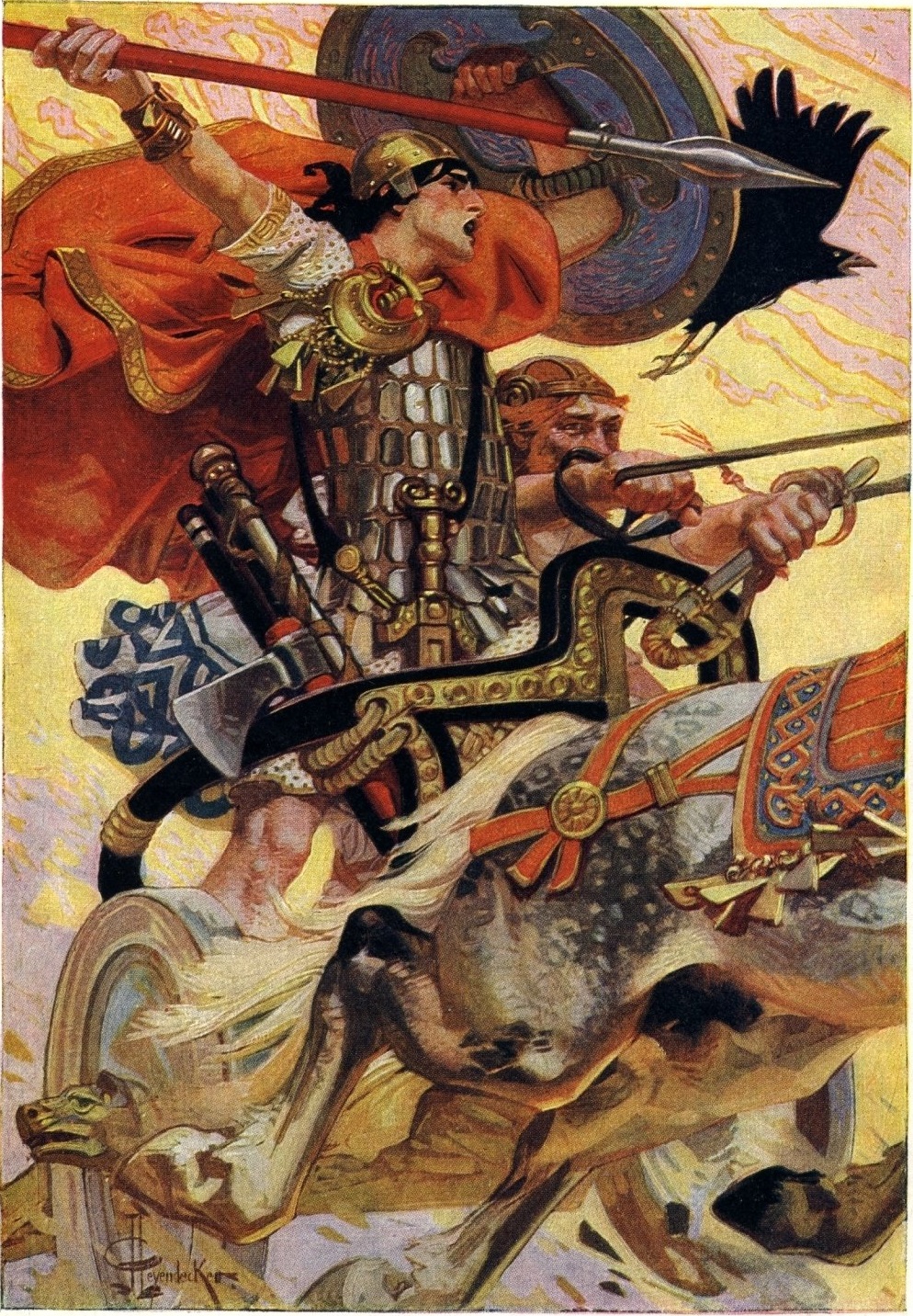
Cuchullain and the Badbh

Cuchullain and the Badbh

Apart from the skilled young trixter-warrior character of Lugh of the Tuatha Dé Danann, Finn Mac Cumhall and Cú Chulainn are the two primary magical warrior-adventurers of Gaelic legend: The former is a member of a youthful warrior-hunter band, the Fianna, whose tales are collectively known as the Fenian Cycle. The latter is the erratic warrior-champion of king Conchobar, and the protagonist of the ‘Ulster Cycle’ tales. Both appear to be from different story-telling traditions from literature and orature, yet they seem to share a tantalising similarity which needs to be examined. They combine an essential function that relates to the pagan mythos – one that Christians felt suitably important to record in written form, perhaps fixing a shared tradition of the pre-literate pre-Christian world into two separate strands. Of the two, Finn represents the more mundane whereas Cúchulainn, like Mongán was part-otherworld.

Of greatest interest is the fact that their names contain what appears to be a phonetic link to the Goddess herself – Cumhall (‘Coowal’) and Chulainn (‘Cullin’) can both be interpreted as potential versions of the Cailleach epithet. One piece of folkloric evidence of a possible link comes from a number of traditions which portray Finn as a giant whose attributes cross over with those ascribed elsewhere to the character of the Cailleach, or ‘the Devil’ or other ‘giants’: namely in the creation of landscape features and displays of strength and agility. These appear (to varying degrees, admittedly) to be attempts at obfuscating pagan creation-myths, where different story-characters are employed to cover the tracks of paganism in local legends and story-traditions.

The origin tales and naming of the two heroes given in the more elaborate literary traditions associate their names with mythical male figures. Cúchulainn is supposed to be named after the magical blacksmith whose dog he killed, Finn the son of a leader the fianna of Ireland, and in one of the Mongán stories it is suggested that Finn is Mongán and therefore a creation of old Manannán himself.  Cú Chulainn – like Mongán – is conceived by a ‘god’ or otherworld man who sleeps with an earthly woman, and in the tale ‘Compert Con Culainn’ this is Lug rather than Manannan. Both warriors have an earthly mother…

Another aspect to the clever-strongman-warrior-hunter-ruler archetype tales is – as mentioned – how they relate to popular conceptions and story-traditions. Finn, Mongán or Cúchulainn might (as semi-divine intermediaries at key (pseudo) historical events) help or hinder the work of kings and whole provinces in the high literary tales but in common folktales the character takes on a somewhat different aspect and meaning:

I have already mentioned the function of Finn in particular in relation to folk tales dealing with the shaping of the landscape. These are common to all of the Gaelic language provinces, and have equivalents in the Brythonic regions and further afield. In the Isle of Man, tales were once told of belief in a half-otherworld spirit called Phynnodderee (also known by the species-name Glashtin), who like the Brownie of Scotland and his equivalents elsewhere was a powerful assister of agricultural and household endeavour and well-being. In the remaining, somewhat corrupted folktales about this island fairy-character, there is a surprising degree of story-function plasticity  and confluence of the Phynnodderee with tales of Finn, the Devil and St Patrick, a giant and his wife, the Cailleach and even Manannan. Phynnodderee is a fairy prince cast out of fairyland, a domestic helper, a Wildman who lives in caves in the hills, a strongman who moves giant stones around and performs great feats for farmers, a lover of mortal women, and a fractious and easily-offended friend (you should never offer him clothes). Had the Isle of Man been more warlike in its recent history, he would almost certainly (as happened with Finn in Ireland and Scotland) have been a great warrior too – and was probably the ‘sleeping prince’ living in the ‘Devil’s Den’ alluded to in George Waldron’s 18thC Manx folktales.

Boand – Water Goddess of the Boyne

I have already mentioned in recent posts that there were legendary connections between the Atlantic Goddess and water: For starters she is represented in the constellation Orion, standing on the banks of the great white river of the Milky Way as it arches across the winter sky. As ‘Tehi Tegi‘ in the Isle of Man, she conveyed the souls of the dead across the land until they reached the rivers or the sea and were able to enter the realm of the Otherworld. The Cailleach traditions of Ireland, Scotland and Wales tell of her role in creating Lochs and other floods by neglecting to close off springs, and as the Bean Nighe she sat near water washing the garments and effects of the dead.. In Brittany she is represented by the oceanic fairy queen known as the ‘Gro’ach‘ and as a Moura Encantada in Portugal and Gallicia she is a guardian of springs. Archaeologists across Atlantic Europe recognise the association of springs with pagan goddess-worship.

It is perhaps unsurprising that the rivers of Ireland have associations with pagan female entities preserved in their legendary lore. A good example of such stories are from the onomastic explanations of placenames found in medieval literature, often produced by Christian monks. These texts – published in compiled form in the early 20thC as the ‘Metrical Dindshenchas‘ (taken from the mss. the Book of the Dun Cow, the Book of Leinster, the Rennes Manuscript, the Book of Ballymote, the Great Book of Lecan and the Yellow Book of Lecan) – has the following (from Vol.3)  to say about the origin of the River Boyne (under ‘Boand 1’), the most prominent river of the Irish midlands, and one associated with a rich mythology and archaeology:

Sid Nechtain is the name that is on the mountain here,

the grave of the full-keen son of Labraid,

from which flows the stainless river

whose name is Boand ever-full.

Fifteen names, certainty of disputes,

given to this stream we enumerate,

from Sid Nechtain away

till it reaches the paradise of Adam.

Segais was her name in the Sid

to be sung by thee in every land:

River of Segais is her name from that point

to the pool of Mochua the cleric.

From the well of righteous Mochua

to the bounds of Meath’s wide plain,

the Arm of Nuadu’s Wife and her Leg are

the two noble and exalted names.

From the bounds of goodly Meath

till she reaches the sea’s green floor

she is called the Great Silver Yoke

and the White Marrow of Fedlimid.

Stormy Wave

from thence onward

unto branchy Cualnge;

River of the White Hazel

from stern Cualnge

to the lough of Eochu Red-Brows.

Banna is her name from faultless Lough Neagh:

Roof of the Ocean as far as Scotland:

Lunnand she is in blameless Scotland —

or its name is Torrand according to its meaning.

Severn is she called through the land of the sound Saxons,

Tiber in the Romans’ keep:

River Jordan thereafter in the east

and vast River Euphrates.

River Tigris

in enduring paradise,

long is she in the east, a time of wandering

from paradise back again hither

to the streams of this Sid.

Boand is her general pleasant name

from the Sid to the sea-wall;

The poet who wrote this account is effusive in his descriptions of the great river, comparing it (or perhaps more accurately actually identifying it) with the other great rivers of the known world, including the River Severn, the Tiber, the Tigris and Euphrates, the Jordan etc. It was believed that the oceans were made up of all the world’s rivers in the era of authorship – an idea born of classical antiquity and beyond. What is more important is the author implies that the river actually runs from Sid Nechtain to the ‘paradise of Adam’, being a direct allusion to a christianised  telling of the pagan Irish belief in an Otherworld at the Ocean’s End, and to the Garden of Eden, where Christians believe life begins! This almost tells of a former belief in rebirth… The passage also implies that the river is regenerated from the East and returns to Sid Nechtain to flow again by some unspecified route.

Quite amazing.

The compiled texts go on to describe the mythological origin of the River of Boand:

I remember the cause whence is named

the water of the wife of Labraid’s son.

Nechtain son of bold Labraid whose wife was Boand, I aver;

a secret well there was in his stead,

from which gushed forth every kind of mysterious evil.

There was none that would look to its bottom

but his two bright eyes would burst:

if he should move to left or right,

he would not come from it without blemish.

Therefore none of them dared approach it

save Nechtain and his cup-bearers: —

these are their names, famed for brilliant deed,

Flesc and Lam and Luam.

Hither came on a day white Boand (her noble pride uplifted her),

to the well, without being thirsty to make trial of its power.

As thrice she walked round about the well heedlessly,

three waves burst from it, whence came the death of Boand.

They came each wave of them against a limb,

they disfigured the soft-blooming woman;

a wave against her foot, a wave against her perfect eye,

the third wave shatters one hand.

She rushed to the sea (it was better for her) to escape her blemish,

so that none might see her mutilation;

The authors relate a typical Irish Christian rescension of the pagan tale of the woman and the water. The passage also tells of the practice of circling a well or spring three times, which any folklorist who has studied Celtic traditions will recognise. The tale of Boand therefore acts on a number of levels: Firstly as a poetic figurative description of the river as a woman, secondly as descriptive account of the Boyne replete with onomastic and pseudo-historical details, and thirdly it seems to contain a warning to the ungodly of the fate which will meet them if they emulate the legendary magical female… Of particular interest is the manner in which the water harms Boand: It causes the ‘wounds’ of the Cailleach – the ‘fairy stroke’ of withering in one eye, one arm, one leg. Such ‘wounds’ are given to other magical females at rivers or fords or shorelines in other Irish myths from medieval works, including that of the Christian ‘St Brighid‘…

Medieval Irish tales with pagan themes usually contain a Christian footnote in their third part…

The meaning of Samhain

Samhain is the quarter-day festival that starts the Celtic year, marking the start of Winter and the end of harvests. It commences at nightfall on October 31st (new style Gregorian calendar) or the 11th November (old-style Julian Calendar) and goes by a number of different English names including Hollantide, All-Hallows Eve, Hallowe’en and All Saint’s Eve. In Scots and Manx Gaelic the name is the same, although written differently: Samhuinn and Sauin, respectively. The pronunciation is ‘Sow-in’ (rhymes with ‘cow-in’). There are a number of other more archaic names, which I will go on to discuss in due course.

It is a festival that symbolizes death – the transitional phase of the seasons when Atlantic Europe’s foliage dies back, and animal life dwindles. The evenings darken rapidly and the first frosts begin to touch the land. Crows and flocks of migratory wading birds throng the skies in great clouds cawing, whistling and chattering. The constellation of Orion begins to dominate the night skies… The spirit which enlivened nature in the summer months has gone from visible reality to the state of an intangible but certain potential for the coming year. In an ancient religious system that viewed life as a continuous oscillation between the tangible living state and a spiritual state awaiting rebirth in the next cycle, Samhain was therefore also the Festival of the Dead. 

It was Julius Caesar who first noted (in Commentarii de Bello Gallico) that the Gauls held that days started with nightfall, and celebrated the commencement of their important days with the falling of night. The same is true of the other Atlantic peoples, and in Ireland, Scotland and the Isle of Man in particular this continued down to modern times. The festival of Samhain was therefore called Oidhche Samhna – ‘Night of Samhain’ – in Irish, and Oie Hauiney or Houney in Manx. Both would be pronounced pronounced something close to ‘Ee ouna’ allowing for the usual lenitions and aspirations of spoken Gaelic.

The Manx had another name yet for the festival – ‘Hop tu naa‘ (pronounced ‘hop the nay’ or as the more modern ‘hop tyoo nay’) – which is of uncertain meaning and sounds curiously close to the Scots name for New Year: Hogmanay. In fact, Samhain was the Celtic New Year – just as days started with a nightfall, so the years started with the dark part also. It is uncertain when the Scots started to use ‘Hogmanay’ as the term for the 31st of December New Year, or for that matter if the term was ever used for Samhain. It seems that folk traditions of the Atlantic European world show quite a degree of transferability across the period between Samhain and the January New Year – customs including guising, playing pranks, gifting and house-visiting were just as likely at Christmas and New Year as they were around the 1st of November. Whether this represents a natural tendency to transfer celebrations that brighten the dull winter months or a concerted religious effort to dissipate or transform wholly pagan festivities remains unclear, but a combination of factors is likely.

There has always been a strong association of the festival with a ‘witch’ or ‘witches’ that has continued right down to the Halloween celebrations of modern times. The Celtic peoples never really had much time for the idea of ‘witches’ in the 16th/17thC judicial and religious sense of a person who worships the Christian Satan and does magic to harm their neighbours. The ‘witch’ referred to in Celtic areas is generally best interpreted as a Christian opinion of the old Goddess herself, rather than a human individual at the margins of society. She seems to be represented by the folklore character referred to as the Cailleach – a monstrous ancient female supposed to have created the landscape and unloosed the rivers, and supposed in some traditions to be responsible for winter. 

To the Celtic peoples of Ireland, Scotland and the Isle of Man ‘The Witch‘ was a figurative legendary character representing Christian opinion of the ancient Goddess, rather than a clear and present social threat posed by ‘a witch’. For this reason, there were hardly any executions of suspected ‘witches’ in Celtic cultural zones.

'Jinny the Witch jumped over the house to fetch a stick to lather the mouse'  (Old Anglo-Manx Samhain song)

‘Jinny the Witch jumped over the house to fetch a stick to hit the mouse’ (line from an old Anglo-Manx Samhain guising-song) – the constellation of Orion presides over the winter skies between Samhain and Imbolc (1st February).

Irish legends and medieval manuscripts contain a number of references to Samhain, and one in particular to a ‘witch’ associated with the festival. The ‘witch’ was Mongfionn/Mongfind – ‘White Hair’ or ‘Fair Hair’ – supposed at least (euhemerisation agains!) to have been sister of Crimthann mac Fidaig, a king of Munster, and mother of Ailill, Brión and Fiachra, the traditional ancestors of the medieval Connachta, by a High King called Eochaid Mugmedon. The Connachta were the opponents of the Ulaid (Ulstermen) in the Tain. She is supposed by to have been a sorceress responsible for poisoning her brother in order to allow her children to succeed the kingship, but who died after tasting her own poison while trying to convince her brother’s children it was safe. It is the old ‘evil fostermother’ tale from folklore, also related in the story of the ‘Children of Lir’. This murder and her death happened at Samhain and the Book of Ballymote (folio 144, b.1) claims that Mongfind was thereafter worshipped at Samhain by the peasantry who called it the ‘Festival of Mongfind’ – Feil Moing! There is a hill called Ard na Ríoghraidhe (Height of the Kingfolk?) or ‘Cnoc Samhna’ (Hill of Samhain) in Co. Limerick that is associated with her. The details of the kingship-oriented stories involving Mongfind are probably an obfuscation of the facts, and the ‘White Haired One’ is likely to have been the aged Cailleach who represented winter and rebirth in the coming year. Perhaps the Milky Way was her hair? The path to renewal…

Cnoc Tlachtga (now also called ‘The Hill of Ward’) near Athboy, Co. Meath was also a place legendarily or historically associated with Irish Samhain festivities, including the lighting of a bonfire. This Hill was supposedly eponymously named from a magical female of the same name, the daughter of a magician-druid called Mug Roith/Mog Ruith who was suppose to have given birth to triplets on the hill before dying. Another site associated with paganism, death and Samhain was, of course, Magh Slécht (Mag Senaig) in Co. Cavan, supposed to have been the site where ‘Tigernmas’, an ahistorical pagan High King of Ireland died along with many of his followers while worshipping an idol called Crom Cruaich at Samhain. This idol was supposed to have later been broken by Patrick. There are many other traditions besides, including the tale of the Ulster Cycle called Serglige Con Culainn (The Wasting Sickness of Cúchulainn) were the Ulster hero is attacked and seduced by the Queen of the Otherworld – Fand, wife of Manannan – during the course of Samhain celebrations of the Ulaid.

Irish legend also place the start of the Second Battle of Maigh Turead at Samhain, and it commences after a sexual coupling of the Dagda with the Morrigan. Likewise, the cattle raid of the Tain Bo Culainge commences at Samhain, and the tales of this also feature the Morrigan, who I have earlier identified with the Cailleach. The medieval tale The Boyhood Deeds of Fionn claimed that the Fairy Hills (Sid) were open at Samhain. You can tell from ancient Irish literature that Samhain had a particular association with death and the otherworld, and with potent magical female characters!

The themes of conflict and death at Samhain follow on from the Harvest, and then the very visible Atlantic autumn die-back of nature – replete with withering, decay, storms and darkness. These processes are set in motion from the festival of Lunasa (Lughnasadh) onwards. The die-back to pagans was simply a part of the renewal-cycle and therefore did not have the confused connotations of ‘evil’ or ‘uncleanliness’ that was imported with the somewhat ectopic Judaic religions during the 1st millennium.


The Atlantean Sea God

Plato, speaking in ca.360BCE of a supposedly historic lost western island-civilisation he called ‘Atlantis’, placed the worship of their founder, the Greek sea god Poseidon (Neptune to the Romans), at the centre of this culture. His accounts have no historical or geographical merit, except that they talk of a potent civilisation of united kingdoms founded on a shared spiritual vision, existing beyond the ‘Pillars of Herakles’. Setting aside the contemporary ‘Clash of the Titans’ style Ancient Greek colouring of Plato’s telling (he was seeking to link the supposed glory of Atlantis with his own state of Athens), the geographically-closest essential match we can find that has any kind of vague archaeological symmetry with Plato’s fable is that of the Atlantic European civilisation of the Neolithic and Bronze Age, which placed its imprint on the landscape from Portugal up to Scandinavia. In Plato’s day it would have been inconceivable to Athenians that the legend of Atlantis might relate to the culture of those hairy uncouth illiterate barbarians to the North and West!

Many modern scholars have dismissed the discussion of Atlantis in the dialogues of Critias and Timaeus as pure invention, devoid of anything but metaphysical truths and object lessons. After all, there is no geographical evidence of such a place as Atlantis, and the theories relating to cataclysmic Mediterranean volcanic eruptions do not fit with the Atlantic specification of the Platonic tale. In fact, the same criticism might be levelled at any other oral tradition handed down, and Plato admits that it is an oral tradition he is conveying. The codification of truth in oral tradition is in fact a more complex discipline to understand, and none of the academic rejections of the historicity of Plato’s Atlantis fable argue from the point of view of this discipline.

I have already discussed in previous blog entries how there is a legendary association between the sea and the world of the dead in many Atlantic European traditions, and how the disappearance of the sun into the ocean in the west and its rising again in the land to the East has probably influenced the fundamental belief in reincarnation as mentioned by 2000 year old Roman and Greek sources about Atlantic European religion, and supported by elements in later local folklore. The idea of a key ‘Sea God’ (rather than an Olympian or Semitic mountain god) is therefore a potent one that must be one of the ‘truths’ woven into Plato’s Atlantis oral tradition. We shall therefore examine this Atlantic ‘Sea God’ in greater detail:

The most definite character surviving in the pagan legends from before the invasion of the Roman and Middle Eastern Religions (Christianity, Catharism, Judaism, Islam) is that of Manannán mac Lir, who is remembered in the legends of Ireland, Wales (as Manawydan fab Lir), Scotland and the Isle of Man (where he is still is portrayed as the principle ancestor-god!). His extent or identity is therefore limited to the ‘Celtic’ Northwest of Europe – the chief god of the more eastern Scandinavian peoples, appears from medieval literary sources to have been Óðinn (Odin), who was known to the more southerly Germanic peoples as Woden or Wodan, and does not appear on superficial inspection of the evidence to have a particular connection with the oceans – moreso the wilds and forests of the East. I shall examine the truth (or otherwise) of this later.

Manannán is represented in the various ancient Irish tales as a Lord of the Otherworld with connections to the sea, as can be expected from an Atlantic theology. This is most strong in the aforementioned Voyage of Bran, and in the Ulster Cycle tale of Serglige Con Culainn (The Sickbed/Wasting Sickness of Cú Chulainn) he is again portrayed as the Lord of Mag Mell. Where he appears in Irish tales, it is usually as otherworld Lord and donor of magical gifts and appears to share an identity with many of the characters of Irish literary legend such as the Dagda, Elatha, Ogma, Lugh and of Aengus Óg (who may represent his youthful aspect). Christian tellers of tales and scribal authors in the middle ages appear to have used the Greco-Roman style of the ‘exploded pantheon’ to explain Irish pagan history, which folklore evidence seems at somewhat at odds with. A prime example of the obfuscation of Manannan comes from his identity as it evolved in the Isle of Man:

In the Isle of Man, folk tradition (including an old ballad possibly dating back to 1507, called Mannanan Beg Mac y Leirr) hales him as the proto-ancestor of the Manx to whom they once paid homage by an annual tithe, still enacted nowadays as part of the annual midsummer Tynwald festival. Manx ideas about Manannan echo medieval Irish descriptions (eg – Cormac’s Glossary) which portray him in a ‘euhemerised’ fashion as a great seafarer/pirate/magician who once resided in and ruled over the Island. To the Manx he appears to have taken the mantle of a Mountain God who lived atop the great fortress hill of South Barrule – more akin to Jehovah than a sea lord, possibly the result of attempts by local Christian clergy and laity to portray him as an earthly alternative to the more feminine land-goddess apparently once venerated by Atlantic pagans! (George MacQuarrie’s ‘Waves of Manannan’ is worth a read as he expands this theory). The Manx Manannan is definitely at odds with the otherworldy one of ancient Irish legends, and the absence of many land features in the Isle of Man named after him, compared to those named after the pagan goddess give testament to this. However this does not detract from the fact that many Manx people today will reply ‘Manannan’ when you ask who the god of the Island is! What other European nation still has a popular pagan god? 😉 There is even a fisherman’s prayer to Manannan that was collected by folklorist Sophia Morrison and published in Volume 1 of the Proceedings of the Isle of Man Natural History and Antiquarian Society (1906-1915):

Mannan beg Mac-y-Lir, fer vannee yn   Ellan,   

Dy bannee shin as nyn moatey.   

Mie goll nagh as ny share chiet stiagh,   

As bio as marroo ‘sy vaatey.  

“Mannan beg Mac-y-Lir,

who blessed the Island,      

Bless us and our boats,   

Good going out, and better coming in,   

With live and with dead in the boat.”

Although echoing a similar prayer to St Patrick it stands alone as an example of pagan or perhaps nationalist devotion, Morrison claimed it to be from a Peel (the island’s western fishing port) woman who was nearly 100 years old who had claimed it to have been used by her grandfather! Note the Manx use of ‘Mannan’ or ‘Mannin’ is interchangeable with ‘Manannan’, ‘Mannin’ being the name of the Island which was supposed to have been named after the God. Some Norwegian fishermen were still apparently offering up prayers to ‘Njor the Merman’* during the 18th and 19th centuries – a late reference to belief in the Vanir god Njörðr and evidence that people in dangerous marginal professions spread their luck among many baskets, and don’t place their faith in the usual socially-accepted agencies. (*Collected by Halldar O. Opedal in Odda, Hordaland, Norway during the 19thC – related by Georges Dumézil in ‘Gods of the Ancient Northmen’, 1973).

A contemporary Manx sculpture of Manannan displayed at a local music festival

A contemporary Manx sculpture of Manannan

Njörðr is possibly the same deity as the ‘Nerthus’ mentioned by the Roman historian Tacitus (responsible for the second or third-hand literary account of the defeat of the Druids on the Island of Mona in the 1stC AD) –  Njörð is pronounced ‘Nyerth’ or ‘Nerth’. Tacitus’ Nerthus is described as a goddess of the Atlantic or Baltic Germanic tribes, whose cult image was annually taken from its sea-island sanctuary in procession among the peoples on a wain drawn by heifers during a certain festival period at which iron objects were locked away and no warfare was carried out. At the end of this according to Tacitus’ (again, second or third-hand account), the wain and the image of the goddess was immersed in a lake and its male attendants died.  Jörð was the feminised portrayal of the Earth (it is the origin of that word in English) in later Germanic and Scandinavian legends – Tacitus refers to Nerthus as ‘Terram matrem’ (mother earth).

Njörðr has a reasonably strong legendary association with the sea and was said (in the Prose Edda text Gylfaginning) to live in a heavenly place called Nóatún, meaning ‘ship enclosure’. In the Poetic Edda  poem Vafþrúðnismál, it is stated that he will survive Raganorok and be reunited with the Vanir, suggesting an afterlife existence in the Scandinavian religious schema. He is associated with wealth, fertility, benignity – much like his son Freyr – and in one tale he was married to the mountain giantess Skaði – a daughter of the jötunn (giant) Þjazi whose attributes included the ability to take the shape of giant eagle. (Skaði and Njörðr’s daughter Freyja’s feathered cloak appears in other tales and gives the ability to shape-shift into the form of a bird!). After the Aesir kill her father, Skaði is allowed to choose Njörðr as a husband, apparently deciding on account of his beautiful feet (presumably being a sea-loving god they are clean and smooth), but they disagree about their favourite place to live –  Njörð wishes to stay near to the sea and Skaði longs for her father’s mountainous province of Þrymheimr.

In the Poetic and Prose Eddas, Njörðr is recorded as being the father of the male and female twins Freyr and Freya (literally ‘Lord’ and ‘Lady’) – described as leaders of the race of gods known as ‘Vanir’, who originate in ‘Vanaheim’. Although it is never stated that Skaði is their mother, it is strongly implied. As we shall explore later, the theme of an estranged otherworld sea-god and his female earthly-mountainous consort was a key theme in Atlantic Paganism further West, and the Vanir tradition of Scandinavian paganism ultimately derives from this.

In the Lokasenna poem of the ‘Poetic Edda’ texts, Loki states that Njörðr came to live as a hostage among the Aesir race of gods from the west (stanza 34) after the first ‘Aesir-Vanir War’ (an account of which occurs in the Völuspá). The mixing of the ‘Aesir’ and ‘Vanir’ in Norse legends is a curious aspect of late Scandinavian Atlantic Paganism, and we need to consider how theirSea God’ Njörðr relates to Manannán Mac Lir. Are they the related to the gods of the Western Atlanteans? I’ll do this in another post to follow….

tbc

The End of Reincarnation

The ultimate fate of Bran and his party in the medieval Irish tale Imram Brain maic Febail (‘The Voyage of Bran Mac Febal’) is that upon attaining the otherworld, when they try to return to the land of the living a great age has passed and the party are unable to set foot in the land without crumbling to dust. In other words, the Christian narrator denies them access to reincarnation. Bran is only allowed to pass on his story and then fade into legend, the narration finishing with the lines:

And from that hour his wanderings are not known.

The motif of immortality’s end appears in a modified form in the other famous Irish medieval legendary tale of the ‘Children of Lir’, who were transformed into immortal swans and cursed to travel Ireland for hundreds of years until ‘released’ by the coming of Christianity. The ‘Voyage of Bran’ leaves the state of Bran and his party indefinite, but the Children of Lir resume a withered mortal form or crumble to dust, though not usually before receiving christian confession and going to the Christian afterlife.

There are other Irish accounts of very long-lived members of ancient races receiving similar treatment. Some of these, such as in the pseudo-historical Christian narrative of the Lebor Gabála Érenn or ‘Book of Invasions’, and other related historical legends written in the middle ages, contain accounts of ‘Fintan’, one of the first settlers in Ireland who legends and stories claimed lived on in various animal and human forms until the coming of christianity. The Welsh medieval author Walter Map (De Nugis Curialum) left us the tale of King Herla which was based on similar themes as that of Bran, Finn and Caílte. The Middle Irish tale of mad pagan King Suibhne (‘Sweeney’) who literally flies around in a semi-animalistic form until released to heaven by a saint may also continue the Irish Christian tradition which told stories designed to counter a pagan belief in reincarnation.

The theme of submission of the pagan order to that of christianity occurs most strongly in the middle irish manuscript tales of the Acallam na Senórach (‘Colloquy of the Ancients’ or ‘Tales of the Elders of Ireland’ etc) which contains the majority of the ancient tales dealing with Finn and his band. It is set within a Christian framework in which the ancient giant warrior Caílte mac Rónáin (Finn’s nephew) relates tales of Finn and of the Tuatha Dé Danann to an interested St Patrick: By implication Caílte is exchanging the reality of an otherworldly existence in the pagan time frame with a Christianised legendary life in the hearafter.

All of these tales are careful to create a linkage between the old and new religious orders, again demonstrating conformity with the principles of the Christianised reformed laws of the Roman Empire propounded by Theodosius and his successors during the late classical period, during which time christianity was setting up shop in the Atlantic West of Europe. It was a theme of peaceful cohabitation of old and new which formed the skeleton of many medieval narrative and literary traditions, and managed to preserve the tenets of paganism, which after all seemed to explain everything which christianity could not and would continue to influence the folk traditions and beliefs down to modern times.

The Cailleach in ‘Togail Bruidne Dá Derga’

Togail Bruidne Dá Derga is one of the most stylised tales from the ‘Ulster Cycle’ mythological tales, found in a number of versions spread over a number of famous medieval Irish manuscripts. It deals with the fate of King Conaire Mór, who is introduced in the tale as being fathered by a magical bird who visits his mother. The story’s themes are fate, inescapable doom, sacral kingship and the idea of geasa – the taboos a king or a recipient of magical gifts must follow if they are to retain the benefits.

The tale is paralleled by another which appears in the ‘Ulster Cycle’ corpus and seems to be an alternative ‘opening act’ to the story: Togail Bruidne Dá Choca in which the character Cormac is cast in place of Conaire. ‘Choca’ appears to be a phonetic/dialetic transliteration of ‘Derga’.

The stage for the tale is set in the ‘Hostel’ or castle of Dá Derga – full of magical rooms filled with the many strange visitors whom the hosteller is obliged to entertain. He is visited by the King who is surprised when a certain Wyrd Sister visits the door of the hostel and gives dire prophecies to Conaire about his coming fate. She is the Cailleach herself, as the tale’s description quite clearly shows:

When they were there they saw a lone woman coming to the door of the Hostel, after sunset, and seeking to be let in. As long as a weaver’s beam was each of her two shins, and they were as dark as the back of a stag-beetle. A greyish, wooly mantle she wore. Her lower hair used to reach as far as her knee. Her lips were on one side of her head. She came and put one of her shoulders against the door-post of the house, casting the evil eye on the king and the youths who surrounded him in the Hostel.

…and identifies herself as one with many names:

CailbSamain, Sinand, Seiscleand, Sodb, Saiglend , Samlocht,
Caill, Coll,
Díchoem, Díchuil, Díchim, Díchuimne, Díchuinne,
Dairne, Dáirine, Der úaine,
Égem, Agam, Ethamne,
Gním, Cluichi, Cethardam,
Nith, Nemain, Noenden,
Badb, Blosc, Bloar,
h-Uaet,
Mede, Mod.”

It is obvious that this character is a very significant individual, whose names echo many others given to ‘fairy women’ in the various other Irish bardic tales. Her great size, twisted face, her mantle, her prophetic powers, ancient nature and names all point directly to the Cailleach archetype or goddess. Standing upon one leg with one arm outstretched she utters a terrible doom on Conaire:

‘Truly I see for thee,’ she answers, ‘that neither fell nor flesh of thine shall escape from the place into which thou hast come, save what birds will bear away in their claws.’

What comes from the birds will go with the birds*, in other words…

In Togail Bruidne Dá Choca the ‘Cailleach’ appears again as the Badb, described as a ‘red woman’ washing blood from a chariot at a Ford, and presaging the death of the would-be king Cormac. She too stands on one foot and closes one eye and chants Cormac’s doom, a similar pose to the Badb or Cailb etc. She then apparently transforms into a fair maiden to restate Cormac’s fate… This Badb is very similar to the TBDD one and also to the Morrigan in the Tain, and was obviously a motif of orature or literature strongly linked to the narratives of the pre-Christian past.

(* Birds appear as a recurring theme in early and middle Irish stories representing the spirits of ancestors and forebears, and the Badb/Cailleach character is often associated with them.)

The <Cailleach/Badb/Aine/Morrigan/Brighid> ‘hypostasis’** is a ruler of herds and flocks in the various traditions surrounding her: Of Cattle, Deer, Birds and Souls of the Dead. She also represents the phases of the annual cycle and embodies both generation and death in continuity with annual rebirth. For this reason she appears in the old irish stories as a prophetic being, as she embodies everything which has gone before (her age) with everything which will come again (her knowledge of the future). The occasional narrative tendency for her to transform into a youthful countenance represents the continuing uncertainty about the future, while the aged decayed appearance arises from our knowledge of past certainties.

The comparison of tribal kings with rutting bulls and their contests in their respective territories (on the Magh or ‘Plain’) is a theme underpinning the contest of the Old Order and New Order in Irish mythology: The attempts of powerful mythical females to control these is the main theme of the Táin Bó Cúailnge.

** Hypostasis means “underlying state” or “underlying substance”