Belenos and St Michael the Archangel?

One curiosity of Atlantic European Christianity is the existence in its collegium of venerated ‘saints’ of a figure with no earthly beginnings whatsoever: St. Michael the Archangel.

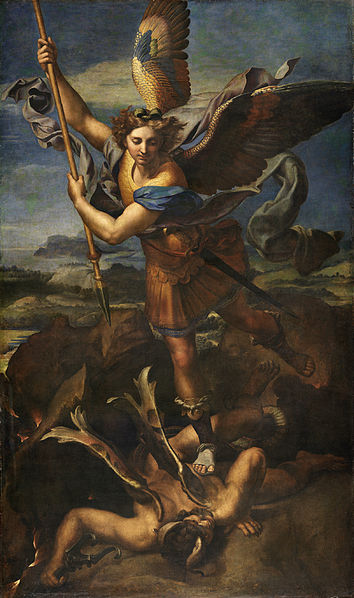
Saint Michael the Satan-slayer, as depicted by Raphael.

Saint Michael the Satan-slayer, as depicted by Raphael.

As the Taxiarch of the heavenly battle host, he occurs firstly in the Darnel-induced visions of the Hebrew Book of Daniel (Daniel 10, to be precise, where he reassures the Hebrews that they as a nation will be protected from the depredations of their Persian captors):

“…Then I lifted up mine eyes, and looked, and behold a certain man clothed in linen, whose loins were girded with fine gold of Uphaz: His body also was like the beryl, and his face as the appearance of lightning, and his eyes as lamps of fire, and his arms and his feet like in colour to polished brass, and the voice of his words like the voice of a multitude…” (KJV)

Michael appears again in the equally hallucinogenic Christian Book of Revelation written by John of Patmos, and leads the War in Heaven.

“…And there was war in heaven: Michael and his angels fought against the dragon…”

It is obvious that in the late -classical period such a character would have had a certain appeal to Central and Northern Europe’s newly Christianised warrior-cultures who venerated their departed heroes religiously, and had complex story traditions recounting their deeds. If you believe St Patrick, the Irish worshipped ‘Idola’ – visions or images – and from the designs of Celtic coins, it is quite possible that Celtic religion was something of a visionary cult.

The idea of a winged, victorious warrior is by no means an invention of the Hebrews, however. The older Egyptian and Babylonian Empires were responsible for this cultural iconography which entered the western Mediterranean sphere during the Hellenistic period, from where it eventually spread into the ‘barbarian’ world of Europe’s Celts.

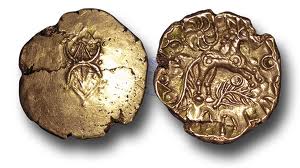
During the period of Roman expansion into the lands of the Danubian and Rhineland Celts, and thereafter into Gaul and Britannia, the coins of the Celtic kings began to pick up on the iconography of the ‘winged’ human or animal form. In particular, this can be seen in those produced by the Belgic cultures – in particular the Atrebates, Trinovantes and Catuvellauni of eastern Britain during the 1stC BCE and 1stC CE who played such a major role in the Romanisation of Britain and northern Gaul. Of particular note are the coins of Commius, Cassivellaunus, Addedomarus, Tincomarus, Tasciovanus and his son Cunobelinus, which all show signs of Roman acculturation through their use of visual motifs such as the use of imagery of Pegasus,  the winged Victoria, and the Eleusinian head of Corn. In so doing, they were copying the iconography that their sons had become accustomed to while in fosterage/hostagery in the Roman curia.

Winged icons of shining deities would find their true Renaissance in the coming Christian era, when angels as warriors of light would replace the icon of the mercurial shining warrior god so beloved of the Celts.

The appearance of places named after ‘Michael’ was already well under way by the early middle ages: In Ireland, the early southern monastic island settlement of Skellig Michael was a key place in this process. St Michaels’ Mount in Cornwall and Mont St Michel in Brittany were another two significant places with religious importance. Diodorus of Sicily, writing in the 1stC CE referred to the metal-mining and smelting heartland of Cornwall by the name Belerion, suggesting a theophoric name based on Belen(os):

“…The inhabitants of that part of Britain which is called Belerion are very fond of strangers and from their intercourse with foreign merchants are civilised in their manner of life. They prepare the tin, working very carefully the earth in which it is produced. The ground is rocky but it contains earthy veins, the produce of which is ground down, smelted and purified. They beat the metal into masses shaped like astralgi and carry it off to a certain island off Britain called Ictis…”

Ictis is believed to refer to St Michael’s Mount near Marazion.

Further to the northwest, another important metal-producing place was the Isle of Man (called Manavia Insula by Ptolemy in the 2ndC CE). Here the concept of the  ‘Angel Michael’ was – as elsewhere – introduced into the popular imagination by Christian monks and priests. To the Manx, the name was converted to ‘Vaayl’. The ‘v’ sound could represent a transition from a name starting with ‘b’ or ‘m’ in the Celtic languages. This makes us consider if the original name was in fact ‘Mel’ or ‘Bel’… The name of this Island’s prime saint, ‘Maughold’, is a version of ‘Mayl’ (referred to as ‘Mel’ in the Brigitine hagiographies). The 12thC hagiographer Jocelyn of Furness told a legend of St Patrick defeating a flying wizard called ‘Melinus’ on the Isle of Man. ‘Melyn’ is the Welsh word for ‘yellow’, and sounds something like the Latin word ‘Malin’, referring to the tide. ‘Creg Malin’ in the Isle of Man overlooks St Patrick’s Isle where Jocelyn probably portrayed his imaginary showdown between christianity and the crusty Simon-Magus imitating wizard. This legend of Melinus actually equates directly to the Manx traditions of Manannan, who they claimed was the original ruler overtunrned by Patrick.  The 18thC English writer George Waldron commented that he had been told that ‘Merlin’ was said to be the legendary wizard-ruler, echoing Jocelyn, albeit with an extra ‘r’ and it is to be noted that ‘Merlin’ and ‘Mercury’ are not too dissimilar as names... the plot thickens!

So, Merlin, ‘Melin’ and ‘Belin’ are linguistically not too far from each other. Also, the tendency of Celtic languages to switch the P/B (‘P-Celtic’) sound with the C/K/Q (‘Q-Celtic’) sound make an association of ‘Belen(us)’ with the legendary ‘Cuillean’ a distinct possibility.

‘Cuillean’ was a legendary Irish/Manx smith and metal-smelter who occurs in the legends and placename-lore of Ireland, Mann and Scotland. If we are to link this character to ‘Belenus’ then it is worth noticing the names ‘Cunobelenus’ and ‘Cuchullain’ are exactly equivalent. Also the ‘germanic’ name of the legendary smith-figure ‘Weland’, with the addition of a Gaelic ‘k’ guttural becomes ‘kWeland’ so is actually an equivalent of ‘Chuillean’, or in the Welsh – ‘Gwyllion’. Slieve Gullion in Armagh, Ireland, and Slieu Whallian and Ard Whallan in the Isle of Man are name after him – possibly also ‘Schiehallion’ in Scotland. All of these places have interesting legends attached to them. Ireland also has its share of ‘giant’ or saint-stories with the name ‘Mal’ or ‘Mel’ attached – Mal Bay in County Clare being an example that comes to mind.

So… Belenus is the same ‘person’ as the smith/wright/craftsman Cuillean/Wayland?   The association of Belenus with Mercury, Mars and Apollo in the Romano-Celtic world has a direct relationship with his identity as a craftsman. Like his various hypostases – Lugus among the continental Celts, and Lleu Llaw Gyffes and Manawydan fab Lir in the Mabinogion, he is a maker of things (shoes – like the Irish Leprachaun) – a forger with the fire of the sun and spiritual ‘fire’ of the Otherworld…

Going back to those famous Belgic rulers of ancient Britain in the 1st centuries BC and CE, an appraisal of their names (as well as their numismatic iconography) shows a deep attraction to the god Belenus. Firstly, and most obviously there is Cunobelenus – the ‘Hound/Wolf of Belenus’. Next the tribe of the Catuvellauni – ‘Seat of Belenus’ and their leader Cassivellaunus (‘Stronghold of Belenus’ – defeated by Caesar in his first invasion). The name of the tribal King Tasciovanus (1stC BCE) also had distinct connections to the name of Celtic ancestor gods that Tacitus cites in his book Germania: Tuisto/Tuisco and Mannus (hence, possibly, ‘Tuisco-Vannus’). All of these are probably related to ‘Beli’ – the bristling, bellicose Sun God of the Celts whose icon was sometimes portrayed as a Boar, the horse with its hair streaming or as the combative rutting ‘Stag-Warrior’: Cernunnos.… In fact, etymologically the word for ‘hair’ in the Indo-European languages has similarity to the word for ‘war’ and ‘beauty’. To use Latin as our example, we have Pillus, Bellum, and Bellus: When considering the imagery of Bellenus as ‘Apollo Grannus’, this relationship becomes quite clear – especially in the context of the aesthetics of a proudly adorned warrior race such as the Celts…. It is no wonder they appropriated the horned image of Alexander as ‘Amon-Ra-Apollo’ which he began to use after liberating Egypt from Persian rule while in his youthful prime.

St Michael the Archangel served as a ‘placeholder’ for the ‘folk-memory’ of this important religious figure of the Celts.

A 'solar warrior'

A ‘solar warrior’


The Celtic Sun God

“…in ancient days first of the long-haired nations, on whose necks once flowed the auburn locks in pride supreme; And those who pacify with blood accursed savage Teutates, Hesus’ horrid shrines, and Taranis’ altars cruel as were those loved by Diana, goddess of the north; All these now rest in peace. And you, ye Bards, whose martial lays send down to distant times the fame of valorous deeds in battle done, pour forth in safety more abundant song. While you, ye Druids, when the war was done, To mysteries strange and hateful rites returned: To you alone ’tis given the gods and stars to know or not to know; secluded groves your dwelling-place, and forests far remote. If what ye sing be true, the shades of men seek not the dismal homes of Erebus or death’s pale kingdoms; but the breath of life still rules these bodies in another age…” Lucan –Pharsalia 1stC AD

Lucan’s famous account attempts, in a few lines, to sum up the whole religious worldview of the defeated Gauls – one which he portrays as once savage and dangerous. He names four gods – Teutates, Hesus and Taranis, and very interestingly ‘Diana, goddess of the north’. It is perhaps surprising that he fails to mention by name the two particular gods who seem from epigraphic, numismatic, literary and historical evidence to have been very prominent in religious landscape of the Celts: Bel(enos) and Lug.

Julius Caesar, instigator of the ‘glorious’ events recounted in the Pharsalia, claimed that Mercury was the Gauls’ chief god:

“…They worship as their divinity, Mercury in particular, and have many images of him, and regard him as the inventor of all arts, they consider him the guide of their journeys and marches, and believe him to have great influence over the acquisition of gain and mercantile transactions…” (De Bello Gallico, Book 6)

Secondarily he mentions that they also worshipped Apollo, Mars, Jupiter and Minerva. ‘Teutatis’, ‘Esus’ and ‘Taranis’ are the names Lucan gives for Caesar’s interpretatio romanum of ‘Apollo’, ‘Mars’ and ‘Jupiter’ but in Pharsalia, he substitutes ‘Minerva’ with ‘Diana’. Given that he was writing almost 100 years after Caesar’s Gaulish conquest, it is fair to say that he may have had better information, but it is clear from the tone of Pharsalia that Lucan considered continental Celtic culture (except, of course, for the poetic arts) to already have been largely smashed and replaced by the Romans. So what of the Gaulish ‘Mercury’ mentioned by Caesar? On this he seems – on the face of things – to be silent, but analysis reveals a more interesting aspect:

It is fairly self-evident from Pharsalia, that Lucan has used Caesar as his source, albeit updated with the names of the indigenous gods. Lucan’s version, however, commences not with a mention of Mercury but with the allusions to the overly-proud barbarians and their fiery flowing locks of hair. Pride, as they say, comes before a fall – and perhaps the greatest and well-known example of this for the people of the ancient Roman world was the story of Alexander of Macedonia – whose ambition so famously over-reached his ability to outlive his conquests. The Celts were well aware of Alexander – they used his image on almost all of their coins.

A horned Alexander from a coin of the Sequani (Jura mountains, France)

A horned Alexander from a coin of the Sequani (Jura mountains, France)

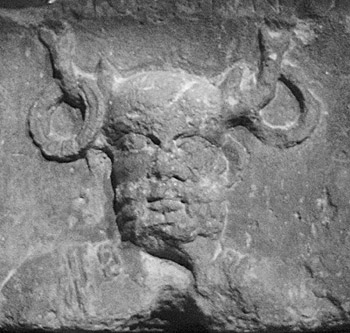
So, what is the connection between Celts, Roman Mercury and Alexander? Caesar’s statement about the ‘many images’ of Mercury is interesting when one considers the most prevalent images created by the Celts were not apparently statuary idols, but coins. To the Romans and Greeks, Mercury (Hermes) was the god of trade, crafts and was generally seen as what Plato might have termed a Daemone or spiritual intermediary between man and the gods. He was also the god of poets such as Lucan perhaps being the reason Lucan does him honour with a form of circumlocution when repeating Caesar’s account of Celtic religion. Mercury was also the psychopomp who conveyed the souls of the dead on their mystical journey – something which was of core interest to Celtic religion, and upon which Lucan remarks. He was usually depicted wearing a winged traveller’s sun-hat or petasus and with winged shoes. It is therefore not inconceivable that the similarity between the ‘horned Alexander’ iconography of the coins and the images of Mercury common in the Greek and Roman world led to Caesar’s assertion that the Gauls venerated Mercury as their chief god. Indeed, on the Gallo-Roman ‘Pillar of the Boatmen’ from Lutetia (modern Paris) on the Seine, the horned figure ‘Cernunnos’ occurs. Note that his horns are adorned with rings – possibly symbolic of the older form of Celtic money before coins became popular:

Horned figure from the 'Pillar of the Boatmen', named 'Cernunnos'.

Horned figure from the ‘Pillar of the Boatmen’, named ‘Cernunnos’.

‘Cernunnos’ is a name obviously derived from the Celtic name for ‘Soldier’ (Cern), and he appears to be wearing a helmet with stags antlers on it: The image of the stag with adorned antlers is specifically associated with therut’ during which combats occur over mating rights, typically at territorial boundaries such as on plains near river crossings (such as with the battles in the Irish epic tale Tain bo Culainge). In a warrior-pastoralist culture the link between battles and fecundity is explicit in this image. In the same way, the branch is a symbol of fecundity for more arable-agrarian societies, and was widely used in Greek and Roman iconography. In fact, the antlers combine both images on account of their shape.  Wings for that matter are also branched, as are bolts of lightning and rivers. The Pillar des Nautes is awash with Roman-Celtic syncretism.

So – the god of wealth and fertility whom Caesar likened to Mercury and had ‘many images’ made of him was represented using the traditional image of Alexander with a cornucopia attached to his head. Lucan’s triple-set of names: Teutates, Hesus and Taranis (and their ‘blood-stained’ altars) may well all be a ‘triple aspect’ of the one he leaves un-named, teasing us with his palpable circumlocution of the underlying divinity he must have realised was represented. Lucan was a clever lad, and the gods (no doubt Mercury himself) were to receive him into Elysium at a young age – a ‘rock and roll’ life and death.

But what about ‘Belenos’? Or, for that matter, ‘Lugus’? What even of the ancestor-god Caesar remarked upon as being called (or like) Dis Pater…. Might they all be one and the same?

In terms of likeness to Mercury, it is Lug(us) who has usually been given this honour, and for whom there have been parallels found in the mythology of the ‘surviving’ Celtic language cultures of Wales (Lleu) and Ireland (Lugh), both of which associate with crafts. Lug (like Belenos) appears in placenames and inscriptions from all across the Atlantic European world, and into the reaches of the Danube river basin.

Evidence for Belenos’ prominence is shown by tribal or kin-group designations such as ‘Belgae‘, and personal names such as that of British King Cunobellin(us) (1stC AD).   In the early medieval ‘Harleian Genealogies’ (British Library Harleian MS 3859) of the Kings of west Britain (Wales) and the ‘Henn Ogled’ (Old North – Southern Scotland down to Lancashire), ‘Beli’ and his wife ‘Anna’ are named as the ultimate ancestors of King Owen of Gwynedd. Anna is even said (like Brighid in Ireland) to be a relative of the Virgin Mary – further proof of attempts at early christianising attempts at syncresis with biblical narratives:

“…Beli magni filius, et Anna, mater eius, quam dicunt esse consobrina Mariae uirginis, matris Domini nostri Iesu Christi. …”

With the Romanisation of the barbarian Celtic cultures, the worship of Bel/Belenos would become submerged in the cult of Apollo, demonstrating that Bel/Belenos was an overtly solar deity.

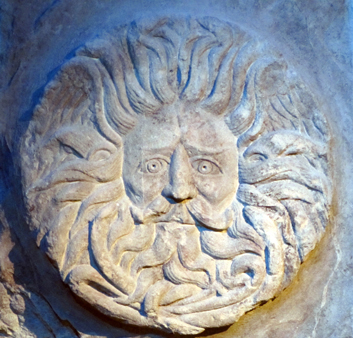
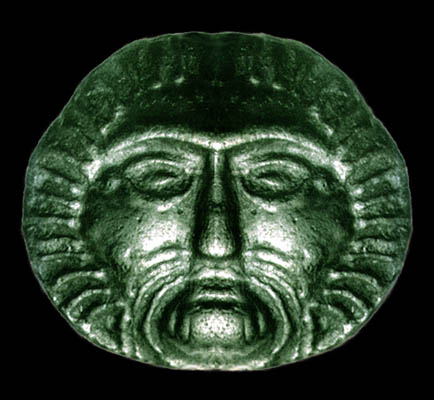
The stone fascia of the Roman-British shrine of 'Minerva Aquae Sulis' at Bath displayed this magnificent head of 'Manannan'. Note the 'solar' rays of the hair and the 'watery' appearance of the beard...

The stone fascia of the Roman-British shrine of ‘Minerva Aquae Sulis’ at Bath displayed this magnificent head of  ‘Apollo  Grannus’. Note the ‘solar’ rays of the hair and the ‘watery’ appearance of the beard…

The association of Apollo Grannus with Mars at various spa shrines in the Romano-Celtic world maintains the martial link of the Celts’ beloved warrior/sun-god icon, Alexander, whose conquests (and failure) had inspired the Celtic invasion of the Balkans, Thrace, Macedonia, Greece and Phrygia in the 3rdC BCE. At some of these, the ‘Celtic’ Mars is also sometimes depicted in attire we would more associate with Mercury, demonstrating a syncresis between the two Roman gods in the Celtic mindset:

A 'Celtic Mars' - note the combined imagery of Mercury and the warrior

A ‘Celtic Mars’ – note the combined imagery of Mercury and the warrior

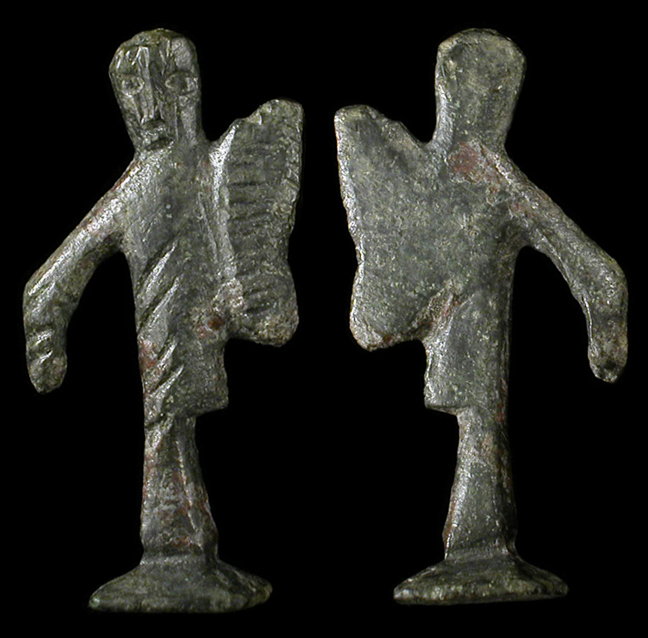
Some depictions even show Mars with wings – perhaps a convenient spiritual representation of what the Celts desired: Death in glorious battle and an ‘autopsychopompic’ flight to the Otherworld.

A 'winged Mars'. Cunobelinus had a winged figure on some his 1stC CE coins.

A ‘winged Mars’ – A winged figure is also seen on some Celtic 1stC BCE/CE coins. The horse depicted is also sometimes winged.

The conjecture I should like to raise again is this:

That the Atlantic Europeans before the Romans had a principally duotheistic religion comprising of a god and a goddess who each had a ‘triple’ identity. The imposition of Roman culture and then the overlay of Christianity created a ‘Celtic Pantheon’ which in truth never really existed. ‘Lugh’, ‘Belenos’, ‘Teutates’, ‘Esus’, ‘Taranis’ were all epithets of the same solar deity who conducted the souls of the dead in their Otherworld destinations. His companion ‘Diana’ (De Áine) had similar multiple-epithets and was associated with the worldy creation and manifestation.

“You can lead a horse to water…”

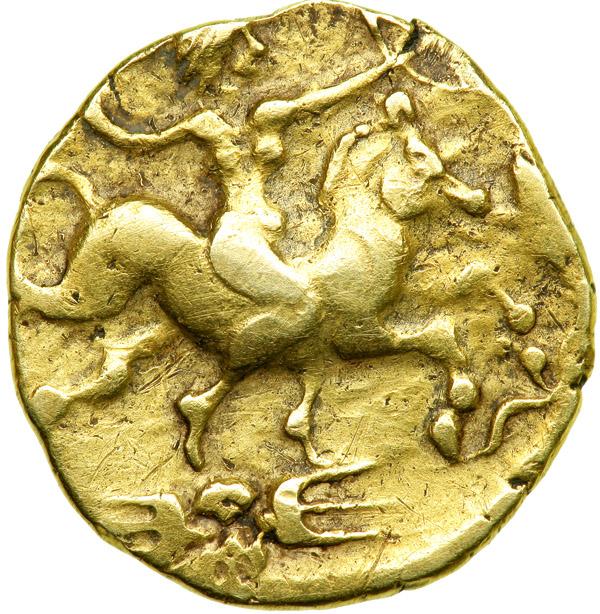
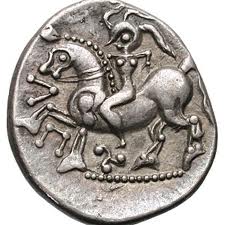
1stC BCE coin of the Redones of NW Gaul, now Brittany.

1stC BCE coin of the Redones of NW Gaul, now Brittany. In the coins of this tribe, the female rider is usually armed.

…When she had thus allured the male part of the Island, she pretended one day to go a progress through the provinces, and being attended by all her adorers on foot, while she rode on a milk-white palfrey, in a kind of triumph at the head of them: she led them into a deep river, which by her art she made seem passable; and when they were all come a good way in it, she caused a sudden wind to rise, which driving the waters in such abundance to one place, swallowed up the poor lovers to the number of six hundred in their tumultuous waves. After which, the sorceress was seen by some persons who stood on the shore to convert herself into a bat, and fly through the air till she was out of sight; as did her palfrey into a sea-hog or porpoise, and instantly plunged itself to the bottom of the stream…. George Waldron – ‘A Description of the Isle of Man’ 1731 – legend of ‘Tehi-Tegi’.

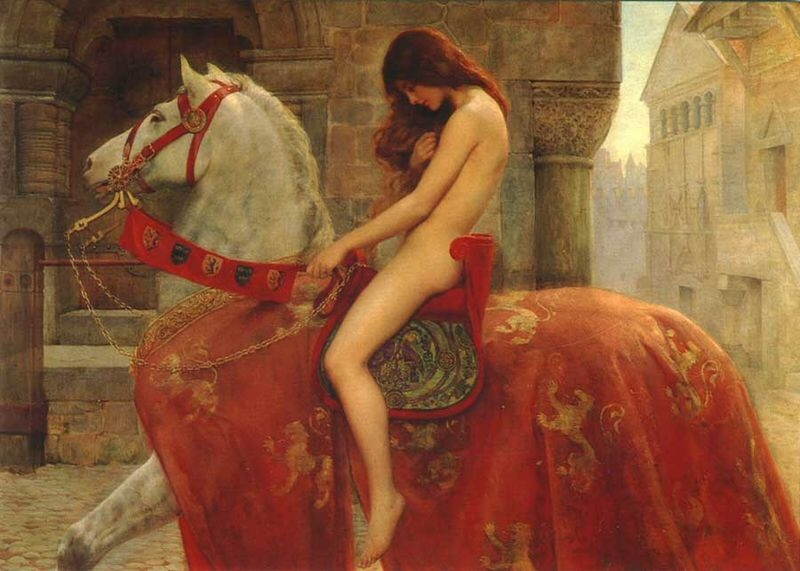
A Pre-Raphaelite Tehi-Tegi

A Pre-Raphaelite Tehi-Tegi

The image of the horse is a striking symbol on Celtic coins of the late European Iron Age, all the more so when depicted ridden by a naked warrior woman, as was the case during times of war with the encroaching Roman empire – both in central-eastern and north-western Europe. The question is – what was the importance of the horse to this culture, such that it was depicted on almost all of its various tribes’ coinage? We know from the writings of the Romans that the Atlantic/western Celtic peoples’ main religious doctrines were based around the principle of reincarnation. However, after subjugating and then ‘Romanising’ them, there is little more said about their beliefs as they seemed no longer to be relevant. The Celtic religious system seemingly incorporated into the Roman pantheon but in a marginal way that gave no precedence over Rome’s greater gods: Statues and stelae of a horse-goddess ‘Epona’ seems to have been one popular expression of native religion, but the original context is not understood. The Batavians (Belgic celts) who built the 3rdC CE temple of the well-goddess ‘Coventina’ at Hadrian’s Wall in England were a cavalry unit – surely a shrine to Epona would have had greater precedence if there was an actual ‘horse goddess’? Perhaps to the Batavians, the well-goddess was the same person as the ‘horse goddess’! To understand this imagery of the divine female and the horse we need to examine how she was represented both before, and after Romanisation. Surviving images of Epona from Romanised Celtic shrines generally portray her as a gentle beneficient figure, conveying pateras of food and cornucopias. When contrasted with the coin imagery of the pre-conquest tribes however, and it immediately becomes clear that there is a clear distinction in imagery: In these, she is a fierce naked horsewoman-warrior, armed for the job of butchering Romans! Of course, once conquered, the Romans put an end to these images and the coins stopped being minted. The cult of ‘Epona’ was therefore probably a deliberate attempt to corrupt an important core tenet. She went from this:

More coins from the Redones tribe

More coins from the Redones tribe

To this…

Cuddly mother Epona - the original would have bought your head on a plate, not food!

Cuddly mother Epona – the original would have brought your head on a plate, not food!

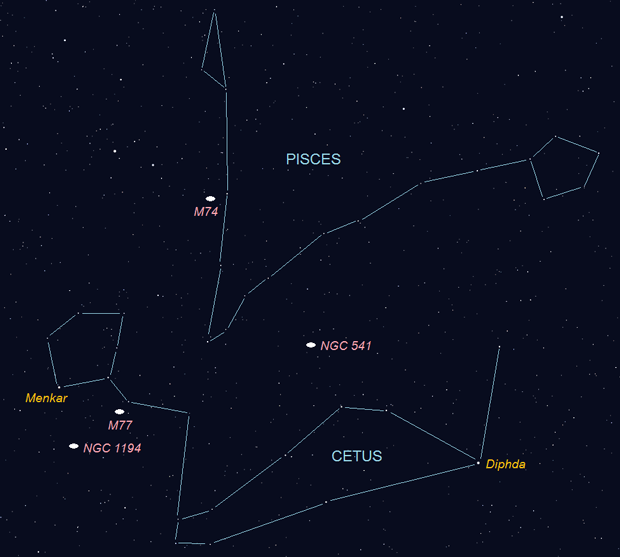
The ‘Tehi-Tegi’ legend from the Isle of Man is perhaps the most overt survival (maybe matched by some Cliodhna legends of Ireland) of the ‘death-dealing horsewoman’ that the Iron Age celts were so enamoured of, but the principle has survived in many other forms. Most notable of these are the folktales of the fairy horse who kills people that try and ride it by jumping into water. Be it the Neck, Nykyr, Nixies or Rhinemaidens of the German and Scandinavian legends or the Kelpie of the Scots myths: all are related the same belief – a woman who conducts the dead to a realm under water. When we examine the fairy lays of the middle ages (Lai de Graelent, Lai de Lanval) we can see that the beautiful ‘fairy woman’ ends up conducting the tragic hero to a deathless realm through water. No wonder so many early Christian saints such as Kentigern spent their days mortifying themselves in water! The Germanic words used for the water-horse-spirit generally revolve around the word-root ‘nik-‘ – from a presumed Proto-Indo-European (PIE) neigw which means ‘wash’ – from which the Irish have nigh and in folklore the fairy washerwoman, the Bean nighe. The most famous portrayal of a Bean nighe in medieval Irish literature is that of the Morrigan washing bloody armour at a ford in the death tale of Cuchullain – part of the Ulster cycle. The Scots word ‘Kelpie’ is an allusion to what is also known in the gaelic world as ‘wrack’ (seaweed) which is also the Brythonic word for ‘hag’ – Gwrach or Groac’h. Martin Martin recovered a tale of Hebridean islanders in the 17thC sacrificing to a sea-god called ‘Shony’ (‘Old One’) in order to receive wrack from the sea to spread on their crops as manure. So there you have it – the military horsewoman on the Celtic coins is the Slachdan-weilding Cailleach – the Morrigan herself: The water woman of the fairy realm – otherwise known as the realm of the dead. The question now remaining to be answered is how does the horse fit in with the general reincarnation/otherworld myth? You might recall from my last post that I remarked upon the profusion of apparently astronomical imagery that accompanied the horse depicted on Celtic coins from before the Roman subjugation. Apart from the sun and the moon and obvious star-shaped figures, there are frequently dot-and-line figures with an uncanny similarity to what astronomers refer to as ‘asterisms’. The horse itself is also very stylised in its appearance, and the logical place to start in understanding the importance of the horse is to turn our eyes to the sky: The most well-known equine asterism is the great constellation of Pegasus which sits next to the Milky Way. We immediately have here an interesting combination: The Milky Way arches across the sky like a great shining white river – nowadays difficult to see clearly due to light pollution, and the great leaping horse in conjunction with this is a remarkable metaphor of the Kelpie, Nixie and Tehi-Tegi legends. However, in terms of Greek mythology, Pegasus represents the horse as a benign force, but with a very aquatic pedigree – his father is Poseidon, his mother Medusa, he is a friend of the Muses and created a magical well for them with his hooves. He is also a conveyor of heroes into the spirit realm. Already sounding like many Celtic myths, isn’t it? The Muses of course represented the ‘fairy-woman’ function of inspiring poets, keeping memory and promoting knowledge to humanity… The other less-benign and more overtly aquatic asterism that sits close to Pegasus on the other (‘southern’) side of the ecliptic path is that of Cetus variably described as a sea monster or whale. In Greek mythology Cetus/Ketos was sent by Poseidon to devour the sacrificially-chained Andromeda, and was killed by the Pegasus-riding hero Perseus who showed it the head of Medusa. Ketos in fact means any large aquatic beast, in the same way that the  old Germanic languages used variants of ‘neck’ to mean the same: nicor was the Old English term used for a water beast or a hippopotamus*, and the Old High German word nihhus was used for ‘crocodile’. As a ‘*water horse’ is what we are interested in, the constellation of Cetus seems like it is worth considering further: The constellation Cetus lies in such close proximity to the ecliptic path (the road travelled by the Sun, Moon and planets in the sky, marked by the 12 zodiacal constellations) that it seems that it should be considered a 13th ‘intercalary’ member of the zodiac. Its proximity to the asterism of Pisces is intimate enough that they can be considered in the same ‘house’. Cetus is in close proximity to the other ‘watery’ constellations: Aquarius and Capricorn (the fish-goat), the ‘river’ Eridanus and the dolphin Delphinus.

Cetus in relation to Pisces - picture borrowed from blackholes.stardate.org

Cetus in relation to Pisces – picture borrowed from blackholes.stardate.org

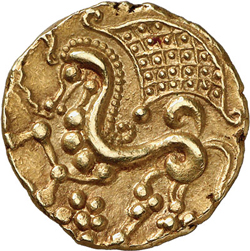
Now we know that the celtic high-priests were reputed to be philosophers and diviners of the heavens, so we might conjecture that celtic coins portrayed astronomical imagery. Having been puzzled by the potential relationship between the horse depicted on those famously beautiful Iron Age coins and that of Pegasus, I initially overlooked one of the motifs that accompanied it – that of the ‘tented net’ depicted on the Celtic Parisii coins. Looking eastward of Pegasus we come immediately to Pisces and Cetus – and the symbolism of the coins is made immediately clear – the horse is not a depiction of Pegasus – it is in fact Cetus, the ‘water horse’, with the net being Pisces! If this interpretation is correct, then a lost celtic star-myth has been recovered, together suggesting some potential original celtic names for their asterisms: ‘the water horse’ and ‘the net’!

Compare the stylised horse's body to the shape of the Cetus asterism

Compare the stylised horse’s body to the shape of the Cetus asterism

So… is there anything special about Cetus? As it turns out , there is – a star on the beast’s ‘neck’ known to us today as Mira Ceti: ‘Mira’ as in ‘mirabilis’ on account of this star’s seemingly miraculous appearance and disappearance from the constellation! It is actually a binary star whose conjunctions and occlusions are responsible for this effect, causing it to reach a maximum brightness every 332 days (approximately 11 months) when it is definitely visible (unless the sun is transitting near it if it falls in early springtime) and invisible to the naked-eye astronomer during its minima. Although there are no definite references to this phenomena in ancient Babylonian or Greek texts, an excavation of a 3rdC BCE Boii temple complex at Libenece in the Czech Republic contains sighting post allignments which possibly correspond to a viewing of Cetus, and (concludes the author of this astronomy paper), Mira Ceti in particular. The other star which famously exhibits this quality of variable intensity is ‘nearby’ in the constellation Perseus – Algol, the gorgon’s eye – whose period of dimming is much more regular – every 2.867 days, to be precise. The coming and going of a star might have been a metaphor for the coming and going of the year – of the sun. The cycles of ‘coming and going’ appear to have been a fundamental theme for the religious viewpoint of metempsychosis, and hence a great deal of attention would have been paid to the natural phenomena in which this was shown: These were – the cycles of the sun, the moon, the seasons and the tides. The principle that the heavens represented the world of spirits pervaded the ancient mindset, and the use of mythology to explain the heavens and their phenomena was a key part of this understanding. The image of the horse and the chariot convey mythological implications of the mysteries of the sun – the Greek legend of Phaethon, son of Helios/Apollo, who took his dad’s sports chariot for a spin with disastrous consequences attests to this. Most of ancient mythology was quite possibly designed to explain the cycles of nature in relation to the cycle of events witnessed in both the sky and on Earth and in the oceans – something which became lost in the Christian age…

Symbolism on Celtic coins

The mysterious symbolism of the horse pervades the artwork of the coins of the Iron Age Celtic peoples of Atlantic Europe. From the Thracian Celts of the Balkan region, to the tribes of Britain, Gaul and Hispania – all produced coins which depicted a strange and compelling set of images, perhaps providing a clue to the supra-regional religion of the peoples classified by the Greeks and Romans as the ‘barbarians’.

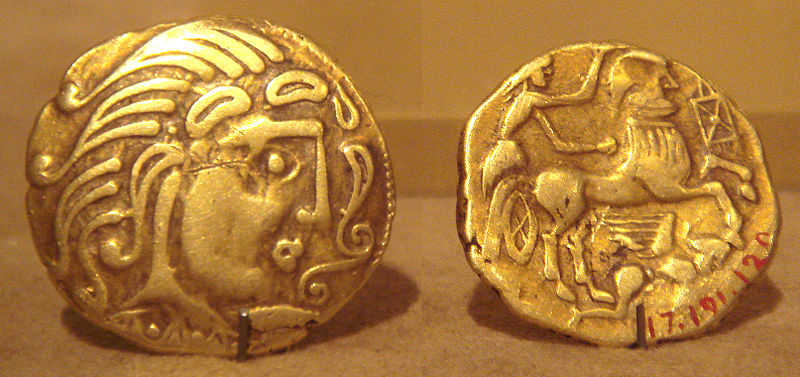
A Celtic coin of the Iron Age depicts a woman riding a horse. Note the apparent astronomical designs!

Celtic (Scordisci) coin from the Balkans depicting a woman riding a horse (?2ndC BCE). Note the apparent astronomical designs!

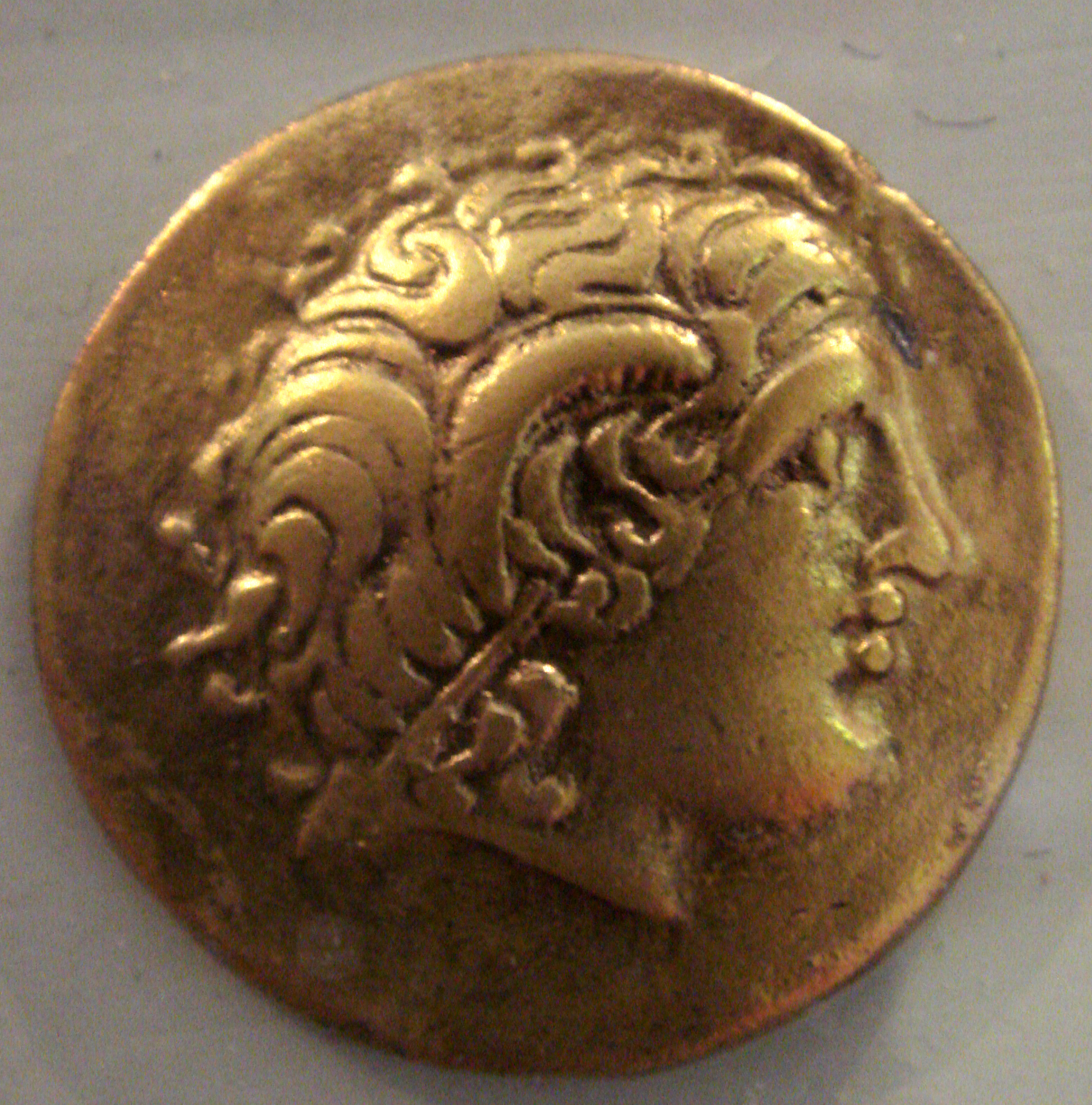
The history of coinage among the Celtic peoples lies in their economic links to the ancient Greek world – in particular through southern Gaul, Macedonia and Thracia at the height of Hellenic influence, and the Empire of Alexander the Great and his successors. For this reason, the design of celtic coins was afterwards strongly influenced by the format of the Macedonian/Greek ones, some of which depicted the horned head of ‘Alexander’, sometimes Apollo, Hercules or Zeus on one side….

Depiction of Alexander (with horn) on a greek coin of the 3rdC BCE

Depiction of Alexander (with horns) on a greek coin of the 3rdC BCE

Due to trade links with celtic tribes through southern Gaul (from 6thC BCE) and trade and warfare with the Illyrian, Pannonian, Dacian, Thracian and eastern Celtic peoples as well as marauding incursions of western Gauls , the indigenous style of coinage developed in the 4thC BCE generally copied the Macedonian and Greek format and typically showed a depiction of ‘Alexander’ on one side – an icon which would become increasingly stylised:

Coin of the Parisii c.4th-1stC BCE. Note the depiction of the charioteer - an image associated with the 'Dioskoroi' in Greek myth.

Coin of the Parisii ca. 1stC BCE. Note the depiction of the martial charioteer – apparently female, in the role of a ‘Badbh Catha’, seemingly trampling an ‘angel’ into the dust….

Trinovantes, Britain, 1stC BCE - what happened to Alexander's head?

Trinovantes, Britain, 1stC BCE – what happened to Alexander’s head?

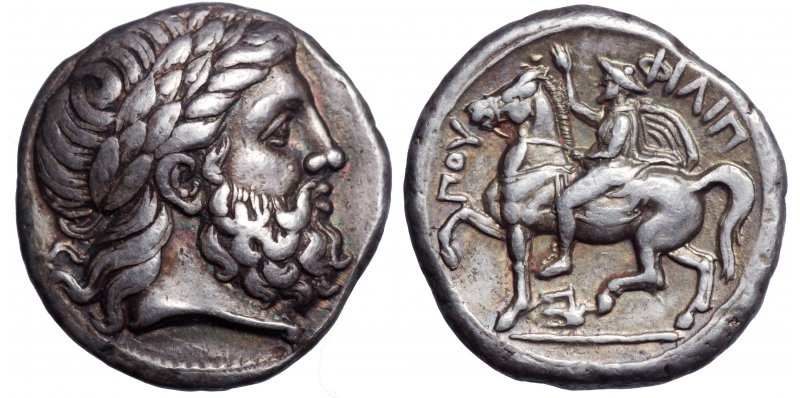
The celts seem to have taken the symbolism of the Greek coins further than the original format… to recap, here is a typical Greek tetradrachm from the 3rdC BCE:

Phillip II of Macedon

Tetradrachm of Phillip II of Macedon – note the ‘Dioskouros’ on the obverse face… one of the famous Hellenic horseman-deities who would have been so popular in the ancient Balkans and steppes north of the Black Sea.

Ostensibly starting with a picture of Alexander’s father Phillip II the coins of the era of Alexander gloried in the imagery of the head of the conquering hero, and evolved between depictions of humans (Philip, Alexander) and gods (Apollo, Zeus, Herakles) depending on how successful and grandiose the ruler who minted them felt himself. In the fragmented succession period that followed Alexander’s death, depicting a god was often a safer bet than advertising your discombobulated head…. The totemic value of the Mercurial ‘Alexander’ among the peoples of Europe’s highly mobile barbarian warrior culture (in the La Tene period) cannot be underestimated, and it is perhaps unsurprising that they would copy the coins of the world’s most astounding military leader, whose legend had elevated him to a godlike status. Vast numbers of Celtic warriors had poured across and down through the Balkans in the 3rd century, culminating with an assault on Delphi itself, and many would afterwards find employment within the Seleucid Empire on account of their warrior prowess, just as ‘Viking’ warriors would in the Byzantine Roman Empire during the 8th-11th centuries.

Belgic tribes like the Parisii (northern France) and their cousins among the Icenii, Trinovantes and Catuvellauni (eastern Britain) produced a great deal of the most interesting and beautiful coins which elaborated on and converted the Greek template designs to meet their own system of material and religious values. In the 3rd-1stC BCE their increasing power was no doubt bought about by trade (and pillage) with the Greek and increasingly powerful Roman worlds, which demanded or received coinage.

We can tell that these tribes were powerful and influential due to the fact that they modified the design of their coins away from the Greek, demonstrating to the world their own culture and beliefs. They obviously understood the symbolism of the greek coins, but were to express their own through some significant changes and additions.

The coins of the Parisii (who occupied the region along the Seine) were typified by placing a star symbol under the front hooves of the horse, which was constructed of a circular arrangement of 6 (sometimes 5) dots. The other interesting feature of their coins was the ‘net’ design in the shape of a ‘tented inverted triangle’ above the serpentine horse, which usually faces left and is riderless. The Parisii further modified the coin template by feminising the head on the obverse side. Tree branch designs often decorate either side. There are no ‘sun wheels’ as seen in many British coins.

Alexander has become a woman on this Parisii coin!

Alexander has become a woman on this Parisii coin!

Across the water in Britain, their cousins the Trinovantes must have watched in dismay, as well as interest as the Parisii and the rest of Gaul succumbed to Julius Caesar and his Roman legions in 52BC. They were another great and wealthy tribe, who – along with their neighbours the Icenii and Catuvellauni – stood to become increasingly wealthy from contact (and alliance) with Rome. Their coins from this period demonstrate a more definite split from the Greek designs of the western European celts – perhaps showing more in common with their central European cousins who also excelled in stylising, perhaps when they too felt the pressure of Roman encroachment.

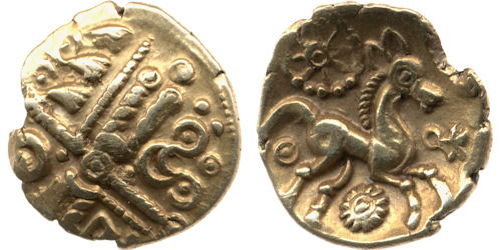
The Trinovantes coins show a number of variations on the theme from the Parisii. Firstly – like other British coins, they do not show the ‘net’ design above the horse, instead favouring a sun symbol (usually depicted as a wheel) and/or a branch. Like the Parisii coins, the ‘star’ symbol also often occurs under the horse’s front feet, but this seems an inconsistent feature – usually depicted as a circle surrounding a point. The horse, branch and sun symbols are more realistic and less stylised, either demonstrating the fact that they were more advanced artisans or perhaps due to the fact these coins are generally from a later date. Of greater interest is the fact that they do away with the head on the obverse side and replace it with symbolic images:

Coin of Addedomaros of the Trinovantes (1stC BCE) - note the reflected, stylised head of corn

Coin of Addedomaros of the Trinovantes (1stC BCE) – note the reflected heads of corn. These have stylistic echoes of Alexander’s headband or horn…

The corn/barley design was probably another borrowing from Greek coinage, but here it might also (during the 1stC BCE/1stC CE) represent the Trinovantes advertising their commercial wares to the Romans and other tribes of Britain: Beer and grains. Their territories were fertile and they had good access to the sea to supply those made hungry by war and famine, over the horizon in the brewing storm of the Roman conquest. Dropping the head of the famous Greek emperor might have represented an act of diplomacy in the face of Caesar’s threatened invasion. Note also the branch under the horse’s feet…

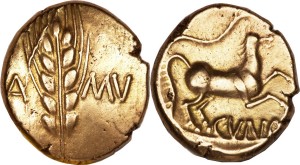
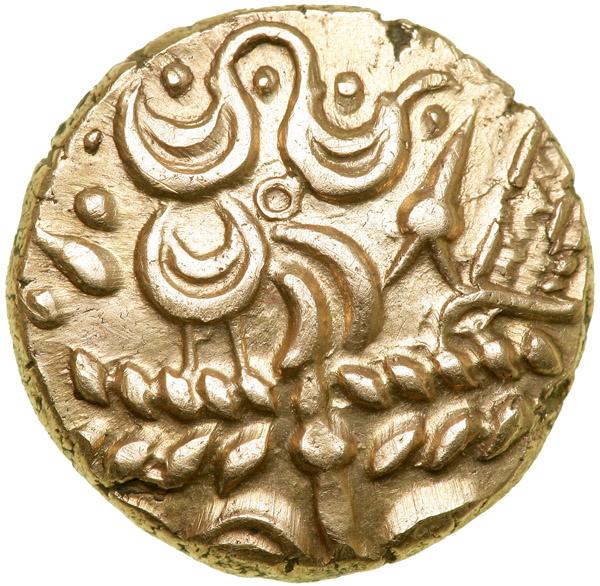
A more explicit depiction of corn, this time barley (similar to the Greek style) appears on another later coin (Cunobelinus of the Catuvellauni in the 1stC CE), but as we shall see it appears to have had a symbolism to the Trinovantes which went beyond mere trade:

Coin of Cunobellinus of the Trinovantes 1stC AD

Coin of Cunobellinus of the Catuvellauni 1stC AD

To any well-connected and spiritually educated person of the Mediterranean world in the 1stC BCE – 1stC CE, the symbolism of the ear of corn was likely understood as a reference to the Rites of Eleusis held near Athens, and the veneration of Demeter – known to the Romans as ‘Ceres’. That it appears on the coins of Cunobelinus might be a reference to this cult – it is not implausible that he himself was an initiate in what was something akin to the Freemasonic Lodge of Europe’s elite! The rites were a mystery cult dramatizing the story of the annual cycle and the return of Kore (Persephone) from Hades. Caesar’s assertion that Celts such as Cunobelinus believed in reincarnation as instructed by the druids means that they would have had a spiritual sympathy with these rites, whose origins link to the Orphic beliefs originating somewhere in the lower Danube in the late Bronze Age, and hence possibly deriving from the indigenous belief system of the north Europeans. The tie-in between heads of corn and reincarnation is therefore obvious – especially at a time when Druidism and Celtic/Atlantic religion was under great threat.

Let us look at some of the designs replacing the head of Alexander on other Trinovantes coins during this period:

Coin of Adeddomaros - the allusion to heads of corn is not so strong, and the opposed crescent symbol is more obvious, as is the branch under the horse.

Coin of Adeddomaros – the allusion to heads of corn is gone, and the opposed crescent symbol is more obvious, as is the branch under the horse’s feet.

One cannot help but be overcome with a feeling that the reflective symmetry and structure of the design on the obverse side to the horse is telling us something – much like the pictograms on the early medieval stone stelae of the Scottish celts or ‘Picts’. The same design occurs in other coins of the same period (immediately pre-conquest when druidism had decamped to Britain, and before the Britons began to Romanise).

Iceni coins demonstrating the opposed crescent design, redolent of Pictish symbol stones

Iceni coins demonstrating the opposed crescent design, redolent of Pictish symbol stones

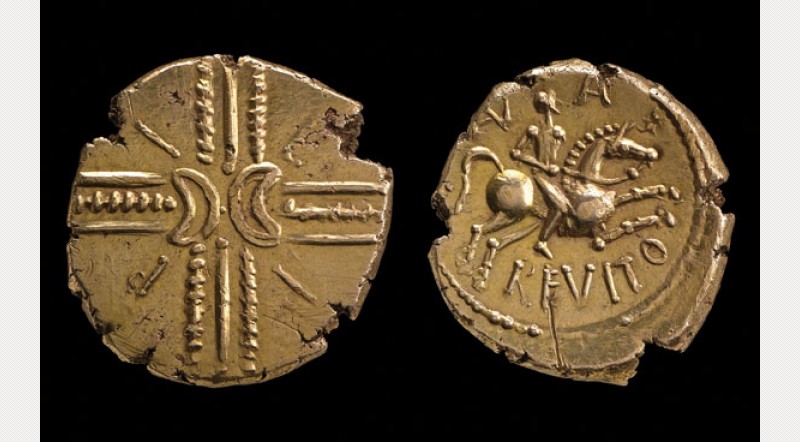
The 'Anarevitos' coin - noted the mounted rider and cross-symbol

The ‘Anarevitos’ coin – noted the mounted rider and cross-symbol

After druidism had retreated to Britain, its coins demonstrated a change. Here the complex symbol on the 'heads' side is matched by the woman riding the horse on the 'tales' side.

The cross-like symbol with its opposed crescents and solar discs seems to prefigure the ‘celtic cross’ by at least 500 years, and is rich in the symbolism of the annual cycle. The four ‘quarter days’ seem to be represented by the branches (or corn heads) forming the limbs of the cross, and joined to the solar symbols still used in astrology today: a circle with the spot in the middle. Between these are the solstices and equinoxes represented by torcs, rings or lunulae and ‘tented triangles’. In the centre of the cross lie the mysterious apposed lunar crescents – symbol of the months.

The woman riding (side-saddle) on the horse is an innovation that we also see in the Balkan/Danube region (see the first picture above) but here it possibly also gains a martial significance – a people, a goddess and a whole religious way of life readying for war… A small serpentine figure occurs where the ‘star’ often appears – another feature seen in celtic coins from central Europe. Was this symbology copied in an effort to invoke the military success of the central European celts against Macedonia, Greece and then Rome?

Another Belgic tribe who settled in Britain were the Atrebates and their coinage seems to demonstrate similar iconography to that of the Trinovantes and their neighbours.

Note the horse with overhead sun apparently trampling a loose wheel.

Note the horse with overhead sun apparently trampling a loose wheel. The pattern on the left is mysterious indeed!

The composition of the imagery may vary in detail, but the obverse side to the horse shows consistent features, seen also in the coins of other tribes, such as the Iceni, Trinovantes, Durotriges etc: separate torcs, linked torcs (the ‘yoke’), crescent-moons, spots, serpentines, ‘corn ears’, branches or wreaths, linear lines, rings and what looks like leaf-shoots. All of these sometimes appearing like a Miróesque deconstruction of the image of Alexander.

More detail on an Atrebates coin

More detail on an Atrebates coin – is that a cockerel on the left? The symbolism is perhaps richer and more mysterious than any Greek or Roman coins…  These coins provided inspiration for 20thC artists such as Miro and Picasso!

All text © 2014 The Atlantic Religion, except where stated.

Fountains, maidens, vessels, crusty wizard-kings, knight-errants and horses

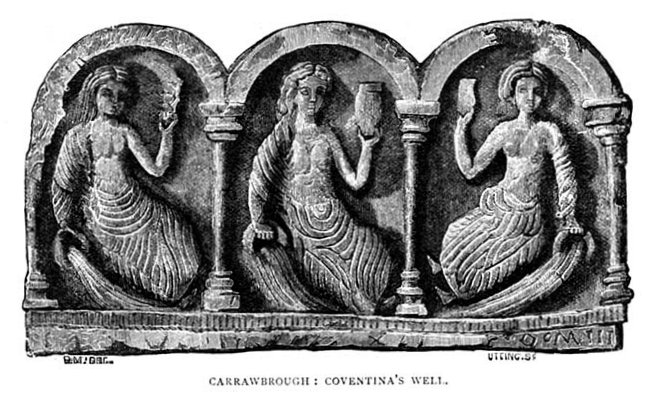
Romano-British stela of the triple-goddess 'Coventina'. Note the vases and the bunch of corn...

Romano-British stela of the triple-goddess ‘Coventina’. Note the vases and the bunch of corn…

The ‘romance’ story traditions, poetry and literature of northern Europe between the 12th and 15th centuries represented a renaissance of interest in the mythology of the pagan era among the secular elites of the English, Normans, French and Germans. This itself seems to have paralleled the renaissance in classical literature and learning during the same period, propelled from the Islamic world, and perhaps by the formal schism of the eastern and western christian patriarchies in the 11th century.

Their heady imagery of bold beautiful knights, mysterious and equally beautiful otherworldly maidens, and complex coded allusions to what christianity disapproved of – sex, violence and paganism – made them a sure-fire hit among the courtly elites. In spite of their apparently un-christian themes, the weavers of these tales were acutely aware of when not to overstep the mark, lest they face accusations of the capital crime of heresy! By investing their main and supporting characters with strong christian values of love, piety, chastity and truth, they were able to send them deep into story realms with mysterious pagan themes underpinning the narrative. Christianity was always triumphant in the end, and moral virtue came out on top: It is important to realise that these authors were often writing for a world where paganism was not such a distant memory (the Normans, for example and their Scandinavian cousins) so reading a pagan rather than a christian bias into their tales would be ill-advised. After all, christianisation had already followed a syncretic path in much of Europe since the Theodosian edicts of the 5thC. That the heartland of this revival in poetry, prose and song tradition was the Aquitanian courts of the Languedoc in southern France (home of the Troubadours) is interesting, since these soon became the heart of a strange dualistic/duotheistic interpretation of christianity known as Catharism, later destroyed in the Albigensian Crusade.

So what are the themes and in which stories in particular are they found?

Meeting a fairy woman at a fountain:

The ‘Lai de Graelent’, the Lai de Lanval (Marie de France 12thC), Yvain, le Chevalier au Lion’ (Chretien de Troyes 12thC), the Irish tale ‘Echtra mac nEchach Muigmedón (Yellow Book of Lecan – late 14thC) and the Fenian lay known as Toraíocht Sliabh Cuilinn or Laoi Na Seilge,as well as
Aided Muirchertaig meic Erca (Yellow Book of Lecan) and others
 all tackle this popular theme. In them, the hero follows a magical white stag or boar (part of the ‘fairy herd’) into a far-off place where he meets a mysterious and fatal woman at a spring, lake or river. She promises him the gifts of the otherworld but imposes a geas upon him which ties him ultimately to the otherworld.

   The otherworld is explicitly reached through water in all of these, as is the Isle of Avalon in the seminal Arthurian works of Geoffrey of Monmouth who, with his literary companions-at-arms Jocelyn of FurnessWalter Map and Gerald of Wales, really got the ball rolling of the ‘second stage’ of trying to put ancient Atlantic legends into a christian ‘historical’ narrative – the first being the Irish and continental hagiographies of the 6th-10th centuries, whose traditions were badly damaged in the Viking raids of the 8th-9th centuries.

The ‘Wizard-King’:

Perhaps the most mysterious otherworldly rulers of medieval story traditions are those we identify with the ‘wizard-king’ archetype. In Ireland, Manannan is the arch-example of this, but in the ‘Lancelot-Grail Cycle’ legends of Britain and France, the Fisher King (Perceval) and Merlin represent the same. Another aspect of the otherworld-lord is the ‘Old King’ of which Gradlon, Arthur, Geoffrey’s King Leir and even Fionn mac Cumhall (Tóraíocht Dhiarmada agus Grainne) function as examples – a projection of the otherworld wizard-king upon the decaying mundane existence. Geoffrey’s Merlin and Jocelyn’s Melinus (his version of Mannannan who Patrick supposedly defeats on the Isle of Man) both provide an attempt at ‘bookending’ the role of the otherworld master of pagan tradition in a (pseudo) historical context, much in the same way that the Arthurian legends’ handling of the Lady of the Lake and the ‘sorceress’ Morgane do.

The stone fascia of the Roman-British shrine of 'Minerva Aquae Sulis' at Bath displayed this magnificent head of 'Manannan'. Note the 'solar' rays of the hair and the 'watery' appearance of the beard...

The stone fascia of the Roman-British shrine of ‘Minerva Aquae Sulis’ at Bath displayed this magnificent head of ‘Manannan’. Note the ‘solar’ rays of the hair and the ‘watery’ appearance of the beard… Minerva was a female god 😉

The ‘Grail’:

Tales such as Yvain and Perceval, Ireland’s Tochmarc Étaíne, the Dagda’s magic cauldron in the story Cath Maige Tuired as well as the continental legends of the bath-loving Melusine, and the middle-Welsh tales of the  Second Branch of the Mabinogi and the legend of Cerridwen and the Birth of Taliesin all feature a magical cauldron, dish or cup.  This always seems to represent the powers of regeneration – a metaphor for the womb in many ways.

A 'Sheela na Gig' - compare her to the images of 'Coventina' from the Romano-British stelae...

A ‘Sheela na Gig’ – compare her to the images of ‘Coventina’ from the Romano-British stelae…

The vision of the bleeding lance from Perceval is the flipside of this ‘genital’ imagery, perhaps demoted in the Christian context due to its phallic nature, but of no lesser importance than the grail in the original telling by Chretien de Troyes. This represents the piercing aspect of new life, coming through from the otherworld – an allusion made concrete in the character of ‘Sir Bors’ whose name contains the Gaelic rootword for both ‘piercing’ things and springs of water.

The 'Ballafreer phallus', Braddan, Isle of Man - known locally as the 'White Lady'!

The ‘Ballafreer phallus’, Braddan, Isle of Man – known locally as the ‘White Lady’!

All text © 2014 The Atlantic Religion, except where stated.


Careless lake ladies and mermaids – flood myths in Celtic folklore

“…There is a lake in Ulster of vast size, being thirty miles long and fifteen broad, from which a very beautiful river, called the Banna, flows into the Northern ocean. The fisher-men in this lake make more frequent complaints of the quantity of fish inclosed in their nets and breaking them than of the want of fish. In our time a fish was caught here which had not come up from the sea, but was taken descending the lake, and was in shape very like a salmon, but it was so large that it could neither be dragged out or conveyed whole, and therefore was carried through the province cut in pieces. It is reported that this lake had its origin in an extraordinary calamity. The land now covered by the lake was inhabited from the most ancient times by a tribe sunk in vice, and more especially incorrigibly addicted to the sin of carnal intercourse with beasts more than any other people of Ireland. Now there was a common proverb in the mouths of the tribe, that whenever the well-spring of that country was left uncovered (for out of reverence shown to it, from a barbarous superstition, the spring was kept covered and sealed), it would immediately overflow and inundate the whole province, drowning and destroying all the population. It happened, however, on some occasion that a young woman, who had come to the spring to draw water, after filling her pitcher, but before she had closed the well, ran in great haste to her little boy, whom she heard crying at a spot not far from the spring, where she had left him.

But the voice of the people is the voice of God ; and on her way back, she met such a flood of water from the spring that it swept off her and the boy, and the inundation was so violent that they both, and the whole tribe, with their cattle, were drowned in an hour in this partial and local deluge. The waters, having covered the whole surface of that fertile district, were converted into a permanent lake, as if the Author of nature judged the land which had been witness to such unnatural bestialities against the order of nature to be unfit for the habitation of men, either then or thereafter.

A not improbable confirmation of this occurrence is found in the fact, that the fishermen in that lake see distinctly under the water, in calm weather, ecclesiastical towers, which, according to the custom of the country, are slender and lofty, and moreover round ; and they frequently point them out to strangers travelling through those parts, who wonder what could have caused such a catastrophe.

…..

It must, however, be observed that the river before mentioned (the Bann), which now flows out of the lake in full stream, had its source in the aforesaid spring from the time of Bartholanus, who lived soon after the flood, when it was fed also by other rivulets, and took its course through the same district, but with a far less volume of water, and it was one of the nine principal rivers of Ireland…” (Topographia Hiberniae by Gerald of Wales (12thC) – trans. Thomas Forester; From: ‘The Historical Works of Giraldus Cambrensis’ – Pub. George Bell & Sons, London 1905)

Gerald’s tale comes from his famous account of Ireland, produced in support of the Anglo-Norman invasion of the island, and designed to support the imposition of continental christianity on this ‘barbarous’ and ‘uncivilised’ people. His sources were the monastic annals and texts of the great abbeys of Ireland. The contemporary secular literary milieu was one enchanted with the ‘Lady of the Lake’ and ‘Morgane le Fee’ and any one of a number of similar fairy themes which defined the ‘Arthurian’ Romance litereature of the 12th and 13th centuries. The following sums up one of his likely sources – from the legends of St Comgall about his apparent conversion and sanctification of a mermaid called Liban, afterwards St. Muirgen!:

“… According to a wild legend in Lebor na h-Uidri, this Liban was the daughter of Eochaidh, from whom Loch Eathach, or Lough Neagh, was named, and who was drowned in its eruption [A. D. 90], together with all his children, except his daughter Liban, and his sons Conaing and Curnan. Liban, was preserved from the waters of Lough n-Eachach for a full year, in her grianan, [palace] under the lake. After this, at her own desire, she was changed into a salmon, and continued to traverse the seas till the time of St. Comhgall of Bangor. It happened that St. Comhgall dispatched Beoan, son of Innli, of Teach-Dabeoc, to Rome, on a message to Pope Gregory [Pope, A. D. 599-604], to receive order and rule. When the crew of Beoan’s currach were at sea, they heard the celebration of angels beneath the boat. Liban, thereupon, addressed them, and stated that she had been 300 years under the sea, adding that she would proceed westward and meet Beoan, that day twelvemonths, at Inbher-Ollarbha [Larne], whither the saints of Dalaradia, with Comhgall, were to resort. Beoan, on his return, related what had occurred, and, at the stated time, the nets were set, and Liban was caught in the net of Fergus of Miliuc; upon which she was brought to land, and crowds came to witness the sight, among whom was the Chief of Ui Conaing. The right to her being disputed by Comhgall, in whose territory,-and Fergus, in whose net,-and Beoan, in promise to whom,-she was taken, they prayed for a heavenly decision; and the next day two wild oxen came down from Carn-Airend; and on their being yoked to the chariot, on which she was placed, they bore her to Teach-Dabeoc, where she was baptized by Comhgall, with the name Muirgen i.e. Born of the sea, or Muirgeilt i.e. traverser of the sea. Another name for her was Fuinchi…” (Annals of the Kingdom of Ireland by the Four Masters, vol.1 – John O’Donovan, ed. and trans.,(Dublin, 1856), p.201.)

This version of the Lough Neagh tale is slightly different as it tells that the father (Eochaid – possibly a reference to the literary figure known as ‘An Dagda’) and tribe of the magical woman are drowned, but that she remained in the form of a salmon in the sea until the coming of St. Comhgall some 300 years later. . There is good evidence from the variety of traditions encountered in Ireland that much hagiography was a deliberate revision of core pagan myths and doctrines. As with many conversion-era themes from Ireland, Liban (like Eithne/Aine in Altram Tigh da Medar) becomes a Christian and is not demonised and defeated, in distinction to the Breton legend of Gradlon and his daughter Ahes (the ‘Groac’h’ or ‘Mari Morgane’). Interestingly, Liban appears as the whip-frenzied companion/double of Manannan’s wife Fand in the ‘Wasting Sickness of Cuchullain’ from the Ulster Cycle. The same legends interested noted Celticist Professor John Rhys at the turn of the 20thC, who recorded some interesting parallel tales which showed the lake-lady/mermaid legend was not just local to Lough Neagh, or for that matter, Ireland or Brittany:

“…David Jones, of Trefriw, in the Conway Valley, was a publisher and poet who wrote between 1750 and 1780. This is his story: ‘In 1735 I had a conversation with a man concerning Tegid Lake. He had heard from old people that near the middle of it there was a well opposite Llangower, and the well was called Tfynnon Gywer, ” Gower’s Well,” and at that time the town was round about the well. It was obligatory to place a lid on the well every night. (It seems that in those days somebody was aware that unless this was done it would prove the destruction of the town.) But one night it was forgotten, and by the morning, behold the town had subsided and the lake became three miles long and one mile wide. They say, moreover, that on clear days some people see the chimneys of the houses.’…”

“…Before I have done with the Irish instances I must append one in the form it was told me in the summer of 1894: I was in Meath and went to see the remarkable chambered cairns on the hill known as Sliabh na Caillighe, ‘the Hag’s Mountain,’ near Oldcastle and Lough Crew. I had as my guide a young shepherd whom I picked up on the way. He knew all about the hag after whom the hill was called except her name: she was, he said, a giantess, and so she brought there, in three apronfuls, the stones forming the three principal cairns. As to the cairn on the hill point known as Belrath, that is called the Chair Cairn from a big stone placed there by the hag to serve as her seat when she wished to have a quiet look on the country round. But usually she was to be seen riding on a wonderful pony she had: that creature was so nimble and strong that it used to take the hag at a leap from one hill-top to another. However, the end of it all was that the hag rode so hard that the pony fell down, and that both horse and rider were killed. The hag appears to have been Cailleach Bhéara, or Caillech Bérre, ‘the Old Woman of Beare,’ that is, Bearhaven, in County Cork. Now the view from the Hag’s Mountain is very extensive, and I asked the shepherd to point out some places in the distance. Among other things we could see Lough Ramor, which he called the Virginia Water, and more to the west he identified Lough Sheelin, about which he had the following legend to tell:–A long, long time ago there was no lake there, but only a well with a flagstone kept over it, and everybody would put the flag back after taking water out of the well. But one day a woman who fetched water from it forgot to replace the stone, and the water burst forth in pursuit of the luckless woman, who fled as hard as she could before the angry flood. She continued until she had run about seven miles-the estimated length of the lake at the present day. Now at this point a man, who was busily mowing hay in the field through which she was running, saw what was happening and mowed the woman down with his scythe, whereupon the water advanced no further…” (John Rhys – Celtic Folklore – Welsh and Manx Volume 2; Ch.6; Pub. Oxford University Press 1901)

As well as Wales and Ireland, this story involving the Cailleach was widespread in the west of Scotland too, as the following account from the late 18thC shows:

“…On a high part of that ridge of hills which seperates Stralachlan from Glendarnel, there is a very large stone, remarkable for its situation. There is a descent from it on every fide. The prospect from it is very extensive. It is called Cailleach-Vear or Vera. In the dark ages of superstition, it was personified, and said to have a considerable property in cattle. Cailleach Vear makes a conspicuous figure in the marvellous tales of the country people, over great part of the West Highlands. Her residence was said to be on the highest mountains; that she could step with ease, and in a moment, from one district to another; when offended, that she caused a flood to come from the mountains, which destroyed the corns, and laid the low grounds under water; that one of these floods was the origin of Lochow, in Lorn, of Locheck, in this parish, and of many other lakes; that the people paid her a superstitious veneration, and were under dreadful apprehensions of her anger…” (The Statistical Account of Scotland: Drawn Up from the Communications of the Ministers of the Different Parishes; Ed. John Sinclair; Pub. W. Creech, 1792; pp. 559-560)

The same story is borrowed and elaborated on by a later author in the following account of Loch Awe from the 19thC following on from the surge in interest in Highland legends generated by Walter Scott:

“…The Highlanders of Argyleshire possess a curious tradition regarding the origin of Lochawe, which has furnished a topic in one of the wild songs of Ossian. The circumstance is connected with the existence and death of a supernatural being, called by the country people Calliach Bhere, ” the old woman.” She is represented as having been a kind of female genie whose residence was on the highest mountains. It is said that she could step with ease and in a moment from one district to another; when offended, that she could cause the floods to descend from the mountains, and lay the whole of the low ground perpetually under water. Her race is described as having lived for an immemorial period near the summit of the vast mountain of Cruachan, and to have possessed a multitude of herds in the vale at its foot. Calliach Bhere was the last of her line, and, like that of her ancestors, her existence was blended with a fatal fountain which lay in the side of her native mountain, and had been committed to the charge of her family since its first existence. It was their duty at evening to cover the well with a large flat stone, and at morning to remove it again. This ceremony was to be performed before the setting and rising of the sun, that his last beam might not die upon the waters, and that his first ray should illuminate their bosom. If this care was neglected a fearful and untold doom was denounced to be the punishment of the omission. When the father of Calliach Bhere died, he committed the office to his daughter, and declared to her, in a solemn charge, the duty and the fatality of the sacred spring. For many years the Military woman attended it without intermission;

But on one unlucky evening, spent with the fatigues of the chase and the ascent of the mountain, she sat down to rest beside the fountain, and wait for the setting of the sun, and falling asleep did not awake until next morning. When she arose she looked abroad from the hill; the vale had vanished beneath her, and a wide and immeasurable sheet of water was all which met her sight. The neglected well had overflowed while she slept; the glen was changed into a lake; the hills into islets; and her people and her cattle had perished in the deluge. The Calliach took but one look over the ruin which she had caused: the spell which bound her existence was loosened with the waters, and she sunk and expired beside the spring. From that day the waters remained upon the vale, and formed the lake which was afterwards called Loch Awe…” (The Gazetteer of Scotland, Volume 1 By Robert Chambers, William Chambers ; Pub: Andrew Jack, Edinburgh, 1844; p.63)

The legend tells that the Cailleach disappeared into the spring – a figurative form of death shared with the Dindshenchas legends of Sinand and Boann as well as many of the others. The theme of the Cailleach and the flood was discovered in the Isle of Mull:

“…In the olden times, on the Headland of Mull, there lived a woman whom the people called Cailleach Bheur. She didn’t hail from the people of this world, since we are told that Cailleach Bheur was a yound girl when Adam and Eve were still enjoying the pleasures of the Garden of Eden. She tells us, in her own words, ‘When the ocean was a forest with its firewood, I was then a young lass.’ Let that be, as it may, and far be from us to doubt it, but it seems that Cailleach Bheurr evaded death in a way that no one was ever able to do, before or since…” (School of Scottish Studies Archives, University of Edinburgh Royal Celtic Society, MSS:AM/35.8 Mull)

“…Now there was only one place where Cailleach Bheurr watered her cattle-herd when she was away from Mull itself. This was a well halfway along the road she took to the headland of Kintyre. I don’t remember what its name was but, indeed, there was such a well there. And there was a great stone lid on the well and as soon as she arrived there in the morning, she would lift off the great stone so that the herd could get a drink at a time when they were thirsty. But if she didn’t place the great stone lid back on the well before the sun went down, the water would flow out of it and flood the whole world. It would pour out of this well and cover the whole world with a flood…” (School of Scottish Studies Archives, University of Edinburgh Royal Celtic Society, MSS:SA 1953/49/B5)

These accounts also add a tradition that the Cailleach would evade death by bathing in a magic Loch every 100 years. Of particular interest is that the quote ‘When the ocean was a forest with its firewood, I was then a young lass’ is mirrored in a folktale quoted in the following 18thC Irish account, discussing regional geology and geography around Lough Foyle:

“….There is a Rock on the side of the Mountain called the Poor Woman (in Irish, Calliagh Veerboght) who tells us when she was a Maid the Place where she stands was once Corn ground and Lough Foyl so narrow that a Lamb could skip from Magilligan Point to Green Castle which is now two Sea Miles distant and the Fairy that lived on the Tuns Banks (AR: Tonn Banks – The fairy referred to is revealed in other stories to be no less than Manannan!) that lye at the Mouth of Logh foyle (mostly formed I believe by what was worn away of this Shore) having a Carpet stole from him by one of this Parish, cursed it and threaten’d that every Year the Breadth of the Carpet should be swept away from the Land till all should be swept away. We may at least gather from such as these that in antient times this Place was losing and not gaining…” (“Miscellaneous letters on several subjects in philosophy and astronomy” – By Robert Innes to the Bishop of Cashel – William Nicolson; Pub.S. Birt, London 1732;p.5 – Letter 1)

The legends of the Cailleach and her relationship to water and herds of cows or deer seem to have been very consistent between Ireland, Wales and Scotland. Even in the 12thC Breton Lai de Graelent where she appears as a fountain-fairy in the woods, there are similar associations – the knight (like Fionn in the Irish ‘Pursuit of Slieve Gullion’) chases the white deer and finds her waiting at a spring in the woods. The lore is perhaps best summed up in this  excerpted 19thC translation of the Scottish highland ballad – Cailleach Bein y Vreich:

“Weird, weird, wife! with the long grey locks, she follows her fleet-foot stags, Noisily moving through splintered rocks, And crashing the grisly crags.

Tall wife! with the long grey hose, in haste the rough stony beach she walks; But dulse or seaweed she will not taste, nor yet the green kail stalks.

“And I will not let my herds of deer, my bonny red deer go down; I will not let them down to the shore, to feed on the sea-shells brown.

O better they live in the corrie’s recess, Or on mountain top to dwell, And feed by my side on the green green cress, That grows by the lofty well.”

“Broad Bein-y-Vreich is grisly and drear, but wherever my feet have been, the well-springs start for my darling deer, And the grass grows tender and green.

“And there high up on the calm nights clear, Beside the lofty spring, They come to my call, and I milk them there, And a weird wild song I sing.”

(Excerpt from translation of the old highland song Cailleach Bein a Vreich by John Campbell Shairp, from ‘Kilmahoe: a Highland pastoral with other poems’; Pub. Macmillan & Co, London 1864; pp.138-139)

The middle irish tale Echtra mac nEchach Muigmedón (Yellow Book of Lecan – late 14thC) recounts the legend of the boyhood of Niall (of the Nine Hostages) – son of Eochaid Mugmedon by Cairenn. It explains the origin of Ui Neill kingship. The theme is of how Niall came to be bestowed with the sovereignty of Ireland by a fairy queen at a well.  The five sons of Eochaid are sent to fosterage and then (at their appointed time) join their Fianna to gain life experience in adventure. While hunting in the woods, they realise they must find water and each in turn goes to a well to draw water, where they encounter a loathsome hag who guards it. Her condition for allowing them to draw water is that they bestow a ‘kiss’ upon her (i.e. – that they have sex with her). The first four sons (whose mother is Mongfind) refuse her, but Niall – last to go – accepts eagerly, else they all die of thirst. The hag immediately transforms into the most gorgeous young woman and announces that she is the Sovereignty of Ireland, which she bestows upon him in an act of Heiros Gamos. He returns to his father who recognizes him as the new High King.

Those familiar with Chaucer’s Canterbury Tales will know that his ‘Tale of the Wife of Bath’ is a facsimile of this same tale, which also occurs in various other forms in the ‘Romance’ fairy tales of the ‘Arthurian’ corpus between the 12th and 15th centuries.

When we consider the ‘Moura’ fairytales from the Iberian Peninsula, the fairytales of Brittany and France, and those of the rest of northern Europe (which I have not discussed), these all point towards an important, pervasive and powerful pagan mythology which was possibly common to all of these regions and was tied to water and the great ocean.


All text © 2014 The Atlantic Religion, except where stated.


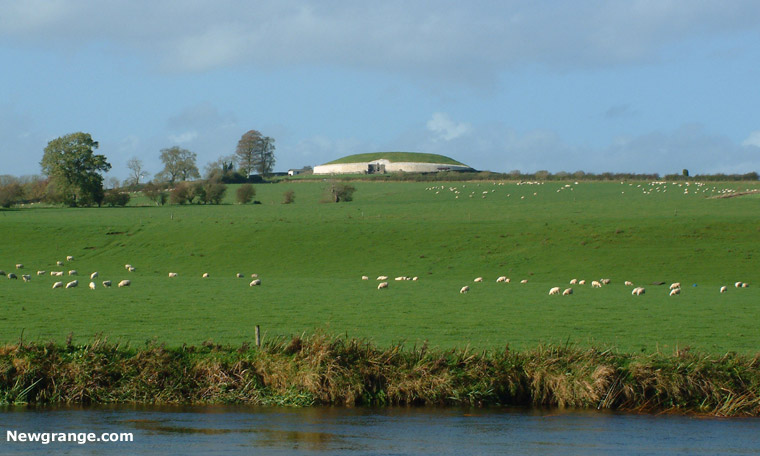
Watery gateways to the Otherworld

See my other post: Boand – Water Goddess of the Boyne

In the ‘Metrical Dindshenchas’ entries about Boand, the eponymous goddess/fairy woman of the River Boyne, there is explicit mention of a belief that all rivers run to the Otherworld which is also the world of Creation:

“…Sid Nechtain is the name that is on the mountain here, the grave of the full-keen son of Labraid, from which flows the stainless river whose name is Boand ever-full.

Fifteen names, certainty of disputes, given to this stream we enumerate, from Sid Nechtain away till it reaches the paradise of Adam…

….from paradise back again hither

to the streams of this Sid.”

The ancient Greeks believed exactly the same – all rivers ran into the ‘world river’ Okeanos (the great sea) which bordered the realm of Cronus-Atlantis (Ogygia)  and the Elysium. The Dindshenchas entry actually claims that the River circulates from the Otherworld, back to Sid Nechtain where it arises within the Sid as the magical spring or stream of Segais, before emerging back into the mundane world at the ‘pool of Mochua the cleric’.

This is an important piece of mysticism that explains much about the reincarnation beliefs of the Atlantic peoples, as promoted by Caesar’s Druids.

Boand is famous in the Irish Mythological Cycle as being the mother of Aengus Og, after an illicit coupling with the Stallion-Man-God known as the Daghda. The similarities between her Dindshenchas stories and those of Sinand are marked by allusions to the mystical origins and recirculation of rivers between this world and the next, and back again. Key to this are the mystical Otherworld/underworld wells from which the Boyne and the Shannon arise: described as ‘Connla’s Well’ (Sinand/Shannon) and Segais (Boann/Boyne) – both interchangeable motifs linked to fairy women at sacred hills (the usual site where springs arise). The Irish, ‘Arthurian’ British, Gallician, Germanic and Breton mythologies plus that of Gallia Aquitania and the Pays D’Oc, are full of the motifs of magical men and women riding horses, associated with spring pools, forests, hills and rivers and the Otherworld. They are connected by an important common thread of themes which defies the explanations of Roman and Greek religion and Roman and Greek understandings of Gaulish, German and British religion in the Iron Age.

All text © 2014 The Atlantic Religion, except where stated.
‘The Elucidation’

The following is appended as a (?13thC) prologue to a copy Chrétien de Troyes’ Perceval, le Conte du Graal in the French medieval manuscript known as  Mons 331/206 (olim 4568). Taken from Mary Jones’ fantastic website – translated by Sebastian Evans:

…. Now listen to me, all ye my friends, and ye shall hear me set forth the story that shall be right sweet to hearken unto, for therein shall be the seven Wardens that hold governance throughout the whole world, and all the good stories that any hath told according as the writing shall set forthwith;  what manner folk the seven Wardens should be, and how they took unto them chief, and whom they took, for never aforetime have ye heard tell the story truly set forth, and how great nose there was and great outcry, and how for what cause was destroyed the rich country of Logres (AP: the Brythonic lands) whereof was much talk in days of yore.

The kingdom turned to loss, the land was dead and desert in suchwise as that it was scarce worth a couple of hazelnuts.  For they lost the voices of the wells and the damsels that were therein.  For no less thing was the service they rendered than this, that scarce any wandered by the way, whether it were at eventide or morning, but that as for drink and victual he would go so far out of his way as to find one of the wells, and then nought could he ask for of fair victual such as pleased him but in content he should have it all so long as her hand asked in reason.  For straightaway, I wise, forth of the well issued a damsel – none fairer need he ask – bearing in her hand a cup of gold with baked meats, pastries, and bread, while another damsel bore a white napkin and a dish of gold or silver wherein was the mess which he had come for the mess had asked for.  Right for welcome found he at the well, and if so it were that his mess did not please him, diverse other ways they brought him all with one accord served fair and joyously all wayfarers by the roads that come to the wells for victual…

The narrator of the introduction or ‘elucidation’ then comments upon the loss of the pagan religion from Logres (Britain) and the goes on to lament how the ‘women of the wells’ were deposed. It is a fitting introduction to the archetypal Grail romance, and seemingly evokes the spirit of the Seven Streams of Poetry said in Irish mythology to issue from the Otherworld wells (of Connla and Segais, for example). Here the term used is the ‘Seven Wardens’, the mysteries of which are supposed to be revealed within the narrative of ‘Percival’, with its tales of the Fisher King (Manannan), magical cups, and maidens who occupy magical pools of water…

All text © 2014 The Atlantic Religion, except where stated.
Through a mirror – water in the Atlantic religion

It has been well-established (if you’ll pardon the pun) that water played a prominent role in the religion of the ancient peoples of north and west Europe before the establishment of christianity. Even afterwards, and particularly in Ireland (no doubt something to do with its superabundance of moisture), this continued to be the case.

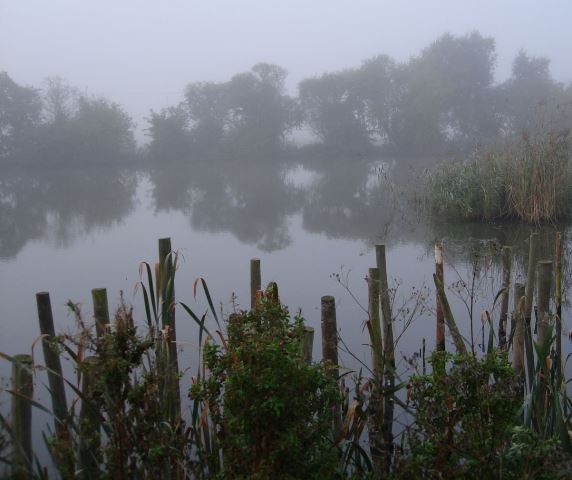
Flag Fen, England - site of a timber trackway and platforms built over water during the Neolithic and Bronze Age, associated with ritual water deposits

Flag Fen, England – site of a timber trackway and platforms built over water during the Neolithic and Bronze Age, associated with ritual water deposits. Anyone seen Grendel’s mother?

Votive deposits of religious artefacts, weapons and artefacts, food such as cheese and even human remains have been discovered in Europe’s wetlands, dating to the Bronze Age if not earlier, and archaeology of these environments has uncovered extensive constructed track-ways and structures to which have been ascribed great religious as well as economic and social importance.

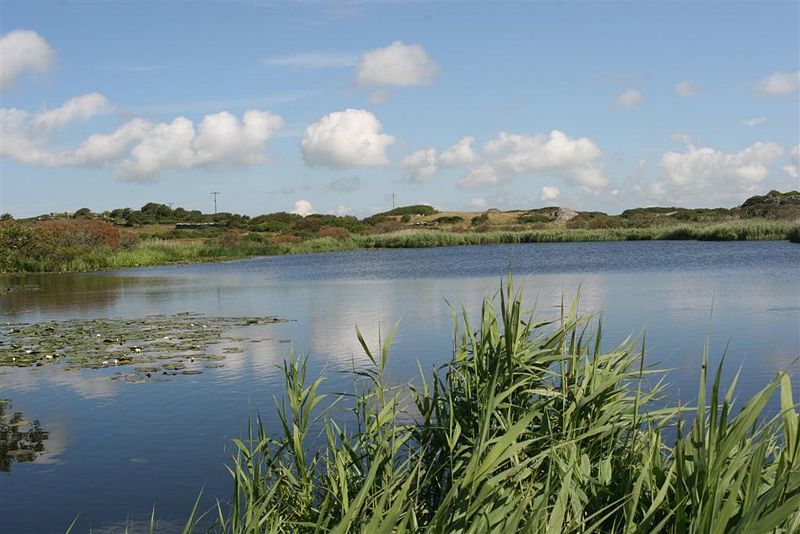
Llyn Cerrig Bach

Llyn Cerrig Bach, Anglesey – Site of Iron Age ritual water-deposits 300BC-100AD

An increasing number of crannogs and related ancient lake structures have been identified in the aquatic (and formerly aquatic) landscapes of Britain, Ireland and the rest of the ancient Celtic world. These are testament to the unique importance of proximity to water in the lives of peoples in the humid and often stormy climes of the Atlantic northwest of Europe: It offered protection, food, a source of power, a medium of transport, and a resource for industry. Coupled with the profound relationship between early (post-‘Theodosian’) Christian churches and religious settlements in northern and western Europe and the older pagan ritual sites at or near wells, springs, lakes, rivers and islands, it can be seen that water was at the heart of religious as well as secular life.

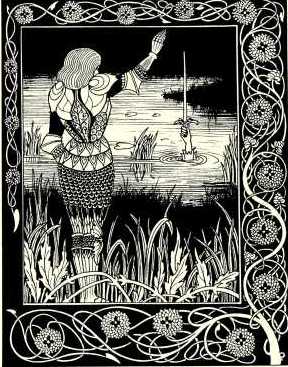
Aubrey Beardsley's depiction of Bedivere consigning the sword Excalibur to the 'Lady of the Lake'

Aubrey Beardsley’s bookplate engraving of Bedivere consigning the sword Excalibur to the ‘Lady of the Lake’

The legendary imagery connecting man with the spirit world through water is found throughout Europe from antiquity, but in particular it remained an active and important feature of the stories and literature of Atlantic Europe in the post-Christian period: From the lake-dwelling ‘Grendel’s mother’ and her role in Kingship in the Anglo-Saxon epic Beowulf, to the ‘Lady of the Lake’ (variously known as Nimue, Viviane, Elaine, Niniane, Nivian, Nyneve, and Evienne etc) of later Gallo-Brythonic ‘Arthurian’ legendary romances, the magical female in water pervades mythology.

Breton traditions tell of Malgven or Morgan, her daughter Dahut – the ‘Groac’h Ahez’ and her silver keys to the gloomy underwater realm – the medieval Lai tradition (Marie de France etc) from the region used the theme of beautiful female fairies met at springs and rivers into which they might plunge carrying worthy knights to the fairy realm of Avalon.

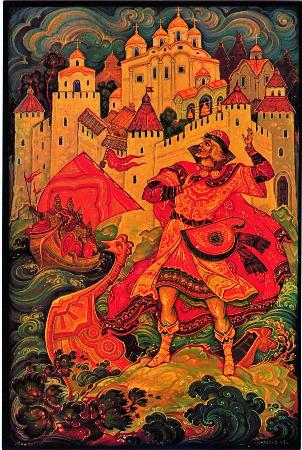
In Russia (where magical female spirits inhabiting rivers are called Rusalka), there is a similar tradition of the aquatic otherworld – a medieval epic tale known as Sadko, in which its eponymous hero visits the world of the ‘Sea Tsar’.

Sadko visits the Sea Tsar

Sadko visits the Sea Tsar

Ancient Irish legends (eg – from Dindsenchas) often confer the origin of rivers upon female characters: Sinand, Boand,  Éirne etc. Lakes are created by legendarily careless legendary girls who forget to cap off wells, and Old Women lament the coming of the sea to take them. Christian tales tell of lake and river monsters who vex their saints and heroes, and in the written accounts of pre-Christian legends, the Morrigan appears at critical junctures on river banks to warn, cajole (and occasionally have sex with) the stories’ male proponents…

Newgrange on the Boyne. Horde of poisonous sheep shown for scale!

Newgrange on the Boyne (Boand). Horde of poisonous sheep shown for scale!

In folklore, there are still many more tales involving the aquatic realm and the magical female, not least of which are those of the merrows and mermaids and the continental melusine.

In my next post, I am going to examine one particular sacred ‘aquatic’ landscape in Ireland: The Bog of Allen.