Norse Sea-Giants in more detail…

Giants and monsters have a special connection to the sea in Norse mythology – just like the Titans in ancient Greek mythology. They represent the unconquerable and titanic forces of nature. As characters in stories, their great size can be considered an expression of the large shadows cast by distant things with the low sun behind them – as happens as it passes into the ocean on the western horizon of the Atlantic. The main characters in these tales of oceanic titans are Thor, Loki and Aegir:

Thor wrestling the Midgard Serpent (painting by Füssli, 1788).

Thor with Hymir wrestling Loki’s son – the Midgard Serpent (painting by Füssli, 1788).

The 13thC CE, Icelandic christian scholar Snorri Sturluson wrote a mythological ‘theogonic’ dialogue on poetry called Skáldskaparmál (“language of poetry”) in which the primal sea-giant Ægir, also known as Gymir (a version of ‘Hymir’) or Hlér, discusses kennings and mythology with the Æsir god, Bragi, after the style of the poetic Edda composition Alvissmal. That Snorri chose these two as characters in the dialogue is interesting, moreso because of they seem to represent the two ‘Platonic’ aspects of what to the ancients was knowable – the first: nature and the elements (Ægir), understandable through sense, and the second: the gods and spiritual things – knowable through the mind, and therefore the province of poetry and philosophy (Bragi). In Alvissmal, it is a wise earth deity – a dwarf/dvergar called Alviss (‘All-Wise’) who instructs Thor on poetic kennings. In Skáldskaparmál, however, it is the ‘sea’ (Aegir) talking…

Aegir is also the host of the feast at the centre of the important poetic Edda story Lokasenna (Codex Regius): This is the tale of a feast of the gods and elves, hosted by Aegir, whose hospitality (and his ale and mead) is considered sacrosanct to the gods, who become angry when troublesome giant/god Loki starts drunkenly abusing the guests. This episode assures Loki’s imprisonment and Promethean-Orphic torture by the gods (he must endure the poison dripping from the fangs of a serpent ) until the showdown of Ragnarok. Aegir’s legendary cauldron or brewing pan seems to provide a link between the elements and the mind, and Lokasenna (the ultimate drunken social meltdown) provides an amusing view of how leisure and strife were never far away from each other in the Viking world. The poetic Edda version from the Codex Regius says Aegir was also called Gymir, and ‘Hymir’ is the giant with mighty caudron/brewing-pan who is Thor’s host and companion when he goes fishing for the giant Midgard Serpent in the poetic Edda tale of Hymiskviða (Codex Regius). Hymir, Gymir and Aegir are probably the same mythological sea-giant.

Aegir was said to be one of three sons of the giant-ancestor Fornjótr (described as an ancient king of the magical north),the other two being Logi (fire) and Kári (wind).  Fornjótr might in literally mean ‘First Giant’. The compounding of his watery son’s name with ‘-gir’ is redolent of the word ‘Gyr’ (eg – Gygr) and theirefore of the Greek words Gigantes and Gygas, representing the larger than life ancestral deities of ancient Greek myth. Ægir might even be a Norse version of and the sea-giant Geryon, who had three bodies. This association with the elements (water in Aegir’s case) comes from the Skáldskaparmál kennings of the primal elemental forces:

“…How should the wind be periphrased? Thus: call it son of Fornjót, Brother of the Sea and of Fire, Scathe or Ruin or Hound or Wolf of the Wood or of the Sail or of the Rigging…”

The only classical element missing from the ÆgirKáriLogi triad is earth (jörð), usually represented in Norse myth and kennings as the eponymous giantess Jörð – ‘wife of Odin’. The Earth is feminine – like in the Greek Gaia/Ge. It is obvious from both ancient Greek and Norse mythology that the ‘giants’ bear names with suffixes which connect them intimately with ‘mother earth’: Gigantes (‘Born of Gaia/Ge’) and Jötnar (‘Born of Jörð’).

Aegir’s other name or kenning is given as Hlér, which seems incredibly close to the Irish/Welsh/Manx name for the sea: Lir/Ller/Lear of whom the legendary Sea God Manannán/Manawydan was the son. In the most important 14thC Icelandic manuscript collection, Flateyjarbók, the following is said of Aegir/Hlér and his family:

“…There was a man called Fornjót. He had three sons; one was Hlér, another Logi, the third Kári; he ruled over winds, but Logi over fire, Hlér over the seas…”

The connection between Logi and the Norse ‘god’ figure Loki is uncertain. The names certainly seem similar, and Loki is definitely one of the Jötnar, being portrayed in the Edda myths as something of an uncontrollable ambiguous shape-shifter as well as a father (or even a mother) of monsters and magical horses. One might even compare him to the role of the Gorgons in Greek myth – a frightful challenge to be overcome by initiates into the mysteries of life, death and the otherworld. Logi represents fire – perhaps one of the most untameable and dangerous, yet useful ‘elements’ – and Loki represents a similar aspect of chaos in his oppositional and inductive roles in the Eddas. He, in fact, comes across as a character the Christian (and Muslim) narrative would assign to their ‘evil god’ – Satan – otherwise known as God’s right-hand man in the Hebrew Book of Job.

Another ‘giant’ of note in Norse myth who is tied closely to Aegir and Loki in surviving narratives is the god Þórr (Thor), whose name seems to be cognate with the word Thurs (þurs) which is another Germanic word for a giant/titan. In the Icelandic mythologies recorded in the Christian era from orally-transmitted traditional pagan poetic and story traditions, Thor is associated with great strength and battles with giants and monsters using his great hammer Mjölnir which represents both a weapon and a tool. His traditional role in Germanic societies is as a protector and battler with the elements akin to the Greek Herakles (a fact not lost on the 1stC CE Roman author and historian Tacitus), and he seems to have an agricultural/fertility aspect on account of this. This connects him to the folk-legends of similarly enthusiastic (but not too bright) ‘helpful fairies’ – Brownies, Glaistigean, Phynnodderee, the hammer-wielding Leprechauns and the ‘Hobthrust‘ of northern England…

The poetic Edda composition called Hymiskviða is a tale of Thor being sent by Aegir to fetch a giant brewing-pan or cauldron from Hymir – the giant who lives ‘at the edge of Heaven’. Hymir is said to be Aegir’s father, and Aegir also goes by the name Gymir, of which ‘Hymir’ is an aspirated pronunciation. Thor ends up going on a perilous fishing expedition with Hymir, during which Odin’s son manages to land the Midgard Serpent, Loki’s son Jörmungandr who encircles the Earth biting his tailHymir considers it very bad news when Thor bashes the serpent over the head before letting it slide (presumably lifeless) back under the waves… It can be seen here that the same consistent association occurs between oceanic Titans and sea monsters in medieval pagan Norse myths.  The outcome of the story is that Thor obtains the brewing pan that will make the ‘poisonous’ ale or mead that spurs Loki to sow discord among the gods in Lokasenna. The killing of Jörmungandr and the breakdown of order with Loki and the giants/monsters presages the Ragnarok… This imagery appears upon a number of incised stones of the Viking era (including Cumbria and the Isle of Man, as well as in Scandinavia), providing corroborative evidence of its importance in Scandinavian-influenced Atlantic mythology.

There is much to be identified between the Norse myths and the Irish and Welsh. For instance, the theme of sea-giants and a ‘fatal feast’ featuring a caudron that determines the world’s outcome is seen in the Welsh Mabinogion tales, and the Irish tales ‘Bricriu’s Feast’ (Fled Bricrenn) and ‘The Destruction of Da Derga’s Hostel’ (Togail Bruidne Derga) among others. They appear to be different figurative ‘branches’ of the same ancient tree whose roots are nourished by ‘world-river’,
 

Similarities in Greco-Roman and Gaelic myth

Although the mythology of the material and intellectual cultures we know as 'Greco-Roman' is Europe's oldest inscribed tradition, that of Ireland and the 'insular Celts' must come next, albeit the written form of it is from a much later date. In particular, it often excels and exceeds the Greek material by its apparent strangeness and stylised 'otherness', yet as a source of pagan myth it needs – like the Norse sagas and Edda texts – to be treated very carefully as it is told by christians, unlike the Greek and Roman material which comes from pagans.

Nonetheless, the Christians did not have much in the way of myth to call their own, except for the 'Old Testament' materials and the early saints' lives, many of which were based on pagan tales, in their style and often in their narrative content: These were essential to pad out its own religious narratives and replace (or at least displace) the contents of the potent oral-transmission culture with a literature-based alternative.

It is worth noting a number of things about southern-European pagan religious culture, however, before framing a debate of paganism vs christianity in terms of oral transmission culture vs. literary culture: Firstly, it is worth remembering that – since the advent of the Hellenistic era in the 5thC BCE – that literary culture became an important stalwart of Greco-Roman societies, and seems to have become a primary mode by which people came to understand their religion. There were certainly traditional aspects to the culture to a late period, but by the advent of christianity, this was being displaced. The role of the priesthood and attendants in many of the most important temples was generally fulfilled as a fixed term civil office by the worthies of Greek and Roman society, so – unlike the traditional and esoteric forms of learning that Gaul (and Britain's) professional priesthood had to undergo, these offices were losing their mystery. Mystery remained the province of cult-centres such as Eleusis, Delphi and the island of Samothrace, and the discourse-communities of the Philosophers – the Neo-Platonists, Hermeticists and Gnostics who thrived in the late-classical world after the advent of Christianity and who pre-figured its rise. It is telling that classical paganism's most complete and (in scope) extensive theogonic text – the Dionysiaca of Nonnus of Persepolis in Egypt – was written by an author whose output later included a commentary on the christian Gospel of John. To understand this is to understand where the impetus for Christianisation was focussed in the less-literate climes of northwest Europe, such as Ireland, in the 5th/6thC CE.

Whereas some of our oldest surviving literature from the pagan world is religious, this aspect of the genre was in mortal decline in parallel to the rise in interest in philosophy and the 'mysteries' from the advent of the Hellenic period. By placing literacy in the hands of a few – a trained elite (after the model perhaps of the barbarian, Egyptian and Eastern peoples) – christianity would place itself at the heart of the new models of kingship appearing in the 'barbarian' world following the collapse of the Roman franchise in the west.

There are many similarities between the written medieval Irish myths and Greek legends. The reasons for this might be fourfold:

1. That the Irish believed in a shared widely-known and ancient cosmic worldview, populated with similar characters and themes to those of ancient Greece and southern Europe, and the Christian authors recorded this from traditional orally-transmitted narratives.

2. That literate monks used Greek and Roman (or Romano-British) myths to flesh out a written Irish narrative which did not otherwise exist – a kind of 'new age' eclecticism.

3. That Irish and Greek myths developed separately, yet shared similarities determined by (a) the culture and traditions/techniques of storytelling and (b) empirical reactions to natural phenomena.

4. A synthesis of points 1-3.

Obviously, the most likely answer is point 4 – we simply do not have enough evidence to support points 1-3 independently, but we have good evidence that all of them have been contributing explanations. I shall now present a number of Irish myths/mythic characters and their apparent Greco-Roman counterparts and let you decide for yourselves:

Cú Chulainn:

The archetypal indefatigable warrior super-hero of the 'Ulster Cycle' stories – Cú Chulainn – seems to have a particular similarity to Herakles or Hercules: He is the son of a god, associated with blacksmith-craftsmen (Cullain). Cullain seems to relate to the Greek 'earth-born' proto-blacksmiths known as the (Idaean) Dactyls, of whom Herakles was sometimes considered one. was a supreme warrior, a lover of goddesses (Fand, wife of Manannán mac Lir) and his nemesis is a goddess (the Morrigan). He is a performer of fantastic tricks and sporting feats, yet forever tied to the whims of his king and his gods. He lives fast and dies young – a true aspect of the Celtic warrior ideal. is also a 'king's champion' warrior archetype – a dog on a leash, as befits his name. He sometimes comes across as bombastic, brash, sometimes clumsy and insensitive – a bit of a lummox at times, and then at others, clever and dextrous, and light on his feet. Like Herakles, he travels to far-off islands and does battle with the weird as well as the mundane, performing 'feats' along the way.

One way in which Cú Chullain differs from Herakles is that Herakles was a folk-hero responsible for taming and conquering the wild and chaotic forces for the good of humanity. In the 'Ulster Cycle', Cú Chullain typically acts on behalf of the interests of his liege lord – like the other famous Greek warrior-strongman Achilles. This perhaps reflects the fact that these Irish legends (like their later French and British 'Arthurian' traditions) were often designed for telling at the courts of elite rulers, and therefore suited the value-system of this milieu. In folk-myths, Fionn and Cú Chullain often take on much more gigantic proportions and attributes.

The Battle of Maige Tuired:

This is the 'showdown' scene of the Irish mythological cycle stories in which the Tuatha Dé Danann, the Fir Bolg and the Fomorians are pitted against one another for supremacy of Ireland. The Fomoire are usually described as a race of sea giants in Irish mythology, and the Manx word Foawr (from 'Fomor') means 'Giant'. They seem similar to the aquatic Titans of Greek myth and the Cath Maige Tuired is like an Irish version of the Greek Titanomachy – the battle and overthrow of the Titans by the Olympian Gods, with whom the TDD share a certain similarity. Similar legends exist from Norse myth – the primal giants here are the Frost Giants: Titans at -40 Celsius! Of course, the bizarre cannibalistic and incestuous Greek narratives of the Titans are absent from the CMT and the 'Book of Invasions' stories which present more of a heroic pseudo-historical dynastic struggle. Tolkein borrowed heavily from the imagery of the battles of Maige Tuired in constructing his battle scenes in Lord of the Rings.

Giants and primordial helpers:

The landscape of Atlantic Europe – particularly those regions where Greco-Roman and later christian culture was slow to assert itself – is riddled with ancient mythology of primordial giants who supposedly played some important roles in determining the shape of the landscape – mountains, fjords, rivers, lakes, plains and great rocks. The same was true of the mythology of the Archaic period and Bronze Age of southern Europe – in particular the mythologies of ancient Greece, but we can discount these as playing a late originating role in the folklore of northern and northwestern legends due to the lack of impact of these material and cultural civilisations in these zones.

The Greek giants and Titans were 'Earth-Born' (Gygas – after Ge/Gaia, the personified Earth). The pagan Norse word used for giants in the middle ages was Gygr – existing into the more modern periods in the Scots Gyre and Faroese Gyro. The Manx equivalent of the Scots Brownie, Uirisk and Grogach legend was the Phynnodderee, 'Dooiney Oie' ('Night Man') or Glashtin – a being considered gigantic, primitive, coarse and animalistic in appearance who helped householders and warmed himself by the hearth at night when humans slept. His local legends seem, curiously, to conflate him with both Fionn mac Cumhaill and even Cú Chullain and, when not explicitly named, with the activities ascribed elsewhere in the Atlantic world to other giants – specified or unspecified. This is a representation of the archetypal earth-born ancestor, and is a particularly important and wide-ranging link between northern and southern pagan mythology which appears to have a commonality stretching way back into the Bronze Age. Herakles was also an aspect of this.

The Otherworld:

Both Greek and Irish myths portray the Otherworld as a location reachable by a westward journey over the great ocean. The legendary Greek islands of Elysium, the Hesperides/Erytheia and Ogygia, and the 'Islands of the Blessed' or 'Fortunate Isles' have their Irish equivalents in the many names of Gaelic mythology's magical western islands which were also considered the resort of departed souls: Mag Mell, Tír na nÓg, Tír na mBeo, Tír Tairngire, Tír fo Thuinn, Ildathach , Hy Brasil, Tech Duinn and Emain Ablach. These places are sometimes explicitly islands, sometimes under the sea, sometimes of a hybrid type that emerges (and just as soon disappears) from the sea.

Like in the Greek legends, the otherworld is also represented as a chthonic realm – beneath the earth. Like the Greeks, the Irish seem to have believed that the rivers of the world joined a 'world river', and that it re-manifested from the otherworld by piercing back though the earth as springs of water. Like the Greeks and Latins of southern Europe, and their fellow Bronze Age and Iron Age era 'Celtic' peoples further north and west they considered springs of water to be important and holy – no doubt for this reason. Sidhe mounds or Fairy Hills were the traditional 'home' of Irish (and to a lesser extent, Manx and Scottish fairies). They were sometimes considered to be the sources of rivers returning from the otherworld. Mountains and artificial mounds had similar associations in Ireland. In a flat landscape, a mound is something akin to an island – a consideration when addressing the 'otherworld inversion' belief that permeates Atlantic European folklore.

An interesting aspect of the Greco-Roman myth is how there seems to be a plasticity in portraying the otherworld 'places' (Elysium, for example) as both meadows or gardens and simultaneously as islands bordering Okeanos. This same conflation appears to represented quite strongly in the old Irish story 'The Voyage of Bran mac Febail' where he is conveyed to the otherworld islands over a sea which gradually appears to become a meadow.

Mermaids and Sirens:

The idea of female (and male) entities who lured men to stay with them in the watery or otherworld realms are common to both Greek and Gaelic myths. The 'Sirens' occur in Greek myths such as Homer's Odyssey and the Argonautica ('Jason/Iason and the Argonauts'). They were sometimes depicted as half-bird, half-female inhabiting islands surrounded by huge rocks and high cliffs, luring sailors to their deaths on the treacherous shores with their beautiful songs. Calypso, the daughter of Atlas on Ogygia also fits the enchanting-island maiden archetype, and although was not considered one of the Sirenai, seems part of the same mythos. Even the Gorgons tempted brave Perseus to their realm, and from his 'killing' of Medusa there was a magical birth (of Pegasus and Chrysaor).

In Atlantic Celtic mythology, this function was the province of alluring beautiful mermaids – usually half-human, half-fish in their conception but sometimes 'seal people' (e.g. – Selkies). The Isle of Man's version of the Cailleach – Caillagh y Groamagh was supposed to fly in from the sea in the form of a bird at Imbolc/La'a Bride, and she may be another aspect of the beautiful fairy maiden called 'Tehi-Tegi' who in Manx legends lures men into the sea or a river to drown them, before flying away in the form of a wren (sometimes a bat!). The Gaelic (Irish/Gallovidian) Merrow was sometimes known as Suire which sounds very much like a version of 'Siren' although this may be in reference to known Greek myths, and this type of mermaid was associated with a feather hat or cape. Crofton Croker's 'Fairy Legends and Traditions of the South of Ireland' is worth reading for a summary on the Merrows.

Harpies and Sidhe Gaoithe:

There was an explicit belief in former times in Ireland, Scotland and the Isle of Man that sudden gusts of wind were caused by the actions of spirits and fairies. Indeed, this was a feature of the demonology of medieval Christian Europe, and may well link back to the ancient Greek beliefs that the Harpies were responsible for the same. They were depicted (again) as half-woman, half bird or as winged female entities and were personifications of storm-winds. The Cailleach Bheara of the Scottish Highlands and Islands had a similar association, and was sometimes considered a female-avian who flapped her wings to make the winter storms. In the Isle of Man, the (not uncommon) tornados were sometimes supposed to be caused by a fairy known as Yn Gilley Vooar ny Gheay – 'Big Boy O' the Wind'.

River Nymphs and Sea Nymphs:

Perhaps subjoined to the mermaid legends, it is notable that the Greeks and the Irish personified their rivers with female spirits or entities. Evidence of this comes from the Dindseanchas legends and those of the so-called 'landscape-sovereignty' goddesses, otherwise referred to as Bean Sidhe, no doubt because river-drainage areas in mountainous landscapes tend to map and define territories. Greco-Roman mythology venerated such female water deities, and this tendency was also found in the European celtic world in the late Iron Age (although much of our evidence here comes after the period of Romanisation). Again, the 'Cailleach' personification from folklore seems to combine many of these functions (Harpies, Sirens, Nymphs etc) into the form of this single protean Titaness. Likewise, the Moura Encantada of the Iberian peninsula and the Marie Morgane of Brittany as well as the 'Lady of the Fountain' (or lake) of Arthurian lays and romances.

Summary:

It is apparent that ancient European paganism was a universal system of philosophy and 'science' illustrated through traditions of the arts: story, poetry, song, pictures, dances and drama. Every possible phenomenon seems to have been addressed by assigning mythology to it, and the boundary between the spiritual and the secular did not really exist – instead there was a continuum. The southern European civilisations emerging from the Bronze Age with a more oriental perspective, eventually coming to consider themselves 'better' and more 'enlightened' than their 'barbarian' cousins (and ancestors) in northeastern and northwest Europe, and due to warfare and incursions of these 'barbarians' between the 5thc BCE and the 1stC CE (and beyond), and due also to the dependence on written knowledge, a perception derived that their religious and spiritual beliefs were 'different', when in fact they had a shared root.


Terror and Beauty from the far shores…

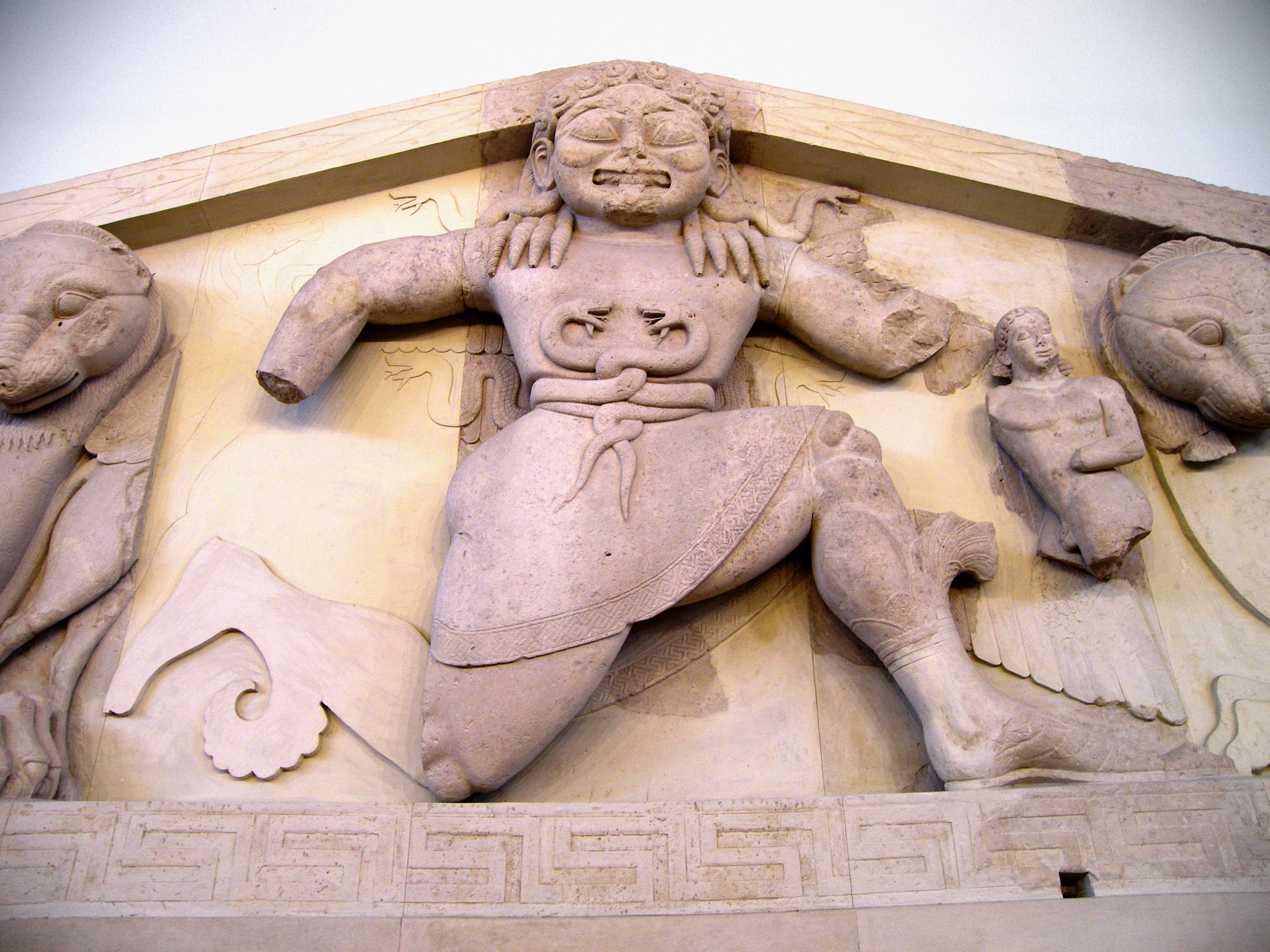
The stylised Gorgon from the pediment of the 6thC BCE Temple of Artemis, Corfu. Was she the Greek version of the 'loathly lady' myths of the north?

The stylised Gorgon from the pediment of the 6thC BCE Temple of Artemis, Corfu. Was she the Greek version of the 'loathly lady' myths of the European north?

To the ancient peoples of Europe, the realm of the dead and of heaven lay deep in the west on the path of the setting sun. This exceeded the bounds of the known world of the Mediterranean and was presumed to lie beyond the extent of the Titanic Atlantic Ocean, believed to represent the extent of the 'world river', Okeanos. Plato (Athens, 4thC BCE) describes the mysterious point where earth and heaven meet in his 'last words of Socrates' dialogue known as Phaedo (trans. Benjamin Jowett) :

“…Also I believe that the earth is very vast, and that we who dwell inthe region extending from the river Phasis to the Pillars of Heracles,along the borders of the sea, are just like ants or frogs about amarsh-pool, and inhabit a small portion only, and that many others dwell inmany like places. For I should say that in all parts of the earththere are hollows of various forms and sizes, into which the water andthe mist and the air collect; and that the true earth is pure and inthe pure heaven, in which also are the stars-that is the heavenwhich is commonly spoken of as the ether, of which this is but thesediment collecting in the hollows of the earth…”

His description of the 'frogs' and the pond is an echo of contemporary Athenian playwright Aristophanes' famous Dionysiac play of the c.405 BCE known as 'The Frogs' when the god Dionysus crosses the river Styx to visit Hades, and rather than being regaled by the shades of the departed from within the water, he is annoyed by a chorus of frogs. The connection between water, and the seemingly grotesques yet miraculous aspects of both death and rebirth was not lost in the ancient European worldview, of which the Greeks were to create the earliest written sophistication:

One of our oldest written sources on ancient Greek mythology, Hesiod ('Theogony'), says that the most archetypal race of Greek monsters, the Gorgons, lived on an island at the furthest extent of the western ocean, supposedly near the island of the Hesperides. This puts them in the realm of Cronos (Saturn) at the far shores of the world-river Okeanos, near Homer's famous island of Ogygia from the Oddyssey. Ogygia in Homer was domicile of the titan Atlas (also called Atlantis) and his daughter Calypso, whose charms almost took Oddyseus away from the land of the living. The name Ogygia (Hy Gyges?) is based upon the greek word gygas, meaning 'born of Ge (Gaia/Ge – the Earth)', often interpreted as 'Giants' (Gigantes) and possibly linked with the name Gorgós (dreadful)…

Accordingly, the Titans of greek myth were viewed as primordial, earth-born giant in stature and monstrously alien. They were supposedly banished in a succession war with their children, the Olympian gods, and the various Greek theogonies suggest these marginal realms were at the farthest reaches of the 'time before memory' of oral-culture mythology – on the shores of the world river Okeanos at the edge of the heavens.

The relation ship between the chthonic underworld of Hades and Tartarus is based upon the fact that the oceans are the deepest places, and the Atlantic far more so that the Mediterranean. The beings of this realm partook of the primal, cthonic 'elements' of Water and Earth. Even the Hebrew Book of Genesis (first compiled 5thC BCE) borrowed this conception…

The children of the Titans were often monstrous, for example: Python, Scylla, Medusa, Charybdis, Cereberus, Ekhidna, the Hydra, Chimera, Geryon, Cetus and the Graeae. Sometimes they were beautiful too, like the titaness Calypso, and Pegasus and Krysaor who were the children born of the neck of Medusa. The mysterious realm of the oceans, has always delivered both beauty and terror to mankind!

Although encountered in Greek mythology in various parts of the Mediterranean, it was not, however, it was not from this comparatively mild 'frogpond' that these creatures and Old Gods derived, but the mighty Atlantic, beyond the 'Pillars of Heracles' or the Straights of Gilbraltar, at the extremes of Okeanos in the Atlantic west. During the era of the Roman expansion into northern Europe, the misty, cold and terrifying reaches of the British Isles, Ireland and the North Sea might well have been at the very brink of this terrifying alien realm… to the ancient world, if you wished to get to Ogygyia and the Hesperides, you went to the furthest navigable islands (Britain and Ireland), and then just went a little further!

In mythology, the monstrous is often depicted as a trial to be overcome by a hero (or 'initiate'). In northern Europe, the aquatic 'loathly lady' traditions of the Melusine, the tale of how Conn Cétchathach gained the High Kingship of Ireland, and Chaucer's 15thC 'Wife of Bath's Tale' are examples of such a tradition. In Greek myth, the story of Perseus and Medusa might be seen as a version of the same principle:

Gorgons:

The most famous monsters of the Greek and Roman world were arguably the three snake-haired Gorgons, who were said to be the daughters of Phorcys (a hypostasis subordinate to Poseidon). These were also the sisters of another divine female triad of Greek myth, the Graeae – the grey, aged and withered, one-eyed Cailleach-like Okeanid nymphs said in some myths to guard the approaches to the Hesperides, Ogygia etc and (redolent of the Norse Valkyries and the Irish Children of Lir) to have part of the form of swans. In the myth of Perseus, the hero is dispatched on an apparent suicide mission by evil King Polydectes to kill and gain the head of the only mortal Gorgon, Medusa, whose gaze turned men to stone. Polydectes fully expected the young hero to die in the task, so that he might marry Perseus' mother, but he survives his 'initiation' and triumphs from it. The Gods Athena, Hades, Zeus and Hermes donate magical weapons and aids for the task, setting Perseus on a perilous course to success. He tricks the Graeae at the approaches, and enters the grey and misty realms to stalk his prey… Upon decapitating Medusa, the magical horse Pegasus is born from her neck – a bizarre conception, fit only for these distant and magical realms of the Titans. Perseus rides the flying horse, saves the maiden Andromeda from being devoured by the sea monster Cetus and rides off into the sunset with the girl.

The characters of the Perseus-Medusa mythology all occupy a portion of the heavens as a group of related constellations named after the characters: Pegasus, Cetus, Perseus, Andromeda, in close proximity to the other 'aquatic' constellations of the zodiac – Pisces, Aquarius and curious Capricorn. This group contains two particular stars which express the curious behaviour of having a cyclical variable intensity, namely the 'blinking' eye of Medusa: Algol (period repeats every 2 days) – seen in the constellation of Perseus, and the longer-period Mira Ceti on the neck of Cetus, whose period is 11 months. Both these stars appear to 'come and go', a feature which must have had particular implications to ancient peoples who believed a star was a perfected heavenly soul. Mythology was sometimes designed to record information about the skies!

By 'killing' Medusa on the far western shores of Okeanos, Perseus immediately helps her 'give birth' to his conveyor back from the Otherworld (Pegasus – whose feet create springs of water on land), and mysterious Chrysaor – the 'golden blade' suggesting agriculture: both aspects of continuity in a culture which believed in reincarnation. By 'kissing' the 'loathly lady', the beauty of regeneration might occur…

Chrysaor, Kallirhoe and Geryon:

Two miraculous children were born at the moment of Medusa's beheading: The winged horse Pegasus ('Creator of Pegai (springs)'?), and the golden boy Chrysaor ('Golden Blade'). Pegasus became the companion and steed of the warrior-hero Perseus, but the mysterious Chrysaor was credited only (so far as we know) with the paternity of another monstrous being: the giant three-bodied cowherd Geryon on whom the legendary strongman-warrior Heracles/Hercules was supposed to have conducted his Tain or cattle-raid. Pegasus and Chrysaor have distinct echoes of the Atlantic Europe's 'fairy helpers' – the 'fairy horse' and the 'brownie'.

Geryon was supposedly born to his father of the Okeanid nymph Kallirhoe who occupied the island of Erytheia, and was said by some later classical authors (Diodorus) have also lived on the mountainous slopes of Atlantic Iberia. Like the tripliform Celtic deities, he was supposed to have been a giant with three bodies.

“From Medusa, daughter of Gorgon, and Neptunus [Poseidon], were born Chrysaor and horse Pegasus; from Chrysaor and Callirhoe, three-formed Geryon.”Pseudo-Hyginus, Fabulae 151 (2ndC CE) – Trans. Grant.

His home was the far-west 'red island' of Erytheia in the mystical Hesperides (equivalent by name and association with the 'Arthurian' Avalon, and Irish Emain Abhlach), no doubt the reason his cattle also had coats the colour of the setting sun – the predominant colour of the flowers in Atlantic Europe after the Summer Equinox and also, notably, the colour of the running blood of the dead… He was once allegedly defeated by Hercules, who stole his cows. The constellations Orion (the 'stick-waver') and Boötes (the 'cowherd') might even be considered cosmic aspects of the legend behind Geryon, on account of the location of his myth – at the boundary of the Otherworld… the heavens near to that great nourishing sky-river, the Milky Way. The 'cattle' of Geryon are a motif for the spirits of the dead, like Aristophanes 'Frogs' and 'Birds' and Hercules taking of them is an expression of the role of the psychopompic gods: Manannan, Dionysus, Hermes/Mercury etc.

The Hesperides:

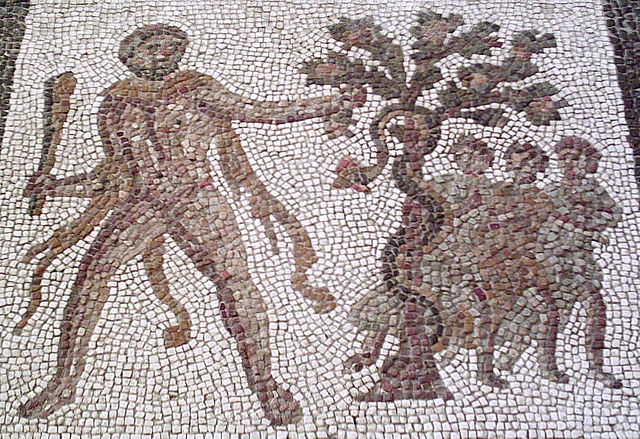
The mythical garden of the Hesperides lay somewhere in the mythological west – either beyond the Atlas mountains and Libya (home of the setting winter sun) or further out beyond the Atlantic ocean at 'Okeanos' far shore' (summer sunset), depending on the accounts. It was the site of goddess Hera's magical apple tree, whose golden fruit imparted divine knowledge (or chaos and warfare when placed in the hands of Eris!), and the three nymphs known as the 'Hesperides' were its guardians. It features in the myths of Perseus (the nymphs tell him where to find Medusa) and of Heracles (who steals the apples). These nymphs were supposed by some sources to be the daughters of Hesperus – personification of the 'evening star' (Venus) known as 'Hesperus' to the Greeks ('Vesper' to the Romans). Venus, being close to the sun, and relatively close to Earth often appears in the sun's train ('evening star') or vanguard ('morning star') as it traverses the ecliptic path. The Greeks, of course, named the planet Venus after Plato's muse Aphrodite.

Not trusting the Hesperides with her precious apples, Hera (a notoriously jealous sort of person) is supposed to have set the dragon Ladon to guard it, and he coils around the base of the apple tree's trunk. This is somewhat redolent of the Norse myth of the Midgard serpent coiled around the world tree, and the constellation Draco was said by Hyginus ancient account of the constellations to represent Ladon.

The exact 'identity' of the 'Island of the Hesperides' itself is somewhat mysterious – is it Ogygia or Erytheia? Or somewhere else, even? Erytheia is sometimes given as the name of one of the Hesperides, so this may link to Geryon and his herd of red cows. Conceptually, of course, this does not matter – the 'island' has no corporal existence, but an important spiritual one. The apples were a bridal gift of Gaia (the Earth) to Hera. The Irish and British also had a legend of an 'Isle of Apples' – Avalon and Emain Abhlach.

Hercules eyes up Hera's 'bridal gift' - perhaps the Hesperides are a tripliform expression of Zeus' wife?...

Hercules eyes up Hera's 'bridal gift' - perhaps the Hesperides are a tripliform expression of Zeus' wife?... The imagery is somewhat phallic!

The location of the Titans and their monstrous offspring at the far reach of Okeanos in ancient European mythology made them occupy the liminal 'crossing place' between the mundane world and the heavens. It is a place simultaneously distant in both space and time, ruled over by its Titan king, Cronus, whose 'star' (the planet Saturn) takes so long to traverse its ponderous path (as if an old Boddagh of a man) when compared to our nearer planets. If this 'crossing place' seemed distant and somehow unobtainable except through an extreme journey and a trial of nerve, the spiritual realm of the heavens on the other side was paradoxically immanent and of the 'here and now'. The meaning of this 'crossing over' point and a belief that the traffic here was bidirectional became a feature of the ancient initiatory mystery cults of Eleusis and the 'Orphic' mysteries and was a key part of the mythology of the barbarians of Atlantic Europe, preserved in their own rich traditions…


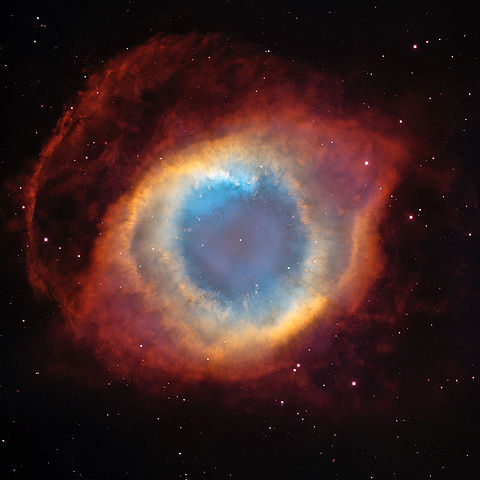
The Evil Eye in ancient Atlantic Europe, ‘101’.

The eye was once considered the one organ which could express the divine light of the soul. In the ancient world a perfected soul was believed to reside in the heavens as a star...

The eye was once considered the one organ which could express the divine light of the soul. In the ancient world a perfected soul was believed to reside in the heavens as a star…

The eye is a curious organ.

As well as receiving light, it appears at times to emit it also. This can be illustrated by the way that nocturnal predators’ eyes appear to glow (actually from reflected light), but there is another ‘light’ of the eye: that which, curiously, seems to disappear from it at the moment of death. This is the ‘spark’ or ‘twinkle’ of the eye whose intensity and quality we perceive to enhance and alter when we laugh, flirt or are excited to enthusiasm or anger. This phenomenon perhaps explained the theory of vision common to the ancient world – that known as the theory of ‘extromission’.

Extromission theory believed that the eye emitted light. Light itself was believed in ancient times to be a higher emanation of the philosopical element of fire, and to the ancient peoples it took two forms for which the Latin words ‘Lumen’ and ‘Lux/Lucis’ came into use. Lumen was mundane light – that emitted by candles, or the sunlight coming through windows and was closest to ‘elemental’ Fire. Lux however represented light in its higher spiritual or intellectual form – the divine light, the light of spiritual and philosophical illumination. Plato explains this in his account of the creation of human bodies from the Dialogue of Timaeus:

“…And so in the vessel of the head, they first of all put a face in which they inserted organs to minister in all things to the providence of the soul, and they appointed this part, which has authority, to be by nature the part which is in front. And of the organs they first contrived the eyes to give light, and the principle according to which they were inserted was as follows: So much of fire as would not burn, but gave a gentle light, they formed into a substance akin to the light of every-day life; and the pure fire which is within us and related thereto they made to flow through the eyes in a stream smooth and dense, compressing the whole eye, and especially the centre part, so that it kept out everything of a coarser nature, and allowed to pass only this pure element. When the light of day surrounds the stream of vision, then like falls upon like, and they coalesce, and one body is formed by natural affinity in the line of vision, wherever the light that falls from within meets with an external object. And the whole stream of vision, being similarly affected in virtue of similarity, diffuses the motions of what it touches or what touches it over the whole body, until they reach the soul, causing that perception which we call sight. But when night comes on and the external and kindred fire departs, then the stream of vision is cut off; for going forth to an unlike element it is changed and extinguished, being no longer of one nature with the surrounding atmosphere which is now deprived of fire: and so the eye no longer sees, and we feel disposed to sleep. For when the eyelids, which the gods invented for the preservation of sight, are closed, they keep in the internal fire; and the power of the fire diffuses and equalises the inward motions; when they are equalised, there is rest, and when the rest is profound, sleep comes over us scarce disturbed by dreams; but where the greater motions still remain, of whatever nature and in whatever locality, they engender corresponding visions in dreams, which are remembered by us when we are awake and in the external world. And now there is no longer any difficulty in understanding the creation of images in mirrors and all smooth and bright surfaces. For from the communion of the internal and external fires, and again from the union of them and their numerous transformations when they meet in the mirror, all these appearances of necessity arise, when the fire from the face coalesces with the fire from the eye on the bright and smooth surface. And right appears left and left right, because the visual rays come into contact with the rays emitted by the object in a manner contrary to the usual mode of meeting; but the right appears right, and the left left, when the position of one of the two concurring lights is reversed; and this happens when the mirror is concave and its smooth surface repels the right stream of vision to the left side, and the left to the right. Or if the mirror be turned vertically, then the concavity makes the countenance appear to be all upside down, and the lower rays are driven upwards and the upper downwards…” Plato – Timaeus 4thC BCE

It is evident from this that Plato considered the pupil of the eye a ‘filter’ to remove the Lumen element of light so that the meaning (information) conveyed in the Lux could be made available for the soul to consider! He considered vision and sensation an interaction between emanations of the soul and emanations of the universe. The Greek word for soul, mind, spirit and consciousness is  ψυχή – ‘psyche‘. The 5thC BCE playwright-‘philosopher’, Epicharmus of Kos, is quoted as saying “It is the psyche that sees, it is the psyche that hears, all the rest is deaf and blind”.

As an organ believed capable of emanation, not just reception, it is of no surprise that beliefs developed suggesting that the gaze of the eye can cause harm. Humans are acutely adjusted to the significance of the manner in which others look at them – a look can convey love, contempt, and any one of a number of other emotions or communications. Aside from the reaction of the perceiver of a gaze, the active principle of light extromission believed in by the ancient Greeks and others allowed that the eye emitted a spiritual force, and if this was evilly intended it would interact with that which it perceived in a harmful way. The most famous mythological account of a harmful gaze was that of the Gorgon – Medusa – whose gaze turned men to stone…

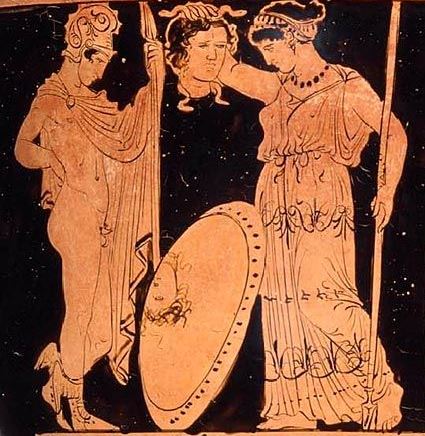
Perseus presents the head of Medousa to an obviously jealous Athena (Aine). Note there are only two snakes protruding from the Gorgon's head...

Perseus presents the head of Medousa to pleased-looking (jealous?) Athena. Note there are only four snakes protruding from the Gorgon’s head – the topmost two resemble horns…

That the gaze of Medusa could turn men to stone was a paradoxical inversion of the eye’s connection to light and thus the philosophical ‘element’ of fire. As Plato expressed it, fire and earth (of which stone was an expression) were the principle diametrically opposed elements of creation, and air and water were those which linked the two fundamental elements in a fourfold system. In Empedocles’ reckoning, the root-element Earth would correspond closest to the consolidating principle of ‘Love’ and Fire to the dissipating principle he called ‘Strife’ – the two contesting forces ascribed to the universe. Medusa’s gaze of stone, rather than light was perhaps a feminine idea of ancient established solidity. The flashing fiery gaze of love was the daimon that inspired the Trojan War, at the advent of Greek (and Roman) oral history’s ‘time of memory’. Being in love might be more dangerous than the stare of Medusa! Plato’s dialogue ‘Symposium‘ examines this theme in more detail.  Lizards and snakes, being considered ‘cold and dry’ by the ancient elemental reckoning, were  linked to the element of Earth and the cold distant chthonic and oceanic realms – the legendary Basilisk, like the snake, could seemingly transfix its prey (‘turn to stone’) with its unblinking stare. Legends are circumlocutive expressions of higher truths and maps of the heavens, as well as good stories…

Yet another European mythological figure with a ‘dangerous eye’ is from the Irish ‘Mythological Cycle’ medieval texts: Balor of the Fomorians, the probable inspiration for Tolkein’s Sauron, whose name also elicits something of the scaly-haired Medusa, or perhaps the legendary Basilisk. The legendary Irish ‘Fomorians‘ were – akin to the Greek Titanes (of whom Medusa was one) – considered a race of giants associated with the sea. They, like the Titans, probably haunted the ancient shores of furthest Okeanos (perhaps even as far as Tory Island!): far away in time and space in the ‘time before memory’…

From the 6thC CE, the western Christian church increasingly began to classify for its adherents the ‘sins’ which it believed were the spiritual errors that led its followers away from God: These were “superbia, avaritia, invidia, ira, luxuria, gula & pigritia” – the ‘seven deadly sins’ of pride, avarice, envy, wrath, lust, gluttony, and sloth. Of these, the majority were deemed ‘sins of the flesh’ or ‘material sins’. However, two were ‘sins of the soul’, namely envy and pride.

   Sins of the Soul were therefore deemed to be those which occupied a spiritual dimension and affected the world in spiritual ways. Envy (Latin: Invidia – ‘in vision’) corresponds exactly to the power known as the Evil Eye. By the ancient extromsission theory of vision the light of the soul illuminated what it perceived as a ‘ray’, and an evil soul would therefore have a negative invidious influence upon what it perceived. Likewise, the common belief that spiritual beings operated in spiritual ways is the foundation for the belief in old Atlantic Europe that ‘fairies’ envied the goods and children of people and wished to spirit them away… The supposed sin of the adversarial Christian spirit called ‘Satan’ or ‘Lucifer’ and his troop of rebel angels was that of pride.

The ‘Evil Eye’ belief in the Gaelic provinces of Ireland, Scotland and the Isle of Man remained important until the late 19th century. It evolved (perhaps as a result of widespread ‘witchcraft’ paranoias of the 16th-18th centuries) to engender two forms: The first (and oldest) belief was that it was a passive force derived from latent human foibles of jealousy (innate sinfulness). The more sinister form of the belief was that which believed the ‘Bad Eye’ to be the actual mode of witchcraft by which magical/spiritual harm could be done by a marginal and jealous socially-disempowered person. In Gaelic areas, there are as many records of belief in the possible abduction of vital forces by fairies as there were by supposed ‘witches’ or even by jealous neighbours. This may be a main reason why there were so few reports of judicial or popular murder of people for ‘witchcraft’ or ‘sorcery’: The alleged ‘perpetrators’ were generally not believed prosecutable in court on account of their lack of corporeality, and/or could not be ascribed the criminal concept of mens rea.

The Gaelic ‘Evil Eye’ belief manifested to observers between the 16th and 20th centuries as the apparent desire by people to offer a blessing on any thing which they had expressed admiration of. People feared that they might passively or unintentionally cause harm. They also obviously feared that their admiration might invite blame if something went wrong. The fact that people who own something that invites envy are prone to that other ‘spiritual sin’ of pride compounds the social aspects of the belief. Ontologically, the message is ‘pride comes before a fall’, or before a loss. The proud are envied, and the envy is ultimately a force which opposes them. Morally, this suggests that modest-living and modest-speaking is the ideal which invites the least trouble in life… This ideal was to become an important cultural shibboleth of many old Atlantic European subsistence cultures, now fallen victim to certain malign aspects of modernity.


Pythagoras, Empedocles and Plato – spiritual philosophy

Medieval accounts of the Cosmos such as that given by the character Taliesin in Geoffrey of Monmouth’s ‘Life of Merlin’ are based upon much older pagan philosophies:

“…I shall tell thee a twofold tale. At one time it grew to be one only out of many; at another, it divided up to be many instead of one. There is a double becoming of perishable things and a double passing away. The coming together of all things brings one generation into being and destroys it; the other grows up and is scattered as things become divided. And these things never cease continually changing places, at one time all uniting in one through Love, at another each borne in different directions by the repulsion of Strife. Thus, as far as it is their nature to grow into one out of many, and to become many once more, when the one is parted asunder, so far they come into being and their life abides not. But, inasmuch as they never cease changing their places continually, so far they are ever immovable as they go round the circle of existence…” Empedocles of Acragas/Agrigentum (Sicily) – 5thC BCE (From: ‘Fragments’ of the Strasbourg Papyrus)

Empedocles was one of the ‘Pre-Socratic’ (Pre-Hellenic) philosophers of the ancient Greek world – a group of individuals including Pythagoras of Samos (attributed to the 6thC BCE, but possibly even legendary) about whom we know little except of what was reported much later. In the case of Empedocles, we are lucky as some of his contemporary writings survive. Empedocles is credited with developing the cosmogenic theory of the Four Elements (Earth, Air, Fire and Water) which her referred to as ‘roots’ of matter, and which was to dominate the worldview of the ancient European, North African and Middle-Eastern peoples right through to the 17th century. Whether or not he was the true originator remains to be seen, but he became an icon of this to the Greeks. His surviving fragmentary works were – like those of Homer and Hesiod – written in a poetic verse, suggesting a possible connection to an oral transmission tradition. He was as much concerned with spiritualism and religion as what we moderns would think of as ‘philosophy’ – to the ancients there was no difference. As a Sicilian Greek, he would have had access to and interest in the ‘Celtic’ peoples and their philosopher-priests. His belief in transmigration of the soul was supposedly shared by/derived from Pythagoras and was common to the Orphic/Eleusinian mysteries, as well as by the Atlantic Europeans. The Greeks would never admit that they derived anything or shared a common heritage with the ‘Barbarian’ world, of course!

The Cosmogony attributed to Empedocles was used by Plato of Athens some 100 years later during the era of the Hellenic expansion. His famous dialogue ‘Timaeus’ discussed the structure of reality and history of creation, framed within Plato’s theories of geometry and number, itself derived from ideas of Pythagoras. Here he discusses the relationship between the elements (stoichaea):

“…Now that which is created is of necessity corporeal, and also visible and tangible. And nothing is visible where there is no fire, or tangible which has no solidity, and nothing is solid without earth. Wherefore also God in the beginning of creation made the body of the universe to consist of fire and earth. But two things cannot be rightly put together without a third; there must be some bond of union between them. And the fairest bond is that which makes the most complete fusion of itself and the things which it combines; and proportion is best adapted to effect such a union. For whenever in any three numbers, whether cube or square, there is a mean, which is to the last term what the first term is to it; and again, when the mean is to the first term as the last term is to the mean-then the mean becoming first and last, and the first and last both becoming means, they will all of them of necessity come to be the same, and having become the same with one another will be all one. If the universal frame had been created a surface only and having no depth, a single mean would have sufficed to bind together itself and the other terms; but now, as the world must be solid, and solid bodies are always compacted not by one mean but by two, God placed water and air in the mean between fire and earth, and made them to have the same proportion so far as was possible (as fire is to air so is air to water, and as air is to water so is water to earth); and thus he bound and put together a visible and tangible heaven. And for these reasons, and out of such elements which are in number four, the body of the world was created, and it was harmonised by proportion, and therefore has the spirit of friendship; and having been reconciled to itself, it was indissoluble by the hand of any other than the framer…” Plato – Dialogue of Timaeus (4thC BCE, Athens)

You will note that Plato talks of the ‘creator’ or ‘God’ as a single force (you’d need to check the Greek original, though!) – surprisingly like the idea of God to the Judaeo-Christian-Islamist faith it would seem. This might seem strange, until one realises that to Plato and the philosophers of this age this was a natural part of polytheismthe plural ‘gods’ were a description of the important functions and continuum of time and space between the philosophical absolute ‘Monad’ and the dissolution of chaos. This was quantum physics for the mind! To worship the Monad was as senseless as worshipping pure chaos.

In the following passage from Timaeus, he explains how the stars and souls are one, expressing a great deal of the same theory as Empedocles, no doubt one of his formative sources. He tells how – as well as the universe being a huge soul ‘framework’ in itself, the souls of beings (gods and mortals) were made by combining them with aspects of the elements:

“…and once more into the cup in which he (ed: the Creator) had previously mingled the soul of the universe he poured the remains of the elements, and mingled them in much the same manner; they were not, however, pure as before, but diluted to the second and third degree. And having made it he divided the whole mixture into souls equal in number to the stars, and assigned each soul to a star; and having there placed them as in a chariot, he showed them the nature of the universe, and declared to them the laws of destiny, according to which their first birth would be one and the same for all,-no one should suffer a disadvantage at his hands; they were to be sown in the instruments of time severally adapted to them, and to come forth the most religious of animals; and as human nature was of two kinds, the superior race would here after be called man. Now, when they should be implanted in bodies by necessity, and be always gaining or losing some part of their bodily substance, then in the first place it would be necessary that they should all have in them one and the same faculty of sensation, arising out of irresistible impressions; in the second place, they must have love, in which pleasure and pain mingle; also fear and anger, and the feelings which are akin or opposite to them; if they conquered these they would live righteously, and if they were conquered by them, unrighteously. He who lived well during his appointed time was to return and dwell in his native star, and there he would have a blessed and congenial existence. But if he failed in attaining this, at the second birth he would pass into a woman, and if, when in that state of being, he did not desist from evil, he would continually be changed into some brute who resembled him in the evil nature which he had acquired, and would not cease from his toils and transformations until he followed the revolution of the same and the like within him, and overcame by the help of reason the turbulent and irrational mob of later accretions, made up of fire and air and water and earth, and returned to the form of his first and better state. Having given all these laws to his creatures, that he might be guiltless of future evil in any of them, the creator sowed some of them in the earth, and some in the moon, and some in the other instruments of time; and when he had sown them he committed to the younger gods the fashioning of their mortal bodies, and desired them to furnish what was still lacking to the human soul, and having made all the suitable additions, to rule over them, and to pilot the mortal animal in the best and wisest manner which they could, and avert from him all but self-inflicted evils…”

    Although seeming mysogynistic to modern readers, Plato’s opinions about unworthy souls being reincarnated first in the body of a woman, and next in that of a ?beast have to be judged, firstly by the standards of his culture and age, and secondarily by considering the otherworld inversion principle I have made previous references to in terms of ancient spirit beliefs. For instance, the ancient Gaelic belief in hereditary healing and protective charms always had contrasexual inheritance as its core mode of transmission. Plato’s audience at his seminars were privileged Athenian males.

   In spite of his apparent misogyny, he was steadfastly devoted to the principles of Sensation (resulting, he believed, from the conflict between matter and spirit and the soul) and Love as the highest faculties motivating humanity. These, to him and his devotees of future generations, were represented in the Goddesses Athena (Strife) and Aphrodite (Love).

The views of Pythagoras, Empedocles and Plato were to have a profound influence upon religious philosophy in the Hellenic and Roman empires, inspiring new generations of philosophers who flourished from the 3rdC BCE to the 4thC CE. The philosophical origins of christianity may in fact be based upon them – albeit with a one-sided doctrine of ‘Love thy Neighbour’ and the denial of the sensationalist aspect…. 


Taliesin’s description of the world in ‘Vita Merlini’

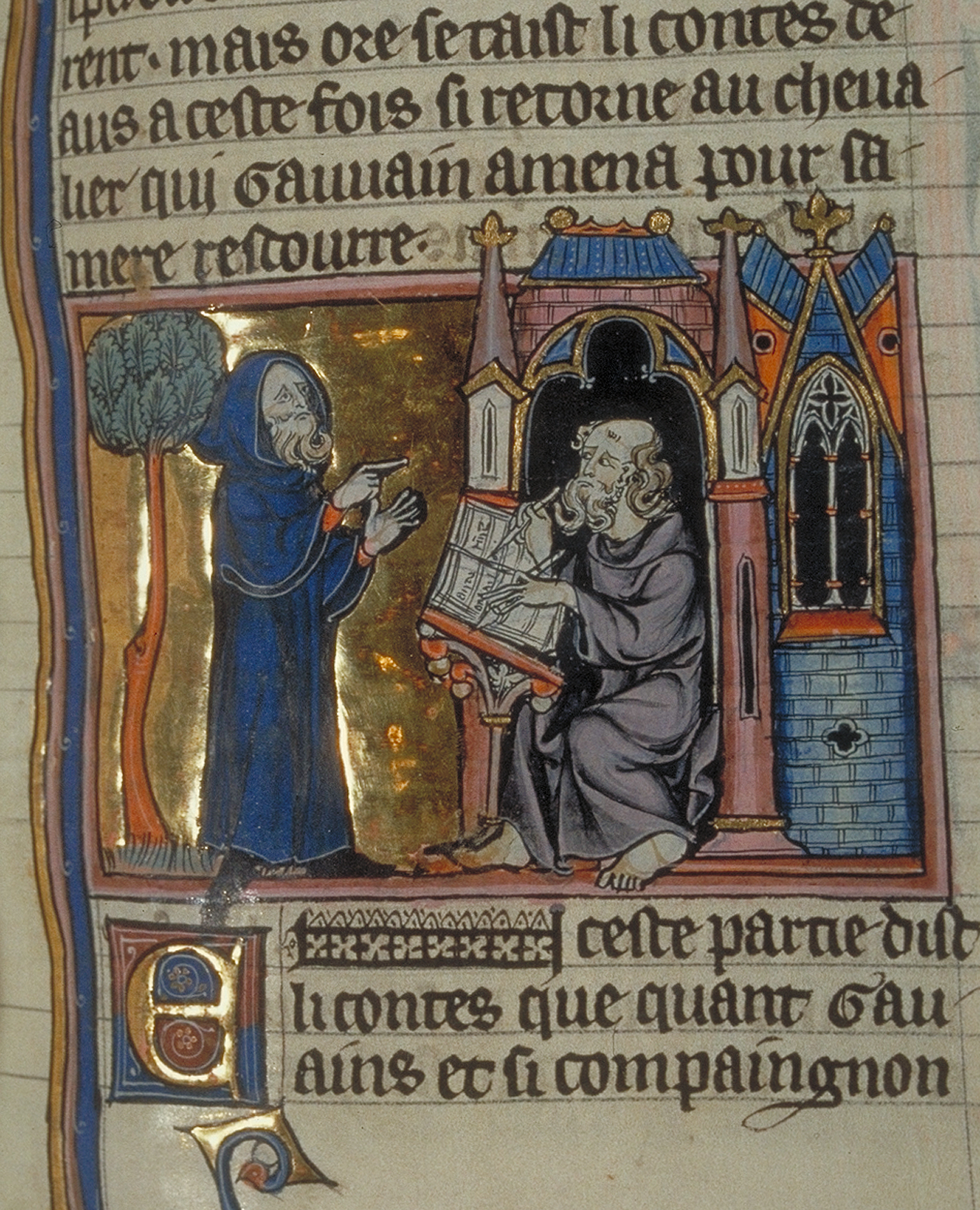
The Monk and the Magician

The Monk and the Magician

Geoffrey of Monmouth – ‘Vita Merlini’: The speech of the bard Taliesin about the order of the heavens and the earth: Trans. John Jay Perry (University of Illinois, 1925)

“…Out of nothing the Creator of the world produced four [elements] that they might be the prior cause as well as the material for creating all things when they were joined together in harmony: the heaven which He adorned with stars and which stands on high and embraces everything like the shell surrounding a nut; then He made the air, fit for forming sounds, through the medium of which day and night present the stars; the sea which girds the land in four circles, and with its mighty refluence so strikes the air as to generate the winds which are said to be four in number; as a foundation He placed the earth, standing by its own strength and not lightly moved, which is divided into five parts, whereof the middle one is not habitable because of the heat and the two furthest are shunned because of their cold.  To the last two He gave moderate temperature and these are inhabited by men and birds and herds of wild beasts.  He added clouds to the sky so that they might furnish sudden showers to make the fruits of the trees and of the ground grow with their gentle sprinkling.  With the help of the sun these are filled like water skins from the rivers by a hidden law, and then, rising through the upper air, they pour out the water they have taken up, driven by the force of the winds.  From them come rain storms, snow, and round hail when the cold damp wind breathes out its blasts which, penetrating the clouds, drive out the streams just as they make them.  Each of the winds takes to itself a nature of its own from its proximity to the zone where it is born.  Beyond the firmament in which He fixed the shining stars He placed the ethereal heaven and gave it as a habitation to troops of angels whom the worthy contemplation and marvellous sweetness of God refresh throughout the ages.  This also He adorned with stars and the shining sun, laying down the law by which the star should run within fixed limits through the part of heaven entrusted to it.  He afterwards placed beneath this the airy heavens, shining with the lunar body, which throughout their high places abound in troops of spirits who sympathize or rejoice with us as things go well or ill.  They are accustomed to carry the prayers of men through the air and to beseech God to have mercy on them, and to bring back intimations of God’s will, either in dreams or by voice or by other signs, through doing which they become wise.  The space beyond the moon abounds in evil demons, who are skilled to cheat and deceive and tempt us; often they assume a body made of air and appear to us and many things often follow.  They even hold intercourse with women and make them pregnant, generating in an unholy manner. So therefore He made the heavens to be inhabited by three orders of spirits that each one might look out for something and renew the world from the renewed seed of things….”

This is a great vision of the spiritual realms of the heavens delivered from the mouth of Taliesin in Geoffrey’s ‘Life of Merlin’ from the 12thC. Geoffrey was Bishop of St Asaph in Wales, and friends with Jocelyn of Furness who seems to have incorporated aspects of the ‘Merlin’ story into his own ‘Life of St Mungo’. Both were keen to retell local Pagan mythology within a pseudohistorical Christianised framework, and to do it in a way that would influence popular culture, consigning ancient ‘religious truths’ into the realms of fantasy, and helping reinforce the foundations of European christianity.

Taliesin was a ‘bard’s bard’ – a literary character who was a verbal expert, historian, fount of knowledge and a storyteller. His account is almost the same as that you would have heard in ancient Athens in the 4thC BCE and stayed consistent across Europe until the start of the ‘Early Modern’ period of European history in the 17thC.

Mogh Ruith – mercenary Druid warrior

Of all of the accounts of magical battles fought in the hallowed mythology of Ireland, one of the most impressive occurs in an early written story from the Book of Lismore known variously as ‘The Siege of Druim Damhgaire’ (Druim Damhgaire = ‘Ridge of the Ox-?bellow’) or using its modern Co. Limerick name: the ‘Siege of Knocklong’, and the main player is the wizard known variously as Mug Ruith or Mogh Roith (Ruith/roith = ‘Wheel’!). It was called by 19thC scholar and Celticist Eugene O’Curry the

‘…most important story full of information on topography manners customs and Druidism…’ (‘Lectures on the Manuscript Materials of Ancient Irish History’)

Mogh Ruith seems in many ways similar to the character of Manannan (the shapeshifting magician) or his Otherworld Lord equivalents – Lugh the active warrior, Donn Lord of the Dead, etc. He was said to come from Dairbre (Valentia) Island off Co. Kerry, so like the Cailleach Beara he is a powerful Munster favourite.

In the ‘Siege of Druim Damhgaire’, the mythical wolf-fostered King, Cormac mac Airt ua Cuinn, inheritor of the fairy-gifted court of Tara, decides to invade Munster and camp at Druim Damhgaire in order to exact tribute. His druids set about strangling the watercourses and drying the lakes of Munster causing much alarm, so Mogh Ruith is summoned to dislodge him. His price is high, but it is worth it:

He storms onto the battlefield in his glorious chariot pulled by magical oxen and, clothed in a hornless bull-hide and wearing a feathered hat (looking no doubt something like a Celtic version of Mercury, you may note) proceeds to perform feats that would make both Gandalf and St Patrick run for cover!  His powers, we are told by the Book of Lismore, come by dint of his oriental tutor – one Simon Magus, famous flying adversary of St Peter in Rome, who also appears to taught the Manx wizard Melinus to fly in Jocelyn’s 12thC Vita Patricii!  It seems like Mogh – like Manannan had a wanderlust that took him to the East, for in other Irish literary accounts he is even responsible for beheading John the Baptist… Mythologists might note that going to (and coming from) the East is a very solar motif.

Mogh’s first magical act of the battle is to free up the water supplies by tossing a magical spear into the ground; he then orders magical fires of Rowan wood to be made which chase across the landscape towards his enemies.  He summons giant eels or serpents, he creates dogs to kill Cormac’s druidesses who assume the guise of magic sheep (a theme also seen in the tales of Mongan mac Fiachna). After this he blows from his mouth a roiling black cloud which descends down upon Cormac’s army as a rain of blood which rushes as far as Tara! Next up are Cormac’s druids who he turns to stone with another magical breath. Cormac, unsurprisingly, concedes defeat and Munster prevails!

The aspects of magical displayed in the narrative show Mogh commanding every one of the classical elements to use as weapons: water, fire, air and earth. It is the kind of omnipotence and mysterious power we’d normally expect from a tribal god rather than a druid professor or bishop, and is certainly one of the most fantastical display of all-out magical mastery that has survived in early Irish literature.

The story represents a powerful tale of Munster sovereignty over the depredations of the Connachta and the Ui Niall. When looked upon in the context of legendary warrior tales, it is also special in that the warrior is magical, like Cuchullain, Fionn, Manannán mac Lir and the Norse Odinn, and their British counterpart Merlin. The wider story-tradition of a wizard-prophet-warrior, was the inspiration for Geoffrey of Monmouth and other ‘Arthurian’ writers (‘Vita Merlini’, the French ‘Vulgate Cycle’) not to mention religious writers such as Jocelyn of Furness during the 12th-15th centuries, but from what we can tell Ireland’s wonder tales are some of the oldest written accounts of these.


Ancestor beliefs and the ‘time before memory’

I have made much of the importance of ancestor beliefs in my posts, and how these relate to a belief in ‘fairies’ and ‘spirits’, and I’d like to examine this a little bit more…

Before the introduction of literary culture to Atlantic Europe by the Greeks and Romans, the transmission of memories, information and knowledge was by oral transmission. This involved the development of a number of ‘tricks’ of formalisation – ‘aides-memoires’ if you will- in order to assist with memorisation, and from this grew the bardic culture: a field of expertise for coding large amounts of complex knowledge into verse and forms which allowed memorisation, as well as providing a shared mnemonic culture and good entertainment.

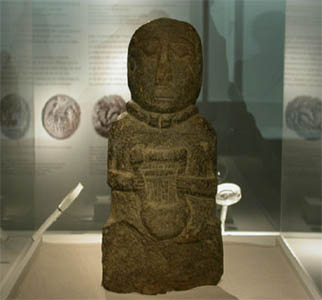
Statue of Iron Age 'bard' clutching a Celtic lyre, or 'Crwth'. The lyre was common to the Greeks from an early period.

Statue of Iron Age ‘bard’ (Brittany) clutching a Celtic lyre, or ‘Crwth’. The lyre was common to the Greeks from an early period.

Bardism survived the Christian period into the late medieval period when they were largely only formally employed as reciters of pedigrees to Gaelic chieftains, but died out with the dissipation of the clan system – the last vestige of Iron Age culture save for those particular story traditions and beliefs which we all know and love, and which I seem to spend a lot of time writing about. Pedigrees offered clans a link with the heroic (i.e. – ‘purer’ and less controversial) past. As such, they were open to a great deal of interpretation and revision in order to satisfy the political needs and claims of contemporary bardic patrons.

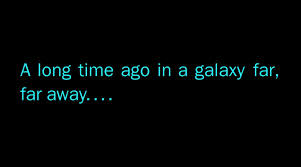
Due to the limitations of memory, the usefulness of information, there is usually a cutoff point or ‘event horizon’ in oral history which represents a ‘time before memory’, and oral/bardic culture had to deal with this in a formalised way. In the context of informal folktales collected from post-literate societies (even if the reciter is illiterate), vague timescales creep into narratives: For example, Irish tales of the Cailleach Bheara collected and stored at the DeLargy Centre at University College Dublin’s folklore survey archive might refer to ‘a long time ago’ or even ‘a hundred years ago or more’ to establish a setting which involves timescales of great supposed antiquity. The opening credits to the Star Wars films open with the same legendary theme before scrolling away to a point of infinity on the screen. In a way it is a method for framing a story in a distant place where anything might be possible, or at least be more difficult to contest!

The start of all good stories...

The start of all good stories…

This ‘time before memory’ is an important place where a storyteller can establish modern ‘facts’ with abstract and alliterative origins. The freedom of the story takes the gravity of established fact and reality from the shoulders of the characters, allowing them freedom to fly in unimaginable ways and perform acts of magic. Time, physics, even conventional morality do not apply, except where it suits the storyteller to remind their audience of them.

Understanding how to address the principle of ‘time before memory’ was undoubtedly a technical discipline to a bardic/oral culture. Beyond the ‘event horizon’ it wouldn’t have been a case of ‘anything goes’, but there were instead degrees of difference depending on just how far back the tale was taking the reader. A good example of this are the written works of the traditional (orally transmitted) lyric poets of ancient Greece, most notably Homer and Hesiod (6thC BCE or earlier), both of whom deal with these shady kingdoms of the legendary past in a formalised and structured pattern. From the foundless chaos of the initial creation to the time of the Golden Age and the subsequent ‘Ages of Men’, through to the matings of gods with men and finally the Trojan War and its aftermath these narratives take the listener (or later the reader) through the various degrees of comprehensibility which end largely in a recognisable world of humans following the sack of Troy. Subsequent ‘histories’ from this part of the ancient world would use the events at the end of the Illiad to start their accounts of history ‘within memory’…

To add another dimension to bardic culture, it often relied upon former bards ‘from beyond the event horizon‘ to give authority or veracity to their accounts, as if these people were astronauts reporting back from the unknown. Thus we have Celtic story figures such as ‘Oisin’, ‘Taliesin’ and ‘Merlin’ (even the egotistical, pompous and bumbling Senchán Torpéist) who occur in stories in such a fashion. Who knows – perhaps Homer and Hesiod themselves were of the same kind?

The real Homer?

The real Homer?

The further back into the unknown and deep ancestral time a narrative tale goes, it is generally fair to say that the more fantastical it becomes. The number of human-like characters dwindles in order to suggest the origins within a single family unit – mother, father and child. Even then, they may take on characteristics which make distinguishing them from the landscape and animals of the land increasingly difficult. They grow to huge stature, as if to explain their likeness to the stars, oceans and mountains which informed the landscape of the listener. 


‘The Hairy Helper’ – folklore of the Brownies.

The belief that there are omnipresent providential spirits that can help or hinder humans is one that pervades cultures across the globe. To some, these represent the spirits of ancestors, to others the spirits of places and land features, to others the frightening forces of chaos seeking to test our resolve. In European cultures, these are represented as a sometimes confused and conflated set of beliefs and traditions in ‘fairies’, ‘elves’, ‘goblins’ and so forth, that handed down to modern times have become contradictory and perhaps meaningless, but in former times were of great importance in navigating the perils of this life and the next.

Fairy traditions come in two main flavours – those about beings encountered in mysterious, marginal, frightening and liminal places far from the comforts and sureties of home – the stuff of good stories. The other comprise of a set of beliefs about fairies or elves interact with us right at the heart of our households and in our daily lives – the stuff of aphorism and custom. In the latter category we place the ‘hobgoblins’ – domestic spirits akin to the Lares once venerated in Roman households, who go under many regional names, but generally follow the same pattern: Brownie, Lubber, Kobold and Goblin, Urisk, Gruagachs, Robin Goodfellows, Hobs, Domovoi, Phooka, Phynnodderee, Glashtin, Dooiney Oie, Tylwth Teg, Mooinjer Veggey, Tomte, Nisse – the list goes on. It is about this class of beliefs that I am going to discuss.

The most primitivist form of the house-fairy myth comes from its expression in Scotland, Northern England and the Isle of Man, where they were portrayed as hairy, semi-wild, slightly stupid and powerful beasts who would help householders with the work of day-to-day survival in return for a bowl of milk or some similar simple form of sustenance which would customarily be left for them at night. Peasants living a subsistence lifestyle would be certain to leave offerings  to these beings in order to gain the favours of the Otherworld in their efforts. Just why such beings had an animalistic aspect is interesting:

Certainly, most of man’s helpers – if not other men – were the beasts whom they had domesticated to their cause, so it is logical from this respect that a Brownie, Gruagach, Phynnodderee or Urisk had a similar half-animal appearance. However, the significance of hairiness went way beyond the primitive and animalistic … The hairy ‘wild man’ had aspects of fecundity and fertility to him that represented the sprouting of nature from the body of the earth. It was also a more ancient allegory for the rays of the sun and tongues of flame from fire…

The worship of solar deities such as Apollo, Dionysus/Bacchus, Hercules, Ammon-Ra and the Celtic Belenos was as much about veneration of the seasonal cycle driven by the sun and the earth’s proximity to its heat as it was about a big fiery glowing orbs in the sky.  Sun-worship was ultimately about transience, changeability and -ultimately – reincarnation. The flowing ‘hair’ of animals such as lions, horses, the bristles of the boar and the flowing locks of a barbarian warrior were a popular representation of this force – the planet’s great fertilising power, represented by the ancient Celtic ‘Grannus Apollo’ figures.

Each winter in Europe, the Earth – like a person as their life progressed – grew old and sparse. As humans were an intimate part of the Earth, they followed her patterns, and they used their own experience to relate to that of the Earth. The baldness and coldness of winter was contrasted to the sprouting youth and vigour of spring and summer when the Earth regrew its ‘hair’ – the foliage and vegetation that re-sprouted from the body of the ground. Hairiness was therefore also an important and naturalistic metaphor for this growth.

The ‘help’ offered by the Brownies and their kin was also a metaphor for the learned experiences passed on between generations in a cultural based upon oral transmission. As such, Brownies might be considered the helpful spirits of those who have gone before – those who had grown out of the very soil of the land. They were therefore quite obviously a manifestation of ‘ancestral’ spirits, and were believed to congregate (as families tended to do on night time evenings) around the hearth of the house – a symbol of continuity, which was customarily kept burning in perpetuity in the Gaelic provinces (it was considered bad luck to let the fire go out completely). Bowls of water or milk, and food was left out at night ‘for the fairies’, who typically (being creatures of the inverted Otherworld) visited at night, which was their daytime.

The ‘man-beast’ nature of these spirits was represented in the winter ‘guising’ traditions (e.g. – the Scandinavian Julbocken or dolly or as a disguised person in an goat costume). It was unlucky to offer a Brownie (or Phynnodderee, or Domovoi) clothes, because (to paraphrase the words of Robert Kirk) ‘When we have plenty, they have little, and so to the contrary’.

In fact, the word ‘Goblin’ (a ‘class name’ for the ‘Brownie’ beings comes from the Celtic/PIE root ‘Gabbal’, meaning ‘horse’. The horse occurs along with the other profound solar images of the sun-wheel and the head of the ‘glorious golden warrior’ on most of the Celtic coins of the Iron Age. In Irish myth, the helpful but horny Dagda appears to have been a representative of this spiritual role. The Nixie and the Kelpie were perhaps other aspects of this spiritual role, when the helper also became the conveyer to the realm of the dead.

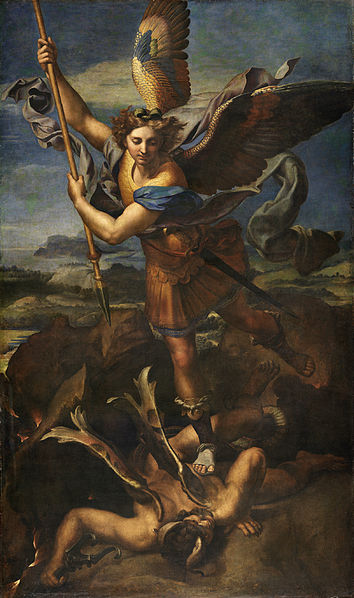
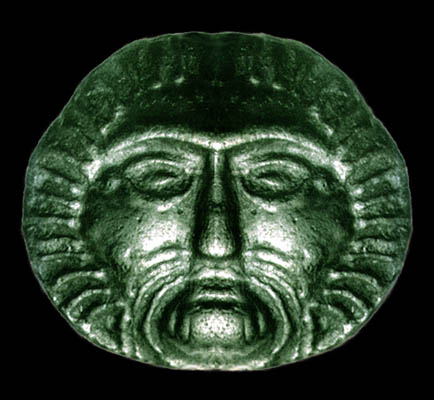
Belenos and St Michael the Archangel?

One curiosity of Atlantic European Christianity is the existence in its collegium of venerated ‘saints’ of a figure with no earthly beginnings whatsoever: St. Michael the Archangel.

Saint Michael the Satan-slayer, as depicted by Raphael.

Saint Michael the Satan-slayer, as depicted by Raphael.

As the Taxiarch of the heavenly battle host, he occurs firstly in the Darnel-induced visions of the Hebrew Book of Daniel (Daniel 10, to be precise, where he reassures the Hebrews that they as a nation will be protected from the depredations of their Persian captors):

“…Then I lifted up mine eyes, and looked, and behold a certain man clothed in linen, whose loins were girded with fine gold of Uphaz: His body also was like the beryl, and his face as the appearance of lightning, and his eyes as lamps of fire, and his arms and his feet like in colour to polished brass, and the voice of his words like the voice of a multitude…” (KJV)

Michael appears again in the equally hallucinogenic Christian Book of Revelation written by John of Patmos, and leads the War in Heaven.

“…And there was war in heaven: Michael and his angels fought against the dragon…”

It is obvious that in the late -classical period such a character would have had a certain appeal to Central and Northern Europe’s newly Christianised warrior-cultures who venerated their departed heroes religiously, and had complex story traditions recounting their deeds. If you believe St Patrick, the Irish worshipped ‘Idola’ – visions or images – and from the designs of Celtic coins, it is quite possible that Celtic religion was something of a visionary cult.

The idea of a winged, victorious warrior is by no means an invention of the Hebrews, however. The older Egyptian and Babylonian Empires were responsible for this cultural iconography which entered the western Mediterranean sphere during the Hellenistic period, from where it eventually spread into the ‘barbarian’ world of Europe’s Celts.

During the period of Roman expansion into the lands of the Danubian and Rhineland Celts, and thereafter into Gaul and Britannia, the coins of the Celtic kings began to pick up on the iconography of the ‘winged’ human or animal form. In particular, this can be seen in those produced by the Belgic cultures – in particular the Atrebates, Trinovantes and Catuvellauni of eastern Britain during the 1stC BCE and 1stC CE who played such a major role in the Romanisation of Britain and northern Gaul. Of particular note are the coins of Commius, Cassivellaunus, Addedomarus, Tincomarus, Tasciovanus and his son Cunobelinus, which all show signs of Roman acculturation through their use of visual motifs such as the use of imagery of Pegasus,  the winged Victoria, and the Eleusinian head of Corn. In so doing, they were copying the iconography that their sons had become accustomed to while in fosterage/hostagery in the Roman curia.

Winged icons of shining deities would find their true Renaissance in the coming Christian era, when angels as warriors of light would replace the icon of the mercurial shining warrior god so beloved of the Celts.

The appearance of places named after ‘Michael’ was already well under way by the early middle ages: In Ireland, the early southern monastic island settlement of Skellig Michael was a key place in this process. St Michaels’ Mount in Cornwall and Mont St Michel in Brittany were another two significant places with religious importance. Diodorus of Sicily, writing in the 1stC CE referred to the metal-mining and smelting heartland of Cornwall by the name Belerion, suggesting a theophoric name based on Belen(os):

“…The inhabitants of that part of Britain which is called Belerion are very fond of strangers and from their intercourse with foreign merchants are civilised in their manner of life. They prepare the tin, working very carefully the earth in which it is produced. The ground is rocky but it contains earthy veins, the produce of which is ground down, smelted and purified. They beat the metal into masses shaped like astralgi and carry it off to a certain island off Britain called Ictis…”

Ictis is believed to refer to St Michael’s Mount near Marazion.

Further to the northwest, another important metal-producing place was the Isle of Man (called Manavia Insula by Ptolemy in the 2ndC CE). Here the concept of the  ‘Angel Michael’ was – as elsewhere – introduced into the popular imagination by Christian monks and priests. To the Manx, the name was converted to ‘Vaayl’. The ‘v’ sound could represent a transition from a name starting with ‘b’ or ‘m’ in the Celtic languages. This makes us consider if the original name was in fact ‘Mel’ or ‘Bel’… The name of this Island’s prime saint, ‘Maughold’, is a version of ‘Mayl’ (referred to as ‘Mel’ in the Brigitine hagiographies). The 12thC hagiographer Jocelyn of Furness told a legend of St Patrick defeating a flying wizard called ‘Melinus’ on the Isle of Man. ‘Melyn’ is the Welsh word for ‘yellow’, and sounds something like the Latin word ‘Malin’, referring to the tide. ‘Creg Malin’ in the Isle of Man overlooks St Patrick’s Isle where Jocelyn probably portrayed his imaginary showdown between christianity and the crusty Simon-Magus imitating wizard. This legend of Melinus actually equates directly to the Manx traditions of Manannan, who they claimed was the original ruler overtunrned by Patrick.  The 18thC English writer George Waldron commented that he had been told that ‘Merlin’ was said to be the legendary wizard-ruler, echoing Jocelyn, albeit with an extra ‘r’ and it is to be noted that ‘Merlin’ and ‘Mercury’ are not too dissimilar as names... the plot thickens!

So, Merlin, ‘Melin’ and ‘Belin’ are linguistically not too far from each other. Also, the tendency of Celtic languages to switch the P/B (‘P-Celtic’) sound with the C/K/Q (‘Q-Celtic’) sound make an association of ‘Belen(us)’ with the legendary ‘Cuillean’ a distinct possibility.

‘Cuillean’ was a legendary Irish/Manx smith and metal-smelter who occurs in the legends and placename-lore of Ireland, Mann and Scotland. If we are to link this character to ‘Belenus’ then it is worth noticing the names ‘Cunobelenus’ and ‘Cuchullain’ are exactly equivalent. Also the ‘germanic’ name of the legendary smith-figure ‘Weland’, with the addition of a Gaelic ‘k’ guttural becomes ‘kWeland’ so is actually an equivalent of ‘Chuillean’, or in the Welsh – ‘Gwyllion’. Slieve Gullion in Armagh, Ireland, and Slieu Whallian and Ard Whallan in the Isle of Man are name after him – possibly also ‘Schiehallion’ in Scotland. All of these places have interesting legends attached to them. Ireland also has its share of ‘giant’ or saint-stories with the name ‘Mal’ or ‘Mel’ attached – Mal Bay in County Clare being an example that comes to mind.

So… Belenus is the same ‘person’ as the smith/wright/craftsman Cuillean/Wayland?   The association of Belenus with Mercury, Mars and Apollo in the Romano-Celtic world has a direct relationship with his identity as a craftsman. Like his various hypostases – Lugus among the continental Celts, and Lleu Llaw Gyffes and Manawydan fab Lir in the Mabinogion, he is a maker of things (shoes – like the Irish Leprachaun) – a forger with the fire of the sun and spiritual ‘fire’ of the Otherworld…

Going back to those famous Belgic rulers of ancient Britain in the 1st centuries BC and CE, an appraisal of their names (as well as their numismatic iconography) shows a deep attraction to the god Belenus. Firstly, and most obviously there is Cunobelenus – the ‘Hound/Wolf of Belenus’. Next the tribe of the Catuvellauni – ‘Seat of Belenus’ and their leader Cassivellaunus (‘Stronghold of Belenus’ – defeated by Caesar in his first invasion). The name of the tribal King Tasciovanus (1stC BCE) also had distinct connections to the name of Celtic ancestor gods that Tacitus cites in his book Germania: Tuisto/Tuisco and Mannus (hence, possibly, ‘Tuisco-Vannus’). All of these are probably related to ‘Beli’ – the bristling, bellicose Sun God of the Celts whose icon was sometimes portrayed as a Boar, the horse with its hair streaming or as the combative rutting ‘Stag-Warrior’: Cernunnos.… In fact, etymologically the word for ‘hair’ in the Indo-European languages has similarity to the word for ‘war’ and ‘beauty’. To use Latin as our example, we have Pillus, Bellum, and Bellus: When considering the imagery of Bellenus as ‘Apollo Grannus’, this relationship becomes quite clear – especially in the context of the aesthetics of a proudly adorned warrior race such as the Celts…. It is no wonder they appropriated the horned image of Alexander as ‘Amon-Ra-Apollo’ which he began to use after liberating Egypt from Persian rule while in his youthful prime.

St Michael the Archangel served as a ‘placeholder’ for the ‘folk-memory’ of this important religious figure of the Celts.

A 'solar warrior'

A ‘solar warrior’