
The ‘Celtic Horse’ seen on the ‘primitivist’ coins of the Iron Age often showed interesting design characteristics related to concentric circles and points. These became prominent elements of insular Celtic coin designs and regional rock-art, such as that seen in Scotland among the ‘Picts’. The design here is taken from a 2000 year old coin of the Dobunni in my collection (W. Britain).
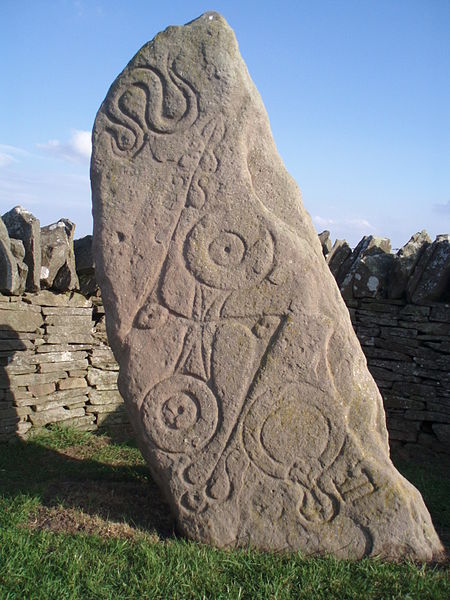
‘Aberlemno 1’ pictish stone (Angus, Scotland). The ‘double disc’ motif appears with the ‘z-rod’ and the mirror: symbols of rotational and reflectional symmetry. The serpent at the top demonstrates that this symbolism is expressive of the Atlantic otherworld beliefs…
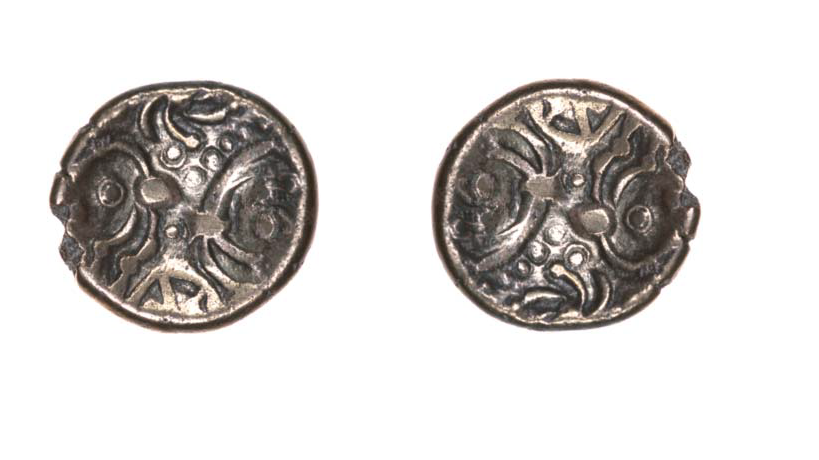
Note the rotational symmetry seen in the horse-design of this coin! Wiltshire ?Dobunni 1stC BCE. Photo: (c) 2014 http://www.celticcoins.com – Chris Rudd
 The Atlantic Religion