The Icenii, ‘Andraste’ and ‘Andate’

2ndC CE Roman historian Cassius Dio famously mentions details of the ill-fated revolt of the Iceni and their allies against Nero’s legions in southern Britain during 60/61CE. His compendium ‘The Roman History’ may well have relied upon on first-hand accounts of the events of this episode, but Dio uses a certain creative licence regaling us with a rousing speech made by queen Boudica to her people before their battles. Indeed, it largely functions to portray Nero as a weak and effete figure of ridicule, but is of interest to religious historians, as he has the queen call upon a British goddess referred to as ‘Andraste’:

“…When she had finished speaking, she employed a species of divination, letting a hare escape from the fold of her dress; and since it ran on what they considered the auspicious side, the whole multitude shouted with pleasure, and Buduica, raising her hand toward heaven, said: “I thank thee, Andraste, and call upon thee…” (The Roman History, Boook 62 -trans. Bill Thayer)

Whoever Andraste was, she seems to have inspired the Britons with a confidence matched only by the fear which drove the Roman legions to eventually overcome them. Little else is known about Andraste save for this account. However, the reason for this might be because the ‘name’ given by Cassius Dio was a misunderstanding of ‘An Dras De’ – which is simply the Brythonic phrase meaning ‘The Tribal God’, ‘Dras’ being an old Welsh word meaning ‘kindred’. Consider the Irish god known as ‘An Dag De’ – the Dagda – a similar composite term is therefore possible.

Cassius Dio goes on to describe the rampage of revenge and humiliation wreaked upon the hapless Romans at Camulodunum (Colchester) and Londinium (London):

“… Having finished an appeal to her people of this general tenor, Buduica led her army against the Romans; for these chanced to be without a leader, inasmuch as Paulinus, their commander, had gone on an expedition to Mona, an island near Britain. This enabled her to sack and plunder two Roman cities, and, as I have said, to wreak indescribable slaughter. Those who were taken captive by the Britons were subjected to every known form of outrage. The worst and most bestial atrocity committed by their captors was the following. They hung up naked the noblest and most distinguished women and then cut off their breasts and sewed them to their mouths, in order to make the victims appear to be eating them; afterwards they impaled the women on sharp skewers run lengthwise through the entire body. All this they did to the accompaniment of sacrifices, banquets, and wanton behaviour, not only in all their other sacred places, but particularly in the grove of Andate. This was their name for Victory, and they regarded her with most exceptional reverence… “

It is possible that ‘Andraste’ and ‘Andate’ were simply kennings for the same female divinity, but another possibility arises: that Cassius Dio got it wrong, and that ‘Andate’ was actually the male deity known in Ireland as ‘An Dagdae’ or ‘Eochaidh Ollathair. This is reasonably within the bounds of Celtic language pronunciation where consonantal sounds within words are readily dropped. Here is my reasoning:

An Dagda and the Morrigan in Cath Magh Turedh:

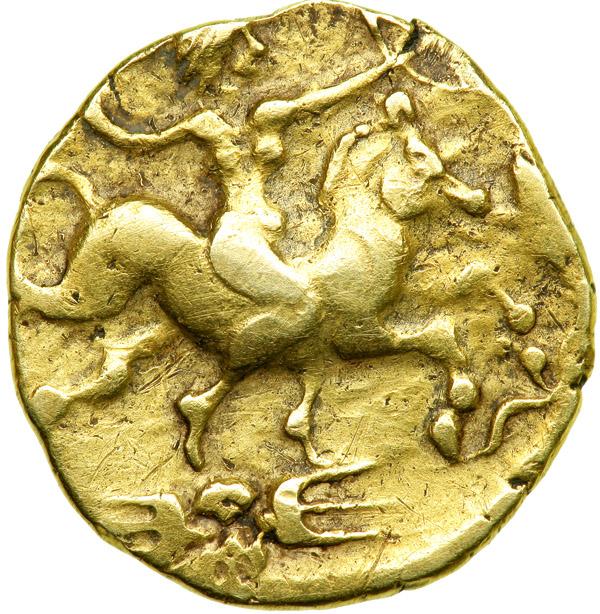
A coin of the Gaulish Redones (Brittany) shows the martial female mounted upon a horse: The Morrigan and Dagda?

A coin of the Gaulish Redones (Brittany) shows the martial female mounted upon a horse: The Morrigan and Dagda?

The Irish mythological cycle tale known as Cath Magh Turedh (possibly a composite of different tellings of an original) contains a number of mysterious, poorly elucidated ‘scenes’ featuring the Dagda.

Firstly, it mentions his ‘cauldron of plenty’. Next it mentions his role doing heavy work as a builder of the fortress of Bres of the Fomorians. He seems unusually trusting and a bit simple, and gives some of his vast meal portions away to a man who demands the best part each sitting, causing him to weaken. He forms a triplicity with Lugh and Ogma, and they go to ‘three gods of Danu’ (one of  whom is stated to be the Morrigan) who give weapons to Lugh. Dagda then has sexual intercourse with the Morrigan at a ford of the River Unshin in Connacht, an act of heiros-gamos ensuring the victory of the Tuatha De Dannan in the coming battle with the Fomorians. In another curious scene, with distinct parallels with to the Siege of Troy described in Homer’s Iliad, the Dagda enters the camp of the Fomorians to spy, seemingly in the guise of a horse. The Fomorians force him to eat a prodigious meal (again demonstrating his great equine appetite) so as to dull his wit.

The story continues (CELT version):

“…Then he went away from them to Tráigh Eabha. It was not easy for the warrior to move along on account of the size of his belly. His appearance was unsightly: he had a cape to the hollow of his elbows, and a grey-brown tunic around him as far as the swelling of his rump. He trailed behind him a wheeled fork which was the work of eight men to move, and its track was enough for the boundary ditch of a province. It is called ‘The Track of the Dagda’s Club’ for that reason. His long penis was uncovered. He had on two shoes of horse-hide with the hair outside. As he went along he saw a girl in front of him, a good-looking young woman with an excellent figure, her hair in beautiful tresses. The Dagda desired her, but he was impotent on account of his belly. The girl began to mock him, then she began wrestling with him. She hurled him so that he sank to the hollow of his rump in the ground.

He looked at her angrily and asked, ‘What business did you have, girl, heaving me out of my right way?’ ‘This business: to get you to carry me on your back to my father’s house.’ ‘Who is your father?’ he asked. ‘I am the daughter of Indech, son of Dé Domnann,’ she said. She fell upon him again and beat him hard, so that the furrow around him filled with the excrement from his belly; and she satirized him three times so that he would carry her upon his back. He said that it was a ges for him to carry anyone who would not call him by his name. ‘”What is your name?’ she asked. ‘Fer Benn,’ he said. ‘That name is too much!’ she said. ‘Get up, carry me on your back, Fer Benn.’ ‘That is indeed not my name,’ he said. ‘What is?’ she asked. ‘Fer Benn Brúach,’ he answered. ‘Get up, carry me on your back, Fer Benn Brúach,’ she said. ‘That is not my name,’ he said. ‘What is?’ she asked. Then he told her the whole thing. She replied immediately and said, ‘Get up, carry me on your back, Fer Benn Brúach Brogaill Broumide Cerbad Caic Rolaig Builc Labair Cerrce Di Brig Oldathair Boith Athgen mBethai Brightere Tri Carboid Roth Rimaire Riog Scotbe Obthe Olaithbe
[gap: meaning of text unclear]
Get up, carry me away from here!’ ‘Do not mock me any more, girl,’ he said. ‘It will certainly be hard,’ she said. Then he moved out of the hole, after letting go the contents of his belly, and the girl had waited for that for a long time. He got up then, and took the girl on his back; and he put three stones in his belt. Each stone fell from it in turn—and it has been said that they were his testicles which fell from it. The girl jumped on him and struck him across the rump, and her curly pubic hair was revealed. Then the Dagda gained a mistress, and they made love. The mark remains at Beltraw Strand where they came together.

Then the girl said to him, ‘You will not go to the battle by any means.’ ‘Certainly I will go,’ said the Dagda. ‘You will not go,’ said the woman, ‘because I will be a stone at the mouth of every ford you will cross.’ ‘That will be true,’ said the Dagda, ‘but you will not keep me from it. I will tread heavily on every stone, and the trace of my heel will remain on every stone forever.’ ‘That will be true, but they will be turned over so that you may not see them. You will not go past me until I summon the sons of Tethra from the síd-mounds, because I will be a giant oak in every ford and in every pass you will cross.’ ‘I will indeed go past,’ said the Dagda, ‘and the mark of my axe will remain in every oak forever.’ …”

The scene is certainly saucy, but also weird – almost a retelling of the Dagda’s encounter with the Morrigan in an earlier passage, albeit with more salacious detail. The picture painted of the Dagda is a half-man, half-stallion: His horse-hide brogues, his great round belly, his large penis, his propensity to create lots of dung: all are heavily suggestive of this, as is one of his other names, Eochu Ollathair. The heiros-gamos with a feisty fighty female (similar to Fand in Serglige Con Chullain) is again used to precede a victory in battle. What is more, the marks of his hoof/foot upon rocks appears to be a reference to cup-marks, bullauns and petrosomatoglyphs of feet, common to the archaeology of the Atlantic world.

The suggestion that can be drawn from this is that victory was ensured by the sexual coupling of the Otherworld masculine god and the worldy goddess. Dagda represents, as the horse, the fertility, power and energy on offer from the Otherworld, albeit a force that was a bit simple. The Morrigan was the warrior aspect of the feminine triplicity – their combination would allow peace to be determined through warfare. Lugh (the battlefield hero of the Cath Maigh Tured) was the active warrior aspect of the masculine triplicity, and Ogmios was the wise thinking part.

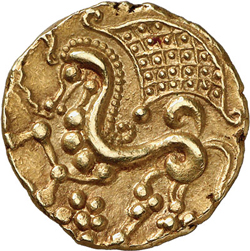
Gold stater of the Gaulish Parisii c.1stC BCE. The horse has a human face, and the charioteer appears female. The image is warlike.

Gold stater of the Gaulish Parisii c.1stC BCE. The horse has a human face, and the charioteer appears female. The image is warlike.

The horse seems so prevalent on Europe’s late Iron Age celtic coinage that it must have had special importance, beyond just being a copy of the coins of those Macedonian-Thracian leaders of the Hellenic world – the horse-loving ‘Phillip’ and, of course, the solar warrior-king, Alexander whose legend was celebrated among the proud warriors of the Celtic world. By invoking the Morrigan aspect of the triple-goddess (the tribal ancestor or sovereignty queen, who Cassius Dio called ‘Andraste’), Boudica set her on a course for her liason with the peace-lord of the Otherworld, a drama possibly acted out in the groves of ‘Andate’ by the seemingly victorious Britons, shortly before General Paulinus reappears bearing the ‘Gorgon’s Head’, taken on Anglesey…


L’Ankou – Gaelic parallels with the Breton death-spirit

‘Ankou’ is the personification of death’s assistant (a psychopomp) from Breton folklore, and a figure which reached greater prominence here than in any other of the modern ‘Celtic’ nations. It was noted by folklorist Walter Evans-Wentz in his 1911 book The Fairy Faith in Celtic Countries, that L’Ankou and The Dead appeared to provide the equivalent role to the Aes Sidhe of Gaelic folklore – a parallel which provides us with some interesting questions as to the nature of Celtic spirit-beliefs:

“… Without setting down here in detail numerous other death-legends which we have collected, we may now note how much the same are the powers and nature of the dead and spirits in Brittany, and the power and nature of the fairy races in Celtic Britain and Ireland. Thus the Breton dead strike down the living just as fairies are said to do; the Ankou who is a king of the dead, and his subjects, like a fairy king and fairies, have their own particular paths or roads over which they travel in great sacred processions; and exactly as fairies, the hosts of the dead are in possession of the earth on November Eve, and the living are expected to prepare a feast and entertainment for them of curded-milk, hot pancakes, and cider, served on the family table covered with a fresh white table-cloth, and to supply music. The Breton dead come to enjoy this hospitality of their friends; and as they take their places at the table the stools are heard to move, and sometimes the plates; and the musicians who help to entertain them think that at times they feel the cold breath of the invisible visitors…”

(The Fairy Faith in Celtic Countries by Walter Evans-Wentz; Pub. Henry Frowde, Oxford University Press, 1911; p.218)

He goes on to note ‘Every parish in the uncorrupted parts of Brittany has its own Ankou, who is the last man to die in the parish during the year‘. Wentz’s source, the respected Breton folklorist Anatole Le Braz, wrote a book about Ankou, called La Légende de la Mort () and had this to say about it:

The Ankou is the henchman of Death (oberour ar maro) and he is also known as the grave yard watcher, they said that he protects the graveyard and the souls around it for some unknown reason and he collects the lost souls on his land. The last dead of the year, in each parish, becomes the Ankou of his parish for all of the following year. When there has been, in a year, more deaths than usual, one says about the Ankou: War ma fé, heman zo eun Anko drouk. (“on my faith, this one is a nasty Ankou”).

Wentz drew parallels with the Gaelic beliefs in people ‘taken’ to fairyland, but unfortunately did not establish much else by the way of concordance with this supposedly ‘Brythonic’, and in terms of surviving folklore, specifically Breton belief. It is therefore my aim here to demonstrate that Ankou did indeed have its Gaelic equivalents, whose memory became lost due to the influence of christianity and the 19thC romantic movement:

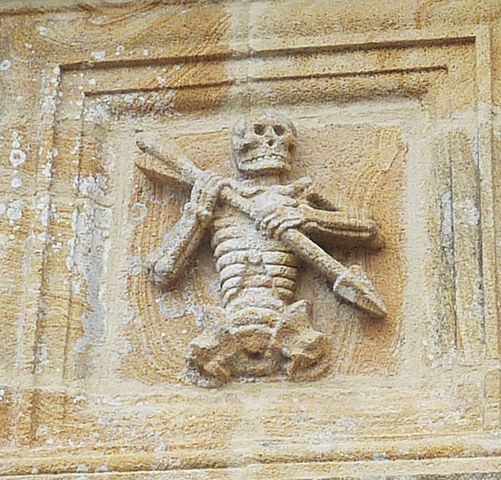
Ankou, depicted on a carving at the ossuary of the chapel of St Joseph at Ploudiry, Brittany.

Ankou, depicted on a carving at the ossuary of the chapel of St Joseph at Ploudiry, Brittany. Note the ‘elf-arrow’ it appears to wield!

Ankou in the Isle of Man and Scotland:

The Manx – a nation whose linguistic and cultural roots lie firmly in the ‘Gaelic’ world – maintained an independent tradition which corresponds closely with that of L’Ankou. However, in examining this it is first necessary to go ‘back’ to Brittany and examine the word ‘Ankou’ itself:

The standard English definition or translation usually given for the Breton word ‘Ankou’ is ‘the agony’, originally proposed in a ‘pirated’ (uncredited) 1860 English translation (Breton Legends – Pub. London 1860, Burns and Lambert) of the folklore collected and published in French by Théodore Claude Henri, vicomte Hersart de la Villemarqué – a noted Breton dictionarian and philologist. ‘An-‘ is the definite article, and ‘-Kou’ is usually (in English translations) supposed to mean ‘agony’. However, this etymology is speculative at best, as the ‘kou’ suffix as a sound can have a number of meanings within the scope of the historical linguistics of the celtic languages. Indeed, the 1821 Breton-French dictionary of Jean-François-Marie-Maurice-Agatha Le Gonidec tellingly uses the word Kouer to mean ‘peasant’, of which more presently.

Fockleyr Manninagh as Baarlagh – the 1863 dictionary (based partly upon an earlier manuscript of John Kelly from the late 18thC) published by the Manx Society contains the following interesting entry:

Keimagh s. pl. -ee, A spirit which is supposed to haunt and guard the churchyard stiles.

Also, the word Cughtagh:

Cughtagh s. pl. cughteeA fairy, a sprite, a spirit of the houghs* …

*AR: Hough in this context refers to a rough, rocky place or a cliff 

Both entries are followed by the interesting usage example ‘Ny keimee as ny cughtee’ of which the authors say no more, but which appears to be a reference to a popular Manx charm for stopping blood, a version of which can be found in William Harrison’s ‘Mona Miscellany’ (Manx Society Volume 16, Pub. Isle of Man, 1869).

The idea of the last deceased watching over the graveyard appears to have been common to the Highlands and Islands of Scotland – Donald MacPherson called it the Faire Chloidh in his book ‘Melodies from the Gaelic, and Original Poems; with Notes on the superstitions of the Highlanders &c’ (Pub. Thomas and George Underwood, London 1824), p.202:

FAIRE CHLOIDH, (THE GRAVE WATCH.)

It was the duty of the spirit of the last person interred, to stand sentry at the grave-yard gate, from sun-set until the crowing of the cock, every night, until regularly relieved. This, sometimes, in thinly inhabited parts of the country, happened to be a tedious and severe duty ; and the duration of the Faire Chloidh gave the deceased’s surviving friends, sometimes, much uneasiness.

The Manx ‘Keimagh’ and ‘Cughtagh’ spirits share a link of sorts to the grave, vagrancy, caves or shelters: This can be seen from the fact that the Manx wordcughhas connotations of dirt, filth and dung, and a link between this and the cave, mound or hole-dwelling spirit is also found in the word Cughlin, meaning a vagrant’s doss-hole or a mean filthy shelter, another Manx word for which is Kemmyrk. Recall that the Breton word Kouer, means ‘peasant’ and consider the restless vagrant properties ascribed to the spirits of the dead and a few ideas might start to form about the origins and meaning behind these archaic terms and the ‘Ankou’ itself.

The Manx word Keim or Keym (from which Keimagh is derived) is the same as the Irish céim, meaning ‘step’ in the same sense as it occurs in English – as a verb and a noun. The stile at old churchyard gates was often a slab of stone which those entering the church precinct would be required step over (and scrape your shoes on) in order to enter hallowed ground. It is common for the ‘m’ sound in Celtic languages to transform into a ‘w’ in pronunciation meaning that a ‘keimagh’ might easily become a ‘keiwagh’. By the same laws of linguistics, -gh-, -ch-, and -th- will lose any pretensions to consonantal pronunciation when occuring inside words.

This puts us in the interesting position of being forced to examine another similarly named spirit from the Gaelic world – Scotland’s An Ciuthach (pronounced ‘Kewach’), a being mentioned as a hairy spirit haunting caves in Volume 3 of John F. Campbell’s ‘Popular Tales of the West Highlands’ (p.55), in a folk-tale based on the story of the Pursuit of Diarmuid and Graine by Fionn Mac Cumhaill.

The Gaelic word ‘cuthach’, means ‘mad’ or ‘raging’ and fits with the portrayal of a marginal ‘wild-man’ who lives underground, and also with the Manx words ‘cugh’ and ‘cughlin’, associated with the filthy ‘Merlinesque’ state of the wild divine, a familiar sight in medieval Ireland, Britain and France where holy men often lived in a state of wild squalor. It should be obvious by now that the Breton word ‘Ankou’ had distinct similarities with the Gaelic ‘An Ciuth’ or ‘An Cuth’, ‘kou’ meaning a state of frantic restlessness, rather than ‘agony’. This fits the etymology of the Breton word for peasant: Kouer – a class of person living in mean conditions and continually working to survive.

The Irish Dullahán and the Gruagachs:

The ‘Dullahán’is the Irish legendary personification of death, usually represented as a skeletal headless horseman. The name possibly signifies ‘black one’ or ‘gloomy one’ (Dubhlachán?), probably on account of the lividity of the dead, and his appearance in popular tradition was to foretoken death. His earliest literary mention is in the writings of Charles Vallancey (‘Prospectus of a Dictionary of the language of the Aire Coti, or Ancient Irish’, Pub. Graisberry & Campbell, Dublin, 1802), who recounts that the Irish peasantry would be in fear of hearing the Dullahan or ‘Wullahan’ dragging his chains through the streets at night. Like the Ankou, it was often associated with a horse or coach and horses.


The Ankou is therefore quite possibly the ‘Wild Hunter’ who leads the Sluagh Sidhe! Was Fionn Mac Cumhaill, really originally Finn-Mac-‘Kou’-al? 

The ‘wild man’ archetype has much to say about where we developed from, and about the processes by which nature is regenerated from its own ‘putrefaction’.


There are important relationships in empirical human culture between dirt, ordure and decayed matter and the regeneration of new life. To live ‘wild’ is to live in comfort with this kind of state. Such symbolism no doubt informs the apparent associations between death, the spirit world and reincarnation that underpin the ancient European beliefs. The idea anciently used to express this was termed putrefaction, and important doctrine of the natural philosophy of Europeans until the scientific age introduced new paradigms.

The British and Irish age of Romanticism started in earnest during the ‘Enlightenment’ era of the late 17th and 18thC with the researches and writings of Roderick O’Flaherty, John Toland, Edward Llhuyd, and James MacPherson, and it continued with the emergence of renewed interest in the pagan past seen in the writings of Edward Williams (Iolo Morganwg), and in the fading customs, beliefs and lifestyles of the defeated Highland peoples documented for popular consumption by authors such as Walter Scott. Romanticism provided a vision of indigenous pagan beliefs still remaining among the peasantry, albeit in a form designed for the tastes and prejudices of educated and wealthy elites. Wavering paradoxically between apparent veneration of quaint rustic traditions and a visceral disgust of its ‘gloomy’ and ‘unenlightened’ superstitions, Romanticism would unfortunately often prove the undoing of much of what it fawned over: by swelling interest in ‘old-fashioned’ customs it ultimately encouraged the aspirational rural poor to resent becoming ‘quaint’ objects of fascination for the middle classes seeking relief from industrialised realities. By the late 1800s many Gaelic speakers had consequently rejected their traditional culture and sought to emulate modernity.

A romanticised view of what the rural poor ought to believe therefore eventually trickled down to influence their ideas: The traditions characterised as ‘gloomy’, ‘dismal’ and ‘unseemly’ – usually dealing with aspects of death, sex and disease – would become increasingly displaced. 

Putrefaction as an essential cultural idea behind abundance and regeneration among rural peoples was probably finally defeated when people stopped putting shit on their crops and used chemicals in its place… This was the era of mass-slaughter and industrial warfare, which reached its first full and horrific manifestation in the First World War.

Otherworld streams and rivers in Norse mythology

I have previously discussed how the ancient Greeks and Irish believed that all rivers flowed eventually to the otherworld where they then took a mysterious course before returning to our own. The Irish medieval ‘Dindsenchas’ texts refer to this belief in regard to a number of mythologically and geographically important rivers such as the Shannon and the Boyne.

The much older classical Greco-Roman texts refer to Okeanos – the world-river composed of all the world’s waters – at whose furthest reaches the heavens begin and where there are islands such as Elysium, Erytheia/Hesperides, Ogygia etc peopled by Titans, monsters and the shades and souls of the dead. The Greek Orphic mysteries (another expression of the core pagan faith of the ancient Mediterranean world) were concerned with the transition of souls to and from this far-off watery/spiritual realm, and it appears that Irish myths entertained similar beliefs.

What about the myths of the Norse peoples of the middle ages, who were among Europe’s longest-surviving pagan cultures? Putting aside for now the various Germanic folklore elements which preserved much of the Atlantic metempsychosis myths in the form of fairy lore, I wish to focus on the Icelandic Edda mythology, recorded and written down during the Christian era in Iceland during the 13th century.

This was written down as the result of a desire among some learned Christian Icelanders to preserve as much as possible of the ancient culturally-important ‘portable’ oral mythology which had followed them on their difficult emigration from the ‘viking’ homelands of Norway, Sweden and Denmark as well as Britain and Ireland. They survive in the form of a number of traditional pagan ‘theogonies’ (descriptions of the gods) detailing the construction of the universe and discussing how the dynamic interplay of spiritual forces cause time to unfold and its cycles repeat – an ancient version of what modern astrophysicists are currently trying (with more or less success) to achieve!

The Icelandic manuscript Codex Regius is the source of the important metrical verse accounts known as the Poetic (or ‘Elder’) Edda, containing the most important pieces of preserved pagan Viking theogony. These are as explicitly about actual gods as the Greek myths, in contrast to many Irish tales which are sometimes not so easy to derive a ‘pantheon’ from. They detail the cosmology of how the comprehended universe was arranged, how the world was formed and (perhaps) how the world ends and is reborn. As such, they share many similarities with ancient Greek and NW European ‘Atlantic’ myths, in particular the belief about the role of springs, streams, rivers and the journey to and from the Otherworld.

The most informative of the Poetic Edda narratives about these themes is the cryptic ‘Seer-woman’s Prophecy’, otherwise known as Völuspá. In some ways it is of a similar genre to the prophetic utterings found in a fragmented state in Atlantic Celtic folktales about the character known as Cailleach: A seeress narrates the theogony of the Norse gods from creation to ‘Ragnarok’ when the gods die. Within this narrative the seeress details the first creation of the giants and gods and the earth/sun/moon etc from the waters; she then says the gods and giants made subterranean men (dvergr – dwarfs) who then produced two supra-terrestrial trees – Ash and Elm – from which the gods made men. Then came the creation of the great ash tree Yggdrasil upon which (figuratively) the creation of the world ‘above-ground’, up to the heavens, rested…

An Ash I know stands, Yggdrasil by name, a high tree, drenched with bright white mud; from there come the dews that drop in the dales, it always stands green over Destiny’s well.

From there come maidens, knowing much, three from the lake that stands under the tree: ‘Destiny’ they called one, ‘Becoming’ the second – they carved on wood tablets – ‘Shall-be’ the third; laws they laid down, lives they chose for the children of mankind, the fates of men.

This famous passage describes the immortal ‘Norns’ who were possibly the same three giantesses who came to disturb the peace of the Aesir (apparently to mate with them) and create the dwarfs, who then helped create the sprouts of the word-tree (Ask and Embla) into which the gods infused life. The poetic Edda is vague or deliberately cryptic as to the exact points but, the picture emerges of a life-giving stream of humanity, reflected in the form of a great tree which grew from the subterranean world (of the dvergr) and which rises to the heavens. This feeds from the ‘lake’ of the Norns at the base of the tree, and it appears that the Norns ‘weave’ the wood of the tree from the water – an idea rooted (if you’ll pardon the pun) in the similarity of trees and plant-life with the branching nature of streams and rivers across the landscape. The Ash tree’s bark has the colour of clay, and has many similarities to water in its shape, form and mode of growth: its ‘raining’ seeds, and the blue-tinged flames that lick around its wood when it burns.

A ‘euhemerised’ version of the poetic Edda myths was produced in the late 13th/early 14thC by the great Icelandic scholar and politician Snorri Sturlusson, and (because it was told in prose form) became known as the Prose Edda. Although purporting that the ‘Gods’ were actually just deified real historic persons and the visions conjured of the spiritual world were illusions and hallucinations, it went on to add increased detail to the poetic Edda narratives which (because of their nature) are likely to be based on traditions that the Christian Snorri understood were important to keep. After all, paganism needed to be understood if it was to stay suppressed – a lesson perhaps learned from the experiences of the Irish… Snorri is obviously reasonably well-versed in certain Greek myths which were of interest to the European Christian euhemerist narratives – Troy, the Golden Age, etc, and weaves them into his narrative. He quotes from the poetic Edda and some Skaldic verses throughout, although he sometimes plays free and loose with the sequencing of the information – possibly to obfuscate the pagan themes from understanding. Snorri elaborates a great deal upon the Yggdrasil in part 15 of his Prose Edda narrative known as Gylfaginning. After going into great detail about the creation of the world, the gods, men and dwarves he tackles the great tree:

Then Gangleri said, ‘Where is the central or holy place place of the gods?’ High answered, ‘It is at the ash Yggdrasil. There each day the gods hold their courts.’… ‘The ash is the largest and the best of all trees. Its branches spread themselves over all the world, and it stands over the sky. Three roots support the tree and they are spread very far apart. One is among the Aesir. A second is among the Frost Giants where Ginnungagap once was. The third reaches down to Niflheim, and under this root is the weel Hvergelmir; but Nidhogg [Hateful Stikrer] gnaws at this root from below. ‘Under the root that goes to the frost giants is the Well of Mimir. Wisdom and intelligence are hidden there, and Mimir is the name of the well’s owner. He is full of wisodom because he drinks of the well from Gjallarhorn. All-Father went there and asked for one drink from the well, but he did not get this until he gave one of his eyes as a pledge…’ ‘…The third root of the ash is in heaven, and under that root is the very holy well called the Well of Urd. There the gods have their place of judgement. Every day the Aesir ride up over Bifrost, which is also called Asbru [Bridge of the Aesir]… ‘…A handsome hall stands under the ash besides the well. Out of this hall come three maidens, who are called Urd [Fate], Verdandi [Becoming] and Skuld [Obligation]. These maidens shape men’s lives. We call them the norns. There are yet more norns, those who come to each person at birth to decide the length of one’s life, and these are related to the gods. Others are descended from the elves, and a third group comes from the dwarves…’

These passages relate each root of the tree to a nourishing source of water – a well. These lie within three realms: that of primal chaos (the giants), that of the Aesir (gods) and that of the mortals who are open to fate (men) and under the destiny of the ‘Norns’ (who remained un-named in the original Völuspá).

Note: Although widely accepted as a ‘map’ of the ‘spiritual world’ of the pagan Scandinavians, the Gylfaginning text should perhaps be seen as Snorri’s attempt to reconcile some kind of ordered state upon a corpus of pagan folk-knowledge with diverse origins and traditions some 300 years into the Scandinavian Christian era. His textual ‘map’ of the ‘worlds’ and description of lists of gods, dwarves, elves and giants is probably his own interpretation and should not be accepted as canonical in understanding Norse paganism.

Later in the Gylfaginning, Snorri introduces us to Valhöll (Valhalla) – the mighty hall of the fallen warriors. He describes this as a hall of repose and reconciliation in the otherworld where warriors can still enjoy their sport (fighting) but as immortals, who can feast and enjoy each others’ company after doing battle. Snorri sites the hall (which belongs to Odin) in Asgard (‘Aesir Home’) although his poetic Edda source (one of which is Grimnismal) is less certain of the arrangement of the worlds.

To the hall is ascribed a very important pair of animals, said to dwell upon its roof and feed from a great tree called ‘Laerad‘, which seems (given the presence of the dead in the hall) to be a version or part of Yggdrasil. Although Snorri does not make this connection with Yggdrasil explicit in his prose Edda, it is more certain in the poetic Edda which places Laerad somewhere above the roots of Yggdrasil. From the tree, the goat Heiðrún feeds and her milk is the mead drunk by the heroes in Valhöll . Also up on the roof (think of it as a turf roof extending down to the ground if you want to be authentic) there is the stag named Eikþyrnir (Eikthyrnir) who too feeds upon the foliage of the great tree, and from whose antlers drips a dew which falls downwards and collects in the deepest chthonic pool of  Hvergelmir from which Yggdrasil is nourished, and from which (the poetic Edda says) all rivers arise.

The prose Edda contains other descriptions of munching stags wandering among the branches of Yggdrasil, in part 16 of Gylfaginning. Although Snorri doesn’t comment on dew coming from their antlers, he does refer to the nourishing dew supposed to drip down from the tree’s branches as described in the Voluspa. Hvergelmir was supposed in the poetic and prose Eddas to be the pool of serpents (which in ancient mythology share the winding characteristics of rivers). Níðhöggr (‘Malice Striker’) was the serpent who occupied this deepest region, and who may have been cognate with Thor’s great foe (in fishing and at Ragnarok) – the world-serpent, Jörmungandr. By the ancient reckoning ‘serpents’ included the whole class of earth-loving burrowing animals and might include earth and mud-worms, insects and larvae and even stinging insects: not just snakes. They were linked to the idea of gnawing and decay in disease, and the stings of serpents (venoms or poisons) were often blamed (figuratively or as exemplars) for diseases – mundane or magical. The dwarves or dvergr of Norse myth were sometimes characterised as serpents or worms who first burrowed in the dead body of the Earth-Giant Mimir – dead corpses were believed to generate worms by the old reckoning. The same for pools of water, in which insect larvae seem to ‘appear’ by magic. For this reason dwarves and dragons have their strange correlation in Norse mythology – none moreso than Sigurd’s opponent Fafnir who is described as both dwarf and dragon.

Conclusion:

It is evident that the Edda’s descriptions of the world tree are an important depiction of the flow of creation to and from the Otherworld. The identity of water and wood is very explicit, and the strong connection in old European pagan lore between the tree (and hence rivers) and the generations (and regenerations) of humanity is explicit. The connection with serpents, death and regenesis is also a part of this deep mythology. The connection between mead (the milk of Heiðrún) and poetry is common in the ancient northern and north-western European world. Here, in the case of Valhalla, it signifies the satisfaction given to ancestors by the telling of lays and poems in their honour – a key aspect of the Atlantic religion’s ancestor-cult. The stag Eikþyrnir fulfils the mystical recirculation of water, no doubt the reason that the pursuit of white stags so often presage the encounters between brave knights and fairy-women at fountains in the forest-pursuits of medieval lays and Arthurian Romances. The mystical process explains why northern Europe’s ancient pagans typically venerated trees in the richly-wooded forests of central northwest Europe, and perhaps why trees played a subservient role to ‘fairy hills’ in the relatively tree-denuded extents of Europe’s Atlantic seaboard. Then again… what would an Irish ‘fairy hill’ be without its attendant spring and its thorn tree? 

Terror and Beauty from the far shores…

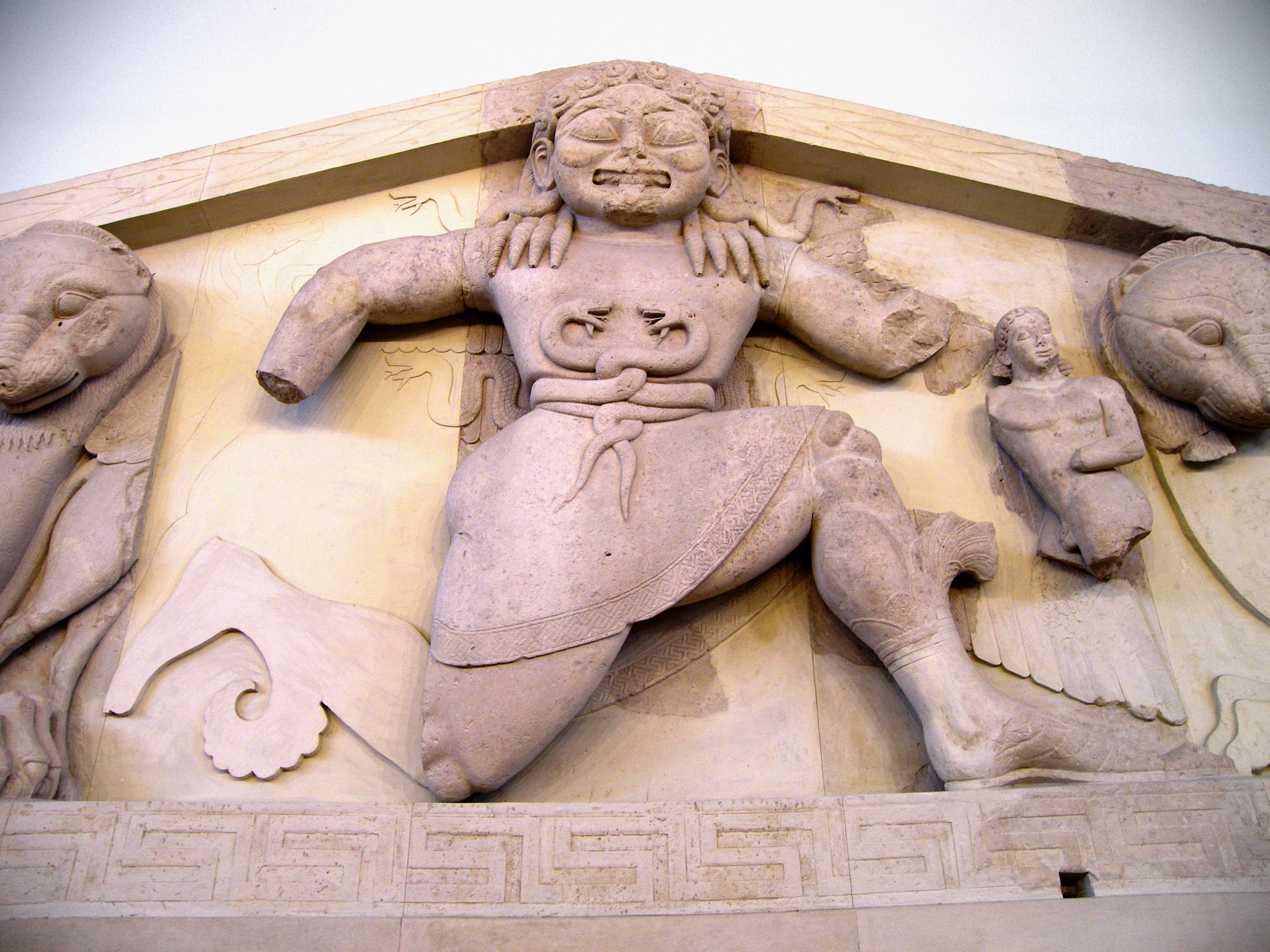
The stylised Gorgon from the pediment of the 6thC BCE Temple of Artemis, Corfu. Was she the Greek version of the 'loathly lady' myths of the north?

The stylised Gorgon from the pediment of the 6thC BCE Temple of Artemis, Corfu. Was she the Greek version of the 'loathly lady' myths of the European north?

To the ancient peoples of Europe, the realm of the dead and of heaven lay deep in the west on the path of the setting sun. This exceeded the bounds of the known world of the Mediterranean and was presumed to lie beyond the extent of the Titanic Atlantic Ocean, believed to represent the extent of the 'world river', Okeanos. Plato (Athens, 4thC BCE) describes the mysterious point where earth and heaven meet in his 'last words of Socrates' dialogue known as Phaedo (trans. Benjamin Jowett) :

“…Also I believe that the earth is very vast, and that we who dwell inthe region extending from the river Phasis to the Pillars of Heracles,along the borders of the sea, are just like ants or frogs about amarsh-pool, and inhabit a small portion only, and that many others dwell inmany like places. For I should say that in all parts of the earththere are hollows of various forms and sizes, into which the water andthe mist and the air collect; and that the true earth is pure and inthe pure heaven, in which also are the stars-that is the heavenwhich is commonly spoken of as the ether, of which this is but thesediment collecting in the hollows of the earth…”

His description of the 'frogs' and the pond is an echo of contemporary Athenian playwright Aristophanes' famous Dionysiac play of the c.405 BCE known as 'The Frogs' when the god Dionysus crosses the river Styx to visit Hades, and rather than being regaled by the shades of the departed from within the water, he is annoyed by a chorus of frogs. The connection between water, and the seemingly grotesques yet miraculous aspects of both death and rebirth was not lost in the ancient European worldview, of which the Greeks were to create the earliest written sophistication:

One of our oldest written sources on ancient Greek mythology, Hesiod ('Theogony'), says that the most archetypal race of Greek monsters, the Gorgons, lived on an island at the furthest extent of the western ocean, supposedly near the island of the Hesperides. This puts them in the realm of Cronos (Saturn) at the far shores of the world-river Okeanos, near Homer's famous island of Ogygia from the Oddyssey. Ogygia in Homer was domicile of the titan Atlas (also called Atlantis) and his daughter Calypso, whose charms almost took Oddyseus away from the land of the living. The name Ogygia (Hy Gyges?) is based upon the greek word gygas, meaning 'born of Ge (Gaia/Ge – the Earth)', often interpreted as 'Giants' (Gigantes) and possibly linked with the name Gorgós (dreadful)…

Accordingly, the Titans of greek myth were viewed as primordial, earth-born giant in stature and monstrously alien. They were supposedly banished in a succession war with their children, the Olympian gods, and the various Greek theogonies suggest these marginal realms were at the farthest reaches of the 'time before memory' of oral-culture mythology – on the shores of the world river Okeanos at the edge of the heavens.

The relation ship between the chthonic underworld of Hades and Tartarus is based upon the fact that the oceans are the deepest places, and the Atlantic far more so that the Mediterranean. The beings of this realm partook of the primal, cthonic 'elements' of Water and Earth. Even the Hebrew Book of Genesis (first compiled 5thC BCE) borrowed this conception…

The children of the Titans were often monstrous, for example: Python, Scylla, Medusa, Charybdis, Cereberus, Ekhidna, the Hydra, Chimera, Geryon, Cetus and the Graeae. Sometimes they were beautiful too, like the titaness Calypso, and Pegasus and Krysaor who were the children born of the neck of Medusa. The mysterious realm of the oceans, has always delivered both beauty and terror to mankind!

Although encountered in Greek mythology in various parts of the Mediterranean, it was not, however, it was not from this comparatively mild 'frogpond' that these creatures and Old Gods derived, but the mighty Atlantic, beyond the 'Pillars of Heracles' or the Straights of Gilbraltar, at the extremes of Okeanos in the Atlantic west. During the era of the Roman expansion into northern Europe, the misty, cold and terrifying reaches of the British Isles, Ireland and the North Sea might well have been at the very brink of this terrifying alien realm… to the ancient world, if you wished to get to Ogygyia and the Hesperides, you went to the furthest navigable islands (Britain and Ireland), and then just went a little further!

In mythology, the monstrous is often depicted as a trial to be overcome by a hero (or 'initiate'). In northern Europe, the aquatic 'loathly lady' traditions of the Melusine, the tale of how Conn Cétchathach gained the High Kingship of Ireland, and Chaucer's 15thC 'Wife of Bath's Tale' are examples of such a tradition. In Greek myth, the story of Perseus and Medusa might be seen as a version of the same principle:

Gorgons:

The most famous monsters of the Greek and Roman world were arguably the three snake-haired Gorgons, who were said to be the daughters of Phorcys (a hypostasis subordinate to Poseidon). These were also the sisters of another divine female triad of Greek myth, the Graeae – the grey, aged and withered, one-eyed Cailleach-like Okeanid nymphs said in some myths to guard the approaches to the Hesperides, Ogygia etc and (redolent of the Norse Valkyries and the Irish Children of Lir) to have part of the form of swans. In the myth of Perseus, the hero is dispatched on an apparent suicide mission by evil King Polydectes to kill and gain the head of the only mortal Gorgon, Medusa, whose gaze turned men to stone. Polydectes fully expected the young hero to die in the task, so that he might marry Perseus' mother, but he survives his 'initiation' and triumphs from it. The Gods Athena, Hades, Zeus and Hermes donate magical weapons and aids for the task, setting Perseus on a perilous course to success. He tricks the Graeae at the approaches, and enters the grey and misty realms to stalk his prey… Upon decapitating Medusa, the magical horse Pegasus is born from her neck – a bizarre conception, fit only for these distant and magical realms of the Titans. Perseus rides the flying horse, saves the maiden Andromeda from being devoured by the sea monster Cetus and rides off into the sunset with the girl.

The characters of the Perseus-Medusa mythology all occupy a portion of the heavens as a group of related constellations named after the characters: Pegasus, Cetus, Perseus, Andromeda, in close proximity to the other 'aquatic' constellations of the zodiac – Pisces, Aquarius and curious Capricorn. This group contains two particular stars which express the curious behaviour of having a cyclical variable intensity, namely the 'blinking' eye of Medusa: Algol (period repeats every 2 days) – seen in the constellation of Perseus, and the longer-period Mira Ceti on the neck of Cetus, whose period is 11 months. Both these stars appear to 'come and go', a feature which must have had particular implications to ancient peoples who believed a star was a perfected heavenly soul. Mythology was sometimes designed to record information about the skies!

By 'killing' Medusa on the far western shores of Okeanos, Perseus immediately helps her 'give birth' to his conveyor back from the Otherworld (Pegasus – whose feet create springs of water on land), and mysterious Chrysaor – the 'golden blade' suggesting agriculture: both aspects of continuity in a culture which believed in reincarnation. By 'kissing' the 'loathly lady', the beauty of regeneration might occur…

Chrysaor, Kallirhoe and Geryon:

Two miraculous children were born at the moment of Medusa's beheading: The winged horse Pegasus ('Creator of Pegai (springs)'?), and the golden boy Chrysaor ('Golden Blade'). Pegasus became the companion and steed of the warrior-hero Perseus, but the mysterious Chrysaor was credited only (so far as we know) with the paternity of another monstrous being: the giant three-bodied cowherd Geryon on whom the legendary strongman-warrior Heracles/Hercules was supposed to have conducted his Tain or cattle-raid. Pegasus and Chrysaor have distinct echoes of the Atlantic Europe's 'fairy helpers' – the 'fairy horse' and the 'brownie'.

Geryon was supposedly born to his father of the Okeanid nymph Kallirhoe who occupied the island of Erytheia, and was said by some later classical authors (Diodorus) have also lived on the mountainous slopes of Atlantic Iberia. Like the tripliform Celtic deities, he was supposed to have been a giant with three bodies.

“From Medusa, daughter of Gorgon, and Neptunus [Poseidon], were born Chrysaor and horse Pegasus; from Chrysaor and Callirhoe, three-formed Geryon.”Pseudo-Hyginus, Fabulae 151 (2ndC CE) – Trans. Grant.

His home was the far-west 'red island' of Erytheia in the mystical Hesperides (equivalent by name and association with the 'Arthurian' Avalon, and Irish Emain Abhlach), no doubt the reason his cattle also had coats the colour of the setting sun – the predominant colour of the flowers in Atlantic Europe after the Summer Equinox and also, notably, the colour of the running blood of the dead… He was once allegedly defeated by Hercules, who stole his cows. The constellations Orion (the 'stick-waver') and Boötes (the 'cowherd') might even be considered cosmic aspects of the legend behind Geryon, on account of the location of his myth – at the boundary of the Otherworld… the heavens near to that great nourishing sky-river, the Milky Way. The 'cattle' of Geryon are a motif for the spirits of the dead, like Aristophanes 'Frogs' and 'Birds' and Hercules taking of them is an expression of the role of the psychopompic gods: Manannan, Dionysus, Hermes/Mercury etc.

The Hesperides:

The mythical garden of the Hesperides lay somewhere in the mythological west – either beyond the Atlas mountains and Libya (home of the setting winter sun) or further out beyond the Atlantic ocean at 'Okeanos' far shore' (summer sunset), depending on the accounts. It was the site of goddess Hera's magical apple tree, whose golden fruit imparted divine knowledge (or chaos and warfare when placed in the hands of Eris!), and the three nymphs known as the 'Hesperides' were its guardians. It features in the myths of Perseus (the nymphs tell him where to find Medusa) and of Heracles (who steals the apples). These nymphs were supposed by some sources to be the daughters of Hesperus – personification of the 'evening star' (Venus) known as 'Hesperus' to the Greeks ('Vesper' to the Romans). Venus, being close to the sun, and relatively close to Earth often appears in the sun's train ('evening star') or vanguard ('morning star') as it traverses the ecliptic path. The Greeks, of course, named the planet Venus after Plato's muse Aphrodite.

Not trusting the Hesperides with her precious apples, Hera (a notoriously jealous sort of person) is supposed to have set the dragon Ladon to guard it, and he coils around the base of the apple tree's trunk. This is somewhat redolent of the Norse myth of the Midgard serpent coiled around the world tree, and the constellation Draco was said by Hyginus ancient account of the constellations to represent Ladon.

The exact 'identity' of the 'Island of the Hesperides' itself is somewhat mysterious – is it Ogygia or Erytheia? Or somewhere else, even? Erytheia is sometimes given as the name of one of the Hesperides, so this may link to Geryon and his herd of red cows. Conceptually, of course, this does not matter – the 'island' has no corporal existence, but an important spiritual one. The apples were a bridal gift of Gaia (the Earth) to Hera. The Irish and British also had a legend of an 'Isle of Apples' – Avalon and Emain Abhlach.

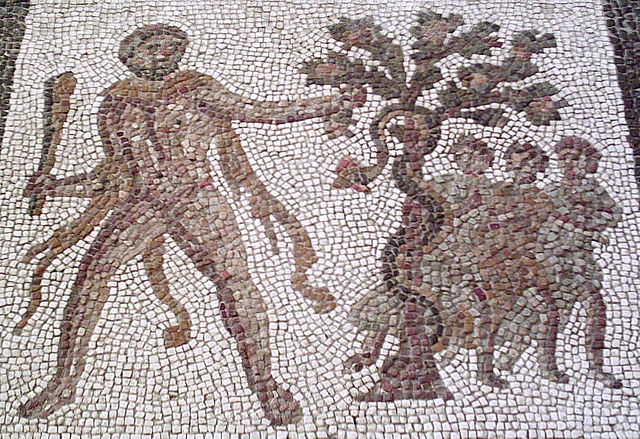
Hercules eyes up Hera's 'bridal gift' - perhaps the Hesperides are a tripliform expression of Zeus' wife?...

Hercules eyes up Hera's 'bridal gift' - perhaps the Hesperides are a tripliform expression of Zeus' wife?... The imagery is somewhat phallic!

The location of the Titans and their monstrous offspring at the far reach of Okeanos in ancient European mythology made them occupy the liminal 'crossing place' between the mundane world and the heavens. It is a place simultaneously distant in both space and time, ruled over by its Titan king, Cronus, whose 'star' (the planet Saturn) takes so long to traverse its ponderous path (as if an old Boddagh of a man) when compared to our nearer planets. If this 'crossing place' seemed distant and somehow unobtainable except through an extreme journey and a trial of nerve, the spiritual realm of the heavens on the other side was paradoxically immanent and of the 'here and now'. The meaning of this 'crossing over' point and a belief that the traffic here was bidirectional became a feature of the ancient initiatory mystery cults of Eleusis and the 'Orphic' mysteries and was a key part of the mythology of the barbarians of Atlantic Europe, preserved in their own rich traditions…


Pythagoras, Empedocles and Plato – spiritual philosophy

Medieval accounts of the Cosmos such as that given by the character Taliesin in Geoffrey of Monmouth’s ‘Life of Merlin’ are based upon much older pagan philosophies:

“…I shall tell thee a twofold tale. At one time it grew to be one only out of many; at another, it divided up to be many instead of one. There is a double becoming of perishable things and a double passing away. The coming together of all things brings one generation into being and destroys it; the other grows up and is scattered as things become divided. And these things never cease continually changing places, at one time all uniting in one through Love, at another each borne in different directions by the repulsion of Strife. Thus, as far as it is their nature to grow into one out of many, and to become many once more, when the one is parted asunder, so far they come into being and their life abides not. But, inasmuch as they never cease changing their places continually, so far they are ever immovable as they go round the circle of existence…” Empedocles of Acragas/Agrigentum (Sicily) – 5thC BCE (From: ‘Fragments’ of the Strasbourg Papyrus)

Empedocles was one of the ‘Pre-Socratic’ (Pre-Hellenic) philosophers of the ancient Greek world – a group of individuals including Pythagoras of Samos (attributed to the 6thC BCE, but possibly even legendary) about whom we know little except of what was reported much later. In the case of Empedocles, we are lucky as some of his contemporary writings survive. Empedocles is credited with developing the cosmogenic theory of the Four Elements (Earth, Air, Fire and Water) which her referred to as ‘roots’ of matter, and which was to dominate the worldview of the ancient European, North African and Middle-Eastern peoples right through to the 17th century. Whether or not he was the true originator remains to be seen, but he became an icon of this to the Greeks. His surviving fragmentary works were – like those of Homer and Hesiod – written in a poetic verse, suggesting a possible connection to an oral transmission tradition. He was as much concerned with spiritualism and religion as what we moderns would think of as ‘philosophy’ – to the ancients there was no difference. As a Sicilian Greek, he would have had access to and interest in the ‘Celtic’ peoples and their philosopher-priests. His belief in transmigration of the soul was supposedly shared by/derived from Pythagoras and was common to the Orphic/Eleusinian mysteries, as well as by the Atlantic Europeans. The Greeks would never admit that they derived anything or shared a common heritage with the ‘Barbarian’ world, of course!

The Cosmogony attributed to Empedocles was used by Plato of Athens some 100 years later during the era of the Hellenic expansion. His famous dialogue ‘Timaeus’ discussed the structure of reality and history of creation, framed within Plato’s theories of geometry and number, itself derived from ideas of Pythagoras. Here he discusses the relationship between the elements (stoichaea):

“…Now that which is created is of necessity corporeal, and also visible and tangible. And nothing is visible where there is no fire, or tangible which has no solidity, and nothing is solid without earth. Wherefore also God in the beginning of creation made the body of the universe to consist of fire and earth. But two things cannot be rightly put together without a third; there must be some bond of union between them. And the fairest bond is that which makes the most complete fusion of itself and the things which it combines; and proportion is best adapted to effect such a union. For whenever in any three numbers, whether cube or square, there is a mean, which is to the last term what the first term is to it; and again, when the mean is to the first term as the last term is to the mean-then the mean becoming first and last, and the first and last both becoming means, they will all of them of necessity come to be the same, and having become the same with one another will be all one. If the universal frame had been created a surface only and having no depth, a single mean would have sufficed to bind together itself and the other terms; but now, as the world must be solid, and solid bodies are always compacted not by one mean but by two, God placed water and air in the mean between fire and earth, and made them to have the same proportion so far as was possible (as fire is to air so is air to water, and as air is to water so is water to earth); and thus he bound and put together a visible and tangible heaven. And for these reasons, and out of such elements which are in number four, the body of the world was created, and it was harmonised by proportion, and therefore has the spirit of friendship; and having been reconciled to itself, it was indissoluble by the hand of any other than the framer…” Plato – Dialogue of Timaeus (4thC BCE, Athens)

You will note that Plato talks of the ‘creator’ or ‘God’ as a single force (you’d need to check the Greek original, though!) – surprisingly like the idea of God to the Judaeo-Christian-Islamist faith it would seem. This might seem strange, until one realises that to Plato and the philosophers of this age this was a natural part of polytheismthe plural ‘gods’ were a description of the important functions and continuum of time and space between the philosophical absolute ‘Monad’ and the dissolution of chaos. This was quantum physics for the mind! To worship the Monad was as senseless as worshipping pure chaos.

In the following passage from Timaeus, he explains how the stars and souls are one, expressing a great deal of the same theory as Empedocles, no doubt one of his formative sources. He tells how – as well as the universe being a huge soul ‘framework’ in itself, the souls of beings (gods and mortals) were made by combining them with aspects of the elements:

“…and once more into the cup in which he (ed: the Creator) had previously mingled the soul of the universe he poured the remains of the elements, and mingled them in much the same manner; they were not, however, pure as before, but diluted to the second and third degree. And having made it he divided the whole mixture into souls equal in number to the stars, and assigned each soul to a star; and having there placed them as in a chariot, he showed them the nature of the universe, and declared to them the laws of destiny, according to which their first birth would be one and the same for all,-no one should suffer a disadvantage at his hands; they were to be sown in the instruments of time severally adapted to them, and to come forth the most religious of animals; and as human nature was of two kinds, the superior race would here after be called man. Now, when they should be implanted in bodies by necessity, and be always gaining or losing some part of their bodily substance, then in the first place it would be necessary that they should all have in them one and the same faculty of sensation, arising out of irresistible impressions; in the second place, they must have love, in which pleasure and pain mingle; also fear and anger, and the feelings which are akin or opposite to them; if they conquered these they would live righteously, and if they were conquered by them, unrighteously. He who lived well during his appointed time was to return and dwell in his native star, and there he would have a blessed and congenial existence. But if he failed in attaining this, at the second birth he would pass into a woman, and if, when in that state of being, he did not desist from evil, he would continually be changed into some brute who resembled him in the evil nature which he had acquired, and would not cease from his toils and transformations until he followed the revolution of the same and the like within him, and overcame by the help of reason the turbulent and irrational mob of later accretions, made up of fire and air and water and earth, and returned to the form of his first and better state. Having given all these laws to his creatures, that he might be guiltless of future evil in any of them, the creator sowed some of them in the earth, and some in the moon, and some in the other instruments of time; and when he had sown them he committed to the younger gods the fashioning of their mortal bodies, and desired them to furnish what was still lacking to the human soul, and having made all the suitable additions, to rule over them, and to pilot the mortal animal in the best and wisest manner which they could, and avert from him all but self-inflicted evils…”

    Although seeming mysogynistic to modern readers, Plato’s opinions about unworthy souls being reincarnated first in the body of a woman, and next in that of a ?beast have to be judged, firstly by the standards of his culture and age, and secondarily by considering the otherworld inversion principle I have made previous references to in terms of ancient spirit beliefs. For instance, the ancient Gaelic belief in hereditary healing and protective charms always had contrasexual inheritance as its core mode of transmission. Plato’s audience at his seminars were privileged Athenian males.

   In spite of his apparent misogyny, he was steadfastly devoted to the principles of Sensation (resulting, he believed, from the conflict between matter and spirit and the soul) and Love as the highest faculties motivating humanity. These, to him and his devotees of future generations, were represented in the Goddesses Athena (Strife) and Aphrodite (Love).

The views of Pythagoras, Empedocles and Plato were to have a profound influence upon religious philosophy in the Hellenic and Roman empires, inspiring new generations of philosophers who flourished from the 3rdC BCE to the 4thC CE. The philosophical origins of christianity may in fact be based upon them – albeit with a one-sided doctrine of ‘Love thy Neighbour’ and the denial of the sensationalist aspect…. 


“You can lead a horse to water…”

1stC BCE coin of the Redones of NW Gaul, now Brittany.

1stC BCE coin of the Redones of NW Gaul, now Brittany. In the coins of this tribe, the female rider is usually armed.

…When she had thus allured the male part of the Island, she pretended one day to go a progress through the provinces, and being attended by all her adorers on foot, while she rode on a milk-white palfrey, in a kind of triumph at the head of them: she led them into a deep river, which by her art she made seem passable; and when they were all come a good way in it, she caused a sudden wind to rise, which driving the waters in such abundance to one place, swallowed up the poor lovers to the number of six hundred in their tumultuous waves. After which, the sorceress was seen by some persons who stood on the shore to convert herself into a bat, and fly through the air till she was out of sight; as did her palfrey into a sea-hog or porpoise, and instantly plunged itself to the bottom of the stream…. George Waldron – ‘A Description of the Isle of Man’ 1731 – legend of ‘Tehi-Tegi’.

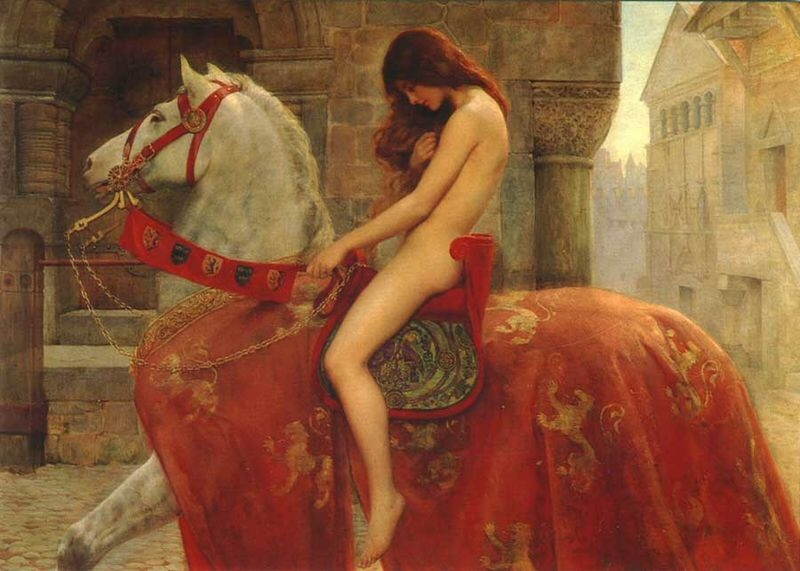
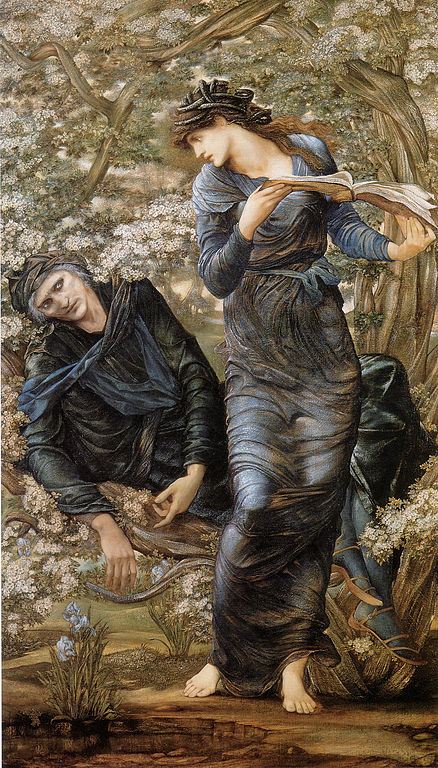
A Pre-Raphaelite Tehi-Tegi

A Pre-Raphaelite Tehi-Tegi

The image of the horse is a striking symbol on Celtic coins of the late European Iron Age, all the more so when depicted ridden by a naked warrior woman, as was the case during times of war with the encroaching Roman empire – both in central-eastern and north-western Europe. The question is – what was the importance of the horse to this culture, such that it was depicted on almost all of its various tribes’ coinage? We know from the writings of the Romans that the Atlantic/western Celtic peoples’ main religious doctrines were based around the principle of reincarnation. However, after subjugating and then ‘Romanising’ them, there is little more said about their beliefs as they seemed no longer to be relevant. The Celtic religious system seemingly incorporated into the Roman pantheon but in a marginal way that gave no precedence over Rome’s greater gods: Statues and stelae of a horse-goddess ‘Epona’ seems to have been one popular expression of native religion, but the original context is not understood. The Batavians (Belgic celts) who built the 3rdC CE temple of the well-goddess ‘Coventina’ at Hadrian’s Wall in England were a cavalry unit – surely a shrine to Epona would have had greater precedence if there was an actual ‘horse goddess’? Perhaps to the Batavians, the well-goddess was the same person as the ‘horse goddess’! To understand this imagery of the divine female and the horse we need to examine how she was represented both before, and after Romanisation. Surviving images of Epona from Romanised Celtic shrines generally portray her as a gentle beneficient figure, conveying pateras of food and cornucopias. When contrasted with the coin imagery of the pre-conquest tribes however, and it immediately becomes clear that there is a clear distinction in imagery: In these, she is a fierce naked horsewoman-warrior, armed for the job of butchering Romans! Of course, once conquered, the Romans put an end to these images and the coins stopped being minted. The cult of ‘Epona’ was therefore probably a deliberate attempt to corrupt an important core tenet. She went from this:

More coins from the Redones tribe

More coins from the Redones tribe

To this…

Cuddly mother Epona - the original would have bought your head on a plate, not food!

Cuddly mother Epona – the original would have brought your head on a plate, not food!

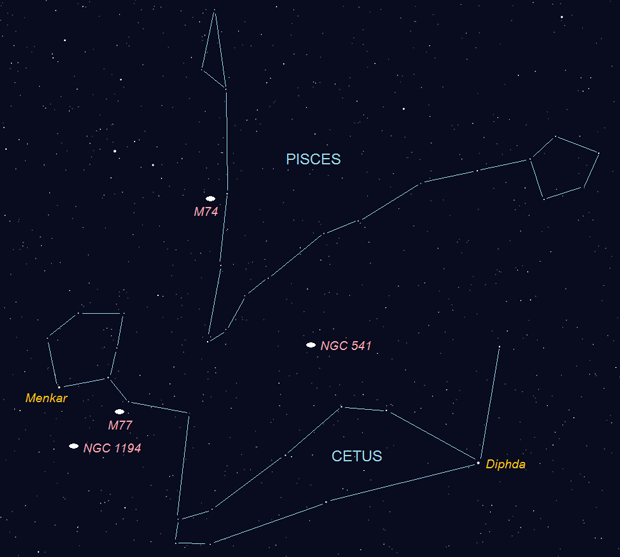
The ‘Tehi-Tegi’ legend from the Isle of Man is perhaps the most overt survival (maybe matched by some Cliodhna legends of Ireland) of the ‘death-dealing horsewoman’ that the Iron Age celts were so enamoured of, but the principle has survived in many other forms. Most notable of these are the folktales of the fairy horse who kills people that try and ride it by jumping into water. Be it the Neck, Nykyr, Nixies or Rhinemaidens of the German and Scandinavian legends or the Kelpie of the Scots myths: all are related the same belief – a woman who conducts the dead to a realm under water. When we examine the fairy lays of the middle ages (Lai de Graelent, Lai de Lanval) we can see that the beautiful ‘fairy woman’ ends up conducting the tragic hero to a deathless realm through water. No wonder so many early Christian saints such as Kentigern spent their days mortifying themselves in water! The Germanic words used for the water-horse-spirit generally revolve around the word-root ‘nik-‘ – from a presumed Proto-Indo-European (PIE) neigw which means ‘wash’ – from which the Irish have nigh and in folklore the fairy washerwoman, the Bean nighe. The most famous portrayal of a Bean nighe in medieval Irish literature is that of the Morrigan washing bloody armour at a ford in the death tale of Cuchullain – part of the Ulster cycle. The Scots word ‘Kelpie’ is an allusion to what is also known in the gaelic world as ‘wrack’ (seaweed) which is also the Brythonic word for ‘hag’ – Gwrach or Groac’h. Martin Martin recovered a tale of Hebridean islanders in the 17thC sacrificing to a sea-god called ‘Shony’ (‘Old One’) in order to receive wrack from the sea to spread on their crops as manure. So there you have it – the military horsewoman on the Celtic coins is the Slachdan-weilding Cailleach – the Morrigan herself: The water woman of the fairy realm – otherwise known as the realm of the dead. The question now remaining to be answered is how does the horse fit in with the general reincarnation/otherworld myth? You might recall from my last post that I remarked upon the profusion of apparently astronomical imagery that accompanied the horse depicted on Celtic coins from before the Roman subjugation. Apart from the sun and the moon and obvious star-shaped figures, there are frequently dot-and-line figures with an uncanny similarity to what astronomers refer to as ‘asterisms’. The horse itself is also very stylised in its appearance, and the logical place to start in understanding the importance of the horse is to turn our eyes to the sky: The most well-known equine asterism is the great constellation of Pegasus which sits next to the Milky Way. We immediately have here an interesting combination: The Milky Way arches across the sky like a great shining white river – nowadays difficult to see clearly due to light pollution, and the great leaping horse in conjunction with this is a remarkable metaphor of the Kelpie, Nixie and Tehi-Tegi legends. However, in terms of Greek mythology, Pegasus represents the horse as a benign force, but with a very aquatic pedigree – his father is Poseidon, his mother Medusa, he is a friend of the Muses and created a magical well for them with his hooves. He is also a conveyor of heroes into the spirit realm. Already sounding like many Celtic myths, isn’t it? The Muses of course represented the ‘fairy-woman’ function of inspiring poets, keeping memory and promoting knowledge to humanity… The other less-benign and more overtly aquatic asterism that sits close to Pegasus on the other (‘southern’) side of the ecliptic path is that of Cetus variably described as a sea monster or whale. In Greek mythology Cetus/Ketos was sent by Poseidon to devour the sacrificially-chained Andromeda, and was killed by the Pegasus-riding hero Perseus who showed it the head of Medusa. Ketos in fact means any large aquatic beast, in the same way that the  old Germanic languages used variants of ‘neck’ to mean the same: nicor was the Old English term used for a water beast or a hippopotamus*, and the Old High German word nihhus was used for ‘crocodile’. As a ‘*water horse’ is what we are interested in, the constellation of Cetus seems like it is worth considering further: The constellation Cetus lies in such close proximity to the ecliptic path (the road travelled by the Sun, Moon and planets in the sky, marked by the 12 zodiacal constellations) that it seems that it should be considered a 13th ‘intercalary’ member of the zodiac. Its proximity to the asterism of Pisces is intimate enough that they can be considered in the same ‘house’. Cetus is in close proximity to the other ‘watery’ constellations: Aquarius and Capricorn (the fish-goat), the ‘river’ Eridanus and the dolphin Delphinus.

Cetus in relation to Pisces - picture borrowed from blackholes.stardate.org

Cetus in relation to Pisces – picture borrowed from blackholes.stardate.org

Now we know that the celtic high-priests were reputed to be philosophers and diviners of the heavens, so we might conjecture that celtic coins portrayed astronomical imagery. Having been puzzled by the potential relationship between the horse depicted on those famously beautiful Iron Age coins and that of Pegasus, I initially overlooked one of the motifs that accompanied it – that of the ‘tented net’ depicted on the Celtic Parisii coins. Looking eastward of Pegasus we come immediately to Pisces and Cetus – and the symbolism of the coins is made immediately clear – the horse is not a depiction of Pegasus – it is in fact Cetus, the ‘water horse’, with the net being Pisces! If this interpretation is correct, then a lost celtic star-myth has been recovered, together suggesting some potential original celtic names for their asterisms: ‘the water horse’ and ‘the net’!

Compare the stylised horse's body to the shape of the Cetus asterism

Compare the stylised horse’s body to the shape of the Cetus asterism

So… is there anything special about Cetus? As it turns out , there is – a star on the beast’s ‘neck’ known to us today as Mira Ceti: ‘Mira’ as in ‘mirabilis’ on account of this star’s seemingly miraculous appearance and disappearance from the constellation! It is actually a binary star whose conjunctions and occlusions are responsible for this effect, causing it to reach a maximum brightness every 332 days (approximately 11 months) when it is definitely visible (unless the sun is transitting near it if it falls in early springtime) and invisible to the naked-eye astronomer during its minima. Although there are no definite references to this phenomena in ancient Babylonian or Greek texts, an excavation of a 3rdC BCE Boii temple complex at Libenece in the Czech Republic contains sighting post allignments which possibly correspond to a viewing of Cetus, and (concludes the author of this astronomy paper), Mira Ceti in particular. The other star which famously exhibits this quality of variable intensity is ‘nearby’ in the constellation Perseus – Algol, the gorgon’s eye – whose period of dimming is much more regular – every 2.867 days, to be precise. The coming and going of a star might have been a metaphor for the coming and going of the year – of the sun. The cycles of ‘coming and going’ appear to have been a fundamental theme for the religious viewpoint of metempsychosis, and hence a great deal of attention would have been paid to the natural phenomena in which this was shown: These were – the cycles of the sun, the moon, the seasons and the tides. The principle that the heavens represented the world of spirits pervaded the ancient mindset, and the use of mythology to explain the heavens and their phenomena was a key part of this understanding. The image of the horse and the chariot convey mythological implications of the mysteries of the sun – the Greek legend of Phaethon, son of Helios/Apollo, who took his dad’s sports chariot for a spin with disastrous consequences attests to this. Most of ancient mythology was quite possibly designed to explain the cycles of nature in relation to the cycle of events witnessed in both the sky and on Earth and in the oceans – something which became lost in the Christian age…

Careless lake ladies and mermaids – flood myths in Celtic folklore

“…There is a lake in Ulster of vast size, being thirty miles long and fifteen broad, from which a very beautiful river, called the Banna, flows into the Northern ocean. The fisher-men in this lake make more frequent complaints of the quantity of fish inclosed in their nets and breaking them than of the want of fish. In our time a fish was caught here which had not come up from the sea, but was taken descending the lake, and was in shape very like a salmon, but it was so large that it could neither be dragged out or conveyed whole, and therefore was carried through the province cut in pieces. It is reported that this lake had its origin in an extraordinary calamity. The land now covered by the lake was inhabited from the most ancient times by a tribe sunk in vice, and more especially incorrigibly addicted to the sin of carnal intercourse with beasts more than any other people of Ireland. Now there was a common proverb in the mouths of the tribe, that whenever the well-spring of that country was left uncovered (for out of reverence shown to it, from a barbarous superstition, the spring was kept covered and sealed), it would immediately overflow and inundate the whole province, drowning and destroying all the population. It happened, however, on some occasion that a young woman, who had come to the spring to draw water, after filling her pitcher, but before she had closed the well, ran in great haste to her little boy, whom she heard crying at a spot not far from the spring, where she had left him.

But the voice of the people is the voice of God ; and on her way back, she met such a flood of water from the spring that it swept off her and the boy, and the inundation was so violent that they both, and the whole tribe, with their cattle, were drowned in an hour in this partial and local deluge. The waters, having covered the whole surface of that fertile district, were converted into a permanent lake, as if the Author of nature judged the land which had been witness to such unnatural bestialities against the order of nature to be unfit for the habitation of men, either then or thereafter.

A not improbable confirmation of this occurrence is found in the fact, that the fishermen in that lake see distinctly under the water, in calm weather, ecclesiastical towers, which, according to the custom of the country, are slender and lofty, and moreover round ; and they frequently point them out to strangers travelling through those parts, who wonder what could have caused such a catastrophe.

…..

It must, however, be observed that the river before mentioned (the Bann), which now flows out of the lake in full stream, had its source in the aforesaid spring from the time of Bartholanus, who lived soon after the flood, when it was fed also by other rivulets, and took its course through the same district, but with a far less volume of water, and it was one of the nine principal rivers of Ireland…” (Topographia Hiberniae by Gerald of Wales (12thC) – trans. Thomas Forester; From: ‘The Historical Works of Giraldus Cambrensis’ – Pub. George Bell & Sons, London 1905)

Gerald’s tale comes from his famous account of Ireland, produced in support of the Anglo-Norman invasion of the island, and designed to support the imposition of continental christianity on this ‘barbarous’ and ‘uncivilised’ people. His sources were the monastic annals and texts of the great abbeys of Ireland. The contemporary secular literary milieu was one enchanted with the ‘Lady of the Lake’ and ‘Morgane le Fee’ and any one of a number of similar fairy themes which defined the ‘Arthurian’ Romance litereature of the 12th and 13th centuries. The following sums up one of his likely sources – from the legends of St Comgall about his apparent conversion and sanctification of a mermaid called Liban, afterwards St. Muirgen!:

“… According to a wild legend in Lebor na h-Uidri, this Liban was the daughter of Eochaidh, from whom Loch Eathach, or Lough Neagh, was named, and who was drowned in its eruption [A. D. 90], together with all his children, except his daughter Liban, and his sons Conaing and Curnan. Liban, was preserved from the waters of Lough n-Eachach for a full year, in her grianan, [palace] under the lake. After this, at her own desire, she was changed into a salmon, and continued to traverse the seas till the time of St. Comhgall of Bangor. It happened that St. Comhgall dispatched Beoan, son of Innli, of Teach-Dabeoc, to Rome, on a message to Pope Gregory [Pope, A. D. 599-604], to receive order and rule. When the crew of Beoan’s currach were at sea, they heard the celebration of angels beneath the boat. Liban, thereupon, addressed them, and stated that she had been 300 years under the sea, adding that she would proceed westward and meet Beoan, that day twelvemonths, at Inbher-Ollarbha [Larne], whither the saints of Dalaradia, with Comhgall, were to resort. Beoan, on his return, related what had occurred, and, at the stated time, the nets were set, and Liban was caught in the net of Fergus of Miliuc; upon which she was brought to land, and crowds came to witness the sight, among whom was the Chief of Ui Conaing. The right to her being disputed by Comhgall, in whose territory,-and Fergus, in whose net,-and Beoan, in promise to whom,-she was taken, they prayed for a heavenly decision; and the next day two wild oxen came down from Carn-Airend; and on their being yoked to the chariot, on which she was placed, they bore her to Teach-Dabeoc, where she was baptized by Comhgall, with the name Muirgen i.e. Born of the sea, or Muirgeilt i.e. traverser of the sea. Another name for her was Fuinchi…” (Annals of the Kingdom of Ireland by the Four Masters, vol.1 – John O’Donovan, ed. and trans.,(Dublin, 1856), p.201.)

This version of the Lough Neagh tale is slightly different as it tells that the father (Eochaid – possibly a reference to the literary figure known as ‘An Dagda’) and tribe of the magical woman are drowned, but that she remained in the form of a salmon in the sea until the coming of St. Comhgall some 300 years later. . There is good evidence from the variety of traditions encountered in Ireland that much hagiography was a deliberate revision of core pagan myths and doctrines. As with many conversion-era themes from Ireland, Liban (like Eithne/Aine in Altram Tigh da Medar) becomes a Christian and is not demonised and defeated, in distinction to the Breton legend of Gradlon and his daughter Ahes (the ‘Groac’h’ or ‘Mari Morgane’). Interestingly, Liban appears as the whip-frenzied companion/double of Manannan’s wife Fand in the ‘Wasting Sickness of Cuchullain’ from the Ulster Cycle. The same legends interested noted Celticist Professor John Rhys at the turn of the 20thC, who recorded some interesting parallel tales which showed the lake-lady/mermaid legend was not just local to Lough Neagh, or for that matter, Ireland or Brittany:

“…David Jones, of Trefriw, in the Conway Valley, was a publisher and poet who wrote between 1750 and 1780. This is his story: ‘In 1735 I had a conversation with a man concerning Tegid Lake. He had heard from old people that near the middle of it there was a well opposite Llangower, and the well was called Tfynnon Gywer, ” Gower’s Well,” and at that time the town was round about the well. It was obligatory to place a lid on the well every night. (It seems that in those days somebody was aware that unless this was done it would prove the destruction of the town.) But one night it was forgotten, and by the morning, behold the town had subsided and the lake became three miles long and one mile wide. They say, moreover, that on clear days some people see the chimneys of the houses.’…”

“…Before I have done with the Irish instances I must append one in the form it was told me in the summer of 1894: I was in Meath and went to see the remarkable chambered cairns on the hill known as Sliabh na Caillighe, ‘the Hag’s Mountain,’ near Oldcastle and Lough Crew. I had as my guide a young shepherd whom I picked up on the way. He knew all about the hag after whom the hill was called except her name: she was, he said, a giantess, and so she brought there, in three apronfuls, the stones forming the three principal cairns. As to the cairn on the hill point known as Belrath, that is called the Chair Cairn from a big stone placed there by the hag to serve as her seat when she wished to have a quiet look on the country round. But usually she was to be seen riding on a wonderful pony she had: that creature was so nimble and strong that it used to take the hag at a leap from one hill-top to another. However, the end of it all was that the hag rode so hard that the pony fell down, and that both horse and rider were killed. The hag appears to have been Cailleach Bhéara, or Caillech Bérre, ‘the Old Woman of Beare,’ that is, Bearhaven, in County Cork. Now the view from the Hag’s Mountain is very extensive, and I asked the shepherd to point out some places in the distance. Among other things we could see Lough Ramor, which he called the Virginia Water, and more to the west he identified Lough Sheelin, about which he had the following legend to tell:–A long, long time ago there was no lake there, but only a well with a flagstone kept over it, and everybody would put the flag back after taking water out of the well. But one day a woman who fetched water from it forgot to replace the stone, and the water burst forth in pursuit of the luckless woman, who fled as hard as she could before the angry flood. She continued until she had run about seven miles-the estimated length of the lake at the present day. Now at this point a man, who was busily mowing hay in the field through which she was running, saw what was happening and mowed the woman down with his scythe, whereupon the water advanced no further…” (John Rhys – Celtic Folklore – Welsh and Manx Volume 2; Ch.6; Pub. Oxford University Press 1901)

As well as Wales and Ireland, this story involving the Cailleach was widespread in the west of Scotland too, as the following account from the late 18thC shows:

“…On a high part of that ridge of hills which seperates Stralachlan from Glendarnel, there is a very large stone, remarkable for its situation. There is a descent from it on every fide. The prospect from it is very extensive. It is called Cailleach-Vear or Vera. In the dark ages of superstition, it was personified, and said to have a considerable property in cattle. Cailleach Vear makes a conspicuous figure in the marvellous tales of the country people, over great part of the West Highlands. Her residence was said to be on the highest mountains; that she could step with ease, and in a moment, from one district to another; when offended, that she caused a flood to come from the mountains, which destroyed the corns, and laid the low grounds under water; that one of these floods was the origin of Lochow, in Lorn, of Locheck, in this parish, and of many other lakes; that the people paid her a superstitious veneration, and were under dreadful apprehensions of her anger…” (The Statistical Account of Scotland: Drawn Up from the Communications of the Ministers of the Different Parishes; Ed. John Sinclair; Pub. W. Creech, 1792; pp. 559-560)

The same story is borrowed and elaborated on by a later author in the following account of Loch Awe from the 19thC following on from the surge in interest in Highland legends generated by Walter Scott:

“…The Highlanders of Argyleshire possess a curious tradition regarding the origin of Lochawe, which has furnished a topic in one of the wild songs of Ossian. The circumstance is connected with the existence and death of a supernatural being, called by the country people Calliach Bhere, ” the old woman.” She is represented as having been a kind of female genie whose residence was on the highest mountains. It is said that she could step with ease and in a moment from one district to another; when offended, that she could cause the floods to descend from the mountains, and lay the whole of the low ground perpetually under water. Her race is described as having lived for an immemorial period near the summit of the vast mountain of Cruachan, and to have possessed a multitude of herds in the vale at its foot. Calliach Bhere was the last of her line, and, like that of her ancestors, her existence was blended with a fatal fountain which lay in the side of her native mountain, and had been committed to the charge of her family since its first existence. It was their duty at evening to cover the well with a large flat stone, and at morning to remove it again. This ceremony was to be performed before the setting and rising of the sun, that his last beam might not die upon the waters, and that his first ray should illuminate their bosom. If this care was neglected a fearful and untold doom was denounced to be the punishment of the omission. When the father of Calliach Bhere died, he committed the office to his daughter, and declared to her, in a solemn charge, the duty and the fatality of the sacred spring. For many years the Military woman attended it without intermission;

But on one unlucky evening, spent with the fatigues of the chase and the ascent of the mountain, she sat down to rest beside the fountain, and wait for the setting of the sun, and falling asleep did not awake until next morning. When she arose she looked abroad from the hill; the vale had vanished beneath her, and a wide and immeasurable sheet of water was all which met her sight. The neglected well had overflowed while she slept; the glen was changed into a lake; the hills into islets; and her people and her cattle had perished in the deluge. The Calliach took but one look over the ruin which she had caused: the spell which bound her existence was loosened with the waters, and she sunk and expired beside the spring. From that day the waters remained upon the vale, and formed the lake which was afterwards called Loch Awe…” (The Gazetteer of Scotland, Volume 1 By Robert Chambers, William Chambers ; Pub: Andrew Jack, Edinburgh, 1844; p.63)

The legend tells that the Cailleach disappeared into the spring – a figurative form of death shared with the Dindshenchas legends of Sinand and Boann as well as many of the others. The theme of the Cailleach and the flood was discovered in the Isle of Mull:

“…In the olden times, on the Headland of Mull, there lived a woman whom the people called Cailleach Bheur. She didn’t hail from the people of this world, since we are told that Cailleach Bheur was a yound girl when Adam and Eve were still enjoying the pleasures of the Garden of Eden. She tells us, in her own words, ‘When the ocean was a forest with its firewood, I was then a young lass.’ Let that be, as it may, and far be from us to doubt it, but it seems that Cailleach Bheurr evaded death in a way that no one was ever able to do, before or since…” (School of Scottish Studies Archives, University of Edinburgh Royal Celtic Society, MSS:AM/35.8 Mull)

“…Now there was only one place where Cailleach Bheurr watered her cattle-herd when she was away from Mull itself. This was a well halfway along the road she took to the headland of Kintyre. I don’t remember what its name was but, indeed, there was such a well there. And there was a great stone lid on the well and as soon as she arrived there in the morning, she would lift off the great stone so that the herd could get a drink at a time when they were thirsty. But if she didn’t place the great stone lid back on the well before the sun went down, the water would flow out of it and flood the whole world. It would pour out of this well and cover the whole world with a flood…” (School of Scottish Studies Archives, University of Edinburgh Royal Celtic Society, MSS:SA 1953/49/B5)

These accounts also add a tradition that the Cailleach would evade death by bathing in a magic Loch every 100 years. Of particular interest is that the quote ‘When the ocean was a forest with its firewood, I was then a young lass’ is mirrored in a folktale quoted in the following 18thC Irish account, discussing regional geology and geography around Lough Foyle:

“….There is a Rock on the side of the Mountain called the Poor Woman (in Irish, Calliagh Veerboght) who tells us when she was a Maid the Place where she stands was once Corn ground and Lough Foyl so narrow that a Lamb could skip from Magilligan Point to Green Castle which is now two Sea Miles distant and the Fairy that lived on the Tuns Banks (AR: Tonn Banks – The fairy referred to is revealed in other stories to be no less than Manannan!) that lye at the Mouth of Logh foyle (mostly formed I believe by what was worn away of this Shore) having a Carpet stole from him by one of this Parish, cursed it and threaten’d that every Year the Breadth of the Carpet should be swept away from the Land till all should be swept away. We may at least gather from such as these that in antient times this Place was losing and not gaining…” (“Miscellaneous letters on several subjects in philosophy and astronomy” – By Robert Innes to the Bishop of Cashel – William Nicolson; Pub.S. Birt, London 1732;p.5 – Letter 1)

The legends of the Cailleach and her relationship to water and herds of cows or deer seem to have been very consistent between Ireland, Wales and Scotland. Even in the 12thC Breton Lai de Graelent where she appears as a fountain-fairy in the woods, there are similar associations – the knight (like Fionn in the Irish ‘Pursuit of Slieve Gullion’) chases the white deer and finds her waiting at a spring in the woods. The lore is perhaps best summed up in this  excerpted 19thC translation of the Scottish highland ballad – Cailleach Bein y Vreich:

“Weird, weird, wife! with the long grey locks, she follows her fleet-foot stags, Noisily moving through splintered rocks, And crashing the grisly crags.

Tall wife! with the long grey hose, in haste the rough stony beach she walks; But dulse or seaweed she will not taste, nor yet the green kail stalks.

“And I will not let my herds of deer, my bonny red deer go down; I will not let them down to the shore, to feed on the sea-shells brown.

O better they live in the corrie’s recess, Or on mountain top to dwell, And feed by my side on the green green cress, That grows by the lofty well.”

“Broad Bein-y-Vreich is grisly and drear, but wherever my feet have been, the well-springs start for my darling deer, And the grass grows tender and green.

“And there high up on the calm nights clear, Beside the lofty spring, They come to my call, and I milk them there, And a weird wild song I sing.”

(Excerpt from translation of the old highland song Cailleach Bein a Vreich by John Campbell Shairp, from ‘Kilmahoe: a Highland pastoral with other poems’; Pub. Macmillan & Co, London 1864; pp.138-139)

The middle irish tale Echtra mac nEchach Muigmedón (Yellow Book of Lecan – late 14thC) recounts the legend of the boyhood of Niall (of the Nine Hostages) – son of Eochaid Mugmedon by Cairenn. It explains the origin of Ui Neill kingship. The theme is of how Niall came to be bestowed with the sovereignty of Ireland by a fairy queen at a well.  The five sons of Eochaid are sent to fosterage and then (at their appointed time) join their Fianna to gain life experience in adventure. While hunting in the woods, they realise they must find water and each in turn goes to a well to draw water, where they encounter a loathsome hag who guards it. Her condition for allowing them to draw water is that they bestow a ‘kiss’ upon her (i.e. – that they have sex with her). The first four sons (whose mother is Mongfind) refuse her, but Niall – last to go – accepts eagerly, else they all die of thirst. The hag immediately transforms into the most gorgeous young woman and announces that she is the Sovereignty of Ireland, which she bestows upon him in an act of Heiros Gamos. He returns to his father who recognizes him as the new High King.

Those familiar with Chaucer’s Canterbury Tales will know that his ‘Tale of the Wife of Bath’ is a facsimile of this same tale, which also occurs in various other forms in the ‘Romance’ fairy tales of the ‘Arthurian’ corpus between the 12th and 15th centuries.

When we consider the ‘Moura’ fairytales from the Iberian Peninsula, the fairytales of Brittany and France, and those of the rest of northern Europe (which I have not discussed), these all point towards an important, pervasive and powerful pagan mythology which was possibly common to all of these regions and was tied to water and the great ocean.


All text © 2014 The Atlantic Religion, except where stated.
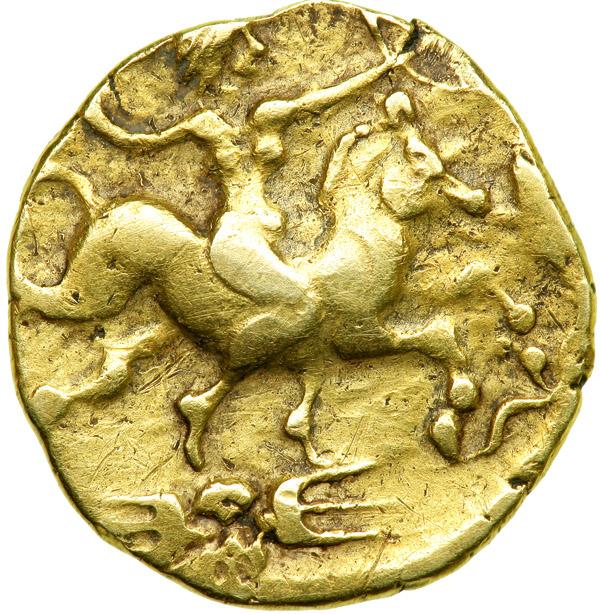


Bridget, Croghan Hill and the Bog of Allen

The Bog of Allen (Móin Alúine) with Croghan Hill ('Cruachan Bri Eile') in the background

The Bog of Allen (Móin Alúine) with Croghan Hill (‘Cruachan Bri Eile’) in the background

“Then holy Patrick came to the well called Clébach, on the slopes of Cruachu to the east, before sunrise, and they sat beside the well,  and, behold, the two daughters of king Loíguire (Ed: Mac Néill), fair-haired Ethne and red-haired Fedelm, came to the well, as women are wont to do, in the morning to wash, and they found the holy assembly of bishops with Patrick beside the well. And they did not know whence they were or of what shape or from what people or from what region, but thought they were sidhe men or earth-gods or a phantom; and the maidens said to them: ‘Whence are you and whence have you come?’ and Patrick said to them: ‘It would be better for you to profess our true God than to ask questions about our race.’  The first maiden said: ‘Who is God and where is God and whose God is he and where is his dwelling-place? Has your God sons and daughters, gold and silver? Is he ever-living, is he beautiful, have many fostered his son, are his daughters dear and beautiful in the eyes of the men of the earth? Is he in the sky or in the earth or in the water, in rivers, in mountains, in valleys?’….”

The quote comes from the Book of Armagh and was originally written in the 7th/8thC by the Bishop Tírechán as part of his collected apocrypha about Patrick, collected from across Ireland in his time and before. The Hill of ‘Cruachu’ mentioned here (usually interpreted as being at Rathcrogan in Connaught) might actually have been the magnificent and significant hill of Cruachan Bri Eile/Ele (‘Hill/Rock of Bri Eile’) or Croghan Hill in Offaly in Leinster, which had distinct fairy associations:

Patrick's Well on Croghan Hill - The original Clebach?

Patrick’s Well on Croghan Hill – The original Clebach?

The hill of Bri Eile is referred to explicitly in the fairy-narratives of The Boyhood Deeds of Fionn from the manuscript Laud 610 (folio: 118Rb-121Va), believed to date from the 12thC: In this, after learning poetry through the mystical medium of the Salmon of Knowledge with the druid Finnecas (who lived on the Boyne, Fionn travels to defeat the notorious fairy woman of Cruachan Bri Eile…

“…. Finn went to Cethern, the son of Fintan, further to learn poetry with him. At that time there was a very beautiful maiden in Bri Ele, that is to say, in the fairy knoll of Bri Ele, and the name of that maiden was Ele. The men of Ireland were at feud about that maiden. One man after another went to woo her. Every year on Samain the wooing used to take place; for the fairy-mounds of Ireland were always open about Samain; for on Samain nothing could ever be hidden in the fairy-mounds. To each man that went to woo her this used to happen: one of his people was slain….” (Boyhood deeds of Fion mac Cumhaill – trans. Cross and Slover 1936)

'Old Croghan Man' - A self-sacrificial bog body from near Croghan Hill. 'The Boyhood Deeds of Fionn' state that the fairy woman of Cruachan Bri Eile took the life of a man from the parties that went to her at Samhain... Either she or the Bord na Móna were certainly fierce to him!

‘Old Croghan Man’ – A possibly self-sacrificial bog body from near Croghan Hill. ‘The Boyhood Deeds of Fionn’ state that the fairy woman of Cruachan Bri Eile took the life of a man from the parties that went to her at Samhain… Either she or the Bord na Móna certainly appear to have been fierce to him!

The association of this ancient bog-island with the mystical (and aquatic) is supported in some of the medieval Dindshenchas onomastic texts. Certain of these associate Cruachan Bri Eile with the source of the River Shannon, said to arise in a magical pool there (‘Rennes’ Prose Dindshenchas trans. Whitley Stokes):

59. SINANN.

Sinend daughter of Lodan Lucharglan son of Ler, out of Tír Tairngire (“Land of Promise, Fairyland”) went to Connla’s Well which is under the sea, to behold it. That is a well at which are the hazels and inspirations (?) of wisdom, that is, the hazels of the science of poetry, and in the same hour their fruit, and their blossom and their foliage break forth, and these fall on the well in the same shower, which raises on the water a royal surge of purple. Then the salmon chew the fruit, and the juice of the nuts is apparent on their purple bellies. And seven streams of wisdom spring forth and turn there again.

Now Sinend went to seek the inspiration, for she wanted nothing save only wisdom. She went with the stream till she reached Linn Mná Feile “the Pool of the Modest Woman”, that is, Brí Ele — and she went ahead on her journey, but the well left its place, and she followed it to the banks of the river Tarr-cáin “Fair-back”. After this it overwhelmed her, so that her back (tarr) went upwards, and when she had come to the land on this side (of the Shannon) she tasted death. Whence Sinann and Linn Mná Féile and Tarr-cain.

The implication of this is a connection between the Otherworld and the hill of Bri Eile through water. Connla’s Well is the same donor of Hazlenuts to the same Salmon of Wisdom eaten by Fionn mac Cumhaill in the Boyhood Deeds of Fionn mentioned above. The lore of the Dindsenchas is that she fell and died after emerging from the Otherworld, becoming the River Shannon. In the ‘Metrical Dindshenchas’ (Book of Leinster) Sinand is also described as a ‘daughter of Mongan’ (who might be interpreted as an incarnation of Manannan in the texts appended to ‘The Voyage of Bran’) and donates a magical stone to Fionn. In another eponymous verse, the poet recounts of Sinand that:

Lind Mna Feile, (I speak truly),
is the name of the pool where she was drowned:
this is its proper title inherited from her
if that be the true tale to tell.

This suggests that, in conjunction with the other legends, Sinand and Eile and even Bridget might be one and the same, and we might also interpret ‘Feile’ to be a literary fixation of the indigenous local tribal name ‘Failghe‘. Add local traditions about Aine into the mix and things certainly get more interesting! Are these all the same?

In the Ulster Cycle tales, ‘Eile’ was the ‘other’ daughter of legendary High King Eochaid Feidlech, whose more famous offspring was the fairy Queen Medb of Connaught, who features prominently in the Táin Bó Cúailnge. Medb was associated with another Cruachan – Rathcroghan in Roscommon – which has similar pagan connotations. Both Cruachans were the site of significant pre-Christian cemeteries, making their connection with the Otherworld strong.

Come to think of it, ‘Eile’ and ‘Allen’ seem to derive from a similar root too: In the middle-Irish tale Acallam na Senórach (‘The Colloquy of the Ancients‘), Aillen or Áillen mac Midhna of Sídh Finnachaidh (also the sídh of Lir) is the fairy whose fiery breath burns Tara each year until defeated by Fionn, confirming the link to the Cruachan Bri Eile and the name ‘Allen’. The ‘Hill of Allen’ in Kildare is also associated with Fionn, who was supposed to live there. The Slieve Bloom mountains are the other Fenian location of note – all lying on the periphery of this great midland bog or Eirenn…

Examining the etymology of ‘Eile’ and ‘Allen’ and considering the association with beautiful fairy women and St Bridget, it is fairly obvious that the derivation in álainn – ‘beautiful’. This makes ‘Cruachan Bri Eile’ mean ‘Rock of the Beautiful Brighde’.

Another place in the locality with goddess/fairy legends is ‘Cluain Aine’ (actual location uncertain), said by John O’Donovan in his edition of the ‘Four Masters’ to be near Croghan Hill. He translates ‘Cluain’ as ‘lawn, meadow or bog island’. Aine (‘Awnya’) is, of course, a name of the goddess encountered both in medieval legends and in placenames across Ireland.

'Connla's Well'

‘Connla’s Well’

The local tradition of Bridget being associated with Bri/Brig Eile is used in the Acta Sanctorum of the Bollandists (17thC):

“S. Maccalleus Episcopus magnus, cujus eccelesia est in Cruachan Brig Eile in regione Ifalgiae, et qui posuit velum candidum supra caput S. Brigidae

Saint MacCaille the great Bishop, whose church was at Cruachan Brig Eile in the district of the Hy Falgae (Offaly), placed the white veil on the head of Saint Bridget”

This may be based upon the following from the Bethu Brighde hagiography of the 8thC:

…On a certain day she goes with seven virgins to take the veil to a foundation on the side of Cróchán of Bri Éile, where she thought that Mel the bishop dwelt. There she greets two virgins, Tol and Etol , who dwelt there. They said: ‘The bishop is not here, but in the churches of Mag Taulach.’ While saying this they behold a youth called Mac Caille, a pupil of Mel the bishop. They asked him to lead them to the bishop. He said: ‘The way is trackless, with marshes, deserts, bogs and pools.’ The saint said: ‘Extricate us [from our difficulty].’ As they proceeded on their way, he could see afterwards a straight bridge there

The hill and its environs was once the stronghold of the powerful ruling Ua Conchobhair Failghe (“O’Connor Faly”), the most significant sept of the Leinster Uí Failghe, from which tribe modern Offaly derives its name.  This seat was at Daingean (Daingean Ua bhFáilghe – formerly Phillipstown) and was a regional capital until the start of the plantations and Flight of the Earls saw its importance decline.

The former power of the historic native rulers is illustrated by annalistic references to the Battle of ‘Tochar Cruacháin Brí Eile’ between the English and the men of Ua Fáilghe, and which took place in 1385 (Source: Annals of the Four Masters). The O’Connor Fáilghe were victorious, destroying and routing the English contingent. The name ‘Tochar’ (causeway) shows that there was an ancient bog trackway here (perhaps the one mentioned in Bethu Brighde), and it must have ‘come ashore’ at the hill or near O’Connor’s castle at Old Croghan village and connected outwards to other destinations. Cruachan Bri Eile was obviously once a powerful and strategic island fortress as well as a religious centre. Archaeological evidence of its importance goes back over thousands of years.

Saint Bridget was said to have come from among these peoples, so it is no surprise that hagiographers describe this as a site where she ‘received the veil’. Another site (of equal pagan importance) also lays claim to this, however: The Hill of Uisneach, visible from Croghan across the sprawling boglands of Allen:

“Mag Teloch, where holy Brigit received the veil from the hands of Mac Caille in Uisnech in Meath.” (Tírechán, Book of Armagh)

‘Teloch’ or ‘Tulach’ means a causeway – many used to criss-cross the boglands in ancient times and there was certainly one at Cruachan Bri Eile. Whatever place you believe the supposed ‘event’ may have happened (and it depends on the tribal loyalties of the writers), you can be certain that it occurred at some place associated with the goddess of the pagan past! The words Brig and Bri seem to link to St Bridget/Brighde, supposedly ‘given the veil’ at Cruachan Bri Eile by a saint whose name sounds suspiciously like a modified form of ‘Cailleach’, and who crops up later associated with the Isle of Man – the other ‘Hy Falga’.

There was once a church dedicated to Bishop MacCaille (said to be a nephew of Patrick) on the slopes of Croghan Hill, the remains of which are still visible on the eastern slopes. The Calendar of Cashel noted that his festival was celebrated there on the 25th of April – somewhat close to Beltain just as the surrounding bog and its pools were being pierced by flowers and new summer growth! The same day was celebrated in the Isle of Man at St Maughold’s Well on an elevated headland over the sea. The well once emptied into a stone coffin-shaped structure in which the ‘saint’ was said to sleep (like Sinand in the Linn Mná Feile at Bri Eile) and Maire MacNeil commented on the Manx Lhunasa celebrations once held there.

Morgan Le Fay and the enchanter Merlin. Even wizards were prone to the charms of the Goddess...

Patrick-MacCaille and Bridget-Eile-Aine?

Other interesting placenames attached to the hill in the medieval Dindsenchas are Magh Dairbhreach and Druim Dairbhreach (‘Plain of the Oaks’ and ‘Ridge of the Oaks’), also on the east side of the hill.

All text © 2014 The Atlantic Religion, except where stated.
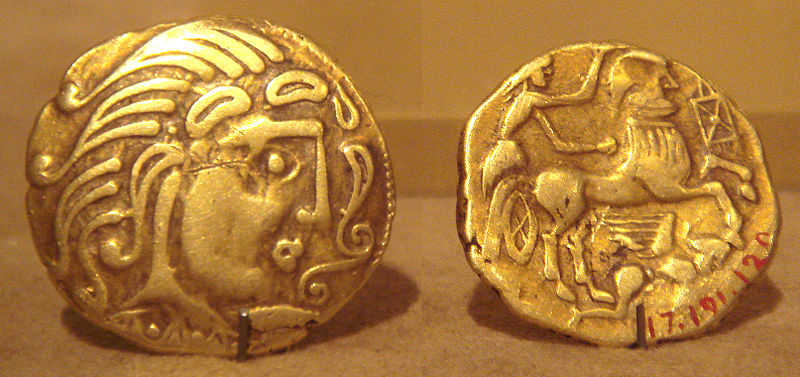
Sí People or Sea People?

The Aes Sídhe (Aos Sí) are the group that in Gaelic folkore are known as fairies. Their name translates to English as ‘People of Peace’ or ‘People of the Sid-Mounds’ depending upon our interpretation of Sídhe, for the word ‘Síd‘ and its variants are used in a number of ways in Gaelic literature and tradition:

The Tuatha Dé Danann live in the ‘Síd‘ mounds in Ireland’s legendary fairy bardic romance literature, for example at ‘Síd Nechtain’. The Hymn of Fiacc (6thC?) claimed that the Irish worshipped Sid, possibly suggesting a race of ?gods called ‘Sid’ or that the Irish worshipped actual mounds. Another hagiographic work from the Book of Armagh (Tírechán‘s Collecteana) describes the reaction of some aristocratic women visiting a holy well at Cruachan, where they meet Patrick and his party, and initially believe them to be

‘viros side aut deorum terrenorum aut fantasiam

This can read ‘Sídhe-men or gods of the earth or apparitions’ or ”Sídhe-men: either gods of the earth or apparitions” depending on how you interpret the Latin (aut … aut …). It is possible that the author was unsure of the definition of the terms…

17thC Irish Historian Ruaidhrí Ó Flaithbheartaigh (Roderic O’Flaherty) made this appraisal of the ‘fair folk’:

“The Irish called aerial spirits or phantoms sidhe, because they are seen to come out of pleasant hills, where the common people imagine they reside, which fictitious habitations are called by us Sidhe or Síodha. ”    (Trans. John O’Donovan)

His summation pretty much expresses the continuing Irish belief. However in the other Gaelic cultural and linguistic territories – the Isle of Man and Scotland – the usage of the term is often open to wider interpretation:

The Manx term ‘Shee’ is less commonly found in relation to geographical locations, although Manx fairy tales often involve visits to subterranean places just as in the Irish traditions. Manx fairies are more often found in wild, peaceful and out-of-the-way locations, suggesting the other Manx etymology of ‘Shee’ – peace – which also corresponds to the inverted state of active daily living.  The same goes for Scottish fairy places called Sithean, which can just as well be secluded places as they can be hillocks or ruins of prehistoric buildings. What the Irish would have called ‘Gentle’ places during the 19thC, frequented by ‘Gentry’ – all Anglo-Irish derivations of the Latin words Gens and Gentes, meaning ‘(a) people’ – generations.

A root-analysis of the words sharing the ‘sith-‘ or ‘sid-‘ prefix in the Irish language can be made by taking a quick look at the online version of the Electronic Dictionary of the Irish Language (‘eDiL’), and is quite revealing. For example:

síd (síodh/sídh/sídhe) – a fairy hill or mound:; wondrous, enchanting, charm-  ing, delightful; In pl. = áes síde supernatural beings, fairies:;

síd/sidi – peace, goodwill, peaceableness;  a state of peace;  a period  of peace, a truce;

sith- (prefix) – long;

síthcháin – peace, a state of peace, a compact  of peace; atonement

sithe/sithi; – permanence (?), lastingness (?);

sithithir/sithir – ‘as long  as’;

Of further interest is how eDiL deals with the term ‘Side’ and its variants:

side (sided/sith/sidi)– a blast or gust (of wind); rush, violent onset, swoop (of a bird), spring (of an  animal); Examples given include the usage: sidhe gaoíthe which folklorists believe means ‘fairy wind’.

The intuitive meaning here for me is that all of these words are related to a common root – one of ‘onset’ or ‘springing up’ and ‘persistence’ which fit with the idea of fairies as the ANCESTORS.

Tírechán, in his collected accounts of Patrick, uses the term ‘Viros side’ to describe what some women think the saint and his companions are when they see them at the spring (fontem) known as Clebach. He does not use ‘Gens side’ or similar but explicitly comments upon their masculine sex. Why?

The first clue lies in the location: Cruachan Hill (‘Cruachan Bri Eile’), probably the Hill of Croghan in Co.Offaly,  bordering the Bog of Allen – a location with some interesting legends and archaeology suggesting it was once a significant place in the pagan Otherworld belief system. The second clue lies in what the women are doing – visiting a spring well. Water was seen as a ‘bridge’ to the fairy world – its reflective qualities suggesting the inverted ‘other’ state. Just as in all of the traditional fairy tales of boy-meets-girl – a woman would expect the síd people she met to be masculine in form, hence ‘Viros Side’

The connection with water and the otherworld is a very strong one in ancient Atlantic European mythology. To the Gaels, the otherworld was sometimes conceived as an island west of the great sea. It might seem frivolous at this point to mention the allusion in the title of this post to a similarity between the Gaelic word síd and the English ‘Sea‘ (from Old English ). However, this equation may not be as fanciful as it at first sounds…

The Germanic word ‘see‘ and its variants is very old, and in its original sense it appears to have referred to any standing body of water. The holy lake in which Tacitus (Germania) tells us ‘Nerthus‘ was bathed in her/his chariot before its attendant slaves were drowned there would represent a ‘sea’ by the old definition. Drowning in pools was almost certainly the fate of the high status Iron Age male bog-body retrieved in 2003 from the Bog of Allen, near to where the girls met those reluctant christian ‘viros side’. Given the importance of raths (often with moats) and crannogs in fairy mythology, it is perhaps worth considering if there is a connection between , síd and ‘sea’…

The Celtic Dioskoroi

As the vernal equinox and green Patrick’s day approaches, I thought it appropriate to comment on the spiritual connotations of one of the season’s visible zodiac constellations: Gemini is visible at the zenith of the ecliptic path directly above Sirius as the sun sets on that day… This is, in mythology, a celestial symbol of the legendary ‘twins’ whose bright stars ‘Castor’ and ‘Pollux’ (Greek: Polydeukes) define the asterism, otherwise known as the ‘Dioscuri’/’Dioskouroi’. These ‘lucky’ brother were usually depicted throughout the Greek and Roman world as horsemen, and were strongly associated in tradition with the protection of mariners.

1stC BCE Greek author Diodorus, writing in the Hellenic province of Sicily made the following comment about the Atlantic Celts (presumably those in the Iberian and Gaulish coasts about whom he knew a fair amount): (‘Library of History’ 4. 56. 4  trans. Oldfather)

“The Keltoi who dwell along the ocean venerate the Dioskoroi above any of the gods, since they have a tradition handed down from ancient times that these gods appeared among them coming from the ocean.”

Of course, we must treat this as we would Caesar’s comment on the worship of ‘Dis Pater’ and ‘Mercury’ – a case of interpretation over that ‘barbarian event-horizon’ which Greeks and Romans (perhaps wilfully) were unable to reconcile with their own worldview. The Celts did not actually venerate ‘Castor and Pollux’ as the same twin demi-gods from Diodorus’ classical world, yet there appears to be a similarity of tradition. The famous ‘twins’ were seen as protecting patrons for Greek and Roman seafarers, as illustrated by their role in the Greek epic tale, Argonautica. However, Diodorus is clearly referring to an ancient indigenous tradition of the Celts involving this constellation.

“Coming from the ocean”

Examining Atlantic Celtic mythology, we can see that there are a good number of traditions of spiritual beings (apart from the obvious figure of Manannan) or saints emerging from the sea, and which could possibly associated with the significance of the Dioskouroi constellation.

In Gallicia we have the christian-era legends associated with Finesterre and Santiago de Compostela (an area strongly associated with local Moura legends) – those of St James or a another character – a horseman – emerging from the sea covered in scallop shells (which have since been the symbol of this pilgrimage).

In Brittany there are the legends of King Gradlon whose horse can gallop on the sea, not to mention his oceanic daughter known as Dahut or Ahes who goes into the sea. The medieval Breton Lais of Graedlent (anon) and Lanval (Marie de France) is also about Gradlon – after falling in love with a fairy the hero is carried into a deep river to fairyland where he lives awaiting a return.

In the Isle of Man, it is a magical female Cailleach – the Caillagh y Groamagh who emerges from the sea at Imbolc (or around the vernal equinox), and back in Brittany she was known as the Groac’h Ahes. Her other Manx incarnation was as ‘Tegi-Tegi’ the beautiful sorceress with the white horse who carries men down into the watery realm to death before transforming into a wren or bat and flying to the heavens. Her horse transforms into a dolphin and swims away.

Celtic saints such as Colmán mac Luacháin, Malo, Brendan, Kentigern, Patrick and Maughold to name a few have similar features appended to their individual legends. That of Colmán mac Luacháin is interesting as the Anglo-Norman era ‘discovery’ of his relics at Lann was dated as March 22 (the spring equinox) in the Annals of Ulster.

Diodorus’ asseertion that the Atlantic Keltoi believed in the ‘Dioskoroi’ as gods, is a statement of equivalency. He is almost certainly referring to the legends of aquatic horsemen involved in Celtic otherworld beliefs.

If we re-examine the original Greek myths of Castor and Polydeukes we can see that they were a ‘split pair’ – one with a celestial provenance (Polydeukes was a son of Zeus) and the other (Castor) merely human. Polydeukes demanded of Zeus that he could be reunited with his mortal brother in death, and Zeus arranged for them to share themselves between Hades and Olympus. This raises the distinct possibility that Gemini was a symbol of the mirrored otherworld co-existence of people, gods and spirits which I have discussed elsewhere.

Their significance at an equinoctial point in the year would be an expression of the balance they represent – hence spending alternating days in Hades and Olympus. The Twins were honoured with a ritual known as the Theoxenios – the setting of a feast for them as guests: much like the former Celtic folk-traditions of leaving food and drink for the ‘fairies’ at night.

The half-human, half-divine equation is also a regular feature of Gaelic legendary lore, explaining man’s relationship to skill and knowledge and with the Otherworld: Characters such as ‘Brownie’ and ‘Gruagach’ (Scotland), ‘Phynnodderee’ (Isle of Man) are portrayed as partaking equally of the human and fairy worlds, as do the semi-divine legendary heroes Cuchaullain and Fionn mac Cumhail of medieval romances. Irish kingship was believed bestowed by a figurative ‘heiros-gamos’ with the fairy world, and the Leanán Sidhe figure was a divine muse of poets. The ‘twins’ are also figurative of tradition – the passage of knowledge from one person (or one world) to the next… For instance, the first codified written law tracts of Ireland came with the advent of Christianity in Ireland:

The Senchus of the men of Erin: What has preserved it? The joint memory of two seniors – the tradition from one ear to another, the composition of poets, the addition from the law of the letter (and) strength from the law of nature, for these are the three rocks by which the judgments of the world are supported. (From: Ancient Laws of Ireland (Senchus Mor) trans. John O’Donovan)

The twin stars in Gemini are exalted in the sky at sunset on the vernal equinox… Winter – the season for storytelling and passing of survival knowledge – is over and the land is again pierced with new life…