Gaelic Polytheism? (Opening a can of worms)

It has become conventional to believe that the Gaels practised a polytheistic form of religion which was partly subsumed or wholly supplanted by Christianity at the coming of St Patrick. However, there are a number of problems with such an interpretation that I would like to address.

Firstly, the contemporary sources we have about actual pagan practises in Ireland are almost non-existent, and most of what we know was written long after the establishment of the new religion. The massive efforts to convert the 4thC Roman Empire from fragmenting polytheism to ‘one-over-all’, top-down theocratic rule started with Emperor Constantine I and his immediate successors. This relied upon propaganda and arguments produced by Christian scholars and apologists operating within the polytheist Mediterranean regions of the empire over the preceding 200 years, and which functioned as a model, a ‘manual’ and a ‘road map’ for propagating Roman christianity across the reaches of its contracting Empire and – in the case of Ireland, way beyond. The spread of Christianity was achieved not by proselytizing rhetoric, but by the conversion and alliance of the church with tribal leaders and their elite inner circles. Once this was complete, the worldview of these rulers’ subjects needed to be changed by coercion, propaganda and cultural revisionism. Bearing in mind that we know that early Irish Christian missionaries travelled to the continent and to Rome to receive their instruction, we must consider how the euhemerist ‘continental’ model for replacing polytheism (operating in earnest from the time of the Emperor Theodosius onwards) influenced their reinvention of the pagan past in order to swing people to christianity. The implication that the Tuatha Dé Danann (as opposed to the síd) were believed in as gods should therefore be viewed with suspicion: The ‘Tuatha’ begin to appear in middle-medieval literature presented variously as former gods, ancestors and historic personages (albeit with a very otherworldly countenance) – much in the same way that continental Christians portrayed pagan gods as deified historic humans in order to demote them. They may well have been created as part of a ‘continental schema’ for imposing Christianity.

Secondly, the conversion of Ireland apparently occurred with surprising ease in a country that had showed little signs of being culturally Romanised. This begs the interpretation that the new religion was therefore possibly not such a titanic shift in worldview as it appeared to have been on the continent. In fact it could even have been considered a ‘paradigm-shift’ or evolution of a system to which it had certain similarities, rather than a wholesale replacement of a complicated pantheon. It certainly ‘hit the floor running’, allowing the Irish to lead with confidence in the christianisation and re-christianisation of the rest of northern Europe. If there had been a hugely ‘other’ and complex polytheistic religion in operation this might not have been so easy, especially as Ireland (so far as we know) didn’t have a religious system that – like that at the heart of the Roman empire – underwent an ‘intellectual gravitational collapse’ after absorbing too many external beliefs. Irish legends in the medieval corpus of texts frequently allude to the pagan Irish prefiguring the coming of christianity, a feature I am not aware of from other cultures.

Thirdly, there is little evidence from folk-tales and traditions supporting the theory of the Tuatha Dé Danann being the former gods. The interpretation of a passage in the presumed 5th-6thC ‘Hymn of Fiacc’ (considered to be an early primary source) may account for this:

On the land of Erin there was darkness;
The Tuatha (Peoples) adored the síd;
They believed not
In the true Deity of the true Trinity.

What exactly the síd are or were is complicated and has no satisfactory resolution from the study of  medieval literature alone. The name was later used for burial and ceremonial mounds, fairy mansions and for the fairies themselves. The TDD were ascribed síd-mounds as homes in the later written myths.

Story traditions from Ireland, Scotland and Mann, often focus on An Cailleach, Fionn mac Cumhaill, Manannan and various other giants and spirits who take on some spectacular and god-like properties in mythological accounts. These are joined by legends of their Christian successors – the saints with their often fantastical and god-like properties. Although there is ample archaeological evidence of supra-regional worldview homogeneity since the Neolithic era, the placenames with pagan origin do not back up the theory that the Tuatha Dé Danann were the gods of the Gael. Where we do have surviving traditions of gods, the most notable is Manannán mac Lir who even today is known to Manx people as ‘their’ god. Medieval literary references to the mysterious gods or idols Crom Cruach or Cenn Croithi (both sounding like epithets rather than proper names) and later folkloric ones to Crom Dubh seem to have little relevance to the literary Tuatha Dé Danann traditions, which monks and/or Christian filidh seemed to use in their suspiciously euhemerist historical revision of paganism. These names (Crom Cruach etc) are linked to assemblies at land-loci: particular plains/fields, or hilltop locations.

SO… if there is a chance that the Gaels were not polytheists, then what were they? The resolution of this question necessarily takes us back to understanding what paganism in general was, and the following is my own personal definition:

Paganism is an allegorical system of spiritual and material philosophy informing the art of survival in a given environment, expressed and transmitted through the mnemonic and dialectic mediums of story, song, aphorism, art and dramatic performance.

If Caesar’s Gallic and British Druids were matched by the magi of the Irish, then  philosophy might be the core value at the heart of the religion, an opinion expressed by the writer on philosophers Diogenes Laertius closer to the time of Ireland’s Christian epiphany. Philosophy was to the ancient world what ‘science’ is to the modern: a technical system that described the universe in both material and allegorical/spiritual terms. Philosophy sought to delineate the indescribable, and the arts provided a non-didactic ‘fuzzy’ medium with which higher truths could be defined without the inevitable destruction that occurs with explicitness. The written word tends to ‘fix’ concepts that are otherwise plastic and ever-changing, thus limiting its conceptual usefulness in establishing doctrines. The Mediterranean approach was to assign a god or spirit to these phenomena and to make statuary images of them which expressed this nature. They also tended to write about them. Both processes produced fixed images of ‘gods’ and created the polytheistic pantheon we know so well. However, the pre-Roman Atlantic Europeans apparently shunned this approach. Their devotion was to images and wordly things (‘idola* et inmunda’) according to Patrick himself (Confessio). (*The definition of ‘idola’ being debateable, as it is a latin usage of a greek word ‘eidola’ meaning ‘image’ orapparition‘ and not necessarily meaning ‘idol’ as in ‘statue or graven image’.)

We have to somehow reconcile the folkloric remainders of what appears to be original practical aspects of Gaelic or Atlantic paganism (with its strong traditions about fairies and their leaders, second sight and the ‘evil eye’) with the literary accounts of the middle ages and evidence from archaeology, place names etc. Analysis of the propaganda techniques used to replace the traditions of the old system has revealed a veritable smorgasbord of euhemerisation, demotion, transformation, canonisation/sanctification and demonization permeating the Christian-era literature and folklore of Europe, making a recovery of the reality of the old pagan system through literature and folklore a difficult but always rewarding task.

Returning to my second point above – the apparent rapidity of conversion – it is worth lingering over the prefigurative literature which alludes to some form of continuity between the pagan and christian systems: The hagiographic legends of Patrick from the Book of Armagh and middle Irish tales such as Altrom Tige Dá Medar (from the Book of Fermoy) state that the way was laid for christianity when the druids prophesised a new order before Patrick arrived, or – in the case of ATDM, Manannán himself is the prophet! Charles MacQuarrie (‘The Waves of Manannan’) makes the case for this god as a pagan exemplar of the Bible’s Yahweh/Jehovah, albeit with a perhaps milder and more sympathetic and less judgemental disposition!

In the Isle of Man, where Manannán is still portrayed as a former king and ancestor as well as an actual current popular god we can see how this process reached its important and unfinished conclusion.

So why choose this overlord of the blessed Isles as the ‘next best’ as an exemplar to the christian god? In Altrom Tige Dá Medar he is cast as overlord of the Tuatha Dé Danann (TDD) whose orders they unquestioningly follow. In spite of this, it is actually quite difficult to include him as a member of the TDD, as he seems to stand apart from them in so many ways. That he should have been chosen for such an explicit euhemerisation in Cormac’s glossary and on the Isle of Man suggests a prominence and equivalence that goes beyond that of the TDD. That a belief in him as lord of the fairy otherworld persisted in folk tradition, along with the strong otherworld ‘fairy’ and ‘second sight’ beliefs I have discussed previously, and the recurring theme of a landscape-associated ‘fairy queen’ suggests that these may well have been core parts of Gaelic paganism.

In the Isle of Man, Manannán is ascribed an immanent presence on the summit of the mountain known as South Barrule, where an ancient hilltop enclosure (‘Cashtal Manannan‘) filled with circular stone ‘beds’ or ‘hut circles’ used to be employed by trysting couples at the festival of Luanys (Lunása – 1st August) as a site for proving love, lust and fertility. The mists which frequently crown the mountain as well as shrouding the whole Island are commonly referred to by most locals as ‘Manannan’s Cloak’. It is somewhat surprising then, that there are comparatively few other places in the Isle of Man named after the god, unless you accept that the whole island itself is eponymous with him.

   Perhaps more interesting are the sneaky profusion of ancient place-names here in this special place that allude to a character of Gaelic folklore with a much more typically immanent presence and connection with the creation and husbandry of the landscape – the Cailleach (Manx: Caillagh) and her various incarnations and epithets as the Fairy Queen. From the hill of ‘Cronk y Berry’ (Eng: Hillberry, Ir: Cnoc Bheara) to the promontory of Gob ny Cally in Maughold and the ancient farm estate of Ballacallin in German the island is peppered with places whose names evoke the giant magical female characters also found in Irish and Scots as well as Welsh mythology, albeit often in ancient and corrupted forms: ‘Chibbyr Unya’ (Aine’s Well), the parish of Santan (‘Saint Anne’ = ‘Seatainne’), ‘Lhing Berrey Dhone’ (‘Pool of Ox-Bheara’, Maughold – there is an ancient Manx folksong about an Ox-stealing ‘witch’, in which it appears that the word Donn has been corrupted. She butchered the Ox in this pool by tradition). There is a ‘Caillagh’s (‘Nun’s’) Chair’ coastal feature on the MArine Drive side of Douglas Head, quite close to a mysterious cliff-cave (now bricked up). The ancient originally Brigitine nunnery of Douglas Priory lies in the shadow of the hill – a continuation of the goddess worship in a pagan guise… Another cave known as ‘Lag Eevl’ (after the Irish Fairy Queen, Aoibheal) in Kirk German, and the hill facing Cronk y Berry known as ‘Cronk y Vill’ or ‘Honey Hill’ have a similar provenance. Add to this the similarly-named hills of ‘Ardwhallin’ (pron. ‘Ardcwhullin’) and the mount of Slieu Whallian (‘Slieve Chullain’) which sits above the Tynwald assembly site and you soon get the idea that Manannan’s presence as an immanent former deity of the island might need to be challenged! The Caillagh was believed to be the Sibyl of the Island and was remembered in recorded folk traditions as late of the 20thC as the source of many prophecies, including one prefiguring the TT Races (which charge deosil around the Island’s central spine of hills). Manannan’s Cloak may once (from the profusion of places named after her) have been the ‘Veil of the Cailleach’…

All this has left me considering if the Gaelic pagan religion was in fact effectively dualistic and ancestor-based? My conclusion is that Manannán was the masculine (solar) polarity who presided over the spiritual Otherworld and the future, terminally and cyclically estranged from the Cailleach who was the elemental ancestress-Creatrix whose body is the earth/elements itself, renewed in the annual cycle. Manannán is a Sun god, NOT a Sea god! There is much circumstantial evidence to support this proposition – in fact, so much more than supports a polytheist interpretation that I find it hard to place a pantheon, except as a philosophical ‘exploding’ of the interactions of these two fundamental characters of Gaelic (and Brythonic) traditions (after the model of Plato’s Timaeus, which I will post on soon). From the Second Sight and Otherworld traditions explained by Robert Kirk, Martin Martin etc to the ancestral-creation myths involving the Cailleach and fairy queen(s) of Ireland and the various half-human wild spirits such as Brownie, Fionn, Phynodderee and Cuchullain, all point towards a binary interpretative system that does not in any way efface with a Tuatha Dé Danann ‘pantheon’.
Diogenes Laertius – the Druids and Magi

Diogenes Laertius was a Greek author of late classical antiquity who wrote an account of the history of Greek philosophy. His introduction deals with the history of Philosophy among the Greeks and ‘Barbarians’ in which he seeks to claim that philosophy – as with all other things of virtue – originated with the Greeks. Of particular interest to scholars of the Atlantic religion are his descriptions of the founding beliefs of barbarian philosophers: (Translation CD Yonge)

I. SOME say that the study of philosophy originated with the barbarians. In that among the Persians there existed the Magi,1 and among the Babylonians or Assyrians the Chaldaei, among the Indians the Gymnosophistae,3 and among the Celts and Gauls men who were called Druids and Semnothei, as Aristotle relates in his book on Magic, and Sotion in the twenty-third book of his Succession of Philosophers. Besides those men there were the Phoenician Ochus, the Thracian Zamolxis, and the Libyan Atlas. For the Egyptians say that Vulcan was the son of Nilus, and that he was the author of philosophy, in which those who were especially eminent were called his priests and prophets.

II. From his age to that of Alexander, king of the Macedonians, were forty-eight thousand eight hundred and sixty-three years, and during this time there were three hundred and seventy-three eclipses of the sun, and eight hundred and thirty-two eclipses of the moon.

Again, from the time of the Magi, the first of whom was Zoroaster the Persian, to that of the fall of Troy, Hermodorus the Platonic philosopher, in his treatise on Mathematics, calculates that fifteen thousand years elapsed. But Xanthus the Lydian says that the passage of the Hellespont by Xerxes took place six thousand years after the time of Zoroaster,6 and that after him there was a regular succession of Magi under the names of Ostanes and Astrampsychos and Gobryas and Pazatas, until the destruction of the Persian empire by Alexander.

III. But those who say this, ignorantly impute to the barbarians the merits of the Greeks, from whom not only all philosophy, but even the whole human race in reality originated. For Musaeus was born among the Athenians, and Linus among the Thebans; and they say that the former, who was the son of Eumolpus, was the first person who taught the system of the genealogy of the gods, and who invented the spheres; and that he taught that all things originated in one thing, and when dissolved returned to that same thing; and that he died at Phalerum, and that this epitaph was inscribed on his tomb:

Phalerum’s soil beneath this tomb contains  Musaeus dead, Eumolpus’ darling son.

And it is from the father of Musaeus that the family called Eumolpidae among the Athenians derive their name. They say too that Linus was the son of Mercury and the Muse Urania; and that he invented a system of Cosmogony, and of the motions of the sun and moon, and of the generation of animals and fruits; and the following is the beginning of his poem,

There was a time when all the present world  Uprose at once.

From which Anaxagoras derived his theory, when he said that all things had been produced at the same time, and that then intellect had come and arranged them all in order.

They say, moreover, that Linus died in Euboea, having been shot with an arrow by Apollo, and that this epitaph was set over him:

The Theban Linus sleeps beneath this ground,  Urania’s son with fairest garlands crown’d.

IV. And thus did philosophy arise among the Greeks, and indeed its very name shows that it has no connection with the barbarians. But those who attribute its origin to them, introduce Orpheus the Thracian, and say that he was a philosopher, and the most ancient one of all. But if one ought to call a man who has said such things about the gods as he has said, a philosopher, I do not know what name one ought to give to him who has not scrupled to attribute all sorts of human feelings to the gods, and even such discreditable actions as are but rarely spoken of among men; and tradition relates that he was murdered by women; but there is an inscription at Dium in Macedonia, saying that he was killed by lightning, and it runs thus:

Here the bard buried by the Muses lies,          The Thracian Orpheus of the golden lyre;  Whom mighty Jove, the Sovereign of the skies,          Removed from earth by his dread lightning’s fire.

V. But they who say that philosophy had its rise among the barbarians, give also an account of the different systems prevailing among the various tribes. And they say that the Gymnosophists and the Druids philosophize, delivering their apophthegmns in enigmatical language, bidding men worship the gods and do no evil, and practise manly virtue.

VI. Accordingly Clitarchus, in his twelfth book, says that the Gymnosophists despise death, and that the Chaldaeans study astronomy and the science of soothsaying–that the Magi occupy themselves about the service to be paid to the gods, and about sacrifices and prayers, as if they were the only people to whom the deities listen: and that they deliver accounts of the existence and generation of the gods, saying that they are fire, and earth, and water; and they condemn the use of images, and above all things do they condemn those who say that the gods are male and female; they speak much of justice, and think it impious to destroy the bodies of the dead by fire; they allow men to marry their mothers or their daughters, as Sotion tells us in his twenty-third book; they study the arts of soothsaying and divination, and assert that the gods reveal their will to them by those sciences. They teach also that the air is full of phantoms, which, by emanation and a sort of evaporation, glide into the sight of those who have a clear perception; they forbid any extravagance of ornament, and the use of gold; their garments are white, their beds are made of leaves, and vegetables are their food, with cheese and coarse bread; they use a rush for a staff, the top of which they run into the cheese, and so taking up a piece of it they eat it. Of all kinds of magical divination they are ignorant, as Aristotle asserts in his book on Magic, and Dinon in the fifth book of his Histories. And this writer says, that the name of Zoroaster being interpreted means, a sacrifice to the stars; and Hermodorus makes the same statement. But Aristotle, in the first book of his Treatise on Philosophy, says, that the Magi are more ancient than the Egyptians; and that according to them there are two principles, a good demon and an evil demon, and that the name of the one is Jupiter or Oromasdes, and that of the other Pluto or Arimanius. And Hermippus gives the same account in the first book of his History of the Magi; and so does Eudoxus in his Period; and so does Theopompus in the eighth book of his History of the Affairs of Philip; and this last writer tells us also, that according to the Magi men will have a resurrection and be immortal, and that what exists now will exist hereafter under its own present name; and Eudemus of Rhodes coincides in this statement. But Hecataeus says, that according to their doctrines the gods also are beings who have been born. But Clearchus the Solensian, in his Treatise on Education says, that the Gymnosophists are descendants of the Magi; and some say that the Jews also are derived from them. Moreover, those who have written on the subject of the Magi condemn Herodotus; for they say that Xerxes would never have shot arrows against the sun, or have put fetters on the sea, as both sun and sea have been handed down by the Magi as gods, but that it was quite consistent for Xerxes to destroy the images of the gods.

VII. The following is the account that authors give of the philosophy of the Egyptians, as bearing on the gods and on justice. They say that the first principle is matter; then that the four elements were formed out of matter and divided, and that some animals were created, and that the sun and moon are gods, of whom the former is called Osiris and the latter Isis, and they are symbolised under the names of beetles and dragons, and hawks, and other animals, as Manetho tells us in his abridged account of Natural Philosophy, and Hecataeus confirms the statement in the first book of his History of the Philosophy of the Egyptians. They also make images of the gods, and assign them temples because they do not know the form of God. They consider that the world had a beginning and will have an end, and that it is a sphere; they think that the stars are fire, and that it is by a combination of them that the things on earth are generated; that the moon is eclipsed when it falls into the shadow of the earth; that the soul is eternal and migratory; that rain is caused by the changes of the atmosphere; and they enter into other speculations on points of natural history, as Hecataeus and Aristagoras inform us.

They also have made laws about justice, which they attribute to Mercury, and they consider those animals which are useful to be gods. They claim to themselves the merit of having been the inventors of geometry, and astrology, and arithmetic. So much then for the subject of invention.

VIII. But Pythagoras was the first person who invented the term Philosophy, and who called himself a philosopher; when he was conversing at Sicyon with Leon, who was tyrant of the Sicyonians or of the Phliasians (as Heraclides Ponticus relates in the book which he wrote about a dead woman); for he said that no man ought to be called wise, but only God. For formerly what is now called philosophy (philosophia) was called wisdom (sophia), and they who professed it were called wise men (sophoi), as being endowed with great acuteness and accuracy of mind; but now he who embraces wisdom is called a philosopher (philosophos).

But the wise men were also called Sophists. And not only they, but poets also were called Sophists: as Cratinus in his Archilochi calls Homer and Hesiod, while praising them highly….

Plutarch’s account of Cronus worship in the Atlantic north

Here is an important part of a chapter from the Moralia of the 1st/2ndC CE Greek philosopher Plutarch, in which his narrators discuss a fascinating tradition of the worship of Cronus on an island somewhere off or in the archipelagos of northwest Europe. They then go on to digress on the  Orphic mysteries…

From: ‘Concerning the Face  Which Appears in the Orb of the Moon’

26 …Almost before I had finished, Sulla broke in. “Hold on, Lamprias,” he said, “and put to the wicket of your discourse lest you unwittingly run the myth aground, as it were, and confound my drama, which has a different setting and a different disposition. Well, I am but the actor of the piece, but first I shall say that its author began for our sake — if there be no objection — with a quotation from Homer:

An isle, Ogygia, lies far out at sea,

a run of five days off from Britain as you sail westward; and three other islands equally distant from it and from one another lie out from it in the general direction of the summer sunset. In one of these, according to the tale told by the natives, Cronus is confined by Zeus, and the antique Briareus, holding watch and ward over those islands and the sea that they call the Cronian main, has been settled close beside him. The great mainland, by which the great ocean is encircled, while not so far from the other islands, is about five thousand stades from Ogygia, the voyage being made by oar, for the main is slow to traverse and muddy as a result of the multitude of streams. The streams are discharged by the great land-mass and produce alluvial deposits, thus giving density and earthiness to the sea, which has been thought actually to be congealed. On the coast of the mainland Greeks dwell about a gulf which is not smaller than the Maeotis and the mouth of the Caspian sea. These people consider and call themselves continentals and the inhabitants of this land islanders because the sea flows around it on all sides; and they believe that with the peoples of Cronus there mingled at a later time those who arrived in the train of Heracles and were left behind by him and that these latter so to speak rekindled again to a strong, high flame the Hellenic spark there which was already being quenched and overcome by the tongue, the laws, and the manners of the barbarians. Therefore Heracles has the highest honours and Cronos the second. Now when at intervals of thirty years the star of Cronus, which we call ‘Splendent’ but they, our author said, call ‘Night-watchman,’ enters the sign of the Bull, they, having spent a long time in preparation for the sacrifice and the expedition, choose by lot and send forth a sufficient number of envoys in a correspondingly sufficient number of ships, putting aboard a large retinue and the provisions necessary for men who are going to cross so much sea by oar and live such a long time in a foreign land. Now when they have put to sea the several voyagers meet with various fortunes as one might expect; but those who survive the voyage first put in at the outlying islands, which are inhabited by Greeks, and see the sun pass out of sight for less than an hour over a period of thirty days, — and this is night, though it has a darkness that is slight and twilight glimmering from the west. There they spend ninety days regarded with honour and friendliness as holy men and so addressed, and then winds carry them across to their appointed goal. Nor do any others inhabit it but themselves and those who have been dispatched before them, for, while those who have served the god together for the stint of thirty years are allowed to sail off home, most of them usually choose to settle in the spot, some out of habit and others because without toil or trouble they have all things in abundance while they constantly employ their time in sacrifices and celebrations or with various discourse and philosophy, for the nature of the island is marvellous as is the softness of the circumambient air. Some when they intend to sail away are even hindered by the divinity which presents itself to them as to intimates and friends not in dreams only or by means of omens, but many also come upon the visions and the voices of spirits manifest. For Cronus himself sleeps confined in a deep cave of rock that shines like gold — the sleep that Zeus has contrived like a bond for him —, and birds flying in over the summit of the rock bring ambrosia to him, and all the island is suffused with fragrance scattered from the rock as from a fountain; and those spirits mentioned before tend and serve Cronus, having been his comrades what time he ruled as king over gods and men. Many things they do foretell of themselves, for they are oracular; but the prophecies that are greatest and of the greatest matters they come down and report as dreams of Cronus, for all that Zeus premeditates Cronus sees in his dreams and the titanic affections and motions of his soul make him rigidly tense until sleep restores his repose once more and the royal and divine element is all by itself, pure and unalloyed. Here then the stranger was conveyed, as he said, and while he served the god became at his leisure acquainted with astronomy, in which he made as much progress as one can by practising geometry, and with the rest of philosophy by dealing with so much of it as is possible for the natural philosopher. Since he had a strange desire and longing to observe the Great Island (for so, it seems, they call our part of the world), when the thirty years had elapsed, the relief-party having arrived from home, he saluted his friends and sailed away, lightly equipped for the rest but carrying a large viaticum in golden beakers. Well, all his experiences and all the men whom he visited, encountering sacred writings and being initiated in all rites — to recount all this as he reported it to us, relating it thoroughly and in detail, is not a task for a single day; but listen to so much as is pertinent to the present discussion. He spent a great deal of time in Carthage inasmuch as Cronus receives great honour in our country, and he discovered certain sacred parchments that had been secretly spirited off to safety when the earlier city was being destroyed and had lain unnoticed in the ground for a long time. Among the visible gods he said that one should especially honour the moon, and so he kept exhorting me to do, inasmuch as she is sovereign over life and death, bordering as she does upon the meads of Hades.

27 When I expressed surprise at this and asked for a clearer account, he said: ‘Many assertions about the gods, Sulla, are current among the Greeks, but not all tom are right. So, for example, although they give the right names to Demeter and Cora, they are wrong in believing that both are together in the same region. The fact is that the former is in the region of earth and is sovereign over terrestrial things, and the latter is in the moon and mistress of lunar things. She has been called both Cora and Phersephonê, the latter as being a bearer of light and Cora because that is what we call the part of the eye in which is reflected the likeness of him who looks into it as the light of the sun is seen in the moon. The tales told of the wandering and the quest of these goddesses Econtain the truth <spoken covertly>, for they long for each other when they are apart and they often embrace in the shadow. The statement concerning Cora that now she is in the light of heaven and now in darkness and night is not false but has given rise to error in the computation of the time, for not throughout six months but every six months we see her being wrapped in shadow by the earth as it were by her mother, and infrequently we see this happen to her at intervals of five months, for she cannot abandon Hades since she is the boundary of Hades, as Homer too has rather well put it in veiled terms:

But to Elysium’s plain, the bourne of earth.

Where the range of the earth’s shadow ends, this he set as the term and boundary of the earth. To this point rises no one who is evil or unclean, but the good are conveyed thither after death and there continue to lead a life most easy to be sure though not blesséd or divine until their second death.

28 And what is this, Sulla? Do not ask about these things, for I am going to give a full explanation myself. Most people rightly hold man to be composite but wrongly hold him to be composed of only two parts. The reason is that they suppose mind to be somehow part of soul, thus erring no less than those who believe soul to be part of body, for in the same degree as soul is superior to body so is mind better and more divine than soul. The result of soul and body commingled is the irrational or the affective factor, whereas of mind and soul the conjunction produces reason; and of these the former is source of pleasure and pain, the latter of virtue and vice. In the composition of these three factors earth furnishes the body, the moon the soul, and the sun furnishes mind to man for the purpose of his generation even as it furnishes light to the moon herself. As to the death we die, one death reduces man from three factors to two and another reduces him from two to one; and the former takes place in the earth that belongs to Demeter (wherefore “to make an end” is called “to render one’s life to her” and Athenians used in olden times to call the dead “Demetrians”), the latter in the moon that belongs to Phersephonê, and associated with the former is Hermes the terrestrial, with the latter Hermes the celestial.While the goddess here dissociates the soul from the body swiftly and violently, Phersephonê gently and by slow degrees detaches the mind from the soul and has therefore been called “single-born” because the best part of man is “born single” when separated off by her. Each of the two separations naturally occurs in this fashion: All soul, whether without mind or with it, when it has issued from the body is destined to wander in the region between earth and moon but not for an equal time. Unjust and licentious souls pay penalties for their offences; but the good souls must in the gentlest part of the air, which they call “the meads of Hades,” pass a certain set time sufficient to purge and blow away the pollutions contracted from the body as from an evil odour. Then, as if brought home from banishment abroad, they savour joy most like that of initiates, which attended by glad expectation is mingled with confusion and excitement. For many, even as they are in the act of clinging to the moon, she thrusts off and sweeps away; and some of those souls too that are on the moon they see turning upside down as if sinking again into the deep. Those that have got up, however, and have found a firm footing first go about like victors crowned with wreaths of feathers called wreaths of steadfastness, because in life they had made the irrational or affective element of the soul orderly and tolerably tractable to reason; secondly, in appearance resembling a ray of light but in respect of their nature, which in the upper region is buoyant as it is here in ours, resembling the ether about the moon, they get from it both tension and strength as edged instruments get a temper, for what laxness and diffuseness they still have is strengthened and becomes firm and translucent. In consequence they are nourished by any exhalation that reaches them, and Heraclitus was right in saying: “Souls employ the sense of smell in Hades.”

29 First they behold the moon as she is in herself: her magnitude and beauty and nature, which is not simple and unmixed but a blend as it were of star and earth. Just as the earth has become soft by having been mixed with breath and moisture and as blood gives rise to sense-perception in the flesh with which it is commingled, so the moon, they say, because it has been permeated through and through by ether is at once animated and fertile and at the same time has the proportion of lightness to heaviness in equipoise. In fact it is in this way too, they say, that the universe itself has entirely escaped local motion, because it has been constructed out of the things that naturally move upwards and those that naturally move downwards. This was also the conception of Xenocrates who, taking his start from Plato, seems to have reached it by a kind of superhuman reasoning. Plato is the one who declared that each of the stars as well was constructed of earth and fire bound together in a proportion by means of the two intermediate natures, for nothing, as he said, attains perceptibility that does not contain an admixture of earth and light; but Xenocrates says that the stars and the sun are composed of fire and the first density, the moon of the second density and air that is proper to her, and the earth of water and air and the third kind of density and that in general neither density all by itself nor subtility is receptive of soul. So much for the moon’s substance. As to her breadth or magnitude, it is not what the geometers say but many times greater. She measures off the earth’s shadow with few of her own magnitudes not because it is small but she more ardently hastens her motion in order that she may quickly pass through the gloomy place bearing away the souls of the good which cry out and urge her one because when they are in the shadow they no longer catch the sound of the harmony of heaven. At the same time too with wails and cries the souls of the chastised then approach through the shadow from below. That is why most people have the custom of beating brasses during eclipses and of raising a din and clatter against the souls, which are frightened off also by the so‑called face when they get near it, for it has a grim and horrible aspect. It is no such thing, however; but just as our earth contains gulfs that are deep and extensive, one here pouring in towards us through the Pillars of Heracles and outside the Caspian and the Red Sea with its gulfs, so those features are depths and hollows of the moon. The largest of them is called “Hecatê’s Recess,” where the souls suffer and exact penalties for whatever they have endured or committed after having already become Spirits; and the two long ones are called “the Gates”, for through them pass the souls now to the side of the moon that faces heaven and now back to the side that faces earth. The side of the moon towards heaven is named “Elysian plain,” the hither side “House of counter-terrestrial Phersephonê.”

30 Yet not forever do the Spirits tarry upon the moon; they descend hither to take charge of oracles, they attend and participate in the highest of the mystic rituals, they act as warders against misdeeds and chastisers of them, and they flash forth as saviour a manifest in war and on the sea. For any act that they perform in these matters not fairly but inspired by wrath or for an unjust end or out of envy they are penalized, for they are cast out upon earth again confined in human bodies. To the former class of better Spirits the attendants of Cronos said that they belong themselves as did aforetime the Idaean Dactyls in Crete and the Corybants in Phrygia as well as the Boeotian Trophoniads in Udora and thousands of others in many parts of the world whose rites, honours, and titles persist but whose powers tended to another place as they achieved the ultimate alteration. They achieve it, some sooner and some later, once the mind has been separated from the soul. It is separated by love for the image in the sun through which shines forth manifest the desirable and fair and divine and blessed towards which all nature in one way or another yearns, for it must be out of love for the sun that the moon herself goes her rounds and gets into conjunction with him in her yearning to receive from him what is most fructifying. The substance of the soul is left upon the moon and retains certain vestiges and dreams of life as it were; it is this that you must properly take to be the subject of the statement

Soul like a dream has taken wing and sped,

for it is not straightway nor once it has been released from the body that it reaches this state but later when, divorced from the mind, it is deserted and alone. Above all else that Homer said his words concerning those in Hades appear to have been divinely inspired.

Thereafter marked I mighty Heracles — His shade; but he is with the deathless god. . .

In fact the self of each of us is not anger or fear or desire just as it is not bits of flesh or fluids either but is that which we reason and understand; and the soul receives the impression of its shape through being moulded by the mind and moulding in turn and enfolding the body on all sides, so that, even if it be separated from either one for a long time, since it preserves the likeness and the imprint it is correctly called an image. Of these, as has been said, the moon is the element, for they are resolved into it as the bodies of the dead are resolved into earth. This happens quickly to the temperate souls who had been fond of a leisurely, unmeddlesome, and philosophical life, for abandoned by the mind and no longer exercising the passions for anything they quickly wither away. Of the ambitious and the active, the irascible and those who are enamoured of the body, however, some pass their time as it were in sleep with the memories of their lives for dreams as did the soul of Endymion; but, when they are excited by restlessness and emotion and drawn away from the moon to another birth, she forbids them <to sink towards earth> and keeps conjuring them back and binding them with charms, for it is no slight, quiet, or harmonious business when with the affective faculty apart from reason they seize upon a body. Creatures like Tityus and Typho and the Python that with insolence and violence occupied Delphi and confounded the oracle belonged to this class of souls, void of reason and subject to the affective element gone astray through delusion; but even these in time the moon took back to herself and reduced to order. Then when the sun with his vital force has again sowed mind in her she receives it and produces new souls, and earth in the third place furnishes body. In fact, the earth gives nothing in giving back after death all that she takes for generation, and the sun takes nothing but takes back the mind that he gives, whereas the moon both takes and gives and joins together and divides asunder in virtue of her different powers, of which the one that joins together is called Ilithyia and that which divides asunder Artemis. Of the three Fates too Atropos enthroned in the sun initiates generation, Clotho in motion on the moon mingles and binds together, and finally upon the earth Lachesis too puts her hand to the task, she who has the largest share in chance. For the inanimate is itself powerless and susceptible to alien agents, and the mind is impassable and sovereign; but the soul is a mixed and intermediate thing, even as the moon has been created by god a compound and blend of the things above and below and therefore stands to the sun in the relation of earth to moon.’

This,” said Sulla, “I heard the stranger relate; and he had the account, as he said himself, from the chamberlains and servitors of Cronus. You and your companions, Lamprias, may make what you will of the tale.”

These passages detail an Atlantic cult of ‘Cronus’ whose initiates spend 30 years in service – the same period Caesar quoted for the druids. They also perform peregrinations from their central territory, where Cronus is believed interred in a cavern in the earth. Plutarch states this place to be Ogygia – an island supposed in Greek myth to have been inhabited by Atlas (Atlantis) and his daughter Calypso, who imprisoned Oddyseus for 7 years – a period of time typical to Irish fairy abduction myths written in the middle ages. Irish myths sometimes portray the magical islands associated with Manannan in such a way – including the Isle of Man.  The name ‘Ogygia’ is connected to the Gyges or ‘giants’ of whom the Titans seem to be the main class in Greek myth. The names of Okeanos and Ogyges have been linked, and Plutarch’s account seems to back up this identity, perhaps conflating Cronus, Okeanos and Atlas/Atlantis under the same identity…

The text also discusses the flight of souls to the moon, which Plutarch describes as being near to Hades in the context of this chapter. Surely he is not describing a purely Greek myth? To the Greeks Hades’ realm is a chthonic underworld place, sitting above the pit of Tartarus…


Cronos, Orphic and Eleusinian mysteries and spirit-traditions of ancient Europe

In Greek poet Hesiod’s c.7thC BCE account of the ‘time before memory’ in the early days of creation, Cronus was the Titan ‘god’ of the ‘Golden Age’ – an idealised period after creation when a perfect race of men existed, and all was bountiful with no work or conflict nescessary:

First of all the deathless gods who dwell on Olympus made a golden race of mortal men who lived in the time of Cronos when he was reigning in heaven.  And they lived like gods without sorrow of heart, remote and free from toil and grief: miserable age rested not on them; but with legs and arms never failing they made merry with feasting beyond the reach of all evils.  When they died, it was as though they were overcome with sleep, and they had all good things; for the fruitful earth unforced bare them fruit abundantly and without stint.  They dwelt in ease and peace upon their lands with many good things, rich in flocks and loved by the blessed gods.

But after earth had covered this generation — they are called pure spirits dwelling on the earth, and are kindly, delivering from harm, and guardians of mortal men; for they roam everywhere over the earth, clothed in mist and keep watch on judgements and cruel deeds, givers of wealth; for this royal right also they received…

Source: Hesiod ‘Works and Days’ trans H.G. Evelyn White 1912.

The myth goes on to relate the subsequent four creations of humans down to Hesiod’s ‘modern’ day (c.7thC BCE, the ‘Age of Iron’), portraying each successive race of mankind as progressively debased and further from the godly ideals. The other races who came after the Golden are the Silver, the Bronze, and penultimately and somewhat curiously – the Race of Demi-Gods: people who were great enough to enjoy a deified status or to have a half-divine parentage. To these, he assigns an eternal existence in the Blessed Isles:

But to the others father Zeus the son of Kronos gave a living and an abode apart from men, and made them dwell at the ends of earth. And they live untouched by sorrow in the Islands of the Blessed (Nesoi Makarôn) along the shore of deep swirling Okeanos, happy heroes for whom the grain-giving earth bears honey-sweet fruit flourishing thrice a year, far from the deathless gods, and Kronos rules over them; for the father of men and gods released him from his bonds. And these last equally have honour and glory.”

It appears that Hesiod has made a distinction between the more ancient Golden Race and the Demigods who preceded the Men of Iron, yet the description of their existence and their ruler -Kronos/Cronos – is more or less identical, suggesting Hesiod sought to somehow change the tradition. This may well relate to Hesiod’s wish to promote the Olympian cult of Zeus which must have displaced that of Cronos, as described in his poetic narratives – Theogony and Works and Days. It is quite possible that Cronos represented a more primitive occidental god that the Greeks identified with the barbarian peoples to their north and west, and for this reason Hesiod and his contemporaries demoted him into exile on an Island far to the west…

Hesiod’s account of the race of the Golden Age is interesting in that these ‘ancestors’ who live on as helper-spirits (the original greek word is Daimôn) seem very similar to what Atlantic Europeans in the 2nd millennium CE referred to as fairies or elves in their own mythology. They certainly have aspects that we encounter in the denizens of much later ‘Celtic’ tales of the glorious otherworld – beauty, abundance, prosperity and peace.

Plato (4thC BCE) in his Socratic dialogue known as Cratylus discusses the belief that the eternal souls of virtuous humans become Daimones or Daemones (helper spirits – not the ‘evil spirits’ which Christianity later created from them) and refers to Hesiod’s Golden Race to make his point. His 4thC BCE Athenians agree that the eternal souls of virtuous men in their own time might achieve the same – not just those of the ancient mythical race of men. In Timaeus Plato expounded a common belief that souls were made of aither and the stars could be conceived of as souls of the departed (which is why demigods were placed in the sky as constellations). He has this to say of the Creator of the Universe:

….And once more into the cup in which he had previously  mingled the soul of the universe he poured the remains of the elements,  and mingled them in much the same manner; they were not, however, pure  as before, but diluted to the second and third degree. And having made  it he divided the whole mixture into souls equal in number to the stars, and assigned each soul to a star…

He based much of this story on Hesiod, who he references in Cratylus. He goes on to discuss reincarnation:

He who lived well during his appointed time was  to return and dwell in his native star, and there he would have a blessed  and congenial existence. But if he failed in attaining this, at the second birth he would pass into a woman, and if, when in that state of being,  he did not desist from evil, he would continually be changed into some  brute who resembled him in the evil nature which he had acquired, and would not cease from his toils and transformations until he followed the revolution  of the same and the like within him, and overcame by the help of reason  the turbulent and irrational mob of later accretions, made up of fire and  air and water and earth, and returned to the form of his first and better  state.

The 1stC BCE Roman author Virgil was of the same opinion, being heavily influenced by Pythagorean, Platonic and Orphic doctrines which often went hand-in-hand in his day, as they were intimately concerned with the passage of the soul in former and future lives as well as the current. In this regard they were not much different to what Caesar said the Atlantic peoples of northwest Europe believed in. One of Roman society’s most popular celebrations was the Saturnalia which terminated at the Winter Solstice and celebrated the abundance of the Golden Age ruled over by Saturn (Rome’s name for Cronos), in the lead-up to the returning year. This was a festival of what I have referred to as ‘Otherworld Inversions‘ – masters would serve slaves, and the slaves could rest, for example.

So … what was Orphism and how does it relate to Cronos?

The Orphic faith has been identified from writings dated from at least the 4thC BCE onwards, though its origins are unknown and it may be partly evolved from a much older belief system – namely the Dionysian and Eleusinian mysteries with which they share much of their narrative structure. Orphism had definitely attained a consolidated (literary) existence at the advent of the Hellenic period and became one of the most influential mystery cults of the classical world, staying in existence until the late classical period. The surviving evidence for it is fragmentary and comes from literature (e.g. – the ‘Dereveni papyrus’, writings of the Neo-Platonist philosophers), art and inscriptions.

The key knowledge of the mysteries was said to have been gained by the proto-poet Orpheus in a visit to (and return from) Hades – the afterlife, which is the key aspect of the mysteries. The background story relied upon what are termed the ‘Orphic Theogonies’ (creation myths of the universe and the gods) which ultimately explained the creation of mankind the passage of the eternal soul through various states or cycles of reincarnation before it reached perfection.

The reincarnation beliefs of the Orphic and Eleusinian mysteries revolved around a shared dramatisation of the reincarnation of the year: The abduction of Kore (Persephone), daughter of Demeter (Rhea) by Hades, and her eventual release on the condition that she returned annually to his underworld. Zeus’ son and heir by Persephone (his daughter!) is the first incarnation of the god Dionysus – sometimes referred to in Orphism as ‘Zagreus’ and identified with Egyptian Osiris. Orphism attempted to weld aspects of older (Mycaenean and Barbarian/Thracian) religion and the high philosophies of Egyptian religion to the Olympian pantheon. In the Orphic theogonies, the young Dionysus-Zagreus is given the throne of Olympus by his father. Rhea inflames the Titans with anger at this and they dismember him after the manner of Osiris before consuming most of his body (Rhea keeps the heart). As punishment Zeus burns the Titans with lightning, turning them (and their meal) to ash and soot from which humans are created – their souls formed from the spiritual essence of Dionysus and their bodies from the soot and ash of the Titans’ bodies.

This is somewhat different from Hesiod’s ages of men, and perhaps explains the importance attained by the Cult of Dionysus or Bacchus in later antiquity: Celebrants of the cult sought to liberate themselves from their bodily limitations and experience the divine in a state of ecstasy. The Orphic and Eleusinian initiates appear to have believed that the soul passed through a number of bodies in order to purify itself from the envy and pride of the Titans of whom Cronus was the exiled leader. Dionysus represented a liminal figure whose death and rebirth (from the heart saved by Rhea) meant that he trod between the ordered realm of the Olympian gods and that of the Titans (who represented chaos, and primal forces), to whom the Olympians were ultimately subject to, in spite of their apparent besting and mastery of them in legend. Zeus and his colleagues were not omnipotent in Greek theology – they were prone to human foibles and subject to the forces of higher powers such as Fate and Chaos, as much as they were beholden to the structure of the elements and aither…

It is apparent that the theologies about Cronus, the origins of humanity, the transmigrations of the soul, and the link of this to the seasonal drama of the returning year was part of a more ancient European and Middle-Eastern religious system. Their existence is paralleled in the fairy beliefs of the Atlantic Europeans, and in the folklore of the Cailleach, Manannan,  Mag Mell and the Land of Youth, all of which are at the heart of the survivals of the Atlantic Religion in folk culture of northwest Europe.


Bronze Age roots of European Paganism

A deep and insoluble question that dogs the history of paganism in northern Europe before the advent of Greek and Roman expansion and christianity is that which asks about its structure and theology. Was it generally polytheist – believing in a host of different gods each with individual functions? If so, did it follow a similar system to the southern European religions? …. Or was its focus dualist – having god and goddess figures representing the perceived universal polarities? What if the dualist interpretation is the root of the polytheist, even?

Romans such as Julius Caesar (1stC BC De Bello Gallico) wrote that the ‘barbarian’ Gauls worshipped similar gods to them, but scholars consider such accounts as undetailed and lacking useful context. The fact that some Gauls in the south appear to have become quite Hellenized by the time of Caesar’s wars demonstrates the complicating factors at play. From the accounts we can see there are some apparent differences in theology and organisation between Gaulish/British and Roman official religion: Foremost was the system or college of learned druids at the apex of these societies, and also the reported emphasis on reincarnation, and the ideas about human ‘sacrifice’ that these appeared to engender:

They are said there to learn by heart a great number of verses; accordingly some remain in the course of training twenty years. Nor do they regard it lawful to commit these to writing, though in almost all other matters, in their public and private transactions, they use Greek characters. That practice they seem to me to have adopted for two reasons; because they neither desire their doctrines to be divulged among the mass of the people, nor those who learn, to devote themselves the less to the efforts of memory, relying on writing; since it generally occurs to most men, that, in their dependence on writing, they relax their diligence in learning thoroughly, and their employment of the memory. They wish to inculcate this as one of their leading tenets, that souls do not become extinct, but pass after death from one body to another, and they think that men by this tenet are in a great degree excited to valor, the fear of death being disregarded. They likewise discuss and impart to the youth many things respecting the stars and their motion, respecting the extent of the world and of our earth, respecting the nature of things, respecting the power and the majesty of the immortal gods

In the same book (De Bello Gallico Book 6 ch.21) Caesar claimed that the German peoples of the 1stC BC:

” … rank in the number of the gods those alone whom they behold, and by whose instrumentality they are obviously benefited, namely, the sun, fire, and the moon; they have not heard of the other deities even by report…”

Coupled to his assertion that the Germans had no Druids, Caesar was possibly making a declaration of their apparent primitivism and lack of philosophical gods and ideals. Surely no Roman would stoop to this? Caesar had his eyes on conquest…

However Caesar’s life was curtailed by jealous forces, and when his successor Augustus commissioned Vergil to write the Aeneid about Rome’s supposed cultural origins at Troy, Caesar’s comment on reincarnation (seemingly a barbaric tenet) has its waters somewhat muddied by Book 6 which depicts Aeneas’ visit to Hades to his father, Anchises. During this he is instructed how purified souls drink the waters of forgetfulness from the River Lethe before crossing into reincarnation. This crossing is sometimes associated with entering Elysium – a place Homer placed on the banks of the world-encircling river, Okeanos, and which Hesiod referred to as the Blessed Isles, watched over by the Titan god Cronus (Saturn to the Romans). This is not actually that unusual as Pythagoras had a well-documented belief in metempsychosis that – along with the writings of Plato (Timaeus) and with the Greek mystery cults – had a popular following among the intellectual elites of the Roman Empire, Vergil and Ovid being particular examples. Here is that part of the Aenied:

[723] Meanwhile, in a retired vale, Aeneas sees a sequestered grove and rustling forest thickets, and the river Lethe drifting past those peaceful homes. About it hovered peoples and tribes unnumbered; even as when, in the meadows, in cloudless summertime, bees light on many-hued blossoms and stream round lustrous lilies and all the fields murmur with the humming. Aeneas is startled by the sudden sight and, knowing not, asks the cause – what is that river yonder, and who are the men thronging the banks in such a host? Then said father Anchises: “Spirits they are, to whom second bodies are owed by Fate, and at the water of Lethe’s stream they drink the soothing draught and long forgetfulness. These in truth I have long yearned to tell and show you to your face, yea, to count this, my children’s seed, that so you may rejoice with me the more at finding Italy.” “But, father, must we think that any souls pass aloft from here to the world above and return a second time to bodily fetters? What mad longing for life possesses their sorry hearts?” “I will surely tell you, my son, and keep you not in doubt,” Anchises replies and reveals each truth in order.

[724] “First, know that heaven and earth and the watery plains the moon’s bright sphere and Titan’s star, a spirit within sustains; in all the limbs mind moves the mass and mingles with the mighty frame. Thence springs the races of man and beast, the life of winged creatures, and the monsters that ocean bears beneath his marble surface. Fiery is the vigour and divine the source of those seeds of life, so far as harmful bodies clog them not, or earthly limbs and frames born but to die. Hence their fears and desires, their griefs and joys; nor do they discern the heavenly light, penned as they are in the gloom of their dark dungeon. Still more! When life’s last ray has fled, the wretches are not entirely freed from all evil and all the plagues of the body; and it needs must be that many a taint, long ingrained, should in wondrous wise become deeply rooted in their being. Therefore are they schooled with punishments, and pay penance for bygone sins. Some are hung stretched out to the empty winds; from others the stain of guilt is washed away under swirling floods or burned out by fire till length of days, when time’s cycle is complete, has removed the inbred taint and leaves unsoiled the ethereal sense and pure flame of spirit: each of us undergoes his own purgatory. Then we are sent to spacious Elysium, a few of us to possess the blissful fields. All these that you see, when they have rolled time’s wheel through a thousand years, the god summons in vast throng to Lethe’s river, so that, their memories effaced, they may once more revisit the vault above and conceive the desire of return to the body.”

In truth, the Greek and Roman spiritual worldviews were a composite of oral traditions woven into the dialectic transmissive mediums of art, poetry, song and theatre. Although deriding ‘barbarian’ religion, the ‘occult’ practices of the mystery religions of Orphism, Mithraism etc allowed Romans to stay in touch with the primitive fundamentals of paganism. In this manner they mirrored what Caesar had seen among the Atlantic peoples and their druidic religious system. The difference with the Roman system of priests of the ‘Olympian’ gods was that they were often simply members of the patrician and aristocratic classes, acting out pietous civic duties. As such we have little evidence that they formed a primary collegium – it was more often a secondary role. The core and perhaps oldest Roman religious cult was that of the household – of the genius, the gens, the lares and manes – representative of the ancestral cults of traditional European societies. These are some of the ‘peoples’ Aeneas sees in Virgil’s vision of Elysium and Hades.

The peoples who the Greeks and Romans interfaced with and conquered generally took on their ways, and they ways of the conquered were fitted in to their cultures (albeit in a demoted form). As the Mediterranean cultures expanded their influence and merged during the progress of the 1st millennium BC, so the Pantheon became a reality. During the process, the figurative realities of poets and philosophers became increasingly concreted by power, religious celebrity and literature.

Rome’s active policy of the plantation of (not just ethnic Roman) migrants among conquered cultures, coupled to the introduction of vigorous consumerism successfully displaced native traditions and imposed Roman worldviews and practices in a relatively short period of time. The fact that we know so little about the paganism of the Atlantic Europeans is because the process was so successful that there was no need to make a detailed religious assessment as the machine of Empire marched sandle-shod across Europe. The final leverage from paganism to christianity was an easy step after Rome’s political multiculturalism ensured the breakdown and replacement of indigenous religious cultures.

Even before the advent of christianity, much derision was heaped upon this overly-complex, often contradictory mass of deities and interpretative ‘mystery cults’ began to become more common. Jewish theologians struggling to establish their model of post-exilic monotheist orthodoxy and theocratic rule in Judaea had been revolting against the cultural aspects of Seleucid Hellenization. This culminated in the Roman occupation of Judaea and within a hundred years, the cataclysmic fracturing of that nation whose emergent monotheist faith began to subdivide all over again. It would eventually partition into three parts during the subsequent displacement and migration of its peoples across the middle east and Mediterranean basin and beyond in the following 600 years.

The more pro-Hellenic ‘Christian’ faction of Judean monotheism would find itself increasingly leading the intellectual (and political) arguments against paganism as the empire of Rome fractured under the strain of the cultures it had absorbed. Christian polemicists such as Cyprian and Augustine of Hippo were to argue that pagan gods were nothing but deified ancestors and leaders, and that the various spirits, daemones, lares and genii that populated the pagan spiritual world were in fact evil: a simplistic but effective argument that suited an intensely confusing, doubt-ridden and stressful period in European history. This approach to Mediterranean polytheism was to influence the tone of subsequent Christian interpretation of paganism, no matter what its actual true form was.

During and after the establishment of christianity in their country, Irish monks began to compile a similar Christian narrative tradition to deal with their own land’s pagan gods and ancestor-traditions, following the template laid by the ‘Augustinian’ polemical style of the ‘New Empire of Light’. The Irish invented their own highly stylised euhemerist Christian literature to match and exceed these: it would consign paganism to the same fate as on the continent, and paint its divinities into a pseudo-history of failed invaders and tyrannical warlike and venal rulers. In the same manner, christian Scandinavians of the 12th and 13th centuries would produce saga traditions which portrayed their (more recently) former gods in a similar manner: multiple, hierarchical, euhemerised, amoral and modelled largely after the deposed ‘Olympian’ gods of the Mediterranean.

The widespread use of euhemerist interpretation, the control of literacy by Christian elites and the difficulties inherent in expressing aspects of oral traditions using the fixed literary medium means that there is little good historical evidence about what pagan North Europeans believed.

The answer to the difficult question about northern pagan identity and belief lies in a fundamental understanding of what ‘paganism’ actually is and was. The state-sponsored religious cults of the Mediterranean classical age were designed to reflect the temporal power of the civilisations promoting them, and as these temporal powers grew so did their religions, the spiritual system reflecting the temporal one in its hierarchy and complexity after the manner of the older religions of ancient Egypt and the ‘Fertile Crescent’. Christianity simply followed in these footsteps.

In fact, the popular religion of country peoples and tribal groups under the classical empires was quite different to that of those involved in expansionism and regional overlordship. It was much simpler and reflected the necessities of the worldview of those who subsisted with the land, and left fewer relics in art, masonry and literature. To metropolitan elites, these simpler versions of religion were considered barbarism and tended to be derided, or to be absorbed into the popular spectacles of the fast-moving, ever-changing mainstream metropolitan cultures. The adornments and trappings of paganism that survived in the archaeological remains to the current day are generally elite interpretations of this core spiritual root.

The core basis of the Greek mythos (derived largely from Hesiod and Homer) is that there were 3 phases of overlord gods: Ouranos, Cronus then Zeus. Ouranos was the sky, who coupled with the Gaia, the Earth. Her offspring were the Titans who deposed Ouranos, and led by Cronus (who famously castrated his father) ruled over the ‘Golden Age’ (which was something akin to Elysium – showing the conflation of historical time with contemporary ‘place’ in the ancient worldview). Cronus then fathered Zeus who in turn deposed him, and the rest – as they say – is ‘history’ (in other words, where the bard Homer picks up the tale). Similar tales of one order replacing the other are echoed much later in the Scandinavian saga literature of the 12th/13thC, which records some original epic verse and stories of their late pagan era. The similarities are interesting.

The Olympian Gods were the third order, but their inception and promotion of their respective cults is very much linked in history to the growth and expansion of powerful kingdoms and city states during the late Greek Bronze Age. During this age (that of Homer and Hesiod – creators  of ‘historic’ epic verse for a new order), the idea of a ‘civilisation’ that was better than that of its ‘barbarian’ origins was born. The second and first order of Greek gods seem to be of the elemental order that existed much further afield than the Mediterranean, and which persisted in the folklore of the Atlantic peoples down to the modern day. Cronos, as Lord of the Golden Age and Elysium/The Blessed Isles  becomes functionally identical with the British & Irish Isles’ own god – Manannan. Greek writer Plutarch even stated explicitly that Cronus was worshipped in an actual Island called Ogygia believed to lie west from Britain. To Homer (in the Oddysey), this ?mythical isle was home to Calypso and her father Atlas/Atlantis. Add in the mythology about Leto mother of Apollo, the river Lethe, and Leda and things become distinctly more interesting. These again, are so curiously similar to Irish and Manx legends that they are either the cause or derived from a common mythos…

Moral philosophy and the Atlantic European ‘Otherworld’

The ‘otherworld’ of the Atlantic Europeans appears to have been the keystone of a system of moral philosophy that existed as a dominant cultural force until the 19th century CE. This moral philosophy was founded firmly in an ancient supra-regional (northern and western European) pagan religion – one that the orientalist Greco-Roman state religions and subsequently their religious inheritor – christianity – had systematically  attempted to displace and replace from the 4th century BC onwards. This religion and culture almost certainly pre-dated the cultural or ethnic impact of the Halstatt and La Teine ‘celtic’ material cultures, but it has subsequently become attached to them and their ‘celtic’ afterglow in the minds of the modern European kindred across the globe.

What was this ‘Otherworld’?

It had many identities expressed in Atlantic popular across a broad swathe of time: In once sense it functioned as a location in which the dramatic and instructional narratives of mythology were played out. In another it was a place where a soul or spirit of a dead or living person might travel to visit or to reside. It might be a place that was distant – the endpoint of a journey – or a place intrusively near to us yet still alien and strange. Its denizens could be at once both very similar to us and yet somehow very different. If one word could sum it up, it would be this: contradiction. At the heart of this contradiction was a fundamental belief that the otherworld somehow mirrored our own. It was a reflection – as if in water or a mirror – that existed in a spiritual form and acted as a counterbalance to the material forces of the world. This belief is in fact traceable in all cultures across the planet, and is a part of empirical (ie – pagan) spirituality.

The confusing, contradictory nature of the otherworld might make it difficult to understand and easy to dismiss, yet the essential paradoxes of these beliefs are in fact their strength and key to the otherworld doctrine. Just as an understanding of indeterminacy and multiple parallel possibilities is the glue that holds together our modern understanding of the subatomic world (and increasingly of the macrocosm), so the otherworld functioned in a similar fashion for the pre-literate, anti-literate and illiterate cultures of the ancient European world down into modern times.

Who was in the otherworld?

When we had plenty in our world, the poor and hungry otherworld denizens were considered jealous of our material wealth (our cattle and kine), and we were poor and needy they might offer us stupendous wealth. and fabulous treasures. They might interrupt our peace and harmony with chaotic acts of cruelty. They could appear as splendidly as they could grotesquely. The people of the otherworld offered a reflection of humanity in all its states, and therefore functioned as a moral anchor that helped us tread the middle path between this world and the next.

As such, it appears that it was believed that each human had a reflection in the ‘other place’ (read Robert Kirk, Martin Martin et al for a 17thC account of how prevalent the beliefs were in the highlands and islands of Scotland). In times of impending peril, this reflection might manifest visibly to people with the ability of  ‘second sight’, and act or appear in a manner which presaged an event that would befall the earthly counterpart. It was called a ‘fetch’ or ‘living ghost’, and a striking account is given by the 14thC monk Ranulph Higden (in ‘Polychronicon’) of the belief in the Isle of Man.

Similar attributes are given to ‘fairies’ in folktales who often presage events in this world through their actions and behaviours. The implication from Robert Kirk’s accounts of highland fairy beliefs is that fairies and fetches are somehow the same, although he himself did not pretend to understand how this was so, except to imply and comment upon a belief that spirits – like the world and its seasons – were continually reincarnated, and lived a long time moving between different places and forms as they went. Ghosts, scal phantoms, fairies, Tuatha de Danann etc may all refer to different statuses occupied by eternal souls in their life cycles.

Spirits were believed to be constituted by that classical ‘fifth element’ – ether, ‘lux’, ‘spirit’ or subtle light. The mundane world was believed to founded, composed and constituted by four philosophical ‘elements’: earth, water, air and fire. Fire was closest in nature to this ‘ether’ which was itself believed to be a form of light, and the substance which all gods and spirits were supposed to be made from.  ‘Spirit’ or ‘ether’ was supposed to be able to represent all of the four mundane worldly qualities – this is why the ancients believed it to be the substance of the ‘otherworld’. This worldview dominated ancient European cultures as late as the 17th century CE after which the anti-pagan paradigms of monotheism couched in Enlightenment era science did away with it as a main force.

Where was the otherworld?

To answer this depends upon reconciling a number of apparent contradictions about location. In medieval Irish prose-tales, ‘otherwordl’ locations such as Mag Mell, Tir Taingaire or Tir nan Og etc are typified as existing in the west, often as distant islands full of magical folk. In the case of Tech Duin and the Isle of Man, these are very real and visible islands, for which ‘west’ is relative. At the same time, the otherworld might also be encountered underground in the Sid mounds, or at liminal points in the landscape, the seasons or the day. Our night-time appears to represent the working daytime of those denizens we call spirits, elves and fairies. People took care never to speak ill of fairies as they were frequently belieed to be very much nearby. The otherworld is therefore both near and distant. Recalling the description I just gave of the ancient ‘elemental’ philosophy, one might say that the world was perfused and pervaded by ‘spirit’ which was the framework around which the mundane elements worked.

The otherworld’s moral philosophy:

How did ‘fairies’ influence behaviour and maintain a moral code without recourse to written statutes? By acting as a counter-ballast to actions in the mundane world. It was ‘Newton’s laws of motion’ and the ‘first law of thermodynamics’ expressed in the timeless empiricism of European pagan spirituality:

Take too much from this world, and the otherworld will come for its portion.

Tread a middle path and the otherworld will treat you the same.

The poor and humble are wealthy and great in the next life.

From decay comes generation.

All of these ideas hinged upon the otherworld/afterlife doctrine of cyclical continuity. We know that ancient Greek philosophers such as Pythagoras and others were influenced by the ‘philosophers’ of the Atlantic Europeans, otherwise known as druids. They later wrote about this and admitted it (eg – Diogenes Laertius).

We have to ask ourselves to what degree these ideas were pervading contemporary philosophers among the Hellenized peoples of the Mediterranean, middle east and asia minor during the early Roman Empire: Jesus of Nazareth in particular, whose own story and philosophies and eventual act of self-sacrifice appear to mimic the practices the Romans were busy trying to stamp out in Gaul, Britannia etc.

I shall finish with the words of Pliny (1stC AD) who had this to say about the druids:

…we cannot too highly appreciate our debt to the Romans for having put an end to this monstrous cult, whereby to murder a man was an act of the greatest devoutness, and to eat his flesh most beneficial.

He could just as likely have been referring to another religion that was  just starting out among a group of philosophical Hellenic Jews in the middle east…

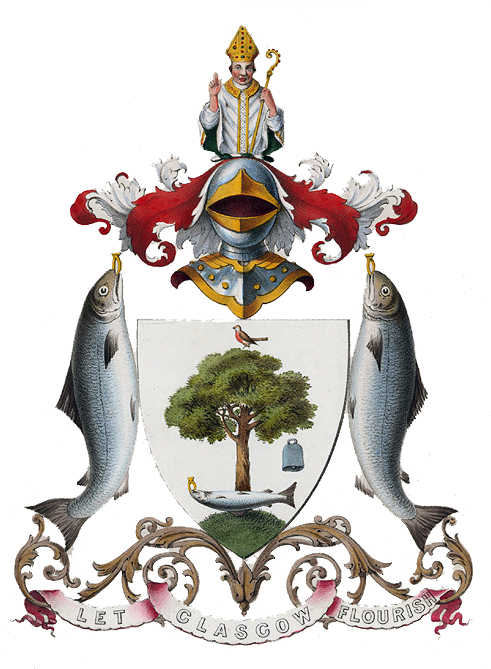
St. Kentigern – a christianised pagan tale?

Kentigern, often known as Mungo, was a saint of the early medieval Christian church who was supposed to have lived in the 6th century and to have been responsible for christianising the ancient Cumbric British Kingdom of Strathclyde, now a part of Scotland.

The region of Strathclyde forms the southern gateway to the Scottish Highlands, and is formed by the plains and foothills surrounding the great River Clyde which discharges into the Irish Sea, and was therefore an important region in the historic interplay between the various cultures of this region during the first millennium, including the peoples of the Scottic Dalriada provinces, Gallovidians, Picts, Cumbrians and peoples of Rheged and later the Anglians and Norse settlers. Its capital city of Glasgu (Glasgow) was supposedly founded by Mungo.

Most of what we know of him is dependent upon the hagiographic writing of the great 12thC Cistercian Abbott, Jocelyn of Furness, who was instrumental in assisting with the mission of the continental (Norman) church to establish dominance and the episcopal system in the northwest Atlantic provinces and who translated Gaelic hagiographical traditions into latinate ones to suit the new ‘Anglo’-Norman world. Jocelyn provided new saints’ lives for Patrick (who supposedly originated in Strathclyde) as well as Mungo/Kentigern. His patrons for the work on Patrick were John de Courcy, and probably also his ally – the King of Mann and the Isles, Godred Olafsson whose sister Auffrica had married de Courcy, and who had assisted in the Norman lord’s conquest of Ulster and the subsequent consolidation of Ireland’s religious power under a post-Gregorian reformed episcopacy. For the work on Kentigern, his sponsor was the Norman Abbott Jocelyn of Melrose who was also Bishop of Glasgow, Strathclyde’s principle town.

The coat of arms of Glasgow depicts the miracles of St Kentigern (Mungo)

The coat of arms of Glasgow depicts the miracles of St Kentigern (Mungo)

Jocelyn’s Life of Kentigern starts with an apology for the problems he encounters in interpreting the various gaelic language traditions of the saint he a had gathered in order to flesh out a text already being developed by the bishop of Glasgow. The stories he gathered were mainly from Strathclyde and from St Asaph’s in Wales: all important ports, along with Furness, in the Irish Sea region. Many of these tales he implies were improper and contained too many elements of heathenism, ‘contrary to certain doctrine and catholic faith’ to use the narrators own words. In fact, it is fairly clear from reading the Furness monk’s work that there is plenty of pagan material still within it, as well as much promoting the other seats of the new continental religious power and spirit of the Gregorian Reforms of church probity and religious rigor that underpinned the Cistercian worldview of the 12th and 13th centuries. His aim was obviously to rid the tale of aspects of what he perceived as syncretic heathenism in the Gaelic forms of Kentigern’s life so as ‘to season with Roman salt what had been ploughed by barbarians’.

Before I embark upon my commentary of the pagan aspects of this legendary text, I urge readers to take a look at a recent translation of the work by Cynthia Whiddon Green.

The first aspect I’d like to examine is the ‘origin story’: This is one of a fallen and rejected heathen woman Thaneu – fallen both in Jocelyn’s medieval Christian moral sense and fallen also in the physical sense that she was apparently thrown off a cliff at the top of Traprain Law in Lothian. The tale mirrors the biblical narrative of the Cistercians’ favourite ‘mother goddess’ – Mary,  with Mungo’s mother pregnant through an illicit extra-marital union with a nebulous and unspecified paternal donor. For such a ‘crime’ her father, the King of Lothian, has her thrown off a crag on Dumpelder (Traprain Law) but she is carried softly down to the ground, as if by wings. She is then cast adrift in the ocean in a coracle – her fate dependent upon the spirit of the seas. It so happens she drifts ashore near to an early Christian centre of learning run by St Servanus/Serf, and she builds a fire for herself on the shore and gives birth to a boy – Mungo – before being discovered by the monks.

Those astute in the folklore originating from Atlantic paganism will recognise that these motifs are to be found in many of the ‘syncretic’ literary and folktales that survive from Ireland, Scotland, the Isle of Man etc. Conception by spirits of magical children, the leapss and falls of giants, the casting adrift of sacred children and female personages who come ashore to figuratively give birth. The narrative is one based in the seasonal drama, and passage of the sun across the sky.  The female character (Thanue) is the Earth Goddess and the male (Mungo) represents the Sun/Son – in the story, the Sun is born out of the land in the east and travels west towards the Atlantic ocean into Strathclyde. The theme of a magical character washing ashore occurs in the Isle of Man’s Caillagh y Groamagh legend attached to Bridget’s day or Imbolc as it is sometimes known. The same theme is used in the Bethu Brigdhe hagiography of Bridget which mentions the bandit-turned-saint Machaldus (Maughold) being cast into the sea and washing up in the Isle of Man. Thanue is therefore a character replacing Bride-Aine, but what of her son?

The fact that Mungo enters his floruit (recorded life) from the sea and spends an awful lot of time in water and controlling water during the rest of his hagiography is highly suggested of the solar deity motif, identifying him with reasonable certainty as a hypostasis for the shining god Manannan who strides so actually godlike among the lesser characters of many of the euhemerist legends of medieval Irish literature and later folk tradition.  Even his name seems to refer to ‘Man’ in the form of ‘Mun’, just like Mongan mac Fiachna in the Irish Manannan legends. Mungo = Manannan.

Christian narratives did their best to replace the dualist Atlantic god and goddess with a masculine counterpart, particularly after the Brigitine church period, so Mungo subsumes the roles of both in the rest of the Vita. Here is a list of some of the features of Jocelyn’s tale which illustrate the pagan legends he was trying to weave in:

1. He emerges from the sea and has power over the waters.

2. He has the power to resurrect (e.g. – the little ‘red bird’ of St Serf – either a Robin or a Wren).

3. He has a magical branch (hazel or holly – the gaelic names can be confused) with which he keeps Serf’s eternal holy flames burning.

4. He resurrects a man who describes being conveyed back from the afterlife by a man of shining fiery light.

5. He conveys the dead to their resting place (the bullock cart is an interesting celestial motif)

7. Like the Cailleach of highland legend, while living as a ‘Culdee’ he exerts control over flocks of deer and wolves, who he treats like cattle, and hitches to his plough.

8. He spends an inordinate amount of time dousing himself in water and radiating holy light. When others are asleep he is awake praying – the Otherworld Inversion.

9. He disappears from the world in winter to fast. His food is the underground parts of dormant plants.

10. He sleeps in a stone sarcophagus and wears goat skins. There are a number of references to paganism in medieval and later literature which attest to ‘saints’ or spirits living in stone sarcophagi covered in water. Brownie/Phynnodderee/Glastig was a hairy half-human.

11. He is associated with a magical white boar, a special ram, and bullocks.

12. He finds a ring in the belly of a salmon. This motif also occurs in a number of traditional ‘fairy tales’ and medieval irish otherworld literature. For example, the Irish legend of Macaldus, the English fairy tale ‘The Fish and the Ring’ and the Irish Tain Bo Fraich. The Salmon returning is a motif of the returning year and the ring also – the goddess name Aine signifies a ring as well.

There are quite a few more referenes which emerge upon careful study of Jocelyn’s work, but these are the most important! Read the text and see what you think…

Otherworld themes in “Aislinge Meic Con Glinne”

The Middle-Irish prose tale Aislinge Meic Con Glinne (‘The Dream-vision of MacConglinne’) is supposed – by the style of its language and themes – to have been composed and written in the late 11th or early 12th century. Two versions of it have survived to the modern day – one (‘B’ recenscion) in the 15thC manuscript collection known as An Leabhar Breac (‘The Speckled Book’ – RIA MS 1230) and the other in the manuscript TCD MS 1337 (‘H’ recescion).

You can read a translation of it here.

Set during the 8th century, it is styled in the form of a somewhat satirical prose-tale interspersed with poetic verses, and revolves around the power of a ‘dream vision’ (Aislinge) to sway the fate of the hero of the plot – a scholastic Armagh monk by the name of Aniér Mac Conglinne, saving his life and saving the kingdoms of the South of Ireland by exorcising their High King, Cathal mac Finguine of a ‘Lon Cráis’ (sometimes translated perhaps erroneously as ‘demon of gluttony’) that had taken up residence in him.

The story contains a number of highly amusing and incisive aspects to its narrative. The first introduces the humourous, energetic, ever-fasting and hungry monastic hero-adventurer whose destiny is to save King Cathal and his subjects from their greedy and sinful ways. So eager and restless is he in his mission that he runs from Armagh to Cork in the space of a day or so. Upon arriving at the monastic hostel in Cork he finds their Benedictine christian values of hospitality severely wanting and sets about causing an annoyance to advertise this fact. This mortally upsets the monks who report his activities and (worse) his biting satires to Abbott Manchín who demands his arrest and has him tortured and prepared for execution. MacConglinne goes willingly to his fate, seeking to demonstrate his piety to the monks by way of example. This part of the tale is obviously an exemplar of the popular spirit of the late 11th and early 12th century ‘Gregorian Reforms’ of church probity and the monastic orders. which led to the explosion of new and disciplined monastic institutions. The character of MacConglinne – being a monk from Armagh who wears a white habit – is obviously designed to represent a forerunner of Malachy of Armagh who promoted the reformed Cistercian Order during the era of the tale’s apparent authorship. This allows him to hold no punches in castigating the lazy, fat, greedy and cruel monks of Cork and refer to them as ‘shit-hounds’ among other choice and amusing epithets!

The most amazing and amusing aspect of the tale comes when the starved MacConglinne is tied to a pillar-stone to await his execution and in delirious depths of his abject suffering and hunger, he is visited by an angel or spirit who grants him a vision of a land made of and peopled by food!

The fort we reached was beautiful,
With works of custards thick,
Beyond the loch.
New butter was the bridge in front,
The rubble dyke was wheaten white,
Bacon the palisade.

Stately, pleasantly it sat,
A compact house and strong.
Then I went in:
The door of it was dry meat,
The threshold was bare bread,
cheese-curds the sides.

Smooth pillars of old cheese,
And sappy bacon props
Alternate ranged;
Fine beams of mellow cream,
White rafters – real curds,
Kept up the house. (Trans. Kuno Meyer, 1892)

When the abbott arrives to see him executed the next day, MacConglinne relates his vision and the abbott and monks have second thoughts and refer him to King Cathal, believing that he may be tasked by god into casting out the King’s Lon Cráis. This ‘demon’ has made the King into a man who only takes food from his vassals and never distributes it, giving him an insatiable hunger.

MacConglinne dons the garb of a poet-juggler and arrives at the court of a local petty-king whom Cathal is visiting. He impresses his way in with his antics and satires and gains an audience with the king and promises to cure him, after relating his vision of a land of food. The king is so impressed by his abilities and religious piety that he begins tossing him apples (having given food to no man for many years) which the hero gladly eats, and this obviously causes MacConglinne’s powers to sally forth even further! He convinces the whole court (including Cathal) to fast overnight, and in the morning has Cathal bound with ropes and orders the most sumptuous foods be prepared which he then taunts him with while reciting a tale he himself has composed which embellishes upon the themes of his vision.

His new tale involves him being approached by a Scál (usually interpreted as a ‘phantom’, but in Irish tales always referring to an otherworld being who tests and/or instructs a hero). The scál sees he is sick with hunger and disease (or ‘original sin’) and instructs him to find (in the land of food) a magical healer or ‘fairy doctor’, known in Middle Irish as a fáthliaig (an archaic term meaning ‘vision-healer’ which survived into 19thC Manx Gaelic in the word fallog’). In MacConglinne’s telling, the fáthliaig advises him that he is sick, evoking a description of him suffering from a spiritual (and physical) inversion of King Cathal’s own predicament (which also reflected the poor traditional values of hospitatlity the monk had found in the South). This is typical of shamanic practice – the figurative/spiritual assumption of the sufferer’s disease by the healer in a dream-vision in order to combat it:

‘‘Pray for me!’ said I to him.’

‘‘In the name of cheese!’ said he to me. ‘Evil is the limp look of thy face,’ said the Wizard Doctor. ‘Alas! it is the look of disease. Thy hands are yellow, thy lips are spotted, thine eyes are grey. Thy sinews have relaxed, they have risen over thy eyes and over thy flesh, and over thy joints and nails. The three women have attacked thee, scarcity and death and famine, with sharp beaks of hunger. An eye that sains not has regarded thee.

The fáthliaig‘s prescription is, again, humorous – MacConGlinne must eat the finest foods, and be tended to by a beautiful woman while reclining upon soft animal skins in front of a roaring fire!  There follows a recitation of the delightful foods he must be fed which so inflames the ‘Lon Cráis’ in Cathal’s throat that it jumps out and hides under a cauldron in the fireplace, at which point after MacConglinne offers thanks to God and Brigit!

So… what is a Lon Cráis? There are repeated references in Gaelic folklore to a creature – often a type of lizard or newt – which can enter the mouths and throats of the unwary and cause a great unsatiated hunger or thirst. In Gaelic Scotland, Robert Kirk (17thC) spoke of possession by the spirit of a ‘great eater’. This was explicitly called the Lon Craois during the 19th century (see JG Campbell’s ‘Popular Tales of the West Highlands Vol.2 p.366), and in Ulster and the Isle of Man the English term for it was ‘Man-Creeper’. In both cases the cure was to tempt it out with delicious food (as with Cathal) or to eat salt and lie near a well with your mouth open (Isle of Man). In both cases it appears that the condition refers to Diabetes Mellitus, where the blood is rick with sugar but the body’s cells cannot take it in. This results in dehydration, great hunger and thirst. Kuno Meyer (1892) preferred to translate the Lon as a ‘demon’, which in the context of the characters of the narrative and their beliefs seems a correct choice, even though he knew of the Scots Gaelic term. The term does not translate literally as ‘demon’ –Lon may be the otherwise attested word Lionn, which is the Irish word for ‘humor’, meaning one of the four classical/medieval humors of the body, and an imbalance of these was believed to be the mode through which disease (and moral failings) was supposed to operate. The OI/MI word Cráes means gluttony or hunger – the latter being invoked as ‘three women’ (an implicit Cailleach reference) by the vision’s seer-leech.

SO…

The ideas of food and gluttony are explicit themes around which this whole tale revolves. The implication is that the Monk of Armagh (MacConglinne, representing both Patrick and the hegemony of Continental christianity under Malachy and the Gregorian reforms) is spiritually proper in his fasting and starvation and that having plenty of physical food and not sharing it with the poor is a form of spiritual starvation. This is another ‘Otherworld Inversion’ similar to many pervading the spirituality of the Gaels or Atlantic peoples and which were deeply influential upon early European Christians. The Lon Cráis was an ‘otherworld’ force which transformed gluttony into hunger, and MacConglinne evokes an ‘otherworld’ vision of the world of this ‘creature’ (a world of food) in which he meets a ‘fairy doctor’ or ‘seer-leech’ who details his cure by having the hero invoke an inversion of Cathals’s disease upon himself so as to defeat the spirit by evocation and provocation. By causing the spirit to escape under the pressure of his bardic or poetic genius, he fulfils his original ambition to exceed his monastic limitations, and the cure is ultimately based in Atlantic otherworld doctrines, and not purely Christian:

It is clear from this text that the hero’s poetic creation of a world and narrative made of food is the force which expels the hungry spirit, not the Christian god who (along with Brigit) gets the credit at the conclusion.

As with all Middle Irish texts and stories, this tale is beset with contradictions between a pagan and a Christian narrative. The explicit connection between fasting and spiritual purity is made in the ancient Hebrew stories collected in the 5th and 4th centuries BC into the written canon of the Hebrew Bible, from which Judaism, Christianity and Islam eventually grew, and is common to many other ancient faiths. What is interesting is how the Atlantic/Gaelic view of the Otherworld and its interaction ‘through a mirror’ with ours influenced the Christian aspects of this narrative by providing a more rational idea of spiritual balance, largely lost from continental christianity in the cultural confusion of the post-Roman period….

The fate of the early Irish Brigitine church

We know from the earliest surviving hagiographic literature from Ireland (written by Cogitosus, Abbot of Kildare some time in the 7thC) that the original Irish ‘Brigitine’ monastic movement was probably one of the first forms of organised christianity that flourished in Ireland, sociologically interesting in that their communities or ‘abbeys’ apparently combined chapters of both male and female ascetics. These abbeys and their leaders are generally accepted to have been places where the children of the local aristocracy would be fostered to the care of the new political and spiritual forces influencing Ireland and Britain in the period, offering opportunities for learning and travel. It appears to have preceded the ‘Patrician’ movement which established its retrospective dominance in the ensuing four centuries of Uí Néill ascendancy, leading to Patrick becoming seen as the main patron saint of Ireland. Even by the 12th century, monastic writer Gerald of Wales was able to comment (perhaps to highlight in his eyes its need for reform) upon the strange setup at Kildare with its holy enclosures, sacred meadows and sanctuary with its eternal flame.

Cogitosus claimed that there had been an explosion of Brigitine missions and Abbeys in his own lifetime that had spread across Ireland, yet it is somewhat difficult to ascertain what and where all of these were. We can be certain that some of these were taken over by the subsequent movements of the male-centred order of Finnian and his students, perhaps in continuity of the Brigitines’ probable appropriation of goddess-centred sanctuaries for their own establishments. Indeed, the language and forms of popular legend and hagiography about characters such as Cóemgen (St Kevin of Glendalough) and Senán mac Geircinn (St Sennan of Scattery Island) contain coded references to deposed female characters and conquered ‘beasts’ – typical motifs used in dealing with indigenous paganism. It is very likely that these Irish early-christian religious institutions were established at the sites of former pagan shrines, and that many if not most of these were associated with well-springs, islands in sacred lakes and rivers and river-crossings, as well as fertile meadowlands – the typical sites of earthly goddess-worship and legends. The attributes of <Christian Brigit> in the accounts by Cogitosus and from later texts such as the Bethu Brighde were loquaciousness, fecundity, hospitality, healing powers, associations with fire and light, and some mechanical miracles.

With this in mind, Cormac’s Glossary (probably 10thC) had this to say about Brigit (trans. by John O’Donovan, Ed. Whitley Stokes):

“Brigit i.e. a poetess, daughter of the Dagda. This is Brigit the female sage, or woman of wisdom, i.e. Brigit the goddess whom poets adored, because very great and very famous was her protecting care. It is therefore they call her goddess of poets, by this name. Whose sisters were Brigit the female physician (woman of leech craft), Brigit the female smith (woman of smith work), from whose names with all Irishmen a goddess was called Brigit.”

The passage is remarkable as it makes a specific reference to a pagan Brigit and claims this was the name by which all the goddesses of Ireland were once called by the Irish! She is referenced as a creatrix through the Smith-association, a mistress of nature’s healing bounty, and an exciter of the human imagination in expressing the things of the world. Explicitly in the Sanais Chormac, she is a triple goddess of the sort seen in the characters of the Matronaes depicted in some of the statuary and bas-relief traditions of late Iron Age Atlantic European cultures: Mother goddesses perhaps representing the three generative seasons of the year…

Brigitine monasticism is likely to have taken over the reigns of traditional goddess-worship in Irish society during the 5th/6th centuries (if not earlier), and then to have been supplanted by a male-centred order under the acolytes of her supposed contemporary Finnian of Clonard (attrib. 5th/6thC) who promoted a non-feminine regime magnifying the missions of Palladius and Patrick (sometimes now referred to as the ‘two Patricks’) as the main forebears of Irish christianity. Finnian is the character that the ‘second wave’ of Irish saints depend upon for their education at his great school. However, we must necessarily question whether these religious establishments that began to cascade as far as Ireland’s westernmost extremes and into Scotland, Mann, Wales and Cornwall before leaping to the continent, were based upon pre-existing (possibly syncretic) Brigitine sites.  There is no explicit evidence to demonstrate this, but much that is oblique or indirect, as formerly commented on.

One particularly interesting piece of literary evidence from the 15thC Book of Fermoy (roughly contemporary with Chaucer) contains an explicitly Christianised version of an older tale also known as ‘The Wooing of Etain’ (earliest surviving version is from the early 12thC), but referred to in this context as Altram Tige Da Medar (‘The Fosterage of the House of the ?Two Pails’). It is set in the pseudo-historical world of the ‘Gebala Eirenn’ mythos, and tells of the warrior tribes of Tuatha De Danann and their ruler Manannan who settles them in various Sid mansions and governs them with the laws of the Otherworld. In this tale, the fairy Eithne (apparently the same character as the earlier Etain, possibly also a version of the name ‘Aine’) has an inverted ‘otherworldly’ encounter with a christian priest and his church after being abstracted from her friends while batheing in the Boyne and becomes fostered by him and becomes a Christian!

You can read a copy of it here: @MaryJones

Readers may recognise ‘Eithne’ or ‘Ethniu’ (‘Enya’) as a character who makes a number of appearances in the mythological cycle tales – as the mother of the hero Lugh. Here she is daughter of a minor Tuatha Dé Danann (TDD) noble called Dicu, fostered by Aengus, and Manannan is portrayed – curiously – as the (Christian) god-fearing ruler of the TDD who tries to bring a new rule of law and order to the fairy tribe to whom he grants their Sidhe mansions or hills. The narrative hands to Eithne (for which we might also read (C)ethlinne or ‘Aine’) the role as the first TDD to become a Christian – fostered by one of Patrick’s priests. It is almost analogous to the early Bridget hagiographies in this regard – building a sympathetic or syncretic bridge between the pagan past and the Christian future which the Book of Fermoy’s 15thC aristocratic patrons must have enjoyed.  Manannan also fulfils the function of ‘Christian Godsend’ that Charles MacQuarrie suggests in his ‘Waves of Manannan’ thesis – an acceptable pagan analogy of the Christian god, who the narrator has Manannan hail and recommend in his role as benevolent otherworld leader of the TDD:

‘…The nobles inquired of Manannan where Ealcmar would find rest. ‘I know not’, said Manannan, ‘and no prophet or sage in the whole world knows, but the one God almighty knows.’ …. ‘

The displacement of Brigitine syncretism became a significant ambition of narrative traditions from the 6/7thC and therefore appears to have continued as late as the 15th century. After all, heresy was always the main home enemy of western christianity and from the 15th century would evolve into something known as the ‘witch craze’ where pagan folk-traditions would eventually under intense scrutiny by both the religious AND secular authorities and become a victim of the polemic of popular culture.

Boand – Water Goddess of the Boyne

I have already mentioned in recent posts that there were legendary connections between the Atlantic Goddess and water: For starters she is represented in the constellation Orion, standing on the banks of the great white river of the Milky Way as it arches across the winter sky. As ‘Tehi Tegi‘ in the Isle of Man, she conveyed the souls of the dead across the land until they reached the rivers or the sea and were able to enter the realm of the Otherworld. The Cailleach traditions of Ireland, Scotland and Wales tell of her role in creating Lochs and other floods by neglecting to close off springs, and as the Bean Nighe she sat near water washing the garments and effects of the dead.. In Brittany she is represented by the oceanic fairy queen known as the ‘Gro’ach‘ and as a Moura Encantada in Portugal and Gallicia she is a guardian of springs. Archaeologists across Atlantic Europe recognise the association of springs with pagan goddess-worship.

It is perhaps unsurprising that the rivers of Ireland have associations with pagan female entities preserved in their legendary lore. A good example of such stories are from the onomastic explanations of placenames found in medieval literature, often produced by Christian monks. These texts – published in compiled form in the early 20thC as the ‘Metrical Dindshenchas‘ (taken from the mss. the Book of the Dun Cow, the Book of Leinster, the Rennes Manuscript, the Book of Ballymote, the Great Book of Lecan and the Yellow Book of Lecan) – has the following (from Vol.3)  to say about the origin of the River Boyne (under ‘Boand 1’), the most prominent river of the Irish midlands, and one associated with a rich mythology and archaeology:

Sid Nechtain is the name that is on the mountain here,

the grave of the full-keen son of Labraid,

from which flows the stainless river

whose name is Boand ever-full.

Fifteen names, certainty of disputes,

given to this stream we enumerate,

from Sid Nechtain away

till it reaches the paradise of Adam.

Segais was her name in the Sid

to be sung by thee in every land:

River of Segais is her name from that point

to the pool of Mochua the cleric.

From the well of righteous Mochua

to the bounds of Meath’s wide plain,

the Arm of Nuadu’s Wife and her Leg are

the two noble and exalted names.

From the bounds of goodly Meath

till she reaches the sea’s green floor

she is called the Great Silver Yoke

and the White Marrow of Fedlimid.

Stormy Wave

from thence onward

unto branchy Cualnge;

River of the White Hazel

from stern Cualnge

to the lough of Eochu Red-Brows.

Banna is her name from faultless Lough Neagh:

Roof of the Ocean as far as Scotland:

Lunnand she is in blameless Scotland —

or its name is Torrand according to its meaning.

Severn is she called through the land of the sound Saxons,

Tiber in the Romans’ keep:

River Jordan thereafter in the east

and vast River Euphrates.

River Tigris

in enduring paradise,

long is she in the east, a time of wandering

from paradise back again hither

to the streams of this Sid.

Boand is her general pleasant name

from the Sid to the sea-wall;

The poet who wrote this account is effusive in his descriptions of the great river, comparing it (or perhaps more accurately actually identifying it) with the other great rivers of the known world, including the River Severn, the Tiber, the Tigris and Euphrates, the Jordan etc. It was believed that the oceans were made up of all the world’s rivers in the era of authorship – an idea born of classical antiquity and beyond. What is more important is the author implies that the river actually runs from Sid Nechtain to the ‘paradise of Adam’, being a direct allusion to a christianised  telling of the pagan Irish belief in an Otherworld at the Ocean’s End, and to the Garden of Eden, where Christians believe life begins! This almost tells of a former belief in rebirth… The passage also implies that the river is regenerated from the East and returns to Sid Nechtain to flow again by some unspecified route.

Quite amazing.

The compiled texts go on to describe the mythological origin of the River of Boand:

I remember the cause whence is named

the water of the wife of Labraid’s son.

Nechtain son of bold Labraid whose wife was Boand, I aver;

a secret well there was in his stead,

from which gushed forth every kind of mysterious evil.

There was none that would look to its bottom

but his two bright eyes would burst:

if he should move to left or right,

he would not come from it without blemish.

Therefore none of them dared approach it

save Nechtain and his cup-bearers: —

these are their names, famed for brilliant deed,

Flesc and Lam and Luam.

Hither came on a day white Boand (her noble pride uplifted her),

to the well, without being thirsty to make trial of its power.

As thrice she walked round about the well heedlessly,

three waves burst from it, whence came the death of Boand.

They came each wave of them against a limb,

they disfigured the soft-blooming woman;

a wave against her foot, a wave against her perfect eye,

the third wave shatters one hand.

She rushed to the sea (it was better for her) to escape her blemish,

so that none might see her mutilation;

The authors relate a typical Irish Christian rescension of the pagan tale of the woman and the water. The passage also tells of the practice of circling a well or spring three times, which any folklorist who has studied Celtic traditions will recognise. The tale of Boand therefore acts on a number of levels: Firstly as a poetic figurative description of the river as a woman, secondly as descriptive account of the Boyne replete with onomastic and pseudo-historical details, and thirdly it seems to contain a warning to the ungodly of the fate which will meet them if they emulate the legendary magical female… Of particular interest is the manner in which the water harms Boand: It causes the ‘wounds’ of the Cailleach – the ‘fairy stroke’ of withering in one eye, one arm, one leg. Such ‘wounds’ are given to other magical females at rivers or fords or shorelines in other Irish myths from medieval works, including that of the Christian ‘St Brighid‘…

Medieval Irish tales with pagan themes usually contain a Christian footnote in their third part…