Bride

“Brede, Brede, tar gys my thie, tar dyn thie ayms noght.
   Foshil jee yn dorrys da Brede, as lhig da Brede e beet staigh.”


” Bridget, Bridget, come to my house, come to my house to-night.
   Open the door for Bridget, and let Bridget come in.”

Manx invocation to Brighde (taken from William Harrison’s Mona Miscellany – Manx Society Vol. 16, p.137).

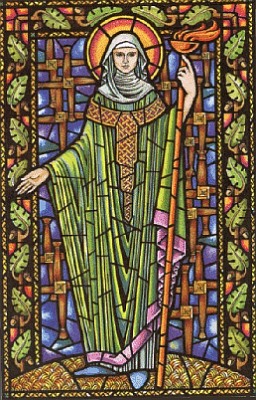
This was a tradition recorded from the second half of the 19th century in the Isle of Man. The invocation was made at the threshold of the house at sunset on the eve of St Bridget’s Day (1st Feb) while holding a handful of green rushes – symbolic of hospitality from ancient times. The rushes were then sprinkled to make a welcoming path into the house, which Harrison describes as a ‘carpet or bed’ for the saint or goddess. In the Hebrides, Carmichael recorded the tradition of women making an actual bed for Bride who they represented by a ‘Corn Dolly’ (Carmina Gaedelica Vol.1). Those familiar with the rush-bearing traditions of the Isle of Man will know that these were also related to Manannan – as a tax the people of the island used to pay the god, and that are still sprinkled on the processional way at the annual Tynwald midsummer festival. They exude a sweet smell when trodden and are soft under the feet. On old Irish welcome greeting was ‘May we strew green rushes under your feet’ (from the Folklore Commission Collection, Delargy Centre, University College Dublin).

The idea was one of welcoming the returning year. When it was recorded, the island had been Protestant since the 16th century but saints such as Bridget, Columba and Patrick still had popular currency as they were held to be the originators of christianity in the region. Curiously though, the saint’s day in the Isle of Man had another name with a distinctly pagan flavour – perhaps unsurprising at it also fell on the ancient Atlantic cross-quarter-day festival known in Irish as Imbolc. In the Isle of Man, the day was also known as the day of the Caillagh ny Groamagh, meaning ‘Old/Veiled Woman of the Gloom’.  It was celebrated on Old St Bridget’s Day (i.e. – by the Julian calendar) on the 12th of February, the Manx preferring to keep the Julian calendar for many of their important festivals including Christmas (Shen Laa Nollick) and Midsummer’s Day (Tynwald Day).

It is quite important to understand that there is an etymological connection between the words Caillagh (Irish/Scots: Cailleach) and the name ‘Brighde’ or ‘Bride’: This is expressed in the Manx Gaelic word for ‘a veil, cover, hood; a sheltered part of the mountains…’, which is ‘Breid’ (Source: Kelly’s Dictionary), and ‘Brat’, ‘Brut’ or ‘Brot’ (Source: eDIL – consider the Germanic words for ‘bread’ when interpreting these!). In other words – they appear to be the same character: The ‘Old Woman’ whose ‘veil’ was ‘ever- renewed’ as the ancient Irish poem related… The Goddess as a metaphor for the annual cycle – the ‘saint’ known as Brighid or Bride.

‘Erdathe’ – The Atlantic religion’s ‘day of judgement’?

The 7thC Patrician biographer Tírechán is a valuable source for some details of the Atlantic religion in Ireland. His work – known as the Collecteana occurs in the Book of Armagh – MS52 of Trinity College Dublin. One of the mysterious Irish words he left in his Latin hagiography of the saint is the word 'erdathe' which Tírechán claims was the term used by Irish pagans for their equivalent to the 'day of reckoning of the Lord'. It can be found in the last paragraph of Folio 10r…

12 (1) Perrexitque ad ciuitatem Temro ad Logairium filium Neill iterum, quia apud illum foedus pepigit, ut non occideretur in regno illius; sed non potuit credere, dicens:(2) “nam Neel pater meus non siniuit mihi credere, sed ut sepeliar in cacuminibus Temro quasi uiris consistentibus in bello” (quia utuntur gentiles in sepulcris armati prumptis armis) “facie ad faciem usque ad diem erdathe” (apud magos, id est iudicii diem Domini) “ego filius Neill et filius Dúnlinge Immaistin in campo Liphi pro duritate odiui ut est hoc”.12 (1) And he proceeded again to the city of Tara to Loíguire son of Níall, because he made a pact with him that he should not be killed within his realm; but (Loíguire) could not accept the faith, saying:(2) 'My father Níall did not allow me to accept the faith, but bade me to be buried on the ridges of Tara, I son of Níall and the sons of Dúnlang in Maistiu in Mag Liphi, face to face (with each other) in the manner of men at war' (for the pagans, armed in their tombs, have their weapons ready) until the day of erdathe (as the magi call it, that is, the day of the Lord's judgement), because of such fierceness of our (mutual) hatred.'

So… what is erdathe? There are two problems in determining the answer to this question: Firstly, is this really the word in the original text (written in 9thC insular minuscule text)? Secondly, the lack in standards for orthography from such early written Irish would make the word (whatever it is) a difficult one to find a more modern equivalent for…

Let's take a look at the first problem. Here is a facsimile of the word as written in paragraph 12 (Folio 10r) of the actual manuscript:

Erdathe_word

For those not accustomed to 9thC insular miniscule scripts, the initial e or a and the following r are compound or ligated and the 'r' part shows the typical dependant leg of the 'long r'. Third letter is 'd', fourth 'a', fifth 't' (capitalised in style), sixth 'h' and final a definite 'e': a/e-r-d-a-t-h-e. So: this is definitely the correct word, but the first letter might be an 'a'. You might also note the four dots above the d, a, t and 'e' where the scribe rested his nib while considering how to write the Irish word – one he was unfamiliar with and which has no other attestations in this form of spelling. This hesitancy on his part might also have given the indeterminate a/e at the start of the word. This leaves us to examine the second problem – that of meaning:

In addressing the second problem, it is necessary to take a phonetic approach and cast a wide net to see how this word relates to later Gaelic words:

Irish:

The words ard and ath(e) appear to compound the word ardathe/erdathe. This offers us a straightforward translation, for 'ard' = 'height', 'high' or 'elevated'. However, the 'athe' part (-ath is not a usual suffix in the Irish language) is slightly more problematic, unless of course it is a pure compound word, in which case áth, meaning a 'ford' or an 'open space or hollow between two objects' (eDIL) seems a likely offering. The áth is a typical place for combats to occur in narrative tales such as those of the Ulster Cycle, and in particular the Táin Bó Cúailnge… this implies a liminal place where 'crossing-over' (death) might occur, as well as being a place typical for the territorial combats of rutting stags on river plains etc. It therefore shows a link of sorts to the word cath- which suffixes terms to do with battle or defence (e.g. Conn Cétchathach – Conn of the Hundred Battles); Bear in mind that the 'd' of 'erd' or 'ard' would possibly lenit a following hard consonant to give '-ath'. Other words that would fit this schema might include 'rath' and 'math'. The use of ath- as a prefix also implies an act of repetition. 'Athair' of course means 'father' – a term used to mean 'god' by Christians ('Pater noster…')

Manx: (definitions from Juan Kelly's Dictionary – Manx Society Vol.13)

The Manx language is a treasure trove for those looking for more ancient forms of Irish, having remained in a purely spoken form until the 17th century, and having enjoyed a level of cultural stability that Ireland could not, and which in turn preserved many aspects of Atlantic religious folklore that was otherwise lost. Literature has a habit of informing the 'correct' pronunciation and flow of ideas in a culture… The best guess of 'erdathe' in Manx is seen in the two forms of the expression for 'high', 'elevated' or 'exalted' – based on the rootword ard:

“Ardaght, ardys, s. height, eminence” – the round 'a' takes on a hollow 'e' sound to make the adjectival:

“Yrjey, a. high, eminent; also promoted, advanced.” – the Manx terminal -ey is pronounced '-ya' or '-yu'. The equivalent of 'ardaght' would by 'yrjaght'. In fact 'erdathe' might be pronounced in exactly this fashion with flat vowels: “er-jer-he”! These are effectively Anglophone ways of writing Irish words, after all…

Sanas Chormaic (Cormac's Glossary):

Another more intriguing and perhaps more likely possibility is a word given by the famous Cormac of Cashel in his 'glossary' of the 10thC. This word (from page 5) is Audacht which Cormac translates as

'a dying testimony' ; ie uath-fecht, ie – when one sets out on a journey (fecht) of (the) grave (uath), ie – of death

(Whitley Stokes' edition of John O'Donovan's translation)

The online Electronic DIL provides a number of variants such as édoct and aidacht. These are used to refer specifically to a 'bequest', 'legacy' or 'testament'. Cormac's etymology may be somewhat fanciful, of course. What kind of legacy/bequest could this be? The death of an individual means their earthly possessions default to the living. It might also be considered as a bequest of the self to future posterity in another incarnation.

So … Tírechán's 'erdathe' or 'ardathe' refers either to a state to do with the heights or something elevated, perhaps to a 'crossing-over' or liminal place leading into another cycle of regeneration and reincarnation, perhaps a testament or bequest of some sort, possibly of oneself to future posterity. His assertion that it was equivalent to a 'day of judgement' may just reflect a christian interpretation of what may well be a different form of the afterlife…


Naomh Pádraig – commentary on the hagiographies Part 1

There is some controversy about who the ‘real’ Patrick was: Although traditionally credited with the Christianisation of Ireland, we know that an important Roman Gaul called Palladius (also known by the ‘power name’ Patricius) was a church leader (Archdeacon and/or Bishop) in Ireland during the early 5th century before the conventional ‘Patrick’, as were a number of other British and continental churchmen. Britain (and Ireland) had remained under the influence of a strain of christianity called Pelagianism deemed heretical by the continental church as it denied original sin and the need for infant baptism. Palladius was probably one of the people given the task of bringing the Irish and British into conformity. Pelagius was an Atlantic European whose Christian doctrines were probably influenced by syncresis with Atlantic paganism, and whose mission and philosophy sought to influence the heart of Christian doctrine and the  Mediterranean church hierarchy during the 4th century. Even in the 2nd century, there was a theologian and bishop of Lyons (Lugudunum) called Ireneus which might well mean ‘Irishman’. Remember – the Druids were an intellectual collegium of northern Europe who were said to have partaken of the study of a number of non-native philosophies, of which christianity was only an interesting new development!

No – Patrick (ca. late 5thC) was NOT the first to bring Christianity to the Irish, but left his name to represent this process in posterity. His prominence appears to emerge with the creation of a political historical ‘event horizon’ formed by the saturation of Christian culture and the apparent establishment of Christianised sacral kingship during the 6th-7th centuries. The earliest Irish hagiography that survives today is that of St Brigit of Kildare, which somewhat surprisingly makes no mention of him. 

The earliest accounts of St Patrick are found preserved in the 9thC Book of Armagh (Ard Macha or Armagh layed claim to be Patrick’s founding church) and include works seemingly written by the actual saint himself as well as two significant 7thC hagiographies. The two original works are two latin letters known as the ‘Confession‘ and the ‘Epistle to Coroticus’: The first is a justificatory account written in the first person of his life and principles. The other is addressed to a military leader or king called Coroticus  (a Romano-British name), complaining about the slaughter and enslavement of some of Patrick’s white-clad Irish missionaries.

The Confessio contains to magical exploits or much in the way of Christianised pagan themes, but is replete with accounts of visions and the saint’s interpretation of providences. It seems to suggest that Ireland was completely subjugated to christianity by the time of Patrick writing it towards the end of his life, although in reality it is more a description of his mission’s popularity among the nobility and their slaves (many of whom were Christians from Britannia). It neither mentions magi or druids or says anything about native Irish religion save for a reference to ‘idola et inmunda’, usually translated as ‘idols and unclean things’ but which might also be read literally as ‘spirit images and worldly things’ – a good appraisal of the Atlantic religion in my opinion. The Latin ‘idola’ is the same as the Greek word ‘eidola’, meaning ‘spirit image’ – it came to represent physical statuary images in the later classical period as christianity increasingly defined these in terms of their material rather than spiritual value. The word munda means ‘refined’, ‘subtle’ or ‘delicate’ (properties synonymous with spirit, and possibly fire and air in the elemental doctrine of the ancients) so inmunda is the opposite. Remember that Christianity was a purificatory religion that rejected worldly things in favour of its ‘higher’ intellectual religious interpretations… Paganism looked to the world to extrapolate its visions.

Hagiographies of the 7thC:

After these the next texts dealing with his life are hagiographical and therefore of a style including miracles and fantastical accounts. These come from the 7th century – a considerable period after the time of his supposed ministry – and are by two quite different authors. The first is by Muirchú moccu Machtheni and is called Vita sancti Patricii or ‘Life of Patrick’. This work (which exists in several fragmentary copies surviving from different eras) credits Patrick with the conversion of Ireland, as well as name-checking Cogitosus of Kildare (author of the earlier Vitae Sanctae Brigitae) as the author’s spiritual ‘father’, perhaps implying that Muirchú was following his hagiographical lead. This also suggests that Brigitine monasticism may have preceded Patrician monasticism in Ireland, as Cogitosus made no mention of Patrick at all – something which would be surprising if he held such precedence throughout Ireland in the late 5th and early 6th centuries during Brigit’s supposed lifetime! Muirchú’s work is marked by its employing Cogitosus’ style of fantastical miracles, but in particular (perhaps befitting the saint’s gender) these are achieved in acts of magical combat mano a mano with a series of Druids. It is written with a distinct Northern bias, and makes particular mention of Armagh. It dismisses the mission of Palladius as irrelevant.

By contrast, the other 7thC ‘hagiography’ of Patrick from the Book of Armagh – the Collecteana of the Bishop Tírechán – is a much more diverse affair, that spends more time dealing with Patrick’s supposed missions outside of the North and deals more with his conversions of Ireland’s western and southern monarchs as well as the Kinf of Tara.  Tírechán spends more time discussing Patrick’s acquisition of specific pagan locations and conversion of these and their pagan celebrations or traditions to Christian alternatives. The Collecteana contains somewhat more detail of paganism than the Vita. For instance, in the famous passage where the saint and his party are met at a pagan holy well by two princesses who had gone there to make their ablutions or devotions:

26

(1) Then holy Patrick came to the well called Clébach, on the slopes of Cruachu to the east, before sunrise, and they sat beside the well, (2) and, behold, the two daughters of king Loíguire, fair-haired Ethne and red-haired Fedelm, came to the well, as women are wont to do, in the morning to wash, and they found the holy assembly of bishops with Patrick beside the well.(3) And they did not know whence they were or of what shape or from what people or from what region, but thought they were men of the sid (the word used in the original latin text!) or earth-gods or a phantom; (4) and the maidens said to them: ‘Whence are you and whence have you come?’ and Patrick said to them: ‘It would be better for you to profess our true God than to ask questions about our race.’ (5) The first maiden said: ‘Who is God and where is God and whose God is he and where is his dwelling-place? Has your God sons and daughters, gold and silver? Is he ever-living, is he beautiful, have many fostered his son, are his daughters dear and beautiful in the eyes of the men of the earth? Is he in the sky or in the earth or in the water, in rivers, in mountains, in valleys? (7) Give us an account of him; how shall he be seen, how is he loved, how is he found, is he found in youth, in old age?’

The passage is replete with references to themes that Tírechán considered essentially pagan – of particular interest is the motif of the well (a spring) which recurs again and again in Irish hagiographies as a place of pagan worship, to be converted to Irish Christian use. Next the use of the word Irish word sid in this Latin text, and its use in contradistinction to the deorum terrenorum (earth gods) and fantassiam (‘phantoms’ or ‘images in the mind’). In fact, Tírechán used a number of native words dealing with pagan things, where no Latin equivalent would suffice. For instance, the word erdathe is described as the pagan name for the ‘day of judgement’, and the druid’s tonsure is called airbacc giunnae.

Discussion of some of the magical acts attributed to Patrick in Tírechán and Muirchú:

General note: Muirchú (M) and Tírechán (T) use the term magus – ‘druid’ is an invention/insertion of later writers and translators.

The M hagiography is explicitly designed to show Patrick to be equivalent to and greater than the magi (druids) at the court of the King of Tara. It even gives credence to the prophetic powers of these magi by having them accurately foretell the coming of Patrick and Christianity before being defeated by the saint, and either being killed or converted. This is a vehicle expressing some form of continuity from druids to monks and priests. The Hill of Tara appears to have been a spiritual omphalos for Ireland, and M tells of the sacred fires first lit there to be propagated to the rest of Ireland – somewhat akin to the teine-éiginn mentioned by Martin Martin and other Celtic-region  folklore observers between the 17th and 19th centuries. This is why M choses it as Patrick’s primary destination for spreading his ‘spiritual fire’. It is likely that the event was Beltain rather than Easter. The Hill of Uisneach was also associated with Beltain fires. M’s account makes Patrick’s showdown with the Tara druids seem like the showdown between the wizards Gandalf and Saruman in Tolkein’s ‘Lord of the Rings’ epic –  bodies are levitated into the air and dashed to pieces, the sun is blotted out, snow and fog is summoned, and armies are scattered with the twitch of a finger! M wishes to portray a definitive victory over the magi (druids)… The style parallels that of Cogitosus, from whom M admits to have taken his lead. Whereas Cogitosus’ Vita and the Bethu Brigte tries to make Brigit the symbol of the ‘new flame’ of Ireland, the Patrician hagiographers of the 7thC – M in particular – try to assert Patrick’s replacing the pagan fire-kindling festivals (Beltain) and instituting his own Christian Easter fire. Easter or Pascha is/was the most important Christian festival.

The T hagiography is somewhat more reserved, also mentions the assembly at Tailtiu as a place Patrick attended in his combat with the druids – associated (according to the ‘Book of Invasions’/LGE) with Lughnasadh (a harvest-fruition festival) rather than Beltain. Both the Tara and Tailtiu assemblies that T’s Patrick attends are at Easter – Christianity was unable to relate to the cross-quarter-day festivals of the Atlantic peoples! T takes the story of Patrick throughout Ireland, giving a blow-by-blow account of how pagan sites were converted to Christian usage. He even combats birds on what later became the pilgrimage site of Croagh Patrick (‘Cruachán Aigli’) in Co. Mayo in the west – a theme for resisting the principle of ancestral-souls-as-birds, associated with hilltops in the Atlantic religion.  Legends about both Brigit and Kevin also refer to birds, as do those about Brendan and other Irish saints: the association of birds with the dead was an important part of the pagan faith! An anonymous 7thC Irish monastic author (known to scholars as Augustinus Hibernicus) even wrote of this belief in an essay on biblical miracles called De mirabilibus sacrae scripturae:

An unknown Irish author of the early 7th century who wrote a tract known as De mirabilibus sacrae scripturae

In this work, the monkish author makes the following statement about ?local magi when discussing evolution (yes – in the 7th century!): He says that to suggest that one species might actually turn into another (there was a belief in the possibility of interspecies metamorphosis until quite late in the middle ages) was to give assent to:

`… et ridiculosis magorum fabulationibus dicentium in avium substantia majores suos saecula pervolasse, assensum praestare videbimur’ (PL 35.2164).

`… the ridiculous myths of the magicians who say that their ancestors flew through the ages in the form of birds’.

‘Augustine’ was a philosopher-theologian with an excellent grasp on classical latin for a monk of the period. As there are no precedents in Roman, Egyptian or Greek paganism, we have to assume he was talking about the Irish magi – otherwise known as the ‘Druids’!


Textualising the Atlantean Bardic World

Written annals surviving from the middle ages and early modern periods tend to employ the arrival of St Patrick as an historical ‘event horizon’ for the establishment of a Christian civitas of history and law in Ireland. Given that literacy followed hand-in-glove with christianity and that – until a very late period – the literate were generally the Christian elite, it follows that our interpretation of the cultural and historical veracity of such sources must be cautious at best.

One example comes from the Annals of Ulster, which commence with two important events: the coming of Patrick during the reign of Emperor Theodosius in 433, followed (after a few entries dealing with O’Neill primacy) by a statement against the year 438 : “The Senchas Már was written”. These events stamp the conversion of Irish religion and law into a form with written primacy – an ‘event’ important to the annalists, as it marks the transition of power from pre-Roman learned memorisers (the Druids, Brehons and Bards) to the Romanised literary system of power and precedent, controlled by the church. This was the selfsame church who had positioned itself at the side of the new model of kingship and land-dominance it had created, replacing the tribal systems of Iron Age Europe which had latterly been destabilised by mass-migration under the Roman Imperium.
Although monkish annals like to fix events on a historical timeline as fait accompli, it is wrong to take them at face value: Ireland probably did not wholly christianise with the coming of Patrick, and it is likely that christianity (perhaps in a form deemed too heretical to admit to) was present there long before Patrick, and that paganism survived for a fairly long time after him. Likewise, the statement in the Annals of Ulster about the codification of Breast Law (the memorised legal traditions of the traditional Brehon judges) into the Senchas Már text has little evidence to suggest a fundamental change occurred in Irish and Gaelic legal culture: We know for a fact that when the Isle of Man (which was culturally and linguistically closest to Ulster) ceded to the rule of the English Stanley potentates in 1405, its laws were still memorised ‘Breast Laws’ kept by oral tradition, in spite of the presence of a significant contingent of clergy and a number of Abbeys from an early period. The commissioning and writing of annals has been shown to serve a purpose of establishing a ‘historical’ argument for the primacy of the secular and religious sponsors of the work. Through the processes of continuous editing and re-copying Annals might evolve a stable and progressive timeline leading to the present, and such a work could be used to settle political disputes in favour of the sponsors – the church in particular.

Of the literature produced in Ireland by Christian scribes, Annals are perhaps the driest and most functional. Other popular forms of literature (other than copies of the gospels and the bible) produced in Ireland’s monasteries included hagiographies (stories of saints’ lives) and the transcriptions of various forms of oral culture knowledge, including laws and secular or pagan stories, which – typical to the artistic/poetic mode typifying oral culture – functioned as a synthesis of history, entertainment and education. Knowledge of the treasure trove of tradition of a pre-literate oral-culture society allowed the literate Christians to challenge the power structure of paganism and effectively replace it with their own model. In Ireland, which was probably ethnically and territorially more conservative (having not partaken to any large degree of the Pax Romana before the collapse of the western empire) this was a necessary method of Christianisation – almost unique in Europe until the pagan Scandinavians became introduced to the same principals. Elsewhere, migration was the cultural upsetter allowing Christianisation to proceed replacing as it did.

The vast majority of ‘Bardic’ knowledge pertaining to pagan religion would have been displaced and indelibly altered when it was transformed into its literary Christian context. The processes for achieving this were convoluted and evolved over a period of time, presumably between the 5th and 10th centuries. Simply banning paganism was impossible, as it pervaded every aspect of the peoples’ worldview and lives, and provided all of the signposts and models to explain the universe. Christianity and Judaism held no models explaining the movement of stars, the meaning of tides and seasons, the reasons why certain plants were useful; they held no history of the Atlantic peoples – simply those of dusty desert tyrants and the ancestors of other races in far-off lands.

The essential doctrines of christianity that would be impressed upon the pagans were that their gods and spirits were in fact devils, opposed to a single ‘true’ god from the middle east whose existence these devils had formerly kept people in ignorance. What is more, this god had created a son here on earth (but a long way from Ireland) who had been put to death in payment for the evil deeds and ignorance of humanity. By accepting this imported ‘truth’ it was supposed that adherents would find favour with this one God and earn a place in an eternal afterlife. This must have been so alien to the Irish that they must have laughed out loud in disbelief when confronted by the early continental and Mediterranean proselytes. Unlike in Britannia and Europe, the collapse of the pagan Roman empire was no argument in favour of christianity to the Irish, as they had not integrated the Roman belief system into their culture and had a perfectly functional religious model of their own.

When christianity did start to make inroads into the lives of pagans was when it started targeting and in fact creating an emerging new model of kingship that was propagated throughout post-Roman Europe. The religion ignored the people and their innate philosophies and targeted their leaders and lawmakers, beginning a drawn-out process of trickle-down acceptance backed up by the threat of power. By necessity, this subtle process would pursue a policy of replacement: like-for-like. It would also gradually subvert and alter the conception and memories of the true nature of paganism, using the following techniques:

1. Creating in stories a ‘pantheon’ of pagan gods similar to the Roman and Greek model, thus allowing the rhetorical methods of continental christianity to be applied. These ‘gods’ were given a history and context that implied they were euhemerised people from history falsely worshipped as a result of encouragement by demons.

2. Combining pagan stories elaborating the reality and functions of the deities into those of local saints. Pagan creation stories for landscape features, plants, animals and features of nature had their attributions transferred to saints.

3. Creating pseudo-historical accounts of the past history of Ireland that gave a middle-eastern or oriental provenance to the Irish.

4. Replacing the empirical human doctrine of ancestral spirits and reincarnation of souls with fairy-beliefs, producing an extra-doctrinal category of spirits ambivalent in their nature between Christianity’s angels and demons.

The model worked so well in Ireland, that Irish clerics and their ideas became vital to the christianising efforts of the rulers of the Anglo-Saxons and the Franks, as well as of the Scandinavians from the 9th century onwards.

So … the Irish mythological cycles, the Welsh ‘Mabinogion’, the Scandinavian ‘Edda’ legends and the other famous mythologies of the ancient north Europeans are products of a concerted campaign of cultural subversion by Christians seeking to obfuscate the true nature of paganism as it once existed in these regions. This process was started by the pagan Romans who sought to replace the worldview of those they conquered with one sympathetic to theirs.

The ‘wand’ or ‘club’ of the Cailleach

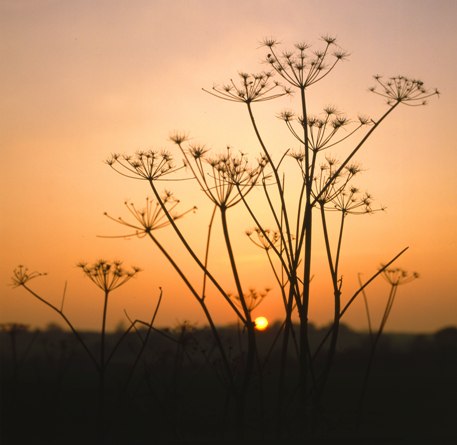
The ‘club’ of the Cailleach was an interesting metaphorical tool that seems to have informed many Atlantic pagan seasonal traditions… In summer (from Beltain to Lúnasa – the season of the constellations Virgo and Taurus) it represented either a ‘sprouting branch’ (traditionally held by the character depicted in Virgo), the drover’s ‘cow-switch’ or the shepherd’s ‘crook’. The ancient Irish word for a cowherd – búachaill – is very similar to that in other Celtic and Indo-European languages (eg – Greek = βουκόλος = boukolos). It is also used adjectivally (as buachalan) to mean ‘cow-switch’ or in modern times, as a class-word for any useful tool. It also became a class-word for stalky plant species: Buachalan Bui is the Ragwort (Senecio Jacobea) and Buachalan Ban (Manx: Bollan Bane) was used for Mugwort (Artemisia Vulgaris): Both make excellent cattle-switches as it happens, and it is desirable to pull up the former from pastures as it harms cattle. The Manx Bollan Bane is the traditional herb associated with the Julian Calendar midsummer celebration of Tynwald Day in the Isle of Man: Old English herbals refer to it as ‘Motherwort’ and it was used as a protective charm against miscarriage (nature’s womb is ripening at midsummer when the Artemisia flowers). Stalky plants (cuiseόg – ‘fairy dogs’?) of this type are notable as they leave their ‘bones’ or ‘ghosts’ standing dry in the winter landscape, whereas more tender vegetation tends to compost. The Artemisia, the Senecio and other plants of the Gaelic cuiseόg class (including the umbilliferae including Hemlock, Cow Parsley etc) were given superstitious associations with fairies and ‘witches’ in folklore.

'Vervain and Dill hinder witches of their will' (English tradition quoted by early folklorist John Aubrey, 1721)

‘Vervain and Dill hinder witches of their will’ (English tradition quoted by early folklorist John Aubrey, 1721) – the stalky plants whose shapes survive in the winter landscape (in spite of a ‘beating’ by the ‘goddess’) often had a superstitious reputation in folklore.

In harvest the ‘club’ might represent the reaping sickle or threshing flail. In fact, harvest is the start of autumn and plants are usually spent of their generative power when they have fruited. They give life and seem to die back – so it is perhaps no surprise that the Cailleach theology gave her a ‘club’ by which she might beat vegetation back and give new life simultaneously.

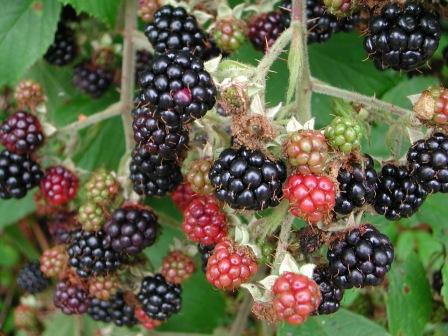
Children in the Isle of Man used to be told not to pick and eat blackberries after 1st October as the 'Devil' was supposed to have touched them with his 'club'.

Children in the Isle of Man (and elsewhere) used to be told not to pick and eat blackberries after 10th October (Old Michaelmas by the Julian calendar) as the ‘Devil’ was supposed to have touched them with his ‘club’ and turned them sour.

In summer the Cailleach’s functioned as a ‘cattle-switch’, but its use is now turned to a more destructive cause. There is a subtle juxtasposition of violence and new life inherent in this, which shows through in a number of ancient Atlantic traditions with pagan associations:

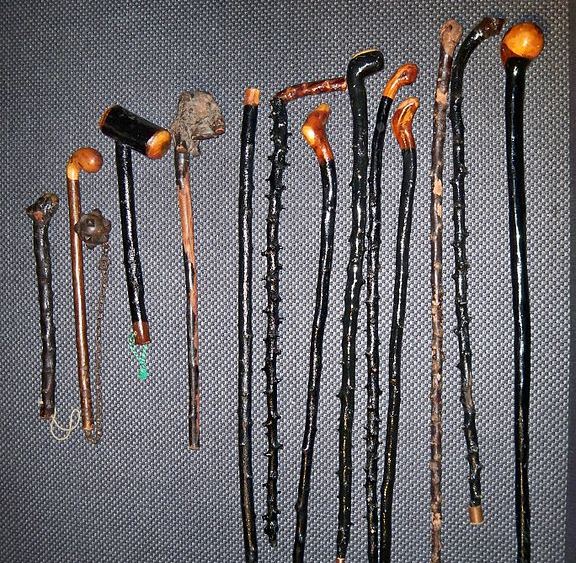
Shillelaghs - cut from the hardwood of Blackthorn or Oak, they make formidable weapons ... or Hurling sticks!

Shillelaghs – cut from the hardwood of Blackthorn or Oak, they make formidable weapons … or Hurling sticks!

In the wren-hunts (Isle of Man, Ireland etc), a stave was the weapon of choice used to hunt and kill this hapless tiny avian – apparently a representation of the Goddess. Once dead, its body was typically hoisted up on a pole, festooned in ribbons and greenery (sometimes even crucified) and paraded about… A simple club-stick with a crook or hook on the end was the original weapon of the related ancient traditional combative mid-winter stick-and-ball games played in the Gaelic lands: Shinty (Scots Gaelic: Camanachd, iomain),  Cammag (the Manx version) and Hurling (Irish: Iománaíocht/Iomáint, played with a stick called a camán). These rough games were often held in conjunction with the wren-hunts in times gone by, and there is another interesting link to the Cailleach (who was depicted as one-eyed, crooked and ancient): The Gaelic word Cam’ means ‘crooked’, ‘twisted’ or ‘deformed’ as well as being formerly applied as a description of a person as ‘one-eyed’

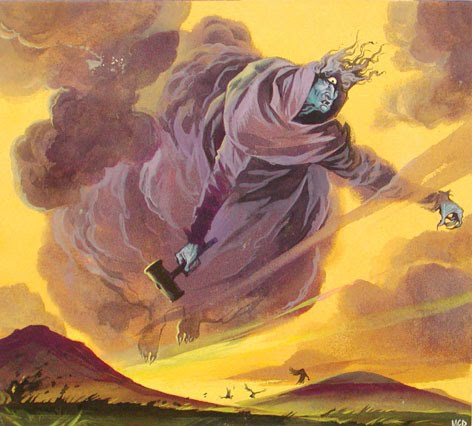
A modern depiction of the Cailleach Bheur ('Hag of Winter') of Scottish Highland legend

A modern depiction of the Cailleach Bheur (‘Hag of Winter’) of Scottish Highland legend. She carried a hammer or staff to beat the vegetation back into the ground in the cold months.

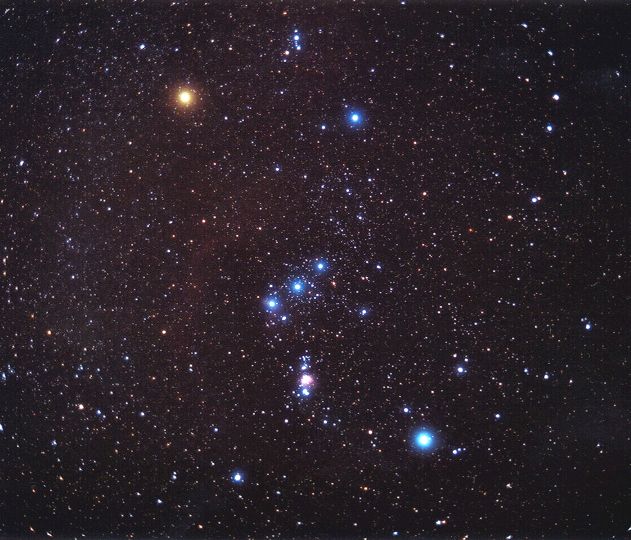
At some of the Lúnasa/Lughnasadh fairs and hilltop gatherings in Ireland, sticks used to be the weapon of choice in traditional faction fights, and it is of note that a long shillelagh might easily double up as a cáman for Hurling or one of its related cousins. The mythological Irish warrior Cúchulainn is described as playing at hurling in the Táin Bó Cúailnge, and is even said in some versions to have killed the hound of ‘Chulainn the Smith’ (possibly a deliberate corruption of Caillean/Cailleach!) with a hurling-ball (sliotar) providing an etymology for his name! The theme of combat and the Morrigan underpins the whole of the Tain, many of the battles of which occur at river fords – bringing to mind the image of Orion standing next to the Milky Way, near Taurus, the ‘Dog Star’ and Canis Minor, not far from the wren-like twinkling stars of the Pleiades or ‘Seven Sisters’… Winter-constellations-decline-1024x722

The meaning of Samhain

Samhain is the quarter-day festival that starts the Celtic year, marking the start of Winter and the end of harvests. It commences at nightfall on October 31st (new style Gregorian calendar) or the 11th November (old-style Julian Calendar) and goes by a number of different English names including Hollantide, All-Hallows Eve, Hallowe’en and All Saint’s Eve. In Scots and Manx Gaelic the name is the same, although written differently: Samhuinn and Sauin, respectively. The pronunciation is ‘Sow-in’ (rhymes with ‘cow-in’). There are a number of other more archaic names, which I will go on to discuss in due course.

It is a festival that symbolizes death – the transitional phase of the seasons when Atlantic Europe’s foliage dies back, and animal life dwindles. The evenings darken rapidly and the first frosts begin to touch the land. Crows and flocks of migratory wading birds throng the skies in great clouds cawing, whistling and chattering. The constellation of Orion begins to dominate the night skies… The spirit which enlivened nature in the summer months has gone from visible reality to the state of an intangible but certain potential for the coming year. In an ancient religious system that viewed life as a continuous oscillation between the tangible living state and a spiritual state awaiting rebirth in the next cycle, Samhain was therefore also the Festival of the Dead. 

It was Julius Caesar who first noted (in Commentarii de Bello Gallico) that the Gauls held that days started with nightfall, and celebrated the commencement of their important days with the falling of night. The same is true of the other Atlantic peoples, and in Ireland, Scotland and the Isle of Man in particular this continued down to modern times. The festival of Samhain was therefore called Oidhche Samhna – ‘Night of Samhain’ – in Irish, and Oie Hauiney or Houney in Manx. Both would be pronounced pronounced something close to ‘Ee ouna’ allowing for the usual lenitions and aspirations of spoken Gaelic.

The Manx had another name yet for the festival – ‘Hop tu naa‘ (pronounced ‘hop the nay’ or as the more modern ‘hop tyoo nay’) – which is of uncertain meaning and sounds curiously close to the Scots name for New Year: Hogmanay. In fact, Samhain was the Celtic New Year – just as days started with a nightfall, so the years started with the dark part also. It is uncertain when the Scots started to use ‘Hogmanay’ as the term for the 31st of December New Year, or for that matter if the term was ever used for Samhain. It seems that folk traditions of the Atlantic European world show quite a degree of transferability across the period between Samhain and the January New Year – customs including guising, playing pranks, gifting and house-visiting were just as likely at Christmas and New Year as they were around the 1st of November. Whether this represents a natural tendency to transfer celebrations that brighten the dull winter months or a concerted religious effort to dissipate or transform wholly pagan festivities remains unclear, but a combination of factors is likely.

There has always been a strong association of the festival with a ‘witch’ or ‘witches’ that has continued right down to the Halloween celebrations of modern times. The Celtic peoples never really had much time for the idea of ‘witches’ in the 16th/17thC judicial and religious sense of a person who worships the Christian Satan and does magic to harm their neighbours. The ‘witch’ referred to in Celtic areas is generally best interpreted as a Christian opinion of the old Goddess herself, rather than a human individual at the margins of society. She seems to be represented by the folklore character referred to as the Cailleach – a monstrous ancient female supposed to have created the landscape and unloosed the rivers, and supposed in some traditions to be responsible for winter. 

To the Celtic peoples of Ireland, Scotland and the Isle of Man ‘The Witch‘ was a figurative legendary character representing Christian opinion of the ancient Goddess, rather than a clear and present social threat posed by ‘a witch’. For this reason, there were hardly any executions of suspected ‘witches’ in Celtic cultural zones.

'Jinny the Witch jumped over the house to fetch a stick to lather the mouse'  (Old Anglo-Manx Samhain song)

‘Jinny the Witch jumped over the house to fetch a stick to hit the mouse’ (line from an old Anglo-Manx Samhain guising-song) – the constellation of Orion presides over the winter skies between Samhain and Imbolc (1st February).

Irish legends and medieval manuscripts contain a number of references to Samhain, and one in particular to a ‘witch’ associated with the festival. The ‘witch’ was Mongfionn/Mongfind – ‘White Hair’ or ‘Fair Hair’ – supposed at least (euhemerisation agains!) to have been sister of Crimthann mac Fidaig, a king of Munster, and mother of Ailill, Brión and Fiachra, the traditional ancestors of the medieval Connachta, by a High King called Eochaid Mugmedon. The Connachta were the opponents of the Ulaid (Ulstermen) in the Tain. She is supposed by to have been a sorceress responsible for poisoning her brother in order to allow her children to succeed the kingship, but who died after tasting her own poison while trying to convince her brother’s children it was safe. It is the old ‘evil fostermother’ tale from folklore, also related in the story of the ‘Children of Lir’. This murder and her death happened at Samhain and the Book of Ballymote (folio 144, b.1) claims that Mongfind was thereafter worshipped at Samhain by the peasantry who called it the ‘Festival of Mongfind’ – Feil Moing! There is a hill called Ard na Ríoghraidhe (Height of the Kingfolk?) or ‘Cnoc Samhna’ (Hill of Samhain) in Co. Limerick that is associated with her. The details of the kingship-oriented stories involving Mongfind are probably an obfuscation of the facts, and the ‘White Haired One’ is likely to have been the aged Cailleach who represented winter and rebirth in the coming year. Perhaps the Milky Way was her hair? The path to renewal…

Cnoc Tlachtga (now also called ‘The Hill of Ward’) near Athboy, Co. Meath was also a place legendarily or historically associated with Irish Samhain festivities, including the lighting of a bonfire. This Hill was supposedly eponymously named from a magical female of the same name, the daughter of a magician-druid called Mug Roith/Mog Ruith who was suppose to have given birth to triplets on the hill before dying. Another site associated with paganism, death and Samhain was, of course, Magh Slécht (Mag Senaig) in Co. Cavan, supposed to have been the site where ‘Tigernmas’, an ahistorical pagan High King of Ireland died along with many of his followers while worshipping an idol called Crom Cruaich at Samhain. This idol was supposed to have later been broken by Patrick. There are many other traditions besides, including the tale of the Ulster Cycle called Serglige Con Culainn (The Wasting Sickness of Cúchulainn) were the Ulster hero is attacked and seduced by the Queen of the Otherworld – Fand, wife of Manannan – during the course of Samhain celebrations of the Ulaid.

Irish legend also place the start of the Second Battle of Maigh Turead at Samhain, and it commences after a sexual coupling of the Dagda with the Morrigan. Likewise, the cattle raid of the Tain Bo Culainge commences at Samhain, and the tales of this also feature the Morrigan, who I have earlier identified with the Cailleach. The medieval tale The Boyhood Deeds of Fionn claimed that the Fairy Hills (Sid) were open at Samhain. You can tell from ancient Irish literature that Samhain had a particular association with death and the otherworld, and with potent magical female characters!

The themes of conflict and death at Samhain follow on from the Harvest, and then the very visible Atlantic autumn die-back of nature – replete with withering, decay, storms and darkness. These processes are set in motion from the festival of Lunasa (Lughnasadh) onwards. The die-back to pagans was simply a part of the renewal-cycle and therefore did not have the confused connotations of ‘evil’ or ‘uncleanliness’ that was imported with the somewhat ectopic Judaic religions during the 1st millennium.


‘Mary’ the Goddess

The curious tale of ‘Saint’ Brighid (Bride, Brigit etc) of Ireland is one of the most striking examples of the conversion of a Pagan Goddess into a Christian Saint. What is more curious still is the efforts of her early monkish hagiographers to identify her with Mary, mother of Jesus, as ‘Mary of the Gael’ according to one of her medieval hagiographies.

stbrigid2

Vita sanctae Brigidae (Bethu Brigte) is the oldest hagiographic Life of Brigid (circa 800CE). In Chapter 11, Brigid is introduced to the assembled saints of Leinster by ‘Bishop Ibor’ who tells them he has had a vision that Brigid is to be the Mary of Ireland. This story is repeated in the later Leabhar Breac account of her life.

Subsequently, the tradition and portrayal of ‘Mary of the Gael’ has stuck. Alexander Carmichael recorded the Hebridean tradition of Bride as ‘Foster Mother of Christ’ as late as the 19th century. The reason why this should be so, is less than clear, and needs to be examined:

Brighid herself was undoubtedly originally a pagan goddess looking for a Christian identity, and it is possible that giving her the well-understood mantle of the christian Mary provided this identity. However, the names of the Gallician and Basque ‘fairy’ goddesses – Moura and Mari – force us to consider the question of identity in greater depth. For starters, it is unlikely that these Hispanic pagan ‘Maries’ were named after the Christian character. In which case, we have to speculate which pagan Irish character was the ‘Mary’ that Saint Brighid was to replace? From the pagan-flavoured Irish legends left to us by monks, one possible character comes to mind – the magical female referred to by a number of names, including Morrígan, Mórrígan and Morrígu, also in the plural as Morrígna.

As examined previously, the Morrigan was represented in some of the old tales as part of a triplicate combination: Badb-Morrigan-Macha, and there was a medieval Christian tradition of ‘Three Maries’ who went to find the body of Jesus after he was presumed dead. With this in mind, we must turn to a fragment of evidence from (again) the Isle of Man, to a reference to a ‘Triple-Morrigan’ in the text of a charm recorded in ecclesiastical court documents from the island during the 18th century: This is known to Manx folklorists as ‘Daniel Kneale’s charm to staunch a horse’s blood’, and runs as follows (copied from Kirk St Anne parish registers for 2nd September 1722):

Tree Moiraghyn hie d’yn Raue,

Kemy, Cughty, Peddyr, as Paul,

Doort Moirrey jeu, Shass,

Doort Mooirey jeu, Shooyl,

Doort Moirrey elley, Dy gast

yn’Uill shoh, myr chast yn’Uill,

haink as Lottyn Chreest:

Mish dy ghra eh, as Mac Voirrey

Dy chooilleeney oh.

My translation:

‘Three Marys/Mothers/Morrigans went to Rome

Boundary Fairies, Cliff Fairies, Peter and Paul.

Mary said to ‘Stand’

Mary said to you ‘Walk

Mary said ‘Go Quickly’ this blood,

like to stop the blood,

Did come by Christ:

Me to say it and the Son of Mary

To fulfil it.’

Curious indeed! The Manx word Moiraghyn is almost exactly like Morrígan – its meaning is can be interpreted as a plural of Mary (‘Maries’) but it also means ‘Mothers’ in its own right, and more importantly the word Muiraghan is given in John Kelly’s 19thC Manx Dictionary as a word for Mermaid. The reference to ‘Kemy’ and ‘Cughty’ is to ‘Keymagh’ and ‘Cughtagh’ – these are Manx terms for local types of spirits, and I have translated these as best I can given current evidence. Kelly’s dictionary has  this translation for Cughtagh: “Cughtagh s. pl Cughtee – a fairy, a sprite, a spirit of the houghs; some say ny keymee as ny cughtee…”. He also gives the related word Guight to mean the same. This is evidently the same word as the English/Germanic word ‘Wight’ (from OE/OHG wiht), meaning a sentient being – the Manx, like the Irish, typically added a guttural sound to words beginning with ‘W’. A Keymagh was a spirit believed to haunt the styles and boundaries of churchyards – possibly the same as the revenant of the last-buried who guarded the same in Scottish and Hebridean folklore. The name itself (allowing for m-w sound transformation) would be pronounced the same as the Scots Gaelic Ciuthach (‘kewach’) – a spirit that lived within rocks. It is therefore also possibly cognate with the Breton death spirit Ankou. The charm provides a fascinating insight into the persistence of pagan ideas in a syncretic form with christianity, as well as giving a new insight into the possible identity of the Morrígan of Irish myth.

All this might be a bit much to take in, but it is only a small part of the picture of these ‘Pagan Maries’ of the Celtic world… Loch Maree (traditionally linked in Christian history to a saint called Máel Ruba) in Wester Ross in the NW Scottish Highlands is associated with a late description (recorded in the records of the Presbytery of Dingwall from 1695) of the apparently pagan sacrifice of cattle to a god called ‘Mourie’ on one of its islands. The town of Tobermory on Mull takes its name from the Gaelic for ‘Mory’s Well’, there being no Christian history of a well dedicated to the Christian Mary! Carmichael notes some Gaelic names for the month of May in Carmina Gaedelica Volume 2 as ‘mi Moire‘, ‘mios Moire‘ (‘month of Mary’) and ‘Bochuin Moire’ (‘Swelling of Mary’) suggesting a connection between the month of exploding fecundity and ‘Mary’. The pagan goddess was, after all, a representation of the year and her different aspects (and names) represented the seasons. Port St Mary in the Isle of Man was and is known to locals as ‘Purt le Murra’. There is a place near it on Meayll (Mull) Hill called Lag ny mBoire, pronounced ‘Lag na Murra’, suggesting a possible link between the names Beara/Berry (ie – the Cailleach) and ‘Mary’.

The question as to the meaning of Mourie, Murra, Mary, Mari, Moura or whatever the original derivation is now arises. There are several possibilities: The first (most likely) is that the word derives from the Latin word for the sea: Mare and its various regional derivations, such as the Germanic Mere, Irish Muir, Welsh Môr, Manx Muir and Moor etc. This is quite in line with the doctrines of the Atlantic Religion I have so far been discussing. The second (less likely) is the Celtic word for ‘big’ – Mór – although the fact that the vastest thing in the experience of Atlantic peoples has always been the sea itself must at least be considered in passing. The Irish version of ‘Mary’ is ‘Muire’. As already mentioned, there is a possibility that there has been a linguistic mutation involving the labial sounds ‘M’ and ‘B’ meaning that the name of the Cailleach – Beara – was originally mBeara – ‘Meara’ or ‘Murra’. A fourth derivation might be from the Greek Moirae, or Fates. A fifth might be the Germanic ‘Mara’ – a spirit that caused nightmares, and from which we derive that word.

Tehi Tegi

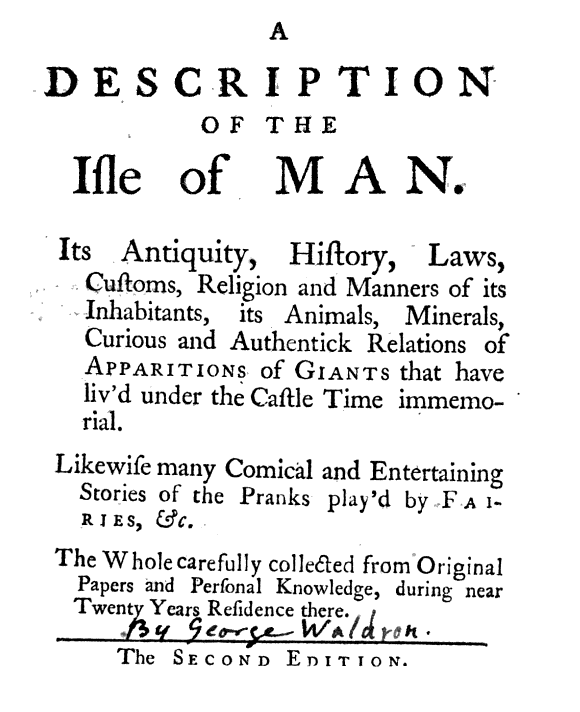
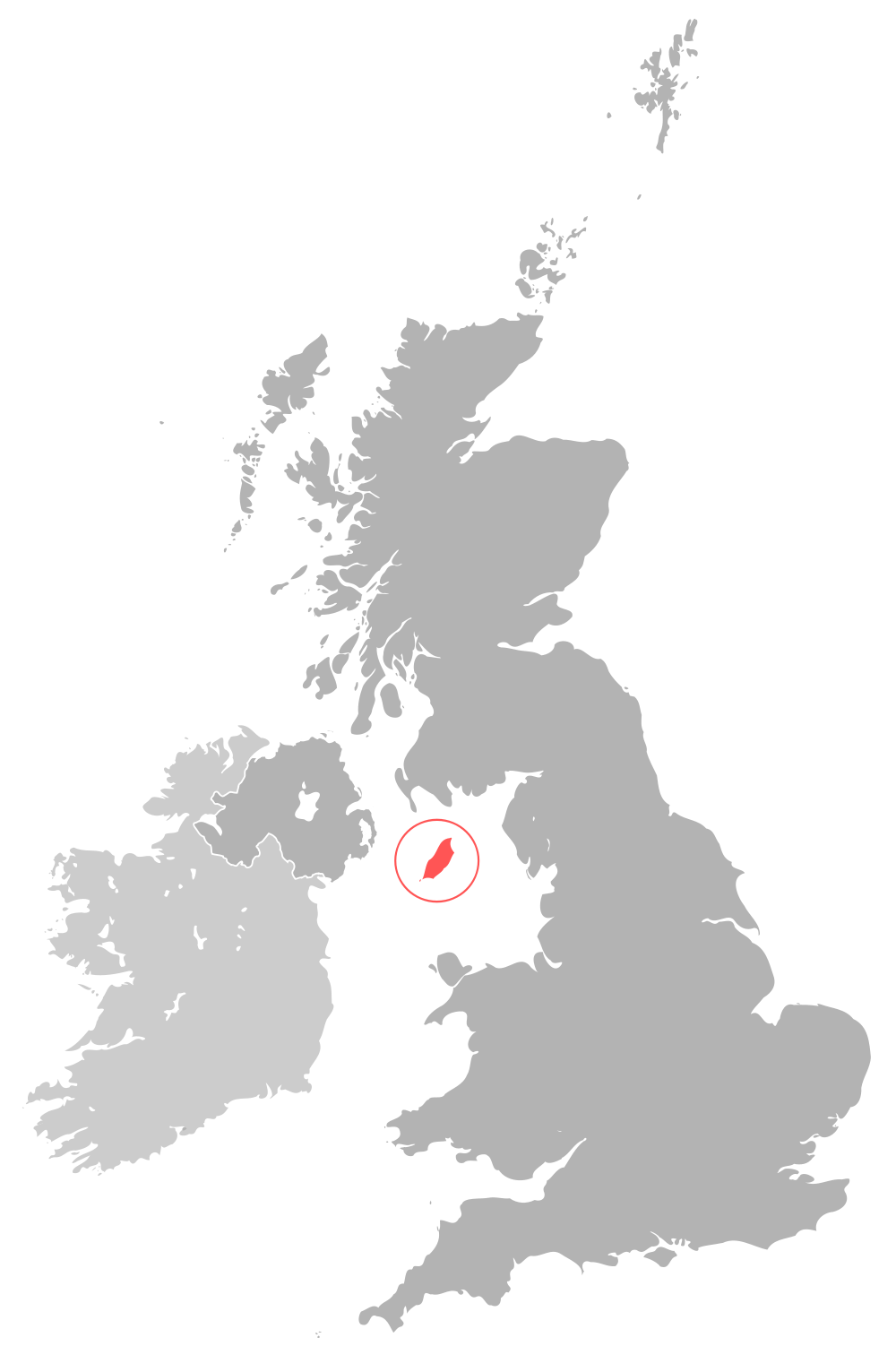
Some time between 1720 and 1730, a young Englishman by the name of George Waldron was living in the Isle of Man, employed as a trade commissioner for the British government who were trying to supress smuggling in the Irish Sea region. Fascinated by the strange history and wild ancient beliefs of the islanders he began compiling a book – ‘A Description of the Isle of Man’ – which provided one of the earliest pieces of indigenous ethnography and folklore writing from Britain and Ireland. This was published shortly after his untimely death in 1731:

WaldronIOMCoverThe book was famously used as source material by romantic authors of the next century, most notably Sir Walter Scott, who employed some of the Island’s fairy tales and legends to embellish historical stories such as Peveril of the Peak. In the book, Waldron related one particular popular local tale of the Manx taken from the popular pseudo-historical narrative tradition:

(pp.143-152)

A person at his first coming to this Island, would be strangely amazed at the little complaisance they pay to the: weaker sex: the men riding always to market on horseback with their creels on each side their horses full of fowls, butter, eggs, or whatever they bring thither to dispose of, and the women following them on foot over rocks, mountains, bogs, sloughs,   and thro’ very deep rivers, and all this without either shoes or stockings’ carrying, these superfluous coverings, as they term them, under their arms till they come near the market-town; then they sit down all together on the side of a hill,   and put them on for fashion sake, and let down their petticoats also, which before were tucked up higher than their knees’   for the convenience of wading thro’ the rivers, and to preserve them from the mire of the bogs and sloughs.

But the reason for obliging the females to this hardship, is a very whimsical one, and such a one, as I believe, cannot but afford some diversion to my curious reader, I shall therefore insert it in the manner it was told me by an old native, to whom it had been handed down from many generations as an undoubted verity.

He told me that a famous enchantress sojourning in this Island, but in what year he was ignorant, had, by her diabolical arts, made herself appear so lovely in the eyes of men, that she ensnared the hearts of as many as beheld her. The passion they had for her so took up all their hearts that they entirely neglected their usual occupations; they neither Flowed nor sowed; neither built houses nor repaired them; their gardens were all overgrown with weeds, and their once fertile fields were covered with stones; their cattle died for want of pasture, their turf lay in the Bowels of the earth undug for; and every thing had the appearance of an utter desolation: even propagation ceased, for no man could have the least inclination for any woman but this universal charmer, who smiled on them, permitted them to follow and admire her, and gave every one leave to hope himself would be at last the happy he.

When she had thus allured the male part of the Island, she pretended one day to go a progress through the provinces, and being attended by all her adorers on foot, while she rode on a milk-white palfrey, in a kind of triumph at the head of them: she led them into a deep river, which by her art she made seem passable; and when they were all come a good way in it, she caused a sudden wind to rise, which driving the waters in such abundance to one place, swallowed up the poor lovers to the number of six hundred in their tumultuous waves. After which, the sorceress was seen by some persons who stood on the shore to convert herself into a bat, and fly through the air till she was out of sight; as did her palfrey into a sea-hog or porpoise, and instantly plunged itself to the bottom of the stream.

To prevent any such like accident for the future, these wise people have ordained their women to go on foot, and follow wheresoever their lords the men shall lead; and this custom is so religiously observed, as indeed all their traditions are, that if by chance a woman is before, whoever sees her, cries out immediately, Tehi-Tegi! Tehi-Tegi ! which, it seems, was the name of that enchantress which occasioned this law among them.

The essence of the legend of ‘Tehi-Tegi’ is of a magical female in times past (the usual narrative subtext for a pagan goddess) whose beauty leads an enslaved army of Manx men on a procession ‘through the provinces’ and then to a river or to the sea (the legend has a certain plasticity) where they are drowned and taken by the waters. The tale contains strong elements of the old Scots legends of Kelpies and the related Scando-Germanic Nixies or Necks – usually portrayed as beautiful women who transform into horses and drown men in rivers or in the ocean. The root word of Nix apparently means ‘wash’, and this probably relates to the fairy washer-women who pepper folk-tales in the Isle of Man, Scotland and Ireland as well as further afield. It is also related to the Mermaid traditions, of which the Isle of Man has a rich share. The theme is of a transforming feminine force, related somehow to horses, which steals men’s lives by conveying them into water. The Manx also call their own local Kelpie the Cabbal Ushtey or Water Horse, or the Glashtyn – ‘Grey One’. There is even a pool on the Island called Nikkesons showing the Viking input to the legendary heritage of the place.

However, ‘Tehi-Tegi’ is also a tale bearing strong similarities to that of Nerthus in Tacitus’ Germania from the 1stC CE. In Waldron’s tale, the ‘Enchantress’ rides a white horse rather than travelling in a wain or waggon, but the parallels are striking: The procession ‘through the provinces’ led by a potent ancient ‘magical’ female, and the drowning of the enslaved at the conclusion of the account… There are also echoes in the medieval story of the Ratcatcher or Piper of Hamelin in Germany. It therefore appears that it might represent a little fragment of pagan belief cast in legend!

The name ‘Tehi-Tegi’ means ‘Fair Chooser’ (Tei is the Manx verb ‘to pick, gather, collect’, Teg is a Brythonic Gaelic word meaning ‘fair’ or ‘beautiful’, placing the origin of the name in the island far back in time). The meaning of the name ‘Tehi-Tegi’ and the description of her as an enchantress mark her as a pagan deitypreserved in a fairy tale. Curious details include her final transformation into a flying creature bring to mind an otherworld-transition; She becomes a bat in Waldron’s version, and but more usually a wren in other local versions, linking ‘Tehi-Tegi’ firmly to the annual Wren Hunt held on St Stephen’s Day (Dec. 26th) on the Island and in former times, elsewhere. Here are some examples of this:

Legends of the north, or The feudal Christmas; a poem By Henry Rolls (mrs.), Pub Simpkin & Marshall London 1825, pp.269-270

The wren is still regarded by the Manx people as possessing supernatural intelligence. They say that when St Maghull (Ed: Maughold – the Manx ‘Saint’) came to the island and converted it to Christianity he banished all the fairies but their queen who assumed the form of a wren in which she at times still appears and that if in that shape she can be killed her power will cease for ever. They hate this bird but fear to destroy it as some dire calamity will befall the person and all his family who effects the destruction of the reign of the fairies in Man.

AND

From: History of the Isle of Man, by Hannah Bullock; Pub. Longman, London, 1819. (Chapter 19):

….one of the most curious ceremonies, and which, I believe, is peculiar to the Isle of Man, is, that of hunting the wren, founded on a tradition, that in former times, a fairy of uncommon beauty exerted such undue influence over the male population, that she at various times seduced numbers to follow her footsteps, till, by degrees, she led them into the sea, where they perished. This barbarous exercise of power had continued for a great length of time, till it was apprehended the island would be exhausted of its defenders, when a knight-errant sprung up, who discovered some means of countervailing the charms used by this syren, and even laid a plot for her destruction, which she only escaped at the moment of extreme hazard, by taking the form of a wren; but though she evaded instant annihilation, a spell was cast upon her, by which she was condemned on every succeeding New Year’s Day, to reanimate the same form, with the definitive sentence, that she must ultimately perish by a human hand. In consequence of this well authenticated legend, on the specified anniversary, every man and boy in the island (except those who have thrown off the trammels of superstition), devote the hours between sun-rise and sun-set, to the hope of extirpating the fairy…

Tehi-Tegi’s white horse (possibly representing the moon which controls the tides) becomes a porpoise and swims away at the end of Waldron’s version of the tale – redolent of the scene in the Voyage of Bran when Manannan introduces the transition to the otherworld and the horses galloping alongside him appear as fish!

The tale probably survived in its traditional form because it also acted as a metaphor where Tehi-Tegi IS the sea – drawing the Manxmen away from agriculture and into the trades of the sea: fishing, commerce and piracy! The Manx rural economy as far back as records go has been supported by its menfolk going to sea during the herring fishing season in order to increase food stocks of winter food and provide cash money to supplement the income from agricultural surplus. It was a dangerous trade, and a law of 1610 limited the fishery to operate only between midsummer and the end of December, meaning that the start of harvest crossed over with that of the fishery, offering some Manxmen a quandary between going to sea and working the land. Either way the womenfolk must have been anxious – both about the danger, and the lack of male help on the farmstead close to harvest… This perhaps provides a social aspect to the legend as told to Waldron, crackling as it is with gender politics.

So who might this ‘enchantress’ or ‘Fair Chooser’ have been? She appears in the legend and by her name to operate as a psychopomp or conductor of souls of the dead. She also represents the ‘otherworld attractor’ qualities of Love and Beauty that typifies fairy legends. She also has a particular association with the rivers and the ocean, and with horses, marine life and flying creatures. The Manx tales state ‘Tehi-Tegi’ was Queen of the Fairies, and there is a similar account from Ireland, naming the Fairy Queen Cliodhna as the protagonist who is annually transformed into a Wren. She is more usually associated with the Tonn Cliodhna – a powerful tidal surge in the neck of Glandore Harbour, Co.Cork. Local legends held her to be a daughter of ‘Manannnan’s druid’. Manannan is also associated with the Tonn Banks off Co. Donegal, which also have Cailleach legends associated with them.

That some of these attributes could be associated with the Scandinavian Vanir goddess Freyja (and her Father:Mother (N)Jörð) is perhaps unsurprising as the Islanders are a genetic combination of Viking and Celtic settlers whose folklore preserves many of the old pagan ideas. Freyja was described in Snorri‘s 13thC Icelandic ‘Prose Edda’ tale – Gylfaginning as having the choice of ‘half of the slain’ in battle, the other half going to Odin. He uses the kenning Valfreyja – ‘Lady of the Fallen’ – a function certainly being carried out by Tehi-Tegi. One of the other kenning-names used by Snorri was Mardöll, possibly meaning ‘Image of the Sea’ (Mar and a contraction of the Lat in/Greek word (e)idola, which entered Germanic languages and Manx at an early stage).

Freyja was supposed to have had a ‘cloak of feathers’ which could transform the wearer into a bird, much in the manner of the jǫtunn Þjazi, to whom some legends have her being grand-daughter. Apart from the connection of Tehi-Tegi with the bat or wren, another Manx legend – of a giant magical female called Caillagh ny Groamagh who comes from the sea in the form of a bird on February 1st (or March 25th – the tradition is confused) to search for firewood/build her nest back on land. The dating of ‘Caillagh ny Groamagh’s Day’ coincides with that of the day of St Bridget, which is also the Celtic/Atlantic festival of Imbolc. The similarity between the Manx name for Bridget: Vreeshey or Breeshey (the terminal -ey in Manx is pronounced ‘-a’, as Vreesha‘) and the name Freyja is very intriguing. One wonders if they might be related? And is the Manx name for the Isle of Man – Vannin or Mannin – related to the tribe of the Vanir? We know that many of the Scandinavians who settled Iceland and who preserved many of the old Eddaic legends were connected strongly to the Viking kingdoms of Dublin and the Isle of Man.

It is possible that regional alliance and cultural and population mobility between the northern European peoples during the Iron Age led to a syncresis between Western and Eastern forms of paganism which led to the combined Aesir and Vanir traditions recorded and described by the (Christian) Icelanders during the 13thC. Alternatively, the Scandinavian and Germanic religions may be the survival of un-Romanised, un-Christianised Celtic paganism, albeit altered through a prolonged interaction with these cultures before the final Christianisation began in the 10th and 11th centuries.

tbc


‘Sluagh Sidhe’ and ‘Hidden Folk’ – the Host of Souls

The belief in souls having an aerial or avian aspect is based upon the ancients’ elemental system of belief which put things of Air above the mundane world of Earth and Water in their scheme of the Universe – closer to the ‘upper’ stations occupied by Fire (which was believed to ascend above air) and Spirit (which was the ‘Ethereal’ aspect of Fire). Christian iconography today still uses the figurative portrayal of their ‘Holy Spirit’ as a dove coming down from the spiritual realms of heaven, but this idea has its roots deep in pagan ideaology (ie – natural philosophy).

Writing in Ireland during the 7thC CE, a monk known to scholars as ‘Augustine Hibernicus’ made a reference (in his exegetic writing known as De mirabilibus sacrae scripturae) ridiculing historic ‘magi’ (pagan priests) who once taught that the ancestral soul took the form of a bird. He argued that to give literal credence to the biblical miracle story of Moses and Aaron in Egypt which states that the wands of the Hebrew magicians were turned into actual serpents was:

`… et ridiculosis magorum fabulationibus dicentium in avium substantia majores suos saecula pervolasse, assensum praestare videbimur…’

`…to show assent to the ridiculous myths of the magi who say that their ancestors flew through the ages in the form of birds…’

The context of this comment was against a political background where Christian authors and proselytes in Ireland (mostly monks related closely to clan chiefs) were still promoting stories about local saints such as Patrick, Brighid, Columba, Kevin, Senan etc. defeating ‘magical’ pagan adversaries in the early days of christianising Ireland, Scotland, the Isle of Man etc. For example, one of the adversaries of St Patrick in Tírechán’s 8thC account of his life was a flock of magical birds on Cruachán Aigli. Contemporary christianity was still struggling to come to terms with the fact that the biblical miracles it was trying to promote could not be reproduced to the sceptical (pagan-thinkers) who still transmitted fabulous magical tales of their own as part of the stylised traditional oral narrative about how the world was, and which undoubtedly formed an unassailable part of clan and community life.  There was therefore an atmosphere of ‘anti-magic’ in the contemporary monkish discourse, but allowances made for magic in historical tales involving saints to show that for every action by a pagan character the Christian god would allow a greater and opposite reaction in order to destroy paganism once and for all.

This Irish theme of birds representing fairies or souls of ancestors (as ‘fallen angels’) appears later in a modified form in one of the most popular European books of the high middle ages – the Legenda Aurea (Golden Legend) of James/Jacob of Voraigne (c.1260). This collection of stories in Latin about saints was drawn from traditions across Europe and of particular interest is the popular Irish hagiography of St Brendan, postulated to be a christianisation of the apparently pagan tale of the voyage of Bran mac Febal to the otherworld. In the Brendan tale, the saint is addressed by a flock of birds (here translated from the Latin):

“…And then anon one of the birds fled from the tree to Saint Brandon, and he with flickering of his wings made a full merry noise like a fiddle, that him seemed he heard never so joyful a melody. And then Saint Brendon commanded the bird to tell him the cause why they sat so thick on the tree and sang so merrily ; and then the bird said: Sometime we were angels in heaven, but when our master Lucifer fell down into hell for his high pride, we fell with him for our offences, some higher and some lower after the quality of the trespass, and because our trespass is but little, therefore our Lord hath set us here out of all pain, in full great joy and mirth after his pleasing, here to serve him on this tree in the best manner we can…”

The birds are recounting to Brendan a version of a belief that became common across Europe after the spread of christianity, and that was applied in dealing with pagan indigenous spirits from Iceland and Orkney (Hulderfolk) through to Slavic Russia (Domovoi etc): This was that these spirits, beloved of the people, were really fallen angels from that (confused) Christian interpretation of the biblical narrative (Isaiah 14:12) about a character called ‘Morning Star’ (‘Lucifer’) and his ‘fall’ from grace. This sole reference in the Jewish religious books is used by christians to suppose that the angel Satan (God’s right-hand man in the Book of Job) was ‘Lucifer’ who fell from heaven with his rebel angels after challenging the monotheistic god. Jews don’t believe this, saying that the passage is about a human ruler punished for his pride. The Christian interpretation was designed to incorporate and find a place for recidivist (probably ‘pre-Olympian’) indigenous European beliefs: of genii and daemones, and in ancestral domestic spirits in the new Christian order. It paints them as evil representatives of an adversarial christian anti-god called ‘Satan’, who appears as god’s most important angel-servant in the semitic Old Testament stories, and arguably in the same context in the Gospel of Matthew (4:9).

‘Augustine Hibernicus’ and James/Jacob of Voraigne both appear to be quoting from or referring to the same tradition of folkore that remembered the old beliefs. This legend existed in Ireland and the Isle of Man in the late 19thC. Manx folklorist William Cashen wrote the following of it (‘William Cashen’s Manx Folk-Lore’, Pub. Johnson, Douglas 1912):

“…The Manx people believed that the fairies were the fallen angels, and that they were driven out of heaven with Satan. They called them “Cloan ny moyrn”: The Children of the pride (or ambition) (Ed: May be a corruption of Cloan ny Moiraghyn – see later). They also believed that when they were driven out of heaven they fell in equal proportions on the earth and the sea and the air, and that they are to remain there until the judgment…”

And Lady Wilde said ( ‘Ancient Legends, Mystic Charms and Superstitions of Ireland’, p.89 1888):

“…all the Irish, believe that the fairies are the fallen angels who were cast down by the Lord God out of heaven for their sinful pride. And some fell into the sea, and some on the dry land, and some fell deep down into hell, and the devil gives to these knowledge and power, and sends them on earth where they work much evil. But the fairies of the earth and the sea are mostly gentle and beautiful creatures, who will do no harm if they are let alone, and allowed to dance on the fairy raths in the moonlight to their own sweet music, undisturbed by the presence of mortals…”

This belief was common to many other countries besides, from the Atlantic to the Baltic. The fairy multitude was the ‘Sluagh Sidhe’ or ‘Fairy Host’ – represented in Irish, Manx, Welsh and Scots folklore as a tumultuous aerial flock who might carry people aloft on wild rides, and that caused whirlwinds and bad weather through their aerial battles. They also caused sickness and disease.

Walter Evans-Wentz’s ‘The Fairy Faith in Celtic Countries’ was a compendium of fairy lore collected around the turn of the 20th century collected with the assistance of a group of prominent folklorists from throughout the Celtic provinces. He collected the following account of the Sluagh Sidhe from a woman named Marian MacLean (nee MacNeil) of Barra (pp.108-110):

‘…Generally, the fairies are to be seen after or about sunset, and walk on the ground as we do, whereas the hosts travel in the air above places inhabited by people. The hosts used to go after the fall of night, and more particularly about midnight. You’d hear them going in fine. weather against a wind like a covey of birds. And they were in the habit of lifting men in South Uist, for the hosts need men to help in shooting their javelins from their bows against women in the action of milking cows, or against any person working at night in a house over which they pass. And I have heard of good sensible men whom the hosts took, shooting a horse or cow in place of the person ordered to be shot…

… My father and grandfather knew a man who was carried by the hosts from South Uist here to Barra. I understand when the hosts take away earthly men they require another man to help them. But the hosts must be spirits, My opinion is that they are both spirits of the dead and other spirits not the dead.’

Wentz then goes on to comment:

The question was now asked whether the fairies were anything like the dead, and Marian hesitated about answering. She thought they were like the dead, but not to be identified with them. The fallen angel idea concerning fairies was an obstacle she could not pass, for she said, ‘When the fallen angels were cast out of Heaven God commanded them thus:–“You will go to take up your abodes in crevices under the earth in mounds, or soil, or rocks.” And according to this command they have been condemned to inhabit the places named for a certain period of time, and when it is expired before the consummation of the world, they will be seen as numerous as ever.’

Again, we can see a tantalising expression of ancient traditions that Wentz found his modern narrator having difficulty fully reconciling in her own mind, although she quotes the catechism about fairies as fallen angels as if it were a passage from the bible!

Alexander Carmichael (Carmina Gaedelica 2 pp.330-331) was more explicit than Wentz when speaking through his Hebridean sources, some of whom he no doubt introduced to Wentz: (Ed note: my emphasis added)

Sluagh – ‘Hosts’, the spirit world – the ‘hosts’ are the spirits of mortals who have died. The people have many curious stories on this subject. According to one informant, the spirits fly about “n’an sgrioslaich mhor, a sios agusa suas air uachdar an domhain mar na truidean’ – ‘In great clouds, up and down the face of the world like the starlings, and come back to the scenes of their earthly transgressions’. No soul of them is without the clouds of earth, dimming the brightness of the works of God, nor can any make heaven until satisfaction is made for the sins on earth. In bad nights, the hosts shelter themselves, ‘ fo gath chuiseaga bheaga ruadha agus bhua-ghallan bheaga bhuidhe’ –

‘behind little russet docken stems and little yellow ragwort stalks’.They fight battles in the air as men do on the earth. They may be heard and seen on clear frosty nights, advancing and retreating, retreating and advancing, against one another. After a battle, as I was told in Barra, their crimson blood may be seen staining rocks and stones. ‘Fuil nan sluagh’, the blood of the hosts is the beautiful red ‘crotal’ of the rocks, melted by frost. These spirits used to kill cats and dogs, sheep and cattle, with their unerring venemous darts. They commanded men to follow them, and men obeyed, having no alternative.

It was these men of earth who slew and maimed at the bidding of their spirit-masters, who in return ill-treated them in a most pitiless manner. ‘Bhiodh iad ’gan loireadh agus ’gan loineadh agus ’gan luidreadh anus gach lod, lud agus lon’–They would be rolling and dragging and trouncing them in mud and mire and pools. ‘There is less faith now, and people see less, for seeing is of faith. God grant to thee and to me, my dear, the faith of the great Son of the lovely Mary.’ This is the substance of a graphic account of the ‘sluagh,’ given me in Uist by a bright old woman, endowed with many natural gifts and possessed of much old lore. There are men to whom the spirits are partial, and who have been carried off by them more than once. A man in Benbecula was taken up several times. His friends assured me that night became a terror to this man, and that ultimately he would on no account cross the threshold after dusk. He died, they said, from the extreme exhaustion consequent on these excursions. When the spirits flew past his house, the man would wince as if undergoing a great mental struggle, and fighting against forces unseen of those around him. A man in Lismore suffered under precisely similar conditions. More than once he disappeared mysteriously from the midst of his companions, and as mysteriously reappeared utterly exhausted and prostrate. He was under vows not to reveal what had occurred on these aerial travels…

… The ‘sluagh’ are supposed to come from the west, and therefore, when a person is dying, the door and the windows on the west side of the house are secured to keep out the malicious spirits. In Ross-shire, the door and windows of a house in which a person is dying are opened, in order that the liberated soul may escape to heaven. In Killtarlity, when children are being brought into the world, locks of chests and of doors are opened, this being supposed, according to traditional belief, to facilitate childbirth.

The West is, of course, the direction of the setting sun and supposed location of the ‘Blessed Isles’ (which go under a variety of euphemistic names) where the dead live in ancient Atlantic/Celtic folklore and legend. Carmichael’s account of the Hebridean idea of the Sluagh draws together the widespread references from throughout the Celtic world of fairies in an aerial state: Riding plant stalks through the air, causing illness by darts and diseased blasts of wind and carrying the living spirits of humans aloft, enslaving them to their bidding.

The connection between birds and spirits also occurs in the Irish and Manx wren legends and wren-hunts, also as the Morrigan-Badbh of Irish folklore and legend, and in the form of the Manx Caillagh ny Groamagh (a personification of winter and storms just like the highland Cailleach) who supposedly comes ashore from the oceans on St Bridget’s day in the form of a great bird before transforming into an old woman (Caillagh/Cailleach) who looks to kindle a fire. In southern Scotland during the 16thC this fearsome legendary female was referred to as the ‘Gyre Carline’ – the bird-form of the ‘Cailleach Vear’ legendary female figure of the Highlands, and once at the centre of the Celtic/Atlantic religious mythos as I shall later attempt to prove. In fact, the association between the Cailleach Vear/Bhear/Beara (and the multiplicity of other names she appears under) and flocks or hosts of animals is explicit in ancient Scottish traditions. In the Isle of Man she was sometimes also known as ‘Caillagh ny Fedjag’ (‘Old Woman of the Feathered Ones’ or ‘Old Woman of the Whistlers’) and was sometimes imagined as a giant whose presence could be witnessed in swirling flocks of birds, such as crows, starlings and plovers. Her name (and gender) became corrupted to Caillagh ny Faashagh in Sophia Morrison’s book of Manx Fairy Tales. Another Manx folklorist – W.W.Gill – said (A Manx Scrapbook, Arrowsmith, 1929) that fairies were known by the term Feathag. All seemingly related to a core idea – first referred to by ‘Augustine Hibernicus’ – that ancestral spirits have an aerial presence…

Going back much further in time to Iron Age Europe, we must remember that the Augurs and Haruspices of ancient Rome (originally Etruscan in their foundation) were priests and officials whose job it was to watch the behaviour and flight of birds in order to determine the will of the divine, so we can see that there is an entrenched ancient belief about spiritual forces being represented by birds in ancient Europe. Medieval Anglo-Saxons and Scandinavians applied similar superstitious import to the calls, flight and behaviour of members of the crow family…

The ‘Hidden Folk’:

The other theme in Atlantic fairy belief is the idea of them as (ancestral) spirits hidden away after the coming of christianity. The Icelandic Huldufólk, Orcadian Hulder-folk, and the fairy children of Germanic folklore’s Huldra/Holde/Hylde female personages have their equivalent versions in the legends of the Atlantic celts: A prime example of this, and one that also ties in to the souls-as-birds theme, is the great medieval Irish story of ‘The Children of Lir’ which occurs in a modified form in the writings of the christianised pseudo-history of Ireland: the ‘Book of Invasions’ or Lebor Gabála Érenn as well as in the text called Acallam na Senórach. These tell of a group of children (adopted or otherwise) of an ancestral heroic figure, sometimes turned into swans (or fish), and destined to wonder or hide in this form for many ages until released by a christian agency, depending on the telling.

Interestingly, the Valkyries of Norse folklore (conductors of the souls of the battle-dead) appear as swan-maidens in some tellings… Even in Wales, a form of the legend exists, and author William Wirt-Sikes reported the following one from Anglesey in the late 1800’s (‘British Goblins: Welsh Folk-Lore, Fairy-mythology, Legends and Traditions’, Pub: London: Sampson Low, Marston, Searle, and Rivington, 1880):

“…In our Savior’s time there lived a woman whose fortune it was to be  possessed of nearly a score of children, and as she saw our blessed Lord  approach her dwelling, being ashamed of being so prolific, and that he  might not see them all, she concealed about half of them closely, and  after his departure, when she went in search of them, to her great  surprise found they were all gone. They never afterwards could be  discovered, for it was supposed that as a punishment from heaven for  hiding what God had given her, she was deprived of them; and it is said  these her offspring have generated the race called fairies…”

All of these types of legend or folktale (Aarne-Thompson-Uther type 758) often refer back to the ‘hidden’ elves/fairies/subterraneans (the souls of the dead) as children of a particular impoverished female, in order to suit a euhemerised christian narrative.
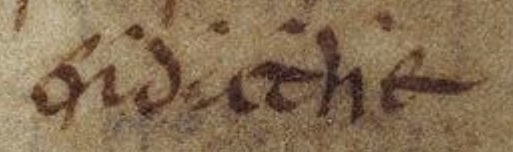
Fairies as ancestors in the Isle of Man

Right at the centre of Europe’s Atlantic archipelago, in the sea between Ireland and Britain and guarding the southern approaches to the Hebrides and west of Scotland, sits the Isle of Man – smallest of the surviving ‘Celtic’ nations. Although falling under successions of external rulers from Ireland, Scandinavia, Scotland and England since the middle ages, it has managed to maintain an independent cultural identity and language (Manx Gaelic, a version of Irish). Due to its insular nature, fertile geology, habitable geography, and because it has faced relatively little major warfare and social or political upheaval in its history, it has managed to maintain a good deal of its ancient traditions down to quite a recent period, traditions which elsewhere would otherwise have been lost.

The_Isle_of_Man_svg

When a man called George Waldron (a commissioner for the British government) was working there in the early 1700s, he wrote a treatise on the island’s history, geography and economy embellished with some interesting sketches of the beliefs, traditions and stories of some of the locals. His purpose was, no doubt, to portray islanders as credulous, superstitious and backward, but you can tell from some of the stories that Waldron’s own credulity was being cheekily tested. Nevertheless, the book he wrote: A Description of the Isle of Man (published posthumously in 1731 following his untimely death) stands as one of the late Early Modern period’s most valuable ethnographic tracts dealing with fairy belief in the Celtic/Atlantic world. Along with Martin Martin’s A Description of the Western Isles of Scotland (1703) and Robert Kirk’s Secret Commonwealth (1691) it was to inspire generations of future writers such as Sir Walter Scott, and fuel the romanticisation of what ‘progress’ was rapidly destroying. In fact it may have been indirecctly responsible for a great deal of the tourism the Isle of Man experienced during the 19th century!

Of the Manx belief in fairies Waldron had this to say:

Some hundred years, say they, before the coming of our Saviour, the Isle of Man was inhabited by a certain species called fairies, and that everything was carried on in a kind of supernatural manner; that a blue mist hanging continually over the land, prevented the ships that passed by from having any suspicion there was an island. This mist, contrary to nature, was preserved by keeping a perpetual fire, which happening once to be extinguished, the shore discover’d itself to some fishermen who were then in a boat on their vocation, and by them notice was given to the people of some country, (but what, they do not pretend to determine) who sent ships in order to make a further discovery: that on their landing they had a fierce encounter with the little people, and having got the better over them, possess’d themselves of Castle Russin (Ed – Castle Rushen, at Castletown in the south of the island), and by degrees, as they received reinforcements, of the whole Island. These new conquerors maintained their ground some time, but were at length beaten out by a race of giants, who were not extirpated, as I said before, till the reign of Prince Arthur, by Merlin, the famous British enchanter. They pretend also that this Island afterward became an asylum to all the distress’d princes and great men in Europe, and that those uncommon fortifications made about Peel Castle were added for their better security…

Waldron’s account that some Manx people in the 18th century apparently believed that their land was first inhabited by fairies and giants would have gained snorts of derision from the enlightened, rational coffee-sipping intellectuals of the day. He continues warming to his theme later in the text:

I know not, idolisers as they are of the clergy, whether they would not be even refractory to them, were they to preach against the existence of fairies, or even against their being commonly seen: for, tho’ the priesthood are a kind of gods among them, yet still tradition is a greater god than they; and as they confidently assert that the first inhabitants of their Island were fairies, so do they maintain that these little people have still their residence among them. They call them the good people, and say they live in wilds and forests, and on mountains, and shun great cities because of the wickedness acted therein; all the houses are blessed where they visit, for they fly vice. A person would be thought impudently profane who should suffer his family to go to bed without having first set a tub, or pail full of clean water, for these guests to bathe them selves in, which the natives aver they constantly do, as soon as ever the eyes of the family are closed, wherever they vouchsafe to come.

He paints a picture of a local belief in fairies not dissimilar to that of Robert Kirk, of which there is ample support in the Island’s folklore records, which show that the Manx had fairy-seers, believed that fairies prognosticated events, and that they interfered with the ‘substance’ or quintessence of humanity. He also demonstrates a belief in them as representing the souls of forebears who continue to live as spirits among the living, and are welcomed into their homes at night. Waldron paints a picture of fairies as moral agents who bestow a blessing upon correct deeds and living – a distinctly religious aspect to the belief, existing in parallel to Christianity.

Writing in 1845, following on from a renewed and somewhat more sympathetic romantic interest in fairies and the rapidly disappearing old world, Joseph Train published his Historical and Statistical Account of the Isle of Man in Two Volumes in which he noted the following custom:

” On New Year’s eve, in many of the upland cottages, it is yet customary for the housewife, after raking the fire for the night, and just before stepping into bed, to spread the ashes smooth over the floor with the tongs, in the hope of finding in it, next morning, the track of a foot ; should the toes of this ominous print point towards the door, then, it is believed, a member of the family will die in the course of that year ; but, should the heel of the fairy foot point in that direction, then, it is firmly believed, that the family will be augmented within the same period.” Volume 2, p. 115, (1845).

The implication here is that it was believed that fairies entering the house portended deaths and births, linking these spirits to the process of genesis and decay. In fact the hearth seems to have been the focus of the domestic fairies in the Isle of Man, as supported by numerous other Manx traditions: leaving bowls of water and food near the hearth for fairies, the traditional curse was a damnation of hearthside empty of ‘root, branch and seed’, ‘Saint’ Bridget’s bed being made here on the 1st of February, planting an Elder (‘Tramman’) tree at the hearth gable end of the house for the fairies to live in, rebuilding houses but maintaining the hearth etc etc. Waldron had commented that it was the custom of the people to never allow their hearth fire to be extinguished, citing the legend of the fairies’ perpetual fire going out, implying this was a superstition against calamity. The original Celtic New Year appears to have been Samhain or the night of October 31st (November 10th in the original Julian calendar) and it is probable that Train’s account refers to this, as throughout the Atlantic/Celtic world Samhain was a time to look for these prognostications. A similar belief in the ‘fairy footprint’ was recorded in Ireland during the same century by Lady Wilde, and in 1932, Manx folklorist William Walter Gill elaborated on Train’s observation of nearly 100 years before, saying that the Manx believed the fairy footprint to be like that of a bird – the crow (W.W. Gill – A Second Manx Scrapbook; Pub. Arrowsmith Bristol 1932).