Fountains, maidens, vessels, crusty wizard-kings, knight-errants and horses

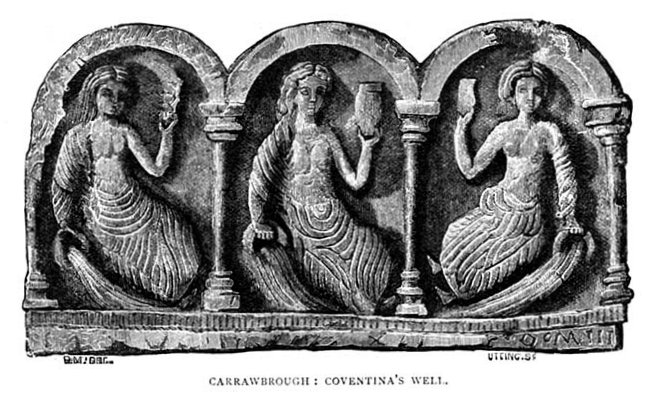
Romano-British stela of the triple-goddess 'Coventina'. Note the vases and the bunch of corn...

Romano-British stela of the triple-goddess ‘Coventina’. Note the vases and the bunch of corn…

The ‘romance’ story traditions, poetry and literature of northern Europe between the 12th and 15th centuries represented a renaissance of interest in the mythology of the pagan era among the secular elites of the English, Normans, French and Germans. This itself seems to have paralleled the renaissance in classical literature and learning during the same period, propelled from the Islamic world, and perhaps by the formal schism of the eastern and western christian patriarchies in the 11th century.

Their heady imagery of bold beautiful knights, mysterious and equally beautiful otherworldly maidens, and complex coded allusions to what christianity disapproved of – sex, violence and paganism – made them a sure-fire hit among the courtly elites. In spite of their apparently un-christian themes, the weavers of these tales were acutely aware of when not to overstep the mark, lest they face accusations of the capital crime of heresy! By investing their main and supporting characters with strong christian values of love, piety, chastity and truth, they were able to send them deep into story realms with mysterious pagan themes underpinning the narrative. Christianity was always triumphant in the end, and moral virtue came out on top: It is important to realise that these authors were often writing for a world where paganism was not such a distant memory (the Normans, for example and their Scandinavian cousins) so reading a pagan rather than a christian bias into their tales would be ill-advised. After all, christianisation had already followed a syncretic path in much of Europe since the Theodosian edicts of the 5thC. That the heartland of this revival in poetry, prose and song tradition was the Aquitanian courts of the Languedoc in southern France (home of the Troubadours) is interesting, since these soon became the heart of a strange dualistic/duotheistic interpretation of christianity known as Catharism, later destroyed in the Albigensian Crusade.

So what are the themes and in which stories in particular are they found?

Meeting a fairy woman at a fountain:

The ‘Lai de Graelent’, the Lai de Lanval (Marie de France 12thC), Yvain, le Chevalier au Lion’ (Chretien de Troyes 12thC), the Irish tale ‘Echtra mac nEchach Muigmedón (Yellow Book of Lecan – late 14thC) and the Fenian lay known as Toraíocht Sliabh Cuilinn or Laoi Na Seilge,as well as
Aided Muirchertaig meic Erca (Yellow Book of Lecan) and others
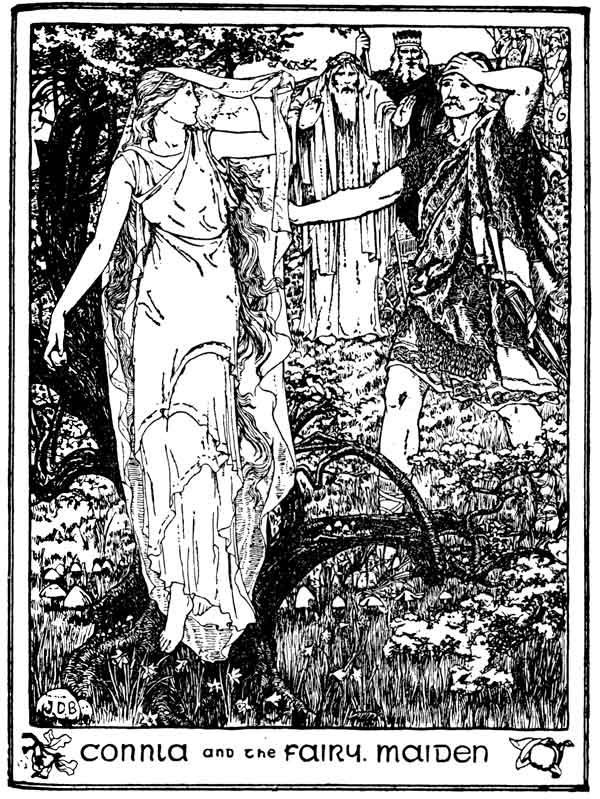
 all tackle this popular theme. In them, the hero follows a magical white stag or boar (part of the ‘fairy herd’) into a far-off place where he meets a mysterious and fatal woman at a spring, lake or river. She promises him the gifts of the otherworld but imposes a geas upon him which ties him ultimately to the otherworld.

   The otherworld is explicitly reached through water in all of these, as is the Isle of Avalon in the seminal Arthurian works of Geoffrey of Monmouth who, with his literary companions-at-arms Jocelyn of FurnessWalter Map and Gerald of Wales, really got the ball rolling of the ‘second stage’ of trying to put ancient Atlantic legends into a christian ‘historical’ narrative – the first being the Irish and continental hagiographies of the 6th-10th centuries, whose traditions were badly damaged in the Viking raids of the 8th-9th centuries.

The ‘Wizard-King’:

Perhaps the most mysterious otherworldly rulers of medieval story traditions are those we identify with the ‘wizard-king’ archetype. In Ireland, Manannan is the arch-example of this, but in the ‘Lancelot-Grail Cycle’ legends of Britain and France, the Fisher King (Perceval) and Merlin represent the same. Another aspect of the otherworld-lord is the ‘Old King’ of which Gradlon, Arthur, Geoffrey’s King Leir and even Fionn mac Cumhall (Tóraíocht Dhiarmada agus Grainne) function as examples – a projection of the otherworld wizard-king upon the decaying mundane existence. Geoffrey’s Merlin and Jocelyn’s Melinus (his version of Mannannan who Patrick supposedly defeats on the Isle of Man) both provide an attempt at ‘bookending’ the role of the otherworld master of pagan tradition in a (pseudo) historical context, much in the same way that the Arthurian legends’ handling of the Lady of the Lake and the ‘sorceress’ Morgane do.

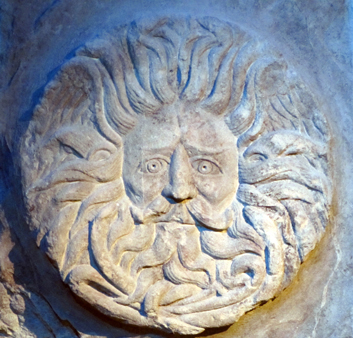
The stone fascia of the Roman-British shrine of 'Minerva Aquae Sulis' at Bath displayed this magnificent head of 'Manannan'. Note the 'solar' rays of the hair and the 'watery' appearance of the beard...

The stone fascia of the Roman-British shrine of ‘Minerva Aquae Sulis’ at Bath displayed this magnificent head of ‘Manannan’. Note the ‘solar’ rays of the hair and the ‘watery’ appearance of the beard… Minerva was a female god 😉

The ‘Grail’:

Tales such as Yvain and Perceval, Ireland’s Tochmarc Étaíne, the Dagda’s magic cauldron in the story Cath Maige Tuired as well as the continental legends of the bath-loving Melusine, and the middle-Welsh tales of the  Second Branch of the Mabinogi and the legend of Cerridwen and the Birth of Taliesin all feature a magical cauldron, dish or cup.  This always seems to represent the powers of regeneration – a metaphor for the womb in many ways.

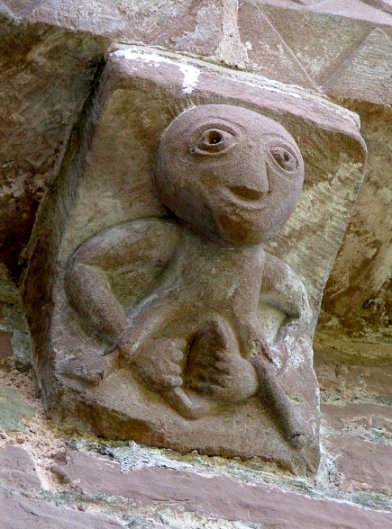
A 'Sheela na Gig' - compare her to the images of 'Coventina' from the Romano-British stelae...

A ‘Sheela na Gig’ – compare her to the images of ‘Coventina’ from the Romano-British stelae…

The vision of the bleeding lance from Perceval is the flipside of this ‘genital’ imagery, perhaps demoted in the Christian context due to its phallic nature, but of no lesser importance than the grail in the original telling by Chretien de Troyes. This represents the piercing aspect of new life, coming through from the otherworld – an allusion made concrete in the character of ‘Sir Bors’ whose name contains the Gaelic rootword for both ‘piercing’ things and springs of water.

The 'Ballafreer phallus', Braddan, Isle of Man - known locally as the 'White Lady'!

The ‘Ballafreer phallus’, Braddan, Isle of Man – known locally as the ‘White Lady’!

All text © 2014 The Atlantic Religion, except where stated.


Careless lake ladies and mermaids – flood myths in Celtic folklore

“…There is a lake in Ulster of vast size, being thirty miles long and fifteen broad, from which a very beautiful river, called the Banna, flows into the Northern ocean. The fisher-men in this lake make more frequent complaints of the quantity of fish inclosed in their nets and breaking them than of the want of fish. In our time a fish was caught here which had not come up from the sea, but was taken descending the lake, and was in shape very like a salmon, but it was so large that it could neither be dragged out or conveyed whole, and therefore was carried through the province cut in pieces. It is reported that this lake had its origin in an extraordinary calamity. The land now covered by the lake was inhabited from the most ancient times by a tribe sunk in vice, and more especially incorrigibly addicted to the sin of carnal intercourse with beasts more than any other people of Ireland. Now there was a common proverb in the mouths of the tribe, that whenever the well-spring of that country was left uncovered (for out of reverence shown to it, from a barbarous superstition, the spring was kept covered and sealed), it would immediately overflow and inundate the whole province, drowning and destroying all the population. It happened, however, on some occasion that a young woman, who had come to the spring to draw water, after filling her pitcher, but before she had closed the well, ran in great haste to her little boy, whom she heard crying at a spot not far from the spring, where she had left him.

But the voice of the people is the voice of God ; and on her way back, she met such a flood of water from the spring that it swept off her and the boy, and the inundation was so violent that they both, and the whole tribe, with their cattle, were drowned in an hour in this partial and local deluge. The waters, having covered the whole surface of that fertile district, were converted into a permanent lake, as if the Author of nature judged the land which had been witness to such unnatural bestialities against the order of nature to be unfit for the habitation of men, either then or thereafter.

A not improbable confirmation of this occurrence is found in the fact, that the fishermen in that lake see distinctly under the water, in calm weather, ecclesiastical towers, which, according to the custom of the country, are slender and lofty, and moreover round ; and they frequently point them out to strangers travelling through those parts, who wonder what could have caused such a catastrophe.

…..

It must, however, be observed that the river before mentioned (the Bann), which now flows out of the lake in full stream, had its source in the aforesaid spring from the time of Bartholanus, who lived soon after the flood, when it was fed also by other rivulets, and took its course through the same district, but with a far less volume of water, and it was one of the nine principal rivers of Ireland…” (Topographia Hiberniae by Gerald of Wales (12thC) – trans. Thomas Forester; From: ‘The Historical Works of Giraldus Cambrensis’ – Pub. George Bell & Sons, London 1905)

Gerald’s tale comes from his famous account of Ireland, produced in support of the Anglo-Norman invasion of the island, and designed to support the imposition of continental christianity on this ‘barbarous’ and ‘uncivilised’ people. His sources were the monastic annals and texts of the great abbeys of Ireland. The contemporary secular literary milieu was one enchanted with the ‘Lady of the Lake’ and ‘Morgane le Fee’ and any one of a number of similar fairy themes which defined the ‘Arthurian’ Romance litereature of the 12th and 13th centuries. The following sums up one of his likely sources – from the legends of St Comgall about his apparent conversion and sanctification of a mermaid called Liban, afterwards St. Muirgen!:

“… According to a wild legend in Lebor na h-Uidri, this Liban was the daughter of Eochaidh, from whom Loch Eathach, or Lough Neagh, was named, and who was drowned in its eruption [A. D. 90], together with all his children, except his daughter Liban, and his sons Conaing and Curnan. Liban, was preserved from the waters of Lough n-Eachach for a full year, in her grianan, [palace] under the lake. After this, at her own desire, she was changed into a salmon, and continued to traverse the seas till the time of St. Comhgall of Bangor. It happened that St. Comhgall dispatched Beoan, son of Innli, of Teach-Dabeoc, to Rome, on a message to Pope Gregory [Pope, A. D. 599-604], to receive order and rule. When the crew of Beoan’s currach were at sea, they heard the celebration of angels beneath the boat. Liban, thereupon, addressed them, and stated that she had been 300 years under the sea, adding that she would proceed westward and meet Beoan, that day twelvemonths, at Inbher-Ollarbha [Larne], whither the saints of Dalaradia, with Comhgall, were to resort. Beoan, on his return, related what had occurred, and, at the stated time, the nets were set, and Liban was caught in the net of Fergus of Miliuc; upon which she was brought to land, and crowds came to witness the sight, among whom was the Chief of Ui Conaing. The right to her being disputed by Comhgall, in whose territory,-and Fergus, in whose net,-and Beoan, in promise to whom,-she was taken, they prayed for a heavenly decision; and the next day two wild oxen came down from Carn-Airend; and on their being yoked to the chariot, on which she was placed, they bore her to Teach-Dabeoc, where she was baptized by Comhgall, with the name Muirgen i.e. Born of the sea, or Muirgeilt i.e. traverser of the sea. Another name for her was Fuinchi…” (Annals of the Kingdom of Ireland by the Four Masters, vol.1 – John O’Donovan, ed. and trans.,(Dublin, 1856), p.201.)

This version of the Lough Neagh tale is slightly different as it tells that the father (Eochaid – possibly a reference to the literary figure known as ‘An Dagda’) and tribe of the magical woman are drowned, but that she remained in the form of a salmon in the sea until the coming of St. Comhgall some 300 years later. . There is good evidence from the variety of traditions encountered in Ireland that much hagiography was a deliberate revision of core pagan myths and doctrines. As with many conversion-era themes from Ireland, Liban (like Eithne/Aine in Altram Tigh da Medar) becomes a Christian and is not demonised and defeated, in distinction to the Breton legend of Gradlon and his daughter Ahes (the ‘Groac’h’ or ‘Mari Morgane’). Interestingly, Liban appears as the whip-frenzied companion/double of Manannan’s wife Fand in the ‘Wasting Sickness of Cuchullain’ from the Ulster Cycle. The same legends interested noted Celticist Professor John Rhys at the turn of the 20thC, who recorded some interesting parallel tales which showed the lake-lady/mermaid legend was not just local to Lough Neagh, or for that matter, Ireland or Brittany:

“…David Jones, of Trefriw, in the Conway Valley, was a publisher and poet who wrote between 1750 and 1780. This is his story: ‘In 1735 I had a conversation with a man concerning Tegid Lake. He had heard from old people that near the middle of it there was a well opposite Llangower, and the well was called Tfynnon Gywer, ” Gower’s Well,” and at that time the town was round about the well. It was obligatory to place a lid on the well every night. (It seems that in those days somebody was aware that unless this was done it would prove the destruction of the town.) But one night it was forgotten, and by the morning, behold the town had subsided and the lake became three miles long and one mile wide. They say, moreover, that on clear days some people see the chimneys of the houses.’…”

“…Before I have done with the Irish instances I must append one in the form it was told me in the summer of 1894: I was in Meath and went to see the remarkable chambered cairns on the hill known as Sliabh na Caillighe, ‘the Hag’s Mountain,’ near Oldcastle and Lough Crew. I had as my guide a young shepherd whom I picked up on the way. He knew all about the hag after whom the hill was called except her name: she was, he said, a giantess, and so she brought there, in three apronfuls, the stones forming the three principal cairns. As to the cairn on the hill point known as Belrath, that is called the Chair Cairn from a big stone placed there by the hag to serve as her seat when she wished to have a quiet look on the country round. But usually she was to be seen riding on a wonderful pony she had: that creature was so nimble and strong that it used to take the hag at a leap from one hill-top to another. However, the end of it all was that the hag rode so hard that the pony fell down, and that both horse and rider were killed. The hag appears to have been Cailleach Bhéara, or Caillech Bérre, ‘the Old Woman of Beare,’ that is, Bearhaven, in County Cork. Now the view from the Hag’s Mountain is very extensive, and I asked the shepherd to point out some places in the distance. Among other things we could see Lough Ramor, which he called the Virginia Water, and more to the west he identified Lough Sheelin, about which he had the following legend to tell:–A long, long time ago there was no lake there, but only a well with a flagstone kept over it, and everybody would put the flag back after taking water out of the well. But one day a woman who fetched water from it forgot to replace the stone, and the water burst forth in pursuit of the luckless woman, who fled as hard as she could before the angry flood. She continued until she had run about seven miles-the estimated length of the lake at the present day. Now at this point a man, who was busily mowing hay in the field through which she was running, saw what was happening and mowed the woman down with his scythe, whereupon the water advanced no further…” (John Rhys – Celtic Folklore – Welsh and Manx Volume 2; Ch.6; Pub. Oxford University Press 1901)

As well as Wales and Ireland, this story involving the Cailleach was widespread in the west of Scotland too, as the following account from the late 18thC shows:

“…On a high part of that ridge of hills which seperates Stralachlan from Glendarnel, there is a very large stone, remarkable for its situation. There is a descent from it on every fide. The prospect from it is very extensive. It is called Cailleach-Vear or Vera. In the dark ages of superstition, it was personified, and said to have a considerable property in cattle. Cailleach Vear makes a conspicuous figure in the marvellous tales of the country people, over great part of the West Highlands. Her residence was said to be on the highest mountains; that she could step with ease, and in a moment, from one district to another; when offended, that she caused a flood to come from the mountains, which destroyed the corns, and laid the low grounds under water; that one of these floods was the origin of Lochow, in Lorn, of Locheck, in this parish, and of many other lakes; that the people paid her a superstitious veneration, and were under dreadful apprehensions of her anger…” (The Statistical Account of Scotland: Drawn Up from the Communications of the Ministers of the Different Parishes; Ed. John Sinclair; Pub. W. Creech, 1792; pp. 559-560)

The same story is borrowed and elaborated on by a later author in the following account of Loch Awe from the 19thC following on from the surge in interest in Highland legends generated by Walter Scott:

“…The Highlanders of Argyleshire possess a curious tradition regarding the origin of Lochawe, which has furnished a topic in one of the wild songs of Ossian. The circumstance is connected with the existence and death of a supernatural being, called by the country people Calliach Bhere, ” the old woman.” She is represented as having been a kind of female genie whose residence was on the highest mountains. It is said that she could step with ease and in a moment from one district to another; when offended, that she could cause the floods to descend from the mountains, and lay the whole of the low ground perpetually under water. Her race is described as having lived for an immemorial period near the summit of the vast mountain of Cruachan, and to have possessed a multitude of herds in the vale at its foot. Calliach Bhere was the last of her line, and, like that of her ancestors, her existence was blended with a fatal fountain which lay in the side of her native mountain, and had been committed to the charge of her family since its first existence. It was their duty at evening to cover the well with a large flat stone, and at morning to remove it again. This ceremony was to be performed before the setting and rising of the sun, that his last beam might not die upon the waters, and that his first ray should illuminate their bosom. If this care was neglected a fearful and untold doom was denounced to be the punishment of the omission. When the father of Calliach Bhere died, he committed the office to his daughter, and declared to her, in a solemn charge, the duty and the fatality of the sacred spring. For many years the Military woman attended it without intermission;

But on one unlucky evening, spent with the fatigues of the chase and the ascent of the mountain, she sat down to rest beside the fountain, and wait for the setting of the sun, and falling asleep did not awake until next morning. When she arose she looked abroad from the hill; the vale had vanished beneath her, and a wide and immeasurable sheet of water was all which met her sight. The neglected well had overflowed while she slept; the glen was changed into a lake; the hills into islets; and her people and her cattle had perished in the deluge. The Calliach took but one look over the ruin which she had caused: the spell which bound her existence was loosened with the waters, and she sunk and expired beside the spring. From that day the waters remained upon the vale, and formed the lake which was afterwards called Loch Awe…” (The Gazetteer of Scotland, Volume 1 By Robert Chambers, William Chambers ; Pub: Andrew Jack, Edinburgh, 1844; p.63)

The legend tells that the Cailleach disappeared into the spring – a figurative form of death shared with the Dindshenchas legends of Sinand and Boann as well as many of the others. The theme of the Cailleach and the flood was discovered in the Isle of Mull:

“…In the olden times, on the Headland of Mull, there lived a woman whom the people called Cailleach Bheur. She didn’t hail from the people of this world, since we are told that Cailleach Bheur was a yound girl when Adam and Eve were still enjoying the pleasures of the Garden of Eden. She tells us, in her own words, ‘When the ocean was a forest with its firewood, I was then a young lass.’ Let that be, as it may, and far be from us to doubt it, but it seems that Cailleach Bheurr evaded death in a way that no one was ever able to do, before or since…” (School of Scottish Studies Archives, University of Edinburgh Royal Celtic Society, MSS:AM/35.8 Mull)

“…Now there was only one place where Cailleach Bheurr watered her cattle-herd when she was away from Mull itself. This was a well halfway along the road she took to the headland of Kintyre. I don’t remember what its name was but, indeed, there was such a well there. And there was a great stone lid on the well and as soon as she arrived there in the morning, she would lift off the great stone so that the herd could get a drink at a time when they were thirsty. But if she didn’t place the great stone lid back on the well before the sun went down, the water would flow out of it and flood the whole world. It would pour out of this well and cover the whole world with a flood…” (School of Scottish Studies Archives, University of Edinburgh Royal Celtic Society, MSS:SA 1953/49/B5)

These accounts also add a tradition that the Cailleach would evade death by bathing in a magic Loch every 100 years. Of particular interest is that the quote ‘When the ocean was a forest with its firewood, I was then a young lass’ is mirrored in a folktale quoted in the following 18thC Irish account, discussing regional geology and geography around Lough Foyle:

“….There is a Rock on the side of the Mountain called the Poor Woman (in Irish, Calliagh Veerboght) who tells us when she was a Maid the Place where she stands was once Corn ground and Lough Foyl so narrow that a Lamb could skip from Magilligan Point to Green Castle which is now two Sea Miles distant and the Fairy that lived on the Tuns Banks (AR: Tonn Banks – The fairy referred to is revealed in other stories to be no less than Manannan!) that lye at the Mouth of Logh foyle (mostly formed I believe by what was worn away of this Shore) having a Carpet stole from him by one of this Parish, cursed it and threaten’d that every Year the Breadth of the Carpet should be swept away from the Land till all should be swept away. We may at least gather from such as these that in antient times this Place was losing and not gaining…” (“Miscellaneous letters on several subjects in philosophy and astronomy” – By Robert Innes to the Bishop of Cashel – William Nicolson; Pub.S. Birt, London 1732;p.5 – Letter 1)

The legends of the Cailleach and her relationship to water and herds of cows or deer seem to have been very consistent between Ireland, Wales and Scotland. Even in the 12thC Breton Lai de Graelent where she appears as a fountain-fairy in the woods, there are similar associations – the knight (like Fionn in the Irish ‘Pursuit of Slieve Gullion’) chases the white deer and finds her waiting at a spring in the woods. The lore is perhaps best summed up in this  excerpted 19thC translation of the Scottish highland ballad – Cailleach Bein y Vreich:

“Weird, weird, wife! with the long grey locks, she follows her fleet-foot stags, Noisily moving through splintered rocks, And crashing the grisly crags.

Tall wife! with the long grey hose, in haste the rough stony beach she walks; But dulse or seaweed she will not taste, nor yet the green kail stalks.

“And I will not let my herds of deer, my bonny red deer go down; I will not let them down to the shore, to feed on the sea-shells brown.

O better they live in the corrie’s recess, Or on mountain top to dwell, And feed by my side on the green green cress, That grows by the lofty well.”

“Broad Bein-y-Vreich is grisly and drear, but wherever my feet have been, the well-springs start for my darling deer, And the grass grows tender and green.

“And there high up on the calm nights clear, Beside the lofty spring, They come to my call, and I milk them there, And a weird wild song I sing.”

(Excerpt from translation of the old highland song Cailleach Bein a Vreich by John Campbell Shairp, from ‘Kilmahoe: a Highland pastoral with other poems’; Pub. Macmillan & Co, London 1864; pp.138-139)

The middle irish tale Echtra mac nEchach Muigmedón (Yellow Book of Lecan – late 14thC) recounts the legend of the boyhood of Niall (of the Nine Hostages) – son of Eochaid Mugmedon by Cairenn. It explains the origin of Ui Neill kingship. The theme is of how Niall came to be bestowed with the sovereignty of Ireland by a fairy queen at a well.  The five sons of Eochaid are sent to fosterage and then (at their appointed time) join their Fianna to gain life experience in adventure. While hunting in the woods, they realise they must find water and each in turn goes to a well to draw water, where they encounter a loathsome hag who guards it. Her condition for allowing them to draw water is that they bestow a ‘kiss’ upon her (i.e. – that they have sex with her). The first four sons (whose mother is Mongfind) refuse her, but Niall – last to go – accepts eagerly, else they all die of thirst. The hag immediately transforms into the most gorgeous young woman and announces that she is the Sovereignty of Ireland, which she bestows upon him in an act of Heiros Gamos. He returns to his father who recognizes him as the new High King.

Those familiar with Chaucer’s Canterbury Tales will know that his ‘Tale of the Wife of Bath’ is a facsimile of this same tale, which also occurs in various other forms in the ‘Romance’ fairy tales of the ‘Arthurian’ corpus between the 12th and 15th centuries.

When we consider the ‘Moura’ fairytales from the Iberian Peninsula, the fairytales of Brittany and France, and those of the rest of northern Europe (which I have not discussed), these all point towards an important, pervasive and powerful pagan mythology which was possibly common to all of these regions and was tied to water and the great ocean.


All text © 2014 The Atlantic Religion, except where stated.


Cailleach ‘Biorar’

Alexander Carmichael: Carmina Gaedelica Volume 2, Notes: “Cailleach uisce” (n.b. – Western Isles, Highlands of Scotland, 19thC)

“…According to some people, ‘Cailleach’ as a period of time is the first week of April, and is represented as a wild hag with a venomous temper, hurrying about with a magic wand in her withered hand switching the grass and keeping down vegetation, to the detriment of man and beast. When, however, the grass upborne by the warm sun, the gentle dew, and the fragrant rain overcomes the ‘Cailleach,’ she flies into a terrible temper, and throwing away her wand into the root of a whin bush, she disappears in a whirling cloud of angry passion till the beginning of April comes again…”

Carmichael’s account is paralleled by that of John Gregorson Campbell, who writes (The Gaelic Otherworld – John Gregorson Campbell’s Superstitions of the Highlands and Islands of Scotland(1901) and Witchcraft and Second Sight in the Highlands and Islands. Ed. Ronald Black, Pub. Birlinn, Edinburgh, 2005, p.544):

A’ Chailleach‘, The Old Wife (?Part of the month after the Faoilleach month)

This old wife is the same as the hag of whom people were afraid in harvest (the last done with the shearing had to feed her till next harvest) and to whom boys bid defiance in their New Year day rhyme, viz., ‘the Famine, or Scarcity of the Farm’. In spring she was engaged with a hammer in keeping the grass under.

Buailidh i thall, buailidh i bhos, Buailidh i eadar a dà chois

(“She strikes here, she strikes there, she strikes between her legs”)

but the grass grows too fast for her, and in despair she throws the hammer from her, and where it lighted no grass grows.

Thilg i e fon chraoibh chruaidh chuilinn, Air nach do chinn gas feur no fionnadh riamh.

(“She threw it beneath the hard holly tree / Where grass or hair has never grown.”)

Holly (Ilex aquifolium) - In Gaelic, the name is Cuillean (Manx: Hollin). Its piercing spines and shiny evergreen leaves made it a tree associated with the Otherworld. 'Bir' in Old Irish means a 'sharp point' or 'spear' (eDiL)

Holly (Ilex aquifolium) – In Gaelic, the name is Cuillean (Manx: Hollin). Its piercing spines and shiny evergreen leaves made it a tree associated with the Otherworld. ‘Bir’ in Old Irish means a ‘sharp point’ or ‘spear’ (eDiL). Some Manx people used to burn their Christmas holly wreaths and formerly the old harvest babbin on the fire at Easter.

The legendary occupying ‘hag’ of Sliabh gCuillinn (Slieve Gullion) in St Patrick’s ‘home’ province Co. Armagh, Ulster, was called Cailleach Biorar in Nicholas O’Kearney’s in-depth account of the Irish goddess Aine, published in 1853 (Transactions of the Kilkenny Archaeological Society, Volumes 1-2, p.32). He translated this name as ‘Old woman of the waters’. On Slieve Gullion, her home was supposed to be the spectacular chambered cairn (the ‘South Cairn’), also known as ‘Cailleach Beara‘s House’, which gets a popular mention among writers about the goddess.  This Cailleach Biorar, O’Kearney reminds us, also went by the name of Milucradh/Miluchradh and was described as a sister the goddess Aine and a main characterin the Fenian tale known as ‘Feis Tighe Chonáin Chinn Shléibhe’ (The Festivities of the house of Conan of Ceann-Slieve).

‘Feis Tighe Chonáin Chinn Shléibhe’:

This Fenian tale was derived from a relatively late copy in a post-MacPherson 18thC manuscript by a Waterford scribe named Foran, although there are fragments from manuscripts some 200 years older. It appears to contain some interesting detail as to the identity of Fionn, as well as the Cailleach Biorar or Milucradh. O’Kearney translated and published this in the journal of the Ossianic Society in 1855.

In a memorable part of the tale Conan asks Fionn how his hair came to be white. He tells them a tale known as ‘The Chase of Slieve Gullion’ in which the sisters Miluchradh and Aine, daughters of Cuailgne of the Tuatha de Danann wish to seduce Fionn, but set to arguing. Aine boasted that her husband’s hair would never turn grey (a boast of her sexual prowess, no doubt) and this enrages the Cailleach (Miluchradh) who bids her hosts build them a magical lake on the slopes of Slieve Gullion. Any man who bathes in the lake is doomed to old age! Milucradh tricks Fionn by shapeshifting into the form of a grey fawn to whom Fionn and his hounds give chase. She is cornered on the banks of the lough and transforms into a beautiful maiden who then tricks Fionn into diving into the waters in order to retrieve her ring (a theme common to the 12thC fairy romances, loaded as it is with sexual allusions). After Fionn emerges ancient and decrepit from the lake, she dives into the waters never to be seen again…

There is a small lake at the top of Slieve Gullion near the cairns, but the Cailleach’s lake doesn’t just exist in the physical sense, being of fairy construction. The lough in the story almost appears to function with an opposite effect to the mystical subterranean wells of regeneration (Segais, Nechtain, Connla etc), associated elsewhere with Cailleach-related legends, sometimes involving capstones that are forgotten about (see later!). It was believed that rivers flowed eventually to the Otherworld, only to return mystically through chthonic wells in hills or sidhe places. These then manifested above ground as ‘holy wells’.

What is the significance of Slieve Gullion?

Slieve Gullion lies just inland from Dundalk on the southern Ulster coast, within sight of the great Carlingford Lough on the Irish Sea, whose name derives from the Old Norse and translates to Irish as ‘Lough Cailleach’! ‘Gullion’ derives from Cuillean or Guillean – supposed to be a famous blacksmith who was employed by legendary king Conchobar mac Nessa, and from whom Cuchullain was named in the Ulster Cycle legends. It is also the name of the holly tree in Irish, Scots and Manx. The words ‘Cuillean’ and ‘Caillean’ are quite similar – just as ‘Cuillean, ‘Chullain’ and ‘Cumhal’ seem so close…

Moninne:

With the ‘coming of Patrick’ all of Ireland’s Cailleach sites (such as Cruachan Bri Eile etc) required a Christian female to replace the resident goddess, and to this end, Slieve Gullion acquired the services of St Moninne, daughter of ‘King Machta’. She was also known as Darerca of Cill Sliebhe Cuillin  or  Blathnaidh/Blinne and had a church/monastery at Kileavy (Cil Aoibhe) on the slopes of the mountain, the remains of which are still there to visit. Astute observers of names associated with the pagan goddess will immediately notice that ‘Mo-ninne’ might be a version of the character known in medieval Arthurian romances as Niniane, the ‘Lady of the Lake’. ‘St Ninian’ also appears as an important evangelist of the Irish Sea region in the early middle ages.

‘Eavy’:

Why Kileavy? It probably means ‘Beautiful Church’, but the other possibility is a church or religious house named after a founder other than Moninna: The name Aoife (Aoibhe or Aífe) is one much associated with the ‘fairy queen’ or ‘banshee’ in legends and placenames, particularly among the Dál gCais of Munster who called her ‘Aibell’ or ‘Aoibheal’ of Craig Liath – the name sounds like an epithet, of which the Gaelic goddess had as many as she had children.

In literature, the early Irish tale Aided Óenfhir Aífe, Aífe (also sometimes spelled Aoife or Aoibhe) was the mother of Cuchullain’s tragic child Connla (‘Connla’s Well’ anyone?), and in the Ulster Cycle tale Tochmairc Emire she is the opponent of Cu’s warrior-woman mentor Scáthach (another ‘epithet’ figure who, although given a Hebridean provenance in the TE, seems to be the same ‘peist’ character defeated by St Senan on the eponymous ‘Scattery’ Island in the mouth of the Shannon on the west coast).

Blathnaidh:

Moninne’s other name Blathnaidh is the Irish equivalent of the Welsh Blodeuwedd – name of the treacherous magical wife of Lleu Llaw Gyffes who was made for him out of flowers by magicians in the fourth branch of the Mabinogion. Lleu is supposed to be equivalent to Ireland’s famous god-son, Lugh. Interestingly, the Moninne legend tells that she and her nuns adopted a widow whose son was named Lug. In Ulster Cycle mythology, Bláthnat is wife of the central figure, the Manannan-like Cu Roi. In the Moninne legend, the saint is guided by St Ibar mac Lugna, supposedly Ireland’s first bishop and a staple of Patrician legends. The Munster fairy queen Clíodhna (who controls the tides of Glandore harbour) is associated with the legend of the ‘Blarney Stone’ on Blarney Castle near Cork, which may be related – a stone of similar shape and dimensions appears on the grave of St Moninne at Kileavy…

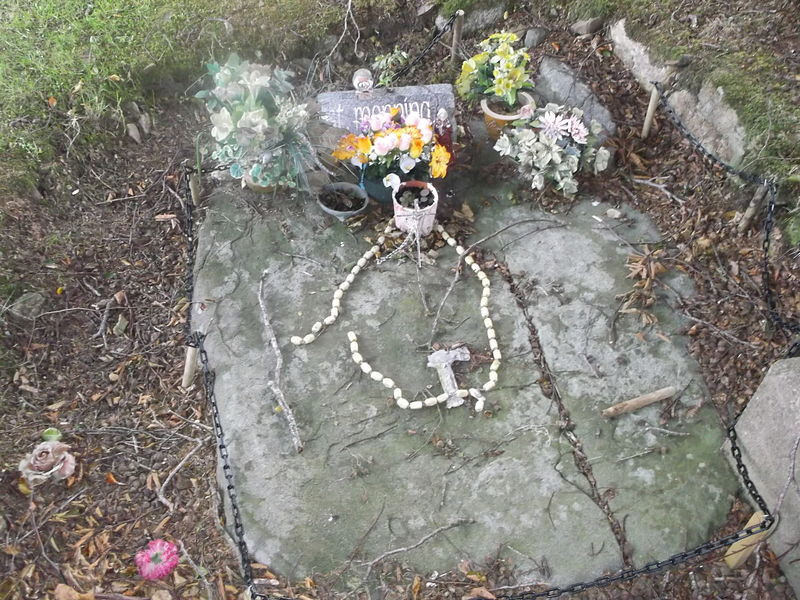
'Grave' slab of Moninne at Kileavy, Slieve Gullion in Armagh. Another 'Blathnaidh' stone for the muse of poets?

‘Grave’ slab of Moninne at Kileavy, Slieve Gullion in Armagh. Another ‘Blathnaidh’ stone for the muse of poets?

Darerca:

St Darerca of Ireland is another mysterious legendary holy woman who shares a name with Moninne – they are likely the same. This other Darerca is made to appear as a ‘great mother’ of many saints and bishops and was supposed to be Patrick’s ‘sister’ (Tripartite Life etc).  Interestingly, her festival is celebrated at the Spring Equinox/Paddymas period (March 22) and she is claimed as the mother of St Mel, legendary purveyor of womens’ millinery goods. As well as gifting Brighid of Kildare with her veil, this curious hypostasis of Manannan (Mel – ‘Melinus’ in Jocelyn’s 12thC Vita Patriciae portrayal of Manannan, otherwise called ‘St. Maughold’) also managed to procure a miraculous fish which he supposedly ploughed up from a field, somewhat in the spirit of ‘The Voyage of Bran’! On the subject of galloping over water, ‘Darerca’ is credited in Brittany with being the mother of legendary King Gradlon! In the Breton legend, Gradlon married the sorceress ‘Malgven’ and was given a horse which could gallop on water (as if it were land) – his ‘evil’ daughter from their coupling was the Groac’h Ahes, Brittany’s answer to the Cailleach. ‘St. Malo’ was another Breton ‘Christian Manannan’.

Is this blowing your mind yet? If the answer is ‘no’, then it is because you believe that hagiographies and church stories of early saints are ‘true’ and about ‘real people’. Otherwise, it may be because you believe that Ireland literally had many multiple gods and goddesses of which the medieval Christian scribes and poets told true accounts… The truth is somewhere else!

Back to ‘Biorar’:

The eDiL (Electronic Dictionary of the Irish Language) gives some interesting etymologies for the Old Irish word ‘Bir’ and its variants – the root of Biorar in ‘Cailleach Biorar’, and possibly the origin of the common variants – Beare and Bheur – although there are many more besides (I’ve included the references this time):

1 bir
Forms: biur; ṁbir; beura;
Meaning: Stake, spit; point; spear;
DIL 2012 B 103.52

2 bir
Forms: beru; B.;
Meaning: Mainly in glossaries and B. na f. and expld. as water; spring, well, stream:;
DIL 2012 B 104.36

Birra
Meaning: having springs or wells (2 bir):;
DIL 2012 B 105.49

Also: Bearnán is a more modern word sometimes used to in the sense of ‘plant’.

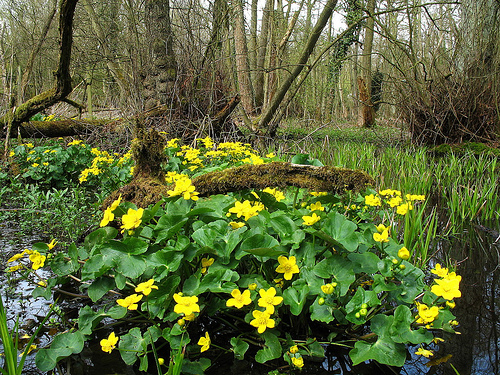
As can be seen, the words for pointed or penetrating things and for springs of water have a connected etymology in Gaelic. In springtime this meaning is deeply connected with the rebirth of nature, reforged underground and in hidden places as if by a magical smith or crafter. Shoots penetrate the ground to bring new life and the flood of springs and wells gush with new waters. Pools in bogs are start to be perforated by reeds, rushes and magical plants representing this process such as the Caltha Palustris (Marsh Marigold, Kingcup, Bwillogh,as Bearnán Beltaine/Bhuide), the Menyanthes trifoliata (Bogbean, Bearnán lachan, Pónaire Chapaill), and the ubiquitous Veronica beccabunga (Brooklime, Biolar Mhuire, Biolar Uisce, Folacht (‘hidden’) etc) whose gaelic names – like that of the Bogbean – hint at the ancient mythological significance of these plants to water and regeneration in springtime and early summer in the Atlantic religion.

Caltha Palustris and other 'piercing' plants emerging in 'Curragh'

Caltha Palustris and other ‘piercing’ plants emerging in ‘Curragh’

Menyanthes Trifoliata emerging from Curragh pool in springtime

Menyanthes Trifoliata emerging from Curragh pool in springtime – reborn from water!

Brooklime and watercress appear as if by magic from pools and streams in the springtime

Brooklime and watercress appear as if by magic from pools and streams in the springtime

All text © 2014 The Atlantic Religion, except where stated.
 

Bridget, Croghan Hill and the Bog of Allen

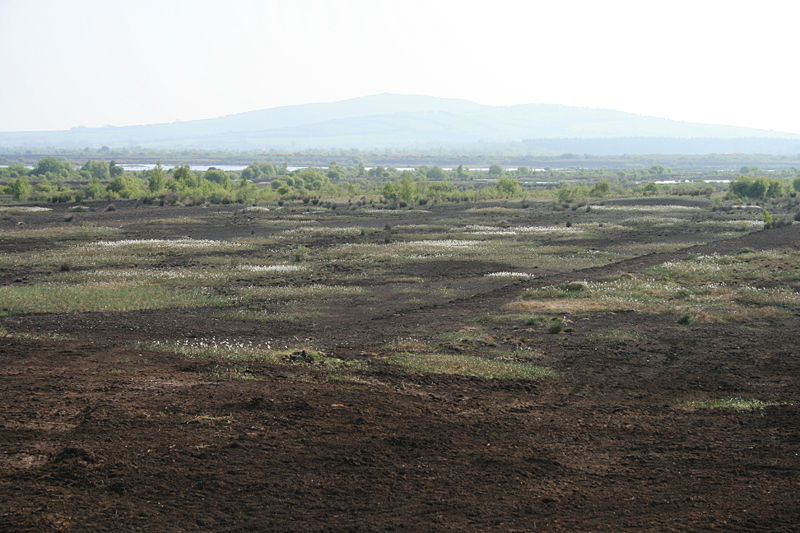
The Bog of Allen (Móin Alúine) with Croghan Hill ('Cruachan Bri Eile') in the background

The Bog of Allen (Móin Alúine) with Croghan Hill (‘Cruachan Bri Eile’) in the background

“Then holy Patrick came to the well called Clébach, on the slopes of Cruachu to the east, before sunrise, and they sat beside the well,  and, behold, the two daughters of king Loíguire (Ed: Mac Néill), fair-haired Ethne and red-haired Fedelm, came to the well, as women are wont to do, in the morning to wash, and they found the holy assembly of bishops with Patrick beside the well. And they did not know whence they were or of what shape or from what people or from what region, but thought they were sidhe men or earth-gods or a phantom; and the maidens said to them: ‘Whence are you and whence have you come?’ and Patrick said to them: ‘It would be better for you to profess our true God than to ask questions about our race.’  The first maiden said: ‘Who is God and where is God and whose God is he and where is his dwelling-place? Has your God sons and daughters, gold and silver? Is he ever-living, is he beautiful, have many fostered his son, are his daughters dear and beautiful in the eyes of the men of the earth? Is he in the sky or in the earth or in the water, in rivers, in mountains, in valleys?’….”

The quote comes from the Book of Armagh and was originally written in the 7th/8thC by the Bishop Tírechán as part of his collected apocrypha about Patrick, collected from across Ireland in his time and before. The Hill of ‘Cruachu’ mentioned here (usually interpreted as being at Rathcrogan in Connaught) might actually have been the magnificent and significant hill of Cruachan Bri Eile/Ele (‘Hill/Rock of Bri Eile’) or Croghan Hill in Offaly in Leinster, which had distinct fairy associations:

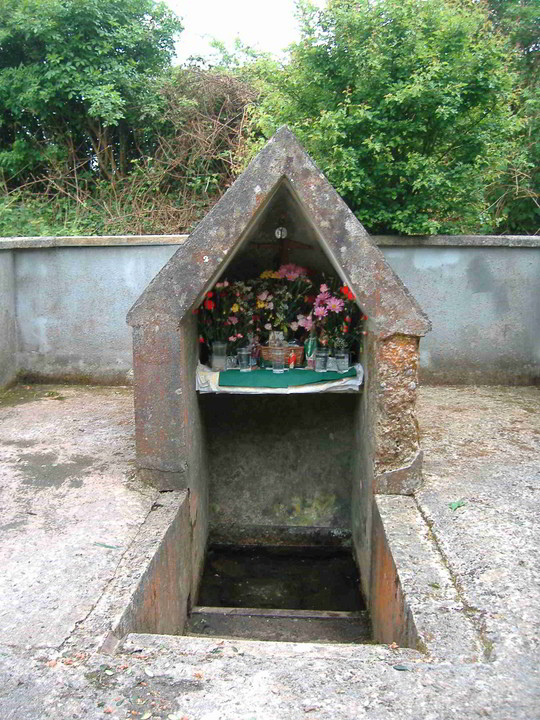
Patrick's Well on Croghan Hill - The original Clebach?

Patrick’s Well on Croghan Hill – The original Clebach?

The hill of Bri Eile is referred to explicitly in the fairy-narratives of The Boyhood Deeds of Fionn from the manuscript Laud 610 (folio: 118Rb-121Va), believed to date from the 12thC: In this, after learning poetry through the mystical medium of the Salmon of Knowledge with the druid Finnecas (who lived on the Boyne, Fionn travels to defeat the notorious fairy woman of Cruachan Bri Eile…

“…. Finn went to Cethern, the son of Fintan, further to learn poetry with him. At that time there was a very beautiful maiden in Bri Ele, that is to say, in the fairy knoll of Bri Ele, and the name of that maiden was Ele. The men of Ireland were at feud about that maiden. One man after another went to woo her. Every year on Samain the wooing used to take place; for the fairy-mounds of Ireland were always open about Samain; for on Samain nothing could ever be hidden in the fairy-mounds. To each man that went to woo her this used to happen: one of his people was slain….” (Boyhood deeds of Fion mac Cumhaill – trans. Cross and Slover 1936)

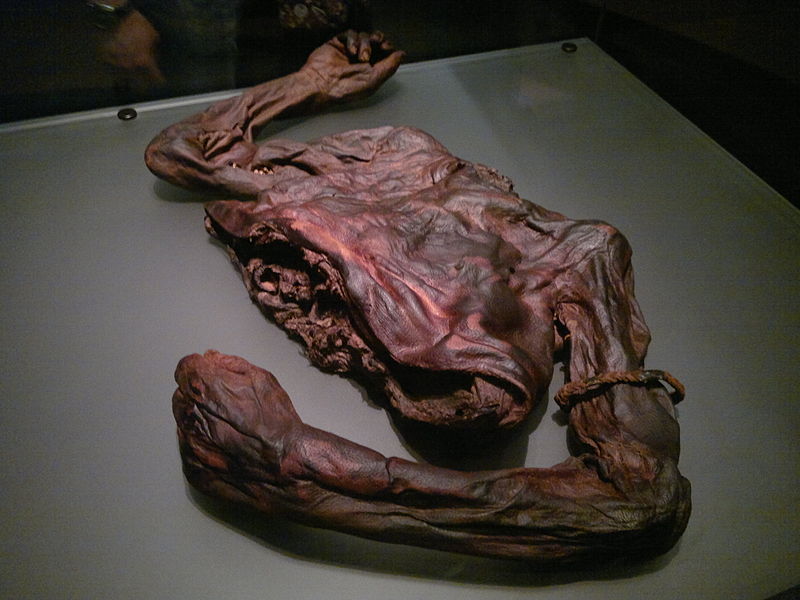
'Old Croghan Man' - A self-sacrificial bog body from near Croghan Hill. 'The Boyhood Deeds of Fionn' state that the fairy woman of Cruachan Bri Eile took the life of a man from the parties that went to her at Samhain... Either she or the Bord na Móna were certainly fierce to him!

‘Old Croghan Man’ – A possibly self-sacrificial bog body from near Croghan Hill. ‘The Boyhood Deeds of Fionn’ state that the fairy woman of Cruachan Bri Eile took the life of a man from the parties that went to her at Samhain… Either she or the Bord na Móna certainly appear to have been fierce to him!

The association of this ancient bog-island with the mystical (and aquatic) is supported in some of the medieval Dindshenchas onomastic texts. Certain of these associate Cruachan Bri Eile with the source of the River Shannon, said to arise in a magical pool there (‘Rennes’ Prose Dindshenchas trans. Whitley Stokes):

59. SINANN.

Sinend daughter of Lodan Lucharglan son of Ler, out of Tír Tairngire (“Land of Promise, Fairyland”) went to Connla’s Well which is under the sea, to behold it. That is a well at which are the hazels and inspirations (?) of wisdom, that is, the hazels of the science of poetry, and in the same hour their fruit, and their blossom and their foliage break forth, and these fall on the well in the same shower, which raises on the water a royal surge of purple. Then the salmon chew the fruit, and the juice of the nuts is apparent on their purple bellies. And seven streams of wisdom spring forth and turn there again.

Now Sinend went to seek the inspiration, for she wanted nothing save only wisdom. She went with the stream till she reached Linn Mná Feile “the Pool of the Modest Woman”, that is, Brí Ele — and she went ahead on her journey, but the well left its place, and she followed it to the banks of the river Tarr-cáin “Fair-back”. After this it overwhelmed her, so that her back (tarr) went upwards, and when she had come to the land on this side (of the Shannon) she tasted death. Whence Sinann and Linn Mná Féile and Tarr-cain.

The implication of this is a connection between the Otherworld and the hill of Bri Eile through water. Connla’s Well is the same donor of Hazlenuts to the same Salmon of Wisdom eaten by Fionn mac Cumhaill in the Boyhood Deeds of Fionn mentioned above. The lore of the Dindsenchas is that she fell and died after emerging from the Otherworld, becoming the River Shannon. In the ‘Metrical Dindshenchas’ (Book of Leinster) Sinand is also described as a ‘daughter of Mongan’ (who might be interpreted as an incarnation of Manannan in the texts appended to ‘The Voyage of Bran’) and donates a magical stone to Fionn. In another eponymous verse, the poet recounts of Sinand that:

Lind Mna Feile, (I speak truly),
is the name of the pool where she was drowned:
this is its proper title inherited from her
if that be the true tale to tell.

This suggests that, in conjunction with the other legends, Sinand and Eile and even Bridget might be one and the same, and we might also interpret ‘Feile’ to be a literary fixation of the indigenous local tribal name ‘Failghe‘. Add local traditions about Aine into the mix and things certainly get more interesting! Are these all the same?

In the Ulster Cycle tales, ‘Eile’ was the ‘other’ daughter of legendary High King Eochaid Feidlech, whose more famous offspring was the fairy Queen Medb of Connaught, who features prominently in the Táin Bó Cúailnge. Medb was associated with another Cruachan – Rathcroghan in Roscommon – which has similar pagan connotations. Both Cruachans were the site of significant pre-Christian cemeteries, making their connection with the Otherworld strong.

Come to think of it, ‘Eile’ and ‘Allen’ seem to derive from a similar root too: In the middle-Irish tale Acallam na Senórach (‘The Colloquy of the Ancients‘), Aillen or Áillen mac Midhna of Sídh Finnachaidh (also the sídh of Lir) is the fairy whose fiery breath burns Tara each year until defeated by Fionn, confirming the link to the Cruachan Bri Eile and the name ‘Allen’. The ‘Hill of Allen’ in Kildare is also associated with Fionn, who was supposed to live there. The Slieve Bloom mountains are the other Fenian location of note – all lying on the periphery of this great midland bog or Eirenn…

Examining the etymology of ‘Eile’ and ‘Allen’ and considering the association with beautiful fairy women and St Bridget, it is fairly obvious that the derivation in álainn – ‘beautiful’. This makes ‘Cruachan Bri Eile’ mean ‘Rock of the Beautiful Brighde’.

Another place in the locality with goddess/fairy legends is ‘Cluain Aine’ (actual location uncertain), said by John O’Donovan in his edition of the ‘Four Masters’ to be near Croghan Hill. He translates ‘Cluain’ as ‘lawn, meadow or bog island’. Aine (‘Awnya’) is, of course, a name of the goddess encountered both in medieval legends and in placenames across Ireland.

'Connla's Well'

‘Connla’s Well’

The local tradition of Bridget being associated with Bri/Brig Eile is used in the Acta Sanctorum of the Bollandists (17thC):

“S. Maccalleus Episcopus magnus, cujus eccelesia est in Cruachan Brig Eile in regione Ifalgiae, et qui posuit velum candidum supra caput S. Brigidae

Saint MacCaille the great Bishop, whose church was at Cruachan Brig Eile in the district of the Hy Falgae (Offaly), placed the white veil on the head of Saint Bridget”

This may be based upon the following from the Bethu Brighde hagiography of the 8thC:

…On a certain day she goes with seven virgins to take the veil to a foundation on the side of Cróchán of Bri Éile, where she thought that Mel the bishop dwelt. There she greets two virgins, Tol and Etol , who dwelt there. They said: ‘The bishop is not here, but in the churches of Mag Taulach.’ While saying this they behold a youth called Mac Caille, a pupil of Mel the bishop. They asked him to lead them to the bishop. He said: ‘The way is trackless, with marshes, deserts, bogs and pools.’ The saint said: ‘Extricate us [from our difficulty].’ As they proceeded on their way, he could see afterwards a straight bridge there

The hill and its environs was once the stronghold of the powerful ruling Ua Conchobhair Failghe (“O’Connor Faly”), the most significant sept of the Leinster Uí Failghe, from which tribe modern Offaly derives its name.  This seat was at Daingean (Daingean Ua bhFáilghe – formerly Phillipstown) and was a regional capital until the start of the plantations and Flight of the Earls saw its importance decline.

The former power of the historic native rulers is illustrated by annalistic references to the Battle of ‘Tochar Cruacháin Brí Eile’ between the English and the men of Ua Fáilghe, and which took place in 1385 (Source: Annals of the Four Masters). The O’Connor Fáilghe were victorious, destroying and routing the English contingent. The name ‘Tochar’ (causeway) shows that there was an ancient bog trackway here (perhaps the one mentioned in Bethu Brighde), and it must have ‘come ashore’ at the hill or near O’Connor’s castle at Old Croghan village and connected outwards to other destinations. Cruachan Bri Eile was obviously once a powerful and strategic island fortress as well as a religious centre. Archaeological evidence of its importance goes back over thousands of years.

Saint Bridget was said to have come from among these peoples, so it is no surprise that hagiographers describe this as a site where she ‘received the veil’. Another site (of equal pagan importance) also lays claim to this, however: The Hill of Uisneach, visible from Croghan across the sprawling boglands of Allen:

“Mag Teloch, where holy Brigit received the veil from the hands of Mac Caille in Uisnech in Meath.” (Tírechán, Book of Armagh)

‘Teloch’ or ‘Tulach’ means a causeway – many used to criss-cross the boglands in ancient times and there was certainly one at Cruachan Bri Eile. Whatever place you believe the supposed ‘event’ may have happened (and it depends on the tribal loyalties of the writers), you can be certain that it occurred at some place associated with the goddess of the pagan past! The words Brig and Bri seem to link to St Bridget/Brighde, supposedly ‘given the veil’ at Cruachan Bri Eile by a saint whose name sounds suspiciously like a modified form of ‘Cailleach’, and who crops up later associated with the Isle of Man – the other ‘Hy Falga’.

There was once a church dedicated to Bishop MacCaille (said to be a nephew of Patrick) on the slopes of Croghan Hill, the remains of which are still visible on the eastern slopes. The Calendar of Cashel noted that his festival was celebrated there on the 25th of April – somewhat close to Beltain just as the surrounding bog and its pools were being pierced by flowers and new summer growth! The same day was celebrated in the Isle of Man at St Maughold’s Well on an elevated headland over the sea. The well once emptied into a stone coffin-shaped structure in which the ‘saint’ was said to sleep (like Sinand in the Linn Mná Feile at Bri Eile) and Maire MacNeil commented on the Manx Lhunasa celebrations once held there.

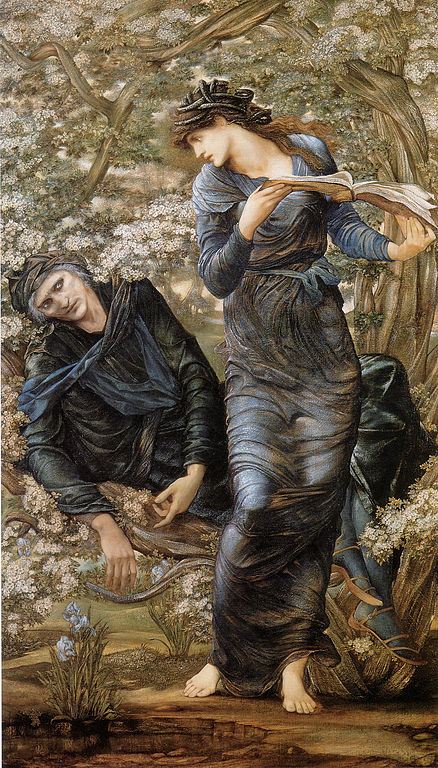
Morgan Le Fay and the enchanter Merlin. Even wizards were prone to the charms of the Goddess...

Patrick-MacCaille and Bridget-Eile-Aine?

Other interesting placenames attached to the hill in the medieval Dindsenchas are Magh Dairbhreach and Druim Dairbhreach (‘Plain of the Oaks’ and ‘Ridge of the Oaks’), also on the east side of the hill.

All text © 2014 The Atlantic Religion, except where stated.
The Celtic Dioskoroi

As the vernal equinox and green Patrick’s day approaches, I thought it appropriate to comment on the spiritual connotations of one of the season’s visible zodiac constellations: Gemini is visible at the zenith of the ecliptic path directly above Sirius as the sun sets on that day… This is, in mythology, a celestial symbol of the legendary ‘twins’ whose bright stars ‘Castor’ and ‘Pollux’ (Greek: Polydeukes) define the asterism, otherwise known as the ‘Dioscuri’/’Dioskouroi’. These ‘lucky’ brother were usually depicted throughout the Greek and Roman world as horsemen, and were strongly associated in tradition with the protection of mariners.

1stC BCE Greek author Diodorus, writing in the Hellenic province of Sicily made the following comment about the Atlantic Celts (presumably those in the Iberian and Gaulish coasts about whom he knew a fair amount): (‘Library of History’ 4. 56. 4  trans. Oldfather)

“The Keltoi who dwell along the ocean venerate the Dioskoroi above any of the gods, since they have a tradition handed down from ancient times that these gods appeared among them coming from the ocean.”

Of course, we must treat this as we would Caesar’s comment on the worship of ‘Dis Pater’ and ‘Mercury’ – a case of interpretation over that ‘barbarian event-horizon’ which Greeks and Romans (perhaps wilfully) were unable to reconcile with their own worldview. The Celts did not actually venerate ‘Castor and Pollux’ as the same twin demi-gods from Diodorus’ classical world, yet there appears to be a similarity of tradition. The famous ‘twins’ were seen as protecting patrons for Greek and Roman seafarers, as illustrated by their role in the Greek epic tale, Argonautica. However, Diodorus is clearly referring to an ancient indigenous tradition of the Celts involving this constellation.

“Coming from the ocean”

Examining Atlantic Celtic mythology, we can see that there are a good number of traditions of spiritual beings (apart from the obvious figure of Manannan) or saints emerging from the sea, and which could possibly associated with the significance of the Dioskouroi constellation.

In Gallicia we have the christian-era legends associated with Finesterre and Santiago de Compostela (an area strongly associated with local Moura legends) – those of St James or a another character – a horseman – emerging from the sea covered in scallop shells (which have since been the symbol of this pilgrimage).

In Brittany there are the legends of King Gradlon whose horse can gallop on the sea, not to mention his oceanic daughter known as Dahut or Ahes who goes into the sea. The medieval Breton Lais of Graedlent (anon) and Lanval (Marie de France) is also about Gradlon – after falling in love with a fairy the hero is carried into a deep river to fairyland where he lives awaiting a return.

In the Isle of Man, it is a magical female Cailleach – the Caillagh y Groamagh who emerges from the sea at Imbolc (or around the vernal equinox), and back in Brittany she was known as the Groac’h Ahes. Her other Manx incarnation was as ‘Tegi-Tegi’ the beautiful sorceress with the white horse who carries men down into the watery realm to death before transforming into a wren or bat and flying to the heavens. Her horse transforms into a dolphin and swims away.

Celtic saints such as Colmán mac Luacháin, Malo, Brendan, Kentigern, Patrick and Maughold to name a few have similar features appended to their individual legends. That of Colmán mac Luacháin is interesting as the Anglo-Norman era ‘discovery’ of his relics at Lann was dated as March 22 (the spring equinox) in the Annals of Ulster.

Diodorus’ asseertion that the Atlantic Keltoi believed in the ‘Dioskoroi’ as gods, is a statement of equivalency. He is almost certainly referring to the legends of aquatic horsemen involved in Celtic otherworld beliefs.

If we re-examine the original Greek myths of Castor and Polydeukes we can see that they were a ‘split pair’ – one with a celestial provenance (Polydeukes was a son of Zeus) and the other (Castor) merely human. Polydeukes demanded of Zeus that he could be reunited with his mortal brother in death, and Zeus arranged for them to share themselves between Hades and Olympus. This raises the distinct possibility that Gemini was a symbol of the mirrored otherworld co-existence of people, gods and spirits which I have discussed elsewhere.

Their significance at an equinoctial point in the year would be an expression of the balance they represent – hence spending alternating days in Hades and Olympus. The Twins were honoured with a ritual known as the Theoxenios – the setting of a feast for them as guests: much like the former Celtic folk-traditions of leaving food and drink for the ‘fairies’ at night.

The half-human, half-divine equation is also a regular feature of Gaelic legendary lore, explaining man’s relationship to skill and knowledge and with the Otherworld: Characters such as ‘Brownie’ and ‘Gruagach’ (Scotland), ‘Phynnodderee’ (Isle of Man) are portrayed as partaking equally of the human and fairy worlds, as do the semi-divine legendary heroes Cuchaullain and Fionn mac Cumhail of medieval romances. Irish kingship was believed bestowed by a figurative ‘heiros-gamos’ with the fairy world, and the Leanán Sidhe figure was a divine muse of poets. The ‘twins’ are also figurative of tradition – the passage of knowledge from one person (or one world) to the next… For instance, the first codified written law tracts of Ireland came with the advent of Christianity in Ireland:

The Senchus of the men of Erin: What has preserved it? The joint memory of two seniors – the tradition from one ear to another, the composition of poets, the addition from the law of the letter (and) strength from the law of nature, for these are the three rocks by which the judgments of the world are supported. (From: Ancient Laws of Ireland (Senchus Mor) trans. John O’Donovan)

The twin stars in Gemini are exalted in the sky at sunset on the vernal equinox… Winter – the season for storytelling and passing of survival knowledge – is over and the land is again pierced with new life…

Gaelic Polytheism? (Opening a can of worms)

It has become conventional to believe that the Gaels practised a polytheistic form of religion which was partly subsumed or wholly supplanted by Christianity at the coming of St Patrick. However, there are a number of problems with such an interpretation that I would like to address.

Firstly, the contemporary sources we have about actual pagan practises in Ireland are almost non-existent, and most of what we know was written long after the establishment of the new religion. The massive efforts to convert the 4thC Roman Empire from fragmenting polytheism to ‘one-over-all’, top-down theocratic rule started with Emperor Constantine I and his immediate successors. This relied upon propaganda and arguments produced by Christian scholars and apologists operating within the polytheist Mediterranean regions of the empire over the preceding 200 years, and which functioned as a model, a ‘manual’ and a ‘road map’ for propagating Roman christianity across the reaches of its contracting Empire and – in the case of Ireland, way beyond. The spread of Christianity was achieved not by proselytizing rhetoric, but by the conversion and alliance of the church with tribal leaders and their elite inner circles. Once this was complete, the worldview of these rulers’ subjects needed to be changed by coercion, propaganda and cultural revisionism. Bearing in mind that we know that early Irish Christian missionaries travelled to the continent and to Rome to receive their instruction, we must consider how the euhemerist ‘continental’ model for replacing polytheism (operating in earnest from the time of the Emperor Theodosius onwards) influenced their reinvention of the pagan past in order to swing people to christianity. The implication that the Tuatha Dé Danann (as opposed to the síd) were believed in as gods should therefore be viewed with suspicion: The ‘Tuatha’ begin to appear in middle-medieval literature presented variously as former gods, ancestors and historic personages (albeit with a very otherworldly countenance) – much in the same way that continental Christians portrayed pagan gods as deified historic humans in order to demote them. They may well have been created as part of a ‘continental schema’ for imposing Christianity.

Secondly, the conversion of Ireland apparently occurred with surprising ease in a country that had showed little signs of being culturally Romanised. This begs the interpretation that the new religion was therefore possibly not such a titanic shift in worldview as it appeared to have been on the continent. In fact it could even have been considered a ‘paradigm-shift’ or evolution of a system to which it had certain similarities, rather than a wholesale replacement of a complicated pantheon. It certainly ‘hit the floor running’, allowing the Irish to lead with confidence in the christianisation and re-christianisation of the rest of northern Europe. If there had been a hugely ‘other’ and complex polytheistic religion in operation this might not have been so easy, especially as Ireland (so far as we know) didn’t have a religious system that – like that at the heart of the Roman empire – underwent an ‘intellectual gravitational collapse’ after absorbing too many external beliefs. Irish legends in the medieval corpus of texts frequently allude to the pagan Irish prefiguring the coming of christianity, a feature I am not aware of from other cultures.

Thirdly, there is little evidence from folk-tales and traditions supporting the theory of the Tuatha Dé Danann being the former gods. The interpretation of a passage in the presumed 5th-6thC ‘Hymn of Fiacc’ (considered to be an early primary source) may account for this:

On the land of Erin there was darkness;
The Tuatha (Peoples) adored the síd;
They believed not
In the true Deity of the true Trinity.

What exactly the síd are or were is complicated and has no satisfactory resolution from the study of  medieval literature alone. The name was later used for burial and ceremonial mounds, fairy mansions and for the fairies themselves. The TDD were ascribed síd-mounds as homes in the later written myths.

Story traditions from Ireland, Scotland and Mann, often focus on An Cailleach, Fionn mac Cumhaill, Manannan and various other giants and spirits who take on some spectacular and god-like properties in mythological accounts. These are joined by legends of their Christian successors – the saints with their often fantastical and god-like properties. Although there is ample archaeological evidence of supra-regional worldview homogeneity since the Neolithic era, the placenames with pagan origin do not back up the theory that the Tuatha Dé Danann were the gods of the Gael. Where we do have surviving traditions of gods, the most notable is Manannán mac Lir who even today is known to Manx people as ‘their’ god. Medieval literary references to the mysterious gods or idols Crom Cruach or Cenn Croithi (both sounding like epithets rather than proper names) and later folkloric ones to Crom Dubh seem to have little relevance to the literary Tuatha Dé Danann traditions, which monks and/or Christian filidh seemed to use in their suspiciously euhemerist historical revision of paganism. These names (Crom Cruach etc) are linked to assemblies at land-loci: particular plains/fields, or hilltop locations.

SO… if there is a chance that the Gaels were not polytheists, then what were they? The resolution of this question necessarily takes us back to understanding what paganism in general was, and the following is my own personal definition:

Paganism is an allegorical system of spiritual and material philosophy informing the art of survival in a given environment, expressed and transmitted through the mnemonic and dialectic mediums of story, song, aphorism, art and dramatic performance.

If Caesar’s Gallic and British Druids were matched by the magi of the Irish, then  philosophy might be the core value at the heart of the religion, an opinion expressed by the writer on philosophers Diogenes Laertius closer to the time of Ireland’s Christian epiphany. Philosophy was to the ancient world what ‘science’ is to the modern: a technical system that described the universe in both material and allegorical/spiritual terms. Philosophy sought to delineate the indescribable, and the arts provided a non-didactic ‘fuzzy’ medium with which higher truths could be defined without the inevitable destruction that occurs with explicitness. The written word tends to ‘fix’ concepts that are otherwise plastic and ever-changing, thus limiting its conceptual usefulness in establishing doctrines. The Mediterranean approach was to assign a god or spirit to these phenomena and to make statuary images of them which expressed this nature. They also tended to write about them. Both processes produced fixed images of ‘gods’ and created the polytheistic pantheon we know so well. However, the pre-Roman Atlantic Europeans apparently shunned this approach. Their devotion was to images and wordly things (‘idola* et inmunda’) according to Patrick himself (Confessio). (*The definition of ‘idola’ being debateable, as it is a latin usage of a greek word ‘eidola’ meaning ‘image’ orapparition‘ and not necessarily meaning ‘idol’ as in ‘statue or graven image’.)

We have to somehow reconcile the folkloric remainders of what appears to be original practical aspects of Gaelic or Atlantic paganism (with its strong traditions about fairies and their leaders, second sight and the ‘evil eye’) with the literary accounts of the middle ages and evidence from archaeology, place names etc. Analysis of the propaganda techniques used to replace the traditions of the old system has revealed a veritable smorgasbord of euhemerisation, demotion, transformation, canonisation/sanctification and demonization permeating the Christian-era literature and folklore of Europe, making a recovery of the reality of the old pagan system through literature and folklore a difficult but always rewarding task.

Returning to my second point above – the apparent rapidity of conversion – it is worth lingering over the prefigurative literature which alludes to some form of continuity between the pagan and christian systems: The hagiographic legends of Patrick from the Book of Armagh and middle Irish tales such as Altrom Tige Dá Medar (from the Book of Fermoy) state that the way was laid for christianity when the druids prophesised a new order before Patrick arrived, or – in the case of ATDM, Manannán himself is the prophet! Charles MacQuarrie (‘The Waves of Manannan’) makes the case for this god as a pagan exemplar of the Bible’s Yahweh/Jehovah, albeit with a perhaps milder and more sympathetic and less judgemental disposition!

In the Isle of Man, where Manannán is still portrayed as a former king and ancestor as well as an actual current popular god we can see how this process reached its important and unfinished conclusion.

So why choose this overlord of the blessed Isles as the ‘next best’ as an exemplar to the christian god? In Altrom Tige Dá Medar he is cast as overlord of the Tuatha Dé Danann (TDD) whose orders they unquestioningly follow. In spite of this, it is actually quite difficult to include him as a member of the TDD, as he seems to stand apart from them in so many ways. That he should have been chosen for such an explicit euhemerisation in Cormac’s glossary and on the Isle of Man suggests a prominence and equivalence that goes beyond that of the TDD. That a belief in him as lord of the fairy otherworld persisted in folk tradition, along with the strong otherworld ‘fairy’ and ‘second sight’ beliefs I have discussed previously, and the recurring theme of a landscape-associated ‘fairy queen’ suggests that these may well have been core parts of Gaelic paganism.

In the Isle of Man, Manannán is ascribed an immanent presence on the summit of the mountain known as South Barrule, where an ancient hilltop enclosure (‘Cashtal Manannan‘) filled with circular stone ‘beds’ or ‘hut circles’ used to be employed by trysting couples at the festival of Luanys (Lunása – 1st August) as a site for proving love, lust and fertility. The mists which frequently crown the mountain as well as shrouding the whole Island are commonly referred to by most locals as ‘Manannan’s Cloak’. It is somewhat surprising then, that there are comparatively few other places in the Isle of Man named after the god, unless you accept that the whole island itself is eponymous with him.

   Perhaps more interesting are the sneaky profusion of ancient place-names here in this special place that allude to a character of Gaelic folklore with a much more typically immanent presence and connection with the creation and husbandry of the landscape – the Cailleach (Manx: Caillagh) and her various incarnations and epithets as the Fairy Queen. From the hill of ‘Cronk y Berry’ (Eng: Hillberry, Ir: Cnoc Bheara) to the promontory of Gob ny Cally in Maughold and the ancient farm estate of Ballacallin in German the island is peppered with places whose names evoke the giant magical female characters also found in Irish and Scots as well as Welsh mythology, albeit often in ancient and corrupted forms: ‘Chibbyr Unya’ (Aine’s Well), the parish of Santan (‘Saint Anne’ = ‘Seatainne’), ‘Lhing Berrey Dhone’ (‘Pool of Ox-Bheara’, Maughold – there is an ancient Manx folksong about an Ox-stealing ‘witch’, in which it appears that the word Donn has been corrupted. She butchered the Ox in this pool by tradition). There is a ‘Caillagh’s (‘Nun’s’) Chair’ coastal feature on the MArine Drive side of Douglas Head, quite close to a mysterious cliff-cave (now bricked up). The ancient originally Brigitine nunnery of Douglas Priory lies in the shadow of the hill – a continuation of the goddess worship in a pagan guise… Another cave known as ‘Lag Eevl’ (after the Irish Fairy Queen, Aoibheal) in Kirk German, and the hill facing Cronk y Berry known as ‘Cronk y Vill’ or ‘Honey Hill’ have a similar provenance. Add to this the similarly-named hills of ‘Ardwhallin’ (pron. ‘Ardcwhullin’) and the mount of Slieu Whallian (‘Slieve Chullain’) which sits above the Tynwald assembly site and you soon get the idea that Manannan’s presence as an immanent former deity of the island might need to be challenged! The Caillagh was believed to be the Sibyl of the Island and was remembered in recorded folk traditions as late of the 20thC as the source of many prophecies, including one prefiguring the TT Races (which charge deosil around the Island’s central spine of hills). Manannan’s Cloak may once (from the profusion of places named after her) have been the ‘Veil of the Cailleach’…

All this has left me considering if the Gaelic pagan religion was in fact effectively dualistic and ancestor-based? My conclusion is that Manannán was the masculine (solar) polarity who presided over the spiritual Otherworld and the future, terminally and cyclically estranged from the Cailleach who was the elemental ancestress-Creatrix whose body is the earth/elements itself, renewed in the annual cycle. Manannán is a Sun god, NOT a Sea god! There is much circumstantial evidence to support this proposition – in fact, so much more than supports a polytheist interpretation that I find it hard to place a pantheon, except as a philosophical ‘exploding’ of the interactions of these two fundamental characters of Gaelic (and Brythonic) traditions (after the model of Plato’s Timaeus, which I will post on soon). From the Second Sight and Otherworld traditions explained by Robert Kirk, Martin Martin etc to the ancestral-creation myths involving the Cailleach and fairy queen(s) of Ireland and the various half-human wild spirits such as Brownie, Fionn, Phynodderee and Cuchullain, all point towards a binary interpretative system that does not in any way efface with a Tuatha Dé Danann ‘pantheon’.

Fionnysus?

Scholars seemed to have remained intrigued by similarities between Irish and ancient Greek mythology since the advent of Irish literature in the early medieval period, down to the modern day: The monastic writers of the medieval periods, the brilliant Ruaidhrí Ó Flaithbheartaigh (who titled his 17thC history of Ireland Ogygia after Homer and Plutarch’s mystic isle) to the eccentric Charles Vallancey in the 18thC, and the eccentric and brilliant James Joyce of the 20th – all have been able to draw parallels.

Care needs to be taken in approaching the subject as it was, after all,  a hallmark of medieval and early modern Renaissance learning to draw parallels with Europe’s classical ‘golden age’.  National histories and mythologies from across Europe have therefore attracted similar comparisons at one time or another. Nevertheless, the Irish mythological landscape bears perhaps the closest resemblance in its content and complexity to that of ancient Greece. The Greek mythology served to illustrate an understanding of the universe by assigning spiritual entities to all of its functions, and in this regard is similar to every other ‘pagan’ system of learning which coded knowledge into an elaborate prosaic, artistic, poetic, dramatic repository of tradition, supported by dialectic traditions.

Fionn mac Cumhaill recurs as one of the key popular figures and vehicles of the ancient Irish traditions. I would like to discuss similarities in function shared by Fionn and his legendary Greek counterpart, Dionysus.

Dionysus (Bacchus) was revered in Europe’s Eastern Mediterranean provinces since the Bronze Age. Although most often characterised as a god of wine and intoxication, a wider reading of his cultural function reveals that he was equally associated with the convocations and group-efforts of human beings. Whether it be feasting or revels, hunting or adventure expeditions, war-bands, public theatre or the large-scale religious rituals and the mystery cults – Dionysus was often the key spiritual figure. His position as an ‘outsider’ to the Olympian tradition (which possibly post-dated him) was incorporated easily into the diversifying and expanding world of the Greek archaic and Hellenic ages. Many of his traditions were supposed to have been related by the poet Orpheus, and it is apparent that we have a number of links here to Ireland’s Fionn legends.

Fionn, like Dionysus, was a troop-leader whose tales are usually related in traditions by his poet-son Oisín or another of his followers. In his legends he feasts, hunts, fights and travels, and – like his counterpart Cuchullain – is often fractious, destructive, sometimes somewhat simple and erratic. Some of the traditions about him (e.g. – ‘Compert Mongan’) deal with his death and reincarnation – similar to Dionysus in the Orphic mysteries. Fionn is also ascribed a semi-divine parentage in some traditions. Dionysus’ Orphic name, Zagreus,  is interpreted as meaning ‘hunter’ or ‘capturer’ – perhaps alluding to his underworld/psychopomp functions in the Dionysiac mysteries.

Fionn, as leader of the Fianna can therefore be seen to serve a similar narrative function to Dionysus. His connection to the Sluagh of disincarnate souls has never been made explicit in Gaelic (Atlantic) literature, but a connection between the Fianna and the ‘Fairy Host’ is implicit in regional folklore. Finally, the Isle of Man’s Phynnodderee – a mythological half-man, half-beast who helps householders – shares Fionn’s name and attributes in many Manx folk traditions, which otherwise reference a giant called ‘Finn MacCool’.

The last (but by no means the least) connection to Dionysus/Bacchus is that ‘Fion’ is the Irish word for wine!

Slainte!

Moral philosophy and the Atlantic European ‘Otherworld’

The ‘otherworld’ of the Atlantic Europeans appears to have been the keystone of a system of moral philosophy that existed as a dominant cultural force until the 19th century CE. This moral philosophy was founded firmly in an ancient supra-regional (northern and western European) pagan religion – one that the orientalist Greco-Roman state religions and subsequently their religious inheritor – christianity – had systematically  attempted to displace and replace from the 4th century BC onwards. This religion and culture almost certainly pre-dated the cultural or ethnic impact of the Halstatt and La Teine ‘celtic’ material cultures, but it has subsequently become attached to them and their ‘celtic’ afterglow in the minds of the modern European kindred across the globe.

What was this ‘Otherworld’?

It had many identities expressed in Atlantic popular across a broad swathe of time: In once sense it functioned as a location in which the dramatic and instructional narratives of mythology were played out. In another it was a place where a soul or spirit of a dead or living person might travel to visit or to reside. It might be a place that was distant – the endpoint of a journey – or a place intrusively near to us yet still alien and strange. Its denizens could be at once both very similar to us and yet somehow very different. If one word could sum it up, it would be this: contradiction. At the heart of this contradiction was a fundamental belief that the otherworld somehow mirrored our own. It was a reflection – as if in water or a mirror – that existed in a spiritual form and acted as a counterbalance to the material forces of the world. This belief is in fact traceable in all cultures across the planet, and is a part of empirical (ie – pagan) spirituality.

The confusing, contradictory nature of the otherworld might make it difficult to understand and easy to dismiss, yet the essential paradoxes of these beliefs are in fact their strength and key to the otherworld doctrine. Just as an understanding of indeterminacy and multiple parallel possibilities is the glue that holds together our modern understanding of the subatomic world (and increasingly of the macrocosm), so the otherworld functioned in a similar fashion for the pre-literate, anti-literate and illiterate cultures of the ancient European world down into modern times.

Who was in the otherworld?

When we had plenty in our world, the poor and hungry otherworld denizens were considered jealous of our material wealth (our cattle and kine), and we were poor and needy they might offer us stupendous wealth. and fabulous treasures. They might interrupt our peace and harmony with chaotic acts of cruelty. They could appear as splendidly as they could grotesquely. The people of the otherworld offered a reflection of humanity in all its states, and therefore functioned as a moral anchor that helped us tread the middle path between this world and the next.

As such, it appears that it was believed that each human had a reflection in the ‘other place’ (read Robert Kirk, Martin Martin et al for a 17thC account of how prevalent the beliefs were in the highlands and islands of Scotland). In times of impending peril, this reflection might manifest visibly to people with the ability of  ‘second sight’, and act or appear in a manner which presaged an event that would befall the earthly counterpart. It was called a ‘fetch’ or ‘living ghost’, and a striking account is given by the 14thC monk Ranulph Higden (in ‘Polychronicon’) of the belief in the Isle of Man.

Similar attributes are given to ‘fairies’ in folktales who often presage events in this world through their actions and behaviours. The implication from Robert Kirk’s accounts of highland fairy beliefs is that fairies and fetches are somehow the same, although he himself did not pretend to understand how this was so, except to imply and comment upon a belief that spirits – like the world and its seasons – were continually reincarnated, and lived a long time moving between different places and forms as they went. Ghosts, scal phantoms, fairies, Tuatha de Danann etc may all refer to different statuses occupied by eternal souls in their life cycles.

Spirits were believed to be constituted by that classical ‘fifth element’ – ether, ‘lux’, ‘spirit’ or subtle light. The mundane world was believed to founded, composed and constituted by four philosophical ‘elements’: earth, water, air and fire. Fire was closest in nature to this ‘ether’ which was itself believed to be a form of light, and the substance which all gods and spirits were supposed to be made from.  ‘Spirit’ or ‘ether’ was supposed to be able to represent all of the four mundane worldly qualities – this is why the ancients believed it to be the substance of the ‘otherworld’. This worldview dominated ancient European cultures as late as the 17th century CE after which the anti-pagan paradigms of monotheism couched in Enlightenment era science did away with it as a main force.

Where was the otherworld?

To answer this depends upon reconciling a number of apparent contradictions about location. In medieval Irish prose-tales, ‘otherwordl’ locations such as Mag Mell, Tir Taingaire or Tir nan Og etc are typified as existing in the west, often as distant islands full of magical folk. In the case of Tech Duin and the Isle of Man, these are very real and visible islands, for which ‘west’ is relative. At the same time, the otherworld might also be encountered underground in the Sid mounds, or at liminal points in the landscape, the seasons or the day. Our night-time appears to represent the working daytime of those denizens we call spirits, elves and fairies. People took care never to speak ill of fairies as they were frequently belieed to be very much nearby. The otherworld is therefore both near and distant. Recalling the description I just gave of the ancient ‘elemental’ philosophy, one might say that the world was perfused and pervaded by ‘spirit’ which was the framework around which the mundane elements worked.

The otherworld’s moral philosophy:

How did ‘fairies’ influence behaviour and maintain a moral code without recourse to written statutes? By acting as a counter-ballast to actions in the mundane world. It was ‘Newton’s laws of motion’ and the ‘first law of thermodynamics’ expressed in the timeless empiricism of European pagan spirituality:

Take too much from this world, and the otherworld will come for its portion.

Tread a middle path and the otherworld will treat you the same.

The poor and humble are wealthy and great in the next life.

From decay comes generation.

All of these ideas hinged upon the otherworld/afterlife doctrine of cyclical continuity. We know that ancient Greek philosophers such as Pythagoras and others were influenced by the ‘philosophers’ of the Atlantic Europeans, otherwise known as druids. They later wrote about this and admitted it (eg – Diogenes Laertius).

We have to ask ourselves to what degree these ideas were pervading contemporary philosophers among the Hellenized peoples of the Mediterranean, middle east and asia minor during the early Roman Empire: Jesus of Nazareth in particular, whose own story and philosophies and eventual act of self-sacrifice appear to mimic the practices the Romans were busy trying to stamp out in Gaul, Britannia etc.

I shall finish with the words of Pliny (1stC AD) who had this to say about the druids:

…we cannot too highly appreciate our debt to the Romans for having put an end to this monstrous cult, whereby to murder a man was an act of the greatest devoutness, and to eat his flesh most beneficial.

He could just as likely have been referring to another religion that was  just starting out among a group of philosophical Hellenic Jews in the middle east…

St. Kentigern – a christianised pagan tale?

Kentigern, often known as Mungo, was a saint of the early medieval Christian church who was supposed to have lived in the 6th century and to have been responsible for christianising the ancient Cumbric British Kingdom of Strathclyde, now a part of Scotland.

The region of Strathclyde forms the southern gateway to the Scottish Highlands, and is formed by the plains and foothills surrounding the great River Clyde which discharges into the Irish Sea, and was therefore an important region in the historic interplay between the various cultures of this region during the first millennium, including the peoples of the Scottic Dalriada provinces, Gallovidians, Picts, Cumbrians and peoples of Rheged and later the Anglians and Norse settlers. Its capital city of Glasgu (Glasgow) was supposedly founded by Mungo.

Most of what we know of him is dependent upon the hagiographic writing of the great 12thC Cistercian Abbott, Jocelyn of Furness, who was instrumental in assisting with the mission of the continental (Norman) church to establish dominance and the episcopal system in the northwest Atlantic provinces and who translated Gaelic hagiographical traditions into latinate ones to suit the new ‘Anglo’-Norman world. Jocelyn provided new saints’ lives for Patrick (who supposedly originated in Strathclyde) as well as Mungo/Kentigern. His patrons for the work on Patrick were John de Courcy, and probably also his ally – the King of Mann and the Isles, Godred Olafsson whose sister Auffrica had married de Courcy, and who had assisted in the Norman lord’s conquest of Ulster and the subsequent consolidation of Ireland’s religious power under a post-Gregorian reformed episcopacy. For the work on Kentigern, his sponsor was the Norman Abbott Jocelyn of Melrose who was also Bishop of Glasgow, Strathclyde’s principle town.

The coat of arms of Glasgow depicts the miracles of St Kentigern (Mungo)

The coat of arms of Glasgow depicts the miracles of St Kentigern (Mungo)

Jocelyn’s Life of Kentigern starts with an apology for the problems he encounters in interpreting the various gaelic language traditions of the saint he a had gathered in order to flesh out a text already being developed by the bishop of Glasgow. The stories he gathered were mainly from Strathclyde and from St Asaph’s in Wales: all important ports, along with Furness, in the Irish Sea region. Many of these tales he implies were improper and contained too many elements of heathenism, ‘contrary to certain doctrine and catholic faith’ to use the narrators own words. In fact, it is fairly clear from reading the Furness monk’s work that there is plenty of pagan material still within it, as well as much promoting the other seats of the new continental religious power and spirit of the Gregorian Reforms of church probity and religious rigor that underpinned the Cistercian worldview of the 12th and 13th centuries. His aim was obviously to rid the tale of aspects of what he perceived as syncretic heathenism in the Gaelic forms of Kentigern’s life so as ‘to season with Roman salt what had been ploughed by barbarians’.

Before I embark upon my commentary of the pagan aspects of this legendary text, I urge readers to take a look at a recent translation of the work by Cynthia Whiddon Green.

The first aspect I’d like to examine is the ‘origin story’: This is one of a fallen and rejected heathen woman Thaneu – fallen both in Jocelyn’s medieval Christian moral sense and fallen also in the physical sense that she was apparently thrown off a cliff at the top of Traprain Law in Lothian. The tale mirrors the biblical narrative of the Cistercians’ favourite ‘mother goddess’ – Mary,  with Mungo’s mother pregnant through an illicit extra-marital union with a nebulous and unspecified paternal donor. For such a ‘crime’ her father, the King of Lothian, has her thrown off a crag on Dumpelder (Traprain Law) but she is carried softly down to the ground, as if by wings. She is then cast adrift in the ocean in a coracle – her fate dependent upon the spirit of the seas. It so happens she drifts ashore near to an early Christian centre of learning run by St Servanus/Serf, and she builds a fire for herself on the shore and gives birth to a boy – Mungo – before being discovered by the monks.

Those astute in the folklore originating from Atlantic paganism will recognise that these motifs are to be found in many of the ‘syncretic’ literary and folktales that survive from Ireland, Scotland, the Isle of Man etc. Conception by spirits of magical children, the leapss and falls of giants, the casting adrift of sacred children and female personages who come ashore to figuratively give birth. The narrative is one based in the seasonal drama, and passage of the sun across the sky.  The female character (Thanue) is the Earth Goddess and the male (Mungo) represents the Sun/Son – in the story, the Sun is born out of the land in the east and travels west towards the Atlantic ocean into Strathclyde. The theme of a magical character washing ashore occurs in the Isle of Man’s Caillagh y Groamagh legend attached to Bridget’s day or Imbolc as it is sometimes known. The same theme is used in the Bethu Brigdhe hagiography of Bridget which mentions the bandit-turned-saint Machaldus (Maughold) being cast into the sea and washing up in the Isle of Man. Thanue is therefore a character replacing Bride-Aine, but what of her son?

The fact that Mungo enters his floruit (recorded life) from the sea and spends an awful lot of time in water and controlling water during the rest of his hagiography is highly suggested of the solar deity motif, identifying him with reasonable certainty as a hypostasis for the shining god Manannan who strides so actually godlike among the lesser characters of many of the euhemerist legends of medieval Irish literature and later folk tradition.  Even his name seems to refer to ‘Man’ in the form of ‘Mun’, just like Mongan mac Fiachna in the Irish Manannan legends. Mungo = Manannan.

Christian narratives did their best to replace the dualist Atlantic god and goddess with a masculine counterpart, particularly after the Brigitine church period, so Mungo subsumes the roles of both in the rest of the Vita. Here is a list of some of the features of Jocelyn’s tale which illustrate the pagan legends he was trying to weave in:

1. He emerges from the sea and has power over the waters.

2. He has the power to resurrect (e.g. – the little ‘red bird’ of St Serf – either a Robin or a Wren).

3. He has a magical branch (hazel or holly – the gaelic names can be confused) with which he keeps Serf’s eternal holy flames burning.

4. He resurrects a man who describes being conveyed back from the afterlife by a man of shining fiery light.

5. He conveys the dead to their resting place (the bullock cart is an interesting celestial motif)

7. Like the Cailleach of highland legend, while living as a ‘Culdee’ he exerts control over flocks of deer and wolves, who he treats like cattle, and hitches to his plough.

8. He spends an inordinate amount of time dousing himself in water and radiating holy light. When others are asleep he is awake praying – the Otherworld Inversion.

9. He disappears from the world in winter to fast. His food is the underground parts of dormant plants.

10. He sleeps in a stone sarcophagus and wears goat skins. There are a number of references to paganism in medieval and later literature which attest to ‘saints’ or spirits living in stone sarcophagi covered in water. Brownie/Phynnodderee/Glastig was a hairy half-human.

11. He is associated with a magical white boar, a special ram, and bullocks.

12. He finds a ring in the belly of a salmon. This motif also occurs in a number of traditional ‘fairy tales’ and medieval irish otherworld literature. For example, the Irish legend of Macaldus, the English fairy tale ‘The Fish and the Ring’ and the Irish Tain Bo Fraich. The Salmon returning is a motif of the returning year and the ring also – the goddess name Aine signifies a ring as well.

There are quite a few more referenes which emerge upon careful study of Jocelyn’s work, but these are the most important! Read the text and see what you think…

The fate of the early Irish Brigitine church

We know from the earliest surviving hagiographic literature from Ireland (written by Cogitosus, Abbot of Kildare some time in the 7thC) that the original Irish ‘Brigitine’ monastic movement was probably one of the first forms of organised christianity that flourished in Ireland, sociologically interesting in that their communities or ‘abbeys’ apparently combined chapters of both male and female ascetics. These abbeys and their leaders are generally accepted to have been places where the children of the local aristocracy would be fostered to the care of the new political and spiritual forces influencing Ireland and Britain in the period, offering opportunities for learning and travel. It appears to have preceded the ‘Patrician’ movement which established its retrospective dominance in the ensuing four centuries of Uí Néill ascendancy, leading to Patrick becoming seen as the main patron saint of Ireland. Even by the 12th century, monastic writer Gerald of Wales was able to comment (perhaps to highlight in his eyes its need for reform) upon the strange setup at Kildare with its holy enclosures, sacred meadows and sanctuary with its eternal flame.

Cogitosus claimed that there had been an explosion of Brigitine missions and Abbeys in his own lifetime that had spread across Ireland, yet it is somewhat difficult to ascertain what and where all of these were. We can be certain that some of these were taken over by the subsequent movements of the male-centred order of Finnian and his students, perhaps in continuity of the Brigitines’ probable appropriation of goddess-centred sanctuaries for their own establishments. Indeed, the language and forms of popular legend and hagiography about characters such as Cóemgen (St Kevin of Glendalough) and Senán mac Geircinn (St Sennan of Scattery Island) contain coded references to deposed female characters and conquered ‘beasts’ – typical motifs used in dealing with indigenous paganism. It is very likely that these Irish early-christian religious institutions were established at the sites of former pagan shrines, and that many if not most of these were associated with well-springs, islands in sacred lakes and rivers and river-crossings, as well as fertile meadowlands – the typical sites of earthly goddess-worship and legends. The attributes of <Christian Brigit> in the accounts by Cogitosus and from later texts such as the Bethu Brighde were loquaciousness, fecundity, hospitality, healing powers, associations with fire and light, and some mechanical miracles.

With this in mind, Cormac’s Glossary (probably 10thC) had this to say about Brigit (trans. by John O’Donovan, Ed. Whitley Stokes):

“Brigit i.e. a poetess, daughter of the Dagda. This is Brigit the female sage, or woman of wisdom, i.e. Brigit the goddess whom poets adored, because very great and very famous was her protecting care. It is therefore they call her goddess of poets, by this name. Whose sisters were Brigit the female physician (woman of leech craft), Brigit the female smith (woman of smith work), from whose names with all Irishmen a goddess was called Brigit.”

The passage is remarkable as it makes a specific reference to a pagan Brigit and claims this was the name by which all the goddesses of Ireland were once called by the Irish! She is referenced as a creatrix through the Smith-association, a mistress of nature’s healing bounty, and an exciter of the human imagination in expressing the things of the world. Explicitly in the Sanais Chormac, she is a triple goddess of the sort seen in the characters of the Matronaes depicted in some of the statuary and bas-relief traditions of late Iron Age Atlantic European cultures: Mother goddesses perhaps representing the three generative seasons of the year…

Brigitine monasticism is likely to have taken over the reigns of traditional goddess-worship in Irish society during the 5th/6th centuries (if not earlier), and then to have been supplanted by a male-centred order under the acolytes of her supposed contemporary Finnian of Clonard (attrib. 5th/6thC) who promoted a non-feminine regime magnifying the missions of Palladius and Patrick (sometimes now referred to as the ‘two Patricks’) as the main forebears of Irish christianity. Finnian is the character that the ‘second wave’ of Irish saints depend upon for their education at his great school. However, we must necessarily question whether these religious establishments that began to cascade as far as Ireland’s westernmost extremes and into Scotland, Mann, Wales and Cornwall before leaping to the continent, were based upon pre-existing (possibly syncretic) Brigitine sites.  There is no explicit evidence to demonstrate this, but much that is oblique or indirect, as formerly commented on.

One particularly interesting piece of literary evidence from the 15thC Book of Fermoy (roughly contemporary with Chaucer) contains an explicitly Christianised version of an older tale also known as ‘The Wooing of Etain’ (earliest surviving version is from the early 12thC), but referred to in this context as Altram Tige Da Medar (‘The Fosterage of the House of the ?Two Pails’). It is set in the pseudo-historical world of the ‘Gebala Eirenn’ mythos, and tells of the warrior tribes of Tuatha De Danann and their ruler Manannan who settles them in various Sid mansions and governs them with the laws of the Otherworld. In this tale, the fairy Eithne (apparently the same character as the earlier Etain, possibly also a version of the name ‘Aine’) has an inverted ‘otherworldly’ encounter with a christian priest and his church after being abstracted from her friends while batheing in the Boyne and becomes fostered by him and becomes a Christian!

You can read a copy of it here: @MaryJones

Readers may recognise ‘Eithne’ or ‘Ethniu’ (‘Enya’) as a character who makes a number of appearances in the mythological cycle tales – as the mother of the hero Lugh. Here she is daughter of a minor Tuatha Dé Danann (TDD) noble called Dicu, fostered by Aengus, and Manannan is portrayed – curiously – as the (Christian) god-fearing ruler of the TDD who tries to bring a new rule of law and order to the fairy tribe to whom he grants their Sidhe mansions or hills. The narrative hands to Eithne (for which we might also read (C)ethlinne or ‘Aine’) the role as the first TDD to become a Christian – fostered by one of Patrick’s priests. It is almost analogous to the early Bridget hagiographies in this regard – building a sympathetic or syncretic bridge between the pagan past and the Christian future which the Book of Fermoy’s 15thC aristocratic patrons must have enjoyed.  Manannan also fulfils the function of ‘Christian Godsend’ that Charles MacQuarrie suggests in his ‘Waves of Manannan’ thesis – an acceptable pagan analogy of the Christian god, who the narrator has Manannan hail and recommend in his role as benevolent otherworld leader of the TDD:

‘…The nobles inquired of Manannan where Ealcmar would find rest. ‘I know not’, said Manannan, ‘and no prophet or sage in the whole world knows, but the one God almighty knows.’ …. ‘

The displacement of Brigitine syncretism became a significant ambition of narrative traditions from the 6/7thC and therefore appears to have continued as late as the 15th century. After all, heresy was always the main home enemy of western christianity and from the 15th century would evolve into something known as the ‘witch craze’ where pagan folk-traditions would eventually under intense scrutiny by both the religious AND secular authorities and become a victim of the polemic of popular culture.