The Celtic Dioskoroi

As the vernal equinox and green Patrick’s day approaches, I thought it appropriate to comment on the spiritual connotations of one of the season’s visible zodiac constellations: Gemini is visible at the zenith of the ecliptic path directly above Sirius as the sun sets on that day… This is, in mythology, a celestial symbol of the legendary ‘twins’ whose bright stars ‘Castor’ and ‘Pollux’ (Greek: Polydeukes) define the asterism, otherwise known as the ‘Dioscuri’/’Dioskouroi’. These ‘lucky’ brother were usually depicted throughout the Greek and Roman world as horsemen, and were strongly associated in tradition with the protection of mariners.

1stC BCE Greek author Diodorus, writing in the Hellenic province of Sicily made the following comment about the Atlantic Celts (presumably those in the Iberian and Gaulish coasts about whom he knew a fair amount): (‘Library of History’ 4. 56. 4  trans. Oldfather)

“The Keltoi who dwell along the ocean venerate the Dioskoroi above any of the gods, since they have a tradition handed down from ancient times that these gods appeared among them coming from the ocean.”

Of course, we must treat this as we would Caesar’s comment on the worship of ‘Dis Pater’ and ‘Mercury’ – a case of interpretation over that ‘barbarian event-horizon’ which Greeks and Romans (perhaps wilfully) were unable to reconcile with their own worldview. The Celts did not actually venerate ‘Castor and Pollux’ as the same twin demi-gods from Diodorus’ classical world, yet there appears to be a similarity of tradition. The famous ‘twins’ were seen as protecting patrons for Greek and Roman seafarers, as illustrated by their role in the Greek epic tale, Argonautica. However, Diodorus is clearly referring to an ancient indigenous tradition of the Celts involving this constellation.

“Coming from the ocean”

Examining Atlantic Celtic mythology, we can see that there are a good number of traditions of spiritual beings (apart from the obvious figure of Manannan) or saints emerging from the sea, and which could possibly associated with the significance of the Dioskouroi constellation.

In Gallicia we have the christian-era legends associated with Finesterre and Santiago de Compostela (an area strongly associated with local Moura legends) – those of St James or a another character – a horseman – emerging from the sea covered in scallop shells (which have since been the symbol of this pilgrimage).

In Brittany there are the legends of King Gradlon whose horse can gallop on the sea, not to mention his oceanic daughter known as Dahut or Ahes who goes into the sea. The medieval Breton Lais of Graedlent (anon) and Lanval (Marie de France) is also about Gradlon – after falling in love with a fairy the hero is carried into a deep river to fairyland where he lives awaiting a return.

In the Isle of Man, it is a magical female Cailleach – the Caillagh y Groamagh who emerges from the sea at Imbolc (or around the vernal equinox), and back in Brittany she was known as the Groac’h Ahes. Her other Manx incarnation was as ‘Tegi-Tegi’ the beautiful sorceress with the white horse who carries men down into the watery realm to death before transforming into a wren or bat and flying to the heavens. Her horse transforms into a dolphin and swims away.

Celtic saints such as Colmán mac Luacháin, Malo, Brendan, Kentigern, Patrick and Maughold to name a few have similar features appended to their individual legends. That of Colmán mac Luacháin is interesting as the Anglo-Norman era ‘discovery’ of his relics at Lann was dated as March 22 (the spring equinox) in the Annals of Ulster.

Diodorus’ asseertion that the Atlantic Keltoi believed in the ‘Dioskoroi’ as gods, is a statement of equivalency. He is almost certainly referring to the legends of aquatic horsemen involved in Celtic otherworld beliefs.

If we re-examine the original Greek myths of Castor and Polydeukes we can see that they were a ‘split pair’ – one with a celestial provenance (Polydeukes was a son of Zeus) and the other (Castor) merely human. Polydeukes demanded of Zeus that he could be reunited with his mortal brother in death, and Zeus arranged for them to share themselves between Hades and Olympus. This raises the distinct possibility that Gemini was a symbol of the mirrored otherworld co-existence of people, gods and spirits which I have discussed elsewhere.

Their significance at an equinoctial point in the year would be an expression of the balance they represent – hence spending alternating days in Hades and Olympus. The Twins were honoured with a ritual known as the Theoxenios – the setting of a feast for them as guests: much like the former Celtic folk-traditions of leaving food and drink for the ‘fairies’ at night.

The half-human, half-divine equation is also a regular feature of Gaelic legendary lore, explaining man’s relationship to skill and knowledge and with the Otherworld: Characters such as ‘Brownie’ and ‘Gruagach’ (Scotland), ‘Phynnodderee’ (Isle of Man) are portrayed as partaking equally of the human and fairy worlds, as do the semi-divine legendary heroes Cuchaullain and Fionn mac Cumhail of medieval romances. Irish kingship was believed bestowed by a figurative ‘heiros-gamos’ with the fairy world, and the Leanán Sidhe figure was a divine muse of poets. The ‘twins’ are also figurative of tradition – the passage of knowledge from one person (or one world) to the next… For instance, the first codified written law tracts of Ireland came with the advent of Christianity in Ireland:

The Senchus of the men of Erin: What has preserved it? The joint memory of two seniors – the tradition from one ear to another, the composition of poets, the addition from the law of the letter (and) strength from the law of nature, for these are the three rocks by which the judgments of the world are supported. (From: Ancient Laws of Ireland (Senchus Mor) trans. John O’Donovan)

The twin stars in Gemini are exalted in the sky at sunset on the vernal equinox… Winter – the season for storytelling and passing of survival knowledge – is over and the land is again pierced with new life…

Gaelic Polytheism? (Opening a can of worms)

It has become conventional to believe that the Gaels practised a polytheistic form of religion which was partly subsumed or wholly supplanted by Christianity at the coming of St Patrick. However, there are a number of problems with such an interpretation that I would like to address.

Firstly, the contemporary sources we have about actual pagan practises in Ireland are almost non-existent, and most of what we know was written long after the establishment of the new religion. The massive efforts to convert the 4thC Roman Empire from fragmenting polytheism to ‘one-over-all’, top-down theocratic rule started with Emperor Constantine I and his immediate successors. This relied upon propaganda and arguments produced by Christian scholars and apologists operating within the polytheist Mediterranean regions of the empire over the preceding 200 years, and which functioned as a model, a ‘manual’ and a ‘road map’ for propagating Roman christianity across the reaches of its contracting Empire and – in the case of Ireland, way beyond. The spread of Christianity was achieved not by proselytizing rhetoric, but by the conversion and alliance of the church with tribal leaders and their elite inner circles. Once this was complete, the worldview of these rulers’ subjects needed to be changed by coercion, propaganda and cultural revisionism. Bearing in mind that we know that early Irish Christian missionaries travelled to the continent and to Rome to receive their instruction, we must consider how the euhemerist ‘continental’ model for replacing polytheism (operating in earnest from the time of the Emperor Theodosius onwards) influenced their reinvention of the pagan past in order to swing people to christianity. The implication that the Tuatha Dé Danann (as opposed to the síd) were believed in as gods should therefore be viewed with suspicion: The ‘Tuatha’ begin to appear in middle-medieval literature presented variously as former gods, ancestors and historic personages (albeit with a very otherworldly countenance) – much in the same way that continental Christians portrayed pagan gods as deified historic humans in order to demote them. They may well have been created as part of a ‘continental schema’ for imposing Christianity.

Secondly, the conversion of Ireland apparently occurred with surprising ease in a country that had showed little signs of being culturally Romanised. This begs the interpretation that the new religion was therefore possibly not such a titanic shift in worldview as it appeared to have been on the continent. In fact it could even have been considered a ‘paradigm-shift’ or evolution of a system to which it had certain similarities, rather than a wholesale replacement of a complicated pantheon. It certainly ‘hit the floor running’, allowing the Irish to lead with confidence in the christianisation and re-christianisation of the rest of northern Europe. If there had been a hugely ‘other’ and complex polytheistic religion in operation this might not have been so easy, especially as Ireland (so far as we know) didn’t have a religious system that – like that at the heart of the Roman empire – underwent an ‘intellectual gravitational collapse’ after absorbing too many external beliefs. Irish legends in the medieval corpus of texts frequently allude to the pagan Irish prefiguring the coming of christianity, a feature I am not aware of from other cultures.

Thirdly, there is little evidence from folk-tales and traditions supporting the theory of the Tuatha Dé Danann being the former gods. The interpretation of a passage in the presumed 5th-6thC ‘Hymn of Fiacc’ (considered to be an early primary source) may account for this:

On the land of Erin there was darkness;
The Tuatha (Peoples) adored the síd;
They believed not
In the true Deity of the true Trinity.

What exactly the síd are or were is complicated and has no satisfactory resolution from the study of  medieval literature alone. The name was later used for burial and ceremonial mounds, fairy mansions and for the fairies themselves. The TDD were ascribed síd-mounds as homes in the later written myths.

Story traditions from Ireland, Scotland and Mann, often focus on An Cailleach, Fionn mac Cumhaill, Manannan and various other giants and spirits who take on some spectacular and god-like properties in mythological accounts. These are joined by legends of their Christian successors – the saints with their often fantastical and god-like properties. Although there is ample archaeological evidence of supra-regional worldview homogeneity since the Neolithic era, the placenames with pagan origin do not back up the theory that the Tuatha Dé Danann were the gods of the Gael. Where we do have surviving traditions of gods, the most notable is Manannán mac Lir who even today is known to Manx people as ‘their’ god. Medieval literary references to the mysterious gods or idols Crom Cruach or Cenn Croithi (both sounding like epithets rather than proper names) and later folkloric ones to Crom Dubh seem to have little relevance to the literary Tuatha Dé Danann traditions, which monks and/or Christian filidh seemed to use in their suspiciously euhemerist historical revision of paganism. These names (Crom Cruach etc) are linked to assemblies at land-loci: particular plains/fields, or hilltop locations.

SO… if there is a chance that the Gaels were not polytheists, then what were they? The resolution of this question necessarily takes us back to understanding what paganism in general was, and the following is my own personal definition:

Paganism is an allegorical system of spiritual and material philosophy informing the art of survival in a given environment, expressed and transmitted through the mnemonic and dialectic mediums of story, song, aphorism, art and dramatic performance.

If Caesar’s Gallic and British Druids were matched by the magi of the Irish, then  philosophy might be the core value at the heart of the religion, an opinion expressed by the writer on philosophers Diogenes Laertius closer to the time of Ireland’s Christian epiphany. Philosophy was to the ancient world what ‘science’ is to the modern: a technical system that described the universe in both material and allegorical/spiritual terms. Philosophy sought to delineate the indescribable, and the arts provided a non-didactic ‘fuzzy’ medium with which higher truths could be defined without the inevitable destruction that occurs with explicitness. The written word tends to ‘fix’ concepts that are otherwise plastic and ever-changing, thus limiting its conceptual usefulness in establishing doctrines. The Mediterranean approach was to assign a god or spirit to these phenomena and to make statuary images of them which expressed this nature. They also tended to write about them. Both processes produced fixed images of ‘gods’ and created the polytheistic pantheon we know so well. However, the pre-Roman Atlantic Europeans apparently shunned this approach. Their devotion was to images and wordly things (‘idola* et inmunda’) according to Patrick himself (Confessio). (*The definition of ‘idola’ being debateable, as it is a latin usage of a greek word ‘eidola’ meaning ‘image’ orapparition‘ and not necessarily meaning ‘idol’ as in ‘statue or graven image’.)

We have to somehow reconcile the folkloric remainders of what appears to be original practical aspects of Gaelic or Atlantic paganism (with its strong traditions about fairies and their leaders, second sight and the ‘evil eye’) with the literary accounts of the middle ages and evidence from archaeology, place names etc. Analysis of the propaganda techniques used to replace the traditions of the old system has revealed a veritable smorgasbord of euhemerisation, demotion, transformation, canonisation/sanctification and demonization permeating the Christian-era literature and folklore of Europe, making a recovery of the reality of the old pagan system through literature and folklore a difficult but always rewarding task.

Returning to my second point above – the apparent rapidity of conversion – it is worth lingering over the prefigurative literature which alludes to some form of continuity between the pagan and christian systems: The hagiographic legends of Patrick from the Book of Armagh and middle Irish tales such as Altrom Tige Dá Medar (from the Book of Fermoy) state that the way was laid for christianity when the druids prophesised a new order before Patrick arrived, or – in the case of ATDM, Manannán himself is the prophet! Charles MacQuarrie (‘The Waves of Manannan’) makes the case for this god as a pagan exemplar of the Bible’s Yahweh/Jehovah, albeit with a perhaps milder and more sympathetic and less judgemental disposition!

In the Isle of Man, where Manannán is still portrayed as a former king and ancestor as well as an actual current popular god we can see how this process reached its important and unfinished conclusion.

So why choose this overlord of the blessed Isles as the ‘next best’ as an exemplar to the christian god? In Altrom Tige Dá Medar he is cast as overlord of the Tuatha Dé Danann (TDD) whose orders they unquestioningly follow. In spite of this, it is actually quite difficult to include him as a member of the TDD, as he seems to stand apart from them in so many ways. That he should have been chosen for such an explicit euhemerisation in Cormac’s glossary and on the Isle of Man suggests a prominence and equivalence that goes beyond that of the TDD. That a belief in him as lord of the fairy otherworld persisted in folk tradition, along with the strong otherworld ‘fairy’ and ‘second sight’ beliefs I have discussed previously, and the recurring theme of a landscape-associated ‘fairy queen’ suggests that these may well have been core parts of Gaelic paganism.

In the Isle of Man, Manannán is ascribed an immanent presence on the summit of the mountain known as South Barrule, where an ancient hilltop enclosure (‘Cashtal Manannan‘) filled with circular stone ‘beds’ or ‘hut circles’ used to be employed by trysting couples at the festival of Luanys (Lunása – 1st August) as a site for proving love, lust and fertility. The mists which frequently crown the mountain as well as shrouding the whole Island are commonly referred to by most locals as ‘Manannan’s Cloak’. It is somewhat surprising then, that there are comparatively few other places in the Isle of Man named after the god, unless you accept that the whole island itself is eponymous with him.

   Perhaps more interesting are the sneaky profusion of ancient place-names here in this special place that allude to a character of Gaelic folklore with a much more typically immanent presence and connection with the creation and husbandry of the landscape – the Cailleach (Manx: Caillagh) and her various incarnations and epithets as the Fairy Queen. From the hill of ‘Cronk y Berry’ (Eng: Hillberry, Ir: Cnoc Bheara) to the promontory of Gob ny Cally in Maughold and the ancient farm estate of Ballacallin in German the island is peppered with places whose names evoke the giant magical female characters also found in Irish and Scots as well as Welsh mythology, albeit often in ancient and corrupted forms: ‘Chibbyr Unya’ (Aine’s Well), the parish of Santan (‘Saint Anne’ = ‘Seatainne’), ‘Lhing Berrey Dhone’ (‘Pool of Ox-Bheara’, Maughold – there is an ancient Manx folksong about an Ox-stealing ‘witch’, in which it appears that the word Donn has been corrupted. She butchered the Ox in this pool by tradition). There is a ‘Caillagh’s (‘Nun’s’) Chair’ coastal feature on the MArine Drive side of Douglas Head, quite close to a mysterious cliff-cave (now bricked up). The ancient originally Brigitine nunnery of Douglas Priory lies in the shadow of the hill – a continuation of the goddess worship in a pagan guise… Another cave known as ‘Lag Eevl’ (after the Irish Fairy Queen, Aoibheal) in Kirk German, and the hill facing Cronk y Berry known as ‘Cronk y Vill’ or ‘Honey Hill’ have a similar provenance. Add to this the similarly-named hills of ‘Ardwhallin’ (pron. ‘Ardcwhullin’) and the mount of Slieu Whallian (‘Slieve Chullain’) which sits above the Tynwald assembly site and you soon get the idea that Manannan’s presence as an immanent former deity of the island might need to be challenged! The Caillagh was believed to be the Sibyl of the Island and was remembered in recorded folk traditions as late of the 20thC as the source of many prophecies, including one prefiguring the TT Races (which charge deosil around the Island’s central spine of hills). Manannan’s Cloak may once (from the profusion of places named after her) have been the ‘Veil of the Cailleach’…

All this has left me considering if the Gaelic pagan religion was in fact effectively dualistic and ancestor-based? My conclusion is that Manannán was the masculine (solar) polarity who presided over the spiritual Otherworld and the future, terminally and cyclically estranged from the Cailleach who was the elemental ancestress-Creatrix whose body is the earth/elements itself, renewed in the annual cycle. Manannán is a Sun god, NOT a Sea god! There is much circumstantial evidence to support this proposition – in fact, so much more than supports a polytheist interpretation that I find it hard to place a pantheon, except as a philosophical ‘exploding’ of the interactions of these two fundamental characters of Gaelic (and Brythonic) traditions (after the model of Plato’s Timaeus, which I will post on soon). From the Second Sight and Otherworld traditions explained by Robert Kirk, Martin Martin etc to the ancestral-creation myths involving the Cailleach and fairy queen(s) of Ireland and the various half-human wild spirits such as Brownie, Fionn, Phynodderee and Cuchullain, all point towards a binary interpretative system that does not in any way efface with a Tuatha Dé Danann ‘pantheon’.

Bronze Age roots of European Paganism

A deep and insoluble question that dogs the history of paganism in northern Europe before the advent of Greek and Roman expansion and christianity is that which asks about its structure and theology. Was it generally polytheist – believing in a host of different gods each with individual functions? If so, did it follow a similar system to the southern European religions? …. Or was its focus dualist – having god and goddess figures representing the perceived universal polarities? What if the dualist interpretation is the root of the polytheist, even?

Romans such as Julius Caesar (1stC BC De Bello Gallico) wrote that the ‘barbarian’ Gauls worshipped similar gods to them, but scholars consider such accounts as undetailed and lacking useful context. The fact that some Gauls in the south appear to have become quite Hellenized by the time of Caesar’s wars demonstrates the complicating factors at play. From the accounts we can see there are some apparent differences in theology and organisation between Gaulish/British and Roman official religion: Foremost was the system or college of learned druids at the apex of these societies, and also the reported emphasis on reincarnation, and the ideas about human ‘sacrifice’ that these appeared to engender:

They are said there to learn by heart a great number of verses; accordingly some remain in the course of training twenty years. Nor do they regard it lawful to commit these to writing, though in almost all other matters, in their public and private transactions, they use Greek characters. That practice they seem to me to have adopted for two reasons; because they neither desire their doctrines to be divulged among the mass of the people, nor those who learn, to devote themselves the less to the efforts of memory, relying on writing; since it generally occurs to most men, that, in their dependence on writing, they relax their diligence in learning thoroughly, and their employment of the memory. They wish to inculcate this as one of their leading tenets, that souls do not become extinct, but pass after death from one body to another, and they think that men by this tenet are in a great degree excited to valor, the fear of death being disregarded. They likewise discuss and impart to the youth many things respecting the stars and their motion, respecting the extent of the world and of our earth, respecting the nature of things, respecting the power and the majesty of the immortal gods

In the same book (De Bello Gallico Book 6 ch.21) Caesar claimed that the German peoples of the 1stC BC:

” … rank in the number of the gods those alone whom they behold, and by whose instrumentality they are obviously benefited, namely, the sun, fire, and the moon; they have not heard of the other deities even by report…”

Coupled to his assertion that the Germans had no Druids, Caesar was possibly making a declaration of their apparent primitivism and lack of philosophical gods and ideals. Surely no Roman would stoop to this? Caesar had his eyes on conquest…

However Caesar’s life was curtailed by jealous forces, and when his successor Augustus commissioned Vergil to write the Aeneid about Rome’s supposed cultural origins at Troy, Caesar’s comment on reincarnation (seemingly a barbaric tenet) has its waters somewhat muddied by Book 6 which depicts Aeneas’ visit to Hades to his father, Anchises. During this he is instructed how purified souls drink the waters of forgetfulness from the River Lethe before crossing into reincarnation. This crossing is sometimes associated with entering Elysium – a place Homer placed on the banks of the world-encircling river, Okeanos, and which Hesiod referred to as the Blessed Isles, watched over by the Titan god Cronus (Saturn to the Romans). This is not actually that unusual as Pythagoras had a well-documented belief in metempsychosis that – along with the writings of Plato (Timaeus) and with the Greek mystery cults – had a popular following among the intellectual elites of the Roman Empire, Vergil and Ovid being particular examples. Here is that part of the Aenied:

[723] Meanwhile, in a retired vale, Aeneas sees a sequestered grove and rustling forest thickets, and the river Lethe drifting past those peaceful homes. About it hovered peoples and tribes unnumbered; even as when, in the meadows, in cloudless summertime, bees light on many-hued blossoms and stream round lustrous lilies and all the fields murmur with the humming. Aeneas is startled by the sudden sight and, knowing not, asks the cause – what is that river yonder, and who are the men thronging the banks in such a host? Then said father Anchises: “Spirits they are, to whom second bodies are owed by Fate, and at the water of Lethe’s stream they drink the soothing draught and long forgetfulness. These in truth I have long yearned to tell and show you to your face, yea, to count this, my children’s seed, that so you may rejoice with me the more at finding Italy.” “But, father, must we think that any souls pass aloft from here to the world above and return a second time to bodily fetters? What mad longing for life possesses their sorry hearts?” “I will surely tell you, my son, and keep you not in doubt,” Anchises replies and reveals each truth in order.

[724] “First, know that heaven and earth and the watery plains the moon’s bright sphere and Titan’s star, a spirit within sustains; in all the limbs mind moves the mass and mingles with the mighty frame. Thence springs the races of man and beast, the life of winged creatures, and the monsters that ocean bears beneath his marble surface. Fiery is the vigour and divine the source of those seeds of life, so far as harmful bodies clog them not, or earthly limbs and frames born but to die. Hence their fears and desires, their griefs and joys; nor do they discern the heavenly light, penned as they are in the gloom of their dark dungeon. Still more! When life’s last ray has fled, the wretches are not entirely freed from all evil and all the plagues of the body; and it needs must be that many a taint, long ingrained, should in wondrous wise become deeply rooted in their being. Therefore are they schooled with punishments, and pay penance for bygone sins. Some are hung stretched out to the empty winds; from others the stain of guilt is washed away under swirling floods or burned out by fire till length of days, when time’s cycle is complete, has removed the inbred taint and leaves unsoiled the ethereal sense and pure flame of spirit: each of us undergoes his own purgatory. Then we are sent to spacious Elysium, a few of us to possess the blissful fields. All these that you see, when they have rolled time’s wheel through a thousand years, the god summons in vast throng to Lethe’s river, so that, their memories effaced, they may once more revisit the vault above and conceive the desire of return to the body.”

In truth, the Greek and Roman spiritual worldviews were a composite of oral traditions woven into the dialectic transmissive mediums of art, poetry, song and theatre. Although deriding ‘barbarian’ religion, the ‘occult’ practices of the mystery religions of Orphism, Mithraism etc allowed Romans to stay in touch with the primitive fundamentals of paganism. In this manner they mirrored what Caesar had seen among the Atlantic peoples and their druidic religious system. The difference with the Roman system of priests of the ‘Olympian’ gods was that they were often simply members of the patrician and aristocratic classes, acting out pietous civic duties. As such we have little evidence that they formed a primary collegium – it was more often a secondary role. The core and perhaps oldest Roman religious cult was that of the household – of the genius, the gens, the lares and manes – representative of the ancestral cults of traditional European societies. These are some of the ‘peoples’ Aeneas sees in Virgil’s vision of Elysium and Hades.

The peoples who the Greeks and Romans interfaced with and conquered generally took on their ways, and they ways of the conquered were fitted in to their cultures (albeit in a demoted form). As the Mediterranean cultures expanded their influence and merged during the progress of the 1st millennium BC, so the Pantheon became a reality. During the process, the figurative realities of poets and philosophers became increasingly concreted by power, religious celebrity and literature.

Rome’s active policy of the plantation of (not just ethnic Roman) migrants among conquered cultures, coupled to the introduction of vigorous consumerism successfully displaced native traditions and imposed Roman worldviews and practices in a relatively short period of time. The fact that we know so little about the paganism of the Atlantic Europeans is because the process was so successful that there was no need to make a detailed religious assessment as the machine of Empire marched sandle-shod across Europe. The final leverage from paganism to christianity was an easy step after Rome’s political multiculturalism ensured the breakdown and replacement of indigenous religious cultures.

Even before the advent of christianity, much derision was heaped upon this overly-complex, often contradictory mass of deities and interpretative ‘mystery cults’ began to become more common. Jewish theologians struggling to establish their model of post-exilic monotheist orthodoxy and theocratic rule in Judaea had been revolting against the cultural aspects of Seleucid Hellenization. This culminated in the Roman occupation of Judaea and within a hundred years, the cataclysmic fracturing of that nation whose emergent monotheist faith began to subdivide all over again. It would eventually partition into three parts during the subsequent displacement and migration of its peoples across the middle east and Mediterranean basin and beyond in the following 600 years.

The more pro-Hellenic ‘Christian’ faction of Judean monotheism would find itself increasingly leading the intellectual (and political) arguments against paganism as the empire of Rome fractured under the strain of the cultures it had absorbed. Christian polemicists such as Cyprian and Augustine of Hippo were to argue that pagan gods were nothing but deified ancestors and leaders, and that the various spirits, daemones, lares and genii that populated the pagan spiritual world were in fact evil: a simplistic but effective argument that suited an intensely confusing, doubt-ridden and stressful period in European history. This approach to Mediterranean polytheism was to influence the tone of subsequent Christian interpretation of paganism, no matter what its actual true form was.

During and after the establishment of christianity in their country, Irish monks began to compile a similar Christian narrative tradition to deal with their own land’s pagan gods and ancestor-traditions, following the template laid by the ‘Augustinian’ polemical style of the ‘New Empire of Light’. The Irish invented their own highly stylised euhemerist Christian literature to match and exceed these: it would consign paganism to the same fate as on the continent, and paint its divinities into a pseudo-history of failed invaders and tyrannical warlike and venal rulers. In the same manner, christian Scandinavians of the 12th and 13th centuries would produce saga traditions which portrayed their (more recently) former gods in a similar manner: multiple, hierarchical, euhemerised, amoral and modelled largely after the deposed ‘Olympian’ gods of the Mediterranean.

The widespread use of euhemerist interpretation, the control of literacy by Christian elites and the difficulties inherent in expressing aspects of oral traditions using the fixed literary medium means that there is little good historical evidence about what pagan North Europeans believed.

The answer to the difficult question about northern pagan identity and belief lies in a fundamental understanding of what ‘paganism’ actually is and was. The state-sponsored religious cults of the Mediterranean classical age were designed to reflect the temporal power of the civilisations promoting them, and as these temporal powers grew so did their religions, the spiritual system reflecting the temporal one in its hierarchy and complexity after the manner of the older religions of ancient Egypt and the ‘Fertile Crescent’. Christianity simply followed in these footsteps.

In fact, the popular religion of country peoples and tribal groups under the classical empires was quite different to that of those involved in expansionism and regional overlordship. It was much simpler and reflected the necessities of the worldview of those who subsisted with the land, and left fewer relics in art, masonry and literature. To metropolitan elites, these simpler versions of religion were considered barbarism and tended to be derided, or to be absorbed into the popular spectacles of the fast-moving, ever-changing mainstream metropolitan cultures. The adornments and trappings of paganism that survived in the archaeological remains to the current day are generally elite interpretations of this core spiritual root.

The core basis of the Greek mythos (derived largely from Hesiod and Homer) is that there were 3 phases of overlord gods: Ouranos, Cronus then Zeus. Ouranos was the sky, who coupled with the Gaia, the Earth. Her offspring were the Titans who deposed Ouranos, and led by Cronus (who famously castrated his father) ruled over the ‘Golden Age’ (which was something akin to Elysium – showing the conflation of historical time with contemporary ‘place’ in the ancient worldview). Cronus then fathered Zeus who in turn deposed him, and the rest – as they say – is ‘history’ (in other words, where the bard Homer picks up the tale). Similar tales of one order replacing the other are echoed much later in the Scandinavian saga literature of the 12th/13thC, which records some original epic verse and stories of their late pagan era. The similarities are interesting.

The Olympian Gods were the third order, but their inception and promotion of their respective cults is very much linked in history to the growth and expansion of powerful kingdoms and city states during the late Greek Bronze Age. During this age (that of Homer and Hesiod – creators  of ‘historic’ epic verse for a new order), the idea of a ‘civilisation’ that was better than that of its ‘barbarian’ origins was born. The second and first order of Greek gods seem to be of the elemental order that existed much further afield than the Mediterranean, and which persisted in the folklore of the Atlantic peoples down to the modern day. Cronos, as Lord of the Golden Age and Elysium/The Blessed Isles  becomes functionally identical with the British & Irish Isles’ own god – Manannan. Greek writer Plutarch even stated explicitly that Cronus was worshipped in an actual Island called Ogygia believed to lie west from Britain. To Homer (in the Oddysey), this ?mythical isle was home to Calypso and her father Atlas/Atlantis. Add in the mythology about Leto mother of Apollo, the river Lethe, and Leda and things become distinctly more interesting. These again, are so curiously similar to Irish and Manx legends that they are either the cause or derived from a common mythos…
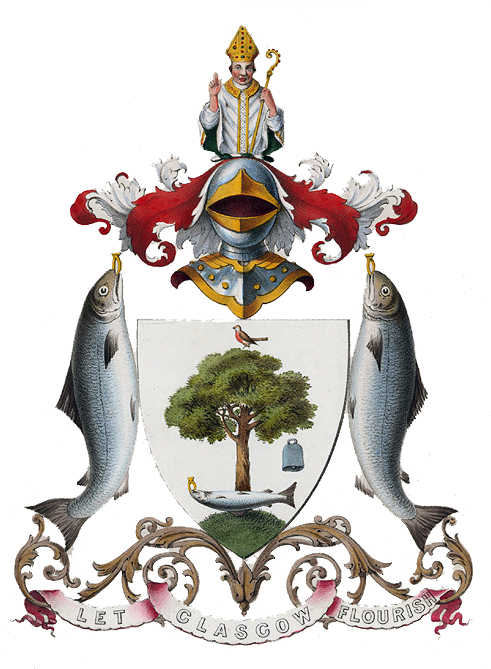
St. Kentigern – a christianised pagan tale?

Kentigern, often known as Mungo, was a saint of the early medieval Christian church who was supposed to have lived in the 6th century and to have been responsible for christianising the ancient Cumbric British Kingdom of Strathclyde, now a part of Scotland.

The region of Strathclyde forms the southern gateway to the Scottish Highlands, and is formed by the plains and foothills surrounding the great River Clyde which discharges into the Irish Sea, and was therefore an important region in the historic interplay between the various cultures of this region during the first millennium, including the peoples of the Scottic Dalriada provinces, Gallovidians, Picts, Cumbrians and peoples of Rheged and later the Anglians and Norse settlers. Its capital city of Glasgu (Glasgow) was supposedly founded by Mungo.

Most of what we know of him is dependent upon the hagiographic writing of the great 12thC Cistercian Abbott, Jocelyn of Furness, who was instrumental in assisting with the mission of the continental (Norman) church to establish dominance and the episcopal system in the northwest Atlantic provinces and who translated Gaelic hagiographical traditions into latinate ones to suit the new ‘Anglo’-Norman world. Jocelyn provided new saints’ lives for Patrick (who supposedly originated in Strathclyde) as well as Mungo/Kentigern. His patrons for the work on Patrick were John de Courcy, and probably also his ally – the King of Mann and the Isles, Godred Olafsson whose sister Auffrica had married de Courcy, and who had assisted in the Norman lord’s conquest of Ulster and the subsequent consolidation of Ireland’s religious power under a post-Gregorian reformed episcopacy. For the work on Kentigern, his sponsor was the Norman Abbott Jocelyn of Melrose who was also Bishop of Glasgow, Strathclyde’s principle town.

The coat of arms of Glasgow depicts the miracles of St Kentigern (Mungo)

The coat of arms of Glasgow depicts the miracles of St Kentigern (Mungo)

Jocelyn’s Life of Kentigern starts with an apology for the problems he encounters in interpreting the various gaelic language traditions of the saint he a had gathered in order to flesh out a text already being developed by the bishop of Glasgow. The stories he gathered were mainly from Strathclyde and from St Asaph’s in Wales: all important ports, along with Furness, in the Irish Sea region. Many of these tales he implies were improper and contained too many elements of heathenism, ‘contrary to certain doctrine and catholic faith’ to use the narrators own words. In fact, it is fairly clear from reading the Furness monk’s work that there is plenty of pagan material still within it, as well as much promoting the other seats of the new continental religious power and spirit of the Gregorian Reforms of church probity and religious rigor that underpinned the Cistercian worldview of the 12th and 13th centuries. His aim was obviously to rid the tale of aspects of what he perceived as syncretic heathenism in the Gaelic forms of Kentigern’s life so as ‘to season with Roman salt what had been ploughed by barbarians’.

Before I embark upon my commentary of the pagan aspects of this legendary text, I urge readers to take a look at a recent translation of the work by Cynthia Whiddon Green.

The first aspect I’d like to examine is the ‘origin story’: This is one of a fallen and rejected heathen woman Thaneu – fallen both in Jocelyn’s medieval Christian moral sense and fallen also in the physical sense that she was apparently thrown off a cliff at the top of Traprain Law in Lothian. The tale mirrors the biblical narrative of the Cistercians’ favourite ‘mother goddess’ – Mary,  with Mungo’s mother pregnant through an illicit extra-marital union with a nebulous and unspecified paternal donor. For such a ‘crime’ her father, the King of Lothian, has her thrown off a crag on Dumpelder (Traprain Law) but she is carried softly down to the ground, as if by wings. She is then cast adrift in the ocean in a coracle – her fate dependent upon the spirit of the seas. It so happens she drifts ashore near to an early Christian centre of learning run by St Servanus/Serf, and she builds a fire for herself on the shore and gives birth to a boy – Mungo – before being discovered by the monks.

Those astute in the folklore originating from Atlantic paganism will recognise that these motifs are to be found in many of the ‘syncretic’ literary and folktales that survive from Ireland, Scotland, the Isle of Man etc. Conception by spirits of magical children, the leapss and falls of giants, the casting adrift of sacred children and female personages who come ashore to figuratively give birth. The narrative is one based in the seasonal drama, and passage of the sun across the sky.  The female character (Thanue) is the Earth Goddess and the male (Mungo) represents the Sun/Son – in the story, the Sun is born out of the land in the east and travels west towards the Atlantic ocean into Strathclyde. The theme of a magical character washing ashore occurs in the Isle of Man’s Caillagh y Groamagh legend attached to Bridget’s day or Imbolc as it is sometimes known. The same theme is used in the Bethu Brigdhe hagiography of Bridget which mentions the bandit-turned-saint Machaldus (Maughold) being cast into the sea and washing up in the Isle of Man. Thanue is therefore a character replacing Bride-Aine, but what of her son?

The fact that Mungo enters his floruit (recorded life) from the sea and spends an awful lot of time in water and controlling water during the rest of his hagiography is highly suggested of the solar deity motif, identifying him with reasonable certainty as a hypostasis for the shining god Manannan who strides so actually godlike among the lesser characters of many of the euhemerist legends of medieval Irish literature and later folk tradition.  Even his name seems to refer to ‘Man’ in the form of ‘Mun’, just like Mongan mac Fiachna in the Irish Manannan legends. Mungo = Manannan.

Christian narratives did their best to replace the dualist Atlantic god and goddess with a masculine counterpart, particularly after the Brigitine church period, so Mungo subsumes the roles of both in the rest of the Vita. Here is a list of some of the features of Jocelyn’s tale which illustrate the pagan legends he was trying to weave in:

1. He emerges from the sea and has power over the waters.

2. He has the power to resurrect (e.g. – the little ‘red bird’ of St Serf – either a Robin or a Wren).

3. He has a magical branch (hazel or holly – the gaelic names can be confused) with which he keeps Serf’s eternal holy flames burning.

4. He resurrects a man who describes being conveyed back from the afterlife by a man of shining fiery light.

5. He conveys the dead to their resting place (the bullock cart is an interesting celestial motif)

7. Like the Cailleach of highland legend, while living as a ‘Culdee’ he exerts control over flocks of deer and wolves, who he treats like cattle, and hitches to his plough.

8. He spends an inordinate amount of time dousing himself in water and radiating holy light. When others are asleep he is awake praying – the Otherworld Inversion.

9. He disappears from the world in winter to fast. His food is the underground parts of dormant plants.

10. He sleeps in a stone sarcophagus and wears goat skins. There are a number of references to paganism in medieval and later literature which attest to ‘saints’ or spirits living in stone sarcophagi covered in water. Brownie/Phynnodderee/Glastig was a hairy half-human.

11. He is associated with a magical white boar, a special ram, and bullocks.

12. He finds a ring in the belly of a salmon. This motif also occurs in a number of traditional ‘fairy tales’ and medieval irish otherworld literature. For example, the Irish legend of Macaldus, the English fairy tale ‘The Fish and the Ring’ and the Irish Tain Bo Fraich. The Salmon returning is a motif of the returning year and the ring also – the goddess name Aine signifies a ring as well.

There are quite a few more referenes which emerge upon careful study of Jocelyn’s work, but these are the most important! Read the text and see what you think…

The ‘Sith’ – Fairies in the medieval Celtic world

We have heard from Caesar and other Roman writers that the Druids of Atlantic Europe used to teach that the soul was recycled into another body after death (metempsychosis), and that this was one of the core doctrines of the Atlantic Religion. Rome swept up through Gaul and Britannia during the 1stC BCE and the 1stC CE actively purging the religion and replacing it with its own new ‘Gallo-Roman’ and ‘Romano-British’ interpretations of religion, the evidence for which we have from multiple epigraphic (inscriptional) sources.

Following the collapse of paganism within the Roman Empire caused by its over-extension and loss of contact with original precepts, Rome’s leaders chose a monotheistic middle-eastern religion to prop up the apical nature of the Imperium. This system could not sustain its grip upon the western parts of its territories, and it subsequently withdrew from these and moved its centre of power to Constantinople. This left the western religious landscape in a state of flux, which Christian religious leaders were keen to exploit.

Britannia – nominally Christian in the 5thC CE – was, following a re-expansion of the peoples and ideas suppressed by the Romans, invaded and dominated by potent pagan cultures (themselves Romanised pagans) from the Atlantic coasts of what is now Germany and Denmark, invited by Romanised christian Britons to restore order. As it appeared that Britannia had reverted to paganism, there was a shift of focus in the Christian evangelical mission to the non-Romanised districts of the East Atlantic Archipelago: Ireland, the Hebrides and Scotland. One of the most famous missionaries during this period was a (Romano-) British man known as ‘Patricius’ or ‘Patrick’ (‘Father’).

Ireland and much of Scotland, Wales and the Isle of Man were largely untouched by the Roman re-invention of paganism during the Imperial era. For this reason, when Christianity arrived it had more flexibility in determining how it was to replace the old religious ways of Druidism. Even though it was written a couple of centuries after Patrick’s arrival in Eirenn, Tírechán’s 7th/8thC account of his conquest (recorded in the Book of Armagh) suggests that the native Irish believed in ‘Side’ and ‘Gods of the Earth’, based upon the his description of the reaction of some native princesses worshipping at a pagan holy well when Patrick and his followers suddenly arrive:

Et quo cumque essent

aut qua cumque forma

aut qua cumque plebe

aut qua cumque regione non cognouerunt

sed illos uiros side

aut deorum terrenorum

aut fantassium estimauerunt

“..and they did not know from what place or of what shape or from which people or from what region they were, but they thought they were men of the Sid or gods of the earth or apparitions…”

The standard explanations of the term ‘Side’/’Sid’ or ‘Sidhe’ (pronounced both as ‘Sith’ and ‘Shee’ and somewhere in between) is ‘Peace’, suggesting a state cognate with death. The term was also used in relation to the ancient man-made mounds that pepper the landscape of Ireland. In fact, as we shall see, the Atlantic belief was one where the Sid were a race whose existence was an opposite state to that of the living. Tírechán in fact draws a distinction between the ‘Side’ and gods when describing the women’s attempts to rationalise the appearance of the strangely attired men.

   That Patrick spent a considerable amount of time lurking at pagan sites and preaching to surprised potential converts is attested elsewhere in the fragmentary early medieval literature and accounts of him. The oldest Patrician text (other than the supposedly autobiographical Confessions) is known as the Hymn of Fiacc, which probably dates from the 7th or 8thC CE albeit citing a tradition and author contemporary to Patrick (a Christianised Bard called Fiacc). It describes the saint spending his time at pagan sites, spending the nights in ponds and the days on mountains, and sleeping on rocks in order to achieve his goals. This suggests such places to be the key pagan holy sites. The Old Irish Hymn (originally copied into mss hymnbooks) also refers to the Side or ‘fairies’:

for tūaith Hérenn bái temel

tūatha adortais síde

On the people of Erin there was darkness;

    The Tuatha adored the Side;

The terms ‘Sid’ and ‘Side’ have been glossed or explained in various copies of these ancient medieval texts as idla (from the Greek: Eidola = Apparitions) . Between the 16th and early 18th centuries, English, Scots and Irish author-observers (eg – Edmund Spenser, WIlliam Camden, Rory O’Flaherty, Robert Kirk, Martin Martin and George Waldron) were commenting on the popular belief in the fairies (or Sidhe/Sith) and visions of apparitions in the old ‘Celtic’ (Atlantic) provinces: Ireland, Scotland, the Hebrides and the Isle of Man. Theirs were a valuable look into the beliefs of a pre-industrial world, essentially unchanged in many of its traditional mannerisms, lifestyles and beliefs since the era of Patrick, Fiacc and Tírechán…