Careless lake ladies and mermaids – flood myths in Celtic folklore

“…There is a lake in Ulster of vast size, being thirty miles long and fifteen broad, from which a very beautiful river, called the Banna, flows into the Northern ocean. The fisher-men in this lake make more frequent complaints of the quantity of fish inclosed in their nets and breaking them than of the want of fish. In our time a fish was caught here which had not come up from the sea, but was taken descending the lake, and was in shape very like a salmon, but it was so large that it could neither be dragged out or conveyed whole, and therefore was carried through the province cut in pieces. It is reported that this lake had its origin in an extraordinary calamity. The land now covered by the lake was inhabited from the most ancient times by a tribe sunk in vice, and more especially incorrigibly addicted to the sin of carnal intercourse with beasts more than any other people of Ireland. Now there was a common proverb in the mouths of the tribe, that whenever the well-spring of that country was left uncovered (for out of reverence shown to it, from a barbarous superstition, the spring was kept covered and sealed), it would immediately overflow and inundate the whole province, drowning and destroying all the population. It happened, however, on some occasion that a young woman, who had come to the spring to draw water, after filling her pitcher, but before she had closed the well, ran in great haste to her little boy, whom she heard crying at a spot not far from the spring, where she had left him.

But the voice of the people is the voice of God ; and on her way back, she met such a flood of water from the spring that it swept off her and the boy, and the inundation was so violent that they both, and the whole tribe, with their cattle, were drowned in an hour in this partial and local deluge. The waters, having covered the whole surface of that fertile district, were converted into a permanent lake, as if the Author of nature judged the land which had been witness to such unnatural bestialities against the order of nature to be unfit for the habitation of men, either then or thereafter.

A not improbable confirmation of this occurrence is found in the fact, that the fishermen in that lake see distinctly under the water, in calm weather, ecclesiastical towers, which, according to the custom of the country, are slender and lofty, and moreover round ; and they frequently point them out to strangers travelling through those parts, who wonder what could have caused such a catastrophe.

…..

It must, however, be observed that the river before mentioned (the Bann), which now flows out of the lake in full stream, had its source in the aforesaid spring from the time of Bartholanus, who lived soon after the flood, when it was fed also by other rivulets, and took its course through the same district, but with a far less volume of water, and it was one of the nine principal rivers of Ireland…” (Topographia Hiberniae by Gerald of Wales (12thC) – trans. Thomas Forester; From: ‘The Historical Works of Giraldus Cambrensis’ – Pub. George Bell & Sons, London 1905)

Gerald’s tale comes from his famous account of Ireland, produced in support of the Anglo-Norman invasion of the island, and designed to support the imposition of continental christianity on this ‘barbarous’ and ‘uncivilised’ people. His sources were the monastic annals and texts of the great abbeys of Ireland. The contemporary secular literary milieu was one enchanted with the ‘Lady of the Lake’ and ‘Morgane le Fee’ and any one of a number of similar fairy themes which defined the ‘Arthurian’ Romance litereature of the 12th and 13th centuries. The following sums up one of his likely sources – from the legends of St Comgall about his apparent conversion and sanctification of a mermaid called Liban, afterwards St. Muirgen!:

“… According to a wild legend in Lebor na h-Uidri, this Liban was the daughter of Eochaidh, from whom Loch Eathach, or Lough Neagh, was named, and who was drowned in its eruption [A. D. 90], together with all his children, except his daughter Liban, and his sons Conaing and Curnan. Liban, was preserved from the waters of Lough n-Eachach for a full year, in her grianan, [palace] under the lake. After this, at her own desire, she was changed into a salmon, and continued to traverse the seas till the time of St. Comhgall of Bangor. It happened that St. Comhgall dispatched Beoan, son of Innli, of Teach-Dabeoc, to Rome, on a message to Pope Gregory [Pope, A. D. 599-604], to receive order and rule. When the crew of Beoan’s currach were at sea, they heard the celebration of angels beneath the boat. Liban, thereupon, addressed them, and stated that she had been 300 years under the sea, adding that she would proceed westward and meet Beoan, that day twelvemonths, at Inbher-Ollarbha [Larne], whither the saints of Dalaradia, with Comhgall, were to resort. Beoan, on his return, related what had occurred, and, at the stated time, the nets were set, and Liban was caught in the net of Fergus of Miliuc; upon which she was brought to land, and crowds came to witness the sight, among whom was the Chief of Ui Conaing. The right to her being disputed by Comhgall, in whose territory,-and Fergus, in whose net,-and Beoan, in promise to whom,-she was taken, they prayed for a heavenly decision; and the next day two wild oxen came down from Carn-Airend; and on their being yoked to the chariot, on which she was placed, they bore her to Teach-Dabeoc, where she was baptized by Comhgall, with the name Muirgen i.e. Born of the sea, or Muirgeilt i.e. traverser of the sea. Another name for her was Fuinchi…” (Annals of the Kingdom of Ireland by the Four Masters, vol.1 – John O’Donovan, ed. and trans.,(Dublin, 1856), p.201.)

This version of the Lough Neagh tale is slightly different as it tells that the father (Eochaid – possibly a reference to the literary figure known as ‘An Dagda’) and tribe of the magical woman are drowned, but that she remained in the form of a salmon in the sea until the coming of St. Comhgall some 300 years later. . There is good evidence from the variety of traditions encountered in Ireland that much hagiography was a deliberate revision of core pagan myths and doctrines. As with many conversion-era themes from Ireland, Liban (like Eithne/Aine in Altram Tigh da Medar) becomes a Christian and is not demonised and defeated, in distinction to the Breton legend of Gradlon and his daughter Ahes (the ‘Groac’h’ or ‘Mari Morgane’). Interestingly, Liban appears as the whip-frenzied companion/double of Manannan’s wife Fand in the ‘Wasting Sickness of Cuchullain’ from the Ulster Cycle. The same legends interested noted Celticist Professor John Rhys at the turn of the 20thC, who recorded some interesting parallel tales which showed the lake-lady/mermaid legend was not just local to Lough Neagh, or for that matter, Ireland or Brittany:

“…David Jones, of Trefriw, in the Conway Valley, was a publisher and poet who wrote between 1750 and 1780. This is his story: ‘In 1735 I had a conversation with a man concerning Tegid Lake. He had heard from old people that near the middle of it there was a well opposite Llangower, and the well was called Tfynnon Gywer, ” Gower’s Well,” and at that time the town was round about the well. It was obligatory to place a lid on the well every night. (It seems that in those days somebody was aware that unless this was done it would prove the destruction of the town.) But one night it was forgotten, and by the morning, behold the town had subsided and the lake became three miles long and one mile wide. They say, moreover, that on clear days some people see the chimneys of the houses.’…”

“…Before I have done with the Irish instances I must append one in the form it was told me in the summer of 1894: I was in Meath and went to see the remarkable chambered cairns on the hill known as Sliabh na Caillighe, ‘the Hag’s Mountain,’ near Oldcastle and Lough Crew. I had as my guide a young shepherd whom I picked up on the way. He knew all about the hag after whom the hill was called except her name: she was, he said, a giantess, and so she brought there, in three apronfuls, the stones forming the three principal cairns. As to the cairn on the hill point known as Belrath, that is called the Chair Cairn from a big stone placed there by the hag to serve as her seat when she wished to have a quiet look on the country round. But usually she was to be seen riding on a wonderful pony she had: that creature was so nimble and strong that it used to take the hag at a leap from one hill-top to another. However, the end of it all was that the hag rode so hard that the pony fell down, and that both horse and rider were killed. The hag appears to have been Cailleach Bhéara, or Caillech Bérre, ‘the Old Woman of Beare,’ that is, Bearhaven, in County Cork. Now the view from the Hag’s Mountain is very extensive, and I asked the shepherd to point out some places in the distance. Among other things we could see Lough Ramor, which he called the Virginia Water, and more to the west he identified Lough Sheelin, about which he had the following legend to tell:–A long, long time ago there was no lake there, but only a well with a flagstone kept over it, and everybody would put the flag back after taking water out of the well. But one day a woman who fetched water from it forgot to replace the stone, and the water burst forth in pursuit of the luckless woman, who fled as hard as she could before the angry flood. She continued until she had run about seven miles-the estimated length of the lake at the present day. Now at this point a man, who was busily mowing hay in the field through which she was running, saw what was happening and mowed the woman down with his scythe, whereupon the water advanced no further…” (John Rhys – Celtic Folklore – Welsh and Manx Volume 2; Ch.6; Pub. Oxford University Press 1901)

As well as Wales and Ireland, this story involving the Cailleach was widespread in the west of Scotland too, as the following account from the late 18thC shows:

“…On a high part of that ridge of hills which seperates Stralachlan from Glendarnel, there is a very large stone, remarkable for its situation. There is a descent from it on every fide. The prospect from it is very extensive. It is called Cailleach-Vear or Vera. In the dark ages of superstition, it was personified, and said to have a considerable property in cattle. Cailleach Vear makes a conspicuous figure in the marvellous tales of the country people, over great part of the West Highlands. Her residence was said to be on the highest mountains; that she could step with ease, and in a moment, from one district to another; when offended, that she caused a flood to come from the mountains, which destroyed the corns, and laid the low grounds under water; that one of these floods was the origin of Lochow, in Lorn, of Locheck, in this parish, and of many other lakes; that the people paid her a superstitious veneration, and were under dreadful apprehensions of her anger…” (The Statistical Account of Scotland: Drawn Up from the Communications of the Ministers of the Different Parishes; Ed. John Sinclair; Pub. W. Creech, 1792; pp. 559-560)

The same story is borrowed and elaborated on by a later author in the following account of Loch Awe from the 19thC following on from the surge in interest in Highland legends generated by Walter Scott:

“…The Highlanders of Argyleshire possess a curious tradition regarding the origin of Lochawe, which has furnished a topic in one of the wild songs of Ossian. The circumstance is connected with the existence and death of a supernatural being, called by the country people Calliach Bhere, ” the old woman.” She is represented as having been a kind of female genie whose residence was on the highest mountains. It is said that she could step with ease and in a moment from one district to another; when offended, that she could cause the floods to descend from the mountains, and lay the whole of the low ground perpetually under water. Her race is described as having lived for an immemorial period near the summit of the vast mountain of Cruachan, and to have possessed a multitude of herds in the vale at its foot. Calliach Bhere was the last of her line, and, like that of her ancestors, her existence was blended with a fatal fountain which lay in the side of her native mountain, and had been committed to the charge of her family since its first existence. It was their duty at evening to cover the well with a large flat stone, and at morning to remove it again. This ceremony was to be performed before the setting and rising of the sun, that his last beam might not die upon the waters, and that his first ray should illuminate their bosom. If this care was neglected a fearful and untold doom was denounced to be the punishment of the omission. When the father of Calliach Bhere died, he committed the office to his daughter, and declared to her, in a solemn charge, the duty and the fatality of the sacred spring. For many years the Military woman attended it without intermission;

But on one unlucky evening, spent with the fatigues of the chase and the ascent of the mountain, she sat down to rest beside the fountain, and wait for the setting of the sun, and falling asleep did not awake until next morning. When she arose she looked abroad from the hill; the vale had vanished beneath her, and a wide and immeasurable sheet of water was all which met her sight. The neglected well had overflowed while she slept; the glen was changed into a lake; the hills into islets; and her people and her cattle had perished in the deluge. The Calliach took but one look over the ruin which she had caused: the spell which bound her existence was loosened with the waters, and she sunk and expired beside the spring. From that day the waters remained upon the vale, and formed the lake which was afterwards called Loch Awe…” (The Gazetteer of Scotland, Volume 1 By Robert Chambers, William Chambers ; Pub: Andrew Jack, Edinburgh, 1844; p.63)

The legend tells that the Cailleach disappeared into the spring – a figurative form of death shared with the Dindshenchas legends of Sinand and Boann as well as many of the others. The theme of the Cailleach and the flood was discovered in the Isle of Mull:

“…In the olden times, on the Headland of Mull, there lived a woman whom the people called Cailleach Bheur. She didn’t hail from the people of this world, since we are told that Cailleach Bheur was a yound girl when Adam and Eve were still enjoying the pleasures of the Garden of Eden. She tells us, in her own words, ‘When the ocean was a forest with its firewood, I was then a young lass.’ Let that be, as it may, and far be from us to doubt it, but it seems that Cailleach Bheurr evaded death in a way that no one was ever able to do, before or since…” (School of Scottish Studies Archives, University of Edinburgh Royal Celtic Society, MSS:AM/35.8 Mull)

“…Now there was only one place where Cailleach Bheurr watered her cattle-herd when she was away from Mull itself. This was a well halfway along the road she took to the headland of Kintyre. I don’t remember what its name was but, indeed, there was such a well there. And there was a great stone lid on the well and as soon as she arrived there in the morning, she would lift off the great stone so that the herd could get a drink at a time when they were thirsty. But if she didn’t place the great stone lid back on the well before the sun went down, the water would flow out of it and flood the whole world. It would pour out of this well and cover the whole world with a flood…” (School of Scottish Studies Archives, University of Edinburgh Royal Celtic Society, MSS:SA 1953/49/B5)

These accounts also add a tradition that the Cailleach would evade death by bathing in a magic Loch every 100 years. Of particular interest is that the quote ‘When the ocean was a forest with its firewood, I was then a young lass’ is mirrored in a folktale quoted in the following 18thC Irish account, discussing regional geology and geography around Lough Foyle:

“….There is a Rock on the side of the Mountain called the Poor Woman (in Irish, Calliagh Veerboght) who tells us when she was a Maid the Place where she stands was once Corn ground and Lough Foyl so narrow that a Lamb could skip from Magilligan Point to Green Castle which is now two Sea Miles distant and the Fairy that lived on the Tuns Banks (AR: Tonn Banks – The fairy referred to is revealed in other stories to be no less than Manannan!) that lye at the Mouth of Logh foyle (mostly formed I believe by what was worn away of this Shore) having a Carpet stole from him by one of this Parish, cursed it and threaten’d that every Year the Breadth of the Carpet should be swept away from the Land till all should be swept away. We may at least gather from such as these that in antient times this Place was losing and not gaining…” (“Miscellaneous letters on several subjects in philosophy and astronomy” – By Robert Innes to the Bishop of Cashel – William Nicolson; Pub.S. Birt, London 1732;p.5 – Letter 1)

The legends of the Cailleach and her relationship to water and herds of cows or deer seem to have been very consistent between Ireland, Wales and Scotland. Even in the 12thC Breton Lai de Graelent where she appears as a fountain-fairy in the woods, there are similar associations – the knight (like Fionn in the Irish ‘Pursuit of Slieve Gullion’) chases the white deer and finds her waiting at a spring in the woods. The lore is perhaps best summed up in this  excerpted 19thC translation of the Scottish highland ballad – Cailleach Bein y Vreich:

“Weird, weird, wife! with the long grey locks, she follows her fleet-foot stags, Noisily moving through splintered rocks, And crashing the grisly crags.

Tall wife! with the long grey hose, in haste the rough stony beach she walks; But dulse or seaweed she will not taste, nor yet the green kail stalks.

“And I will not let my herds of deer, my bonny red deer go down; I will not let them down to the shore, to feed on the sea-shells brown.

O better they live in the corrie’s recess, Or on mountain top to dwell, And feed by my side on the green green cress, That grows by the lofty well.”

“Broad Bein-y-Vreich is grisly and drear, but wherever my feet have been, the well-springs start for my darling deer, And the grass grows tender and green.

“And there high up on the calm nights clear, Beside the lofty spring, They come to my call, and I milk them there, And a weird wild song I sing.”

(Excerpt from translation of the old highland song Cailleach Bein a Vreich by John Campbell Shairp, from ‘Kilmahoe: a Highland pastoral with other poems’; Pub. Macmillan & Co, London 1864; pp.138-139)

The middle irish tale Echtra mac nEchach Muigmedón (Yellow Book of Lecan – late 14thC) recounts the legend of the boyhood of Niall (of the Nine Hostages) – son of Eochaid Mugmedon by Cairenn. It explains the origin of Ui Neill kingship. The theme is of how Niall came to be bestowed with the sovereignty of Ireland by a fairy queen at a well.  The five sons of Eochaid are sent to fosterage and then (at their appointed time) join their Fianna to gain life experience in adventure. While hunting in the woods, they realise they must find water and each in turn goes to a well to draw water, where they encounter a loathsome hag who guards it. Her condition for allowing them to draw water is that they bestow a ‘kiss’ upon her (i.e. – that they have sex with her). The first four sons (whose mother is Mongfind) refuse her, but Niall – last to go – accepts eagerly, else they all die of thirst. The hag immediately transforms into the most gorgeous young woman and announces that she is the Sovereignty of Ireland, which she bestows upon him in an act of Heiros Gamos. He returns to his father who recognizes him as the new High King.

Those familiar with Chaucer’s Canterbury Tales will know that his ‘Tale of the Wife of Bath’ is a facsimile of this same tale, which also occurs in various other forms in the ‘Romance’ fairy tales of the ‘Arthurian’ corpus between the 12th and 15th centuries.

When we consider the ‘Moura’ fairytales from the Iberian Peninsula, the fairytales of Brittany and France, and those of the rest of northern Europe (which I have not discussed), these all point towards an important, pervasive and powerful pagan mythology which was possibly common to all of these regions and was tied to water and the great ocean.


All text © 2014 The Atlantic Religion, except where stated.


‘The Elucidation’

The following is appended as a (?13thC) prologue to a copy Chrétien de Troyes’ Perceval, le Conte du Graal in the French medieval manuscript known as  Mons 331/206 (olim 4568). Taken from Mary Jones’ fantastic website – translated by Sebastian Evans:

…. Now listen to me, all ye my friends, and ye shall hear me set forth the story that shall be right sweet to hearken unto, for therein shall be the seven Wardens that hold governance throughout the whole world, and all the good stories that any hath told according as the writing shall set forthwith;  what manner folk the seven Wardens should be, and how they took unto them chief, and whom they took, for never aforetime have ye heard tell the story truly set forth, and how great nose there was and great outcry, and how for what cause was destroyed the rich country of Logres (AP: the Brythonic lands) whereof was much talk in days of yore.

The kingdom turned to loss, the land was dead and desert in suchwise as that it was scarce worth a couple of hazelnuts.  For they lost the voices of the wells and the damsels that were therein.  For no less thing was the service they rendered than this, that scarce any wandered by the way, whether it were at eventide or morning, but that as for drink and victual he would go so far out of his way as to find one of the wells, and then nought could he ask for of fair victual such as pleased him but in content he should have it all so long as her hand asked in reason.  For straightaway, I wise, forth of the well issued a damsel – none fairer need he ask – bearing in her hand a cup of gold with baked meats, pastries, and bread, while another damsel bore a white napkin and a dish of gold or silver wherein was the mess which he had come for the mess had asked for.  Right for welcome found he at the well, and if so it were that his mess did not please him, diverse other ways they brought him all with one accord served fair and joyously all wayfarers by the roads that come to the wells for victual…

The narrator of the introduction or ‘elucidation’ then comments upon the loss of the pagan religion from Logres (Britain) and the goes on to lament how the ‘women of the wells’ were deposed. It is a fitting introduction to the archetypal Grail romance, and seemingly evokes the spirit of the Seven Streams of Poetry said in Irish mythology to issue from the Otherworld wells (of Connla and Segais, for example). Here the term used is the ‘Seven Wardens’, the mysteries of which are supposed to be revealed within the narrative of ‘Percival’, with its tales of the Fisher King (Manannan), magical cups, and maidens who occupy magical pools of water…

All text © 2014 The Atlantic Religion, except where stated.

The ‘Otherworld’ Father, Manannan.

Manannan was the personification of the sovereignty of the Otherworld in literature and folklore of the Gaelic peoples. Like his counterpart, he too had epithets and identities which sometimes make it difficult to identify him in corrupted or obfuscated mythologies.

The otherworld was a realm made of what the ancient Greeks defined as ‘spirit’ or ‘aither’/’ether’ – an extended form of the loftiest of the four mundane elements, Fire, manifesting as light, of which there were two forms: lumen (ordinary light) and lux (spiritual light) being their Latin names. This was believed to cleave to the form of any of the ‘manifest’ elements (water, earth, air and fire) – perhaps making it the mysterious spiritual ‘skeleton’ or framework of the universe, corresponding to a universal divine soul. Such an idea pervades the philosophies and mythologies of the ancient world, and can be examined in works such as Plato’s ‘Dialogue of Timaeus’.

In the Christianisation of Ireland, Scotland and the Isle of Man during the early middle ages, as a lord of the ethereal world, Manannan would not have posed much of a problem of interpolation into the new order. The god of the far-off Israelites was an easy substitution: After all, didn’t the redeeming sun (son) return from the East? Didn’t christianity also offer eternal life? …

Where he occurs as a character in medieval Irish literature, Manannan is not infrequently given an oriental provenance – be it in the Asia Minor province of Armenia (which seemed to the scribes and bards to bear his name, as well as an important early Christian provenance) or even – like the Dionysus of Nonnus – in India where he was said to have aquired a magically fertile and abundant cow. At the conclusion of the tale Serglige Con Culainn (‘Sickbed of Cuchullain’) he arrives from the east to redeem the cast members (including his wife Fand) of their indiscretions, passing out drinks of forgetfulness and shaking his cloak between the unfaithful parties in order that all might be reconciled. A very idealised model of Christian charity and forgiveness, the importance of which would not have been lost on the tale’s audience…

Fionnysus?

Scholars seemed to have remained intrigued by similarities between Irish and ancient Greek mythology since the advent of Irish literature in the early medieval period, down to the modern day: The monastic writers of the medieval periods, the brilliant Ruaidhrí Ó Flaithbheartaigh (who titled his 17thC history of Ireland Ogygia after Homer and Plutarch’s mystic isle) to the eccentric Charles Vallancey in the 18thC, and the eccentric and brilliant James Joyce of the 20th – all have been able to draw parallels.

Care needs to be taken in approaching the subject as it was, after all,  a hallmark of medieval and early modern Renaissance learning to draw parallels with Europe’s classical ‘golden age’.  National histories and mythologies from across Europe have therefore attracted similar comparisons at one time or another. Nevertheless, the Irish mythological landscape bears perhaps the closest resemblance in its content and complexity to that of ancient Greece. The Greek mythology served to illustrate an understanding of the universe by assigning spiritual entities to all of its functions, and in this regard is similar to every other ‘pagan’ system of learning which coded knowledge into an elaborate prosaic, artistic, poetic, dramatic repository of tradition, supported by dialectic traditions.

Fionn mac Cumhaill recurs as one of the key popular figures and vehicles of the ancient Irish traditions. I would like to discuss similarities in function shared by Fionn and his legendary Greek counterpart, Dionysus.

Dionysus (Bacchus) was revered in Europe’s Eastern Mediterranean provinces since the Bronze Age. Although most often characterised as a god of wine and intoxication, a wider reading of his cultural function reveals that he was equally associated with the convocations and group-efforts of human beings. Whether it be feasting or revels, hunting or adventure expeditions, war-bands, public theatre or the large-scale religious rituals and the mystery cults – Dionysus was often the key spiritual figure. His position as an ‘outsider’ to the Olympian tradition (which possibly post-dated him) was incorporated easily into the diversifying and expanding world of the Greek archaic and Hellenic ages. Many of his traditions were supposed to have been related by the poet Orpheus, and it is apparent that we have a number of links here to Ireland’s Fionn legends.

Fionn, like Dionysus, was a troop-leader whose tales are usually related in traditions by his poet-son Oisín or another of his followers. In his legends he feasts, hunts, fights and travels, and – like his counterpart Cuchullain – is often fractious, destructive, sometimes somewhat simple and erratic. Some of the traditions about him (e.g. – ‘Compert Mongan’) deal with his death and reincarnation – similar to Dionysus in the Orphic mysteries. Fionn is also ascribed a semi-divine parentage in some traditions. Dionysus’ Orphic name, Zagreus,  is interpreted as meaning ‘hunter’ or ‘capturer’ – perhaps alluding to his underworld/psychopomp functions in the Dionysiac mysteries.

Fionn, as leader of the Fianna can therefore be seen to serve a similar narrative function to Dionysus. His connection to the Sluagh of disincarnate souls has never been made explicit in Gaelic (Atlantic) literature, but a connection between the Fianna and the ‘Fairy Host’ is implicit in regional folklore. Finally, the Isle of Man’s Phynnodderee – a mythological half-man, half-beast who helps householders – shares Fionn’s name and attributes in many Manx folk traditions, which otherwise reference a giant called ‘Finn MacCool’.

The last (but by no means the least) connection to Dionysus/Bacchus is that ‘Fion’ is the Irish word for wine!

Slainte!

Otherworld themes in “Aislinge Meic Con Glinne”

The Middle-Irish prose tale Aislinge Meic Con Glinne (‘The Dream-vision of MacConglinne’) is supposed – by the style of its language and themes – to have been composed and written in the late 11th or early 12th century. Two versions of it have survived to the modern day – one (‘B’ recenscion) in the 15thC manuscript collection known as An Leabhar Breac (‘The Speckled Book’ – RIA MS 1230) and the other in the manuscript TCD MS 1337 (‘H’ recescion).

You can read a translation of it here.

Set during the 8th century, it is styled in the form of a somewhat satirical prose-tale interspersed with poetic verses, and revolves around the power of a ‘dream vision’ (Aislinge) to sway the fate of the hero of the plot – a scholastic Armagh monk by the name of Aniér Mac Conglinne, saving his life and saving the kingdoms of the South of Ireland by exorcising their High King, Cathal mac Finguine of a ‘Lon Cráis’ (sometimes translated perhaps erroneously as ‘demon of gluttony’) that had taken up residence in him.

The story contains a number of highly amusing and incisive aspects to its narrative. The first introduces the humourous, energetic, ever-fasting and hungry monastic hero-adventurer whose destiny is to save King Cathal and his subjects from their greedy and sinful ways. So eager and restless is he in his mission that he runs from Armagh to Cork in the space of a day or so. Upon arriving at the monastic hostel in Cork he finds their Benedictine christian values of hospitality severely wanting and sets about causing an annoyance to advertise this fact. This mortally upsets the monks who report his activities and (worse) his biting satires to Abbott Manchín who demands his arrest and has him tortured and prepared for execution. MacConglinne goes willingly to his fate, seeking to demonstrate his piety to the monks by way of example. This part of the tale is obviously an exemplar of the popular spirit of the late 11th and early 12th century ‘Gregorian Reforms’ of church probity and the monastic orders. which led to the explosion of new and disciplined monastic institutions. The character of MacConglinne – being a monk from Armagh who wears a white habit – is obviously designed to represent a forerunner of Malachy of Armagh who promoted the reformed Cistercian Order during the era of the tale’s apparent authorship. This allows him to hold no punches in castigating the lazy, fat, greedy and cruel monks of Cork and refer to them as ‘shit-hounds’ among other choice and amusing epithets!

The most amazing and amusing aspect of the tale comes when the starved MacConglinne is tied to a pillar-stone to await his execution and in delirious depths of his abject suffering and hunger, he is visited by an angel or spirit who grants him a vision of a land made of and peopled by food!

The fort we reached was beautiful,
With works of custards thick,
Beyond the loch.
New butter was the bridge in front,
The rubble dyke was wheaten white,
Bacon the palisade.

Stately, pleasantly it sat,
A compact house and strong.
Then I went in:
The door of it was dry meat,
The threshold was bare bread,
cheese-curds the sides.

Smooth pillars of old cheese,
And sappy bacon props
Alternate ranged;
Fine beams of mellow cream,
White rafters – real curds,
Kept up the house. (Trans. Kuno Meyer, 1892)

When the abbott arrives to see him executed the next day, MacConglinne relates his vision and the abbott and monks have second thoughts and refer him to King Cathal, believing that he may be tasked by god into casting out the King’s Lon Cráis. This ‘demon’ has made the King into a man who only takes food from his vassals and never distributes it, giving him an insatiable hunger.

MacConglinne dons the garb of a poet-juggler and arrives at the court of a local petty-king whom Cathal is visiting. He impresses his way in with his antics and satires and gains an audience with the king and promises to cure him, after relating his vision of a land of food. The king is so impressed by his abilities and religious piety that he begins tossing him apples (having given food to no man for many years) which the hero gladly eats, and this obviously causes MacConglinne’s powers to sally forth even further! He convinces the whole court (including Cathal) to fast overnight, and in the morning has Cathal bound with ropes and orders the most sumptuous foods be prepared which he then taunts him with while reciting a tale he himself has composed which embellishes upon the themes of his vision.

His new tale involves him being approached by a Scál (usually interpreted as a ‘phantom’, but in Irish tales always referring to an otherworld being who tests and/or instructs a hero). The scál sees he is sick with hunger and disease (or ‘original sin’) and instructs him to find (in the land of food) a magical healer or ‘fairy doctor’, known in Middle Irish as a fáthliaig (an archaic term meaning ‘vision-healer’ which survived into 19thC Manx Gaelic in the word fallog’). In MacConglinne’s telling, the fáthliaig advises him that he is sick, evoking a description of him suffering from a spiritual (and physical) inversion of King Cathal’s own predicament (which also reflected the poor traditional values of hospitatlity the monk had found in the South). This is typical of shamanic practice – the figurative/spiritual assumption of the sufferer’s disease by the healer in a dream-vision in order to combat it:

‘‘Pray for me!’ said I to him.’

‘‘In the name of cheese!’ said he to me. ‘Evil is the limp look of thy face,’ said the Wizard Doctor. ‘Alas! it is the look of disease. Thy hands are yellow, thy lips are spotted, thine eyes are grey. Thy sinews have relaxed, they have risen over thy eyes and over thy flesh, and over thy joints and nails. The three women have attacked thee, scarcity and death and famine, with sharp beaks of hunger. An eye that sains not has regarded thee.

The fáthliaig‘s prescription is, again, humorous – MacConGlinne must eat the finest foods, and be tended to by a beautiful woman while reclining upon soft animal skins in front of a roaring fire!  There follows a recitation of the delightful foods he must be fed which so inflames the ‘Lon Cráis’ in Cathal’s throat that it jumps out and hides under a cauldron in the fireplace, at which point after MacConglinne offers thanks to God and Brigit!

So… what is a Lon Cráis? There are repeated references in Gaelic folklore to a creature – often a type of lizard or newt – which can enter the mouths and throats of the unwary and cause a great unsatiated hunger or thirst. In Gaelic Scotland, Robert Kirk (17thC) spoke of possession by the spirit of a ‘great eater’. This was explicitly called the Lon Craois during the 19th century (see JG Campbell’s ‘Popular Tales of the West Highlands Vol.2 p.366), and in Ulster and the Isle of Man the English term for it was ‘Man-Creeper’. In both cases the cure was to tempt it out with delicious food (as with Cathal) or to eat salt and lie near a well with your mouth open (Isle of Man). In both cases it appears that the condition refers to Diabetes Mellitus, where the blood is rick with sugar but the body’s cells cannot take it in. This results in dehydration, great hunger and thirst. Kuno Meyer (1892) preferred to translate the Lon as a ‘demon’, which in the context of the characters of the narrative and their beliefs seems a correct choice, even though he knew of the Scots Gaelic term. The term does not translate literally as ‘demon’ –Lon may be the otherwise attested word Lionn, which is the Irish word for ‘humor’, meaning one of the four classical/medieval humors of the body, and an imbalance of these was believed to be the mode through which disease (and moral failings) was supposed to operate. The OI/MI word Cráes means gluttony or hunger – the latter being invoked as ‘three women’ (an implicit Cailleach reference) by the vision’s seer-leech.

SO…

The ideas of food and gluttony are explicit themes around which this whole tale revolves. The implication is that the Monk of Armagh (MacConglinne, representing both Patrick and the hegemony of Continental christianity under Malachy and the Gregorian reforms) is spiritually proper in his fasting and starvation and that having plenty of physical food and not sharing it with the poor is a form of spiritual starvation. This is another ‘Otherworld Inversion’ similar to many pervading the spirituality of the Gaels or Atlantic peoples and which were deeply influential upon early European Christians. The Lon Cráis was an ‘otherworld’ force which transformed gluttony into hunger, and MacConglinne evokes an ‘otherworld’ vision of the world of this ‘creature’ (a world of food) in which he meets a ‘fairy doctor’ or ‘seer-leech’ who details his cure by having the hero invoke an inversion of Cathals’s disease upon himself so as to defeat the spirit by evocation and provocation. By causing the spirit to escape under the pressure of his bardic or poetic genius, he fulfils his original ambition to exceed his monastic limitations, and the cure is ultimately based in Atlantic otherworld doctrines, and not purely Christian:

It is clear from this text that the hero’s poetic creation of a world and narrative made of food is the force which expels the hungry spirit, not the Christian god who (along with Brigit) gets the credit at the conclusion.

As with all Middle Irish texts and stories, this tale is beset with contradictions between a pagan and a Christian narrative. The explicit connection between fasting and spiritual purity is made in the ancient Hebrew stories collected in the 5th and 4th centuries BC into the written canon of the Hebrew Bible, from which Judaism, Christianity and Islam eventually grew, and is common to many other ancient faiths. What is interesting is how the Atlantic/Gaelic view of the Otherworld and its interaction ‘through a mirror’ with ours influenced the Christian aspects of this narrative by providing a more rational idea of spiritual balance, largely lost from continental christianity in the cultural confusion of the post-Roman period….

The fate of the early Irish Brigitine church

We know from the earliest surviving hagiographic literature from Ireland (written by Cogitosus, Abbot of Kildare some time in the 7thC) that the original Irish ‘Brigitine’ monastic movement was probably one of the first forms of organised christianity that flourished in Ireland, sociologically interesting in that their communities or ‘abbeys’ apparently combined chapters of both male and female ascetics. These abbeys and their leaders are generally accepted to have been places where the children of the local aristocracy would be fostered to the care of the new political and spiritual forces influencing Ireland and Britain in the period, offering opportunities for learning and travel. It appears to have preceded the ‘Patrician’ movement which established its retrospective dominance in the ensuing four centuries of Uí Néill ascendancy, leading to Patrick becoming seen as the main patron saint of Ireland. Even by the 12th century, monastic writer Gerald of Wales was able to comment (perhaps to highlight in his eyes its need for reform) upon the strange setup at Kildare with its holy enclosures, sacred meadows and sanctuary with its eternal flame.

Cogitosus claimed that there had been an explosion of Brigitine missions and Abbeys in his own lifetime that had spread across Ireland, yet it is somewhat difficult to ascertain what and where all of these were. We can be certain that some of these were taken over by the subsequent movements of the male-centred order of Finnian and his students, perhaps in continuity of the Brigitines’ probable appropriation of goddess-centred sanctuaries for their own establishments. Indeed, the language and forms of popular legend and hagiography about characters such as Cóemgen (St Kevin of Glendalough) and Senán mac Geircinn (St Sennan of Scattery Island) contain coded references to deposed female characters and conquered ‘beasts’ – typical motifs used in dealing with indigenous paganism. It is very likely that these Irish early-christian religious institutions were established at the sites of former pagan shrines, and that many if not most of these were associated with well-springs, islands in sacred lakes and rivers and river-crossings, as well as fertile meadowlands – the typical sites of earthly goddess-worship and legends. The attributes of <Christian Brigit> in the accounts by Cogitosus and from later texts such as the Bethu Brighde were loquaciousness, fecundity, hospitality, healing powers, associations with fire and light, and some mechanical miracles.

With this in mind, Cormac’s Glossary (probably 10thC) had this to say about Brigit (trans. by John O’Donovan, Ed. Whitley Stokes):

“Brigit i.e. a poetess, daughter of the Dagda. This is Brigit the female sage, or woman of wisdom, i.e. Brigit the goddess whom poets adored, because very great and very famous was her protecting care. It is therefore they call her goddess of poets, by this name. Whose sisters were Brigit the female physician (woman of leech craft), Brigit the female smith (woman of smith work), from whose names with all Irishmen a goddess was called Brigit.”

The passage is remarkable as it makes a specific reference to a pagan Brigit and claims this was the name by which all the goddesses of Ireland were once called by the Irish! She is referenced as a creatrix through the Smith-association, a mistress of nature’s healing bounty, and an exciter of the human imagination in expressing the things of the world. Explicitly in the Sanais Chormac, she is a triple goddess of the sort seen in the characters of the Matronaes depicted in some of the statuary and bas-relief traditions of late Iron Age Atlantic European cultures: Mother goddesses perhaps representing the three generative seasons of the year…

Brigitine monasticism is likely to have taken over the reigns of traditional goddess-worship in Irish society during the 5th/6th centuries (if not earlier), and then to have been supplanted by a male-centred order under the acolytes of her supposed contemporary Finnian of Clonard (attrib. 5th/6thC) who promoted a non-feminine regime magnifying the missions of Palladius and Patrick (sometimes now referred to as the ‘two Patricks’) as the main forebears of Irish christianity. Finnian is the character that the ‘second wave’ of Irish saints depend upon for their education at his great school. However, we must necessarily question whether these religious establishments that began to cascade as far as Ireland’s westernmost extremes and into Scotland, Mann, Wales and Cornwall before leaping to the continent, were based upon pre-existing (possibly syncretic) Brigitine sites.  There is no explicit evidence to demonstrate this, but much that is oblique or indirect, as formerly commented on.

One particularly interesting piece of literary evidence from the 15thC Book of Fermoy (roughly contemporary with Chaucer) contains an explicitly Christianised version of an older tale also known as ‘The Wooing of Etain’ (earliest surviving version is from the early 12thC), but referred to in this context as Altram Tige Da Medar (‘The Fosterage of the House of the ?Two Pails’). It is set in the pseudo-historical world of the ‘Gebala Eirenn’ mythos, and tells of the warrior tribes of Tuatha De Danann and their ruler Manannan who settles them in various Sid mansions and governs them with the laws of the Otherworld. In this tale, the fairy Eithne (apparently the same character as the earlier Etain, possibly also a version of the name ‘Aine’) has an inverted ‘otherworldly’ encounter with a christian priest and his church after being abstracted from her friends while batheing in the Boyne and becomes fostered by him and becomes a Christian!

You can read a copy of it here: @MaryJones

Readers may recognise ‘Eithne’ or ‘Ethniu’ (‘Enya’) as a character who makes a number of appearances in the mythological cycle tales – as the mother of the hero Lugh. Here she is daughter of a minor Tuatha Dé Danann (TDD) noble called Dicu, fostered by Aengus, and Manannan is portrayed – curiously – as the (Christian) god-fearing ruler of the TDD who tries to bring a new rule of law and order to the fairy tribe to whom he grants their Sidhe mansions or hills. The narrative hands to Eithne (for which we might also read (C)ethlinne or ‘Aine’) the role as the first TDD to become a Christian – fostered by one of Patrick’s priests. It is almost analogous to the early Bridget hagiographies in this regard – building a sympathetic or syncretic bridge between the pagan past and the Christian future which the Book of Fermoy’s 15thC aristocratic patrons must have enjoyed.  Manannan also fulfils the function of ‘Christian Godsend’ that Charles MacQuarrie suggests in his ‘Waves of Manannan’ thesis – an acceptable pagan analogy of the Christian god, who the narrator has Manannan hail and recommend in his role as benevolent otherworld leader of the TDD:

‘…The nobles inquired of Manannan where Ealcmar would find rest. ‘I know not’, said Manannan, ‘and no prophet or sage in the whole world knows, but the one God almighty knows.’ …. ‘

The displacement of Brigitine syncretism became a significant ambition of narrative traditions from the 6/7thC and therefore appears to have continued as late as the 15th century. After all, heresy was always the main home enemy of western christianity and from the 15th century would evolve into something known as the ‘witch craze’ where pagan folk-traditions would eventually under intense scrutiny by both the religious AND secular authorities and become a victim of the polemic of popular culture.

‘Erdathe’ – The Atlantic religion’s ‘day of judgement’?

The 7thC Patrician biographer Tírechán is a valuable source for some details of the Atlantic religion in Ireland. His work – known as the Collecteana occurs in the Book of Armagh – MS52 of Trinity College Dublin. One of the mysterious Irish words he left in his Latin hagiography of the saint is the word 'erdathe' which Tírechán claims was the term used by Irish pagans for their equivalent to the 'day of reckoning of the Lord'. It can be found in the last paragraph of Folio 10r…

12 (1) Perrexitque ad ciuitatem Temro ad Logairium filium Neill iterum, quia apud illum foedus pepigit, ut non occideretur in regno illius; sed non potuit credere, dicens:(2) “nam Neel pater meus non siniuit mihi credere, sed ut sepeliar in cacuminibus Temro quasi uiris consistentibus in bello” (quia utuntur gentiles in sepulcris armati prumptis armis) “facie ad faciem usque ad diem erdathe” (apud magos, id est iudicii diem Domini) “ego filius Neill et filius Dúnlinge Immaistin in campo Liphi pro duritate odiui ut est hoc”.12 (1) And he proceeded again to the city of Tara to Loíguire son of Níall, because he made a pact with him that he should not be killed within his realm; but (Loíguire) could not accept the faith, saying:(2) 'My father Níall did not allow me to accept the faith, but bade me to be buried on the ridges of Tara, I son of Níall and the sons of Dúnlang in Maistiu in Mag Liphi, face to face (with each other) in the manner of men at war' (for the pagans, armed in their tombs, have their weapons ready) until the day of erdathe (as the magi call it, that is, the day of the Lord's judgement), because of such fierceness of our (mutual) hatred.'

So… what is erdathe? There are two problems in determining the answer to this question: Firstly, is this really the word in the original text (written in 9thC insular minuscule text)? Secondly, the lack in standards for orthography from such early written Irish would make the word (whatever it is) a difficult one to find a more modern equivalent for…

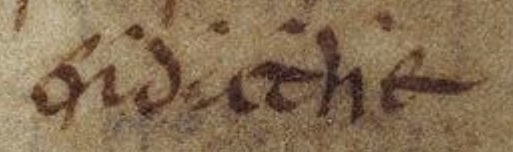
Let's take a look at the first problem. Here is a facsimile of the word as written in paragraph 12 (Folio 10r) of the actual manuscript:

Erdathe_word

For those not accustomed to 9thC insular miniscule scripts, the initial e or a and the following r are compound or ligated and the 'r' part shows the typical dependant leg of the 'long r'. Third letter is 'd', fourth 'a', fifth 't' (capitalised in style), sixth 'h' and final a definite 'e': a/e-r-d-a-t-h-e. So: this is definitely the correct word, but the first letter might be an 'a'. You might also note the four dots above the d, a, t and 'e' where the scribe rested his nib while considering how to write the Irish word – one he was unfamiliar with and which has no other attestations in this form of spelling. This hesitancy on his part might also have given the indeterminate a/e at the start of the word. This leaves us to examine the second problem – that of meaning:

In addressing the second problem, it is necessary to take a phonetic approach and cast a wide net to see how this word relates to later Gaelic words:

Irish:

The words ard and ath(e) appear to compound the word ardathe/erdathe. This offers us a straightforward translation, for 'ard' = 'height', 'high' or 'elevated'. However, the 'athe' part (-ath is not a usual suffix in the Irish language) is slightly more problematic, unless of course it is a pure compound word, in which case áth, meaning a 'ford' or an 'open space or hollow between two objects' (eDIL) seems a likely offering. The áth is a typical place for combats to occur in narrative tales such as those of the Ulster Cycle, and in particular the Táin Bó Cúailnge… this implies a liminal place where 'crossing-over' (death) might occur, as well as being a place typical for the territorial combats of rutting stags on river plains etc. It therefore shows a link of sorts to the word cath- which suffixes terms to do with battle or defence (e.g. Conn Cétchathach – Conn of the Hundred Battles); Bear in mind that the 'd' of 'erd' or 'ard' would possibly lenit a following hard consonant to give '-ath'. Other words that would fit this schema might include 'rath' and 'math'. The use of ath- as a prefix also implies an act of repetition. 'Athair' of course means 'father' – a term used to mean 'god' by Christians ('Pater noster…')

Manx: (definitions from Juan Kelly's Dictionary – Manx Society Vol.13)

The Manx language is a treasure trove for those looking for more ancient forms of Irish, having remained in a purely spoken form until the 17th century, and having enjoyed a level of cultural stability that Ireland could not, and which in turn preserved many aspects of Atlantic religious folklore that was otherwise lost. Literature has a habit of informing the 'correct' pronunciation and flow of ideas in a culture… The best guess of 'erdathe' in Manx is seen in the two forms of the expression for 'high', 'elevated' or 'exalted' – based on the rootword ard:

“Ardaght, ardys, s. height, eminence” – the round 'a' takes on a hollow 'e' sound to make the adjectival:

“Yrjey, a. high, eminent; also promoted, advanced.” – the Manx terminal -ey is pronounced '-ya' or '-yu'. The equivalent of 'ardaght' would by 'yrjaght'. In fact 'erdathe' might be pronounced in exactly this fashion with flat vowels: “er-jer-he”! These are effectively Anglophone ways of writing Irish words, after all…

Sanas Chormaic (Cormac's Glossary):

Another more intriguing and perhaps more likely possibility is a word given by the famous Cormac of Cashel in his 'glossary' of the 10thC. This word (from page 5) is Audacht which Cormac translates as

'a dying testimony' ; ie uath-fecht, ie – when one sets out on a journey (fecht) of (the) grave (uath), ie – of death

(Whitley Stokes' edition of John O'Donovan's translation)

The online Electronic DIL provides a number of variants such as édoct and aidacht. These are used to refer specifically to a 'bequest', 'legacy' or 'testament'. Cormac's etymology may be somewhat fanciful, of course. What kind of legacy/bequest could this be? The death of an individual means their earthly possessions default to the living. It might also be considered as a bequest of the self to future posterity in another incarnation.

So … Tírechán's 'erdathe' or 'ardathe' refers either to a state to do with the heights or something elevated, perhaps to a 'crossing-over' or liminal place leading into another cycle of regeneration and reincarnation, perhaps a testament or bequest of some sort, possibly of oneself to future posterity. His assertion that it was equivalent to a 'day of judgement' may just reflect a christian interpretation of what may well be a different form of the afterlife…


Naomh Pádraig – commentary on the hagiographies Part 1

There is some controversy about who the ‘real’ Patrick was: Although traditionally credited with the Christianisation of Ireland, we know that an important Roman Gaul called Palladius (also known by the ‘power name’ Patricius) was a church leader (Archdeacon and/or Bishop) in Ireland during the early 5th century before the conventional ‘Patrick’, as were a number of other British and continental churchmen. Britain (and Ireland) had remained under the influence of a strain of christianity called Pelagianism deemed heretical by the continental church as it denied original sin and the need for infant baptism. Palladius was probably one of the people given the task of bringing the Irish and British into conformity. Pelagius was an Atlantic European whose Christian doctrines were probably influenced by syncresis with Atlantic paganism, and whose mission and philosophy sought to influence the heart of Christian doctrine and the  Mediterranean church hierarchy during the 4th century. Even in the 2nd century, there was a theologian and bishop of Lyons (Lugudunum) called Ireneus which might well mean ‘Irishman’. Remember – the Druids were an intellectual collegium of northern Europe who were said to have partaken of the study of a number of non-native philosophies, of which christianity was only an interesting new development!

No – Patrick (ca. late 5thC) was NOT the first to bring Christianity to the Irish, but left his name to represent this process in posterity. His prominence appears to emerge with the creation of a political historical ‘event horizon’ formed by the saturation of Christian culture and the apparent establishment of Christianised sacral kingship during the 6th-7th centuries. The earliest Irish hagiography that survives today is that of St Brigit of Kildare, which somewhat surprisingly makes no mention of him. 

The earliest accounts of St Patrick are found preserved in the 9thC Book of Armagh (Ard Macha or Armagh layed claim to be Patrick’s founding church) and include works seemingly written by the actual saint himself as well as two significant 7thC hagiographies. The two original works are two latin letters known as the ‘Confession‘ and the ‘Epistle to Coroticus’: The first is a justificatory account written in the first person of his life and principles. The other is addressed to a military leader or king called Coroticus  (a Romano-British name), complaining about the slaughter and enslavement of some of Patrick’s white-clad Irish missionaries.

The Confessio contains to magical exploits or much in the way of Christianised pagan themes, but is replete with accounts of visions and the saint’s interpretation of providences. It seems to suggest that Ireland was completely subjugated to christianity by the time of Patrick writing it towards the end of his life, although in reality it is more a description of his mission’s popularity among the nobility and their slaves (many of whom were Christians from Britannia). It neither mentions magi or druids or says anything about native Irish religion save for a reference to ‘idola et inmunda’, usually translated as ‘idols and unclean things’ but which might also be read literally as ‘spirit images and worldly things’ – a good appraisal of the Atlantic religion in my opinion. The Latin ‘idola’ is the same as the Greek word ‘eidola’, meaning ‘spirit image’ – it came to represent physical statuary images in the later classical period as christianity increasingly defined these in terms of their material rather than spiritual value. The word munda means ‘refined’, ‘subtle’ or ‘delicate’ (properties synonymous with spirit, and possibly fire and air in the elemental doctrine of the ancients) so inmunda is the opposite. Remember that Christianity was a purificatory religion that rejected worldly things in favour of its ‘higher’ intellectual religious interpretations… Paganism looked to the world to extrapolate its visions.

Hagiographies of the 7thC:

After these the next texts dealing with his life are hagiographical and therefore of a style including miracles and fantastical accounts. These come from the 7th century – a considerable period after the time of his supposed ministry – and are by two quite different authors. The first is by Muirchú moccu Machtheni and is called Vita sancti Patricii or ‘Life of Patrick’. This work (which exists in several fragmentary copies surviving from different eras) credits Patrick with the conversion of Ireland, as well as name-checking Cogitosus of Kildare (author of the earlier Vitae Sanctae Brigitae) as the author’s spiritual ‘father’, perhaps implying that Muirchú was following his hagiographical lead. This also suggests that Brigitine monasticism may have preceded Patrician monasticism in Ireland, as Cogitosus made no mention of Patrick at all – something which would be surprising if he held such precedence throughout Ireland in the late 5th and early 6th centuries during Brigit’s supposed lifetime! Muirchú’s work is marked by its employing Cogitosus’ style of fantastical miracles, but in particular (perhaps befitting the saint’s gender) these are achieved in acts of magical combat mano a mano with a series of Druids. It is written with a distinct Northern bias, and makes particular mention of Armagh. It dismisses the mission of Palladius as irrelevant.

By contrast, the other 7thC ‘hagiography’ of Patrick from the Book of Armagh – the Collecteana of the Bishop Tírechán – is a much more diverse affair, that spends more time dealing with Patrick’s supposed missions outside of the North and deals more with his conversions of Ireland’s western and southern monarchs as well as the Kinf of Tara.  Tírechán spends more time discussing Patrick’s acquisition of specific pagan locations and conversion of these and their pagan celebrations or traditions to Christian alternatives. The Collecteana contains somewhat more detail of paganism than the Vita. For instance, in the famous passage where the saint and his party are met at a pagan holy well by two princesses who had gone there to make their ablutions or devotions:

26

(1) Then holy Patrick came to the well called Clébach, on the slopes of Cruachu to the east, before sunrise, and they sat beside the well, (2) and, behold, the two daughters of king Loíguire, fair-haired Ethne and red-haired Fedelm, came to the well, as women are wont to do, in the morning to wash, and they found the holy assembly of bishops with Patrick beside the well.(3) And they did not know whence they were or of what shape or from what people or from what region, but thought they were men of the sid (the word used in the original latin text!) or earth-gods or a phantom; (4) and the maidens said to them: ‘Whence are you and whence have you come?’ and Patrick said to them: ‘It would be better for you to profess our true God than to ask questions about our race.’ (5) The first maiden said: ‘Who is God and where is God and whose God is he and where is his dwelling-place? Has your God sons and daughters, gold and silver? Is he ever-living, is he beautiful, have many fostered his son, are his daughters dear and beautiful in the eyes of the men of the earth? Is he in the sky or in the earth or in the water, in rivers, in mountains, in valleys? (7) Give us an account of him; how shall he be seen, how is he loved, how is he found, is he found in youth, in old age?’

The passage is replete with references to themes that Tírechán considered essentially pagan – of particular interest is the motif of the well (a spring) which recurs again and again in Irish hagiographies as a place of pagan worship, to be converted to Irish Christian use. Next the use of the word Irish word sid in this Latin text, and its use in contradistinction to the deorum terrenorum (earth gods) and fantassiam (‘phantoms’ or ‘images in the mind’). In fact, Tírechán used a number of native words dealing with pagan things, where no Latin equivalent would suffice. For instance, the word erdathe is described as the pagan name for the ‘day of judgement’, and the druid’s tonsure is called airbacc giunnae.

Discussion of some of the magical acts attributed to Patrick in Tírechán and Muirchú:

General note: Muirchú (M) and Tírechán (T) use the term magus – ‘druid’ is an invention/insertion of later writers and translators.

The M hagiography is explicitly designed to show Patrick to be equivalent to and greater than the magi (druids) at the court of the King of Tara. It even gives credence to the prophetic powers of these magi by having them accurately foretell the coming of Patrick and Christianity before being defeated by the saint, and either being killed or converted. This is a vehicle expressing some form of continuity from druids to monks and priests. The Hill of Tara appears to have been a spiritual omphalos for Ireland, and M tells of the sacred fires first lit there to be propagated to the rest of Ireland – somewhat akin to the teine-éiginn mentioned by Martin Martin and other Celtic-region  folklore observers between the 17th and 19th centuries. This is why M choses it as Patrick’s primary destination for spreading his ‘spiritual fire’. It is likely that the event was Beltain rather than Easter. The Hill of Uisneach was also associated with Beltain fires. M’s account makes Patrick’s showdown with the Tara druids seem like the showdown between the wizards Gandalf and Saruman in Tolkein’s ‘Lord of the Rings’ epic –  bodies are levitated into the air and dashed to pieces, the sun is blotted out, snow and fog is summoned, and armies are scattered with the twitch of a finger! M wishes to portray a definitive victory over the magi (druids)… The style parallels that of Cogitosus, from whom M admits to have taken his lead. Whereas Cogitosus’ Vita and the Bethu Brigte tries to make Brigit the symbol of the ‘new flame’ of Ireland, the Patrician hagiographers of the 7thC – M in particular – try to assert Patrick’s replacing the pagan fire-kindling festivals (Beltain) and instituting his own Christian Easter fire. Easter or Pascha is/was the most important Christian festival.

The T hagiography is somewhat more reserved, also mentions the assembly at Tailtiu as a place Patrick attended in his combat with the druids – associated (according to the ‘Book of Invasions’/LGE) with Lughnasadh (a harvest-fruition festival) rather than Beltain. Both the Tara and Tailtiu assemblies that T’s Patrick attends are at Easter – Christianity was unable to relate to the cross-quarter-day festivals of the Atlantic peoples! T takes the story of Patrick throughout Ireland, giving a blow-by-blow account of how pagan sites were converted to Christian usage. He even combats birds on what later became the pilgrimage site of Croagh Patrick (‘Cruachán Aigli’) in Co. Mayo in the west – a theme for resisting the principle of ancestral-souls-as-birds, associated with hilltops in the Atlantic religion.  Legends about both Brigit and Kevin also refer to birds, as do those about Brendan and other Irish saints: the association of birds with the dead was an important part of the pagan faith! An anonymous 7thC Irish monastic author (known to scholars as Augustinus Hibernicus) even wrote of this belief in an essay on biblical miracles called De mirabilibus sacrae scripturae:

An unknown Irish author of the early 7th century who wrote a tract known as De mirabilibus sacrae scripturae

In this work, the monkish author makes the following statement about ?local magi when discussing evolution (yes – in the 7th century!): He says that to suggest that one species might actually turn into another (there was a belief in the possibility of interspecies metamorphosis until quite late in the middle ages) was to give assent to:

`… et ridiculosis magorum fabulationibus dicentium in avium substantia majores suos saecula pervolasse, assensum praestare videbimur’ (PL 35.2164).

`… the ridiculous myths of the magicians who say that their ancestors flew through the ages in the form of birds’.

‘Augustine’ was a philosopher-theologian with an excellent grasp on classical latin for a monk of the period. As there are no precedents in Roman, Egyptian or Greek paganism, we have to assume he was talking about the Irish magi – otherwise known as the ‘Druids’!


Understanding stories about the Celtic Saints

Christianity's super-heroes

Christianity’s super-heroes

‘Hagiography’ is the form of literature dealing with accounts of the lives of saints, specifically Christian saints. The word ‘Saint’ comes from the latin word ‘Sancte’ meaning ‘Holy’, and ‘holy’ is defined by the standard entry in the OED as:

‘dedicated or consecrated to God or a religious purpose; sacred:’

The English word ‘holy’ is derived from the Germanic languages: In Old English, it is hālig and in German heilig. This has connotations of ‘whole’ and the words ‘hale’ and ‘health’ are related. We might consider the English use of the word to refer to the wholeness of the spiritual world linked to the material world – a ‘holy’ person being akin to what the Greeks would call a ‘philosopher’ who understands how God(s) influences the mundane, by virtue of a higher knowledge. The Romans characterised the holy men of the pagan Britons, Gauls, Germans etc as ‘philosophers’ so it is perhaps unsurprising that their Christianised descendants would continue with the Germanic epithet denoting a ‘wholeness’.

Naomh Pádraig - the 'Shining Daddy'

Naomh Pádraig – the ‘Shining Daddy’

The Gaelic equivalent word was Naomh – pronounced ‘Neev’ if you are Irish or Scots and ‘Noo’ if you were Manx (who converted the ‘m’ to a ‘w’ sound rather than a ‘v’). This appears to have originated from the word noíb and to have mutated through naem(h) to naomh (source: eDIL online = Electronic Dictionary of the Irish Language- níam(h). The ocean-going currachs of Ireland’s west coast are called naomhóg – presumably because they might carry you to those fabled lustrous western isles where the sun sets: the pagan Atlantic equivalent of heaven, or possibly some far-flung monastery! ‘Saint Patrick’ would be Naomh PadraigThe Old Irish word for heaven was Nem curiously close to the word for ‘poison’: neim(h) – a paradox which is understandable when you consider the otherworld-inversion principle by which a place (death) to which life flowed and from which it would again be reborn!

Right – enough of the philology and linguistics and back to the topic:

When discussing the ‘Celtic’ saints, I am referring to the traditions of Christianity’s ‘holy heroes’ originating in Northern Hispania, late sub-Roman Gaul, Brittany, Cornwall, the West and Northwest of Britain, Wales, Ireland, the Isle of Man, Scotland, the Hebrides and the Orkneys. There are a vast number of them and not all have official recognition by the Vatican.

They assumed special ‘superhero’ names, as it was the custom of monks to relinquish their birth names and take on a name with specific holy meaning. Some of these names may even have been designed to reflect pagan names or traditions in order to Christianise them in the Theodosius II tradition. This may have been particularly true of the ‘ahistoric’ saints – heroes who existed only in storytelling traditions.

Stories about the ‘Celtic’ saints have existed in written form and in oral folklore, and the written stories (known as ‘hagiographies’ or ‘lives’). The earliest accounts would have relied upon the collection of oral testimonies as very few of these persons (where they actually existed at all) left surviving identifiable personal writings, let alone autobiographies. The ‘peri-christianisation’ hagiographies relate largely to saints of the 5th-7th centuries,  a period often formerly referred to by historians as the ‘dark ages’ on account of the paucity of surviving written evidence we have from it – many early accounts are copies from much later on.  It didn’t help that the ‘Black Gentiles’ (Vikings) freely burnt many of the early Christian records in a futile attempt to stamp out the spiritual ‘invaders’ who had overturned paganism. Many of these lost works probably contained significant details of paganism, now largely lost.

The ‘magical’ aspects of hagiography reach their greatest and most fantastical heights in medieval Irish texts. However, it is always worth considering how important the use of allegory was in early Christian expression, so apparently magical occurrences need not be taken literally: For instance, the ‘miracle’ of giving ‘sight’ or ‘light’ to the ‘blind’ is an allegory for conversion to the Christian faith. Magicians ‘rising’ into the air before being discomposed by a saint may be an allegory for the inevitable result of haughty pride. A ‘mute’ being given the power of speech is the conversion of a person who then becomes a preacher. A ‘leper’ is someone who – after the Old Testament sense – is a ‘sinner’ suffering in some worldly way as a result, and their ‘healing’ is the committal of penance or confession of faith.

The functions of hagiography can be summed up as follows:

The ‘unbroken’ continuation of Apostolic authority:

As far as the church as a corporate entity was concerned a saint was a person who displayed divine apostolic holiness, inherited through a direct chain of authority deriving from the ‘commission’ the biblical Jesus passed on to his first disciples, to whom he supposedly gave the same holy powers of healing and converting. The Nicene Creed established a doctrine of Jesus as equivalent to God, rather than just a prophet, thus the chain of disciples following on were believed to display signs of this divine gift. Apostolic sanctity was therefore confirmed by providing evidence of miracles performed by the saint both during their life and after their death. As there is no objective way of proving this, the process depended upon oral and written testimony of persons considered suitably holy and trustworthy, and for this reason the science or art of hagiology and hagiography developed. This allowed a special status to be posthumously granted to the founders of religious institutions and dynasties who served the political and ideological ends of the church. By the sixth century, it may have been apparent that in contemporary time people were not being ‘actually’ raised from the ‘dead’ or cured of ‘blindness’ or ‘leprosy’, but a belief in this power was very strong, and ordinary people were willing to accept stories of what appears to have been the figurative ‘otherworld’ healing in a more literal sense: ‘death’ was paganism, ‘blindness’ was recusancy, and ‘leprosy’ was sin – the marks left upon the body by imperfect living and faith.

Hagiographies boosted the claims of Abbeys:

Early medieval abbeys served several purposes: On one level they were communities designed to reinforce the message of christianity by acting as an exemplary focal point of the religion and source of Christian learning. In early medieval Ireland, they also offered an alternative for young freemen to joining the cultural institution of the Fian, where they would learn traditional hunting, social and fighting skills before re-entering Irish society in their majority. By implication, they might also have had the option to join the hedge-schools of the pagan philosophical/religious scholars referred to in tales as the Draoi otherwise translated as ‘druids’, although by the time of the writing of early law tracts during the Christian period, this had been supplanted by the system of Abbeys. Either which way, Abbeys would provide a form of economic relief and education and – like other courtly institutions – allow the forming of alliances outside of the usual tribal sphere and the chance to interact with others from outside of the tribe. They offered education and opportunities for travel and adventure to young men, and to young women they relieved their parents of the burden of marriage dowries (often cattle); In fact, due to the marriage system referred to as lánamnas comthinchuir (?’marriage of equals’) it also relieved the bridegroom’s family of the burden of donation of land equal in value to the dowry to a bride’s family: celibate monks and nuns were economically independent of their families, yet would still be able to interact and take part in family life and politics. They would bring power and influence without economic outlay, and in a time of polygamous marriages (7th/8thC) could offer a buffer against successional disputes among siblings and step-siblings.

So … Abbeys could bring, stability, new contacts, peace and prosperity. To support them further, keeping and maintaining an official memory of their founders would have been essential to their establishment and power. As they expanded their influence to ‘daughter’ houses, the influence of the patron saint and his/her stories would expand to a wider geographical area and fix the importance of the parent house in the emerging Christian kingdoms of the early medieval period. This would ensure the wider propagation of the hagiography, which would support central canonisation through the Vatican.

Hagiographies boosted the claims of secular powers:

Hagiography gave historicity and power to the claims of the secular leaders who were responsible for introducing and promoting christianity in their districts, or of offering overt material support to an institution in their territories.

‘The sons and daughters of the leaders of the Irish are seen to be monks and virgins of Christ!’ (St Patrick, Confessio, ?late 5thC)

They were, after all, allying themselves to the international power of the Church and its secular ‘Holy’ Empire (Rome and Byzantium). In Ireland, the Saints of the ‘first’ and ‘second’ waves of historical Christianisation were almost invariably (except for Patrick) the close relatives of the secular leaders. Given the dynastic and tribal nature of early medieval society in Ireland and its allied cultural territories, power with provenance was generated by sponsoring abbeys and the expensive task of writing books which effectively ‘fixed’ a version of history in the official schema. As the orature of pagan learning and power was supplanted by the written word, so there was a shift of authority to the literary medium (albeit probably still supervised by the traditional keepers of law, lore and history who had converted and learned to write under church supervision). There is good evidence that early hagiographies were often rewritten to suit the claim of successive dynasties, and this process may be repeated a number of times across the centuries. This is why hagiographies do not make good historical sources.

Hagiographies were designed to give a Christian face to a pagan narrative:

Being a religion founded on the hegemonic leanings of some far-off desert tribes coupled to a lot of figurative Greek philosophy, Christianity had little to tell people of Atlantic Europe about how their world worked. Where it did work was in the circles of secular leaders who admired hegemonic power, and in the spiritually-bereft, consumerised multi-cultural wastelands of the collapsed western Roman Empire, where a longing for healing and future glory amidst an apparent landscape beset with disease, decay and barbarity inspired people to take up their leaders’ new religion. In such an atmosphere of cognitive dissonance, people will latch on to anything with the appearance of a cohesive paradigm and christianity was just that. The decay of paganism had started earlier with Romanisation, and the process had started earlier within the Roman culture due to ambitious over-assimilation of some very carefully crafted religious philosophies of the ‘Golden’ or ‘Bronze Age’.

The Byzantine Roman Emperor Theodosius II enacted laws in 439AD establishing Christianity as the state religion, and stipulating how paganism was to be officially replaced – by converting its holy sites and festivals to Christian purpose. The expense and cultural resistance to destroying all of these and starting afresh was too great to do otherwise. Armed with this principle, missionaries took up the spirit of this and sought to perfect it in the furthest reaches of Rome’s former western empire.

Culturally, such ‘barbarian’ regions were based on a tribal model, although with Christianisation came the concept of hegemonic Kingship which was to progressively erode this. These tribal cultures were illiterate, agricultural and warlike, and therefore had a rich and highly sophisticated narrative tradition dealing with survival skills, interpretation of the natural environment, and the tales of heroes and genealogies of tribal leaders. To fit into this culture, it became necessary to fit Christians into this form of narrative: Historical stories of why the tribe was successful and why their environment was formed the way it was could be replaced by tales of saints! These could either be invented or embellished upon the memories of  real persons who acted in the christianising process. By forming a literary tradition, the oral culture could be influenced by a more persistent and less evolutionary (and therefore potentially devolutionarypropaganda. Christianity was, after all, a wholly consumerist religion! For this reason, the hagiographies of Celtic saints are some of the most fantastical and amusing of any in the Christian world, far outstripping the New Testament antics of their Apostolic anticedents, including Jesus himself!

Hagiographies as repositories of Pagan knowledge:

When the Viking invaders began their religious war against the Christians centres of Britain, Ireland and northern France in the 8th century, they sought out and destroyed many of the books held by the great Abbeys. The unfortunate consequence of this ultimately futile gesture is that we may have lost many of the only contemporary records of pagan beliefs, recorded in christianised form within hagiographic stories or actual written accounts kept for technical reasons. A few survive today, and it is from these that we have been trying so hard to unravel the mysterious jigsaw of these sleeping mysteries and knowledge of our ancestors. If you wish to find this knowledge in medieval hagiographies, then you need to have some understanding of a number of types of knowledge: An understanding of Christian stories and doctrines – to see what is not Christian; An understanding of the cultures from which the hagiographies derived – including monastic, secular and contemporary narrative styles and traditions. Finally, you will need to look at the non-Christian folklore of these cultures, surviving into more modern times, including legends, fairy tales and cultural beliefs – both Christian and otherwise. Added to this, it is worth mentioning that:

Paganism itself was an empirical reaction of a pre-literate culture to the science and philosophy of the natural world, expressed in the arts of story, song, performance and practice.

From Cogitosus to Giraldus Cambrensis – Brigit replaces the Goddess

It is generally accepted that the oldest surviving account we have of the life of Brigit of Kildare is the Latin ‘Vita Sanctae Brigidae’ written by ‘Cogitosus Ua hAedha’, believed to have been a monk or even Abbott at the joint monastery-nunnery establishment of Kildare (of which Brigit is supposed the founder) during the 7th century. His account (widely copied and transmitted outside of Ireland) may be one of the oldest surviving works of this class of somewhat fantastical hagiography, as well as providing a contemporary architectural description of features of Kildare Abbey church and environs, no doubt designed for the consumption of monks distant to Kildare during a time when the Abbey and its Brigitine order was expanding. This order was marked as unusual for its day on account of its joint-establishments which had monks and nuns working together and in parallel, and which at the time of Cogitosus’ writing appeared to be taking the monastic scene by storm, if you believe his own hyperbolisms. Cogitosus’ Vita reads as a document designed to make or reinforce the case for formal canonisation by the Vatican, so formal and methodical is it in ‘ticking the boxes’ that prove sainthood. It reads like a saintly Curriculum Vitae

Although lacking any historical timeline and detail save a basic account of her ancestral pedigree, and the remarks about the contemporary functioning of the Abbey, the Vita is rich in legendary and magical details of the saint’s powers. It was obviously used as a source for the later Bethu Brigte which appears to be an attempt to weave the miracles into a more historical timeline and flavour it with additions (eg – that she was ordained by Patrick) designed to suit its contemporary sponsors and readership. The essential important facts of the text which suggest that Brigit is a hypostasis of the pagan goddess can be summarised from the list of miracles in the text:

1. She is strongly associated with milk, butter and dairying.

2. She is invested with her nun’s veil by a character (a bishop) called ‘Mac Caille’, a name strongly associated with the word ‘Cailleach’ that we later know from folklore to be a name of the ancient ‘Fairy Queen’.

3. She is strongly associated with the fecundity, welfare and genesis of flocks of all animals, particularly those useful to mankind.

4. She turns water into beer, and makes salt from rocks.

5. She is able to magically terminate pregnancies.

6. She has control over waters, and moves rivers.

7. Animals are her servants.

8. She moves giant and heavy objects far across the landscape by her powers.

9. She casts spells to deceive peoples’ eyes.

One of the major details by which the Bethu Brigte differs from the older account is that it associates her with Patrick and ‘Bishop Mel’, where Cogitosus makes no mention of him at all. This is a detail which he would surely have mentioned if Patrick indeed had such importance as he was supposed to during the 7thC. The Bethu was therefore establishing political primacy for Patrick, perhaps due to the syncretic aspects apparent in the cult of Brigit. Another detail is the Bethu’s repeated references to holy fires (ignis sacer) emanating from Brigit, and to the numerous ‘lepers’. The biblical and medieval construct of Leprosy as caused by a spiritual fire from god are no doubt behind this. Manx people in the 19th century were still calling cutaneous diseases ‘Chenney Jee’ (Teine Dia – God’s Fire) and curing them with poultices of the herb Foxglove (Digitalis Purpurea – notorious in Irish folklore as a weapon against fairies and their magic). Foxglove has a number of names in irish, one of which is Lus na mBan Sí – Herb of the Fairy Woman.

Brigit's cross

Brigit’s cross

Fire is again mentioned some 400 years later in an account of St Brigit’s sanctuary at Kildare in the late 12th century by Brito-Norman aristocratic scholar and churchman Gerald of Wales, who visited the newly conquered territories of the Brito-Normans and their Angevin King and wrote about them. His account was not without a good deal of prejudice, and at a time when the Angevins were seeking to legitimise their invasion of Ireland with the papacy, and when the papacy was seeking to further regularise Irish religious practice with continental norms. The following is a translation from the latin of Gerald’s account of Kildare (SOURCE: TOPOGRAPHY OF IRELAND (1185) (Trans. Thomas Forester; From: The Historical Works of Giraldus Cambrensis; Pub. George Bell & Sons, London, 1894):

CHAPTER XXXIV.

OF VARIOUS MIRACLES IN KILDARE ; AND FIRST, OF THE FIRE WHICH NEVER GOES OUT, AND THE ASHES WHICH NEVER INCREASE.

AT Kildare, in Leinster, celebrated for the glorious Brigit, many miracles have been wrought worthy of memory. Among these, the first that occurs is the fire of St. Brigit, which is reported never to go out. Not that it cannot be extinguished, but the nuns and holy women tend and feed it, adding fuel, with such watchful and diligent care, that from the time of the Virgin, it has continued burning through a long course of years ; and although such heaps of wood have been consumed during this long period, there has been no accumulation of ashes.

AP: It may well be that the fire was of butter or tallow.

CHAPTER XXXV.

HOW THE FIRE IS KEPT ALITE BY ST. BRIGIT ON HER NIGHT.

As in the time of St. Brigit twenty nuns were here engaged in the Lord’s warfare, she herself being the twentieth, after her glorious departure, nineteen have always formed the society, the number having never been increased. Each of them has the care of the fire for a single night in turn, and, on the evening before the twentieth night, the last nun, having heaped wood upon the fire, says, ” Brigit, take charge of your own fire ; for this night belongs to you.” She then leaves the fire, and in the morning it is found that the fire has not gone out, and that the usual quantity of fuel has been used.

CHAPTER XXXVI.

OF THE HEDGE ROUND THE FIRE, WHICH NO MALE CAN ENTER.

THIS fire is surrounded by a hedge, made of stakes and brushwood, and forming a circle, within which no male can enter ; and if any one should presume to enter, which has been sometimes attempted by rash men, he will not escape the divine vengeance. Moreover, it is only lawful for women to blow the fire, fanning it or using bellows only, and not with their breath. Moreover, by virtue of a curse pronounced by the virgin, goats here never have any young. 

AP: This is somewhat at odds with the older hagiographies which generally describe the saint’s desire to promote fertility of useful animals. Perhaps there was an emerging prejudice towards goats as somehow evil in the 12th century?

In this neighbourhood there are some very beautiful meadows called St. Brigit’s pastures, in which no plough is ever suffered to turn a furrow. Respecting these meadows, it is held as a miracle that although all the cattle in the province should graze the herbage from morning till night, the next day the grass would be as luxuriant as ever. It may be said, indeed, of them,

Et quantum longis carpunt armenta diebus,

Exigua tantum gelidus ros nocte reponit.

Cropt in a summer’s day by herds, the dew’s

Refreshing moisture verdure still renews.

AP: This is a quote from Virgil. The sacred meadow seems to be something of a pagan origin. Most of the Sid mounds in the Irish legendary romances have a special ‘green’ adjacent to them where events are often portrayed.

CHAPTER XXXVII.

OF THE FALCON IN KILDARE WHICH APPEARED TAME AND DOMESTICATED.

FROM the time of Brigit, a beautiful falcon frequented that spot, and was accustomed to perch on the top of the church tower. Hence it was popularly called Brigit’s Bird, and held by all in great veneration. At the beck of the townspeople or of the knights in the castle, just as if it was tamed and trained for the purpose, it would chase ducks and other birds, both those which frequent the plain sand the rivers in the plain of Kildare, to the great delight of the spectators, pouncing upon them in the air, and striking them to the ground with its instinctive velocity. What chance of escape was left to these poor birds, when the ground and the waters were beset by man, and their cruel tyrant had possession of the air ! It was remarkable in this falcon, that it never suffered any bird to pair with it in the neighbourhood of the church which it frequented, but at the proper season withdrew to the mountains of Glendalough (Glindelachan),and pairing there, in the usual manner, indulged its natural instinct. This ended, it returned to the church without its mate ; thus setting a good example to ecclesiastical persons, and especially to those engaged in divine offices within the recesses and precincts of a church.

At the time of earl John’s first departure from Ireland, this bird, after existing so many centuries, and affording so much delight, as well as adding glory to St. Brigit’s shrine, at length, incautiously settling on a quarry it had pierced, and fearless of the footsteps of man, was killed by the staff of some passing rustic. Hence it is evident, that in prosperity we ought to be prepared for misfortune, and that we must not trust in the prospect of long life and cherished happiness.

CHAPTER XLVIII.

OF AN ARCHER WHO CROSSING ST. BRIGIT’S HEDGE WAS STRUCK WITH MADNESS ; AND OF ANOTHER WHO LOST THE USE OF HIS LEG.

AT Kildare, an archer belonging to the household of earl Richard leapt over the hedge of St. Brigit and blew the fire with his mouth. On leaping back over the hedge, he began to lose his senses, and blew into every one’s mouth he met, exclaiming, “See how I blew St. Brigit’s fire.” In the same way, running from house to house, through the city, wherever he found a fire, he began to blow it, using the same words. At last, having been seized by his comrades and bound, he entreated to be taken to the nearest water. Being conducted there, and parched with thirst, he took such deep draughts that he burst in the midst of them, and died in their hands. Another, who attempted to enter the circle round the fire, and with that intention had already planted one of his legs across the hedge, though he was dragged back and held by his companions, had his leg and foot instantly withered ; whence afterwards, as long as he lived, he was lame and an idiot.

…….

CHAPTER LV.

THAT THE SAINTS OF THIS COUNTRY APPEAR TO BE OF A VINDICTIVE TEMPER.

IT appears to me very remarkable, and deserving of notice, that, as in the present life the people of this nation are beyond all others irascible and prompt to revenge, so also in the life that is after death, the saints of this country, exalted by their merits above those of other lands, appear to be of a vindictive temper. There appears to me no other way of accounting for this circumstance, but this : — As the Irish people possessed no castles, while the country is full of marauders who live by plunder, the people, and more especially the ecclesiastics, made it their practice to have recourse to the churches, instead of fortified places, as refuges for themselves and their property ; and, by divine Providence and permission, there was frequent need that the church should visit her enemies with the severest chastisements; this being the only mode by which evil-doers and impious men could be deterred from breaking the peace of ecclesiastical societies, and for securing even to a servile submission the reverence due to the very churches themselves, from a rude and irreligious people.

The accounts of Kildare actually appear to be tales told to Gerald by his hosts, and possibly garnered from local people. They therefore lack any first-hand detail, although include a lot that is not otherwise known to scholarship about Bridget and Kildare. Most importantly the mention of the eternal fire, the circular wattle or wickerwork boundary hedge and the sacred ‘virgin’ meadow nearby. These are by no means typical of monastic practices of the era! The story about the bird is interesting – particularly the tale that it travels to Glendalough (ie – the sanctuary of NaomhCóemgen whose legends also equate him with birds) to mate…

Reading between the lines, you can detect many subtle and many more not so subtle digs at the Irish way of doing things. There are hints of a fear of that great bugbear of the 12th and 13th centuries: Heresy.This was, after all, the era of Catharism – something that tainted the alliances and loyalties within the house of Angevin. What is more, the Brigitine model of recreating a pagan goddess in a Christian mould had long before inspired and laid the models for the continental theological school known as Maryology, a banner now taken up by the continental reformed monasticism – especially by the Cistercians and their great leader Bernard of Clairvaux and his successors, including his Man in Ireland,  Malachy of Armagh. The Irish model was for them outdated, and touched with implications of heathenism and heresy and Gerald appears to have been out to promote this idea! Read the text yourself, and then read Edmund Spenser’s A View of the Present State of Ireland (first circulated c.1598) and you will become better aware of this style of prejudicial polemical literature designed specifically for a political cause. Nowadays we have WMD, Hollywood and Bin Laden as cover stories for our power-grabs…

"Holy Lactating Mothe of God!" - Bernard has his eyes 'cured' with a splash of milk...

“Holy Lactating Mother of God!” – Bernard has his eyes ‘cured’ with a splash of milk…