The ancient philosophical model of existence

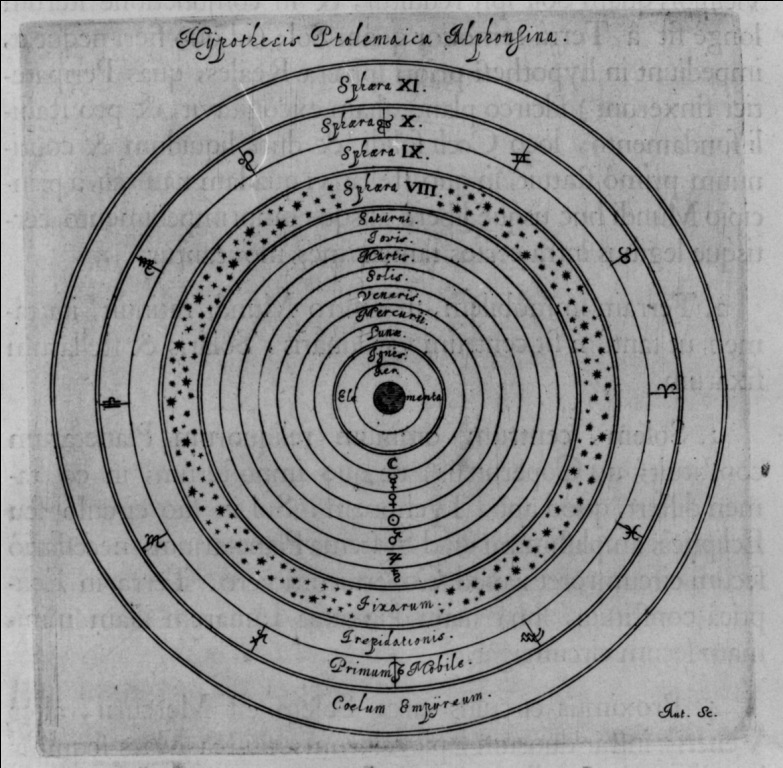
A medieval illustration of the ancient map of the universe, after Claudius Ptolemy (2ndC CE).

A medieval illustration of the ancient map of the universe, after Claudius Ptolemy (2ndC CE).

The ancients had a very practical, empirically deductive and reductive system of describing how the universe worked. This was based on a synthesis of observations of natural cycles, the rotation of the stars and planets, and the physical properties of things, and it produced an intellectual ‘map’ which included both the earth and the heavens, people, animals, spirits and gods and described how they interacted – quite some achievement!

This system divided the universe into the mundane world and the spheres of the heavens. The mundane world and everything in it was deemed to be made of four ‘Elements’: Earth, Water, Air and Fire. These were under the control of a fifth element called Spirit or Aether, which was the substance from which the stars, heavens, gods, souls and spirits were formed. Aether was the ‘divine substance’ and was the driving ‘spirit’ of nature.

The elements were in a state of continuity and flux with one another. The theory arose from observations of how natural things change their qualities, through inductive reasoning. Solid stone becomes liquid under the influence of heat, water becomes solid ice when heat is taken away. Water and solids (‘earth’) becomes gaseous (air) when evaporated by heat (fire). Water lies on top of earth in the oceans, fire rises up above air towards the heavens, which are made of spirit. Rain falling from the heavens brings life back to the land, so it must have partaken of the animating spirit of Aether. Different animals were classified by their affinity to elements: snakes to the earth, birds to the air, fish to water etc. The system even made up animals that associated with fire (the phoenix)! Even the human body was deemed to made of four ‘humors’ which represented the elements. It seemed the most logical way to view things.

EARTH <> WATER <> AIR <> FIRE <> AETHER/SPIRIT

The ancient Greek word for an element was Stoicheon, meaning ‘to line up’, probably after the elements’ dynamic relationships as just mentioned. The system was first described in Mediterranean European literature by Greeks including Empedocles of Sicily (who described them as ‘roots of nature’ under the influence of the twin forces of love and hate), and later fleshed out in discourse by Plato and Aristotle at Athens. Plato frequently ascribes such learning to his favourite ancient scholars – the Egyptians, especially so in his book known as The Dialogue of Timaeus or just Timaeus, from the 4thC BCE.  However, we know that these divisions were obvious to all in the ancient world – why else would people everywhere offer burnt sacrifices to their spiritual gods during the Bronze Age, why were bodies cremated if not to release their souls back into the sphere of spirit?  The Greeks just wanted to appear first with a ‘published’ system in literature – something that Julius Caesar said the Druids of Atlantic Europe in the 1stC BCE apparently abhorred, even though they used Greek writing for secular matters!
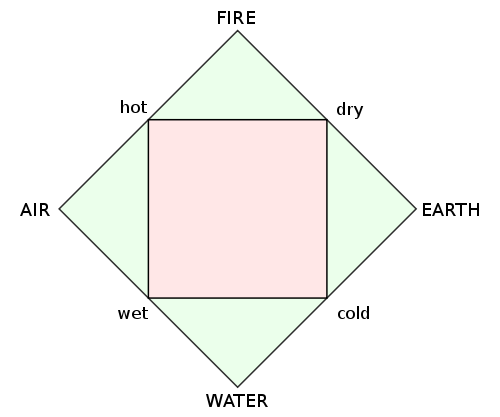
The Four Elements and Four Qualities linking them

The Four Elements and Four Qualities linking them

Above the elemental world in this ancient map lay the heavens, comprising of the moving stars (planets and constellations) and above these the fixed stars of the Empyrean, representing the universal spiritual godhead! Yes – even before Hebrew monotheistic religion came to dominate Europe in the form of Christianity, Islam and Rabbinic Judaism, those polytheistic pagans had a concept of a unified central spirit! This may come as something of a surprise…

The spiritual ‘Gods’ were represented by the moving stars of the visible planets, the sun and the moon, who could be seen moving most rapidly across the sky and interacting with the constellations. The constellations appeared at different points in the sky, marking different times of the year. The interactions between the planets and constellations provided an ‘astral story’ narrative that linked their appearance and activity to natural phenomena in the elemental realm of existence. Many ancient religious stories offer explanations for how the constellations came to be. Astrology was the science of interpreting the conjunctions of planets and constellations with their influence upon the elemental world

The fact is that paganism itself was not in its origins so much an adorative suppliant religion as a Philosophy or Science describing existence through the relation of allegory and archetypes in the form of gods. This system was most successfully illustrated in a dialectic fashion through the arts: Story, poetry, illustration, dance and drama. Given the complex and plastic nature of reality, a literary representation would be too limited and didactic to hold true.

The problem with Europe during the period known as the ‘Iron Age’, was that there was a pressure, particularly within powerful centralised cultures, to represent the figurative in an increasingly concrete or literal manner. this caused the philosophical ‘gods’ to become physical manifestations, commodities and properties under the control of worldy human power.  If Caesar was correct about the Druids refusing to commit their religious doctrines to writing, then he was describing a political religious movement which recognised and rebelled against this change which characterised their era.
Primitive Roman Religion

The core of Roman religion traditionally involved the veneration of ancestral and domestic/territorial spirits: The Lares, Lemures, and Manes, collectively referred to as di inferi (‘gods of the lower world’). This was Rome’s ancestral cult, and has no parallel in Greek religion. It also seems to have had little narrative relationship with the world of the higher (eg – Olympian style) gods and demigods which borrowed/merged with the Greek system: Mars (Ares), Jupiter (Zeus), Minerva (Athena), Juno (Hera), Mercury (Hermes), Hercules (Herakles), Pluto (Hades), Vulcan (Hephaestos), Diana (Artemis) etc.

The worship of di inferi was perhaps the most conservative part of their religion, and contemporary educated high-class Romans (Ovid, Varro, Cicero, etc) often wrote of them in connection with country people and the plebeian classes, much in the way that later Christian writers would identify ‘common’ opinion with recidivist paganism. It is therefore highly likely that this form of religion preceded the introduction and worship of the Hellenic, Pontic, Egyptian and Middle Eastern deities that characterised our popular concepts of Roman religious life between the 5thC BCE – 4thC CE.

Lares were typically venerated as the worthy ancestral spirits who watched over the hearth and home. Lemures and Larvae represented the restless and turbulent spirits who inhabited liminal places in the physical and temporal world; They might be thought of as Lares ‘gone bad’ either due to their own unworthy lives or through improper treatment (such as incorrect veneration, or the displacement/destruction of their own proper familia) and required appeasement to prevent them causing harm.

Manes on the other hand appear to be a name for the whole class, of which Lares and Lemures are the subsets. They are akin to what we would nowadays consider ‘fairies’ or ‘ghosts’, and are therefore of a more morally ambivalent nature, perhaps unattached to individuals and arising from an undifferentiated impersonal and more historic provenance – the world of the dead in general. As these were cthonic deities, they were typically worshipped in underground temples or caves.

Despite their apparent disgust for the core Druid doctrine of metempsychosis, the Romans (like the Greeks) also associated the world of the dead with regeneration and fertility, as the worship and legends regarding Dis/Pluto/Hades/Orcus and Prosperina/Persephone/Ana Perenna clearly show. These cults were tied in to the worship of Ceres/Demeter and Liber/Bacchus/Dionysus, and by association with the most significant and influential ancient mystery cults of the Mediterranean: Orphism and the Rites of Eleusis. These earth and ancestor-based beliefs were, it would appear, the historic basis for most of Europe’s popular ancient religions, yet were to mutate under the influence of hierarchical city-based cultures and the philosophies stemming from these.
Where the Romans claimed they differed from the Druids (and the Orphics and Eleusians) was that they held that human souls were treated exceptionally in death and went to a gloomy ‘underworld’ existence rather than taking part in the cycles of regeneration so apparent in the empirical observations of nature. The druids (representing ancient Atlantic European spirituality) taught that human souls were included in the natural cycles of regeneration, an opinion which appears to be based on the same natural observations as the Mediterranean mystery cults. Why Rome chose to be different is perhaps illustrated by their attitudes to the effect the belief in metempsychosis had on their enemies: Rome was about top-down power, with the living at the apex and the dead (usually representing their enemies) thus consigned downwards… In this manner, they were again treading on the toga tails of the Greeks who had first introduced Europe to the notion of the human God-Emperor in the form of Alexander during the 4thC BCE! The foundations for the introduction of a tyrannical monotheism were set far earlier than most realise…

Geographical origins of Roman religion

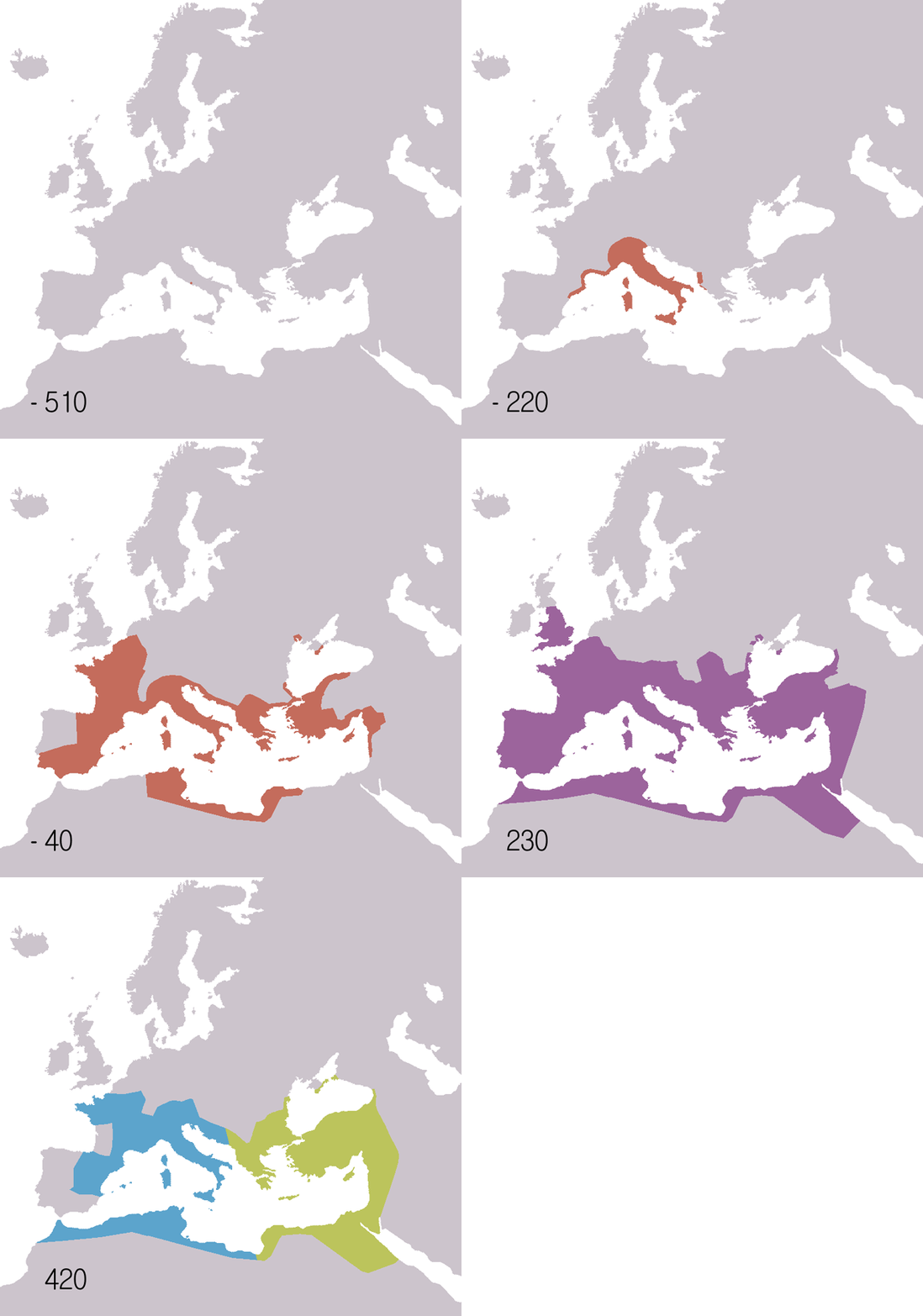
Religion in the Roman civilization was strongly influenced by the cultures of its primary ‘interest zones’, which in turn seem to have been most strongly influenced by the ‘biogeographical’ zones from which they derived. The progress can be illustrated by the following animated map which dates its territories, influence and influences. You will need to click the map to start the animation! (source: Wikimedia Commons):

Roman_Republic_Empire_map

The civilization’s origins appear to have arisen from the Etruscan civilisation’s tendency to follow the Greek tendency and to unite the tribal structure of Iron Age Italy under a more centralised civic theocracy – tribal temporal power being united and mobilised through a shared centralised theocracy, based on notions of immanent polytheism (gods presiding over all natural phenomena) then prevalent in the Northern Mediterranean spiritual landscape, particularly in Magna Graecia (which included southern Italy). Success in trade (aided by climate and geography) supported success in the conduct of warfare leading to stability and expansionism, increasingly centred in Latium (the western coastal midlands of Italy) and from around c.500 BCE at its heart in Rome on the river Tiber. This gave rise to the cultural identity we know as ‘Roman’, under a leadership that mutated from Kingship (Res) to Republican rule (Res Publica) with the public aspects of religion overseen and directed by the Patrician class.

The story of this transition was also a story of the transition from conservative agrarian/pastoralist Bronze Age and Iron Age Italic cultures, ruled by the rhythms of nature and sense of place in the landscape, to one focussed on temporal power and influence and creating a new identity giving it a place in the wider scheme of the world. To this end, Roman civilisation began to affect the philosophies, Gods and cultural ideas of its subjects and neighbours. As its reach expanded and these neighbours became its subjects, the process of multi-cultural conflation would become in itself an identifier of Roman culture, and under Roman economic and religious control. Intellectual cultural threats to a spiritual and cultural morass which borrowed rhetoric and ideas from the conquered would be difficult to deflect.

As it distanced itself from the independent tribal style of culture at its origin, and increasingly followed on the footsteps of the Hellenes in its acquisition of oriental territory and ideas, Rome’s religion began to differentiate from that of its Western European origins. It’s ‘frontier zone’ of this difference had, before the 1st century BCE been limited to Gallia Cisaplina (modern North Italy) and Gallia Narbonensis (modern Mediterranean France) which represented the former interface of the Etruscans (and Greeks) with the Gallic tribes further north, and had been the corridor linking its territories in the formerly Celtic provinces of Hispania, the conquest of which were completed in 19BC, and the Romanised peoples of which were to achieve greatness within the Imperium itself (the Senecas, Lucan, and Emperors Trajan, Hadrian and Marcus Aurelius among others). There is no evidence from ancient Roman or Greek writers supporting a doctrine of metempsychosis among the Celtic Iberians, although further west (in Anatolia, now modern Turkey) the Galatians were rumoured to follow the doctrine of druidism, imported from their supposed original homelands in Gallia Narbonensis.

As the 1stC BCE progressed, Rome’s influence would extend from the East to the West of the Mediterranean ‘biogeographical zones’, and its culture had been busy incorporating and transferring religions, ideas and peoples within its boundaries to suit its new multi-ethnic domain. Its attempts to expand into and change the Atlantic part of northern Europe would mark the start of some fundamental changes that would secure the fate of religion in the West for another 2000 years.

Lucan on metempsychosis

Marcus Annaeus Lucanus (d.65 CE) – otherwise known as Lucan – was a poet and author with close ties to the imperial court of Rome. He is best known for his description of the Roman Civil War in the 1stC BC, albeit more for its poetic rather than historical merit. Like Caesar, he commented on the druidic belief in the transmigration of souls:

While you, ye Druids, when the war was done,
To mysteries strange and hateful rites returned:
To you alone ’tis given the gods and stars
To know or not to know; secluded groves
Your dwelling-place, and forests far remote.
If what ye sing be true, the shades of men
Seek not the dismal homes of Erebus
Or death’s pale kingdoms; but the breath of life
Still rules these bodies in another age —
Life on this hand and that, and death between.
Happy the peoples ‘neath the Northern Star
In this their false belief; for them no fear
Of that which frights all others: they with hands
And hearts undaunted rush upon the foe
And scorn to spare the life that shall return.
(Translation by J.D. Duff: “Lucan: The Civil War”, Loeb Classics Library, London, 1928.)

It is possible he was quoting from Julius Caesar, yet almost a century after Caesar’s murder it still appears that the apparently core druidical doctrine of metempsychosis was contentious to Romans such as Lucan. The politics of the day was that the focus of the druidic religion had been pushed back into the Atlantic islands of Britannia and Hibernia, and Rome was in the process of its campaign of subjugating the former. Both Caesar and Lucan’s attitude towards the reincarnation doctrine was mirrored by other Roman writers such as Pomponius Mela (De Situ Orbiis c.43CE) who (like Lucan and Seneca) was from Roman Spain. These authors, along with Pliny the Elder, provided rhetorical accounts unkind to the religion of the druids during the period that Rome’s armies were pushing up through Britannia. A political reason to attack the core doctrine was that it was perceived that it rendered believers fearless of death.

Romans had no objection to the veneration of native gods in the territories they conquered, and must have actually created many as they went. The large number of remaining inscriptions and statuary items dedicated to these ‘Romano-Celtic’ deities in Britain is proof of this. It is a matter of conjecture, though, if these represented ancient original cults, especially as Roman historians and literary commentators during the first 100 years of Roman subjugation in Atlantic Europe indicated a Roman campaign against fundamental tenets of this style of religion, particularly the doctrine on metempsychosis.

It is quite likely that Romano-Gallic and Romano-British ‘deities’ were the result of an active campaign of interpretatio romanum designed to change the fundamental nature of local pagan belief to match one acceptable to the Mediterranean mindset of Rome (centred around their idea of ‘proper veneration’ of the ‘eternal gods’) and to the (often non-Roman) troops and auxiliaries it employed to do its dirty work in frontier provinces.

In Lucan’s time (middle of the 1stC CE) Ireland and the western and northern reaches of the ‘Britannic Isles’ would still have followed the doctrines that Julius Caesar wrote of after he had started to purge them in the 1stC BCE.

Caesar on Celtic Religion

Julius Caesar’s memoir Commentarii De Bello Gallico (‘Commentary On the Gallic War’) was an account of the Roman army’s subjugation of Gaul in 51BCE and which he himself led.

The work is famous for its descriptions of the enigmatic priestly caste of the Gauls: the Druids. These were leaders of the ancient religious system then common to Gaul, Britannia and Hibernia/Scotia (Ireland). He says very little about the religion itself, being more interested in expressing the Druids’ political and social importance, but he does give a few tantalising details… (Translations by W. A. McDevitte and W. S. Bohn)

They wish to inculcate this as one of their leading tenets, that souls do not become extinct, but pass after death from one body to another, and they think that men by this tenet are in a great degree excited to valour, the fear of death being disregarded.

… and about their gods he has this to say:

All the Gauls assert that they are descended from the god Dis, and say that this tradition has been handed down by the Druids.

As well as naming ‘Dis’, Caesar used the convention of giving Roman names for the rest of the gods of the Gauls and describes ‘Mercury’ as their chief deity, as well as Apollo, Mars, Jupiter, and Minerva. As war is perhaps the least satisfactory arena in which to study cultural anthropology, his is probably a very rough and unreliable overview of the reality of Gaulish religion. After all, this was an era where even the Romans were confused about their own gods and religion: To contemporary intellectuals (such as followers of the 4thC BCE Hellenic philosopher Plato) gods were scientific expressions of universal phenomena, not to be taken literally. To the masses, they were a literal truth – an unseen power made visible and understood through images and ceremonies. Religion was diversifying at an alarming and unsustainable rate. His appraisal of the Gauls and the contradistinction he makes with the German tribes in chapter 21 (where he claims that they had no druids and worshipped only what they saw – the sun, fire and the moon) have underpinned the study of European paganism ever since, but it is likely that the Gauls, Britons, Irish and Germans probably shared very similar beliefs, which the mediterranean mind found it difficult to conceptualise.

The thing is… there is very little evidence of the exact nature of Pre-Roman/Pre-Hellenic religion among Iron Age ‘Celtic’ or German tribes. What exists is – like Caesar’s account – seen from a very jaded Roman or Greek viewpoint. There is ample evidence of Romanised ‘Celtic’ deities from the next 5 centuries after Caesar, and even before he took Gaul its southern part was under the cultural influence of the Hellenes (and was probably itself influential upon the Greek world). Familiar attested names of ‘gods’ such as ‘Toutatis’, ‘Taranis’, ‘Belenos’, ‘Cernunnos’ and so forth remain as popular totems that have scant evidence linking them to a systematic beliefs, and perhaps the biggest problem is that folklore from the more modern celtic world that preserves obvious and fundamental pre-chistian beliefs does not offer much support for a Roman-style pantheon of gods. The reasons for this need to be and will be investigated in my writing.

The most important key belief that Caesar mentions is that the soul flies free of the body after death and returns to another corporeal existence in time. Such a belief is the core of an ancestor-based religion. Also the Gaulish god Caesar calls ‘Dis’ (to the Romans a psychopomp or conductor of souls, and guardian of the earth’s fertility and mystery) was believed to be the racial forefather, thus making him/it the key archetype god for this soul-belief. When he omits mentioning ‘Dis’ in his assessment of Gaul’s most important totem gods in the previous chapter, he is probably seeking to discourse on something the Romans knew more about. Roman ‘Mercury’ (Hermes to the Greeks) was also a psychopomp (conductor of souls) and Caesar may well have been using the names ‘Mercury’ and ‘Dis’ (as well as ‘Mars’, ‘Apollo’ and ‘Jupiter’) to refer to the same important progenitor divinity, and I will present evidence for this in due course. His intention with the interpretatio romanum was also possibly an attempt to orientate his Roman readers to similarities between them and the Gauls, especially as many would own Gaulish slaves as a result of his campaign. The core domestic (and plebian) religion of Rome was, after all, based upon ancestor-spirit worship (of ‘Lares’ and ‘Genii’ as well as ‘Lemures’, ‘Larvae’ and ‘Manes’) and veneration of the ‘eternal gods’ (Jupiter etc) was generally seen as a more high-minded and public affair, albeit open to fads and trends, and imperial decree. The Roman beliefs in disincarnate souls therefore showed a distinct commonality with their ‘Celtic’ neighbours, and is in evidence among Rome’s Etruscan forerunners.

In christian times, it seems that stubbornly tenuous pagan ideas about discarnate ‘souls’ were to become identified with ‘fairies’ – spirits who inhabited an inverted parallel world to our own, their daytime being our night, and vice versa… Fairy belief was to become a cultural shibboleth of Atlantic Celtic peoples.

Atlantis? … or Atlantic?

“…For many generations, as long as the divine nature lasted in them, they were obedient to the laws, and well-affectioned towards the god, whose seed they were; for they possessed true and in every way great spirits, uniting gentleness with wisdom in the various chances of life, and in their intercourse with one another. They despised everything but virtue, caring little for their present state of life, and thinking lightly of the possession of gold and other property, which seemed only a burden to them; neither were they intoxicated by luxury; nor did wealth deprive them of their self-control; but they were sober, and saw clearly that all these goods are increased by virtue and friendship with one another, whereas by too great regard and respect for them, they are lost and friendship with them. By such reflections and by the continuance in them of a divine nature, the qualities which we have described grew and increased among them…”

The above quote is from Plato’s narrator Critias (4thC BCE) on the people of ‘Atlantis’, who the ancient Egyptians claimed were the children and followers of Poseidon and who were supposed to have once lived ‘beyond the Pillars of Herakles’ – an ancient name for the Straights of Gilbraltar. (Translation by Benjamin Jowett.)

The Sea, the Sun and the West

The sea is the most defining part of Atlantic Europe, and perhaps the ultimate destination of the cultural idea called ‘Celtic’ has found its true expression facing west into the setting sun upon Atlantic shores.
Many central European countries, have identified their history with Iron Age Celtic culture at one time or another, and it remains a potent nationalistic icon for asserting provincial identity, even in cultures no longer (or even ever) considered ‘Celtic’. For those that still maintain a Celtic identity, the main identifiers are language, custom and traditions – particularly (in modern times) in the arts.
The ‘Celtic Provinces’ today are: Gallicia, Brittany, Cornwall, Wales, Ireland, the Isle of Man and Scotland, including the Hebrides, Orkneys and Shetlands (which have regional flavours somewhat different to the mainland). All of these are bathed in Atlantic currents and Atlantic sunsets, scoured by Atlantic wind and rains. They are provided for, challenged and protected by the great Ocean.

So, beyond the ethnic identifiers of language, genetics, dress, music and art there is a deeper ‘Atlantic’ culture pervading these regions – a geological, climatic and biological fountainhead from which they (and their neighbours) feed and from which their customs and traditional beliefs of ancient provenance are shaped as allegories of the great Atlantic European or Atlantean world…

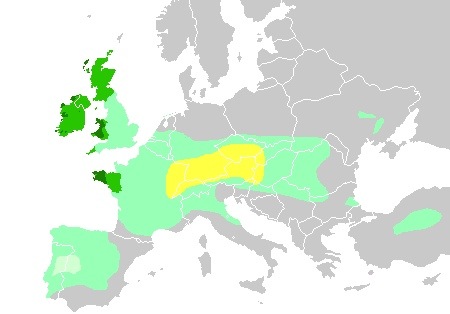
20130726-224748.jpg

Key: The ancient (light green) and modern (dark green) Celtic provinces.
The yellow region represents what archaeologists have identified as the core heartland of an identifiably ‘celtic’ European material culture during the early Iron Age.

Indigenous Religion and Philosophy

An indigenous people are those whose ‘root, branch, leaf and seed’ are deeply connected with the land they inhabit. They are made of the soil and they return to the soil that makes them, connecting them to future and past generations through the land. Their culture reflects this closeness and sympathy with their environment, and through the transmission of traditions, aphorisms, beliefs, stories, songs and art they are connected to a ‘vanishing point’ in the past where the idea of the land and the people are merged as one. From this place they develop their legends and dreams – their philosophies and models of the temporal and spiritual – the physics and metaphysics by which they describe their past, present and future existence. It is the ultimate expression of connectedness. It is their unique art and unique gift – the most precious thing they own, next to their children.

The cultural aspects of indigenous habitation are so deeply linked with the land that indigenous culture and belief has a strong biogeographical component: Land and climate determines plant life, plant life determines invertebrate life, and this in turn determines the patterns of habitations by vertebrates, including humans. Each type of life then negotiates the position of each other form and this in turn ultimately re-shapes the geography. It is the web of life. Here is a map of the patterns of plant life in Europe (credit: Wolfgang Frey and Rainer Lösch – image from Wikimedia Commons). Note how it relates to historic cultural zones of indigenous Europeans:Image

You may notice that the ‘Atlantic’ zone corresponds most strongly with peoples who have maintained a cultural identity of ‘Celtic’ in more recent times, although when considering the eastern part of the biogeographical zone (modern Belgium, Holland, Germany, Denmark and Norway) it is notable that archaeological evidence of pre-Iron Age material cultures is often very similar to that in the western part of the ‘Atlantic’ zone.

Before the invasion of Northern Europe by middle-eastern literary religious philosophies during the early centuries of the ‘Common Era’ (CE), religion and belief was a matter of interpretation of nature and man’s place in it. It was a system of what might be called ‘Natural Philosophy’ which explained the origins, mechanics and inter-relations of natural phenomena, employing ‘spiritual’ ideas to explain supra-rational and metaphysical concepts. These ideas and concepts were illustrated and transmitted in a deliberately non-didactic manner using story, poetry, aphorism, drama, music, song, dance and other similar types of non-literary transmission. ‘Gods’ and ‘spirits’ were therefore an artistic means of expressing aspects of what we today refer to as ‘Science’,’Knowledge’ and ‘Philosophy’. As with all ‘art’ it was a plastic mode of expression based upon a synthesis of inductive reasoning and empirical knowledge attained through the survival of generations of indigenous peoples with a deep spiritual link to the land of their birth and of their ancestors. It was a self-contained, self-explaining worldview whose authority was written in the landscape and by the forces which controlled and modelled it – something that no book would be able to do.

Pagan religion grows from the land which sustains it. Anciently, it was one with ‘philosophy’, art and the practicalities of daily living.