Catharism – a late flowering of pagan doctrine in Europe?

The ‘Cathar’ religion reached its height of popularity and notoriety in southern France, parts of Germany and northern Italy between the 12th and 14th centuries. It was founded on a belief in two gods – God in Heaven and a God of the Earth. Essentially Christian, it held that the good Heavenly God represented the redeeming god of the New Testament, whereas the bad Earthly God was that of the Old Testament – the angry creator of the world, who Cathars identified with the evil principle – Satan! If you are familiar with my breakdown and interpretation of ancient Atlantic European (‘Atlantean’) paganism so far, you might recognise this Cathar dualism as being largely similar to what I have proposed, albeit in a Christian guise!

The movement believed that souls were those of Angels who were destined to be continually reincarnated in corrupt, evil worldly flesh until they could attain a state of religious perfection, when they might be released from the cycle and go to Heaven! Catharisms leaders were the ‘Perfects’ who had attained such a state while in the earthly form, and when the  Catholic church sought to eradicate the movement (the Albigensian Crusade from 1209-1229) observers were amazed at how willingly adherents accepted death, echoing the observations of Romans when fighting the Atlantean Celts of Gaul and Brittania 1200 years before. They rejected baptism, the sacraments, the eating of meat, and the swearing of oaths (which they might inadvertently break in another life, denying them perfection).

Catharism’s origins are usually traced by historians and commentators back to the Paulician and Bogomil dualist christian movements based on the older doctrine of Manicheanism from Eastern Europe and the Near East. This opinion demands revision, as it is based largely upon the apparent similarity with these branches of the Christian faith. Of greater interest are the similarities between the religion’s doctrines and those of pagan Atlantic Europe that I have been examining. Catharism can speculatively be proposed as a resurgent interest in certain ideas of the old Atlantic paganism which had developed Christian clothes (in fact as much as with many aspects of Roman Catholicism!). It was identified as an emerging movement in its heyday, which coincided with the medieval Renaissance of classical pagan learning in Europe, as well as upwellings in popular fads and cultures in religion and the  arts. For its inception to have been an attempt by a shadowy group of aristocratic pagans to reignite the pre-christian worldview of ancient northwest Europe, would be one possibility; after all it was supported by such networks. More reasonable though, was that it was a case of a good idea that wouldn’t die so easily. The reason to consider all of this is the popularity at the time of the telling of Europe’s old pagan stories – the Arthurian romances and tales of Parsifal, Siegfrid etc – many of which were riding the wave of popular troubadour culture that emerged from the Cathar lands in and around Occitania in southern France! Pagan conspiracies by shadowy aristocratic groups to kick out Christians were not unheard of (take the Vikings, for instance), and in the 15th and 16th centuries there was a good deal of official paranoia about such conspiracies among ordinary people which led to the infamous witchhunts. In fact, churchmen had been preoccupied with this issue for a good deal longer – right back to the time of first Christianisation. To the church, the social elites had always been unhealthily preoccupied with ‘pagan’ knowledge and traditions and complied with religion only where it suited them; Conversely, the obedient and thankfully illiterate peasantry dutifully accepted what the Church served to them, but their ‘ignorance’ meant that they continued to entertain pagan magical practices and beliefs. Catharism seemed to unite both groups in its heresy, and was therefore eventually annihilated with violence by the Church.
Arianism – The rejection of Man as God

When the Roman Empire Christianised under Constantine I and moved its powerbase to Byzantium (Constantinople, later Istanbul) in the 4th century CE, there was a clear shift in power towards the worship of Man as spiritual overlord of mankind, a shift that had commenced with the pagan Emperors three centuries before, and attained its Christian dimension with the Councils of Nicea and the development of the Nicene Creed which identified Jesus as God. The main threat to the theological establishment of this form of Christianity within the Empire during the 4th century was a movement called ‘Arianism’: The Arians (named after their main apologist – a northern African theologian named Arius) effectively rejected the idea that Jesus was anything more than a prophet of the new Middle Eastern God who had been chosen to rule the Romano-Greek Empire – a radical reinvention designed to settle its divisions. Although suppressed under Constantine, Arianism had a brief resurgence in the mainstream following his death, when many (not the least his son and successor Constantius) were uneasy about the Emperor’s use of the Nicene interpretation to promote the Imperial Godhead. During this period, (Arian style) Christianity came to and spread rapidly through the Germanic world of the Goths (Gutani). These were peoples which Rome had largely failed to conquer by military might but had formed strong alliances with through treaty, and whose men manned many of Rome’s legions. So … why might Arianism have been so successful among these pagan peoples?

One of the main reasons may have been that the foregoing philosophy of paganism would have considered the worship of a man as a complete heresy and anathema. For the Byzantine Roman Empire created by Constantine and later consolidated by Theodosius, the primacy of man was critical to the power of the re-invented Theocratic rulers – one God, one Emperor, one Empire. This structure also served the religious hierarchs who ruled the Christian polities out of Rome, Alexandria, Jerusalem etc

Arians such as the Gothic warlord and Emperor Alaric were deeply disillusioned by what they found when they conquered the Western Roman Empire, perhaps just a little disillusioned too by the Eastern interpretation of religion that portrayed men as gods, which they would likely have considered as degenerate as the city they conquered. Arianism was anathema to the Nicene Creed which had dominated most of the European Christian scene by 410AD when Alaric took Rome, and it (Arianism) was considered representative of the conquering Visigothic and Vandal elites, and probably also the old Pagan ‘barbarian’ ways which typically painted gods as greater and more potent forces than the corrupt mankind now dominated by Christian hierarchs. Christianity tended to view the world as fundamentally corrupt and damned and the 4th and 5th centuries certainly had more than their fair share of chaos to support this point of view, including serious disease epidemics, natural disasters and political and social upheaval. Still, Arian-styled christianity survived into the 7th century until it was gradually replaced by Nicene christianity or the violent conquest of Islam.


Textualising the Atlantean Bardic World

Written annals surviving from the middle ages and early modern periods tend to employ the arrival of St Patrick as an historical ‘event horizon’ for the establishment of a Christian civitas of history and law in Ireland. Given that literacy followed hand-in-glove with christianity and that – until a very late period – the literate were generally the Christian elite, it follows that our interpretation of the cultural and historical veracity of such sources must be cautious at best.

One example comes from the Annals of Ulster, which commence with two important events: the coming of Patrick during the reign of Emperor Theodosius in 433, followed (after a few entries dealing with O’Neill primacy) by a statement against the year 438 : “The Senchas Már was written”. These events stamp the conversion of Irish religion and law into a form with written primacy – an ‘event’ important to the annalists, as it marks the transition of power from pre-Roman learned memorisers (the Druids, Brehons and Bards) to the Romanised literary system of power and precedent, controlled by the church. This was the selfsame church who had positioned itself at the side of the new model of kingship and land-dominance it had created, replacing the tribal systems of Iron Age Europe which had latterly been destabilised by mass-migration under the Roman Imperium.
Although monkish annals like to fix events on a historical timeline as fait accompli, it is wrong to take them at face value: Ireland probably did not wholly christianise with the coming of Patrick, and it is likely that christianity (perhaps in a form deemed too heretical to admit to) was present there long before Patrick, and that paganism survived for a fairly long time after him. Likewise, the statement in the Annals of Ulster about the codification of Breast Law (the memorised legal traditions of the traditional Brehon judges) into the Senchas Már text has little evidence to suggest a fundamental change occurred in Irish and Gaelic legal culture: We know for a fact that when the Isle of Man (which was culturally and linguistically closest to Ulster) ceded to the rule of the English Stanley potentates in 1405, its laws were still memorised ‘Breast Laws’ kept by oral tradition, in spite of the presence of a significant contingent of clergy and a number of Abbeys from an early period. The commissioning and writing of annals has been shown to serve a purpose of establishing a ‘historical’ argument for the primacy of the secular and religious sponsors of the work. Through the processes of continuous editing and re-copying Annals might evolve a stable and progressive timeline leading to the present, and such a work could be used to settle political disputes in favour of the sponsors – the church in particular.

Of the literature produced in Ireland by Christian scribes, Annals are perhaps the driest and most functional. Other popular forms of literature (other than copies of the gospels and the bible) produced in Ireland’s monasteries included hagiographies (stories of saints’ lives) and the transcriptions of various forms of oral culture knowledge, including laws and secular or pagan stories, which – typical to the artistic/poetic mode typifying oral culture – functioned as a synthesis of history, entertainment and education. Knowledge of the treasure trove of tradition of a pre-literate oral-culture society allowed the literate Christians to challenge the power structure of paganism and effectively replace it with their own model. In Ireland, which was probably ethnically and territorially more conservative (having not partaken to any large degree of the Pax Romana before the collapse of the western empire) this was a necessary method of Christianisation – almost unique in Europe until the pagan Scandinavians became introduced to the same principals. Elsewhere, migration was the cultural upsetter allowing Christianisation to proceed replacing as it did.

The vast majority of ‘Bardic’ knowledge pertaining to pagan religion would have been displaced and indelibly altered when it was transformed into its literary Christian context. The processes for achieving this were convoluted and evolved over a period of time, presumably between the 5th and 10th centuries. Simply banning paganism was impossible, as it pervaded every aspect of the peoples’ worldview and lives, and provided all of the signposts and models to explain the universe. Christianity and Judaism held no models explaining the movement of stars, the meaning of tides and seasons, the reasons why certain plants were useful; they held no history of the Atlantic peoples – simply those of dusty desert tyrants and the ancestors of other races in far-off lands.

The essential doctrines of christianity that would be impressed upon the pagans were that their gods and spirits were in fact devils, opposed to a single ‘true’ god from the middle east whose existence these devils had formerly kept people in ignorance. What is more, this god had created a son here on earth (but a long way from Ireland) who had been put to death in payment for the evil deeds and ignorance of humanity. By accepting this imported ‘truth’ it was supposed that adherents would find favour with this one God and earn a place in an eternal afterlife. This must have been so alien to the Irish that they must have laughed out loud in disbelief when confronted by the early continental and Mediterranean proselytes. Unlike in Britannia and Europe, the collapse of the pagan Roman empire was no argument in favour of christianity to the Irish, as they had not integrated the Roman belief system into their culture and had a perfectly functional religious model of their own.

When christianity did start to make inroads into the lives of pagans was when it started targeting and in fact creating an emerging new model of kingship that was propagated throughout post-Roman Europe. The religion ignored the people and their innate philosophies and targeted their leaders and lawmakers, beginning a drawn-out process of trickle-down acceptance backed up by the threat of power. By necessity, this subtle process would pursue a policy of replacement: like-for-like. It would also gradually subvert and alter the conception and memories of the true nature of paganism, using the following techniques:

1. Creating in stories a ‘pantheon’ of pagan gods similar to the Roman and Greek model, thus allowing the rhetorical methods of continental christianity to be applied. These ‘gods’ were given a history and context that implied they were euhemerised people from history falsely worshipped as a result of encouragement by demons.

2. Combining pagan stories elaborating the reality and functions of the deities into those of local saints. Pagan creation stories for landscape features, plants, animals and features of nature had their attributions transferred to saints.

3. Creating pseudo-historical accounts of the past history of Ireland that gave a middle-eastern or oriental provenance to the Irish.

4. Replacing the empirical human doctrine of ancestral spirits and reincarnation of souls with fairy-beliefs, producing an extra-doctrinal category of spirits ambivalent in their nature between Christianity’s angels and demons.

The model worked so well in Ireland, that Irish clerics and their ideas became vital to the christianising efforts of the rulers of the Anglo-Saxons and the Franks, as well as of the Scandinavians from the 9th century onwards.

So … the Irish mythological cycles, the Welsh ‘Mabinogion’, the Scandinavian ‘Edda’ legends and the other famous mythologies of the ancient north Europeans are products of a concerted campaign of cultural subversion by Christians seeking to obfuscate the true nature of paganism as it once existed in these regions. This process was started by the pagan Romans who sought to replace the worldview of those they conquered with one sympathetic to theirs.

The ‘Evil Eye’ and the Atlantic world

In earlier posts I commented on how the ‘Evil Eye’ beliefs of the ancient Gaelic world were linked to belief in a poisonous force that could affect health, wealth and the outcomes of situations.

The English word ‘Envy’ comes from the introduced Norman-French term ‘En Vie’ which has the literal English meaning ‘In View’. It therefore is a term loaded with the feelings and consequences derived from looking upon things, particularly those that are outside of our possession or influence. The Latin original of ‘En Vie’ – ‘In Vidia’ – gives us the word ‘invidious‘, generally agreed to mean ‘malign jealousy’. These terms represent the main idea underpinning the principle of both ‘witchcraft’ and ‘fairies’ in the folklore of Atlantic northwest Europe:

Fairies were ‘jealous’ of our world and sought to strike a balance with their ‘inverted’ otherworld by stealing away the spiritual substance of what they envied for themselves. ‘Witches’ were jealous humans who sought to do the same – both were seen as active forces taking part in a balancing interplay of force between the mundane world and the otherworld. To the Gael, the ‘Evil Eye’ was more than just a criminal act – it was a fact of nature and part of a scientific worldview that described the apportioning of forces in the universe. In the non-Gaelic Christian world, people were consequently treated in criminal courts and (between the late-medieval and early modern periods) routinely judicially-murdered for being ‘witches’. In the Gaelic/Atlantic world – except in zones of frictional interface (particularly lowland Scotland and the Basque country) – there were comparatively few, if any, ‘witch hunts’.


Balor of the ‘Evil Eye’

Another famous character of Irish pagan mythology is Balor. He appears to exist as an adversarial character, and leader of the Fomorian race who were supposed to have occupied Ireland before the Tuatha Dé Danann and the humans opposed and replaced them in the medieval pseudo-historical myths, such as those in the famous Lebor Gabála Érenn. His main attribute was a ‘piercing’ (birugderc) , ‘destructive’ (milledach) or ‘poisonous’(neimnech) eye which could, depending on the tradition do anything from making men helpless in battle to blasting, blighting and destroying. This property is often linked to the popular ‘evil eye’ mythology once so common to Europe, and still current in much of Africa and Asia. Balor was supposedly killed by his own semi-divine warrior-grandchild, Lugh, who himself was said to have been fostered by Manannán mac Lir. As such, Balor appears to have been an inspiration for Sauron in Tolkein’s ‘Lord of the Rings’, chosen perhaps because he operated as a hypostasis for an ‘evil god’ in medieval and early-modern myths. He even operated as a political representation of Ireland’s oppressors in some traditions, and his showdown with Lugh is a popular folktale.

So … who or what was this character really supposed to be? The key to understanding him correctly is understanding the idea of the ‘evil eye’ as it pertains to Atlantic European mythology. The Evil Eye, Bad Eye or Destructive Eye was a phenomenon known in particular from its recorded incidence among peoples from the Scottish Highlands and Islands, the Isle of Man and Ireland between the 17th and 20th centuries.

The essence of the Gaelic evil eye belief was that the eye emitted a spiritual force (spirit was anciently considered an ethereal form of light) which could alter what it looked at (touched). This idea (the ‘extromission’ of light from the eye) was known from classical antiquity, and discussed in both scientific and religious theory by medieval European authors such as Robert Grosseteste and Thomas Aquinas. Pride and envy were considered the ‘spiritual’ sins and operated through spirit and thus light, which was considered the substance from which spirit was made. The force of the Evil Eye was supposed to be driven by the ‘deadly sin’ of envy, and caused a loss of vitality and well-being in the subject of the envious gaze: it was a metaphysical interpretation of how the spiritual ‘sin’ of envy (literally translating as ‘in vision’) worked as a malign force which could change things at a distance. It could be a passive force (whereas ‘witchcraft‘ or sorcery was considered an active process), and this distinction was perhaps one of the reasons why the Gaelic peoples (preoccupied by fairies and the ‘bad eye’) did not prosecute witchcraft as a general rule. The ‘Evil Eye’ and its associated otherworld theory was the explanation for misfortune! And the ‘Evil Eye’ was a force by which those ‘spiritual’ beings – the fairies – exerted their power on this world. They envied our ‘substance’ and ‘worth’ and tried to take it from us… they abducted our healthy children and left us their unhealthy ones… they sickened and blighted: It was the mode by which the ‘Otherworld’ interacted with ours!

Considering this, we must now turn our attention to the Gaelic Lord of the OtherworldManannán mac Lir – who ruled the world beneath the sea and behind the horizon where the sun sets. As ruler of this inverted place and we must consider if he might in fact be identifiable with the ‘Balor’ character of Irish myth – a sea-ruler who originally (in some traditions such as the Manx) held the sovereignty of the Land, and whose eye chose the lives to be transferred to the Otherworld… Balor is associated with Tory Island off Donegal, and his ‘race’ is supposed by the medieval writings to have come from the sea. Traditions tell that he was grandfather or father of Lugh (who eventually killed him) and that Lugh was fostered by Manannán, so there is a reasonable argument in suggesting that Balor may be a part of the Manannán hypostasis.

The early Welsh Arthurian tale known as Culwch and Olwen features a central character with features similar to Balor – the giant Ysbaddaden Bencawr. The description of him sounds a little like that of Balor in the Irish tale Cath Maige Tuired (Battles of Moytura) in that he is of a giant size and had eyes (or an eye) so huge that they required great forked sticks to open his eyelids. This begs the question of wether the character is a bardic metaphor or a character nested deep in popular mythology. Other similarities include the possession of a desirable daughter over whom heroes fight – with Balor it is Eithne and with Ysbaddaden it is Olwen.

The concepts of decay and death have stronger ‘evil’ or ‘unclean’ connotations for  christians, yet in religious cultures with a belief in reincarnation they are loaded with more positive connotations. This begs the question of why and to whom Balor’s eye was supposed to be ‘evil’? This is not explicit in the descriptions of the ‘Second Battle of Magh Tuired’, in which Balor’s eye is said to be Birugderc – piercing. The ‘evil’ appelation is one of the narrative tales of his behaviour and of christian tradition, such as that collected in the early 19thC by John O’Donovan from Donegal and Tory, and from those of the other folklore records, including those of the goverment-sponsored Folklore Commission (Coimisiún Béaloideasa Éireann) from the 1930’s onwards, now curated by University College Dublin.

Divine Sons: Mongán, Fionn and Cúchulainn

Mongán is a character who appears in medieval Irish myth literature in connection to both Manannán Mac Lir and the Cailleach. This relationship appears in one of the versions of the various Mongán tales found in the manuscript collection known as the ‘Book of Fermoy’ (Royal Irish Academy: MS 23 E 29): ‘Compert Mongáin ocus Serc Duibe-Lácha do Mongán’ (‘The Conception of Mongan and Dub-Lacha’s Love for Mongan’), appended to the story The Voyage of Bran both of which were translated together by Kuno Meyer.

The tale starts with a visit by the Irish King Fiachna Finn to the sick king of ‘Lochlann’ (either Scotland or Scandinavia), Eolgarg Mor, who sends his men to beg the ‘Caillech Dub’ for her magical cow, the flesh of which would heal him. This she agrees to do, on the condition that Fiachna stands surety with his life and honour that Eolgarg will make good. He doesn’t and the Cailleach comes to Fiachna and demands he make war on Lochlann, and he obliges her, although his assault is initially thwarted by Eolgarg who unleashes battalions of deadly poisonous sheep (!) against the Irish, killing many of them. Manannán Mac Lir then appears to Fiachna and gives him a magical hound to defeat the Scots and their deadly sheep, sleeping with Fiachna’s wife into the bargain and conceiving him a magical son called Mongán whom he spirits off to the Otherworld to teach him wizadry and shape-shifting abilities under his fosterage until the boy matures. Meanwhile, Fiachna is killed through the treachery of one of his ambitious retainers and the peace of Ireland is disturbed, so the people of Ulster implore Manannán to restore Mongán, which he eventually does.

To radically shorten the rest of the story to its bare essentials, Mongán then goes around Ireland using his magical abilities to sleep with queens and to induce kings to sleep with the Cailleach by making her appear as a young woman – at one point he even kills her, but true to form she reappears later in the narrative as ‘Cuimne of the Mill’ and seduces the King of Leinster. The tale seems to be a vehicle to demonstrate the power of the Otherworld over that of men – particularly in regard to the choice of sovereigns, which was the traditional role of the Fairy Queen or Cailleach.

The two Otherworld characters of the narrative are the Cailleach and Manannán, and their natures are made clear in the telling of the story: She is both beautiful and ugly, young and old, the decider of fate, and – like the seasons – dies and is reborn. He comes from beyond and shifts his form to influence events. Mongán is his divine son, and begins to function exactly like him in the world of men, causing Manannán to drop out of the plot. He even appears to be the power that transforms the Cailleach from old hag to attractive bride! This ‘loathly lady’ motif recurs often in medieval fairy literature, for instance in Chaucer’s ‘Wife of Bath’s Tale’.

The Compert Mongáin tale has several slightly different versions in Irish manuscripts which appear to be from different dates, so is therefore possibly important to the canon of recorded pagan belief that Christians needed to be aware of in order to combat the ancient faith. Other tellings even hint that Mongán and Finn Mac Cumhall are one and the same (Mongán’s earthly father was Fiachna Finn), and there is even a suggestion that Manannán and Cailte the warrior (and foster-son of Finn in the Fenian legends) might somehow be related! Wasn’t Mongán himself also the foster-son of Manannán, and then functions as an incarnation of his foster-father in the stories? It is a complex and intriguing tradition dealing with reincarnation, possibly made moreso by scribes who perhaps did not understand the narratives or who wished that listeners would not understand the elements of it…

Mongán functions as a ‘divine son’ – a link between kingship and the otherworld, whose assumption of earthly sovereignty is mirrored by his assumption of his father’s powers. He is identified in one tradition with the magical warrior-adventurer Finn, and the question needs to be asked how this character relates to that of the magical warrior Cúchulainn…

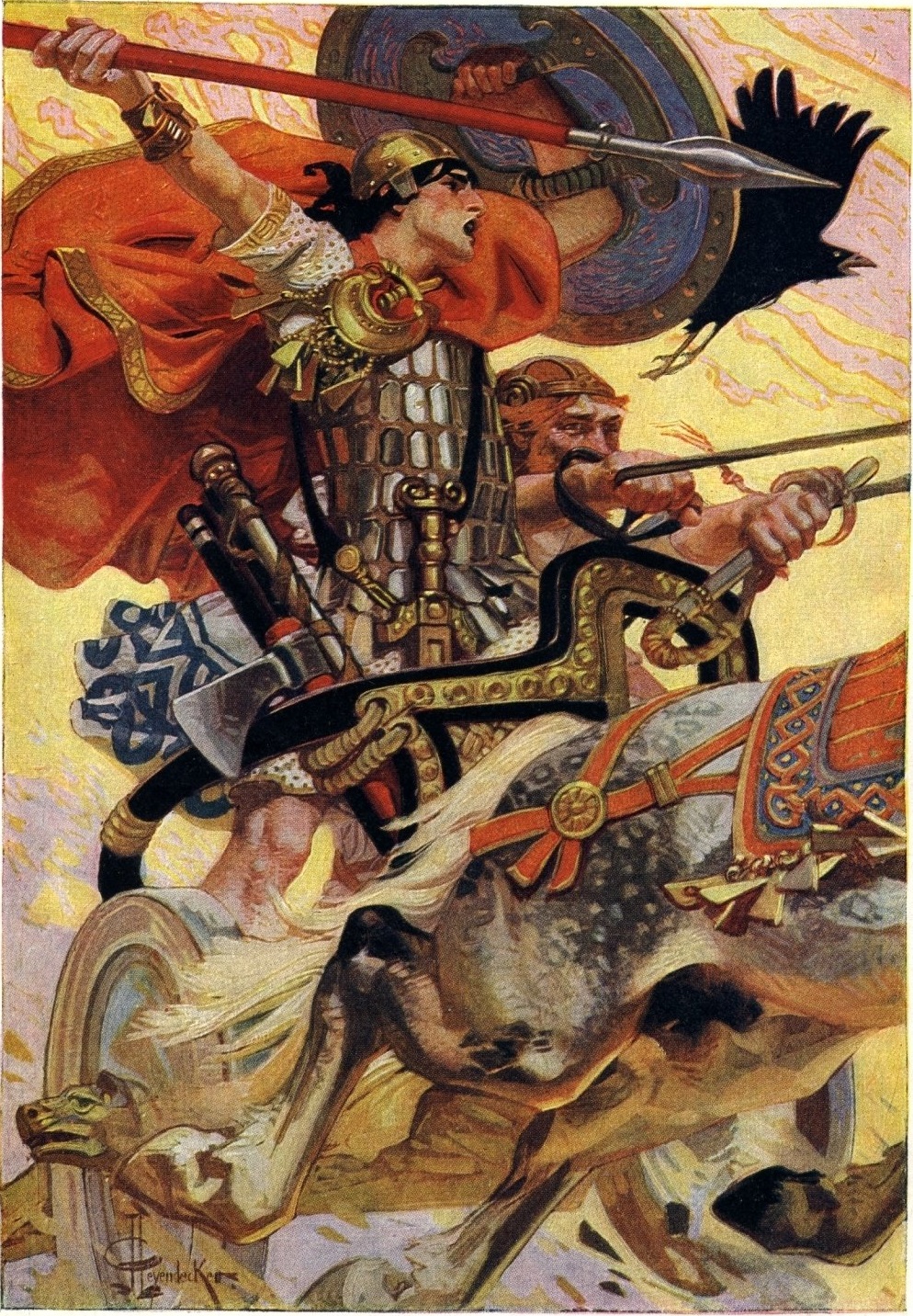
Cuchullain and the Badbh

Cuchullain and the Badbh

Apart from the skilled young trixter-warrior character of Lugh of the Tuatha Dé Danann, Finn Mac Cumhall and Cú Chulainn are the two primary magical warrior-adventurers of Gaelic legend: The former is a member of a youthful warrior-hunter band, the Fianna, whose tales are collectively known as the Fenian Cycle. The latter is the erratic warrior-champion of king Conchobar, and the protagonist of the ‘Ulster Cycle’ tales. Both appear to be from different story-telling traditions from literature and orature, yet they seem to share a tantalising similarity which needs to be examined. They combine an essential function that relates to the pagan mythos – one that Christians felt suitably important to record in written form, perhaps fixing a shared tradition of the pre-literate pre-Christian world into two separate strands. Of the two, Finn represents the more mundane whereas Cúchulainn, like Mongán was part-otherworld.

Of greatest interest is the fact that their names contain what appears to be a phonetic link to the Goddess herself – Cumhall (‘Coowal’) and Chulainn (‘Cullin’) can both be interpreted as potential versions of the Cailleach epithet. One piece of folkloric evidence of a possible link comes from a number of traditions which portray Finn as a giant whose attributes cross over with those ascribed elsewhere to the character of the Cailleach, or ‘the Devil’ or other ‘giants’: namely in the creation of landscape features and displays of strength and agility. These appear (to varying degrees, admittedly) to be attempts at obfuscating pagan creation-myths, where different story-characters are employed to cover the tracks of paganism in local legends and story-traditions.

The origin tales and naming of the two heroes given in the more elaborate literary traditions associate their names with mythical male figures. Cúchulainn is supposed to be named after the magical blacksmith whose dog he killed, Finn the son of a leader the fianna of Ireland, and in one of the Mongán stories it is suggested that Finn is Mongán and therefore a creation of old Manannán himself.  Cú Chulainn – like Mongán – is conceived by a ‘god’ or otherworld man who sleeps with an earthly woman, and in the tale ‘Compert Con Culainn’ this is Lug rather than Manannan. Both warriors have an earthly mother…

Another aspect to the clever-strongman-warrior-hunter-ruler archetype tales is – as mentioned – how they relate to popular conceptions and story-traditions. Finn, Mongán or Cúchulainn might (as semi-divine intermediaries at key (pseudo) historical events) help or hinder the work of kings and whole provinces in the high literary tales but in common folktales the character takes on a somewhat different aspect and meaning:

I have already mentioned the function of Finn in particular in relation to folk tales dealing with the shaping of the landscape. These are common to all of the Gaelic language provinces, and have equivalents in the Brythonic regions and further afield. In the Isle of Man, tales were once told of belief in a half-otherworld spirit called Phynnodderee (also known by the species-name Glashtin), who like the Brownie of Scotland and his equivalents elsewhere was a powerful assister of agricultural and household endeavour and well-being. In the remaining, somewhat corrupted folktales about this island fairy-character, there is a surprising degree of story-function plasticity  and confluence of the Phynnodderee with tales of Finn, the Devil and St Patrick, a giant and his wife, the Cailleach and even Manannan. Phynnodderee is a fairy prince cast out of fairyland, a domestic helper, a Wildman who lives in caves in the hills, a strongman who moves giant stones around and performs great feats for farmers, a lover of mortal women, and a fractious and easily-offended friend (you should never offer him clothes). Had the Isle of Man been more warlike in its recent history, he would almost certainly (as happened with Finn in Ireland and Scotland) have been a great warrior too – and was probably the ‘sleeping prince’ living in the ‘Devil’s Den’ alluded to in George Waldron’s 18thC Manx folktales.

Beara

The Cailleach is often referred to by other secondary epithets, most commonly a variant of ‘Beara’:

Beara

Bheara

Beare

Bheur

Beira

Vear

Vera

Berri

Berrey

Berry

mBoire

Biróg

Birogue

Bearthach

Is this a proper name or a title? A title seems likely, much in the way ‘Cailleach’ is a title:

The existence of the Cailleach legend is so widespread throughout the region that a commonly-proposed connection or origin in the Beare peninsula is highly unlikely. The Gaelic word Bior (and its variant forms bir and beara) have connotations of water, springs and marshes (biorra) as well as things that are ‘pointed’, piercing or sharp (biorán), or grow in a stalky fashion from water (biorrach = reeds and rushes, Manannan’s traditional ‘gift’ at midsummer in the Isle of Man). The elements Bio- or Bea- occur in Gaelic words to do with health, womanhood, mountains, sweetness and life, as well as the aforementioned springs, marshes and pointed sharp things. This provides us with a reasonable derivation of the name from a stem-word indicating the ‘growth or springing of things from apparent barrenness’, which sums up the function of the goddess archetype quite succinctly:

Reading between all of these Gaelic language etymologies we find the attributes of the Atlantic Goddess: As creatrix of floods, as herdswoman of the mountains, as haunter of headlands and hilltops, as cutter of plants (in winter) and as promoter of life (in spring and summer). Also described as giver of poetic inspiration, the ‘Fairy Woman’  or ‘Fairy Queen’ might therefore be seen as a mnemonic ‘hub’ for linguistic concepts related to the religio-philosophical ideas that underpinned the universal worldview of the ancient Atlantic peoples. Maybe a core part of the secrets of original ‘druidism’ and ‘bardism’? I will go on to examine this in due course.

The names of the Cailleach

Her trails through the dust of Atlantic European folklore are as subtle as they are vast, almost erased by centuries of exposure to alien religious philosophies. She is called by a title:

Cailleach

Caillagh

Calliagh

Caillech

Calligh

Callighe

Coillagh

Killyogh

Galliach/Galliagh

Cally

Caille

Caillean

Callin

Callan

Cuillean

Gullion

Ceithleann

Cathaleen

Killen

Gwyllion

Carlin

Carline

All the names appear slightly different when written, but phonetically they are linked – linked to a time before christianity and the empires of men bought the written word…

Dictionaries and literature of the Gaelic languages provide us with a number of etymologies for the word ‘Cailleach’: Caill means not only a veil or covering (the English equivalent is cowl) but also ‘injury’ or ‘damage’. Cailleach can also mean ‘Cockerel’ (think Kellogg’s Cornflakes) or ‘Hen’, and there are several birds bearing the Gaelic name ‘Cailleach’ (the owl is Cailleach Oidche (Sc.G) for instance). Cailleach is an ‘old woman’ or ‘nun’, whereas Caillin is a young girl. Caillean (Sc.G) also means ‘seed’ or ‘husk of grain’. Caillte means ‘lost, ruined, damned’ (Armstrong). All of these terms evoke aspects of the Cailleach legends – that she destroys, that she takes a bird form, that she carelessly lost things she carried to form the landscape, that she veils the mountains in cloud and the land in snow…

More modern onomastics often use the word cailleach (or its variants) in the context of post-Dissolution explanations of placenames in Ireland, Scotland and the Isle of Man, to mean ‘Nun’. This is perhaps based on the tradition of women wearing veils which was common until the early modern period. However, Gaelic placenames with supposed ‘Nun’ associations are often based upon oral traditions that lack archaeological or historic evidence to back them up. Where there is evidence of nunneries giving places ‘Cailleach’ placenames, then there is always the consideration that these monastic establishments (as was so often the case) were set to ‘guard over’ former pagan sites and provide a Christian interpretation which eventually worked its way into the local oral culture replacing paganism.

Idol stones? ‘Celtic’ crosses?

With this stewardship of paganism in mind, another etymology of ‘Cailleach’ can be derived from splitting the word in two: Cail- and -leach, the second part of which can mean ‘a stone’ (leach or liagh) as in ‘standing stone’ or ‘pillar’. The word ‘Cailleach’ might therefore even refer to an idol stone, possibly one what was once given a covering to wear (as on Inniskea, and in the ‘Lament of the Sentuinne Berri‘). The often bizarre ‘early christian’ crosses of Ireland, Scotland, Wales and the Isle of Man might be a little older than supposed… have you ever wondered at how their shape relates to the ‘Celtic’ seasons and model of the renewing year?

Boand – Water Goddess of the Boyne

I have already mentioned in recent posts that there were legendary connections between the Atlantic Goddess and water: For starters she is represented in the constellation Orion, standing on the banks of the great white river of the Milky Way as it arches across the winter sky. As ‘Tehi Tegi‘ in the Isle of Man, she conveyed the souls of the dead across the land until they reached the rivers or the sea and were able to enter the realm of the Otherworld. The Cailleach traditions of Ireland, Scotland and Wales tell of her role in creating Lochs and other floods by neglecting to close off springs, and as the Bean Nighe she sat near water washing the garments and effects of the dead.. In Brittany she is represented by the oceanic fairy queen known as the ‘Gro’ach‘ and as a Moura Encantada in Portugal and Gallicia she is a guardian of springs. Archaeologists across Atlantic Europe recognise the association of springs with pagan goddess-worship.

It is perhaps unsurprising that the rivers of Ireland have associations with pagan female entities preserved in their legendary lore. A good example of such stories are from the onomastic explanations of placenames found in medieval literature, often produced by Christian monks. These texts – published in compiled form in the early 20thC as the ‘Metrical Dindshenchas‘ (taken from the mss. the Book of the Dun Cow, the Book of Leinster, the Rennes Manuscript, the Book of Ballymote, the Great Book of Lecan and the Yellow Book of Lecan) – has the following (from Vol.3)  to say about the origin of the River Boyne (under ‘Boand 1’), the most prominent river of the Irish midlands, and one associated with a rich mythology and archaeology:

Sid Nechtain is the name that is on the mountain here,

the grave of the full-keen son of Labraid,

from which flows the stainless river

whose name is Boand ever-full.

Fifteen names, certainty of disputes,

given to this stream we enumerate,

from Sid Nechtain away

till it reaches the paradise of Adam.

Segais was her name in the Sid

to be sung by thee in every land:

River of Segais is her name from that point

to the pool of Mochua the cleric.

From the well of righteous Mochua

to the bounds of Meath’s wide plain,

the Arm of Nuadu’s Wife and her Leg are

the two noble and exalted names.

From the bounds of goodly Meath

till she reaches the sea’s green floor

she is called the Great Silver Yoke

and the White Marrow of Fedlimid.

Stormy Wave

from thence onward

unto branchy Cualnge;

River of the White Hazel

from stern Cualnge

to the lough of Eochu Red-Brows.

Banna is her name from faultless Lough Neagh:

Roof of the Ocean as far as Scotland:

Lunnand she is in blameless Scotland —

or its name is Torrand according to its meaning.

Severn is she called through the land of the sound Saxons,

Tiber in the Romans’ keep:

River Jordan thereafter in the east

and vast River Euphrates.

River Tigris

in enduring paradise,

long is she in the east, a time of wandering

from paradise back again hither

to the streams of this Sid.

Boand is her general pleasant name

from the Sid to the sea-wall;

The poet who wrote this account is effusive in his descriptions of the great river, comparing it (or perhaps more accurately actually identifying it) with the other great rivers of the known world, including the River Severn, the Tiber, the Tigris and Euphrates, the Jordan etc. It was believed that the oceans were made up of all the world’s rivers in the era of authorship – an idea born of classical antiquity and beyond. What is more important is the author implies that the river actually runs from Sid Nechtain to the ‘paradise of Adam’, being a direct allusion to a christianised  telling of the pagan Irish belief in an Otherworld at the Ocean’s End, and to the Garden of Eden, where Christians believe life begins! This almost tells of a former belief in rebirth… The passage also implies that the river is regenerated from the East and returns to Sid Nechtain to flow again by some unspecified route.

Quite amazing.

The compiled texts go on to describe the mythological origin of the River of Boand:

I remember the cause whence is named

the water of the wife of Labraid’s son.

Nechtain son of bold Labraid whose wife was Boand, I aver;

a secret well there was in his stead,

from which gushed forth every kind of mysterious evil.

There was none that would look to its bottom

but his two bright eyes would burst:

if he should move to left or right,

he would not come from it without blemish.

Therefore none of them dared approach it

save Nechtain and his cup-bearers: —

these are their names, famed for brilliant deed,

Flesc and Lam and Luam.

Hither came on a day white Boand (her noble pride uplifted her),

to the well, without being thirsty to make trial of its power.

As thrice she walked round about the well heedlessly,

three waves burst from it, whence came the death of Boand.

They came each wave of them against a limb,

they disfigured the soft-blooming woman;

a wave against her foot, a wave against her perfect eye,

the third wave shatters one hand.

She rushed to the sea (it was better for her) to escape her blemish,

so that none might see her mutilation;

The authors relate a typical Irish Christian rescension of the pagan tale of the woman and the water. The passage also tells of the practice of circling a well or spring three times, which any folklorist who has studied Celtic traditions will recognise. The tale of Boand therefore acts on a number of levels: Firstly as a poetic figurative description of the river as a woman, secondly as descriptive account of the Boyne replete with onomastic and pseudo-historical details, and thirdly it seems to contain a warning to the ungodly of the fate which will meet them if they emulate the legendary magical female… Of particular interest is the manner in which the water harms Boand: It causes the ‘wounds’ of the Cailleach – the ‘fairy stroke’ of withering in one eye, one arm, one leg. Such ‘wounds’ are given to other magical females at rivers or fords or shorelines in other Irish myths from medieval works, including that of the Christian ‘St Brighid‘…

Medieval Irish tales with pagan themes usually contain a Christian footnote in their third part…