Otherworld themes in “Aislinge Meic Con Glinne”

The Middle-Irish prose tale Aislinge Meic Con Glinne (‘The Dream-vision of MacConglinne’) is supposed – by the style of its language and themes – to have been composed and written in the late 11th or early 12th century. Two versions of it have survived to the modern day – one (‘B’ recenscion) in the 15thC manuscript collection known as An Leabhar Breac (‘The Speckled Book’ – RIA MS 1230) and the other in the manuscript TCD MS 1337 (‘H’ recescion).

You can read a translation of it here.

Set during the 8th century, it is styled in the form of a somewhat satirical prose-tale interspersed with poetic verses, and revolves around the power of a ‘dream vision’ (Aislinge) to sway the fate of the hero of the plot – a scholastic Armagh monk by the name of Aniér Mac Conglinne, saving his life and saving the kingdoms of the South of Ireland by exorcising their High King, Cathal mac Finguine of a ‘Lon Cráis’ (sometimes translated perhaps erroneously as ‘demon of gluttony’) that had taken up residence in him.

The story contains a number of highly amusing and incisive aspects to its narrative. The first introduces the humourous, energetic, ever-fasting and hungry monastic hero-adventurer whose destiny is to save King Cathal and his subjects from their greedy and sinful ways. So eager and restless is he in his mission that he runs from Armagh to Cork in the space of a day or so. Upon arriving at the monastic hostel in Cork he finds their Benedictine christian values of hospitality severely wanting and sets about causing an annoyance to advertise this fact. This mortally upsets the monks who report his activities and (worse) his biting satires to Abbott Manchín who demands his arrest and has him tortured and prepared for execution. MacConglinne goes willingly to his fate, seeking to demonstrate his piety to the monks by way of example. This part of the tale is obviously an exemplar of the popular spirit of the late 11th and early 12th century ‘Gregorian Reforms’ of church probity and the monastic orders. which led to the explosion of new and disciplined monastic institutions. The character of MacConglinne – being a monk from Armagh who wears a white habit – is obviously designed to represent a forerunner of Malachy of Armagh who promoted the reformed Cistercian Order during the era of the tale’s apparent authorship. This allows him to hold no punches in castigating the lazy, fat, greedy and cruel monks of Cork and refer to them as ‘shit-hounds’ among other choice and amusing epithets!

The most amazing and amusing aspect of the tale comes when the starved MacConglinne is tied to a pillar-stone to await his execution and in delirious depths of his abject suffering and hunger, he is visited by an angel or spirit who grants him a vision of a land made of and peopled by food!

The fort we reached was beautiful,
With works of custards thick,
Beyond the loch.
New butter was the bridge in front,
The rubble dyke was wheaten white,
Bacon the palisade.

Stately, pleasantly it sat,
A compact house and strong.
Then I went in:
The door of it was dry meat,
The threshold was bare bread,
cheese-curds the sides.

Smooth pillars of old cheese,
And sappy bacon props
Alternate ranged;
Fine beams of mellow cream,
White rafters – real curds,
Kept up the house. (Trans. Kuno Meyer, 1892)

When the abbott arrives to see him executed the next day, MacConglinne relates his vision and the abbott and monks have second thoughts and refer him to King Cathal, believing that he may be tasked by god into casting out the King’s Lon Cráis. This ‘demon’ has made the King into a man who only takes food from his vassals and never distributes it, giving him an insatiable hunger.

MacConglinne dons the garb of a poet-juggler and arrives at the court of a local petty-king whom Cathal is visiting. He impresses his way in with his antics and satires and gains an audience with the king and promises to cure him, after relating his vision of a land of food. The king is so impressed by his abilities and religious piety that he begins tossing him apples (having given food to no man for many years) which the hero gladly eats, and this obviously causes MacConglinne’s powers to sally forth even further! He convinces the whole court (including Cathal) to fast overnight, and in the morning has Cathal bound with ropes and orders the most sumptuous foods be prepared which he then taunts him with while reciting a tale he himself has composed which embellishes upon the themes of his vision.

His new tale involves him being approached by a Scál (usually interpreted as a ‘phantom’, but in Irish tales always referring to an otherworld being who tests and/or instructs a hero). The scál sees he is sick with hunger and disease (or ‘original sin’) and instructs him to find (in the land of food) a magical healer or ‘fairy doctor’, known in Middle Irish as a fáthliaig (an archaic term meaning ‘vision-healer’ which survived into 19thC Manx Gaelic in the word fallog’). In MacConglinne’s telling, the fáthliaig advises him that he is sick, evoking a description of him suffering from a spiritual (and physical) inversion of King Cathal’s own predicament (which also reflected the poor traditional values of hospitatlity the monk had found in the South). This is typical of shamanic practice – the figurative/spiritual assumption of the sufferer’s disease by the healer in a dream-vision in order to combat it:

‘‘Pray for me!’ said I to him.’

‘‘In the name of cheese!’ said he to me. ‘Evil is the limp look of thy face,’ said the Wizard Doctor. ‘Alas! it is the look of disease. Thy hands are yellow, thy lips are spotted, thine eyes are grey. Thy sinews have relaxed, they have risen over thy eyes and over thy flesh, and over thy joints and nails. The three women have attacked thee, scarcity and death and famine, with sharp beaks of hunger. An eye that sains not has regarded thee.

The fáthliaig‘s prescription is, again, humorous – MacConGlinne must eat the finest foods, and be tended to by a beautiful woman while reclining upon soft animal skins in front of a roaring fire!  There follows a recitation of the delightful foods he must be fed which so inflames the ‘Lon Cráis’ in Cathal’s throat that it jumps out and hides under a cauldron in the fireplace, at which point after MacConglinne offers thanks to God and Brigit!

So… what is a Lon Cráis? There are repeated references in Gaelic folklore to a creature – often a type of lizard or newt – which can enter the mouths and throats of the unwary and cause a great unsatiated hunger or thirst. In Gaelic Scotland, Robert Kirk (17thC) spoke of possession by the spirit of a ‘great eater’. This was explicitly called the Lon Craois during the 19th century (see JG Campbell’s ‘Popular Tales of the West Highlands Vol.2 p.366), and in Ulster and the Isle of Man the English term for it was ‘Man-Creeper’. In both cases the cure was to tempt it out with delicious food (as with Cathal) or to eat salt and lie near a well with your mouth open (Isle of Man). In both cases it appears that the condition refers to Diabetes Mellitus, where the blood is rick with sugar but the body’s cells cannot take it in. This results in dehydration, great hunger and thirst. Kuno Meyer (1892) preferred to translate the Lon as a ‘demon’, which in the context of the characters of the narrative and their beliefs seems a correct choice, even though he knew of the Scots Gaelic term. The term does not translate literally as ‘demon’ –Lon may be the otherwise attested word Lionn, which is the Irish word for ‘humor’, meaning one of the four classical/medieval humors of the body, and an imbalance of these was believed to be the mode through which disease (and moral failings) was supposed to operate. The OI/MI word Cráes means gluttony or hunger – the latter being invoked as ‘three women’ (an implicit Cailleach reference) by the vision’s seer-leech.

SO…

The ideas of food and gluttony are explicit themes around which this whole tale revolves. The implication is that the Monk of Armagh (MacConglinne, representing both Patrick and the hegemony of Continental christianity under Malachy and the Gregorian reforms) is spiritually proper in his fasting and starvation and that having plenty of physical food and not sharing it with the poor is a form of spiritual starvation. This is another ‘Otherworld Inversion’ similar to many pervading the spirituality of the Gaels or Atlantic peoples and which were deeply influential upon early European Christians. The Lon Cráis was an ‘otherworld’ force which transformed gluttony into hunger, and MacConglinne evokes an ‘otherworld’ vision of the world of this ‘creature’ (a world of food) in which he meets a ‘fairy doctor’ or ‘seer-leech’ who details his cure by having the hero invoke an inversion of Cathals’s disease upon himself so as to defeat the spirit by evocation and provocation. By causing the spirit to escape under the pressure of his bardic or poetic genius, he fulfils his original ambition to exceed his monastic limitations, and the cure is ultimately based in Atlantic otherworld doctrines, and not purely Christian:

It is clear from this text that the hero’s poetic creation of a world and narrative made of food is the force which expels the hungry spirit, not the Christian god who (along with Brigit) gets the credit at the conclusion.

As with all Middle Irish texts and stories, this tale is beset with contradictions between a pagan and a Christian narrative. The explicit connection between fasting and spiritual purity is made in the ancient Hebrew stories collected in the 5th and 4th centuries BC into the written canon of the Hebrew Bible, from which Judaism, Christianity and Islam eventually grew, and is common to many other ancient faiths. What is interesting is how the Atlantic/Gaelic view of the Otherworld and its interaction ‘through a mirror’ with ours influenced the Christian aspects of this narrative by providing a more rational idea of spiritual balance, largely lost from continental christianity in the cultural confusion of the post-Roman period….

The fate of the early Irish Brigitine church

We know from the earliest surviving hagiographic literature from Ireland (written by Cogitosus, Abbot of Kildare some time in the 7thC) that the original Irish ‘Brigitine’ monastic movement was probably one of the first forms of organised christianity that flourished in Ireland, sociologically interesting in that their communities or ‘abbeys’ apparently combined chapters of both male and female ascetics. These abbeys and their leaders are generally accepted to have been places where the children of the local aristocracy would be fostered to the care of the new political and spiritual forces influencing Ireland and Britain in the period, offering opportunities for learning and travel. It appears to have preceded the ‘Patrician’ movement which established its retrospective dominance in the ensuing four centuries of Uí Néill ascendancy, leading to Patrick becoming seen as the main patron saint of Ireland. Even by the 12th century, monastic writer Gerald of Wales was able to comment (perhaps to highlight in his eyes its need for reform) upon the strange setup at Kildare with its holy enclosures, sacred meadows and sanctuary with its eternal flame.

Cogitosus claimed that there had been an explosion of Brigitine missions and Abbeys in his own lifetime that had spread across Ireland, yet it is somewhat difficult to ascertain what and where all of these were. We can be certain that some of these were taken over by the subsequent movements of the male-centred order of Finnian and his students, perhaps in continuity of the Brigitines’ probable appropriation of goddess-centred sanctuaries for their own establishments. Indeed, the language and forms of popular legend and hagiography about characters such as Cóemgen (St Kevin of Glendalough) and Senán mac Geircinn (St Sennan of Scattery Island) contain coded references to deposed female characters and conquered ‘beasts’ – typical motifs used in dealing with indigenous paganism. It is very likely that these Irish early-christian religious institutions were established at the sites of former pagan shrines, and that many if not most of these were associated with well-springs, islands in sacred lakes and rivers and river-crossings, as well as fertile meadowlands – the typical sites of earthly goddess-worship and legends. The attributes of <Christian Brigit> in the accounts by Cogitosus and from later texts such as the Bethu Brighde were loquaciousness, fecundity, hospitality, healing powers, associations with fire and light, and some mechanical miracles.

With this in mind, Cormac’s Glossary (probably 10thC) had this to say about Brigit (trans. by John O’Donovan, Ed. Whitley Stokes):

“Brigit i.e. a poetess, daughter of the Dagda. This is Brigit the female sage, or woman of wisdom, i.e. Brigit the goddess whom poets adored, because very great and very famous was her protecting care. It is therefore they call her goddess of poets, by this name. Whose sisters were Brigit the female physician (woman of leech craft), Brigit the female smith (woman of smith work), from whose names with all Irishmen a goddess was called Brigit.”

The passage is remarkable as it makes a specific reference to a pagan Brigit and claims this was the name by which all the goddesses of Ireland were once called by the Irish! She is referenced as a creatrix through the Smith-association, a mistress of nature’s healing bounty, and an exciter of the human imagination in expressing the things of the world. Explicitly in the Sanais Chormac, she is a triple goddess of the sort seen in the characters of the Matronaes depicted in some of the statuary and bas-relief traditions of late Iron Age Atlantic European cultures: Mother goddesses perhaps representing the three generative seasons of the year…

Brigitine monasticism is likely to have taken over the reigns of traditional goddess-worship in Irish society during the 5th/6th centuries (if not earlier), and then to have been supplanted by a male-centred order under the acolytes of her supposed contemporary Finnian of Clonard (attrib. 5th/6thC) who promoted a non-feminine regime magnifying the missions of Palladius and Patrick (sometimes now referred to as the ‘two Patricks’) as the main forebears of Irish christianity. Finnian is the character that the ‘second wave’ of Irish saints depend upon for their education at his great school. However, we must necessarily question whether these religious establishments that began to cascade as far as Ireland’s westernmost extremes and into Scotland, Mann, Wales and Cornwall before leaping to the continent, were based upon pre-existing (possibly syncretic) Brigitine sites.  There is no explicit evidence to demonstrate this, but much that is oblique or indirect, as formerly commented on.

One particularly interesting piece of literary evidence from the 15thC Book of Fermoy (roughly contemporary with Chaucer) contains an explicitly Christianised version of an older tale also known as ‘The Wooing of Etain’ (earliest surviving version is from the early 12thC), but referred to in this context as Altram Tige Da Medar (‘The Fosterage of the House of the ?Two Pails’). It is set in the pseudo-historical world of the ‘Gebala Eirenn’ mythos, and tells of the warrior tribes of Tuatha De Danann and their ruler Manannan who settles them in various Sid mansions and governs them with the laws of the Otherworld. In this tale, the fairy Eithne (apparently the same character as the earlier Etain, possibly also a version of the name ‘Aine’) has an inverted ‘otherworldly’ encounter with a christian priest and his church after being abstracted from her friends while batheing in the Boyne and becomes fostered by him and becomes a Christian!

You can read a copy of it here: @MaryJones

Readers may recognise ‘Eithne’ or ‘Ethniu’ (‘Enya’) as a character who makes a number of appearances in the mythological cycle tales – as the mother of the hero Lugh. Here she is daughter of a minor Tuatha Dé Danann (TDD) noble called Dicu, fostered by Aengus, and Manannan is portrayed – curiously – as the (Christian) god-fearing ruler of the TDD who tries to bring a new rule of law and order to the fairy tribe to whom he grants their Sidhe mansions or hills. The narrative hands to Eithne (for which we might also read (C)ethlinne or ‘Aine’) the role as the first TDD to become a Christian – fostered by one of Patrick’s priests. It is almost analogous to the early Bridget hagiographies in this regard – building a sympathetic or syncretic bridge between the pagan past and the Christian future which the Book of Fermoy’s 15thC aristocratic patrons must have enjoyed.  Manannan also fulfils the function of ‘Christian Godsend’ that Charles MacQuarrie suggests in his ‘Waves of Manannan’ thesis – an acceptable pagan analogy of the Christian god, who the narrator has Manannan hail and recommend in his role as benevolent otherworld leader of the TDD:

‘…The nobles inquired of Manannan where Ealcmar would find rest. ‘I know not’, said Manannan, ‘and no prophet or sage in the whole world knows, but the one God almighty knows.’ …. ‘

The displacement of Brigitine syncretism became a significant ambition of narrative traditions from the 6/7thC and therefore appears to have continued as late as the 15th century. After all, heresy was always the main home enemy of western christianity and from the 15th century would evolve into something known as the ‘witch craze’ where pagan folk-traditions would eventually under intense scrutiny by both the religious AND secular authorities and become a victim of the polemic of popular culture.

Bride

“Brede, Brede, tar gys my thie, tar dyn thie ayms noght.
   Foshil jee yn dorrys da Brede, as lhig da Brede e beet staigh.”


” Bridget, Bridget, come to my house, come to my house to-night.
   Open the door for Bridget, and let Bridget come in.”

Manx invocation to Brighde (taken from William Harrison’s Mona Miscellany – Manx Society Vol. 16, p.137).

This was a tradition recorded from the second half of the 19th century in the Isle of Man. The invocation was made at the threshold of the house at sunset on the eve of St Bridget’s Day (1st Feb) while holding a handful of green rushes – symbolic of hospitality from ancient times. The rushes were then sprinkled to make a welcoming path into the house, which Harrison describes as a ‘carpet or bed’ for the saint or goddess. In the Hebrides, Carmichael recorded the tradition of women making an actual bed for Bride who they represented by a ‘Corn Dolly’ (Carmina Gaedelica Vol.1). Those familiar with the rush-bearing traditions of the Isle of Man will know that these were also related to Manannan – as a tax the people of the island used to pay the god, and that are still sprinkled on the processional way at the annual Tynwald midsummer festival. They exude a sweet smell when trodden and are soft under the feet. On old Irish welcome greeting was ‘May we strew green rushes under your feet’ (from the Folklore Commission Collection, Delargy Centre, University College Dublin).

The idea was one of welcoming the returning year. When it was recorded, the island had been Protestant since the 16th century but saints such as Bridget, Columba and Patrick still had popular currency as they were held to be the originators of christianity in the region. Curiously though, the saint’s day in the Isle of Man had another name with a distinctly pagan flavour – perhaps unsurprising at it also fell on the ancient Atlantic cross-quarter-day festival known in Irish as Imbolc. In the Isle of Man, the day was also known as the day of the Caillagh ny Groamagh, meaning ‘Old/Veiled Woman of the Gloom’.  It was celebrated on Old St Bridget’s Day (i.e. – by the Julian calendar) on the 12th of February, the Manx preferring to keep the Julian calendar for many of their important festivals including Christmas (Shen Laa Nollick) and Midsummer’s Day (Tynwald Day).

It is quite important to understand that there is an etymological connection between the words Caillagh (Irish/Scots: Cailleach) and the name ‘Brighde’ or ‘Bride’: This is expressed in the Manx Gaelic word for ‘a veil, cover, hood; a sheltered part of the mountains…’, which is ‘Breid’ (Source: Kelly’s Dictionary), and ‘Brat’, ‘Brut’ or ‘Brot’ (Source: eDIL – consider the Germanic words for ‘bread’ when interpreting these!). In other words – they appear to be the same character: The ‘Old Woman’ whose ‘veil’ was ‘ever- renewed’ as the ancient Irish poem related… The Goddess as a metaphor for the annual cycle – the ‘saint’ known as Brighid or Bride.

‘Erdathe’ – The Atlantic religion’s ‘day of judgement’?

The 7thC Patrician biographer Tírechán is a valuable source for some details of the Atlantic religion in Ireland. His work – known as the Collecteana occurs in the Book of Armagh – MS52 of Trinity College Dublin. One of the mysterious Irish words he left in his Latin hagiography of the saint is the word 'erdathe' which Tírechán claims was the term used by Irish pagans for their equivalent to the 'day of reckoning of the Lord'. It can be found in the last paragraph of Folio 10r…

12 (1) Perrexitque ad ciuitatem Temro ad Logairium filium Neill iterum, quia apud illum foedus pepigit, ut non occideretur in regno illius; sed non potuit credere, dicens:(2) “nam Neel pater meus non siniuit mihi credere, sed ut sepeliar in cacuminibus Temro quasi uiris consistentibus in bello” (quia utuntur gentiles in sepulcris armati prumptis armis) “facie ad faciem usque ad diem erdathe” (apud magos, id est iudicii diem Domini) “ego filius Neill et filius Dúnlinge Immaistin in campo Liphi pro duritate odiui ut est hoc”.12 (1) And he proceeded again to the city of Tara to Loíguire son of Níall, because he made a pact with him that he should not be killed within his realm; but (Loíguire) could not accept the faith, saying:(2) 'My father Níall did not allow me to accept the faith, but bade me to be buried on the ridges of Tara, I son of Níall and the sons of Dúnlang in Maistiu in Mag Liphi, face to face (with each other) in the manner of men at war' (for the pagans, armed in their tombs, have their weapons ready) until the day of erdathe (as the magi call it, that is, the day of the Lord's judgement), because of such fierceness of our (mutual) hatred.'

So… what is erdathe? There are two problems in determining the answer to this question: Firstly, is this really the word in the original text (written in 9thC insular minuscule text)? Secondly, the lack in standards for orthography from such early written Irish would make the word (whatever it is) a difficult one to find a more modern equivalent for…

Let's take a look at the first problem. Here is a facsimile of the word as written in paragraph 12 (Folio 10r) of the actual manuscript:

Erdathe_word

For those not accustomed to 9thC insular miniscule scripts, the initial e or a and the following r are compound or ligated and the 'r' part shows the typical dependant leg of the 'long r'. Third letter is 'd', fourth 'a', fifth 't' (capitalised in style), sixth 'h' and final a definite 'e': a/e-r-d-a-t-h-e. So: this is definitely the correct word, but the first letter might be an 'a'. You might also note the four dots above the d, a, t and 'e' where the scribe rested his nib while considering how to write the Irish word – one he was unfamiliar with and which has no other attestations in this form of spelling. This hesitancy on his part might also have given the indeterminate a/e at the start of the word. This leaves us to examine the second problem – that of meaning:

In addressing the second problem, it is necessary to take a phonetic approach and cast a wide net to see how this word relates to later Gaelic words:

Irish:

The words ard and ath(e) appear to compound the word ardathe/erdathe. This offers us a straightforward translation, for 'ard' = 'height', 'high' or 'elevated'. However, the 'athe' part (-ath is not a usual suffix in the Irish language) is slightly more problematic, unless of course it is a pure compound word, in which case áth, meaning a 'ford' or an 'open space or hollow between two objects' (eDIL) seems a likely offering. The áth is a typical place for combats to occur in narrative tales such as those of the Ulster Cycle, and in particular the Táin Bó Cúailnge… this implies a liminal place where 'crossing-over' (death) might occur, as well as being a place typical for the territorial combats of rutting stags on river plains etc. It therefore shows a link of sorts to the word cath- which suffixes terms to do with battle or defence (e.g. Conn Cétchathach – Conn of the Hundred Battles); Bear in mind that the 'd' of 'erd' or 'ard' would possibly lenit a following hard consonant to give '-ath'. Other words that would fit this schema might include 'rath' and 'math'. The use of ath- as a prefix also implies an act of repetition. 'Athair' of course means 'father' – a term used to mean 'god' by Christians ('Pater noster…')

Manx: (definitions from Juan Kelly's Dictionary – Manx Society Vol.13)

The Manx language is a treasure trove for those looking for more ancient forms of Irish, having remained in a purely spoken form until the 17th century, and having enjoyed a level of cultural stability that Ireland could not, and which in turn preserved many aspects of Atlantic religious folklore that was otherwise lost. Literature has a habit of informing the 'correct' pronunciation and flow of ideas in a culture… The best guess of 'erdathe' in Manx is seen in the two forms of the expression for 'high', 'elevated' or 'exalted' – based on the rootword ard:

“Ardaght, ardys, s. height, eminence” – the round 'a' takes on a hollow 'e' sound to make the adjectival:

“Yrjey, a. high, eminent; also promoted, advanced.” – the Manx terminal -ey is pronounced '-ya' or '-yu'. The equivalent of 'ardaght' would by 'yrjaght'. In fact 'erdathe' might be pronounced in exactly this fashion with flat vowels: “er-jer-he”! These are effectively Anglophone ways of writing Irish words, after all…

Sanas Chormaic (Cormac's Glossary):

Another more intriguing and perhaps more likely possibility is a word given by the famous Cormac of Cashel in his 'glossary' of the 10thC. This word (from page 5) is Audacht which Cormac translates as

'a dying testimony' ; ie uath-fecht, ie – when one sets out on a journey (fecht) of (the) grave (uath), ie – of death

(Whitley Stokes' edition of John O'Donovan's translation)

The online Electronic DIL provides a number of variants such as édoct and aidacht. These are used to refer specifically to a 'bequest', 'legacy' or 'testament'. Cormac's etymology may be somewhat fanciful, of course. What kind of legacy/bequest could this be? The death of an individual means their earthly possessions default to the living. It might also be considered as a bequest of the self to future posterity in another incarnation.

So … Tírechán's 'erdathe' or 'ardathe' refers either to a state to do with the heights or something elevated, perhaps to a 'crossing-over' or liminal place leading into another cycle of regeneration and reincarnation, perhaps a testament or bequest of some sort, possibly of oneself to future posterity. His assertion that it was equivalent to a 'day of judgement' may just reflect a christian interpretation of what may well be a different form of the afterlife…


Naomh Pádraig – commentary on the hagiographies Part 1

There is some controversy about who the ‘real’ Patrick was: Although traditionally credited with the Christianisation of Ireland, we know that an important Roman Gaul called Palladius (also known by the ‘power name’ Patricius) was a church leader (Archdeacon and/or Bishop) in Ireland during the early 5th century before the conventional ‘Patrick’, as were a number of other British and continental churchmen. Britain (and Ireland) had remained under the influence of a strain of christianity called Pelagianism deemed heretical by the continental church as it denied original sin and the need for infant baptism. Palladius was probably one of the people given the task of bringing the Irish and British into conformity. Pelagius was an Atlantic European whose Christian doctrines were probably influenced by syncresis with Atlantic paganism, and whose mission and philosophy sought to influence the heart of Christian doctrine and the  Mediterranean church hierarchy during the 4th century. Even in the 2nd century, there was a theologian and bishop of Lyons (Lugudunum) called Ireneus which might well mean ‘Irishman’. Remember – the Druids were an intellectual collegium of northern Europe who were said to have partaken of the study of a number of non-native philosophies, of which christianity was only an interesting new development!

No – Patrick (ca. late 5thC) was NOT the first to bring Christianity to the Irish, but left his name to represent this process in posterity. His prominence appears to emerge with the creation of a political historical ‘event horizon’ formed by the saturation of Christian culture and the apparent establishment of Christianised sacral kingship during the 6th-7th centuries. The earliest Irish hagiography that survives today is that of St Brigit of Kildare, which somewhat surprisingly makes no mention of him. 

The earliest accounts of St Patrick are found preserved in the 9thC Book of Armagh (Ard Macha or Armagh layed claim to be Patrick’s founding church) and include works seemingly written by the actual saint himself as well as two significant 7thC hagiographies. The two original works are two latin letters known as the ‘Confession‘ and the ‘Epistle to Coroticus’: The first is a justificatory account written in the first person of his life and principles. The other is addressed to a military leader or king called Coroticus  (a Romano-British name), complaining about the slaughter and enslavement of some of Patrick’s white-clad Irish missionaries.

The Confessio contains to magical exploits or much in the way of Christianised pagan themes, but is replete with accounts of visions and the saint’s interpretation of providences. It seems to suggest that Ireland was completely subjugated to christianity by the time of Patrick writing it towards the end of his life, although in reality it is more a description of his mission’s popularity among the nobility and their slaves (many of whom were Christians from Britannia). It neither mentions magi or druids or says anything about native Irish religion save for a reference to ‘idola et inmunda’, usually translated as ‘idols and unclean things’ but which might also be read literally as ‘spirit images and worldly things’ – a good appraisal of the Atlantic religion in my opinion. The Latin ‘idola’ is the same as the Greek word ‘eidola’, meaning ‘spirit image’ – it came to represent physical statuary images in the later classical period as christianity increasingly defined these in terms of their material rather than spiritual value. The word munda means ‘refined’, ‘subtle’ or ‘delicate’ (properties synonymous with spirit, and possibly fire and air in the elemental doctrine of the ancients) so inmunda is the opposite. Remember that Christianity was a purificatory religion that rejected worldly things in favour of its ‘higher’ intellectual religious interpretations… Paganism looked to the world to extrapolate its visions.

Hagiographies of the 7thC:

After these the next texts dealing with his life are hagiographical and therefore of a style including miracles and fantastical accounts. These come from the 7th century – a considerable period after the time of his supposed ministry – and are by two quite different authors. The first is by Muirchú moccu Machtheni and is called Vita sancti Patricii or ‘Life of Patrick’. This work (which exists in several fragmentary copies surviving from different eras) credits Patrick with the conversion of Ireland, as well as name-checking Cogitosus of Kildare (author of the earlier Vitae Sanctae Brigitae) as the author’s spiritual ‘father’, perhaps implying that Muirchú was following his hagiographical lead. This also suggests that Brigitine monasticism may have preceded Patrician monasticism in Ireland, as Cogitosus made no mention of Patrick at all – something which would be surprising if he held such precedence throughout Ireland in the late 5th and early 6th centuries during Brigit’s supposed lifetime! Muirchú’s work is marked by its employing Cogitosus’ style of fantastical miracles, but in particular (perhaps befitting the saint’s gender) these are achieved in acts of magical combat mano a mano with a series of Druids. It is written with a distinct Northern bias, and makes particular mention of Armagh. It dismisses the mission of Palladius as irrelevant.

By contrast, the other 7thC ‘hagiography’ of Patrick from the Book of Armagh – the Collecteana of the Bishop Tírechán – is a much more diverse affair, that spends more time dealing with Patrick’s supposed missions outside of the North and deals more with his conversions of Ireland’s western and southern monarchs as well as the Kinf of Tara.  Tírechán spends more time discussing Patrick’s acquisition of specific pagan locations and conversion of these and their pagan celebrations or traditions to Christian alternatives. The Collecteana contains somewhat more detail of paganism than the Vita. For instance, in the famous passage where the saint and his party are met at a pagan holy well by two princesses who had gone there to make their ablutions or devotions:

26

(1) Then holy Patrick came to the well called Clébach, on the slopes of Cruachu to the east, before sunrise, and they sat beside the well, (2) and, behold, the two daughters of king Loíguire, fair-haired Ethne and red-haired Fedelm, came to the well, as women are wont to do, in the morning to wash, and they found the holy assembly of bishops with Patrick beside the well.(3) And they did not know whence they were or of what shape or from what people or from what region, but thought they were men of the sid (the word used in the original latin text!) or earth-gods or a phantom; (4) and the maidens said to them: ‘Whence are you and whence have you come?’ and Patrick said to them: ‘It would be better for you to profess our true God than to ask questions about our race.’ (5) The first maiden said: ‘Who is God and where is God and whose God is he and where is his dwelling-place? Has your God sons and daughters, gold and silver? Is he ever-living, is he beautiful, have many fostered his son, are his daughters dear and beautiful in the eyes of the men of the earth? Is he in the sky or in the earth or in the water, in rivers, in mountains, in valleys? (7) Give us an account of him; how shall he be seen, how is he loved, how is he found, is he found in youth, in old age?’

The passage is replete with references to themes that Tírechán considered essentially pagan – of particular interest is the motif of the well (a spring) which recurs again and again in Irish hagiographies as a place of pagan worship, to be converted to Irish Christian use. Next the use of the word Irish word sid in this Latin text, and its use in contradistinction to the deorum terrenorum (earth gods) and fantassiam (‘phantoms’ or ‘images in the mind’). In fact, Tírechán used a number of native words dealing with pagan things, where no Latin equivalent would suffice. For instance, the word erdathe is described as the pagan name for the ‘day of judgement’, and the druid’s tonsure is called airbacc giunnae.

Discussion of some of the magical acts attributed to Patrick in Tírechán and Muirchú:

General note: Muirchú (M) and Tírechán (T) use the term magus – ‘druid’ is an invention/insertion of later writers and translators.

The M hagiography is explicitly designed to show Patrick to be equivalent to and greater than the magi (druids) at the court of the King of Tara. It even gives credence to the prophetic powers of these magi by having them accurately foretell the coming of Patrick and Christianity before being defeated by the saint, and either being killed or converted. This is a vehicle expressing some form of continuity from druids to monks and priests. The Hill of Tara appears to have been a spiritual omphalos for Ireland, and M tells of the sacred fires first lit there to be propagated to the rest of Ireland – somewhat akin to the teine-éiginn mentioned by Martin Martin and other Celtic-region  folklore observers between the 17th and 19th centuries. This is why M choses it as Patrick’s primary destination for spreading his ‘spiritual fire’. It is likely that the event was Beltain rather than Easter. The Hill of Uisneach was also associated with Beltain fires. M’s account makes Patrick’s showdown with the Tara druids seem like the showdown between the wizards Gandalf and Saruman in Tolkein’s ‘Lord of the Rings’ epic –  bodies are levitated into the air and dashed to pieces, the sun is blotted out, snow and fog is summoned, and armies are scattered with the twitch of a finger! M wishes to portray a definitive victory over the magi (druids)… The style parallels that of Cogitosus, from whom M admits to have taken his lead. Whereas Cogitosus’ Vita and the Bethu Brigte tries to make Brigit the symbol of the ‘new flame’ of Ireland, the Patrician hagiographers of the 7thC – M in particular – try to assert Patrick’s replacing the pagan fire-kindling festivals (Beltain) and instituting his own Christian Easter fire. Easter or Pascha is/was the most important Christian festival.

The T hagiography is somewhat more reserved, also mentions the assembly at Tailtiu as a place Patrick attended in his combat with the druids – associated (according to the ‘Book of Invasions’/LGE) with Lughnasadh (a harvest-fruition festival) rather than Beltain. Both the Tara and Tailtiu assemblies that T’s Patrick attends are at Easter – Christianity was unable to relate to the cross-quarter-day festivals of the Atlantic peoples! T takes the story of Patrick throughout Ireland, giving a blow-by-blow account of how pagan sites were converted to Christian usage. He even combats birds on what later became the pilgrimage site of Croagh Patrick (‘Cruachán Aigli’) in Co. Mayo in the west – a theme for resisting the principle of ancestral-souls-as-birds, associated with hilltops in the Atlantic religion.  Legends about both Brigit and Kevin also refer to birds, as do those about Brendan and other Irish saints: the association of birds with the dead was an important part of the pagan faith! An anonymous 7thC Irish monastic author (known to scholars as Augustinus Hibernicus) even wrote of this belief in an essay on biblical miracles called De mirabilibus sacrae scripturae:

An unknown Irish author of the early 7th century who wrote a tract known as De mirabilibus sacrae scripturae

In this work, the monkish author makes the following statement about ?local magi when discussing evolution (yes – in the 7th century!): He says that to suggest that one species might actually turn into another (there was a belief in the possibility of interspecies metamorphosis until quite late in the middle ages) was to give assent to:

`… et ridiculosis magorum fabulationibus dicentium in avium substantia majores suos saecula pervolasse, assensum praestare videbimur’ (PL 35.2164).

`… the ridiculous myths of the magicians who say that their ancestors flew through the ages in the form of birds’.

‘Augustine’ was a philosopher-theologian with an excellent grasp on classical latin for a monk of the period. As there are no precedents in Roman, Egyptian or Greek paganism, we have to assume he was talking about the Irish magi – otherwise known as the ‘Druids’!


From Cogitosus to Giraldus Cambrensis – Brigit replaces the Goddess

It is generally accepted that the oldest surviving account we have of the life of Brigit of Kildare is the Latin ‘Vita Sanctae Brigidae’ written by ‘Cogitosus Ua hAedha’, believed to have been a monk or even Abbott at the joint monastery-nunnery establishment of Kildare (of which Brigit is supposed the founder) during the 7th century. His account (widely copied and transmitted outside of Ireland) may be one of the oldest surviving works of this class of somewhat fantastical hagiography, as well as providing a contemporary architectural description of features of Kildare Abbey church and environs, no doubt designed for the consumption of monks distant to Kildare during a time when the Abbey and its Brigitine order was expanding. This order was marked as unusual for its day on account of its joint-establishments which had monks and nuns working together and in parallel, and which at the time of Cogitosus’ writing appeared to be taking the monastic scene by storm, if you believe his own hyperbolisms. Cogitosus’ Vita reads as a document designed to make or reinforce the case for formal canonisation by the Vatican, so formal and methodical is it in ‘ticking the boxes’ that prove sainthood. It reads like a saintly Curriculum Vitae

Although lacking any historical timeline and detail save a basic account of her ancestral pedigree, and the remarks about the contemporary functioning of the Abbey, the Vita is rich in legendary and magical details of the saint’s powers. It was obviously used as a source for the later Bethu Brigte which appears to be an attempt to weave the miracles into a more historical timeline and flavour it with additions (eg – that she was ordained by Patrick) designed to suit its contemporary sponsors and readership. The essential important facts of the text which suggest that Brigit is a hypostasis of the pagan goddess can be summarised from the list of miracles in the text:

1. She is strongly associated with milk, butter and dairying.

2. She is invested with her nun’s veil by a character (a bishop) called ‘Mac Caille’, a name strongly associated with the word ‘Cailleach’ that we later know from folklore to be a name of the ancient ‘Fairy Queen’.

3. She is strongly associated with the fecundity, welfare and genesis of flocks of all animals, particularly those useful to mankind.

4. She turns water into beer, and makes salt from rocks.

5. She is able to magically terminate pregnancies.

6. She has control over waters, and moves rivers.

7. Animals are her servants.

8. She moves giant and heavy objects far across the landscape by her powers.

9. She casts spells to deceive peoples’ eyes.

One of the major details by which the Bethu Brigte differs from the older account is that it associates her with Patrick and ‘Bishop Mel’, where Cogitosus makes no mention of him at all. This is a detail which he would surely have mentioned if Patrick indeed had such importance as he was supposed to during the 7thC. The Bethu was therefore establishing political primacy for Patrick, perhaps due to the syncretic aspects apparent in the cult of Brigit. Another detail is the Bethu’s repeated references to holy fires (ignis sacer) emanating from Brigit, and to the numerous ‘lepers’. The biblical and medieval construct of Leprosy as caused by a spiritual fire from god are no doubt behind this. Manx people in the 19th century were still calling cutaneous diseases ‘Chenney Jee’ (Teine Dia – God’s Fire) and curing them with poultices of the herb Foxglove (Digitalis Purpurea – notorious in Irish folklore as a weapon against fairies and their magic). Foxglove has a number of names in irish, one of which is Lus na mBan Sí – Herb of the Fairy Woman.

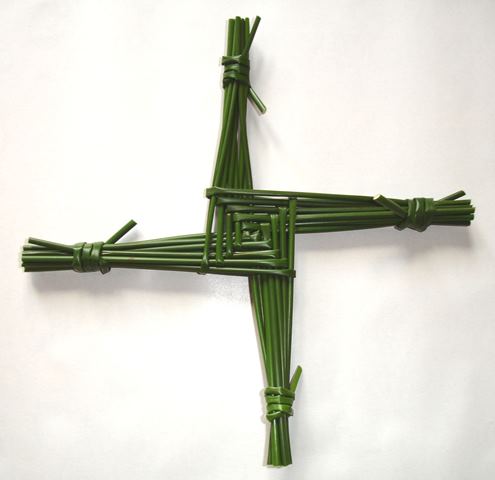
Brigit's cross

Brigit’s cross

Fire is again mentioned some 400 years later in an account of St Brigit’s sanctuary at Kildare in the late 12th century by Brito-Norman aristocratic scholar and churchman Gerald of Wales, who visited the newly conquered territories of the Brito-Normans and their Angevin King and wrote about them. His account was not without a good deal of prejudice, and at a time when the Angevins were seeking to legitimise their invasion of Ireland with the papacy, and when the papacy was seeking to further regularise Irish religious practice with continental norms. The following is a translation from the latin of Gerald’s account of Kildare (SOURCE: TOPOGRAPHY OF IRELAND (1185) (Trans. Thomas Forester; From: The Historical Works of Giraldus Cambrensis; Pub. George Bell & Sons, London, 1894):

CHAPTER XXXIV.

OF VARIOUS MIRACLES IN KILDARE ; AND FIRST, OF THE FIRE WHICH NEVER GOES OUT, AND THE ASHES WHICH NEVER INCREASE.

AT Kildare, in Leinster, celebrated for the glorious Brigit, many miracles have been wrought worthy of memory. Among these, the first that occurs is the fire of St. Brigit, which is reported never to go out. Not that it cannot be extinguished, but the nuns and holy women tend and feed it, adding fuel, with such watchful and diligent care, that from the time of the Virgin, it has continued burning through a long course of years ; and although such heaps of wood have been consumed during this long period, there has been no accumulation of ashes.

AP: It may well be that the fire was of butter or tallow.

CHAPTER XXXV.

HOW THE FIRE IS KEPT ALITE BY ST. BRIGIT ON HER NIGHT.

As in the time of St. Brigit twenty nuns were here engaged in the Lord’s warfare, she herself being the twentieth, after her glorious departure, nineteen have always formed the society, the number having never been increased. Each of them has the care of the fire for a single night in turn, and, on the evening before the twentieth night, the last nun, having heaped wood upon the fire, says, ” Brigit, take charge of your own fire ; for this night belongs to you.” She then leaves the fire, and in the morning it is found that the fire has not gone out, and that the usual quantity of fuel has been used.

CHAPTER XXXVI.

OF THE HEDGE ROUND THE FIRE, WHICH NO MALE CAN ENTER.

THIS fire is surrounded by a hedge, made of stakes and brushwood, and forming a circle, within which no male can enter ; and if any one should presume to enter, which has been sometimes attempted by rash men, he will not escape the divine vengeance. Moreover, it is only lawful for women to blow the fire, fanning it or using bellows only, and not with their breath. Moreover, by virtue of a curse pronounced by the virgin, goats here never have any young. 

AP: This is somewhat at odds with the older hagiographies which generally describe the saint’s desire to promote fertility of useful animals. Perhaps there was an emerging prejudice towards goats as somehow evil in the 12th century?

In this neighbourhood there are some very beautiful meadows called St. Brigit’s pastures, in which no plough is ever suffered to turn a furrow. Respecting these meadows, it is held as a miracle that although all the cattle in the province should graze the herbage from morning till night, the next day the grass would be as luxuriant as ever. It may be said, indeed, of them,

Et quantum longis carpunt armenta diebus,

Exigua tantum gelidus ros nocte reponit.

Cropt in a summer’s day by herds, the dew’s

Refreshing moisture verdure still renews.

AP: This is a quote from Virgil. The sacred meadow seems to be something of a pagan origin. Most of the Sid mounds in the Irish legendary romances have a special ‘green’ adjacent to them where events are often portrayed.

CHAPTER XXXVII.

OF THE FALCON IN KILDARE WHICH APPEARED TAME AND DOMESTICATED.

FROM the time of Brigit, a beautiful falcon frequented that spot, and was accustomed to perch on the top of the church tower. Hence it was popularly called Brigit’s Bird, and held by all in great veneration. At the beck of the townspeople or of the knights in the castle, just as if it was tamed and trained for the purpose, it would chase ducks and other birds, both those which frequent the plain sand the rivers in the plain of Kildare, to the great delight of the spectators, pouncing upon them in the air, and striking them to the ground with its instinctive velocity. What chance of escape was left to these poor birds, when the ground and the waters were beset by man, and their cruel tyrant had possession of the air ! It was remarkable in this falcon, that it never suffered any bird to pair with it in the neighbourhood of the church which it frequented, but at the proper season withdrew to the mountains of Glendalough (Glindelachan),and pairing there, in the usual manner, indulged its natural instinct. This ended, it returned to the church without its mate ; thus setting a good example to ecclesiastical persons, and especially to those engaged in divine offices within the recesses and precincts of a church.

At the time of earl John’s first departure from Ireland, this bird, after existing so many centuries, and affording so much delight, as well as adding glory to St. Brigit’s shrine, at length, incautiously settling on a quarry it had pierced, and fearless of the footsteps of man, was killed by the staff of some passing rustic. Hence it is evident, that in prosperity we ought to be prepared for misfortune, and that we must not trust in the prospect of long life and cherished happiness.

CHAPTER XLVIII.

OF AN ARCHER WHO CROSSING ST. BRIGIT’S HEDGE WAS STRUCK WITH MADNESS ; AND OF ANOTHER WHO LOST THE USE OF HIS LEG.

AT Kildare, an archer belonging to the household of earl Richard leapt over the hedge of St. Brigit and blew the fire with his mouth. On leaping back over the hedge, he began to lose his senses, and blew into every one’s mouth he met, exclaiming, “See how I blew St. Brigit’s fire.” In the same way, running from house to house, through the city, wherever he found a fire, he began to blow it, using the same words. At last, having been seized by his comrades and bound, he entreated to be taken to the nearest water. Being conducted there, and parched with thirst, he took such deep draughts that he burst in the midst of them, and died in their hands. Another, who attempted to enter the circle round the fire, and with that intention had already planted one of his legs across the hedge, though he was dragged back and held by his companions, had his leg and foot instantly withered ; whence afterwards, as long as he lived, he was lame and an idiot.

…….

CHAPTER LV.

THAT THE SAINTS OF THIS COUNTRY APPEAR TO BE OF A VINDICTIVE TEMPER.

IT appears to me very remarkable, and deserving of notice, that, as in the present life the people of this nation are beyond all others irascible and prompt to revenge, so also in the life that is after death, the saints of this country, exalted by their merits above those of other lands, appear to be of a vindictive temper. There appears to me no other way of accounting for this circumstance, but this : — As the Irish people possessed no castles, while the country is full of marauders who live by plunder, the people, and more especially the ecclesiastics, made it their practice to have recourse to the churches, instead of fortified places, as refuges for themselves and their property ; and, by divine Providence and permission, there was frequent need that the church should visit her enemies with the severest chastisements; this being the only mode by which evil-doers and impious men could be deterred from breaking the peace of ecclesiastical societies, and for securing even to a servile submission the reverence due to the very churches themselves, from a rude and irreligious people.

The accounts of Kildare actually appear to be tales told to Gerald by his hosts, and possibly garnered from local people. They therefore lack any first-hand detail, although include a lot that is not otherwise known to scholarship about Bridget and Kildare. Most importantly the mention of the eternal fire, the circular wattle or wickerwork boundary hedge and the sacred ‘virgin’ meadow nearby. These are by no means typical of monastic practices of the era! The story about the bird is interesting – particularly the tale that it travels to Glendalough (ie – the sanctuary of NaomhCóemgen whose legends also equate him with birds) to mate…

Reading between the lines, you can detect many subtle and many more not so subtle digs at the Irish way of doing things. There are hints of a fear of that great bugbear of the 12th and 13th centuries: Heresy.This was, after all, the era of Catharism – something that tainted the alliances and loyalties within the house of Angevin. What is more, the Brigitine model of recreating a pagan goddess in a Christian mould had long before inspired and laid the models for the continental theological school known as Maryology, a banner now taken up by the continental reformed monasticism – especially by the Cistercians and their great leader Bernard of Clairvaux and his successors, including his Man in Ireland,  Malachy of Armagh. The Irish model was for them outdated, and touched with implications of heathenism and heresy and Gerald appears to have been out to promote this idea! Read the text yourself, and then read Edmund Spenser’s A View of the Present State of Ireland (first circulated c.1598) and you will become better aware of this style of prejudicial polemical literature designed specifically for a political cause. Nowadays we have WMD, Hollywood and Bin Laden as cover stories for our power-grabs…

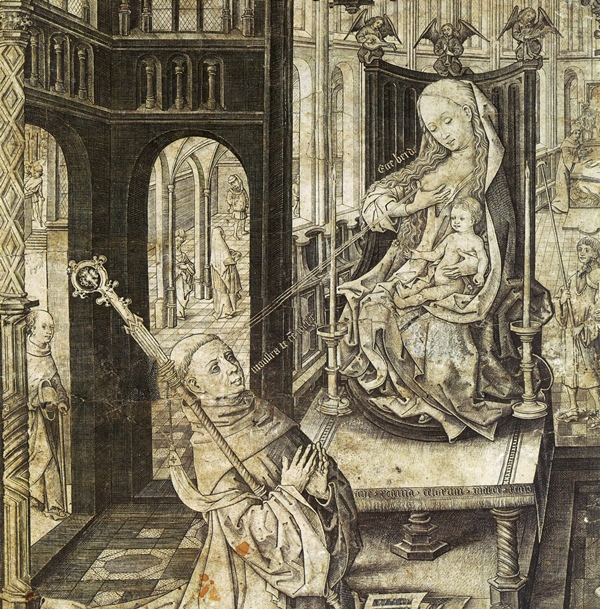
"Holy Lactating Mothe of God!" - Bernard has his eyes 'cured' with a splash of milk...

“Holy Lactating Mother of God!” – Bernard has his eyes ‘cured’ with a splash of milk…

Commentary on Bethu Brigte

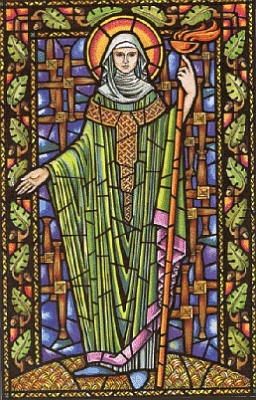
stbrigid2

Bride, Brighid, Brigit, Bridget and Brigte – all names of this important Irish holy figure linked to Kildare and generally supposed to have been active in the 5th and 6th centuries coeval with the mission of Patrick. She was contemporary to the early (more accurately post-Patrician) christianising process in Ireland and there are very cogent theories that she was a Christianisation of a pagan Goddess, which I intend to explore.

One of the earliest written records we have of her in the Irish language is a hagiographical text composed by unknown monks during the 9th century, based on the earlier Latin texts, and copied into manuscript collections by Abbeys and collectors: This is known as ‘Bethu Brigte’ (from Oxford University: MS Rawlinson B 512)It is full of magical details and is obviously designed to portray Brigit as an ally and contemporary of Patrick, a fact missing from the older Latin hagiographies….

I have reproduced here the CELT translation, taken from: Bethu Brigte. Donnchadh Ó hAodha (ed),  First edition. Pub.  Dublin Institute for Advanced Studies, Dublin (1978) … with my own interlineal notes for your interest… (please note that the start and end of the original text are incomplete;)

1

. . .The miracles were published abroad. One day in that place Broicsech went to milk and she leaves nobody in her house except the holy girl who was asleep. They saw that the house had caught fire behind them. The people run to its aid, thinking that they would not one house-post against another. The house is found intact and the girl asleep and her face like . . . And Brigit is revered [there] as long as it may exist (?).

AP: The name of Brigit’s mother: Broicsech may be a derived from the act of pot-cooking, as befits her position as a slave. The source of the fire would be the hearth of the house, the focus of influence for a pagan goddess. The presence of a ‘sacred hearth’ that was never allowed to be extinguished, along with a sacred meadow, and a sacred enclosure that no man could pass were observations of the saint’s sanctuary at Kildare made by Giraldus Cambrensis during the 12th century, following the Anglo-Norman invasions. The Niamhog of Inniskea was an ‘idol’ reverenced by the islanders as late as the 19th century, and it was supposed to protect a house from fire.

2

On a certain day the druid was asleep and he saw three clerics wearing white hooded garments baptizing (the above-mentioned) Brigit, and one of the three said to him, ‘Let Brigit be your name for the girl.’

AP: The ‘three men in white’ are implied to be Patrick and his attendants, echoing the description of Tirechan in the Book of Armagh: The text claims that God wants the girl to be given the pagan name Brigit.  

3

The druid and the female slave and her child were at Loch Mescae, and the druid’s mother’s brother was there too; the latter was a Christian. When they were there at midnight the druid was watching the stars and he saw a fiery column rising out of the house, from the precise spot where the slave and her daughter were. He woke his mother’s brother and he saw it also, and the latter said that she was a holy girl. ‘That is true’, said he, ‘if I were to relate to you all her deeds.’

AP: These Christian slaves are probably British in origin, gained by the raids by the Irish on sub-Roman Wales, England and Scotland. The text describes Brigit’s father – a druid/magus – watching the stars and making auguries, and gives validity to these powers as they proclaim the girl as a Christian saint! The druid and his uncle appear to begin to convert their beliefs…

4

On another occasion when the druid and his mother’s brother were in a house and the girl asleep, wherever her mother was, they heard the low voice of the girl in the side of the house, and she had not yet begun to speak. ‘Look for us’, said the druid to his maternal uncle, ‘how our girl is, for I do not dare to do so since I am not a Christian.’ He saw her lying in a crossvigil and she was praying. ‘Go again’, said the druid, ‘and ask her something this time, for she will say something to you now.’ He goes and addressed her. ‘Say something to me, girl’, said he. The girl then spoke two words to him: ‘This will be mine, this will be mine.’ The maternal uncle of the druid did not understand that. ‘Reveal [it] to us’, said he to the druid, ‘for I do not understand [it].’ ‘You will be very displeased with it’, said the druid. ‘This is what she has said’, said the druid, ‘this place will be hers till the day of doom.’ The maternal uncle of the druid shrank for the idea of (?) Brigit’s holding the land. The druid said, ‘Truly it shall be fulfilled. This place will be hers although she go with me to Munster’.

AP: Another vision of the future to the figurative pagan father, Dubthach (a name used as a hypostasis for similar characters in other early Irish Christianisation narratives). Brigit (the daughter of a slave, not supposed to inherit) claims the land of her father (an tribal leader or aristocrat)… ‘This to me’ (or its Irish and Manx equivalents) were the words supposedly spoken by well- and field-skimming witches in 19thC folklore accounts!


p.21

5

When it was time to wean her the druid was anxious about her; anything he gave her [to eat] she vomited at once, but her appearance was none the worse. ‘I know’, said the druid, ‘what ails the girl, [it is] because I am impure.’ Then a white red-eared cow was assigned to sustain her and she became well as a result.

AP: A curious syncresis – fairy or otherworld animals were supposed to be white with red ears in ancient Irish folklore! This passage appears to represent Brigit’s need for spiritual sustenance. The authors appear to make no difference between the Christian heaven and the Irish Otherworld in this interesting passage.

6

Thereafter the druid went to Munster, to be precise into Úaithne Tíre. There the saint is fostered. After a time she says to her fosterer: ‘I do not desire to serve here, but send me to my father, where he may come to meet me.’ This was done and her father Dubthach brought her away to his own patrimony in the two plains of Uí Fhailgi. She remained there among her relatives, and while still a girl performed miracles.

AP: This passage appears to show that Brigit and her father were more powerful than her fosterer, and perhaps simply exists to reinforce a historic primacy. It is she that decides that she does not wish to be fostered at this location (perhaps because it was anti-Christian?).

7

Then she was taken to a certain virgin to be fostered by her. It is Brigit who was cook for her afterwards. She used to find out the number of guests that would come to her fostermother, and whatever the number of guests might be the supply of bread did not fail them during the night.

AS: This passage again evokes the spiritual power of fecundity of the hearth that Brigit represents, a position that appears to be a pagan attribution to the Goddess.

8

Once her fostermother was seriously ill. She was sent with another girl to the house of a certain man named Báethchú  to ask for a drink of ale for the sick woman. They got nothing from Báethchú . . . They came to a certain well. She brought three vessels’ full therefrom. The liquid was tasty and intoxicating, and her fostermother was healed immediately. God did that for her.

AP: She changes water from a spring well (a pagan theme) into wine (a Christian one). Alcoholic beverages were the safest drink, and therefore most suitable for the sick.

9

One day Dubthach made her herd pigs. Robbers stole two of the boars. Dubthach went in his chariot from Mag Lifi and he met them and recognized his two boars with them. He seizes the robbers and bound a good mulct for his pigs on them. He brought his two boars home and said to Brigit: ‘Do you think you are herding the pigs well?’ ‘Count them’, said she. He counts them and finds there numbers complete.

AP: She is without reproach by a pagan druid! Dubthach fines the robbers, but he apparently has no right to this ‘tithe’ as God has made sure his fine was unlawful… This is an indictment of the pagan leader.

10

On a certain day a guest came to Dubthach’s house. Her father entrusted her with a flitch of bacon to be boiled for the guest. A hungry dog came up to which she gave a fifth part of the bacon. When this had been consumed she gave another [fifth]. The guest, who was looking on, remained silent as though he was overcome by sleep. On returning home again the father finds his daughter. ‘Have you boiled the food well?’, said her father. ‘Yes’, said she. And he himself counted [them] and found [them intact]. Then the guest tells Dubthach what the girl had done. ‘After this’, said Dubthach, ‘she has performed more miracles than can be


p.22

recounted.’ This is what was done then: that portion of food was distributed among the poor.

AP: The Druid begins to practice Christian charity!

11

On another occasion after that an old pious nun who lived near Dubthach’s house asked Brigit to go and address the twenty-seven Leinster saints in one assembly. It was just then that Ibor the bishop recounted in the assembly a vision which he had seen the night before. ‘I thought’, said he, ‘that I saw this night the Virgin Mary in my sleep, and a certain venerable cleric said to me: ‘This is Mary who will dwell among you’.’ Just then the nun and Brigit came to the assembly. ‘This is the Mary who was seen by me in a dream.’ The people of the assembly rose up before her and went to converse with her. They blessed her. The assembly was held where now is Kildare, and there Ibor the bishop says to the brethren: ‘This site is open to heaven, and it will be the richest of all in the whole island; and today a girl, for whom it has been prepared by God, will come to us like Mary.’ It happened thus.

AP: This is the passage which appears to give credence to the conflation of Brigit with Mary. She became known as the ‘Mary of Ireland’ or ‘Mary of the Gael’ (Carmichael). It is probable that ‘Mary’ refers to ‘Berry’, ‘Beara’, ‘mBoire’, ‘Muire’, ‘Morrigan’, ‘Mourie’ etc – epithets of the Goddess which survived in folklore.  

12

Another time thereafter she wished to visit her mother who was in slavery in Munster, and her father and fostermother would scarcely allow her to go. She went however. Her mother was at that time in . . . engaged in dairy work away from the druid, and she was suffering from a disease of the eye. Brigit was working in her stead, and the druid’s charioteer was herding the cattle; and every churning she made, she used to divide the produce into twelve portions with its curds, and the thirteenth portion would be in the middle and that was greater than every other portion. ‘Of what advantage to you deem that to be?’, said the charioteer. ‘Not hard’, said Brigit. ‘I have heard that there were twelve apostles with the Lord, and he himself the thirteenth. I shall have from God that thirteen poor people will come to me one day, the same number as Christ and his apostles.’ ‘And why do you not store up some of the butter?’ said the charioteer, ‘for that is what every dairy-worker does.’ ‘It is difficult for me’, said Brigit, ‘to deprive Christ of his own food.’ Then baskets were brought to her to be filled from the wife of the druid. She had only the butter of one and a half churnings. The baskets were filled with that and the guests, namely the druid and his wife, were satisfied. The druid said to Brigit: ‘The cows shall be yours and let you distribute the butter among the poor, and your mother shall not be in service from today and it shall not be necessary to buy her, and I shall be baptized and I shall never part from you.’ ‘Thanks be to God’, said Brigit.

AP: Women’s work, again! This description  of dairying applies to the old principle of the ‘baker’s dozen’ in bread-making but applied to making butter: Fascinatingly it was still a practice of dairying women in the Isle of Man into the 20th century, would always place a pat of butter from the churning on the wall of the dairy ‘for the fairies’. Butter was a vital part of the diet in the Atlantic world – high rainfall and warmer oceanic climates made Ireland and Mannin prime dairying regions. SOfar, Brigit’s work is that of a young woman: minding the hearth, cooking, fetching water, making beer, milking, making butter. The druid frees her mother from servitude, gives her the freedom of her cattle (the goddess at Beltain), and agrees to be baptized. The story now enters another phase in the ‘three ages of woman’…

13

On one occasion Dubthach brought Brigit to the king of Leinster, namely Dúnlang, to sell her as a serving slave, because her stepmother


p.23

had accused her of stealing everything in the house for clients of God. Dubthach left her in his chariot to mind it on the green of the fort and he leaves his sword with her. She gave it to a leper who came to her. Dubthach said to the king: ‘Buy my daughter from me to serve you, for her manners have deserved it.’ ‘What cause of annoyance has she given?’, said the king. ‘Not hard’, said Dubthach. ‘She acts without asking permission; whatever she sees, her hand takes.’ Dubthach on returning questions her about that precious sword. She replied: ‘Christ has taken it.’ Having learned that, he said: ‘Why, daughter, did you give the value of ten cows to a leper? It was not my sword, but the king’s.’ The girl replied: ‘Even if I had the power to give all to Leinster, I would give it to God.’ For that reason the girl is left in slavery. Dubthach returned to his home. Wonderful to relate, the virgin Brigit is raised by divine power and placed behind her father. ‘Truly, Dubthach’, said the king, ‘this girl can neither be sold nor bought.’ Then the king gives a sword to the virgin, and . . .After the afore-mentioned miracles they return home.

AP: It comes time to place her into service… The King of Leinster recognises Brigit’s holiness and returns her to her father along with a replacement sword (a gift of nobility placed in her hands).

14

Shortly afterwards a man came to Dubthach’s house to woo Brigit. His name was Dubthach moccu Lugair. That pleased her father and her brothers. ‘It is difficult for me’, said Brigit, ‘I have offered up my virginity to God. I will give you advice. There is a wood behind your house, and there is a beautiful maiden [therein]. She will be betrothed to you, and this is how you will recognize it: You will find an enclosure wide open and the maiden will be washing her father’s head and they will give you a greater welcome, and I will bless your face and your speech so that whatever you say will please them.’ It was done as Brigit said.

AP: Brigit rejects the pagan prince, but arranges a satisfactory marriage for him. This is allegorical for the power of the church in shaping temporal power and alliance.

15

Her brothers were grieved at her depriving them of the bride-price. There were poor people living close to Dubthach’s house. She went one day carrying a small load for them. Her brothers, her father’s sons, who had come from Mag Lifi, met her. Some of them were laughing at her; others were not pleased with her, namely Bacéne, who said: ‘The beautiful eye which is in your head will be betrothed to a man though you like it or not.’ Thereupon she immediately thrusts her finger into her eye. ‘Here is that beautiful eye for you’, said Brigit. ‘I deem it unlikely’, said she, ‘that anyone will ask you for a blind girl.’ Her brothers rush about her at once save that there was no water near them to wash the wound. ‘Put’, said she, ‘my staff about this sod in front of you.’ That was done. A stream gushed forth from the earth. And she cursed Bacéne and his descendants, and said: ‘Soon your two eyes will burst in your head.’ And it happened thus.

AP: This passage is an important recognition of the ‘Cailleach’ figure which Brigit was to replace: she loses one eye rather, becoming alike to the poets’ representation of the Hag. She also creates a spring well from the earth at the point of this act – wells were closely linked to cures for the eyes in ancient Atlantic folklore. The clarity of water and the clarity of the healthy eye were linked, and the ‘Evil Eye’ is a thing of envy (or even love and lust) – for this reason Brigit plucks out her own eye in this passage.


p.24

16

Dubthach said to her: ‘Take the veil then, my daughter, for this is what you desire. Distribute this holding to God and man.’ ‘Thanks be to God’, said Brigit.

AS: The parent finally accepts the new vocation.

17

On a certain day she goes with seven virgins to take the veil to a foundation on the side of Cróchán of Bri Éile, where she thought that Mel the bishop dwelt. There she greets two virgins, Tol and Etol , who dwelt there. They said: ‘The bishop is not here, but in the churches of Mag Taulach.’ While saying this they behold a youth called Mac Caille, a pupil of Mel the bishop. They asked him to lead them to the bishop. He said: ‘The way is trackless, with marshes, deserts, bogs and pools.’ The saint said: ‘Extricate us [from our difficulty].’ As they proceeded on their way, he could see afterwards a straight bridge there.

AP: This is an expression of Brigit as one who guides lost travellers. Manx fishermen used to cast the palatal bone of the Bollan Wrasse to achieve such an augury – this was probably one of the oceanic forms associated with the goddess: it was a fish who tended the wrack. The ‘veil’ as well as the name ‘Mac Caille’ reminds us of the Cailleach. The Manx word for ‘veil’ or ‘covering’ is Breid. Bride. Brighde. Brigit….

18

The hour of consecration having arrived, the veil was raised by angels from the hand of Mac Caille, the minister, and is placed on the head of saint Brigit. Bent down moreover during the prayers she held the ash beam which supported the altar. It was afterwards changed into acacia, which is neither consumed by fire nor does it grow old through centuries. Three times the church was burned down, but the beam remained intact under the ashes.

AP: Mac Caille may be the same character as the Manx saint ‘Maughold’. The Isle of Man had a nunnery dedicated to St Brigid and its 12thC Viking king was involved with the Anglo-Norman invasion of Ireland during which there was a translation and centralisation of relics of the patron saints of Ireland: Patrick, Brigid and Colmcille… There is another reference in this passage to resistance to fire, and the local Ash beam is converted to (fireproof) Acacia – a Middle-Eastern or African tree, described in the Bible (Exodus) as the material employed in the construction of the tabernacle and its shrines, hence the use here.

19

The bishop being intoxicated with the grace of God there did not recognise what he was reciting from his book, for he consecrated Brigit with the orders of a bishop. ‘This virgin alone in Ireland’, said Mel, ‘will hold the Episcopal ordination.’ While she was being consecrated a fiery column ascended from her head.

AP: The column of fire is mentioned again! Brigit is ordained with apostolic primacy… quite unusual for a woman. Was the compositor of this hagiography a woman?

20

Afterwards the people granted her a place called Ached hÍ in Saltus Avis. Remaining there a little while, she persuaded three pilgrims to remain there and granted them the place. She performed three miracles in that place, namely: The spring flowed in dry land, the meat turned into bread, the hand of one of the three men was cured.

AP: Ached hÍ in Saltus Avis = (?) Island on the plain of the leaping birds: a composite Irish/Latin name. It seems to describe a Crannog… Brigit creates a well, converts meat (a pagan sacrificial offering) to bread, and cures the sick.

21

Once at Eastertide: ‘What shall we do?’, said Brigit to her maidens. ‘We have one sack of malt. It were well for us to prepare it that we might not be without ale over Easter. There area moreover seventeen churches in Mag Tailach. Would that I might keep Easter for them in the matter of ale on account of the Lord whose feast it is, that they might have drink although they should not have food. It is unfortunate for us only that we have no vessels.’ That was true. There was one vat in the house and two tubs. ‘They are good; let it be prepared(?).’


p.25

This is what was done: the mashing in one of the tubs, in the other it was put to ferment; and that which was put to ferment in the second tub, the vat used to be filled from it and taken to each church in turn, so that the vat kept on coming back, but though it came back quickly that which was in the tub was ale. Eighteen vatfuls had come from the one sack, and what sufficed for herself over Easter. And there was no lack of feasting in every single church from Easter Sunday to Low Sunday as a result of that preparation by Brigit.

AP: The pagan tales tell of ever-renewing cauldrons and goblets: this is a Brigitine re-visioning of this theme!

22

A woman from Fid Éoin who was a believer gave her a cow on that Easter Day. There were two of them driving the cow, namely the woman and her daughter. They were not able however to drive their cow . . . They had lost their calf as they were coming through the wood. They besought Brigit then. That prayer availed them; their cow leads the way before them to the settlement where Brigit was. ‘This is what we must do’, said Brigit to her maidens, ‘for this is the first offering made to us since occupying this hermitage, let it be taken to the bishop who blessed the veil on our head.’ ‘It is of little benefit to him’, said the maidens, ‘the cow without the calf.’ ‘That is of no account’, said Brigit. ‘The little calf will come to meet its mother so that it will be together they will reach the enclosure.’ It was done thus as she said.

AP: The cow with calf produces milk… This is the first reference to Brigit herself being involved with droving. The passage deals with the springtime fertility of cattle and onset of milking, as well as the primacy of the celebration of Easter to Christians. There is an allegory here that the faithful must bring their children to the fold, as well…

23

On the same Easter Sunday there came to her a certain leper from whom his limbs were falling, to ask for a cow. ‘For God’s sake, Brigit, give me a cow.’ ‘Grant me a respite’, said Brigit. ‘I would not grant you’, said he, ‘even the respite of a single day.’ ‘My son, let us await the hand of God’, said Brigit. ‘I will go off’, said the leper. ‘I will get a cow in another stead although I obtain it not from you.’ ‘. . .’, said Brigit, ‘and if we were to pray to God for the removal of your leprosy, would you like that?’, ‘No’, said he, ‘I obtain more this way than when I shall be clean.’ ‘It is better’, said Brigit, ‘. . . and you shall take a blessing [and] shall be cleansed.’ ‘All right then’, said he, ‘for I am sorely afflicted.’ ‘How will this man be cleansed?’, said Brigit to her maidens. ‘Not hard, O nun. Let your blessing be put on a mug of water, and let the leper be washed with it afterwards.’ It was done thus and he was completely cured. ‘I shall not go’, said the leper, ‘from the cup which has healed me — I shall be your servant and woodman.’ Thus it was done.

AP: The ‘leper’ becomes the servant after receiving healing. Christianity promoted itself as a healing religion, this being the main biblical power of the apostles. The passage gives the goddess-saint power to bless water for healing. ‘Leprosies’ was a biblical term for diseases inflicted by God – typically ‘cutaneous’ (skin) or visible disorders. The ‘blast’ and the ‘stroke’ from a spiritual agency were two names from Atlantic folklore that described such diseases (‘leprosies’ in the biblical/medieval sense, rather than Hansen’s Disease per se) and these were more often ascribed to fairies rather than the Christian god in folklore accounts!

Brigit’s healing escapades increase now she is a young woman, reflecting the biblical ministry of Jesus once he came of age…

24

On the following day, Monday, Mel came to Brigit to preach and say Mass for her between the two Easters. A cow had been brought to her on that day also and it was given to Mel the bishop, the other cow having been taken. Ague assails one of Brigit’s maidens and she was


p.26

given Communion. ‘Is there anything you might desire?’, said Brigit. ‘There is’, said she. ‘If I do not get some fresh milk, I shall die at once.’ Brigit calls a maiden and said: ‘Bring me my own mug, out of which I drink, full of water. Bring it without anyone seeing it.’ It was brought to her then, and she blessed it so that it became warm new milk, and the maiden was immediately completely cured when she tasted of it. So that those are the two miracles simultaneously, i.e. the changing of water to milk and the cure of the maiden.

AP: Transforming water into healing milk is a transformation of the ‘water-into-wine’ biblical passage into an Irish context! Milk and buttermilk was a popular healing drink down to modern times. It has a maternal, nourishing metaphysical association, so is fitting for the female saint to distribute it. Medieval religious depictions of Mary feeding milk from her breasts to the faithful are worth considering as equivalent. It is even faintly possible that such ‘Maryology’ (for example that promoted by the Cistercian monks throughout Europe from the 12thC) might have been derived from Ireland’s syncretic Brigitine faith…

25

On the following day, Tuesday, there was a good man nearby who was related to Brigit. He had been a full year ailing. ‘Take for me today’, said he, ‘the best cow in my byre to Brigit, and let her pray to God for me, to see if I shall be cured.’ The cow was brought, and Brigit said to those who brought it: ‘Take it immediately to Mel.’ They brought it back to their house and exchanged it for another cow unknown to their sick man. That was related to Brigit, who was angry at the deceit practised on her. ‘Between a short time from now and the morning’, said Brigit, ‘wolves shall eat the good cow which was given into my possession and which was not brought to you’, said she to Mel, ‘and they shall eat seven oxen in addition to it.’ That was related then to the sick man. ‘Go’, said he, ‘take to her seven oxen of choice of the byre.’ It was done thus. ‘Thanks be to God’, said Brigit. ‘Let them be taken to Mel to his church. He has been preaching and saying Mass for us these seven days between the two Easters; a cow each day to him for his labour, it is not greater than what he has given; and take a blessing with all eight, a blessing on him from whom they were brought’, said Brigit. When she said that he was healed immediately.

AP: Easter again linked to healing (of sins, by Jesus’ supposed sacrifice). The giving of tithes – dues to the holy men – seems to be a subtext implied here. Cows and oxen were the wealth of the Irish lords.

26

During the time between the two Easters Brigit suffered greatly from a headache. ‘That does not matter’, said Mel. ‘When we go to visit our first settlement in Tethbae, Brigit and her maidens will go with us. There is a wonderful physician in Mide, namely Aed mac Bricc. He will heal you.’ It was then she healed two paralytic virgins of the Fothairt.

AP: Aed Mac Bricc was pa atron saint of the Uí Néill. Mide = Meath, which came under the dominance of the Clann Cholmáin (a branch of the Uí Néill) in the 5thC. Kildare was part of their territories…

27

Then two blind Britons with a young leper of the sept of Eocchaid came and pray with importunity  to be healed. Brigit said to them: ‘Wait a while.’ But they said, ‘You have healed the infirm of your own people and you neglect the healing of foreigners. But at least heal our boy who is of your people.’ And by this the blind are made to see and the leper is cleansed.

AP: Christianity preached ‘illumination’ and cleansing of the harm caused by the beam of evil once believed to have been emitted from the jealous or proud eye. This passage implies that the Christian mission must be spread back East.

28

Low Sunday approached. ‘I do not think it fortunate now’, said


p.27

Brigit to her maidens, ‘not to have ale on Low Sunday for the bishop who will preach and say Mass.’ As soon as she said that, two maidens went to the water to bring in water and they had a large churn for the purpose, and Brigit was not aware of this. When they came back again, Brigit saw them there. ‘Thanks be to God’, said Brigit. ‘God has given us beer for our bishop.’ The nuns became frightened then. ‘May God help us. O maiden.’ ‘Whatever foolish thing I said, I have not said anything evil, O nuns.’ ‘The water which was brought inside, because you have blessed it, God did what you desired and immediately it was changed into ale with the smell of wine from it, and better ale was never set to brew in the [whole] world.’ The one churn was sufficient [for them] with their guests and the bishop.

AP: Yet again, an emphasis upon the creation of health-giving drinks from water.

29

On the Monday after Low Sunday Brigit went in her chariot and her maidens along with her and the two bishops and Mel and Melchú into the plain of Mide to a physician, and that they might go afterwards into the plain of Tethbae to visit a foundation which Mel and Melchú had there. On Tuesday at nightfall they turn aside to the house of a certain Leinsterman of the Uí Brolaig. He received them and out of respect and kindness he entertained the holy Brigit and the bishops. That good man and his wife complained. The wife said: ‘All the children I have given birth to have died, except two daughters and they are dumb since the day of their birth.’ She goes to Ath Firgoirt. The holy Brigit falls in the middle of the ford, the horses being frightened for some unknown reason, and the saint’s head was dashed against a stone and was injured on top, and it richly stained the waters with the blood which was shed. The holy Brigit said to one of the two dumb girls: ‘Pour the water mixed with blood about your neck in the name of God.’ And she did so and said: ‘You have healed me. I give thanks to God’. ‘Call you sister’, said Brigit to the girl who had been healed. ‘Come here, sister’, said she. ‘I shall come indeed’, said her companion, ‘and though I go I have already been healed. I bowed down in the track of the chariot and I was cured.’ ‘Go home’, said Brigit to the girl, ‘and ye shall again bring forth as many male children as have died on you.’ They were delighted at that. And that memorable stone often heals many. Any head with a disease of the head which is placed on it returns from it cured. It was then they met the learned leech, Aed mac Bricc. ‘ . . .’, said the bishop, ‘the head of the holy maiden.’ He touched it and with these words addresses the virgin: ‘The vein of your head, O virgin, has been touched by a physician who is much better than I am.’

AP: This passage recalls a pagan one from the Metrical Dindsenchas when Boand dashes her head. It was also used as a motif in the hagiographical Life of St Declan – he dashes his head against a rock which thereafter was supposed to have healing properties by pilgrims down to the modern day. This is a theme with other precedents in legends and hagiography from Ireland in the post-pagan period… There is also a connection between stones, river fords and heads – possibly a vague reference to idol worship that had been replaced.

30

They go to Tethbae, to the first settlements of the bishops, namely Ardagh. The king of Tethbae was feasting nearby. A churl in the king’s house had done a terrible thing. He let fall a valuable goblet belonging to the king, so that it smashed to pieces against the table in front of the


p.28

king. The vessel was a wonderful one, it was one of the rare treasures of the king. He seized the wretch then, and there was nothing for him but death. One of the two bishops comes to beseech the king. ‘Neither shall I give him to anybody’, said the king, ‘nor shall I give him in exchange for any compensation, but he shall be put to death.’ ‘Let me have from you’, said the bishop, ‘the broken vessel.’ ‘You shall have that’, said the king. The bishop then brought it in his arms to Brigit, relating everything to her. ‘Pray to the Lord for us that the vessel may be made whole.’ She did so and restored it and gave it to the bishop. The bishop comes on the following day with his goblet to the king and [says]: ‘If your goblet should come back to you make whole’, said the bishop, ‘would the captive be released?.’ ‘Not only that, but whatever gifts he should desire, I would give him.’ The bishop shows him the vessel and speaks these words to the king: ‘It is not I who performed this miracle, but holy Brigit’.

AP: The goblet/cauldron/vessel motif returns…

31

When Brigit’s fame had resounded throughout Tethbae, there was a certain pious virgin in Tethbae from whom a message was sent in order that Brigit might go and speak to her, namely Bríg daughter of Coimloch. Brigit went and Bríg herself arose to wash her feet. There was a pious woman ailing at that time. While they were washing Brigit’s feet, that sick person who was in the house sent a maiden to bring her out of the tub some of the water which was put over Brigit’s feet. It was brought to her then and she put it about her face and she was completely cured at once; and after being ailing for a year, she was the only servant that night. When their dishes were put in front of them, Brigit began to watch her dishes intently. ‘May it be fitting for us’, said Bríg, ‘O holy maiden, what do you perceive on your dish?’, ‘I see Satan sitting on the dish in front of me’, said Brigit. ‘If it is possible’, said Bríg, ‘I should like to see him.’ ‘It is possible indeed’, said Brigit, ‘provided that the sign of the cross goes over your eyes first; for anyone who sees the devil and does not bless himself first or . . ., will go mad.’ Bríg blesses herself then and sees that fellow. His appearance seemed ugly to her. ‘Ask, O Brigit’, said Bríg, ‘why has he come.’ ‘Grant an answer to men’, said Brigit. ‘No, O Brigit’, said Satan, ‘you are not entitles to it, for it is not to harm you that I have come.’ ‘Answer me then’, said Bríg, ‘what in particular has brought on to this dish?.’ The demon replied: ‘I dwell here always with a certain virgin, with whom excessive sloth has given me a place.’ And Bríg said, ‘Let her be called.’ When she who was called came: ‘Sain her eyes’, said Bríg, ‘so that she may see him whom she has nourished in her own bosom.’ Her eyes having been sained, she beholds the awful monster. Brigit says to the maiden, now terrified with fear and trembling: ‘Behold you see him whom you have cherished for many years and seasons’. ‘O holy maiden,’ said Bríg, ‘that


p.29

he may never enter this house again.’ ‘He shall not enter this house’, said Brigit, ‘till the day of doom.’ They partake of their food and return thanks to God.

AP: This passage is interesting on a number of levels: Firstly, it deals with the practice of foot-washing as an honorary – something of ancient biblical provenance. It also touches upon an Atlantic belief that dust trodden by people might hold a connection to forms of sin or the Evil Eye and loss of substance: In the Isle of Man, such spiritual or magical assaults were once dealt with universally by procuring such dust and disposing of it in various fashions! Brigit sees Satan in the bowl of water, suggesting both an aspect of this principle at the same time as a divinatory practice of staring into the mirror-reflection of water (ie – seeing the inverted otherworld!). Needless to say, the evil is banished by thesaint’s growing power…

32

Once she was hurrying on the bank of the Inny. There were many apples and sweet sloes in that church. A certain nun gave her a small gift in a basket of bark. When she brought [it] into the house, lepers came at once into the middle of the house to beg of her. ‘Take’, said she, ‘yonder apples’, Then she who had presented the apples [said]: ‘I did not give the gift to lepers.’ Brigit was displeased and said: ‘You act wrongly in prohibiting gifts to the servants of God; therefore your trees shall never bear any fruit.’ And the donor, on going out, sees that all at once her garden bore no fruit, while shortly before it had abundant fruits. And it remains barren for ever, except for foliage.

AP: The saint bestows barrenness as well as fecundity: woe to those who don’t donate to the church! Of interest, the Gaelic words for a church and for a stand of trees are very similar… Here it is implied that a church itself was a source of fruit. This could be an allegorical swipe at a particular institution. Hagiography was a very political art form – one that was sponsored by the Uí Néill dynasties above all others!

33

Another virgin brought her apples and sweet sloes in large quantities. She gave [them] immediately to some lepers who were begging. ‘She who brought it will be sound’, said Brigit. ‘O nun, bless me and my garden.’ ‘May God indeed bless’, said Brigit, ‘that big tree yonder which I see in your garden; may there be sweet apples on it, and sweet sloes as to one third; and that twofold fruit shall not be lacking from it and its offshoots.’ And thus it was done. As the nun went into her garden she saw the alder tree with its fruit, and sweet sloes on it as to one third.

AP: Again, this seems like an allegorical passage with a political undertone.

34

In a certain place, namely Aicheth Fir Leth, two lepers followed Brigit. Great jealousy [of each other] took hold of them. They began to quarrel, but their hands and feet grew stiff. Seeing this, Brigit said: ‘Do penance’. They did so. Not only did she release them, but she healed them of their leprosy.

AP: Jealousy = Envy. One of the ‘spiritual sins’. The use of ‘lepers’ and ‘servants’ or ‘followers’ seems interchangeable and suggests that all are sinners, whose sin gives them a disease. Brigit is the physician for these followers. Remember, ‘leprosy’ in a medieval or biblical context doesn’t necessarily mean the disease caused by Mycobacterium leprae!

35

It was then that two virgins came to Brigit that she might go with them to consecrate their foundation and house along with them. Induae and Indiu were their names. On the way they met a youth [who had come] to speak to the nuns with whom Brigit was going. ‘I have come to you’, said he, ‘from this ill person, that a chariot might be brought to him, so that he might die in the same enclosure with you.’ ‘We have no chariot’, said the nuns. ‘Let my chariot be brought to him’, said Brigit. That is what was done then. They were waiting till matins, until the sick man came. Lepers come to them afterwards in the morning. ‘O Brigit’, said they, ‘give us your chariot, for the sake of Christ.’ ‘Take [it]’, said Brigit, ‘[but] grant us a respite, O ye clients


p.30

of God, so that we may bring the sick man first of all to our house which is quite near us.’ ‘We will not grant’, said they, ‘even the respite of a single hour, unless our chariot is being taken from us anyway.’ ‘Take [it] anyway’, said Brigit. ‘What shall we do’, said the nuns, ‘with our sick man?.’ ‘Not hard’, said Brigit. ‘Let him come with us on foot.’ That is what was done then; he was completely cured on the spot.

AP: It has been commented on by scholars and archaeologists that descriptions from early Irish literature of heroes or saints riding in chariots has not been backed up with archaeological discoveries of such equipment. However, ‘absence of evidence is not evidence of absence’. The Old Irish term for a chariot was ‘carpat’ from the Latin term carpentum, used in reference to the lightweight chariots of the British and continental Celts of the Iron Age. These were the provenance of the aristocracy, who were sometimes referred to in Irish texts as cairptech. Here dying Irish nobleman wishes to be conveyed by chariot to Brigit, which she afterwards donates to some more lepers! 

36

It was then that she washed the feet of the nuns of Cúl Fobair, and healed four of them while washing them, namely a paralytic one, a blind one, a leper and a possessed one.

AP: All of the diseases afflicting these nuns are typical religious fare that had overtones of fairy disease in later Irish folklore: (in order) – the Fairy Stroke, the Evil Eye, the Fairy Blast and one ‘taken’ by fairies! I assume the ‘paralytic’ nun was neither drunk on the copious amounts of booze that the clergy used to make, not suffering from some form of repressed hysterical disorder…

37

It was then that she healed the dumb paralytic at the house of Mac Odráin. It happened that Brigit and the dumb boy were left alone. Some destitute people having come and desired a drink, the holy Brigit looked for the key of the kitchen and did not find it. Being ignorant of the boy’s affliction, she addresses him thus: ‘Where is the key?’, And by this the dumb paralytic boy speaks and ministers.

AP: Again, as with other diseases mentioned in this text, the boy’s ‘dumbness’ must be considered allegorical, especially as it mentions his ministry after being given the ‘gift’ of speech by Brigit upon receiving the key to the kitchen. 

38

Shortly afterwards at the beginning of summer: ‘Verily’, said Mel and Melchú to Brigit, ‘it has been related to us that Patrick is coming from the south of Ireland into Mag mBreg. We will go to speak to him. Will you go?.’ ‘I will’, said Brigit, ‘so that I may see him and speak to him, and that he may bless me.’ As they set out, a certain cleric with a great amount of chattels and a following pursues them on the way, to ask [them] to accompany him into Mag mBreg. ‘It is a matter of urgency for us’, said Mel, ‘that our cleric may not escape us.’ ‘Let me find this out from you’, said Brigit, ‘the place in which we will meet in Mag mBreg, and I will wait for this pitiable gathering.’ Brigit waited afterwards for the migratory band. ‘There are twenty maidens with me [coming] along the road’, said Brigit, ‘give them some of the burdens.’ The wretched ones say: ‘Not so let it be done, for you have conferred a greater boon on us, since in your company the road is safe for us’. ‘Are there not two carts [coming] along the road?’, said Brigit. ‘Why is it not they which carry the loads?.’ For she had not looked to see what was in them. Since Brigit entered religion, she never looked aside but only straight ahead. ‘There is a brother of mine’, said the cleric, ‘in one of the carts, who has been paralysed for fourteen years. There is a sister of mine in the other who is blind.’ ‘That is a pity’, said Brigit. They came that night to a certain stream, called the Manae. They all ate that night save only Brigit. On the morrow she healed the two sick people who were along with her, and the loads were put into the carts; and they returned thanks to God.


p.31

39

It was then she healed the household of a plebean on the edge of the sea. Thus it was done. A certain man was working in a cow-pasture, of whom the saint asked why he was working alone. He said: ‘All my family is ill.’ Hearing this, she blessed some water and immediately healed twelve sick members of the man’s family.

40

They come then to Tailtiu. Patrick was there. They were debating an obscure question there, namely a certain woman came to return a son to a cleric of Patrick’s household. Brón was the cleric’s name. ‘How has this been make out?’, said everyone. ‘Not hard’, said the woman. ‘I had come to Brón to have the veil blessed on my head and to offer my virginity to God. This is what my cleric did, he debauched me, so that I have borne him a son.’ As they were debating, Brigit came towards the assembly. Then Mel said to Patrick: ‘The holy maiden Brigit is approaching the assembly, and she will find out for you by the greatness of her grace and the proximity of her miracles whether this is true or false; for there is nothing in heaven or earth which she might request of Christ, which would be refused her. This then is what should be done in this case’, said Mel. ‘She should be called apart out of the assembly about this question, for she will not perform miracles in the presence of holy Patrick.’ Brigit came then. The host rises up before her. She is summoned apart out of the assembly immediately to address the woman, and the clerics excepting Patrick accompany her. ‘Whose yonder child?’, said Brigit to the woman. ‘Brón’s’, said the woman. ‘That is not true’, said Brigit. Brigit made the sign of the cross over her face, so that her head and tongue swelled up. Patrick comes to them then in that great assembly-place. Brigit addresses the child in the presence of the people of the assembly, though it had not yet begun to speak. ‘Who is your father’, said Brigit. The infant replied: ‘Brón the bishop is not my father but a certain low and ill-shaped man who is sitting in the outermost part of the assembly; my mother is a liar.’ They all return thanks to God, and cry out that the guilty one be burned. But Brigit refuses, saying: ‘Let this woman do penance.’ This was done, and the head and tongue lost their swelling. The people rejoiced, the bishop was liberated, and Brigit was glorified.

AP: Brigit holds her own in front of the foreign assembly and gets a bishop off the hook. She causes the mother of the child to suffer what appears to be an attack of angioedema or anaphylaxis in order to shut her up, and then makes her baby tell that another man is in fact the father (it was supposed that the innocent cannot lie, just as we generally suppose today that infants cannot speak…).

41

At the end of the day everybody went apart out of the assembly for hospitality. There was a good man living on the bank of the river called Seir. He sent his slave to the assembly to call Brigit, saying to his household: ‘The holy maiden who performed the wonderful miracle in the assembly-place today, I want her to consecrate my house tonight.’ He welcomed her. ‘Let water be put on our hands’, said her maidens


p.32

to Brigit, ‘here is our food.’ ‘It is of no use now’, said Brigit. ‘For the Lord has shown me that this is a heathen home, with the one exception only of the slave who summoned us. On that account I shall not eat now.’ The good man finds this out, namely that Brigit was fasting until he should be baptized. ‘I have said indeed’, said he, ‘that Patrick and his household would not baptize me. For your sake, however, I will believe’, [said he] to Brigit. ‘I do not mind provided that you be baptized’, said Brigit. ‘There is not a man in orders with me. Let someone go from us to Patrick, so that a bishop or priest may come to baptize this man.’ Brón came and baptized the man with all his household at sunrise. They eat at midday. They return thanks. They come to holy Patrick. Patrick said: ‘You should not go about without a priest. Your charioteer should always be a priest.’ And that was observed by Brigit’s abbesses up to recent times.

AP: Only priests can baptize – Patrick recommends that from now on Brigit goes about with a priest. This is a tacit acceptance of her as an agent for his mission to convert the houses of the aristocracy of Ireland, in particular the lands of the Southern Uí Néill

42

After that she healed the old peasant woman who was placed in the shadow of her chariot at Cell Shuird in the south of Brega.

43

She healed the possessed man . . . who had gone round the borders. He was brought to Brigit afterwards. Having seen her, he was cured.

AP: Another soul ‘taken’ by the fairies is ‘found’ in Christ…

44

Brigit went afterwards to Cell Lasre. Lassar welcomed her. There was a single milch ewe there which had been milked, and it was killed for Brigit. As they were [there] at the end of the ay, they saw Patrick coming towards the stead. ‘May God help us, O Brigit’, said Lassar. ‘Give us your advice.’ Brigit replied: ‘How much have you?’, She said,: ‘There is no food except twelve loaves, a little milk which you have blessed and a single lamb which has been prepared for you’. This is what [they do]: They all go into her refectory, both Patrick and Brigit, and they were all satisfied. And Lassar gave her her church, and Brigit is venerated there.

AP: Another example of ‘Bread and Fishes’ ministry, which paints the saint with powers exactly equivalent to those of the biblical Jesus! It does not appear that it was considered in any way heretical to do so – she was portrayed as a ‘Female Christ’, to all intents and purposes!

45

She remained the next day in Cell Lasre. A certain man of Kells by origin (?), whom his wife hated, came to Brigit for help. Brigit blessed some water. He took it with him and, his wife having been sprinkled [therewith], she straightaway loved him passionately.

AP: The making of Love Philtres is condemned as a pagan practice by the Penitential of Finnian (said to derive from Finnian of Clonard in the 6thC). Here we see the saint usurping this ability from common people – the church was keeping ‘magic’ for itself and out of the hands of its flock.

46

A certain pious virgin sent to Brigit, in order that Brigit might go to visit her. Fine was her name. From her Cell Fhine was named. She went and remained there. One day wind and rain, thunder and lightning set in. ‘Which of you, O maidens, will go today with our


p.33

sheep into this terrible storm?’, All the maidens were equally reluctant. Brigit answered: ‘I love very much to pasture sheep.’ ‘I do not want you to go’, said Fine. ‘Let my will be done’, said Brigit. She went then and chanted a verse while going:

    1. Grant me a clear day for Thou art a dear friend, a kingly youth; for the sake of Thy mother, loving Mary, ward off rain, ward off wind.
    2. My king will do [it] for me, Rain will not fall till the night, On account of Brigit today, Who is going here to the herding.

She stilled the rain and the wind.

AP: This final passage of the surviving text begins to deal with Brigit’s usurped functions as a guardian of flocks and controller of the weather: roles subsumed from what we know from later folklore constituted the Cailleach archetype or ‘goddess’!

The text appears in general to deal with the tripartite forms of womanhood, girl<>woman<>dotage/seniority, although the last part of her life-story is lost. This threefold division was the same as that of the Atlantic goddess herself, who was a regenerating figurative representation of the seasons and nature. It was the purpose of the legend of ‘Saint Brigit’ to replace that of this ‘Fairy Queen’ in a way that the male ‘Patrick’ could not.

(c) 2013 Atlantean Perspective. 
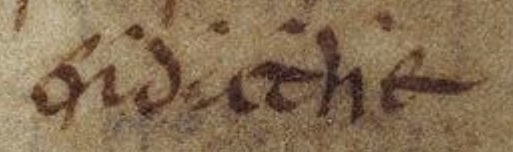
Converting paganism to hagiography in the post-classical Atlantic world

After the Theodosian edicts were enacted throughout the easternn and western Roman Empire in 439 CE, the official process of re-using pagan religious sites as Christian places of worship began in earnest. As paganism was a nature-landscape-ancestor-based religion, this process necessitated the re-interpretation of the oral history associated with these sites as well seeking a Christian narrative to replace that of the pagans at each site. Consequently it must have been fairly difficult for Christian officials to implement, as the laws gave little if any guidance as to how this might be achieved, save that sites, buildings and structures ought to be preserved for use by Christians. Having made paganism illegal, the laws were designed with Christianisation in mind, intended not to alienate potential converts. They were enacted with the metropolitan Romanised lifestyles of the southern Europeans in mind, and although the metropolitan centres of the British Isles were de facto Romanised by this period, these were islands in a pagan landscape that had its roots in a religion quite different to that of the southerners.

What evolved over subsequent centuries was a slow assimilation of the principles, histories and legends of those that frequented and relied upon them in maintaining the spiritual dimension of their lifestyles. This appears to have been achieved by the propagandistic method of coding these principles etc into popular stories about ‘saints’ – Christian antecedent heroes who were supposed to have bought this far-off religion to the peoples of Atlantic Europe. The greatest success (perhaps unsurprisingly) in re-envisioning Atlantic paganism came out of Ireland, where there had been no significant Romanisation and miscegenation, thus allowing a more sensitive and cohesive approach to the Christianisation of pagan peoples. The repercussions of the end of the western Empire meant that Ireland was to provide the stable ideological base and models for establishing the conversion of much of Atlantic Europe: This would be subtly syncretic, and whereas Kings and nobles (and their metropolitan followers) were expected to follow a pious continental model of Roman Catholic christianity and abandon the trappings of paganism, their peoples were largely to be allowed to keep their feet in both worlds, although were nominally seen as christian.

The stories of local saints’ lives that started to be generated from the 4-5th centuries onwards are therefore full of pagan details, as are various legends associated with the former pagan shrines they inherited. These were often written down for the use of clergy in establishing the canon for oral legend, which would still be the cultural mode of the vast majority (95%+) of illiterate ordinary people. Some of these have survived to modern times in written form, whereas others remain only in oral folklore. As many are realising, they contain a very significant amount of information for those seeking to recover the traditional religion of the Atlantic Europeans.

The main operators who pushed this process – and almost made it official – are the Irish monks of the 5th-6th centuries and their inheritors of the 7th-9th centuries who consolidated this approach. Of all of the names of the most significant chancellors of this new university of syncretisation, surely the most significant were those of Finnian of Clonard and his students (including the ‘Twelve Apostles of Ireland’) who propagated a network of Abbeys throughout Ireland. Finnian’s great British compatriot and apparent co-worker was Cadog of Llancarfan, who appears to have taken care of business on the eastern shores of the Irish Sea.  It is almost certain that the majority of these religious men were the brothers and sires of local tribal leaders if not kings themselves (Cadog was a king and Colmcille was a prince, for example) and therefore had access to the learned classes who were repositories of pagan knowledge and traditional learning. Although Finnian’s immediate fore-runners such as Patrick were often credited with Christianisation in Ireland, it was this next generation which were to provide the propaganda which pushed the Christian narrative back beyond the horizon of its advent and begin to replace paganism in earnest among ordinary people by using a concerted scheme. Although it had its origins in Britain, the Anglo-Saxon incursions and post Empire collapse of Britain pushed the emphasis of Christianisation into Ireland, Mann etc. This scheme, once established, then appears to have cascaded back outwards into Wales, Devon, Cornwall, Somerset, the Hebrides and the Isle of Man, western Scotland and Brittany during the 5th and 6th centuries, after which time the pagan invaders and settlers were becoming influenced by the international power and benefits of the Christian church, which continued the glory of the Roman imperium, modelled on Augustine of Hippo‘s allegorical and historically aspirational treatise known as ‘The City of God‘.

The historicity of these Atlantic holy men and women is often difficult to ascertain, and many of the sources that name them are much later than the supposed dates of their ministry. In addition, the details of their lives (where recorded in manuscripts or folklore) are often so full of fantastical or pagan details that we sometimes have to wonder if their existence was only required to be legendary. All of the saints operated under assumed pseudonyms, adding to their mystery, and perhaps their effectiveness as faceless vessels of the new order….

In some of my further postings I will detail a few of these and start to bring the pieces of the jigsaw to the table…

Seasonal cycles in ancient southern european pagan religion

The mysteries of the ancestors and the seasonal cycles were pre-eminent features of the lost north European ‘Atlantic Religion’. They also still pervaded the popular culture of the ‘Olympian’ system of gods that ruled the worlds of the ancient Greeks and then the Romans who largely copied much of their religious ideologies. The main difference between the southern and northern pagan religions appears to have been the belief in reincarnation popular among northern Europe’s barbarians – the Gauls and Britons in particular. The belief that human souls followed a regenerative cycle similar to that of the returning year appears to have been a fundamental aspect of this ideology. However, many of the Greek mystery religions appear to have kept hold of this idea – what little we know of their secrets suggests strongly that this was the case.

The Greek ‘Eleusian Mysteries’, for example, were founded upon divine personifications of the seasonal regenerative cycle. In these, The fertile spring and summer was portrayed as a daughter – Persephone – stolen away annually from her mother Demeter (the earth-mother, queen of harvests) during the winter months, and periodically allowed back to the world each year. The abductor was the cthonic lord – Hades – who ruled over the dead (believed in Greek and Roman religion, and its successor Christianity to have passed beyond life). Hades was known by the epithet Ploutos – ‘the wealthy one’ – because death and decay were responsible for fertility of the earth and regeneration. This was exactly the same seasonal drama that the Atlantic peoples employed and remembered in their later christian-era personifications of the Cailleach and Bride.
Roman-era accounts of the pre-conquest Atlantic peoples (the Gauls and Britons in particular) suggested that they believed that the dead were reincarnated and – like Persephone/Kore – lived again in another cycle.

The Eleusinian rites appear to have originated in the Mycaenean Bronze Age and continued down into the 4thC CE – covering a period possibly in excess of 2000 years until they fell into abeyance with the Christianisation of The Roman Empire. These rites were one of the most popular public pagan religious cults in the ancient world, and attracted people from across the Greek and Roman empires, until Eleusis was eventually destroyed by Alaric and his army of Arian Christian Visigoths as they surged through the Balkans on their way to Rome during the 5th century.

The Roman festival of Saturnalia – celebrated for a week around the time of the winter solstice – invoked the fertility of Saturn who reigned over the supposed ‘Golden Age’ of the ancestors: a time when plenty reigned, an inverted world where the slaves were the freemen and the rulers bound in chains. This concept appears to have been a direct echo of the Celtic/Atlantic concept which was later to state that the ancestral beings of the Otherworld (‘fairies’ or ‘sith’) lived in a plane of being that was inverse to our own. It is possible these beliefs were a Romanised continuity of pan-European ideas, although we have little evidence of this. More likely, as elsewhere, is that the ideas of paganism emerged spontaneously – coming out of the land itself with no written authority, only the absolute authority of nature.

The Anthesteria of the Greeks echoed the Saturnalia of the Romans, but is believed to have been celebrated during the January/February full moon. The Romans were largely responsible for imposing the solar months, yet everyone else in their Empire recognised the lunar time divisions – even the Anglo-Saxons who provided the English word for month: Monath, meaning ‘Moon’… The Ancient Greeks held this festival in honour of Dionysos: the god of stored abundance, particularly wine! He was therefore equivalent to the Roman Saturn (Kronos) and the Saturnalia in which societal roles were also interchanged…

Solstice, Christmas and the Twelve Days

The Winter Solstice is nigh: 21st December at 17.11 to be precise! This, the shortest day, marks the onset of the midwinter festival of darkness and light in the northern hemisphere, although the celebration is largely superimposed upon by the syncretic festival of Christmas: the birth of a Son for the birth of the Sun, as it were… The solstice is when the Sun appears at its minimum elevation in the sky, and travels its shortest path from east to west after rising, hence the derivation of the word from latin: Sol Stitium , meaning the ‘sun stands’.

Christmas has a traditional period lasting 12 days, and in more ancient times this was marked by for what was for most people, the only true prolonged holiday of the working year. 12 is itself an interesting number in this context, as there are 12 months in the solar year, and people used to fancy that they might predict the weather for the coming year by ascribing the conditions on each day of the festial period to the equivalent month. 12 was the number of the Apostles of the Middle Eastern religion’s stories of their ‘bringer of light’.

So … what do the twelve days mean? It is necessary to examine the Christian and Pagan aspects of the period. For Christians, the period starts at nightfall on Christmas Eve (24th Dec) with the festival of Nativity and ends with the festival of Epiphany (celebrating Christ’s first worshipping as God in Nicene christianity), celebrated 12 days later. The cosmic (ie – pagan) reason for the 12 day festival probably lies in our ability to perceive the lengthening of days following the Solstice. 12 days after the solstice, you can definitely tell things are getting lighter again and its time to get back to work, but before this the rate of change appears so slow that our inner clocks (and those of nature) can barely perceive the difference.

To the ancient pagans of the Roman culture, the Solstice fell as part of the festivities of Saturnalia – usually commencing on the 17th of December and lasting a week, and it is from these traditions that many of our achristian Christmas festivities can be traced (holidays, gift-giving, feasting, lords serving the servants etc). Saturn (Kronos to the Greeks) was the god who in Greek myths ruled over the Golden Age of men. His day of the week (Saturday) preceded that of the Sun (Sunday) so it is fitting that his festival marked the advent of the returning Sun. In the later Roman empire, a festival celebrating the rebirth of the sun was celebrated on 25th December – the Dies natalis of Sol Invictus, instituted by Aurelian in the 3rdC CE. Just why it took them so long to cotton on to this is an interesting point, and the reason for it might just be tied up in the cultural influences their conquests in the north of Europe had upon the Empire…

When the Sun stands, and the days are dark, it is time to make fires and bring light and be merry – see you on the other side!